Combat Profile
Cinerous Renewal
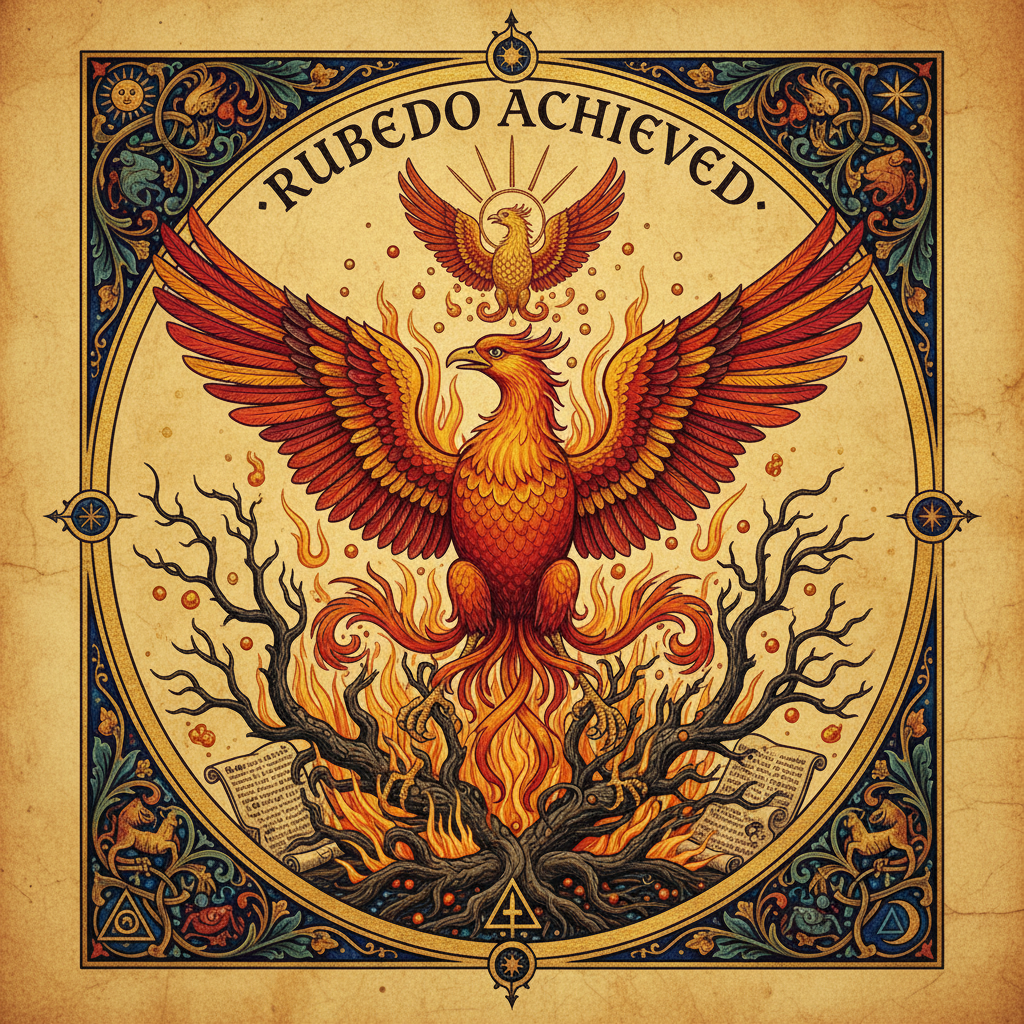
Upon death, the Phoenix is reborn with full vitality after three turns, consuming all negative conditions and emerging purified.
Rubedo Transmutation
All fire damage dealt triggers purification auras that gradually restore the Phoenix's health and grant temporary resistance to future harm.
Must die completely to be reborn -- there is no phoenix without the fire; any attempt to preserve the old form prevents the resurrection; the fire cannot be partial
“But who can endure the day of his coming? Who can stand when he appears? For he will be like a refiner’s fire.” — Malachi 3:2
Lore: The Phoenix appeared in Christian symbolism as early as Clement of Rome (writing ~96 AD, less than a generation after Paul), who used it explicitly as a proof of the resurrection: if a pagan bird can die and rise again, how much more can God raise the dead? The alchemists made the Phoenix the climactic symbol of the entire Work. After the blackness of Nigredo, the whiteness of Albedo, and the yellowing of Citrinitas, the Phoenix bursts into flame and rises red — the Rubedo achieved. The fire is not destruction; it is completion. The Phoenix does not survive the fire; it is made by the fire. The old bird dies. What rises is new.
Parallel: The Resurrection of Christ (1 Corinthians 15:42-44: “It is sown in dishonor; it is raised in glory”). Baptism by fire (Matthew 3:11: “He will baptize you with the Holy Spirit and fire”). The refiner’s fire (Malachi 3:2-3). The burning bush that is not consumed (Exodus 3:2). The three young men in Nebuchadnezzar’s furnace who emerge unharmed (Daniel 3:25-27). “Our God is a consuming fire” (Hebrews 12:29) — but the fire that consumes dross perfects gold.
1 min read
Water without fire (purification without transformation); the fear of death that prevents rebirth
Herodotus (*Histories* II.73); Clement of Rome, *First Epistle* (earliest Christian use, ~96 AD); *Physiologus*; all major alchemical traditions