Benkei Standing Dead at the Bridge
1189 CE — early Kamakura period, Battle of Koromogawa · Koromogawa no Tachi — Hiraizumi, Ōshū Province (modern Iwate Prefecture)
Contents
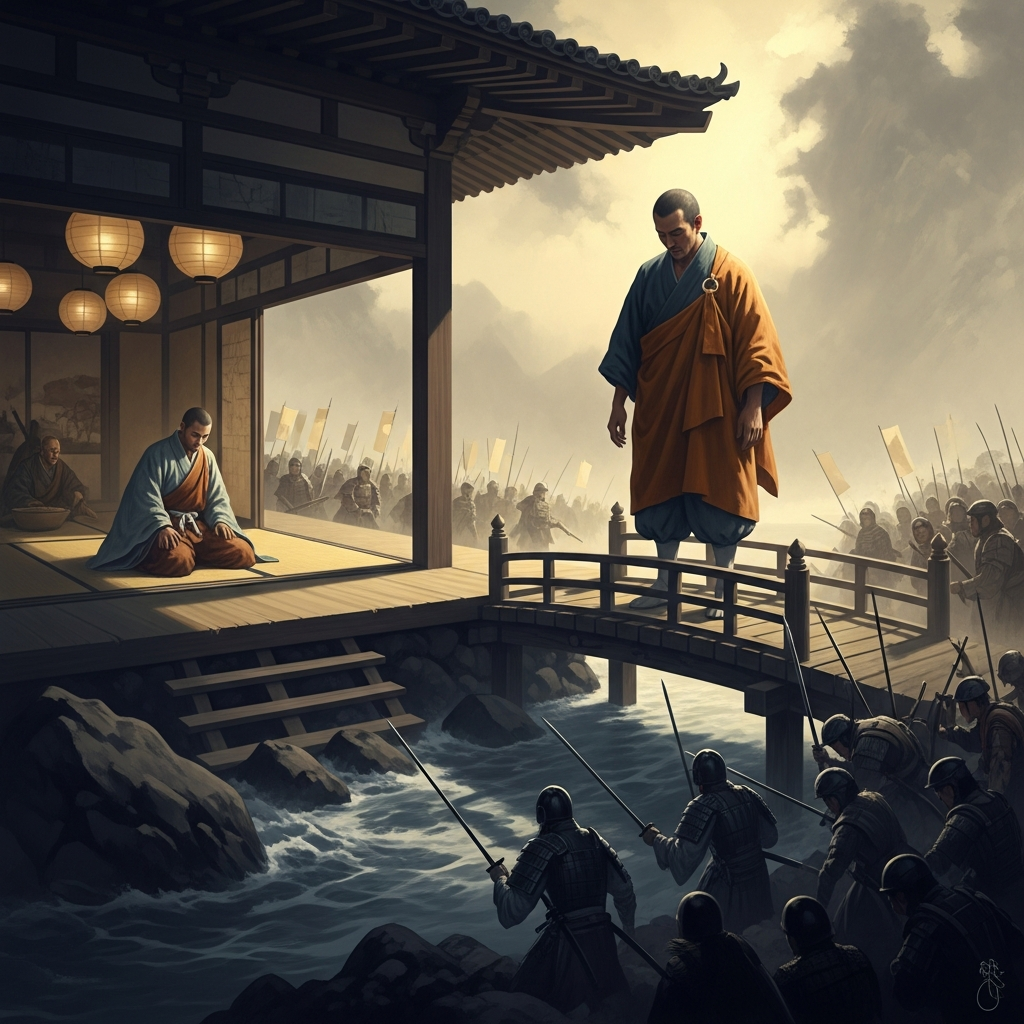
At Koromogawa, while Yoshitsune prepares to die inside the hall, the giant monk-warrior Benkei holds the bridge against an army alone — and the enemy soldiers realize, only when they approach, that he has been dead for some time, still standing.
- When
- 1189 CE — early Kamakura period, Battle of Koromogawa
- Where
- Koromogawa no Tachi — Hiraizumi, Ōshū Province (modern Iwate Prefecture)
The bridge is narrow and long.
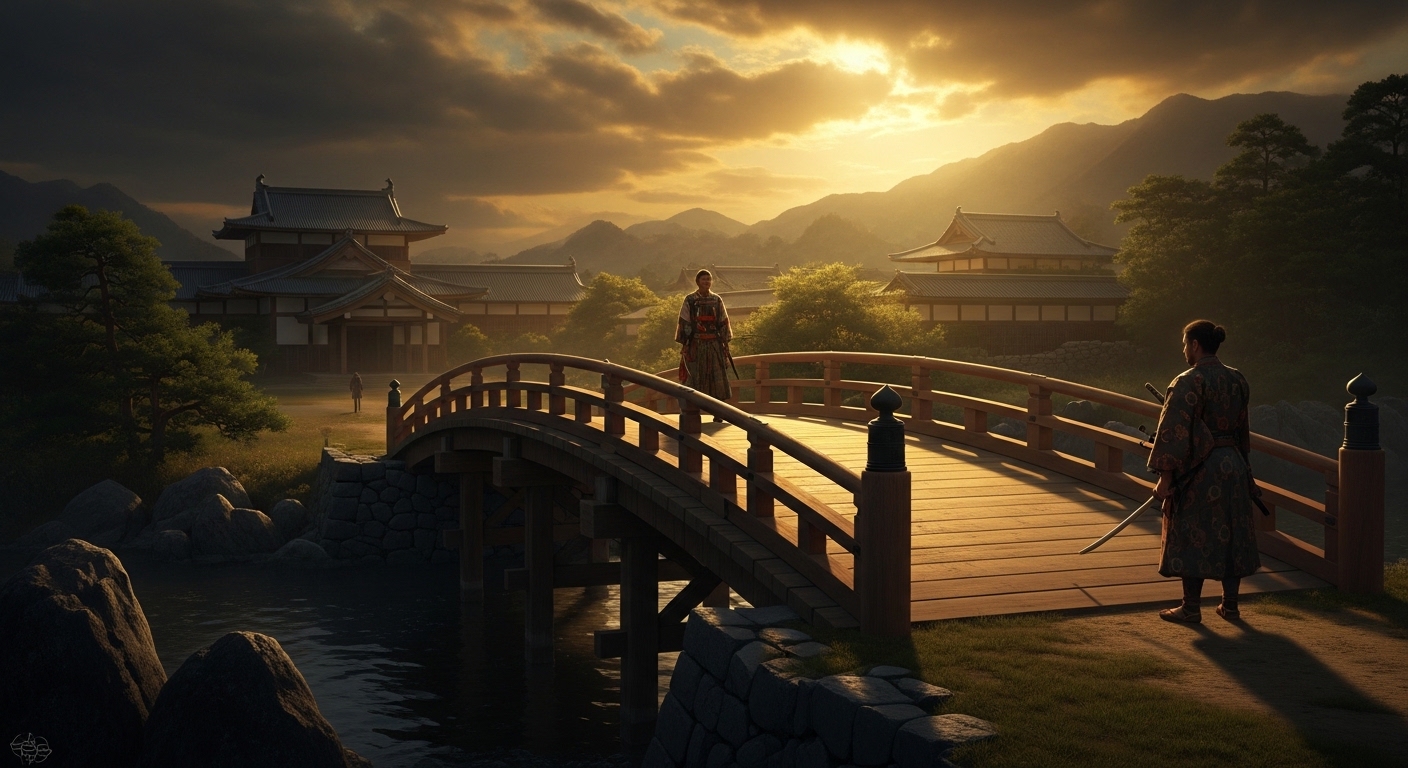
In the geography of Koromogawa no Tachi — the final stronghold where Yoshitsune has taken refuge at the court of the Fujiwara of Ōshū — there is a bridge that must be crossed before the hall can be reached. Yasuhira’s soldiers, coming to take Yoshitsune’s head for delivery to Kamakura and to Yoritomo, must cross this bridge.
Benkei is at the bridge.
He has been Yoshitsune’s man since the night they met on Gojō Bridge in Kyoto — the night the young monk with a naginata was collecting swords from passers-by, waiting for his thousandth blade, and the slight young man came across the bridge and turned out to be impossible to defeat. Benkei followed him that night and had been following him for the years since, through the war and the victories and the flight and the fugitive years and the narrowing world of the hunted.
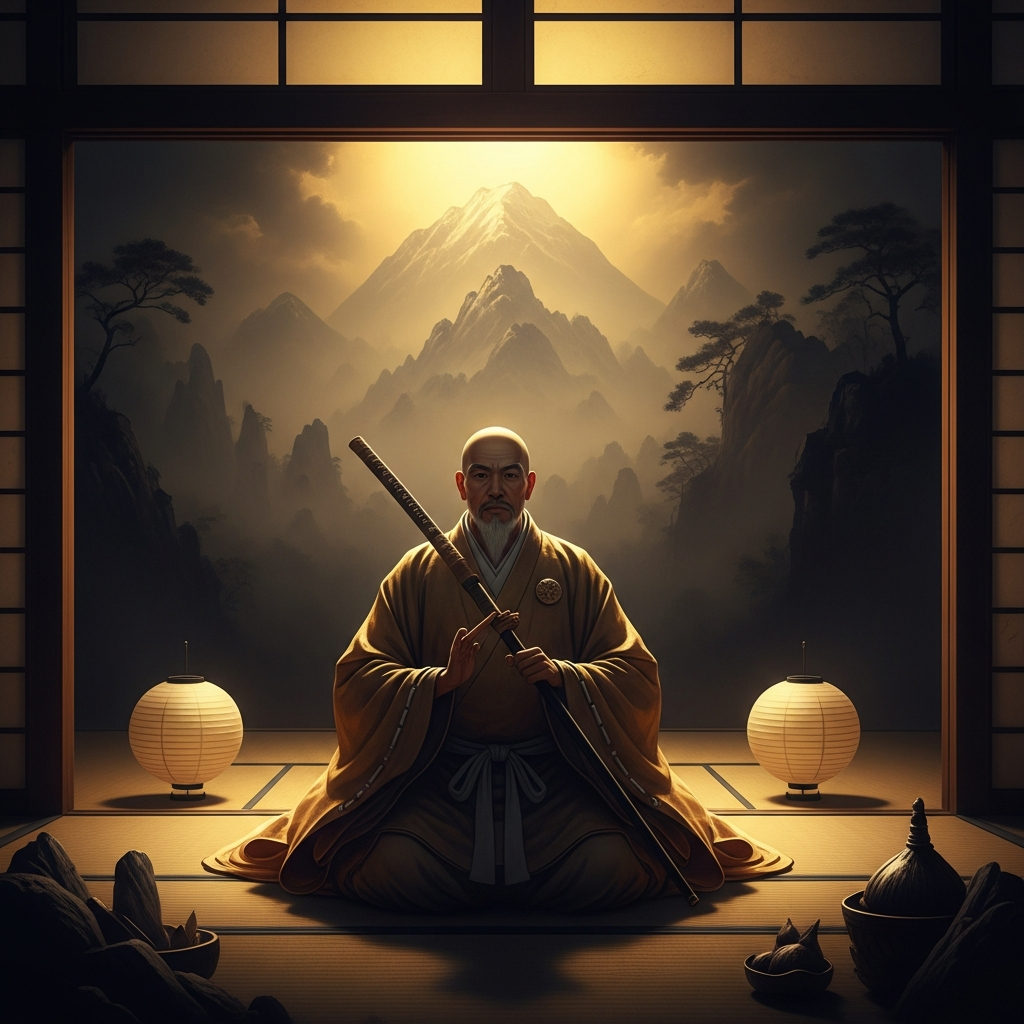
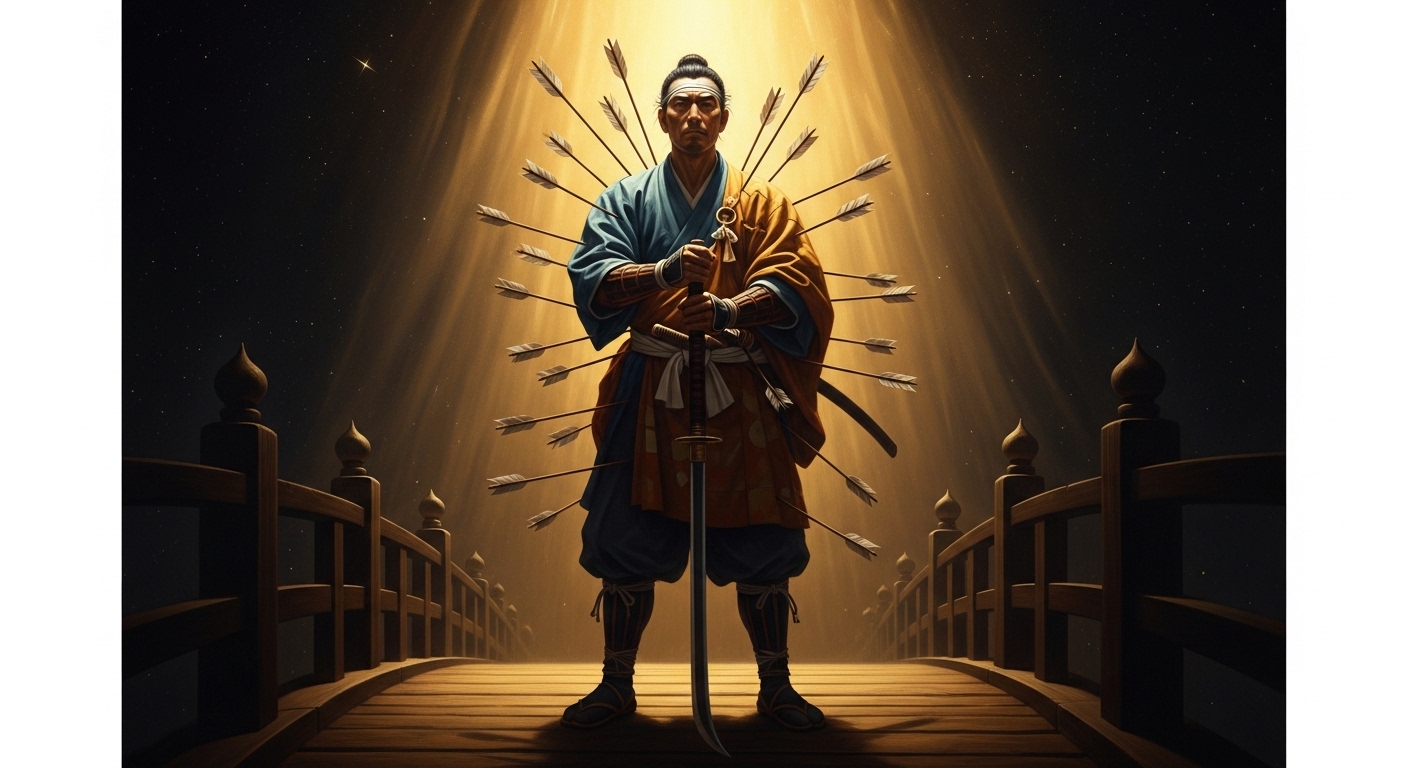
He is not a small man. The histories and the plays describe him as enormous — six feet and more, the monk’s robes never quite fitting right on the frame of something that was probably a military deity in its previous existence. He carries a naginata. He stands on the bridge.
The arrows come first.
Yoshitsune needs time inside the hall — time to give his family the honorable ending rather than the dishonor of capture, time to compose himself for his own ending. Every moment Benkei holds the bridge is a moment Yoshitsune has.
Benkei fights.
The arrows come and he keeps fighting. The arrows become numerous and he keeps fighting. The arrows are in his body — this is not metaphor, the arrows are physically in him — and he keeps fighting. His movement gradually changes from attack to the movement of a man who is maintaining position through will alone, the body increasingly not the source of the motion but the instrument of a motion sourced elsewhere.
He stops moving.
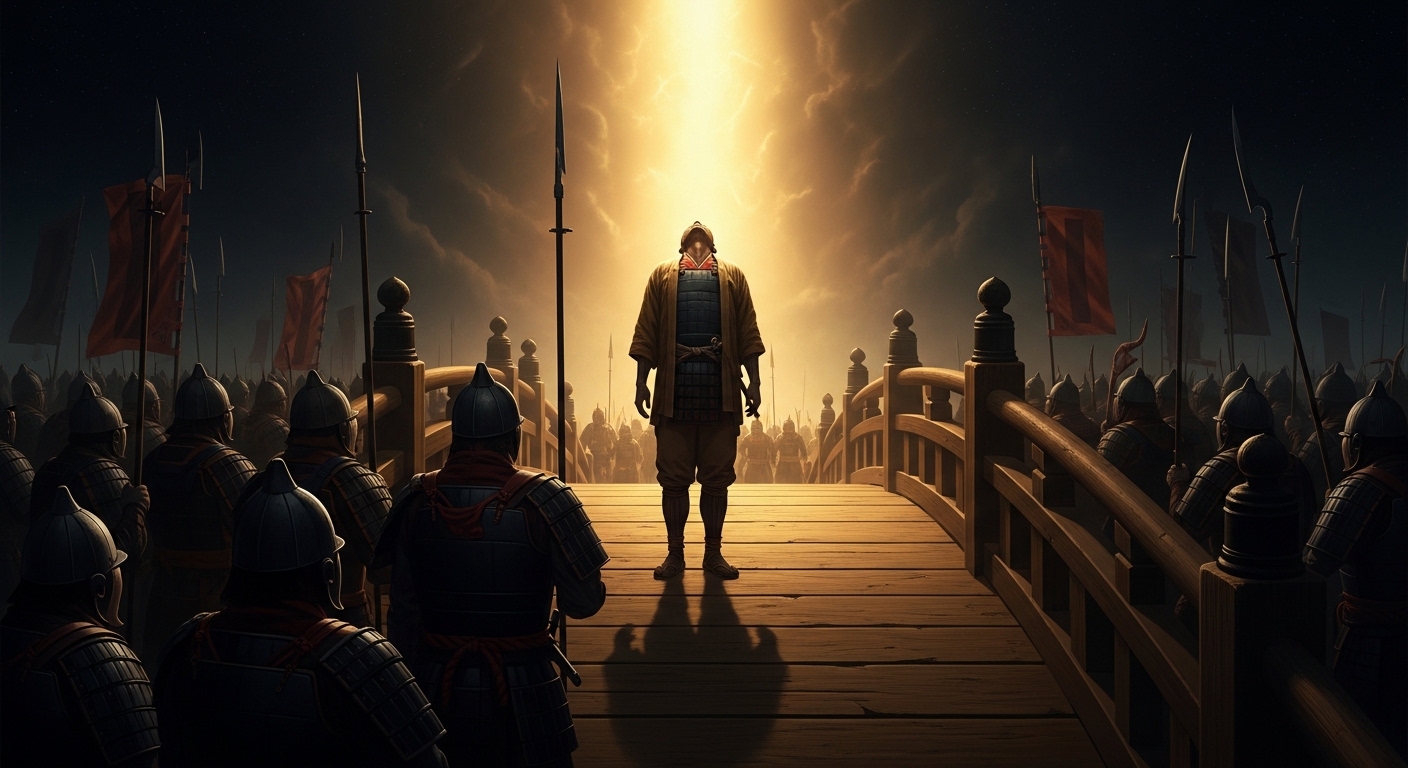
The soldiers, watching from the far end of the bridge, see that he has stopped. They watch him for a time. He is upright. He is still. The arrows are in him like porcupine quills. His eyes are open.
They approach carefully.
He does not react.
They realize, at the close distance, that he is dead. He has been dead for some time. He is standing because — and this is the only explanation the witnesses and the chronicles and everyone who tells the story afterward can offer — he simply had not stopped yet.
Inside the hall, Yoshitsune has finished.
Benkei’s standing corpse held the bridge long enough.
The image is this: a man dead on a bridge, upright, with an army of soldiers stopped in front of him waiting to see what he would do next.
Benkei no tachi ōjō. Benkei’s standing death. The phrase entered the language.
It describes the moment when a body refuses to fall, when the momentum of service outlasts the servant. Japan did not find this grim. Japan found it honorable in the most precise sense of the word: it honored the relationship. The body kept the promise the living man had made, past the point where the living man could keep it.
The soldiers crossed the bridge eventually.
The hall was silent.
Benkei did not fall until they moved him.
Scenes
Echoes Across Traditions
Entities
- Benkei
- Minamoto no Yoshitsune
- Yasuhira's soldiers
Sources
- Gikeiki (Chronicle of Yoshitsune), 14th century
- Heike Monogatari (Tale of the Heike), c. 13th century
- McCullough, Helen, trans., *Yoshitsune* (Stanford, 1966)
- Keene, Donald, *Seeds in the Heart* (Columbia, 1993)