The Bardö Thödol Read Aloud to the Dying
14th century discovery, applied continuously to the present — the text discovered by Karma Lingpa c. 1326 CE · Tibetan deathbeds — the practice applies wherever a practitioner dies, in monasteries, in homes, in any circumstance where the text can be read and the dying can hear
Contents
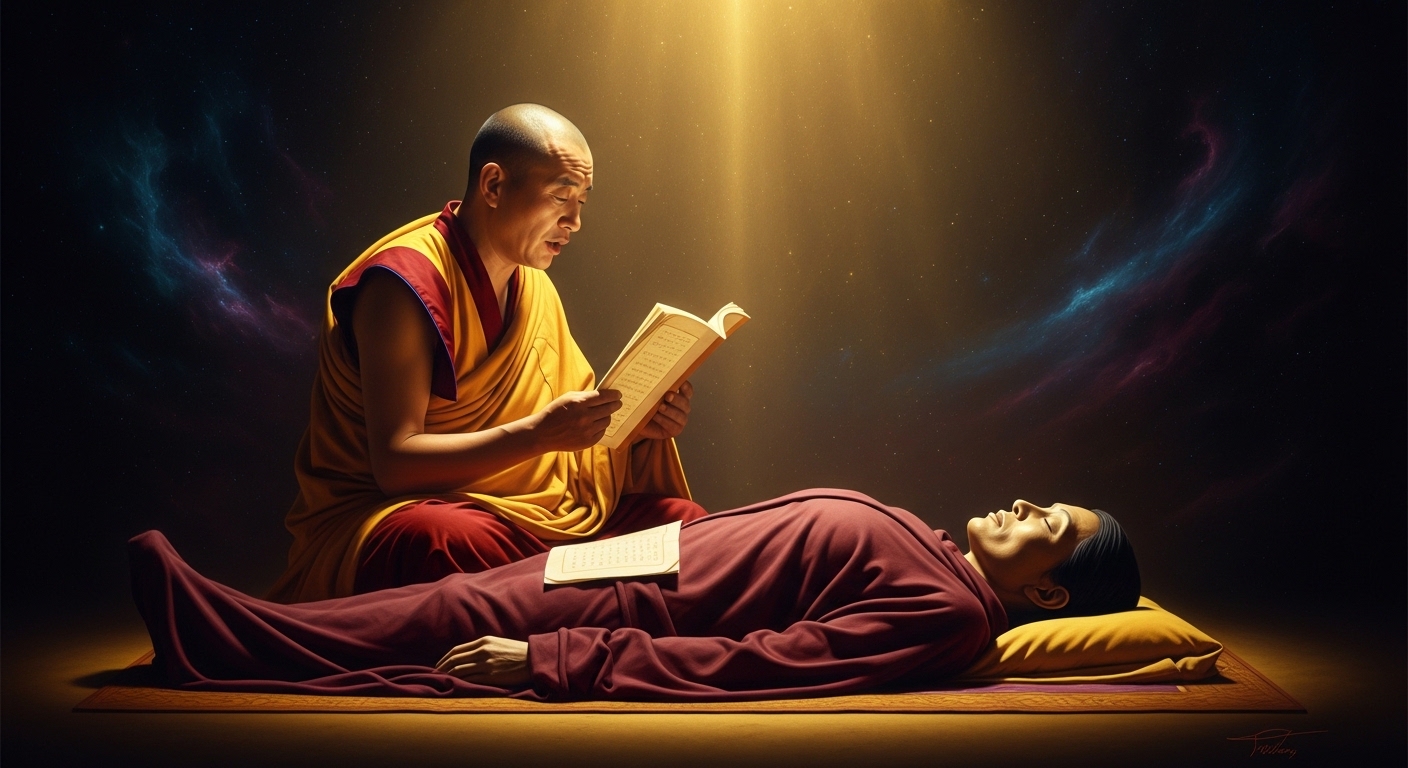
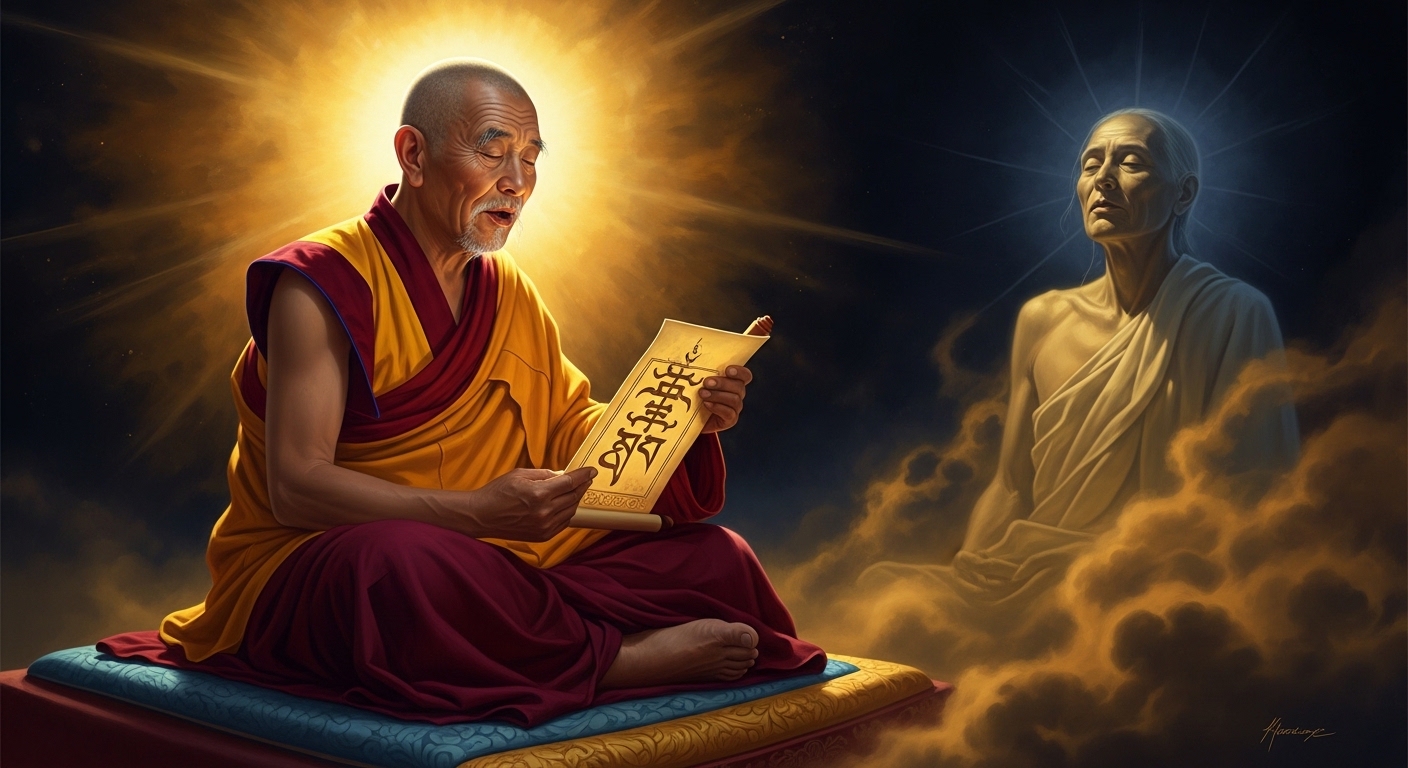
At the deathbed of a practitioner, the lama reads the Bardo Thodol aloud — not as ceremony but as active instruction for a consciousness that may still hear, guiding it toward recognition at the most critical moment of its journey.
- When
- 14th century discovery, applied continuously to the present — the text discovered by Karma Lingpa c. 1326 CE
- Where
- Tibetan deathbeds — the practice applies wherever a practitioner dies, in monasteries, in homes, in any circumstance where the text can be read and the dying can hear
He begins reading before the breath stops.
This is the practice: the lama arrives at the deathbed while the person is still living, if possible, and begins reading the Bardo Thodol. The text is not read to comfort the dying — or not only. It is read as active instruction, on the premise that the consciousness can hear even when the body can no longer respond, that the auditory pathway remains open longer than most others, that the last thing the dying person hears will be with them at the moment when hearing matters most.
The text begins: O nobly born, that which is called death being come to you now, resolve thus:
O this is now the hour of death. By taking advantage of this death, I will so act, for the good of all sentient beings, pervading the skies of space, as to obtain the Perfect Buddhahood, by resolving upon love and compassion toward them.
The address is direct. It assumes the dying person is present. It does not speak of them in the third person or as someone past communication. It speaks to them as someone who has a choice to make, right now, in this moment, and who needs the instruction for making it.
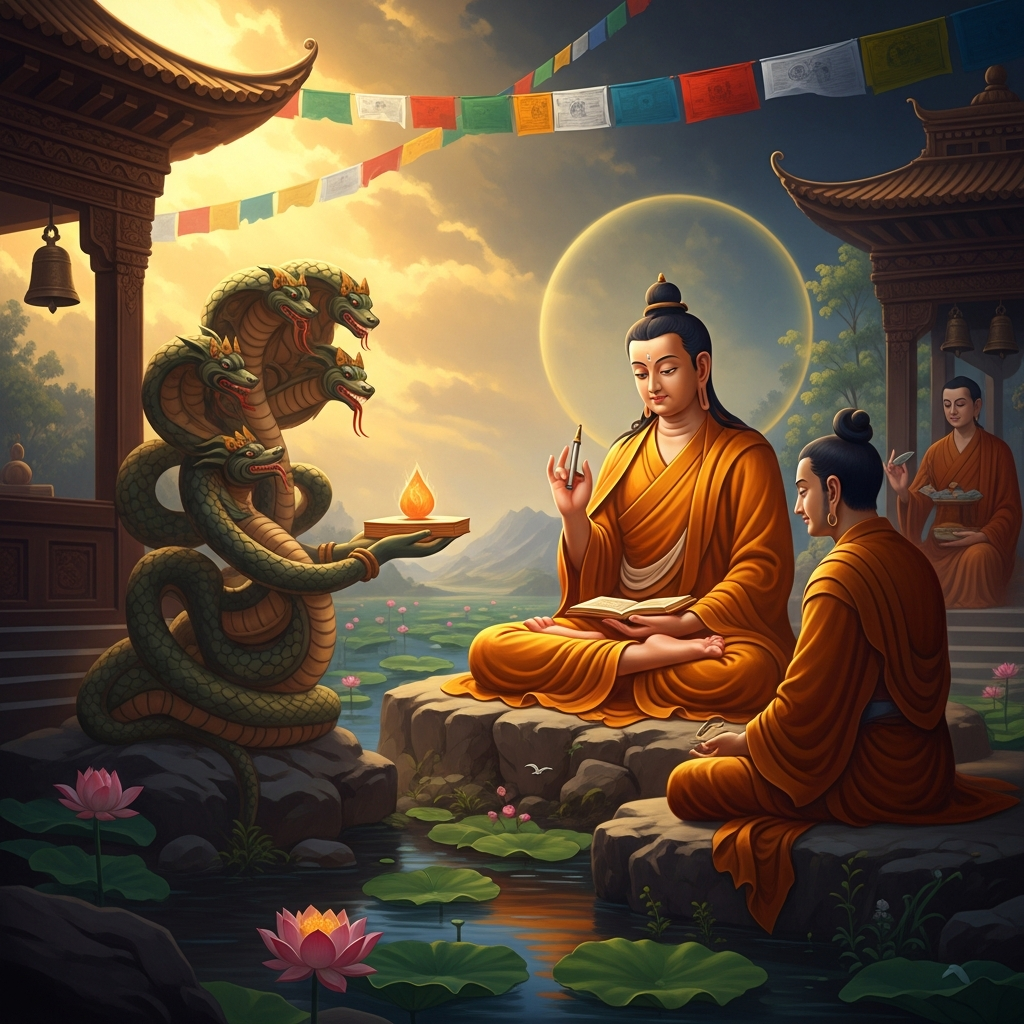
Karma Lingpa found the text in a cliff face at Gampodar Mountain in the fourteenth century.
He recognized it as a terma — a text hidden by Padmasambhava in the eighth century for revelation at the moment it was needed. The recognition involved a specific quality of encounter that the terma tradition describes: the practitioner arrives at a location that feels significant in a way that is not ordinary aesthetic appreciation, and finds, in rock or water or sometimes in their own mind, a text that could not have been placed there by ordinary means.
The Bardo Thodol that Karma Lingpa found — the text Evans-Wentz would translate in the 1920s as The Tibetan Book of the Dead, the text Chogyam Trungpa would retranslate with the title The Tibetan Book of the Dead in 1975, the text that has been read at more Tibetan deathbeds than any other — was already complete when he found it. It required no authorship, only revelation.
The premise of the terma tradition is that Padmasambhava, who had complete knowledge of what would be needed and when, encoded texts in the landscape for retrieval by practitioners who would be incarnate at the right moment. The Bardo Thodol was hidden in the eighth century because the fourteenth century would need it, and the fourteenth century would produce the practitioner who could find and transmit it.
The reading continues after the death.
This is what distinguishes the Tibetan practice from most other deathbed traditions: the text is not closed when the breath stops. The lama continues reading for days — the full forty-nine-day schedule of appearances in the bardo is read aloud over the days following death, as though the deceased can still hear it, because the teaching holds that they can. The consciousness in the bardo is not deaf. It is unmoored, confused, uncertain about where it is and what it is encountering. The familiar voice reading the familiar words is an anchor — a thread back to the teaching, a reminder of the recognition it was trained to make.
The lama reads: O nobly born, your present awareness, vacant, naked, is itself the very Reality, the All-Good. Your own awareness, not formed into anything, in reality void, is itself the very Reality…
The words are not magic. They do not compel recognition. They remind. They point again, at the moment of death, at the same thing the teacher pointed to in life: the awareness that was always present, the sky behind every cloud that appeared in it. If the dying practitioner recognizes it, the reading is complete. If not, the reading continues — day after day, into the second and third weeks, through the appearances of the peaceful and wrathful deities, through the simpler guidance for navigating toward a good rebirth if liberation is not achieved.
The lama reads until the consciousness is gone. Then the book is closed. Then the book is opened again at the next deathbed.
Scenes

Echoes Across Traditions
Entities
- the lama reading the text
- the dying practitioner
- Padmasambhava (the text's attributed author)
- Karma Lingpa (the tertön who discovered the text in the 14th century)
Sources
- Chogyam Trungpa and Francesca Fremantle, trans., *The Tibetan Book of the Dead* (Shambhala, 1975)
- Donald Lopez, ed., *Religions of Tibet in Practice* (Princeton University Press, 1997)
- Glenn Mullin, *Death and Dying: The Tibetan Tradition* (Arkana, 1986)