The Wooing of Emer
circa 105 BCE — before the Táin, during Cú Chulainn's youth · Forgall's fortress at Lusk, County Dublin, Ireland
Contents
Cú Chulainn arrives at Emer's father's fort speaking only in riddles, and Emer answers every one — because she alone in Ireland is clever enough to be worth marrying the greatest warrior in the world.
- When
- circa 105 BCE — before the Táin, during Cú Chulainn's youth
- Where
- Forgall's fortress at Lusk, County Dublin, Ireland
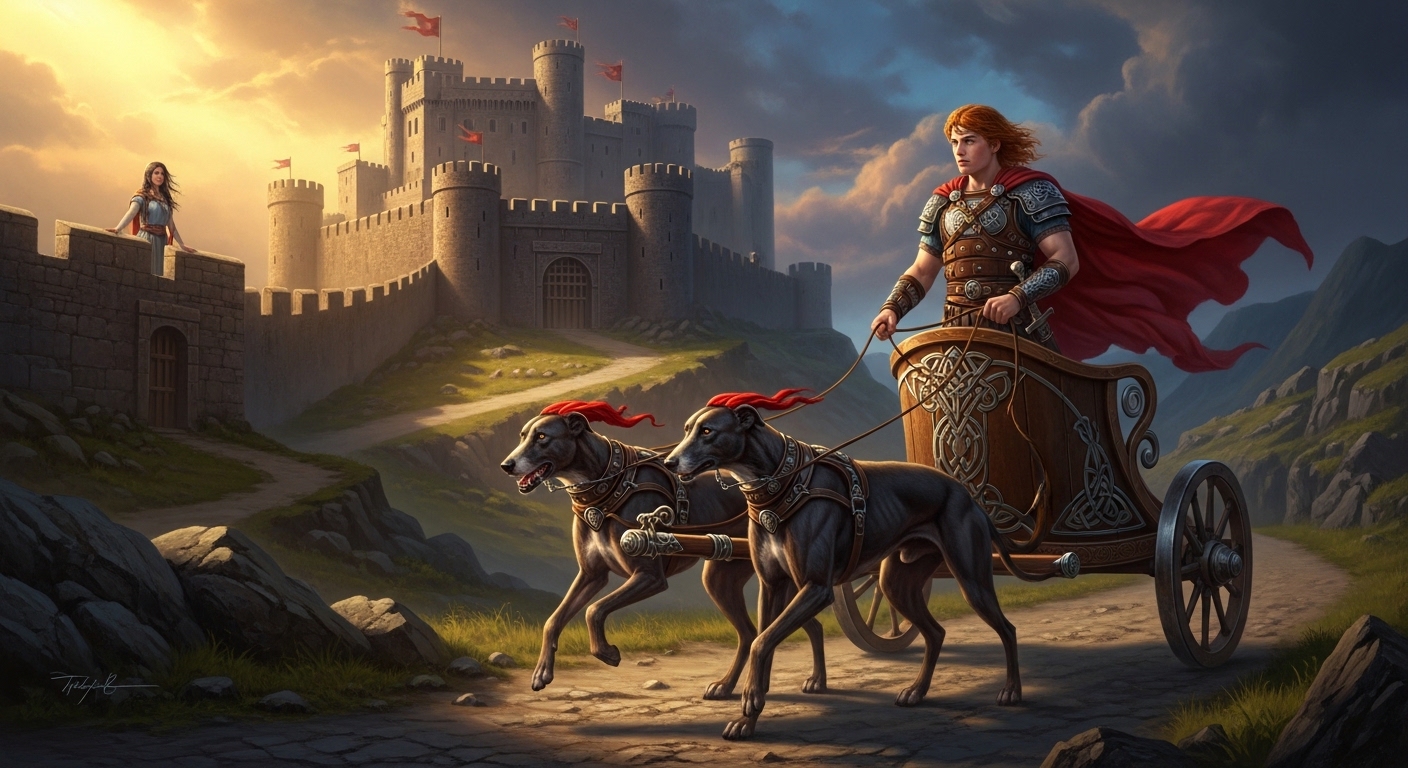
He drives past Emer’s father’s fortress three times before he stops, so she can see how he handles a chariot.
It is, admittedly, the most impressive chariot-driving in County Dublin, but Emer is sitting on the rampart watching with the expression of a woman who has been watching men show off since she could walk. She is the daughter of Forgall the Wily, one of the shrewdest politicians in Leinster, and she has inherited his mind without his smallness of spirit. When Cú Chulainn finally parks the chariot and walks toward her, she looks at him the way she would look at an interesting problem.
He looks at her.
The old sources say she was the one woman in Ireland who possessed all six gifts: beauty, chastity, sweet speech, needlework skill, wisdom, and chastity again — the repetition is intentional, the scribes emphasizing. The sources also say this about her: she had no equal in form and grace and speech. What they mean is: she was his equal.
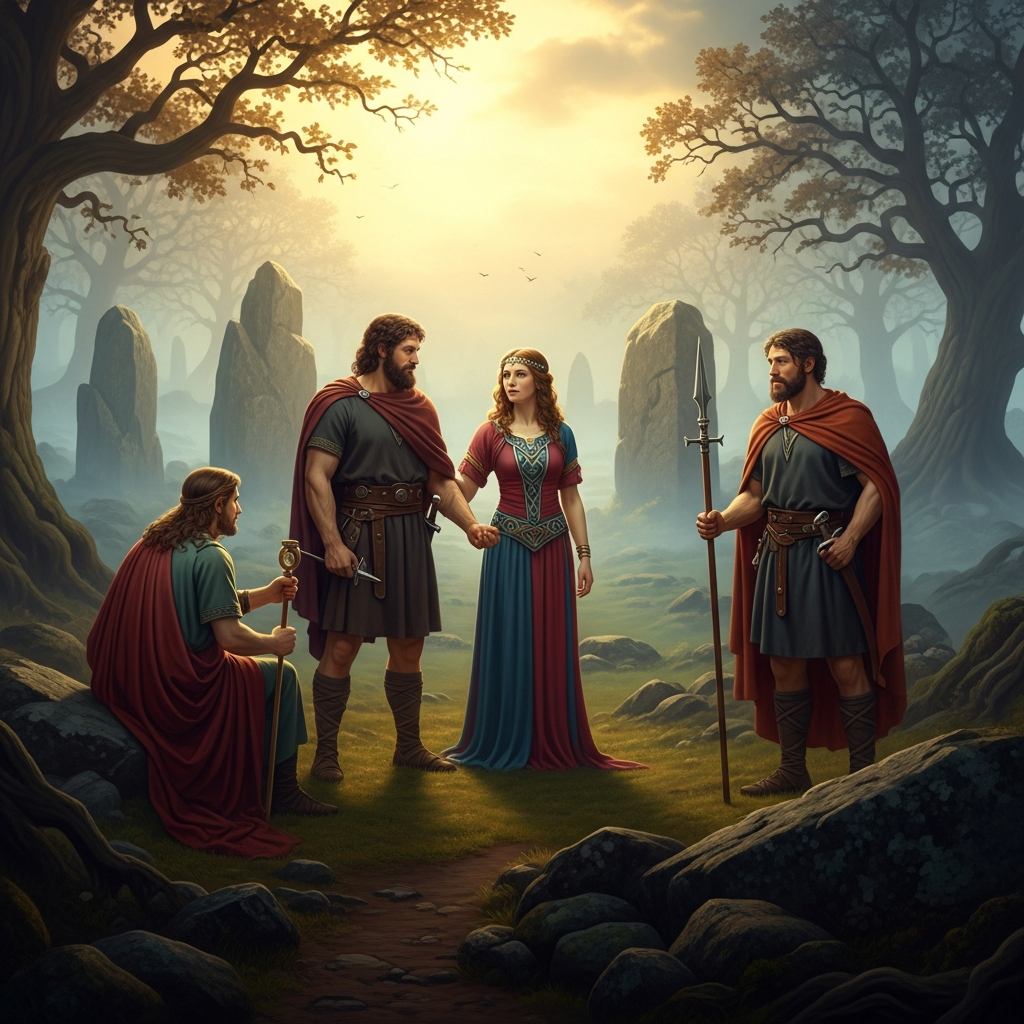
He opens in riddles. The entire conversation, recorded in the oldest Irish legal and literary Irish in the Ulster Cycle, is conducted in a coded speech called berla na filed — the language of the poets — where every statement is a metaphor and every metaphor is a test. He describes his journey in symbolic terms, the plain of the road, the forest of the chariot, the two oxen that pull the chariot-yoke. She answers each metaphor in the same register and unmasks the next layer.
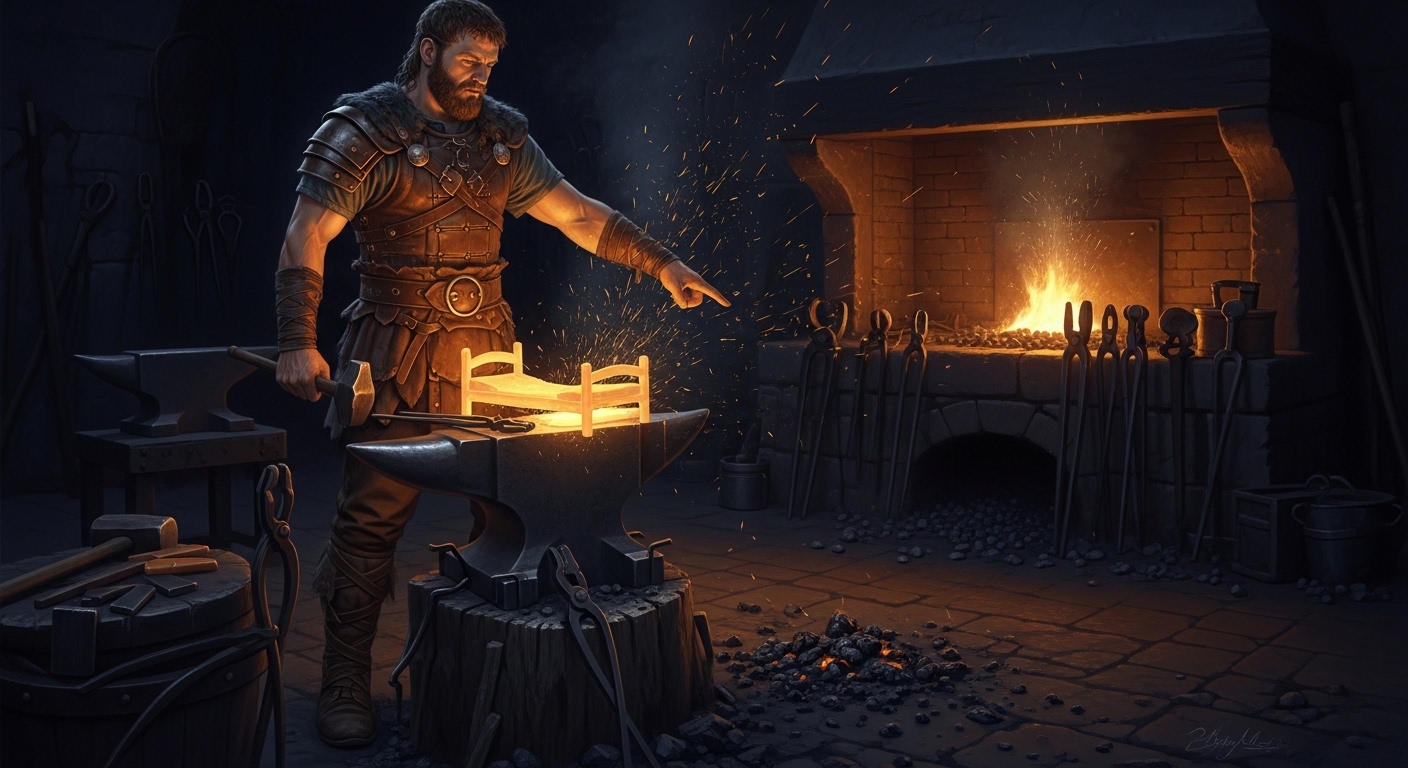
When he says where he slept last night, he says it in imagery from the smith’s craft. She unpacks it. When she asks who he is, she asks it through allusions to the royal bloodlines of Ulster, and his answer maps him precisely without once using his own name or the name of his father.
They are making a language between two people for the purpose of excluding everyone else in the world, which is one of the things that courtship is for.
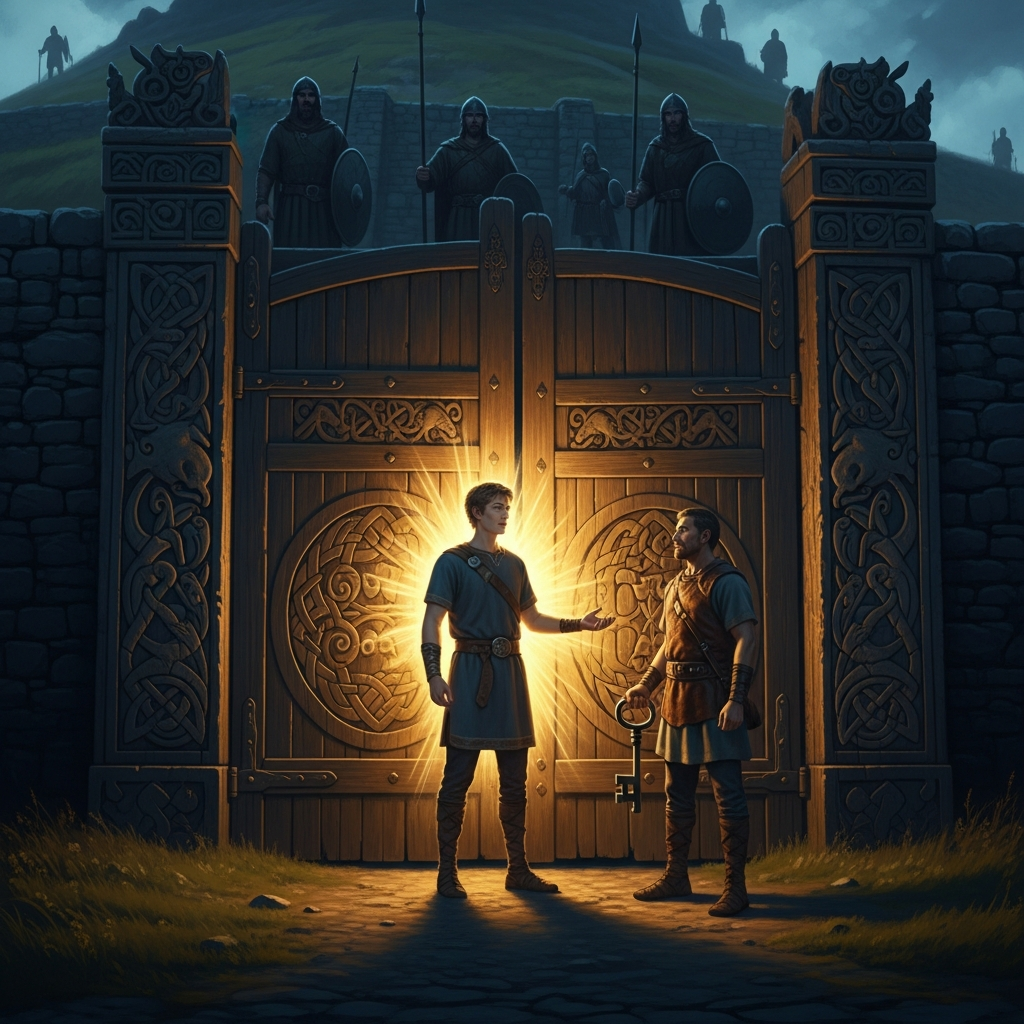
Her father, Forgall the Wily, has been listening from behind the gate and likes none of this. He sees what is happening: his daughter is matching the greatest warrior in Ulster word for word, and the warrior is smiling. This is a problem. Forgall wants Emer married to someone he can manage. He does not want her married to Cú Chulainn, because no one has ever managed Cú Chulainn.
He sends the warrior away with a suggestion: go train with Scáthach in Scotland, become even better, come back afterward. His calculation is that the journey to the Isle of Shadow kills approximately everyone who tries it, and this will solve his problem with considerably less political cost than an outright refusal.
Cú Chulainn goes — and comes back.
He comes back with the Gáe Bolga and a year of training that has turned him from the finest warrior in Ireland into something that barely fits in a human category. He comes back to Forgall’s fortress, which he takes apart stone by stone, carrying Emer out over the wall while her father falls from the rampart trying to stop them.
Forgall dies in the fall. This was not the plan, exactly, but it is hard to mourn Forgall very deeply. He sent a young man to die on a bridge that pitches vertically, and the young man came back.
Cú Chulainn and Emer are married and the marriage is the center of the Ulster Cycle’s emotional life. She is not a passive wife. When he sleeps with the goddess Fand — when he is enchanted away from her for an entire year into the Otherworld — Emer comes to the assembly where he meets Fand at the shore, and she comes with fifty women and bronze knives. Not to kill Fand, as it turns out: the moment Emer speaks her own grief aloud, Fand understands what it means to love something you cannot keep, and she releases him.
Two intelligent women stand at a shore, and the one who has more to lose says so honestly, and the other hears it.
This, too, is who Emer is: the woman who wins the hardest argument of her marriage not with bronze but with language, in the same register she used at the rampart the first day — precisely and without a wasted word.
Scenes
Echoes Across Traditions
Entities
- Cú Chulainn
- Emer
- Forgall Monach
- Conchobar Mac Nessa
Sources
- A.H. Leahy, trans., *Heroic Romances of Ireland* (David Nutt, 1905)
- Jeffrey Gantz, trans., *Early Irish Myths and Sagas* (Penguin, 1981)
- Máire Herbert, 'The Universe of Male and Female: A Reading of the Deirdre Story,' in *Celtic Languages and Celtic Peoples*, 1992