Contents
A druid prophesies at a girl's birth that she will bring ruin to Ulster — and though the king locks her away in a forest to prevent it, she escapes with the man she loves and every prophecy comes true anyway, on a slower and more devastating schedule.
- When
- circa 100 BCE — the age of the Ulster heroes, a generation before the Táin
- Where
- Emain Macha and the forests of Ulster, Scotland, and finally back to Ulster
The prophecy comes before she is born.
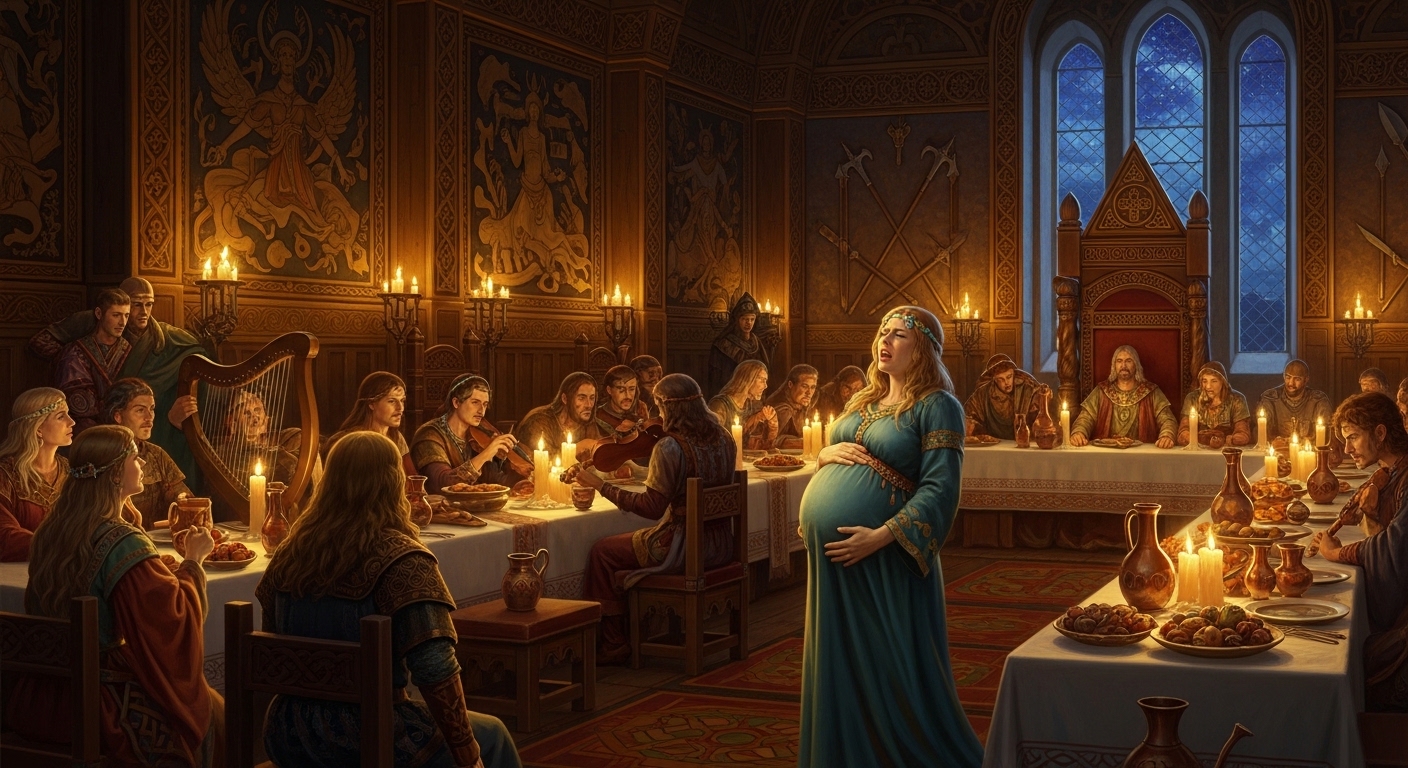
Conchobar Mac Nessa’s court is at feast when Felimid the harper’s wife goes into labor. Cathbad the druid comes to the doorway and places his hand on the woman’s belly and says what he sees: the child within will be the most beautiful woman in Ireland, and she will bring ruin to Ulster.
The warriors at the feast suggest killing the child now, before it arrives.
Conchobar says no. He has another plan. He will keep the child himself, in a forest enclosure, alone with a nurse and a woman-warrior to train her, and he will marry her when she is old enough. He will solve the prophecy problem through total control of the prophesied woman.
The child is Deirdre. She grows up in the forest, and the forest is the only world she knows, which is another way of saying that Conchobar has successfully prevented her from having a context in which to make decisions. She is the most beautiful woman in Ireland, as prophesied, in a forest where there is no one to notice.
She notices a raven on the snow beside a slaughtered calf, blood-red on white, the black bird at the center of the two colors. She tells her foster-mother: I want a man with hair as black as that raven, cheeks as red as that blood, body as white as that snow.
The foster-mother says: Naoise of the Sons of Uisneach.
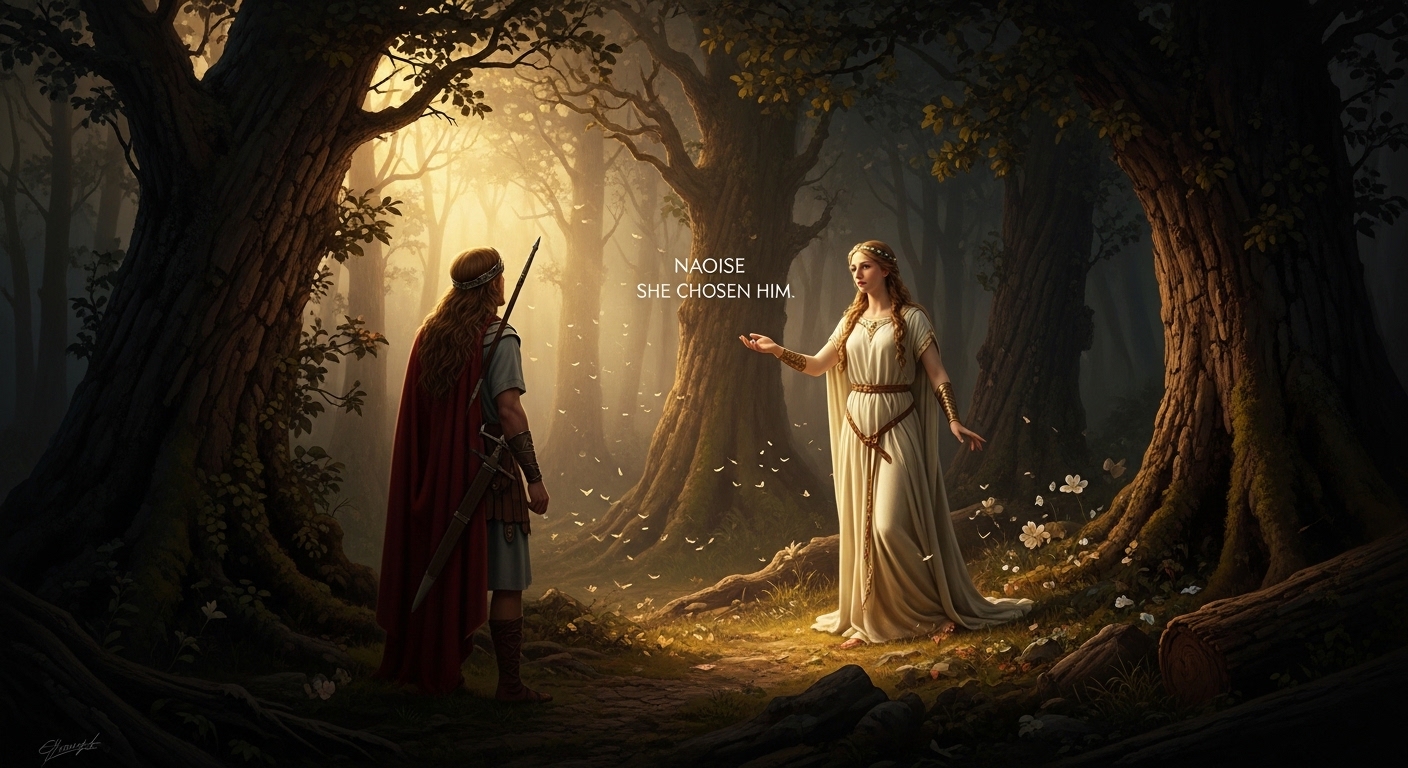
Naoise comes to the forest — not searching for Deirdre, simply traveling through — and she steps out before him and names him and tells him she has chosen him. Naoise, who has heard the prophecy, says: you have the king’s protection, I cannot take you.
She takes his ear and tells him that refusing her is the greater shame.
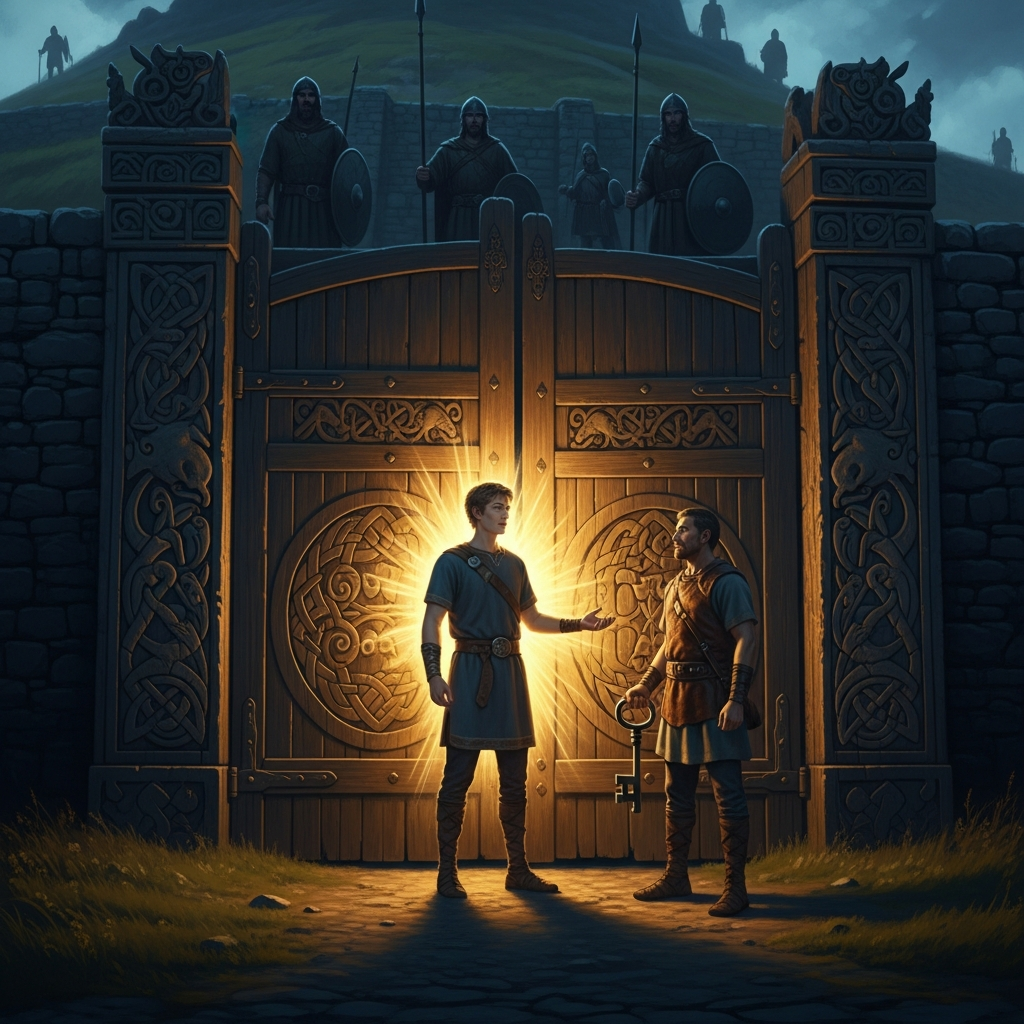
He takes her. He knows exactly what it means. He and his brothers Ainnle and Ardan leave Ulster with Deirdre that night and spend years in Scotland, building a life in exile, waiting for Conchobar’s anger to cool.
Conchobar sends an offer of peace. He swears by the sun and moon and all the elements that the Sons of Uisneach may return safely to Ulster. He sends Fergus Mac Róich, the most trusted man in Ulster, as guarantee.
They come back.
At the ford at the boundary of Ulster, Fergus is bound by a geis that requires him to accept a feast-invitation when one is offered. Someone offers. The feast cannot be refused. Naoise and Deirdre go on ahead to Emain Macha without Fergus.
Conchobar murders the Sons of Uisneach. He has Naoise killed while Deirdre watches.
She lives with Conchobar afterward, against her will. For a year she does not smile. Conchobar asks who she hates most in the world. She says: you. Who else? Eógan, who carried out the killing. Very well, says Conchobar, I’ll give you to Eógan for a year.
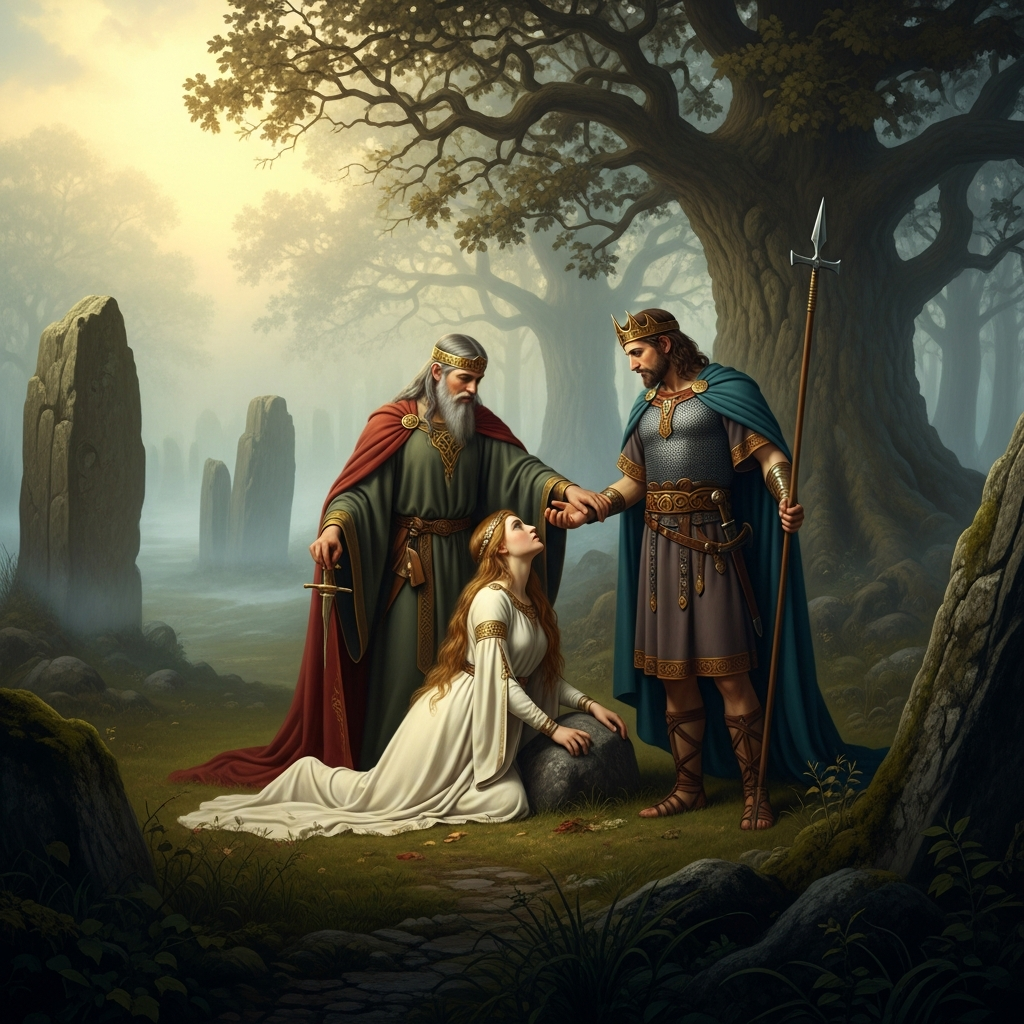
She is in the chariot between them — Conchobar and Eógan — and the chariot passes a standing stone. She throws herself from the chariot and breaks her head on the stone.
She is found on the cold ground of Ulster. The place where she falls is near where Naoise was buried.
Cathbad’s prophecy was accurate. The ruin of Ulster — the exile of Fergus and his allies, the decades of instability, the shifting alliances that weaken the province — all of it traces back to the birth that night at the harper’s feast. The girl in the forest chose with open eyes. The king who thought he could manage prophecy by imprisoning its instrument could not. No one ever can. The druid knew this and said so. Nobody listened, which is the eternal problem with druids.
Scenes
Echoes Across Traditions
Entities
- Deirdre
- Naoise
- Conchobar Mac Nessa
- Cathbad the Druid
- The Sons of Uisneach
Sources
- Jeffrey Gantz, trans., 'Longes Mac nUislenn,' in *Early Irish Myths and Sagas* (Penguin, 1981)
- Lady Augusta Gregory, *Cuchulain of Muirthemne* (John Murray, 1902)
- J.M. Synge, *Deirdre of the Sorrows* (Maunsel, 1910)