The Dokkaebi and the Club That Turned Regret to Gold
Korean folk tradition; recorded from Joseon Dynasty (1392–1897 CE) onward · Rural Korea; the abandoned house; the dokkaebi's haunted domain
Contents
Dokkaebi are Korean goblins born from objects abandoned by humans — old brooms, rusty tools, discarded straw — who develop spirits after absorbing human energy. They love wrestling, drinking, and testing character. In the most famous dokkaebi story, a kind old man shelters from rain in a haunted house, shares his meal honestly with the dokkaebi who live there, and wakes to find his gourd full of gold. His greedy neighbor tries the same trick — and it fails, exactly the way greedy tricks always fail.
- When
- Korean folk tradition; recorded from Joseon Dynasty (1392–1897 CE) onward
- Where
- Rural Korea; the abandoned house; the dokkaebi's haunted domain
A dokkaebi is born when a human being stops paying attention.
Not when someone dies, not when a sacred place is violated, not through the machinery of cosmic transgression — simply when a broom is worn down to the stub and thrown in a ditch, when a club is left leaning against a wall that the owner never comes back to, when a straw effigy is abandoned in a field after the harvest festival and the rain comes and goes through several seasons and the straw absorbs, through some process the traditions never quite explain, the residue of all the human intention that was nearby for all those years.
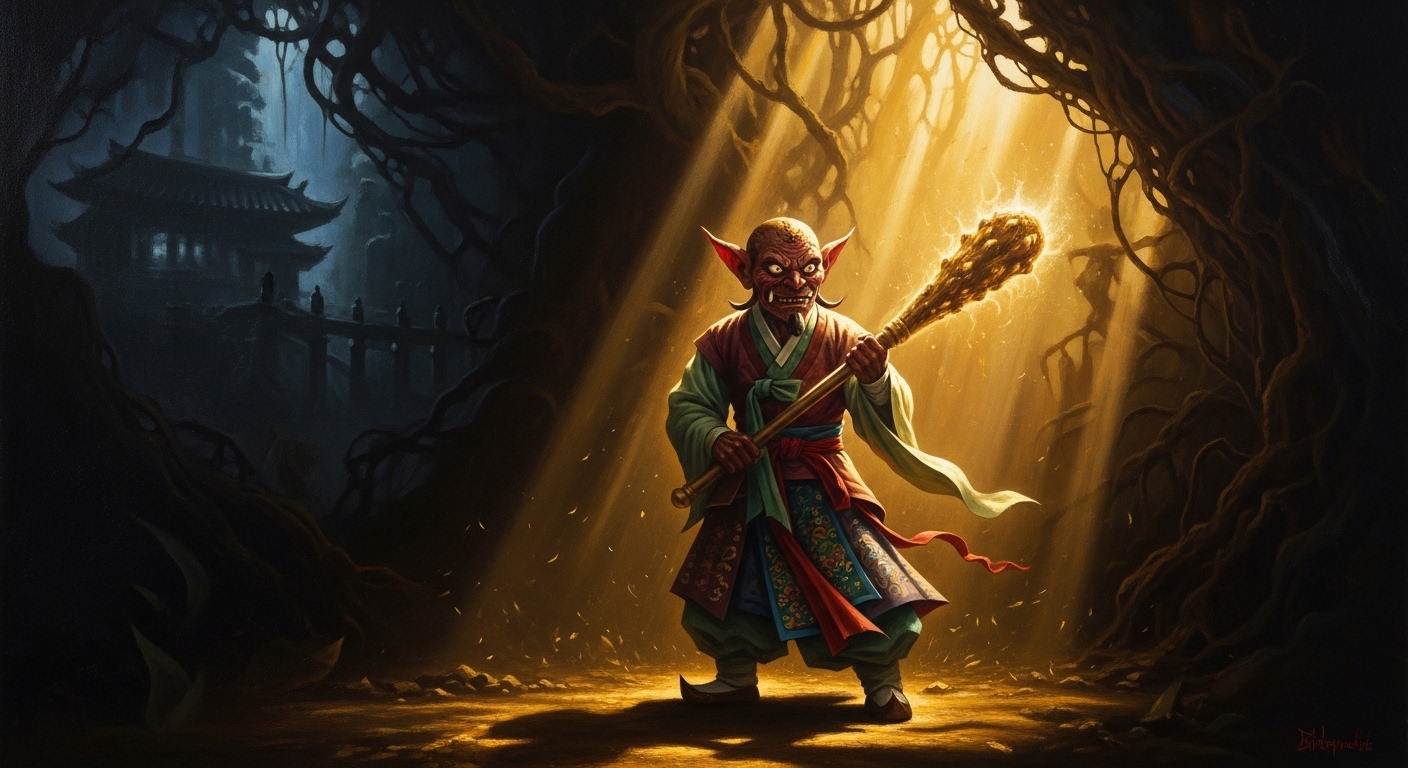
The dokkaebi comes out at night. It has a gnarled wooden club, usually — the bangmangi — which it uses to make things happen: gold from nothing, movement from stillness, confusion from order. It loves wrestling, which it will attempt with any human it encounters on a dark road. It loves makgeolli, the milky Korean rice wine, which it will consume in quantities that should be impossible. It loves games of chance, which it always wins unless you already know that, in which case you have a chance.
It is not malevolent. It is not benevolent. It is testing, the way weather tests, without caring about the result but producing results nonetheless.
The kind old man encountered the haunted house on a night of rain.
He had been traveling — the versions differ on where, but consistently describe a country road, a failing light, and rain that was already heavy when it began and showed no sign of stopping. He saw the house at the edge of a stand of trees. It had the look of abandonment: the gate hanging at an angle, the courtyard full of the particular silence of places where nothing has moved for a long time. But there was shelter, and he needed shelter.
He went in.
He found a corner that was dry and sat down and opened his bundle. He had rice, wrapped in cloth, and a few vegetables, and he arranged these and ate his meal in the empty house while the rain hammered on the roof. He did not pray before eating because he was not a particularly religious man. He did not announce himself or ask permission because he was simply a traveler in a house that no one was using and he was hungry and wet.
He shared his rice.
He set out a small portion at the edge of the room — not because he knew who lived there, not because he was performing a ritual, but because it was his habit, the way some people leave a portion of their meal for whatever in the house might need it. An old habit, carried from a mother or grandmother, the kind of practice that persists past belief into simple custom.
He fell asleep.
The dokkaebi noticed the rice.
It had been in the house for several years by this point — born from a discarded threshing flail, drawn in from the fields by the long residence of human-made things, attracted to the particular frequency that abandoned structures emit when they have been full of life and then emptied of it. It had spent its nights practicing with the club, wrestling with shadows, conducting the private dokkaebi business that outsiders do not witness.
It found the rice at the edge of the room.
It found the sleeping man. It spent some time looking at him — and this is the part the stories preserve, the image of the dokkaebi standing over the old man with its wild hair and burning eyes and gnarled club, considering — and then it went back to its business.
In the morning, the old man woke to find his gourd, which had been empty when he placed it in the corner, full of gold pieces.
He did not know who had put them there. He gathered his things and left before he could think too hard about it.
His neighbor heard the story.
The neighbor was the kind of man who is described in every version of this story with the same phrase: he heard about the gold and wanted some. He is a type, not a character — the person who looks at a reward and reverse-engineers the behavior that produced it, who mistakes the mechanism for the source.
He packed his bundle carefully. He found the same house. He sat down in the same corner, and he shared his rice — demonstratively, with a certain theatrical placement of the portion at the edge of the room that communicated, to anyone watching, that this was a performance of generosity rather than generosity itself.
He waited.
The dokkaebi came. It stood over the sleeping man the way it had stood over the first traveler. It spent some time looking at him.
Then it beat him with the club.
The neighbor staggered home in the morning, bruised, without gold.
The versions of this story differ on what the dokkaebi said, if it said anything. Some versions have it explaining — you came here for the gold, not for the shelter; the rice was not a gift, it was a transaction; I am not a machine you can operate — and some versions have it simply silent, which is perhaps more accurate to how the dokkaebi actually works. It doesn’t explain. The explanation is the bruises.
What the dokkaebi is testing, in the accumulated weight of all its stories, is attention.
Not goodness in any abstract theological sense — the kind old man was not particularly saintly, was not performing acts of deliberate virtue, was not trying to impress anyone with his moral quality. He shared his rice because it was his habit, because the house felt empty in a particular way that habitual people respond to, because he didn’t know anyone was watching and shared anyway.
That last part is the thing.
The dokkaebi’s club can manufacture gold. It can also manufacture bruises. The machinery is the same. What determines the output is whether the person in front of it is genuinely what they appear to be — which is a question you can only answer if you catch them when they don’t know they’re being evaluated.
This is why the dokkaebi works at night, in rain, in abandoned houses on roads that no careful traveler should be using. It sets the conditions under which the real person appears. Then it makes its assessment.
The dokkaebi are still reported in Korea.
Not frequently, not in the form of formal sightings, but in the way that a tradition persists: as the explanation for why things happen at night, why the house feels occupied when it should be empty, why objects that were left in one place are found in another, why the feeling of being observed settles over a dark road and then lifts.
They have appeared in contemporary Korean film and television in forms that are sometimes comic and sometimes genuinely strange — a goblin who falls in love, a goblin who guards a village, a goblin who has been alive for nine hundred years and is tired of it. The tradition is flexible because the thing it is tracking is flexible: the residue of human attention in the objects humans make and leave behind, looking back at the world with whatever character the leaving gave it.
The club is still gnarled. It still produces gold for the right person.
The right person, as far as the dokkaebi is concerned, is the one who set out the rice without knowing it would matter.
The greedy neighbor’s mistake was not greed — at least not primarily. His mistake was that he thought the story was about the rice. The story was never about the rice. The rice was evidence, not currency: proof of something already present that the gold was simply confirming.
The dokkaebi can tell the difference. That is why they exist.
Scenes


Echoes Across Traditions
Entities
- Dokkaebi (Korean goblins)
- The kind old man
- The greedy neighbor
- The dokkaebi's magical club (gnarled stick)
Sources
- Zong In-sob, *Folk Tales from Korea* (Hollym International, 1952) — the primary English-language collection of dokkaebi stories
- Laurel Kendall, *Shamans, Housewives, and Other Restless Spirits* (University of Hawaii Press, 1985)
- Kim Tae-gon, *Korean Shamanism: Muism* (Jimoondang, 1998) — on dokkaebi in the context of Korean folk religion
- Sim Woo-Seong (ed.), *Dokkaebi: The Korean Goblin* (National Folk Museum of Korea, 2010)
- Hyun-key Kim Hogarth, *Korean Shamanism and Cultural Nationalism* (Jimoondang, 1999)