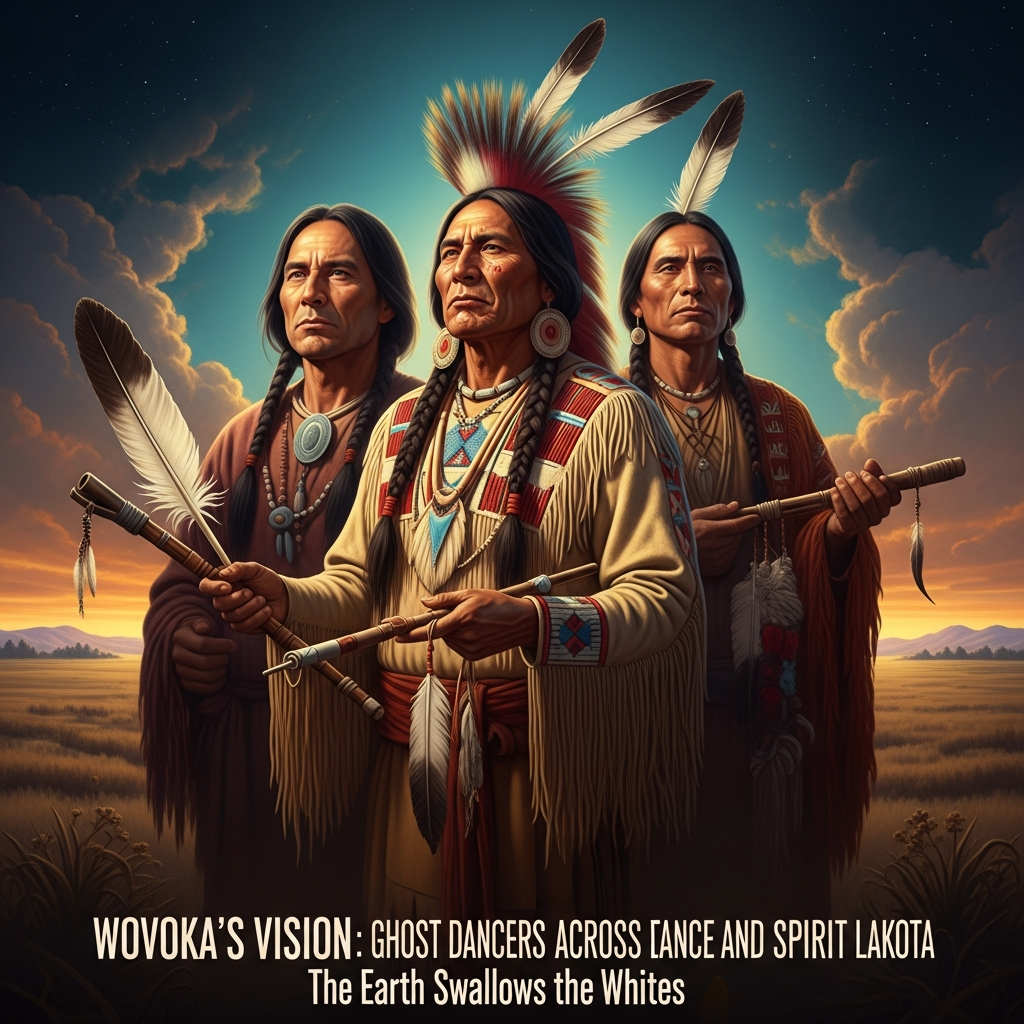
Wovoka's Vision: The Earth Swallows the Whites
January 1, 1889 — the solar eclipse; December 29, 1890 — Wounded Knee · Mason Valley, Nevada; the Pine Ridge Reservation, South Dakota
Contents
During a solar eclipse in 1889, the Northern Paiute prophet Wovoka dies and travels to the spirit world, where he receives a dance and a prophecy: if the people dance together, the dead will return, the buffalo will return, and the earth will renew itself.
- When
- January 1, 1889 — the solar eclipse; December 29, 1890 — Wounded Knee
- Where
- Mason Valley, Nevada; the Pine Ridge Reservation, South Dakota
The sun goes dark on the first day of 1889.
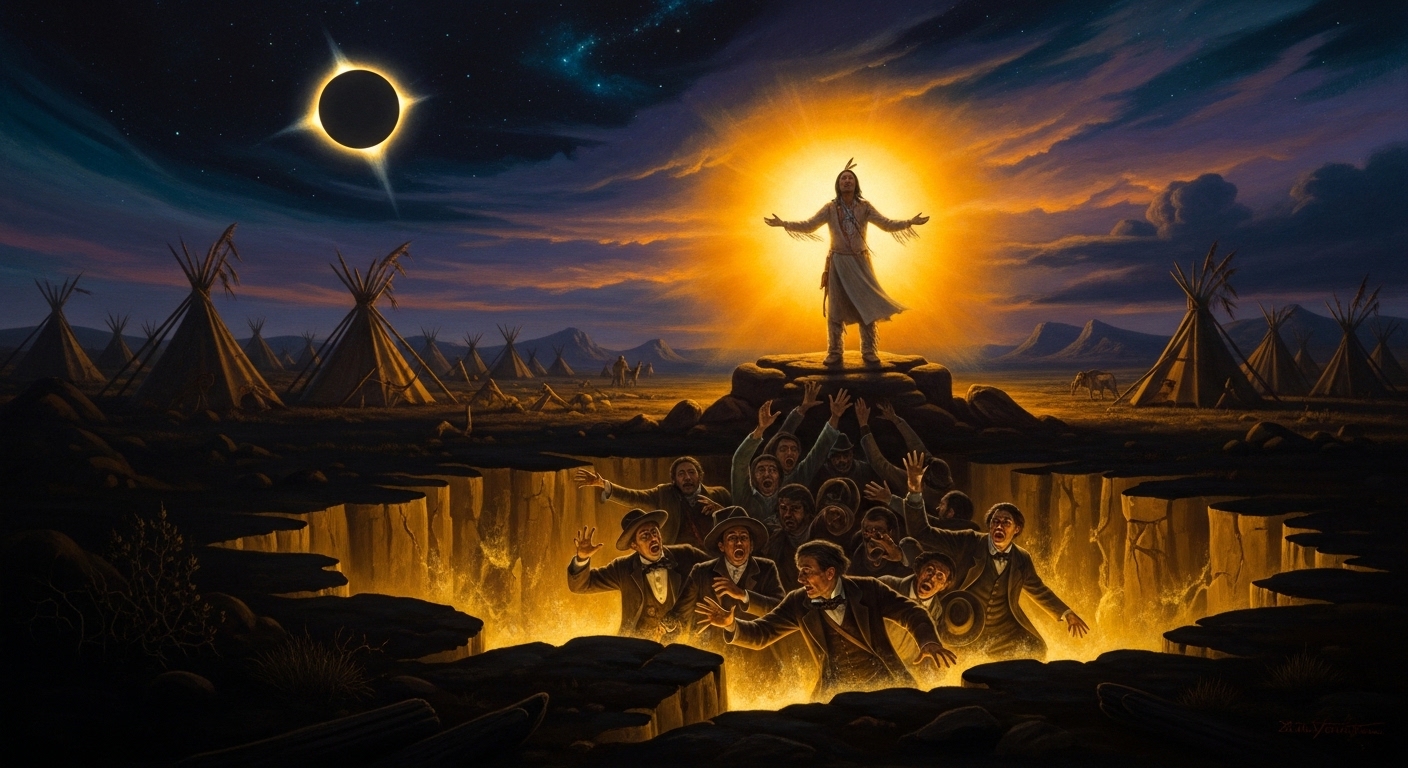
Wovoka is sick with fever when the solar eclipse begins. His family watches him collapse as the sun disappears, and for the duration of the eclipse — a few minutes, the sun swallowed and returned — he is somewhere else.
He is in the spirit world.
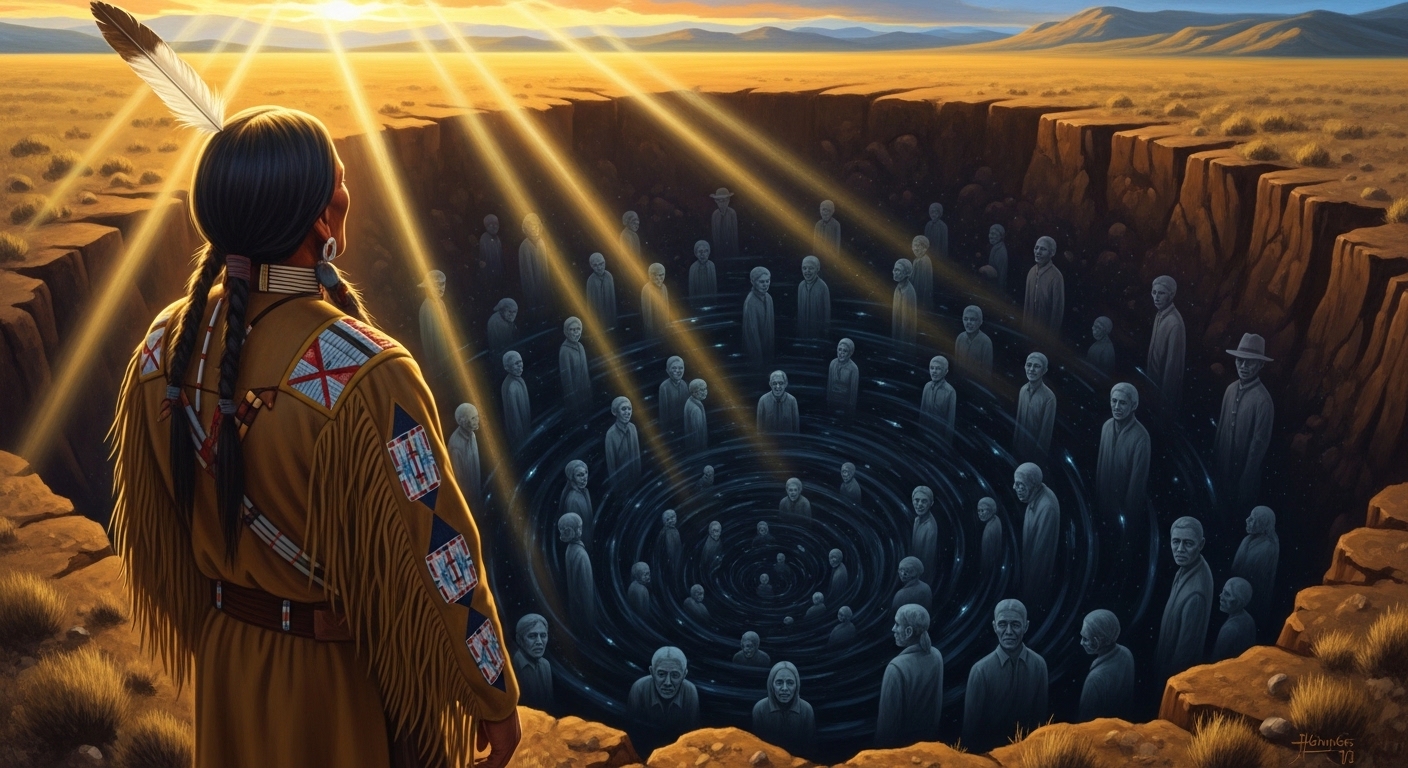
What he sees there is the most beautiful thing he has ever seen: the dead. Every person who has died in the years since the white settlers came — every warrior killed in battle, every elder who died of the new diseases, every child who did not survive the first winters on the reservation — all of them are there, alive, young, healthy, living in a world that is unmistakably the old world, the world before the reservations and the disappearance of the buffalo and the tearing up of the earth.
The land is full of buffalo. There is no barbed wire. The grass runs to every horizon unbroken. The people are dancing.
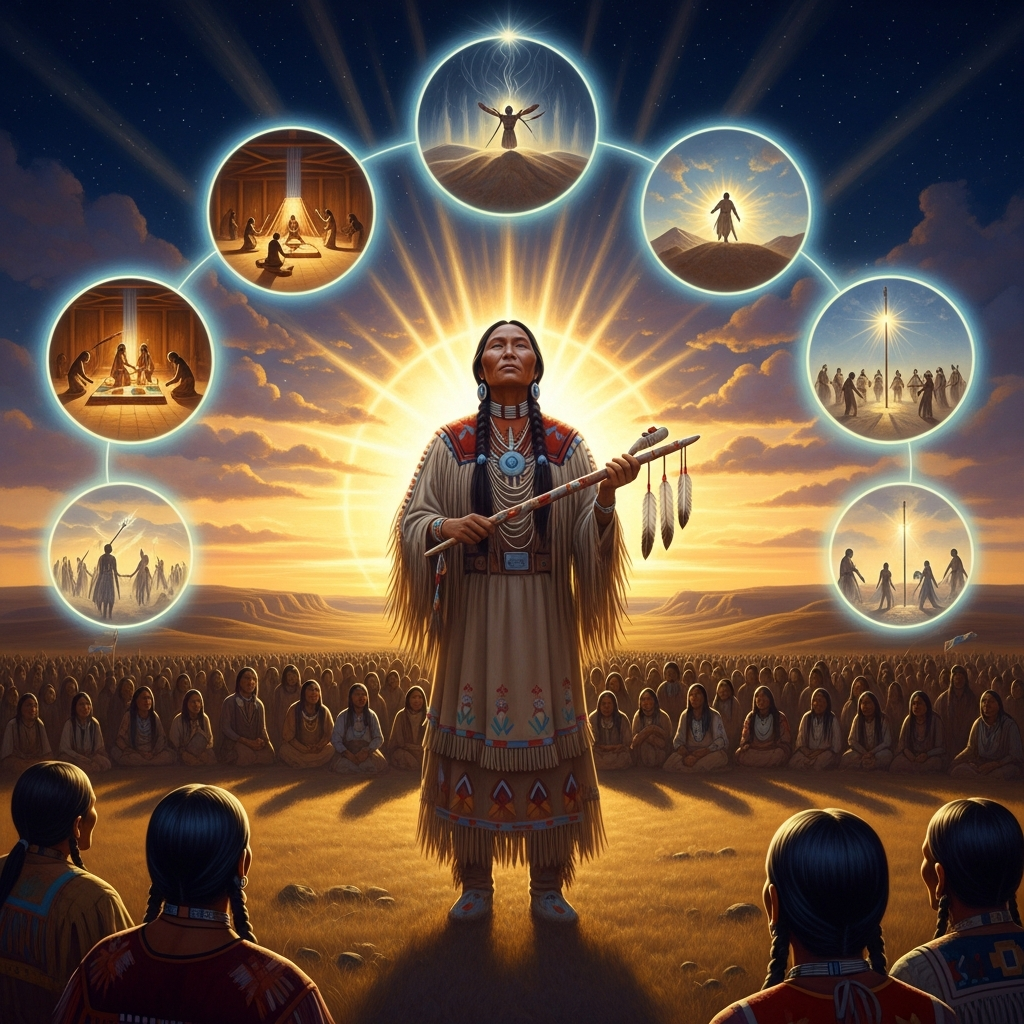
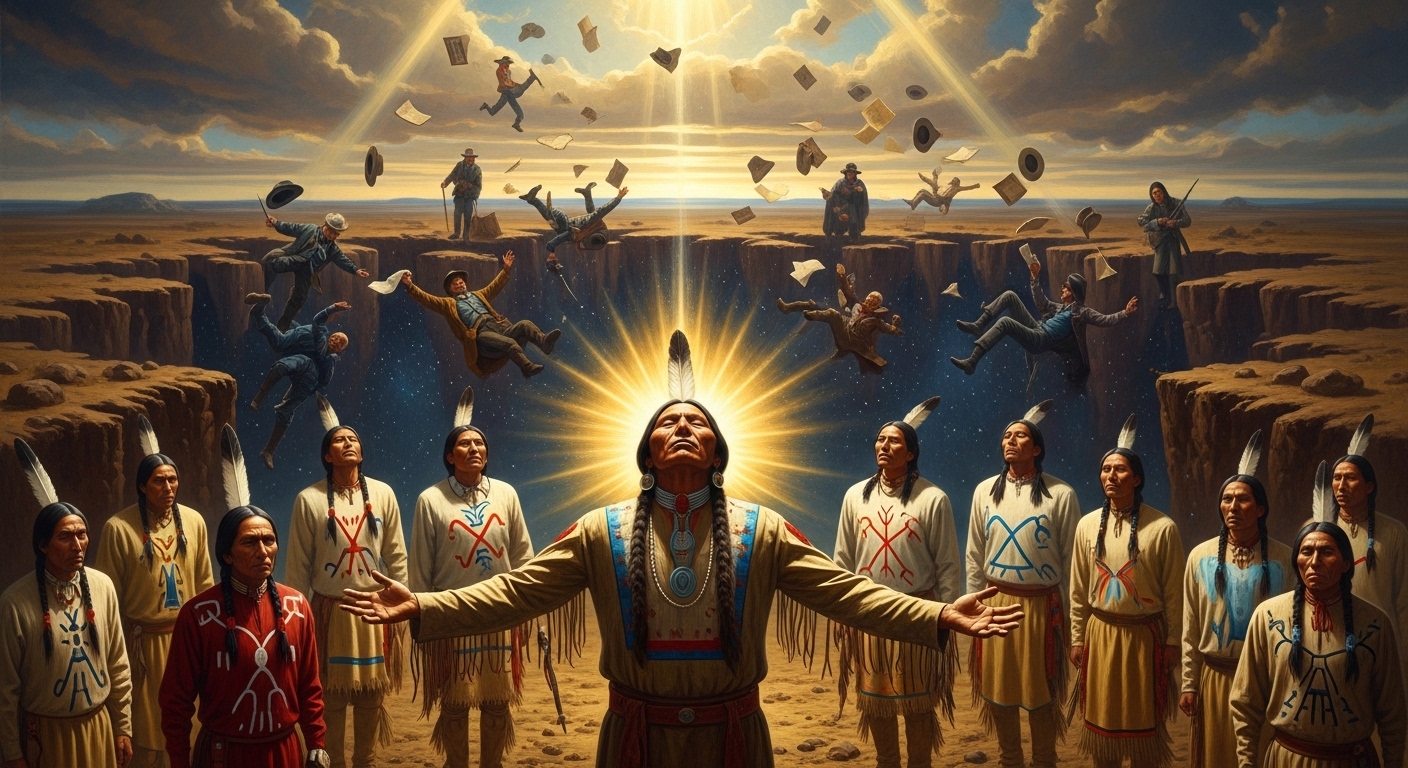
God tells him — or the spirit tells him, or the power of the vision tells him — that this world is coming. That the earth will renew itself: a new earth, alive with all the living and all the dead returned, will cover the old exhausted earth like a new skin covers a healing wound. He is given a dance and told to teach it. He is given songs. He is told: if the people dance in peace, without violence, without weapons, the renewal will come.
He comes back when the sun returns.
The Ghost Dance spreads across the Plains with a speed that the reporters of 1889 find alarming.
It reaches the Lakota at Pine Ridge and Standing Rock reservations, where Kicking Bear and Short Bull bring it and teach the steps and the songs. The Lakota add the Ghost Shirts — white garments decorated with sacred symbols, said to make the wearer invulnerable to bullets. (Wovoka himself did not teach this; it was added by the Lakota who were desperate for protection.) By the winter of 1890, hundreds of Lakota are dancing together on the cold plain, in large groups, for hours — dancing until the vision comes, dancing the dead back.
The US government, watching from a distance, does not understand the dance.
The news reports describe it as a war dance, a preparation for uprising. The agents at Pine Ridge request military backup. By December twenty-ninth, the 7th Cavalry is surrounding a group of Miniconjou Lakota at Wounded Knee Creek. A deaf man named Black Coyote resists having his rifle taken; a shot is fired — whether by him or by a soldier is disputed. The cavalry opens fire with rifles and Hotchkiss guns.
Approximately three hundred people are killed. Most are women and children.
Wovoka was still alive when Wounded Knee happened. He was still alive in 1932 when the ethnographer Omer Stewart visited him. He said he had never told the Lakota to add the Ghost Shirts. He said the dance was for peace.
The dead they danced for did not return.
But the people danced again, in another generation, and again. The Ghost Dance tradition was not extinguished at Wounded Knee — it went underground and surfaced again in different forms, and the theology of the dance — the deep belief that the sacred world is still present under the visible world, that the dead are not gone but are somewhere close, that prayer and ceremony can bring the renewal — has never left.
It is the most honest prayer in American history: the prayer of a people who had lost almost everything, asking for the earth to turn over and give it back.
Scenes
Echoes Across Traditions
Entities
- Wovoka (Jack Wilson)
- the ghost dancers across the Plains
- Kicking Bear and Short Bull (who brought the dance to the Lakota)
- the massacred people at Wounded Knee
Sources
- James Mooney, *The Ghost-Dance Religion and the Sioux Outbreak of 1890* (Bureau of American Ethnology, 1896)
- Dee Brown, *Bury My Heart at Wounded Knee* (Holt, 1970)
- Rani-Henrik Andersson, *The Lakota Ghost Dance of 1890* (University of Nebraska Press, 2008)