
The Full Cup That Cannot Receive Teaching
Meiji period — this version attributed to the 19th-century master Nan-in; the teaching is much older · A Zen master's tea room, Japan
Contents
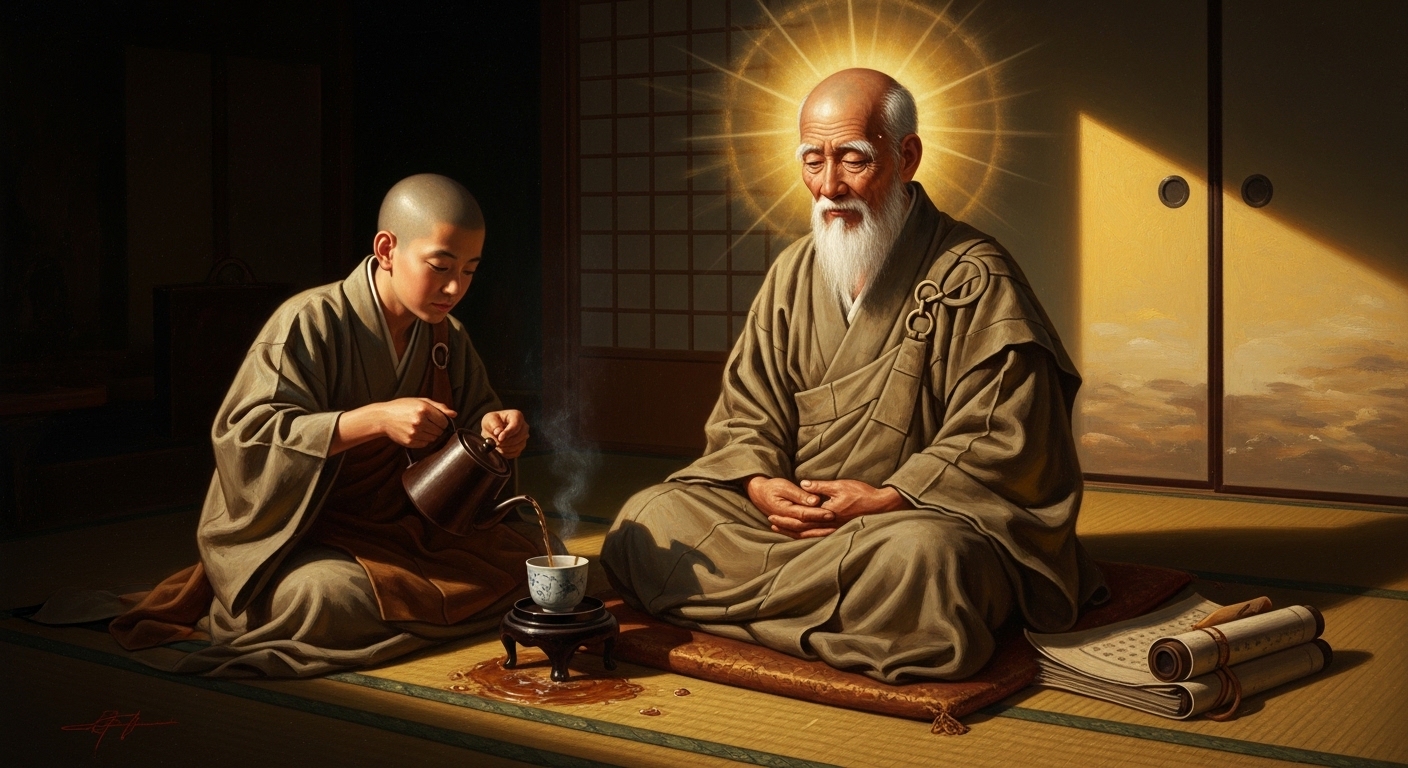
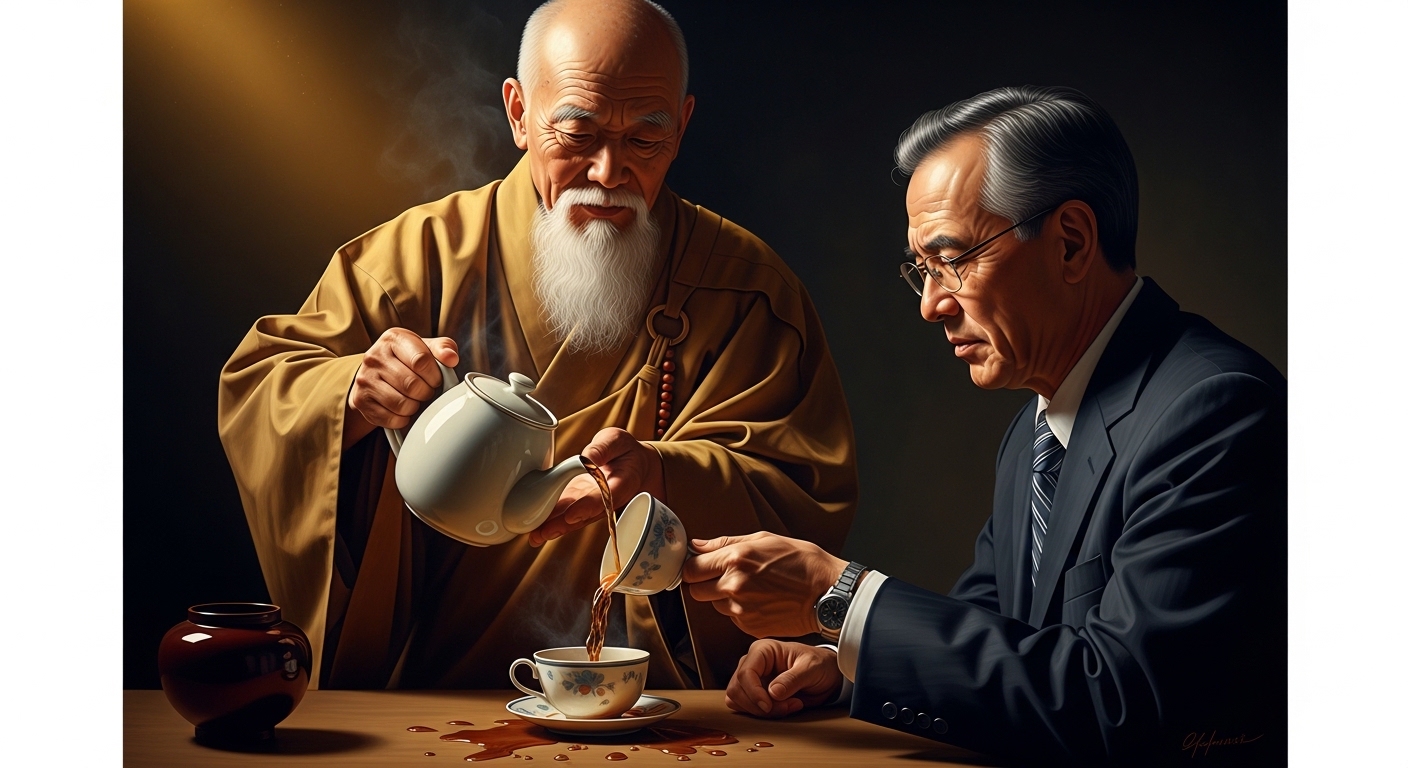
A professor of philosophy visits the Zen master Nan-in and talks about Zen at length — and Nan-in pours tea into the professor's cup until it overflows onto the table, and says: like this cup, you are full.
- When
- Meiji period — this version attributed to the 19th-century master Nan-in; the teaching is much older
- Where
- A Zen master's tea room, Japan
The professor has come to ask about Zen.
He is a scholar. He has read the major texts. He can explain the concept of sunyata (emptiness) from three different theoretical frameworks. He has written a monograph on the relationship between Madhyamaka philosophy and the Rinzai koan tradition. He is curious about Zen in the way that a person who knows a great deal about something is curious — which is to say, he is curious about whether the master will agree with what he already knows.
The master Nan-in invites him to sit.
He offers tea.
The professor sits and continues to talk about Zen. His observations are not foolish — they are sophisticated, carefully organized, the product of real thought. He talks about emptiness. He talks about the koan curriculum. He offers his analysis of the relationship between sudden enlightenment and gradual cultivation. He talks about Bodhidharma facing the wall.
Nan-in begins to pour tea into the professor’s cup.
The professor talks. Nan-in pours.
The cup fills. The tea reaches the rim. Nan-in pours. The tea goes over the rim and runs across the saucer and onto the table. The professor stops talking. He looks at his cup, which is overflowing. He looks at Nan-in, who is still pouring.
The cup is overflowing.
Nan-in stops pouring.
He says: You are like this cup. Full. How can I show you Zen unless you first empty your cup?
The professor has come to receive something, but bringing a full cup to a source means nothing can flow in. The teaching cannot enter a space that is already occupied by the student’s prior knowledge of what the teaching will say. The knowing and the reality are on opposite sides of the rim.
This is not an argument against scholarship. Nan-in is not saying that reading is bad or that theoretical knowledge is worthless. He is making a narrower point: in this room, in this conversation, what he can offer is not an addition to the professor’s framework but something that has no room in it. The cup that overflows is the mind that is experiencing reality through the filter of its own understanding of reality rather than directly.
Shoshin — beginner’s mind — is Shunryu Suzuki’s twentieth-century articulation of what Nan-in is pointing to: In the beginner’s mind there are many possibilities, but in the expert’s mind there are few. The expert’s mind has collapsed the field of possible experience into the field of expected experience. The beginner’s mind has not yet done this.
Empty the cup.
This is not difficult to say.
It is, for anyone who has filled their cup with years of careful learning, very difficult to do.
The tea pools on the table.
Nan-in holds the pot.
He is waiting.
Scenes

Echoes Across Traditions
Entities
- Nan-in (the Zen master)
- the professor
Sources
- Shaseki-shū (Collection of Stone and Sand), compiled by Mujū Ichien, c. 1283 — early versions of similar stories
- Nyogen Senzaki and Paul Reps, *Zen Flesh, Zen Bones* (Tuttle, 1957) — Nan-in version
- Shunryu Suzuki, *Zen Mind, Beginner's Mind* (Weatherhill, 1970)
- Keene, Donald, *Nō and Bunraku* (Columbia, 1990)