Horatius at the Bridge
508 BCE — the second year of the Roman Republic, just after the expulsion of the Tarquins · The Pons Sublicius — the wooden pile-bridge across the Tiber at the foot of the Janiculum, the first and oldest bridge of Rome
Contents
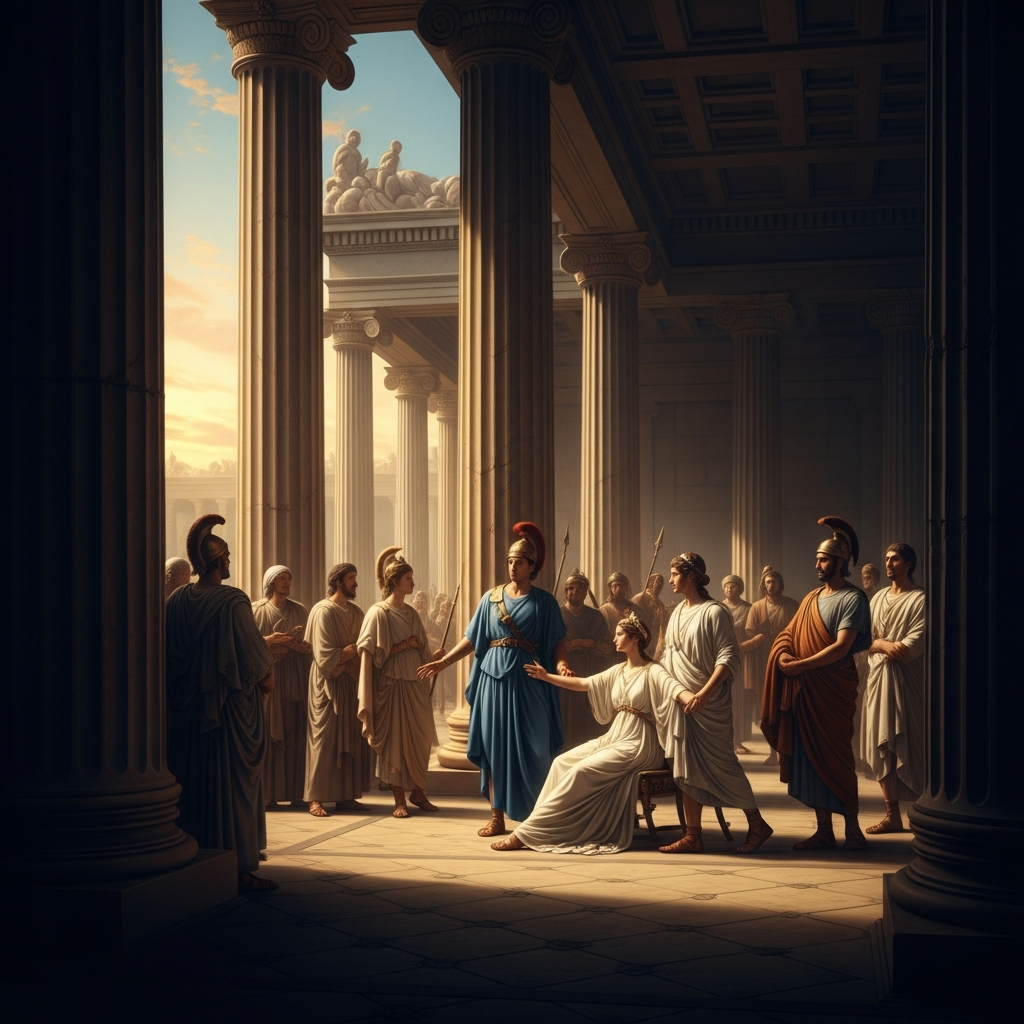
The Etruscan army of Lars Porsena pours toward the wooden bridge that is Rome's only entrance. One man stands at the far end with two companions, then alone, and holds the span long enough for the Romans behind him to chop it into the Tiber. When the timbers fall, he prays to the river and jumps in full armor.
- When
- 508 BCE — the second year of the Roman Republic, just after the expulsion of the Tarquins
- Where
- The Pons Sublicius — the wooden pile-bridge across the Tiber at the foot of the Janiculum, the first and oldest bridge of Rome
The fog over the Tiber is the colour of old iron when the watchman on the Janiculum sees them coming.
He sees the standards first. Then the helmets. Then the long line of them filling the road that descends from the hill to the river, and he understands that Lars Porsena of Clusium has not stopped at the frontier — has not stopped anywhere — and is going to be at the wooden bridge before the sun is fully up. He runs. He shouts. He is in the Forum before he has caught his breath, and the consuls are calling the city to the walls.
But the walls are not the problem.
The problem is the Pons Sublicius — the old wooden pile-bridge, the only crossing over the Tiber, the road that leads straight into the heart of Rome. If the Etruscans reach it before it falls, they walk into the city as if invited.
Horatius is at the bridge before the consuls give the order.
He is a soldier — a Roman of the Horatian gens, with the cognomen Cocles, the one-eyed, from a wound he took years ago. He is standing at the far end of the bridge, looking up the road, and what he sees coming toward him through the dispersing fog is the entire field army of Etruria.
He turns his head over his shoulder.
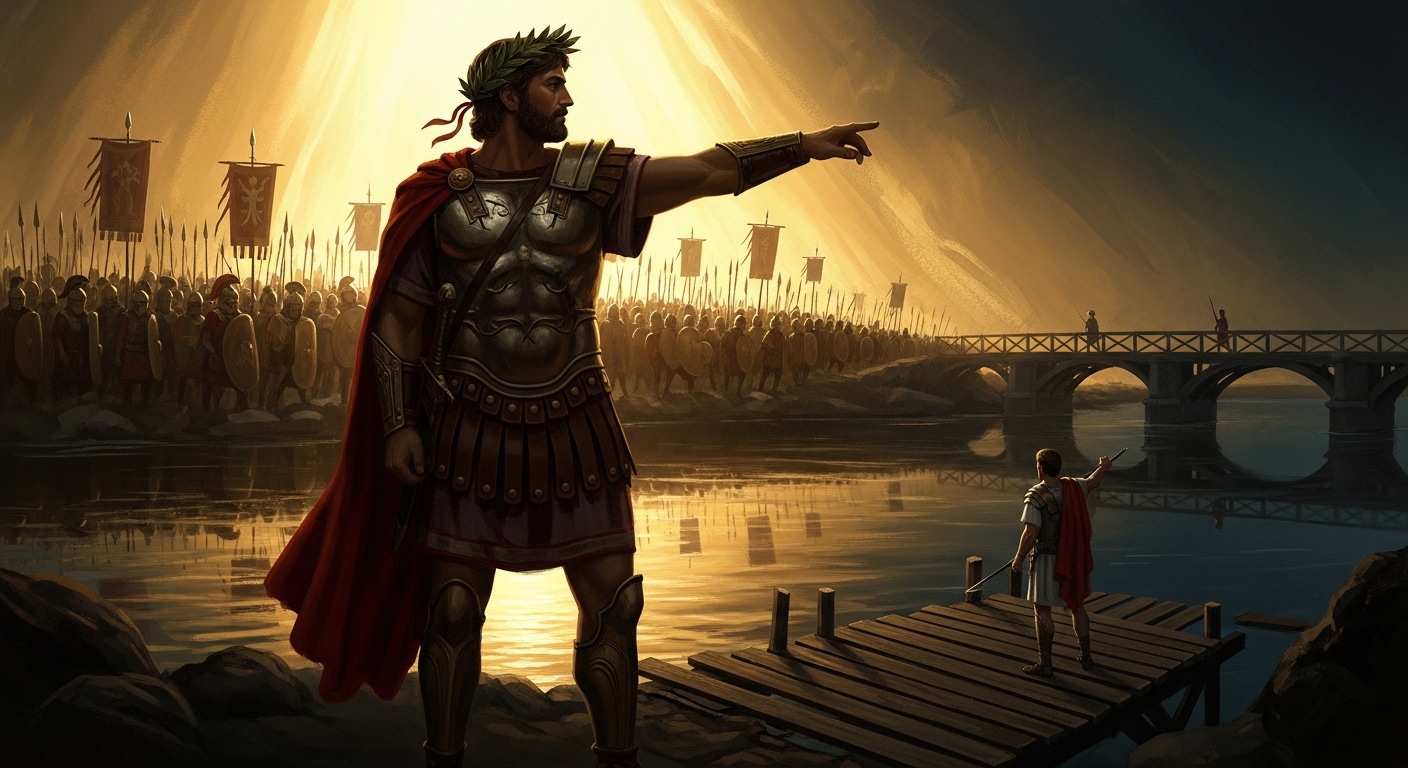
Tear it down, he says, to the men still on the Roman side. Cut the supports. Burn the planks. Use axes, use fire, use your hands. I will hold this end.
They stare at him. He is one man.
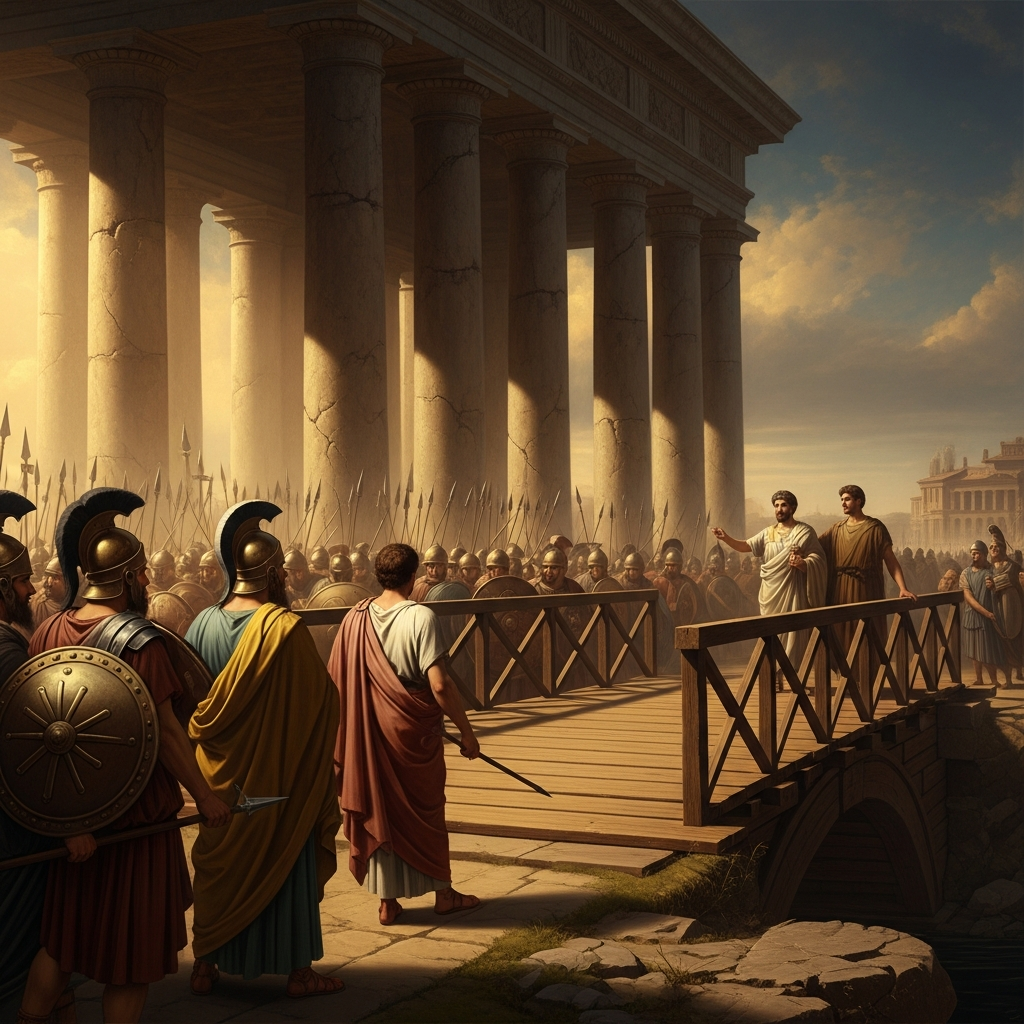
Two of them — Spurius Lartius and Titus Herminius — walk out onto the bridge to stand with him. Three men, then, on the far end of the Pons Sublicius, with the Tiber black under their feet and the Etruscan vanguard already close enough that they can see the faces of individual riders.
Behind them, the axes start.
The first wave hits the bridge.
Horatius is a Roman with a Roman shield — heavy oblong, iron-rimmed, the kind a man can plant and stand behind — and the bridge is exactly the width that two shields will fill. The Etruscans cannot get around him. They cannot ride at him in numbers. They have to come in twos and threes and meet what is, on a bridge this narrow, three Roman shields and three Roman swords, and that is a price they pay slowly and in blood.
Spurius Lartius is wounded.
Titus Herminius is wounded.
Behind them, the axes are eating through the timbers — Horatius can hear it under the grunting of men dying on his sword-point, the steady chock-chock-chock of Roman wood being unmade by Roman hands so that the Roman city behind it can live.
He turns his head again.
Go back, he tells the other two. Cross while you still can. The bridge will not hold both of us much longer. They argue. He shouts them off. They limp back across the trembling planks, and Horatius is left alone at the far end of the Pons Sublicius with all of Etruria coming at him.
He taunts them.
This is what Livy preserves and Macaulay made into schoolboy poetry — Horatius, alone on a shaking bridge, calling out to the Etruscan nobles by their names. Are you slaves of a tyrant that you forget what free men look like? Come on, then. Come and see. He stands his ground. He kills the men who reach him. The bridge groans under his feet because the supports behind him are almost gone.
Then he hears the crash.
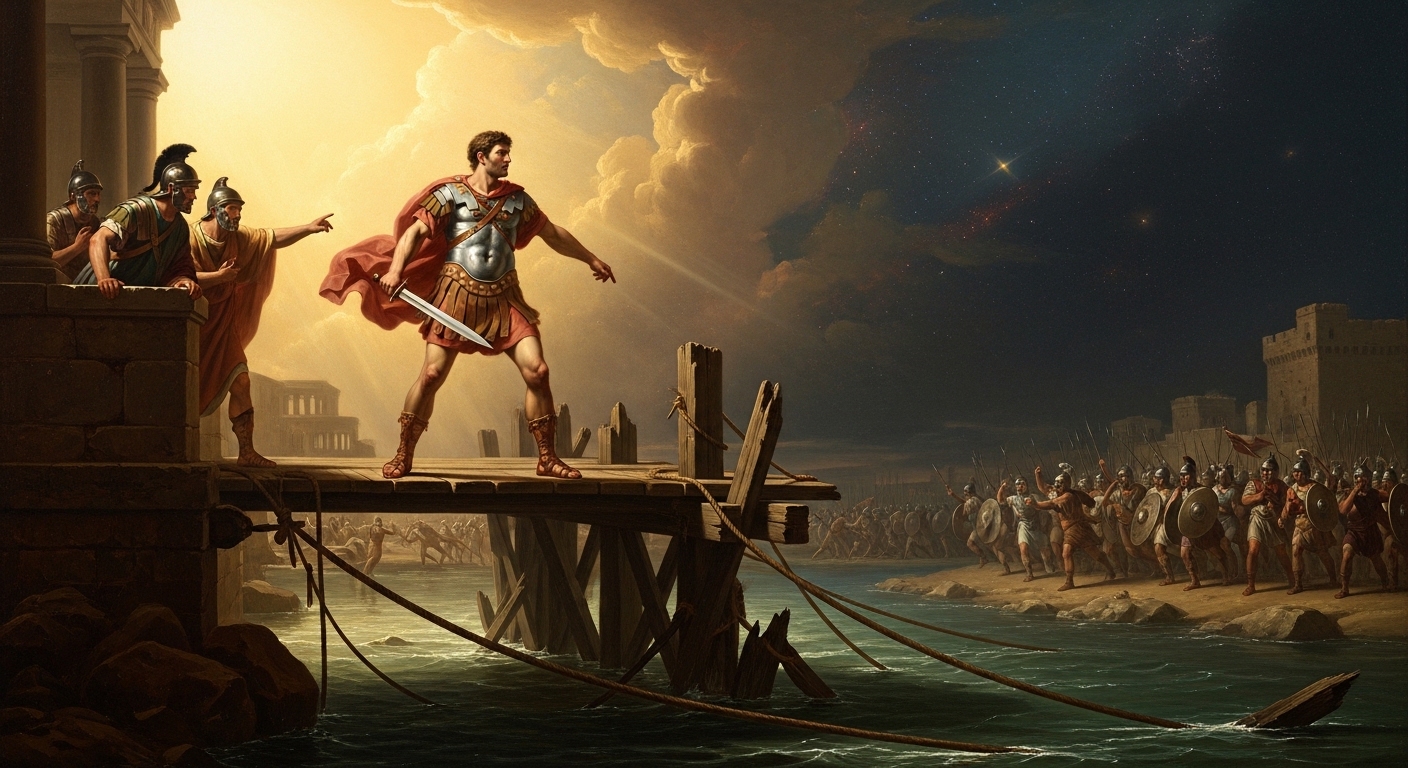
The Pons Sublicius gives way along its length — the timbers separating, the piles falling sideways into the current — and the road into Rome breaks behind Horatius like a sentence cut off mid-word. There is no bridge anymore. There is only him, on a fragment of platform over the Tiber, with the Etruscan host on the bank and the river full of broken wood below.
He turns to face the river.
He prays.
Tiberinus, father, holy one — receive these arms and this soldier in your kindly stream. That is the Latin Livy gives him: Tiberine pater, te sancte precor, haec arma et hunc militem propitio flumine accipias. No grand theology, no last speech to the city — a soldier’s prayer to the river-god of his own city, asking the water not to drown him.
Then he jumps.
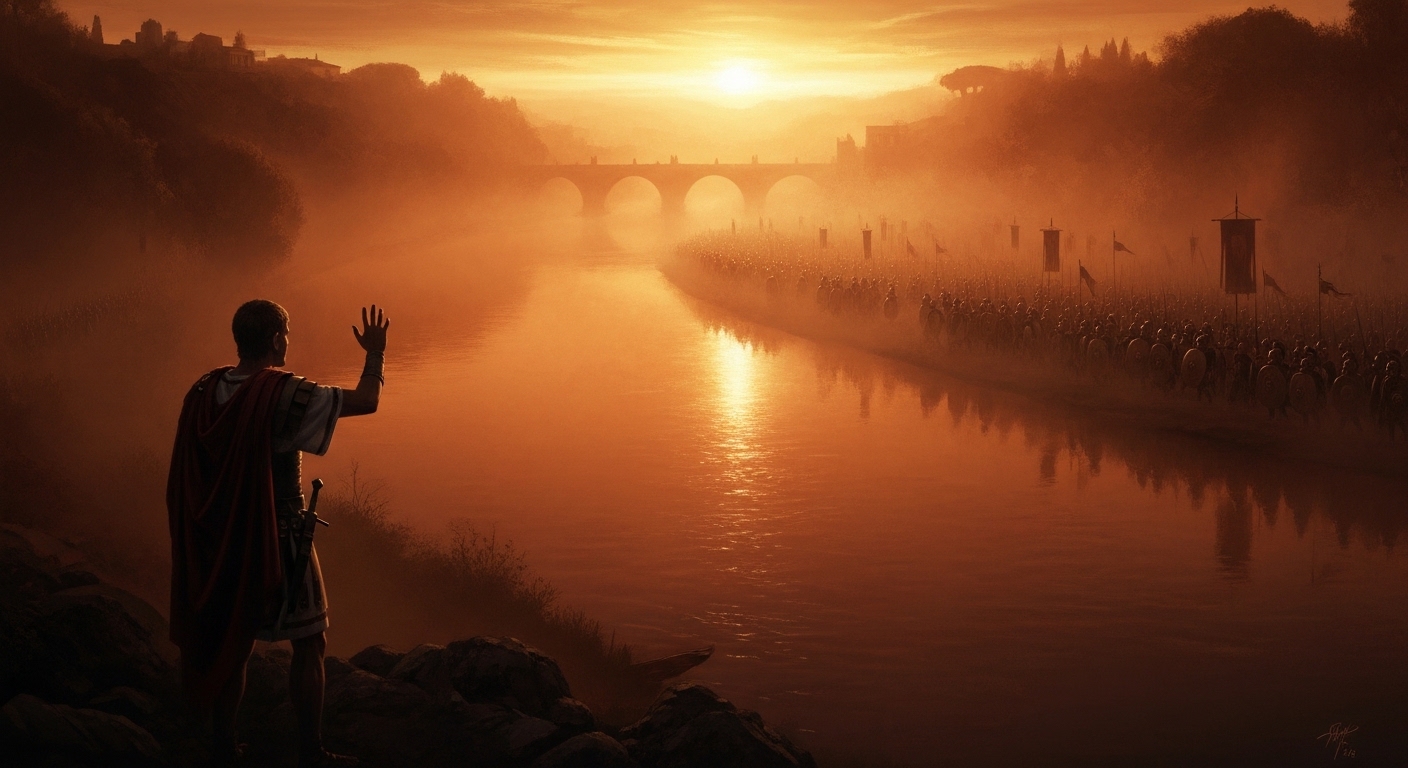
He jumps in full armor. Bronze cuirass, helmet, greaves, oblong shield, sword still on him. The current of the Tiber takes him sideways under the smoke. The Etruscans on the bank shoot arrows at him. The Romans on the far bank — his own people, who have just chopped the road out from under his feet to save the city — stand up on the riverside and watch a man in iron try to swim.
He reaches the Roman bank.
He climbs out, drenched, bleeding, alive — and the city he has bought ten more minutes for closes around him in a roar.
Lars Porsena is on the far side of the river.
He has the field. He has the road. He has the high ground above the broken bridge. He has everything except the one thing he came for, which was a Rome that could be ridden into. Across a Tiber he cannot now cross, he watches the smoke of his own dead drift over the water and a one-eyed Roman soldier being carried up the bank by men who have just learned what their republic is for.
The Romans give Horatius land — as much as he can plow around in a day with a yoke of oxen. They put a statue of him in the Comitium. The story enters the catechism of the young Republic as the first answer to the first question every free city eventually has to ask, which is: what does a citizen owe?
The answer Rome will keep telling itself, all the way to Cincinnatus and Regulus and the long centuries afterward, is the answer Horatius gave on a wooden bridge at dawn, alone, with the axes working behind him.
He owes the bridge.
Livy writes the story almost five hundred years after it happens — in the reign of Augustus, when Rome has just emerged from civil wars that ate its own institutions, and the question of what a Roman citizen ought to be has gone from settled to dangerous. He gives Horatius the prayer to Tiberinus and the leap in armor not as decoration but as theology. The river is the city’s river. The man is the city’s soldier. The bridge between them is the thing he is willing to die on top of so that the city can pull it down.
Polybius, the Greek, tells the same story two centuries earlier — and has Horatius drown in the river, weighed down by his armor. Livy lets him live. The Roman version cannot quite let the citizen die for the bridge; the citizen has to climb out, drenched and counted, so that everyone watching understands what the city is keeping faith with when it gives him land and a statue. The Republic is the contract: you stand on the bridge, the city pulls it down behind you, the city carries you out of the river afterward.
Macaulay made it a marching song. Behind the marching song is the older thing — the soldier on the wooden span, the axes behind him, the prayer to a river he is about to be in. The image is older than Rome and persists after Rome. Wherever a free city decides what citizenship costs, somebody is on a bridge.
Scenes
Echoes Across Traditions
Entities
- Horatius Cocles
- Lars Porsena
- Spurius Lartius
- Titus Herminius
- Tiberinus
Sources
- Livy, *Ab Urbe Condita* 2.10 (c. 27 BCE - 9 CE)
- Polybius, *Histories* 6.55 (c. 140 BCE)
- Dionysius of Halicarnassus, *Roman Antiquities* 5.23-25
- Plutarch, *Life of Publicola* 16
- Thomas Babington Macaulay, *Lays of Ancient Rome* (1842)