Contents
Izanagi flees the rotting form of his dead wife through the underworld passage, blocking the entrance with a boulder — and the world divides forever into the living and the dead.
- When
- Age of the Gods — before historical time, Kojiki cosmogony
- Where
- The pass of Yomotsu Hirasaka — the boundary between the underworld and the living world
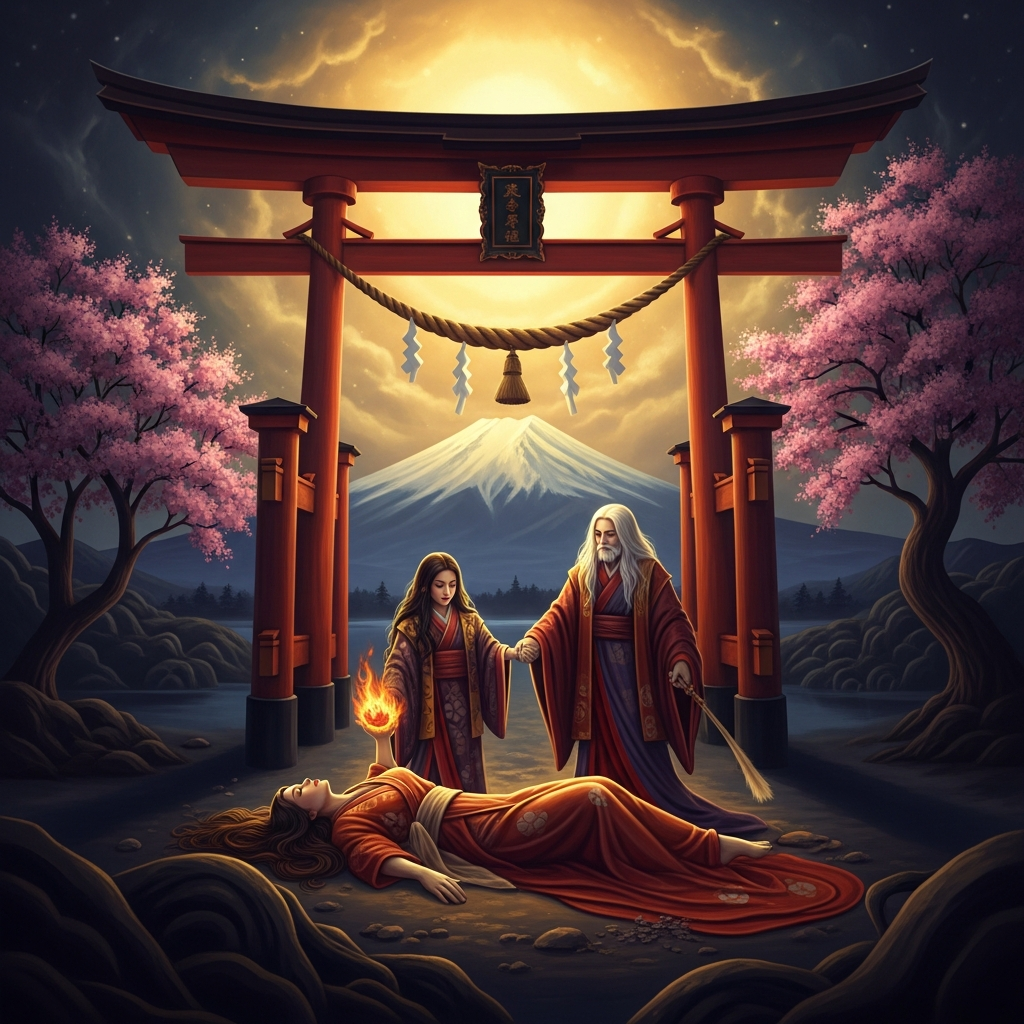
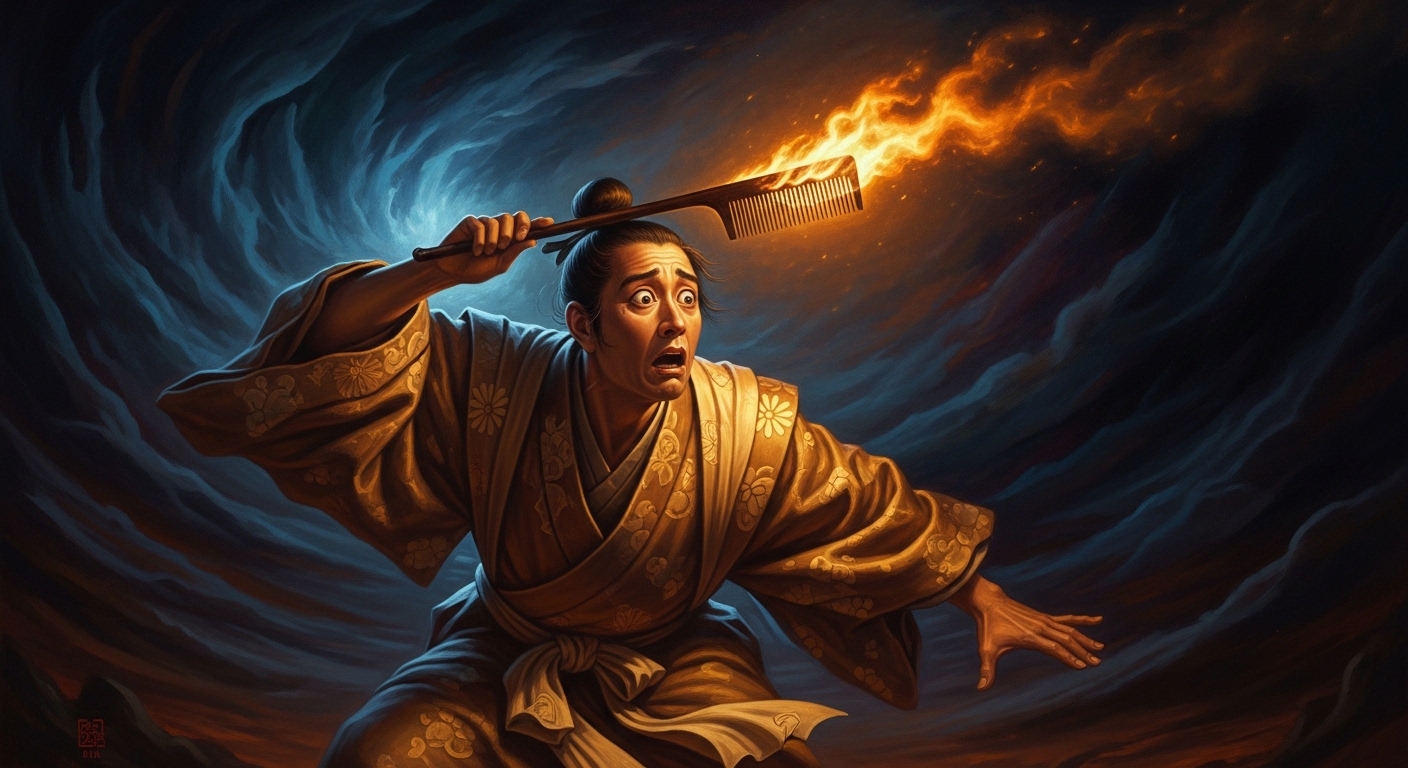
He breaks off a tooth from the comb in his hair and uses it as a torch.
This is how the Kojiki describes the moment before the looking: Izanagi has waited in the darkness outside the inner chamber of Yomi, where Izanami has gone to beg the gods of the dead for her release, and the wait has become unbearable. He takes the left tooth of the comb in his hair — the hair-comb of heaven, carried by all divine beings of this era — and he lights it like a torch and he walks into the chamber.
What the torchlight shows him cannot be unseen.
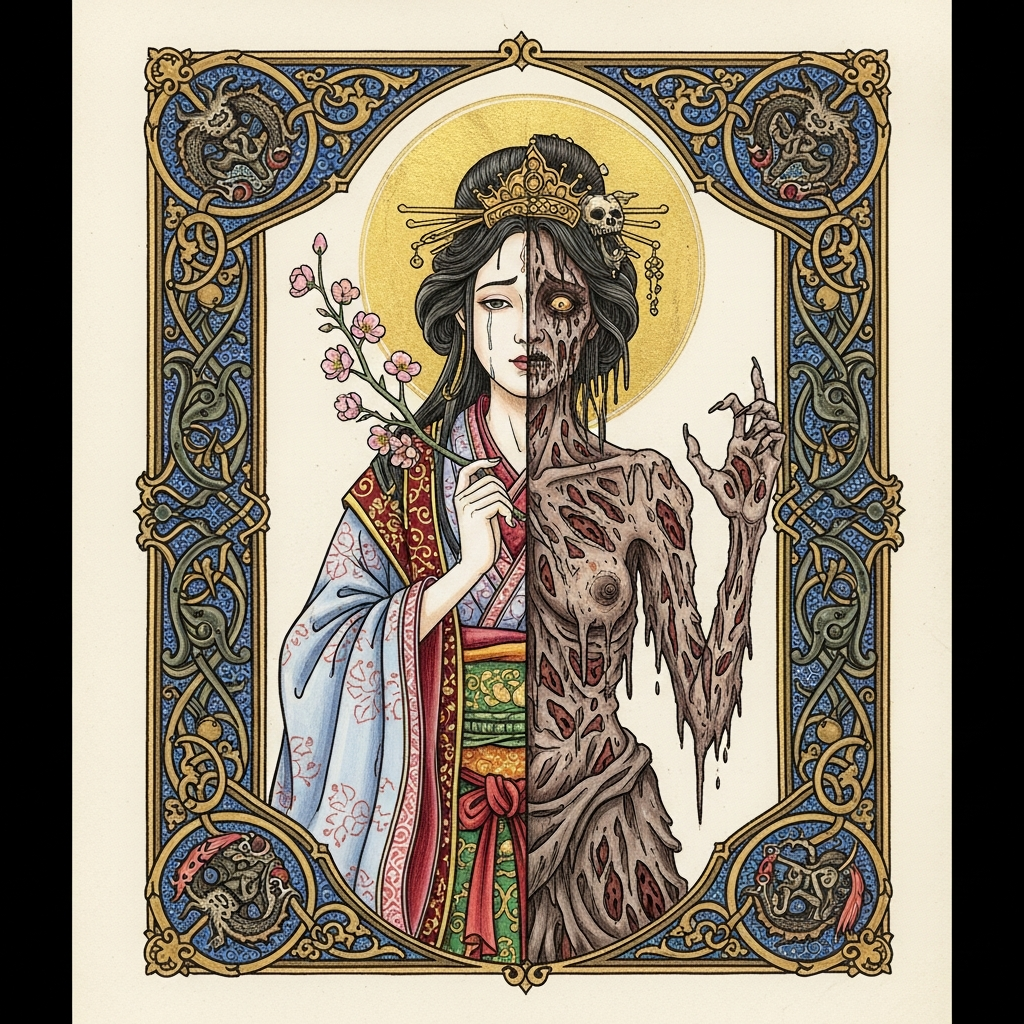
The body of Izanami is covered with maggots. They are everywhere in her — moving through her head, her chest, her belly, her limbs. The sound they make in the silence of Yomi is described in the Kojiki as a roaring, a tumultuous noise, the sound of something being unmade at speed. Different deities of thunder have been born from different parts of her body as it decomposes: Fire-Thunder, Black-Thunder, Earth-Thunder, Sobbing-Thunder, Young-Thunder, each a kind of divine horror, each occupying a different region of her ruined form.
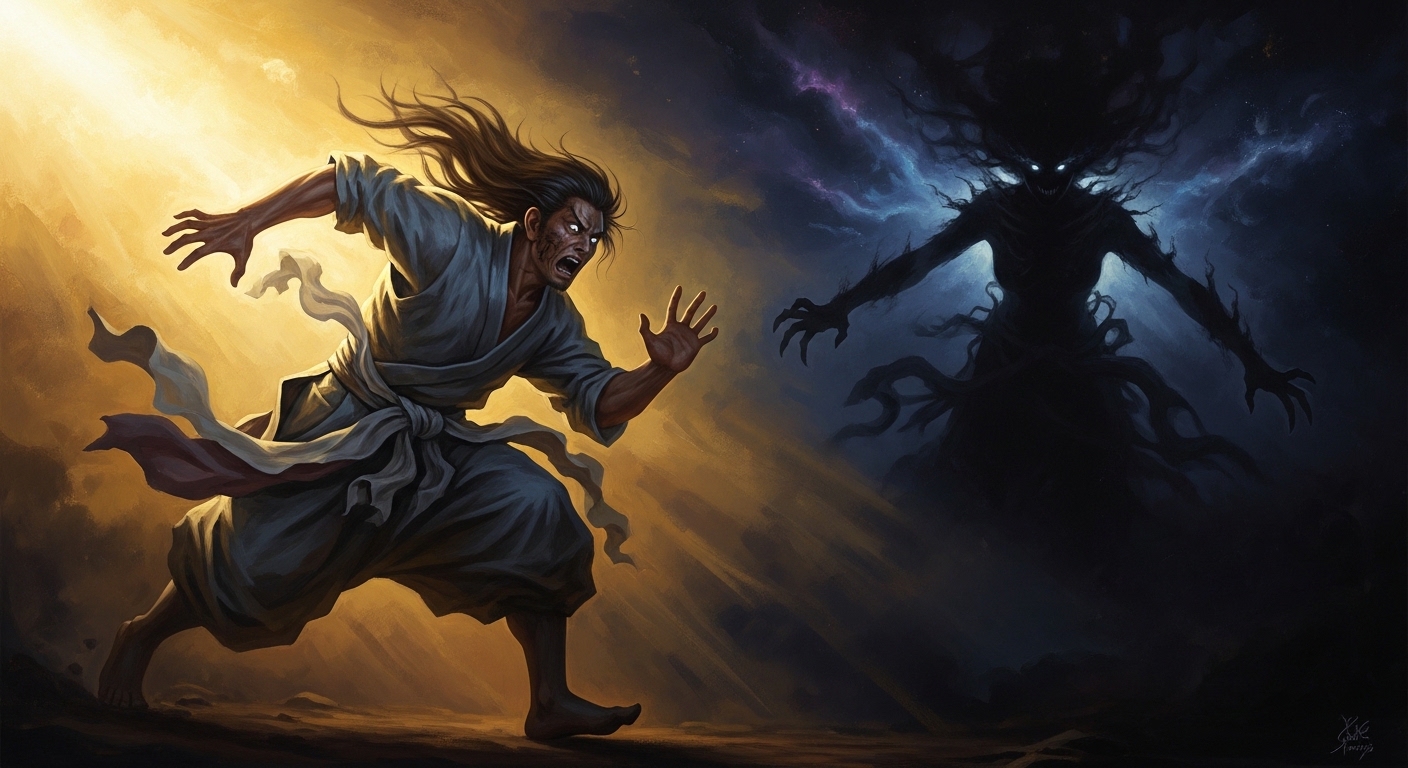
Izanagi runs.
The running is long. Yomi is not a small country. Izanami sends the hags — the Shikome, the Ugly Women of Yomi — after him first, and he throws things as he goes: he pulls the black vine from his hair and it becomes grapes, and the Shikome pause to eat them. He throws the bamboo shoots from his comb and they become bamboo shoots in the earth and the Shikome pause to eat those too. He runs while they eat.
But the armies of Yomi are faster. He draws his sword and swings it behind him, running, fighting without turning back, and this slows them. Then Izanami herself comes after him, and behind her come the army of the dead and eight thunders and fifteen hundred demon soldiers, and the whole of Yomi is in motion behind him.
He reaches a pass — the place where the passage from Yomi meets the world of light. He finds three peaches growing there, impossibly, at the edge of the dead country, and he throws all three at the pursuing army. Peaches, for reasons the Kojiki does not explain but the reader feels immediately, are averse to the dead. The army stops at the peaches. He names the peaches: Ohokamudzumi, the Great Divine Peach, and commands them to drive back evil spirits from the living world as they drove back the armies of Yomi.
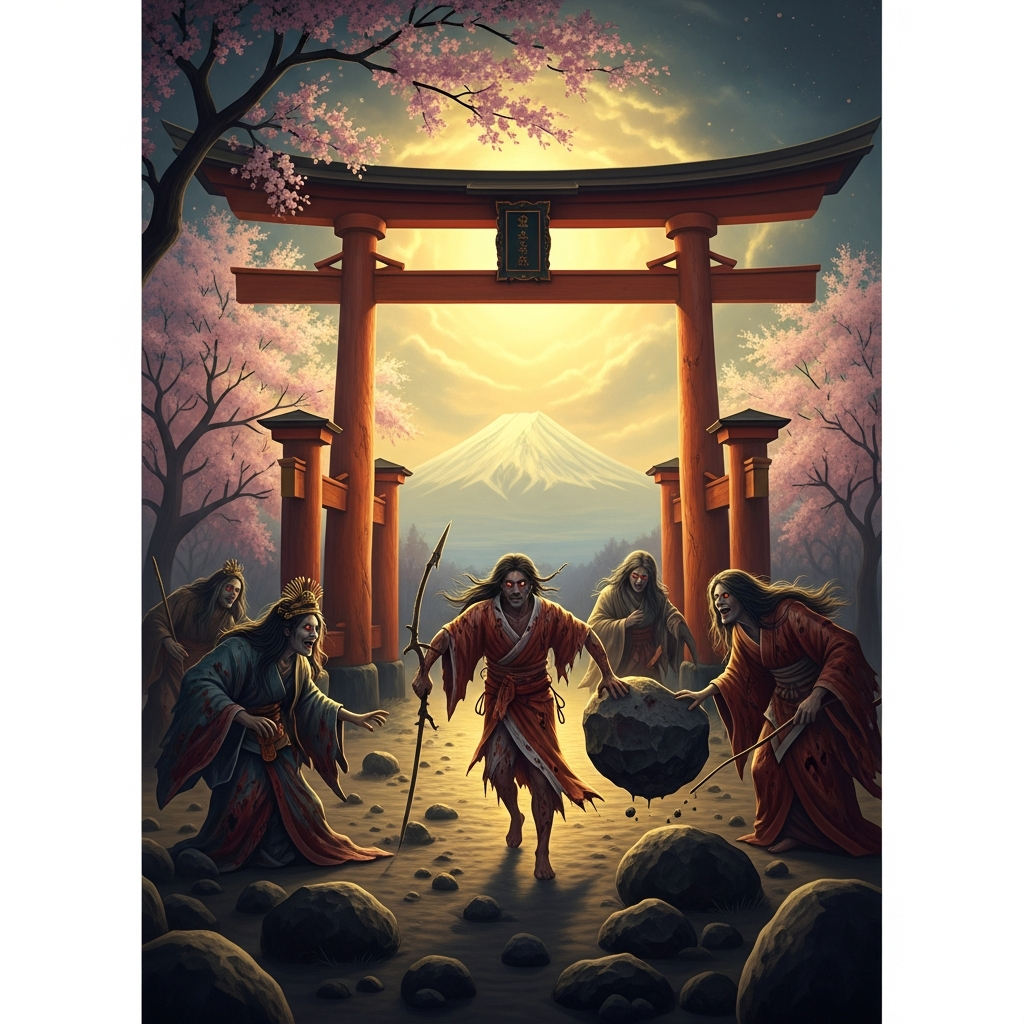
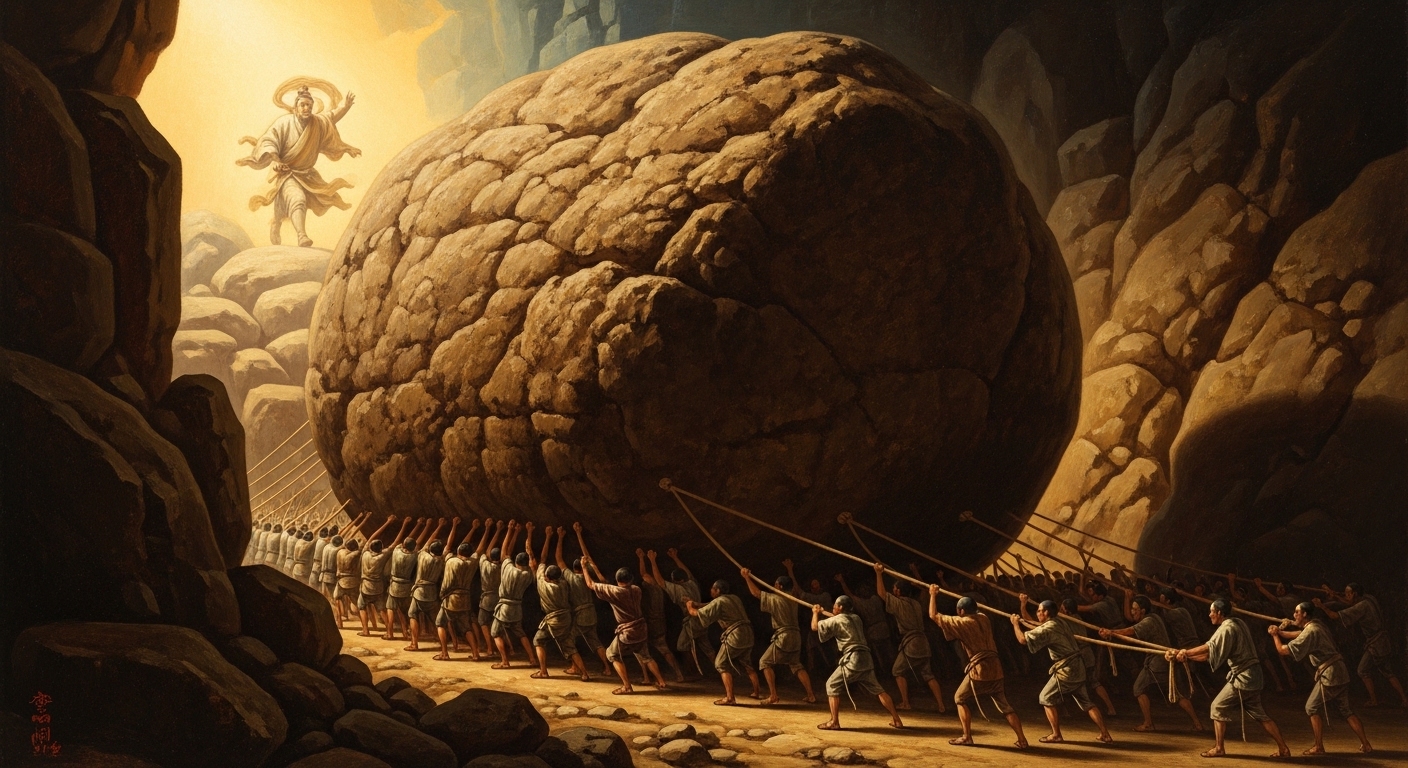
Then he rolls a great boulder across the mouth of the pass.
The boulder is so large it takes a thousand men to move. It fills the passage completely. Izanami stands on her side. Izanagi stands on his.
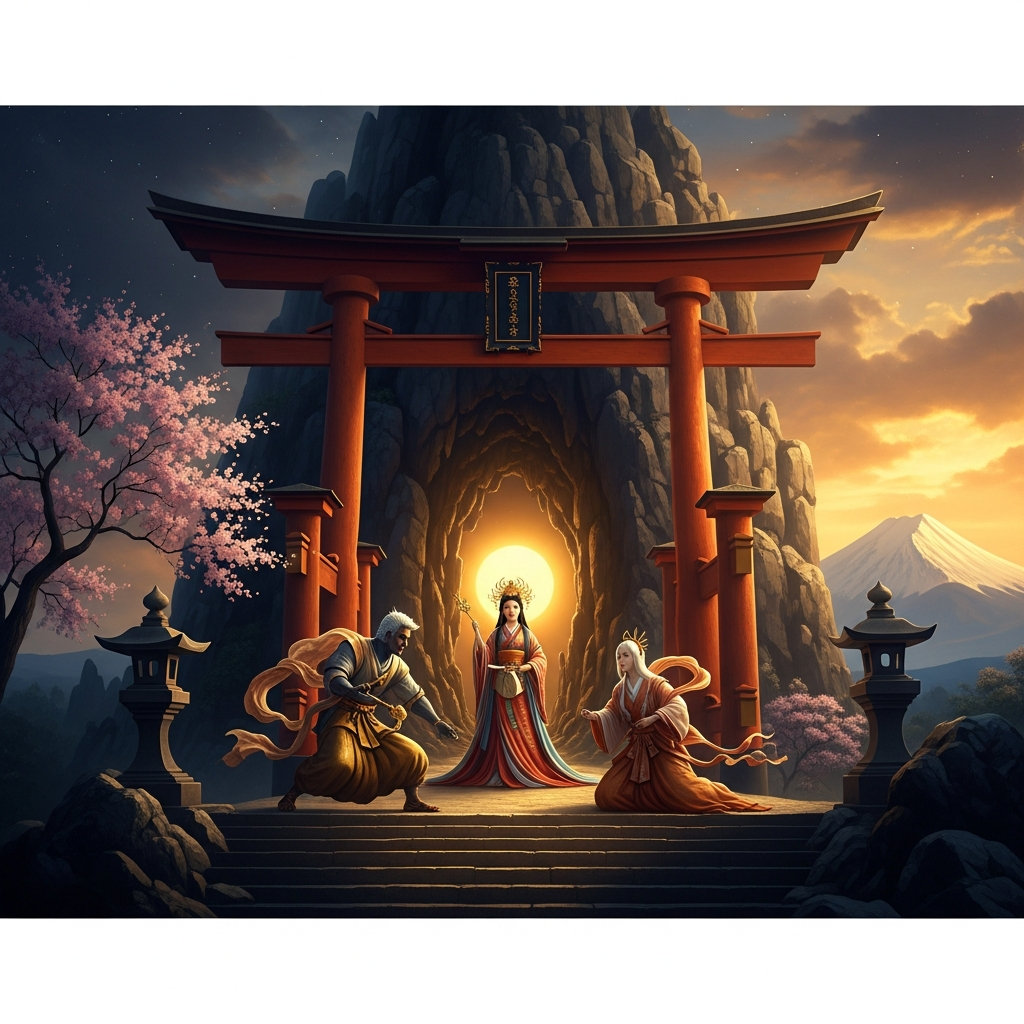
They speak to each other across the boulder, across the boundary between the living world and the dead country, and what they say is a divorce and a declaration simultaneously.
She says: If you do this, I will kill a thousand people from your country every day.
He says: If you do that, I will build fifteen hundred parturition huts every day.
Death. Birth. A thousand dying. Fifteen hundred being born. The world does not collapse into death because Izanagi will always be one step ahead — not triumphant, not celebrating, but simply committed to the arithmetic of continuation. This is the Shinto explanation of why humanity does not go extinct despite dying: not because death is defeated, but because it is outpaced.
The names they call each other across the boulder are the names of people who have been somewhere together and are no longer together. He calls her the woman my beloved wife once was. She calls him my beloved husband. The endearments still fit, but they cross a boundary that cannot be uncrossed. She is the deity of the underworld now. He is the deity of the world above. The gods of creation have become, in one terrible night of looking, the gods of separation.
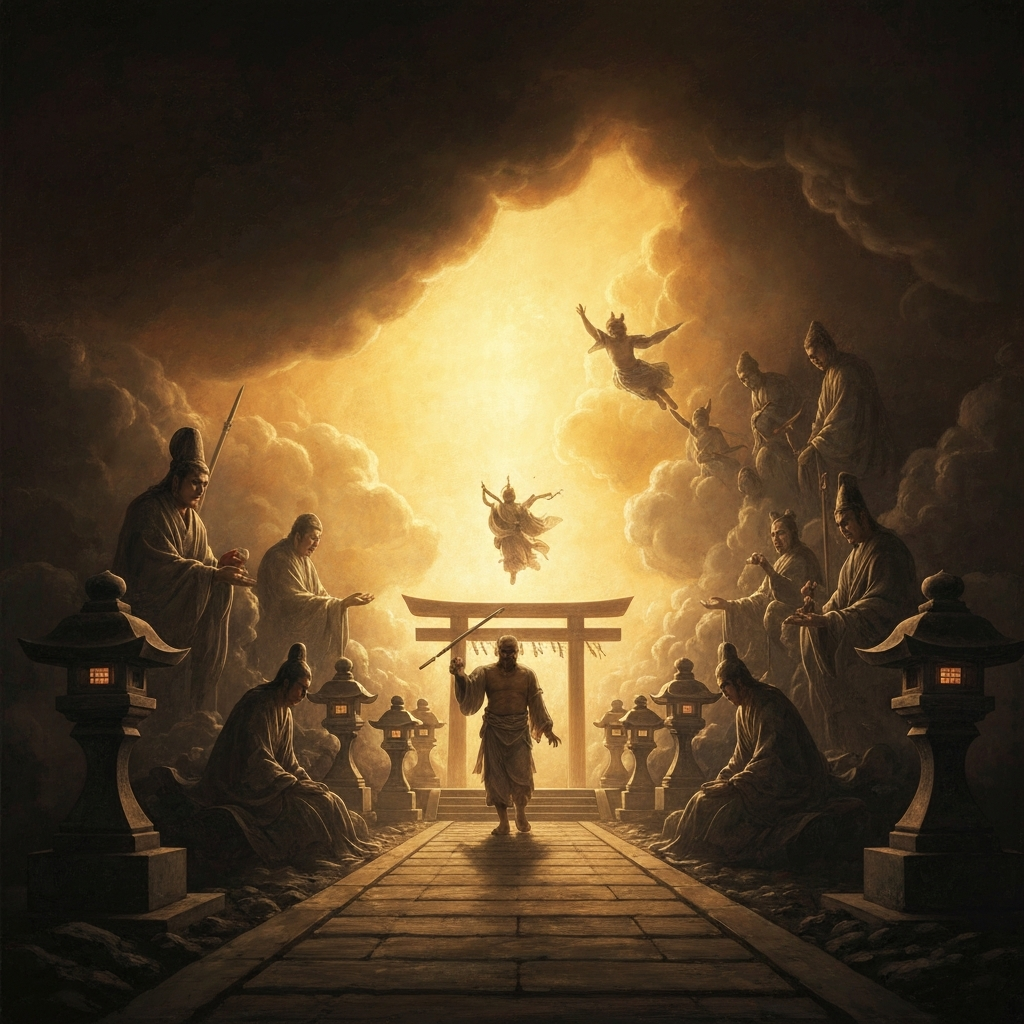
He walks up into the sunlight.
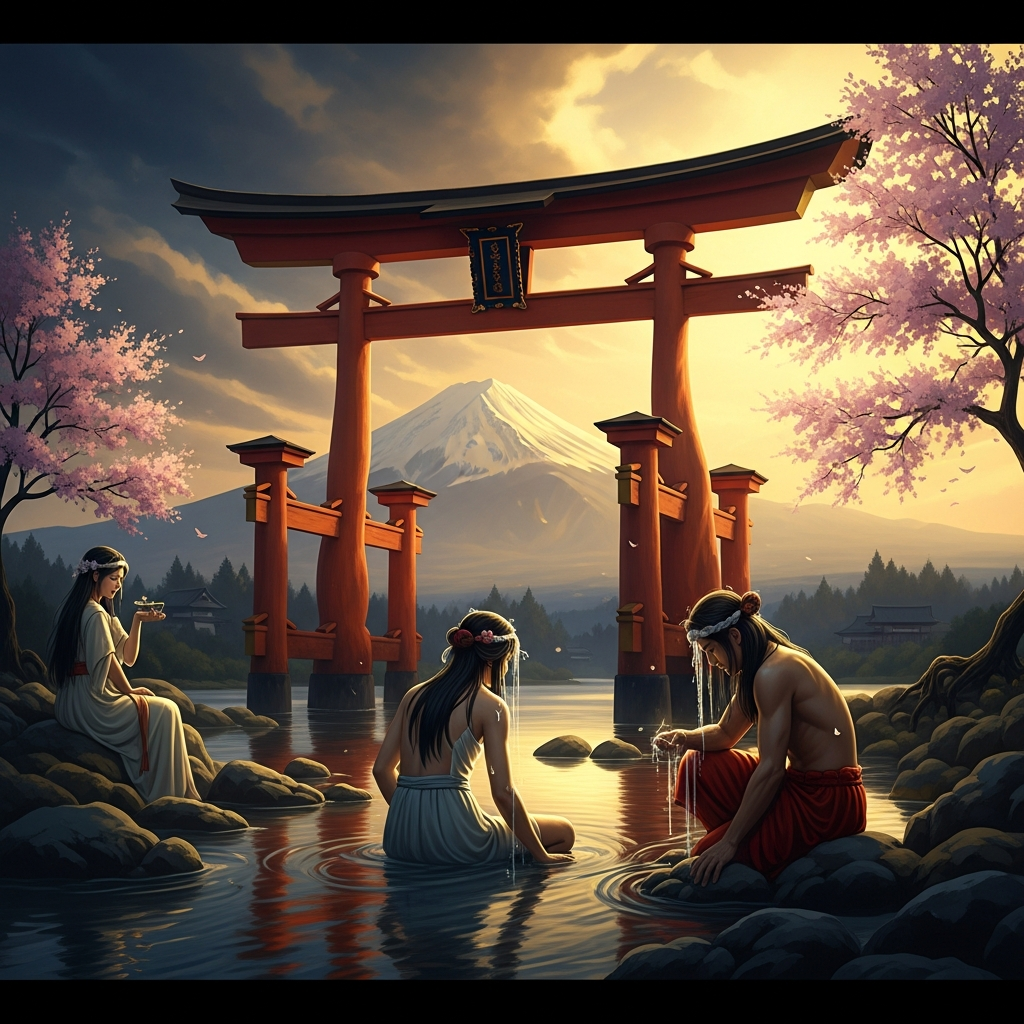
What he does next — the washing, the purification, the birth of Amaterasu and Tsukuyomi and Susanoo from his ablutions — is one of the most consequential moments in Japanese religious history. But first, just for a moment, he stands at the top of the pass and breathes the living air.
Behind him, the great boulder seals the dark country shut.
It is still sealed. Somewhere. In the thin place between what lives and what does not, a boulder holds the passage closed. The living world persists because a frightened god ran fast enough to reach it and rolled a stone against the door.
Scenes
Echoes Across Traditions
Entities
- Izanagi
- Izanami
- the Shikome (hags of Yomi)
- the armies of Yomi
Sources
- Kojiki (Record of Ancient Matters), compiled 712 CE, Book I, Sections 9-10
- Nihon Shoki (Chronicles of Japan), compiled 720 CE
- Carmen Blacker, *The Catalpa Bow: A Study of Shamanistic Practices in Japan* (Allen & Unwin, 1975)
- Arata Hamada, 'The Myth of Izanagi's Return from Yomi,' *Japanese Journal of Religious Studies*, 2003