Contents
When Izanami died giving birth to the fire god, her husband Izanagi descended to Yomi to retrieve her. She met him in the darkness and made one request: do not look at me. He looked. What he saw was not his wife but something the darkness had made of her — and what she saw in his face was that she had been witnessed in her ruin. She drove him out of Yomi with fury, blocked the entrance with a boulder, and across that stone they made their final vows: one thousand dead per day, fifteen hundred born. That is still the arithmetic of the world.
- When
- Mythological time, recorded in writing 712 CE (Kojiki)
- Where
- The islands of Japan · Yomi, the land of the dead beneath the earth
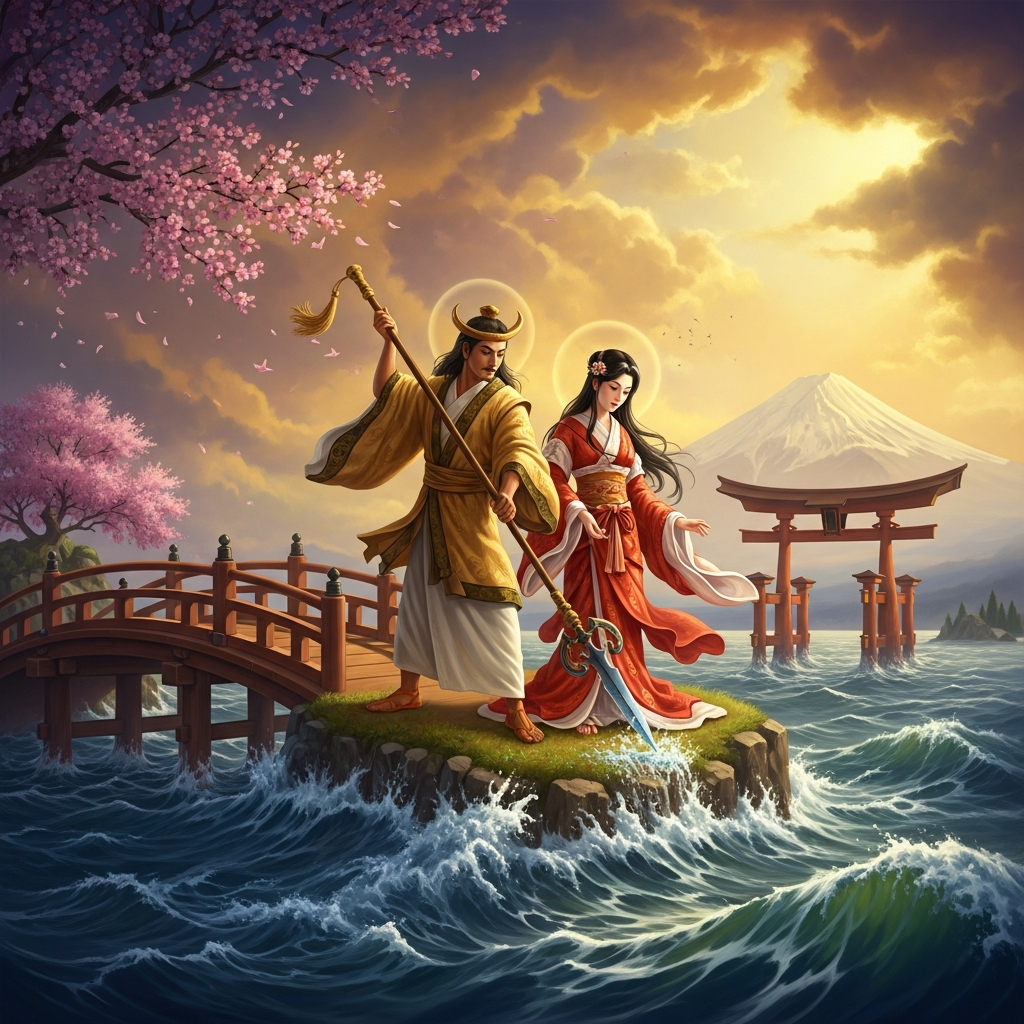
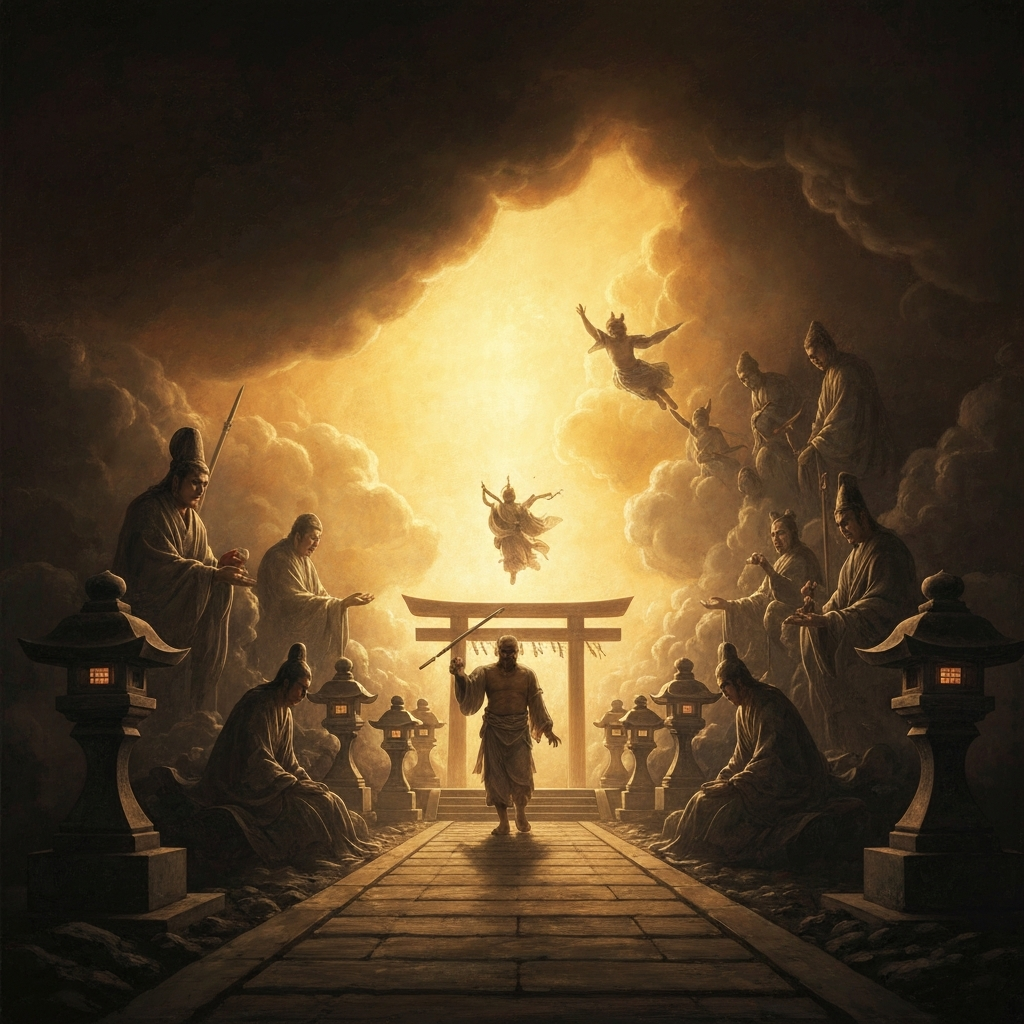
Before there were names for things, Izanami and Izanagi stood on the floating bridge of heaven and stirred the sea with a jeweled spear. Salt water dripped from the spear’s tip and solidified into islands. This is how Japan was made — by two deities leaning over nothing and making something. They came down from the bridge and lived in what they had created, and together they continued to make: the winds, the sea, the mountains, the trees, the gods of rain and food and stone.
The Kojiki names thirty-five deities they created together. Thirty-five, before the fire.
The fire god’s name was Kagutsuchi. His birth killed Izanami.
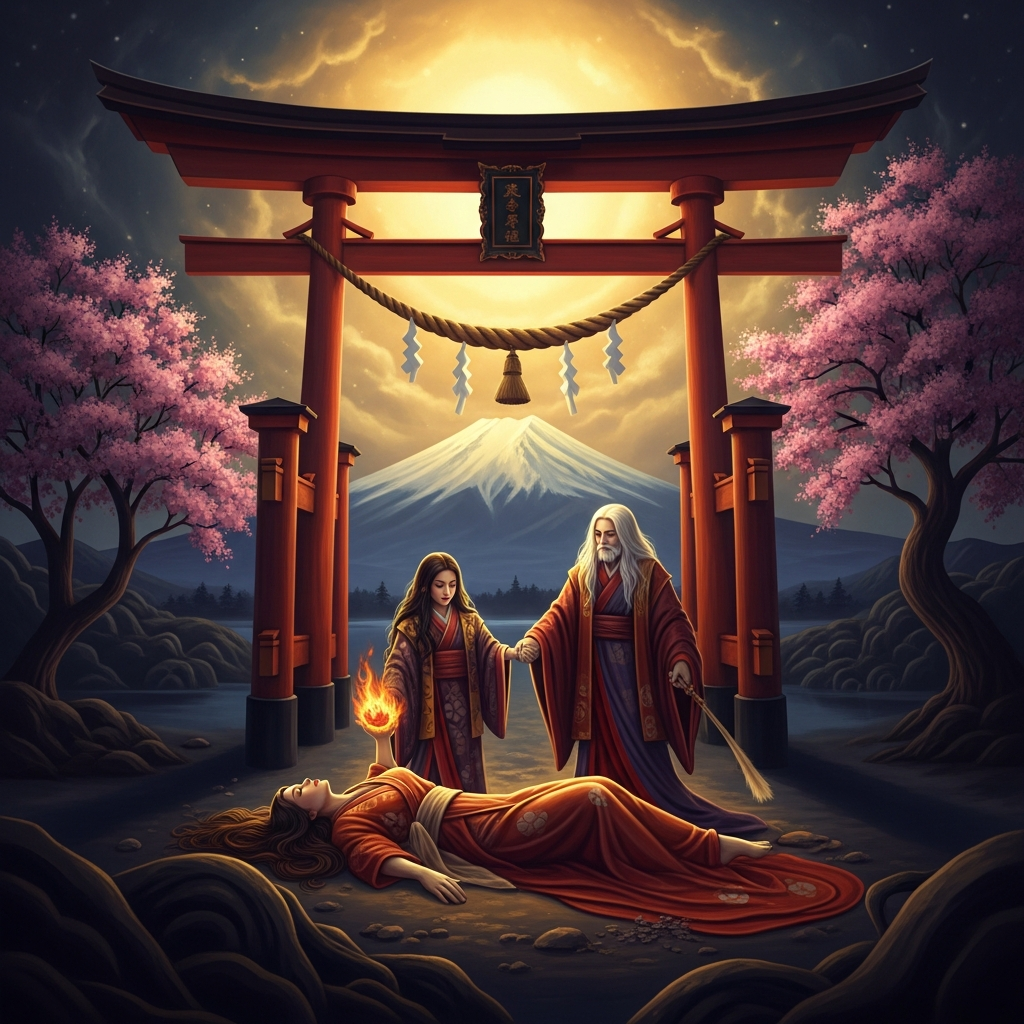
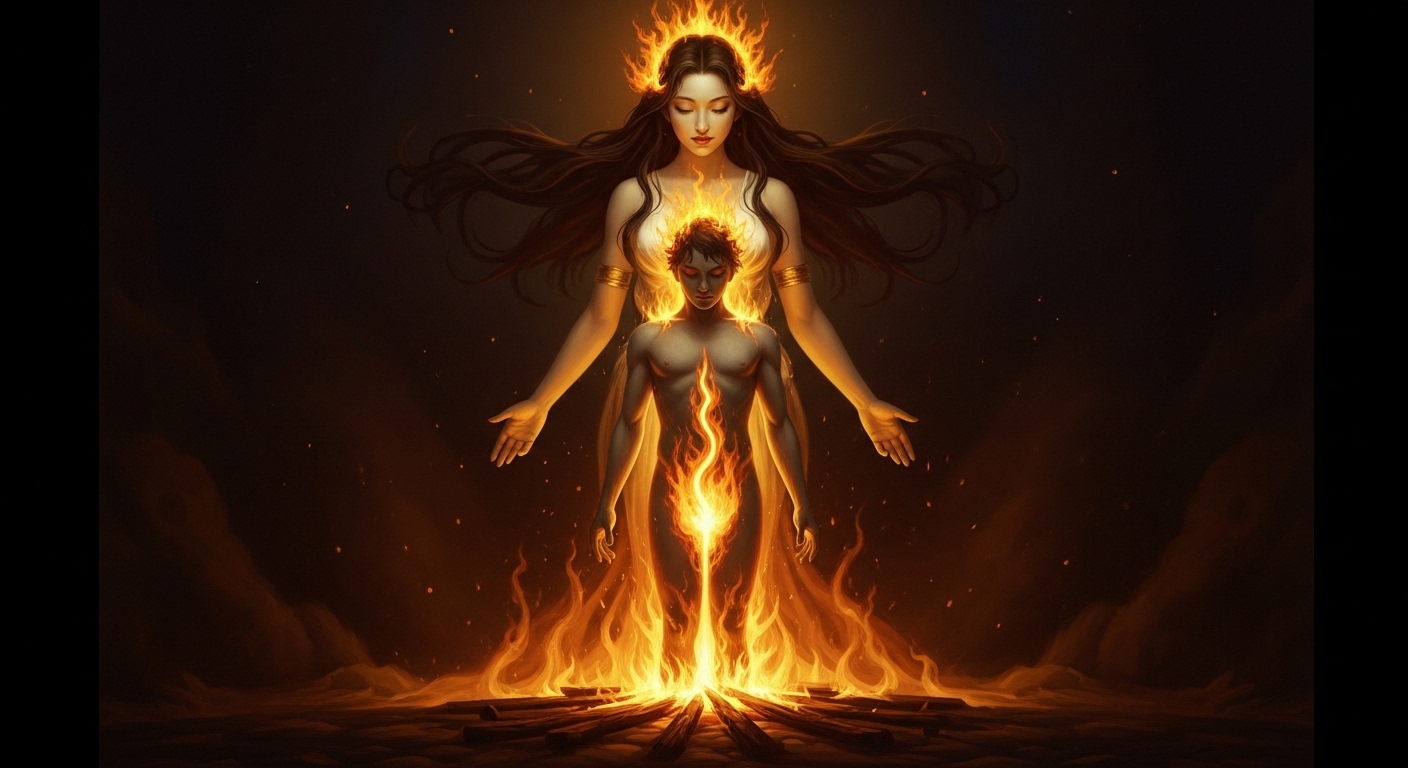
The text does not soften this. The deity of fire, being fire, burned his way into the world through the body of the goddess who was giving him life. She burned in her birth-passage. She burned in her thighs. She cried out and fell and could not be recovered. The Kojiki records that from her vomit, her urine, her feces in the final agony came additional deities — creation continuing through the act of dying, making right up to the moment of stopping. Then she descended to Yomi, the land of the dead, the root-country of darkness beneath the earth.
Izanagi grieved. The Kojiki says he wept at her head and at her feet. He killed Kagutsuchi — ten more deities born from the fire god’s blood as the sword came down. Then he followed his wife into the dark.
He found her at the entrance to the palace in Yomi. She came to him in the darkness — the text is careful about this; she did not let him see her. She came near.
My lovely Lord, do not come closer. Do not look at me. I am consulting with the deities of Yomi. Wait for me here. Do not look.
He waited. She went back inside.
She did not return quickly. The Kojiki says he waited a very long time. The wait is not measured in hours. It is measured in the way time moves in grief: without boundary, without indication of when it will end, without any assurance that it will end at all.
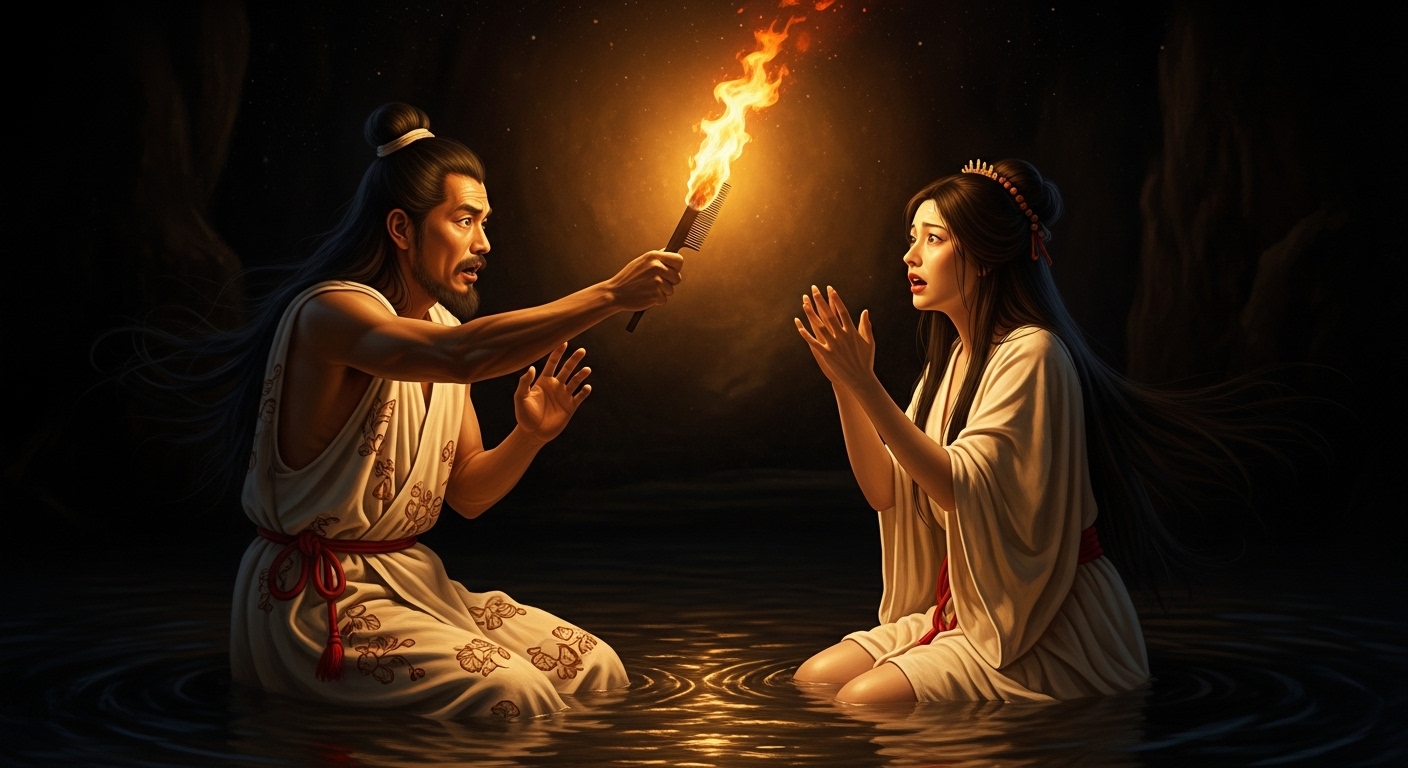
He broke a tooth from his comb and lit it as a torch.
He went in.
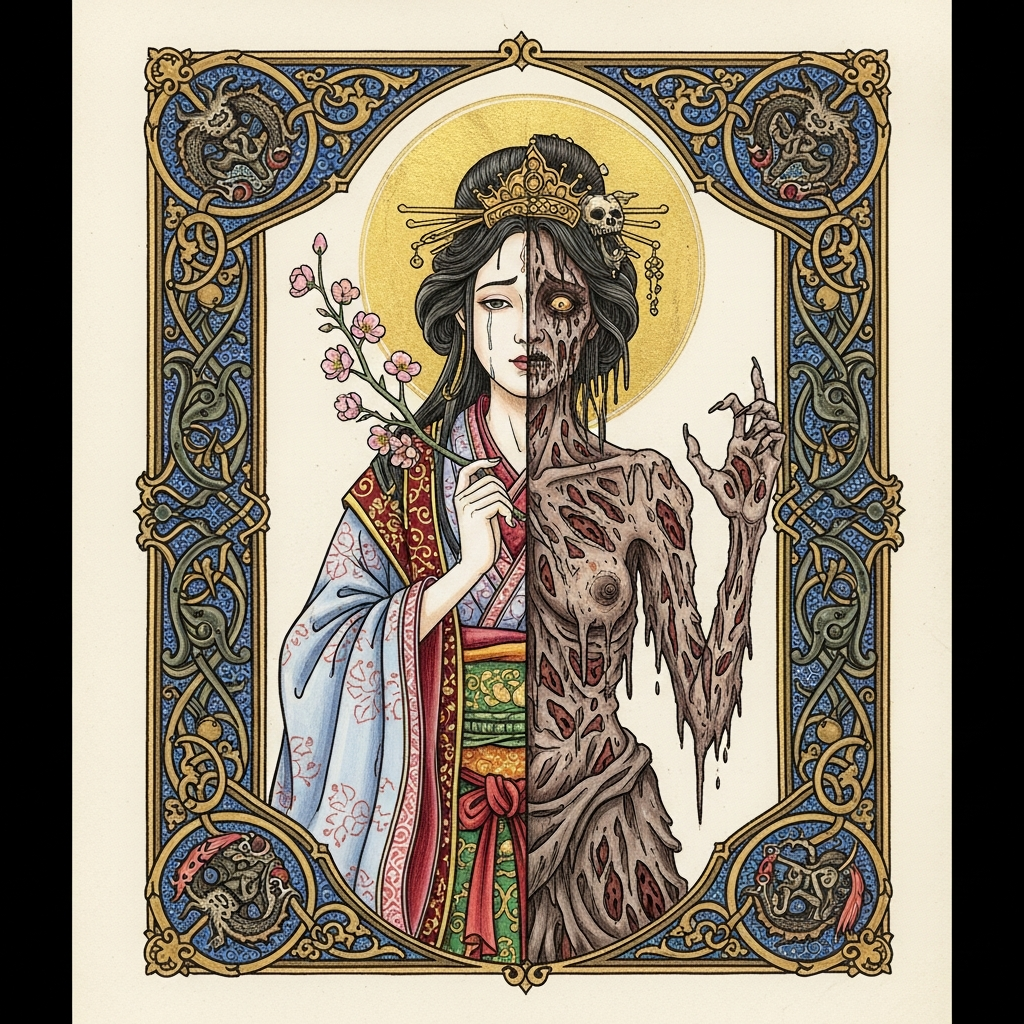
What the torch showed him was a body in advanced decay, maggots moving through it, thunder deities born from the decomposition — gods of fire-thunder and earth-thunder and black-thunder and rending-thunder — eight thunder deities rising from what had been his wife. The Kojiki’s account of what he saw is clinical in its specificity. This is not vagueness about horror. This is the text looking directly at what Izanagi could not stop himself from looking at.
He turned and ran.
She knew immediately.
You have shamed me.
The shame is the center of the story. Not the decomposition — Izanami had been managing her decomposition, navigating it, consulting with the deities of death about what was possible. She had a plan. She had asked for one thing: do not look at me while I am like this. And he had looked, because he could not bear the waiting, because grief is not patient, because love is sometimes indistinguishable from the need to see the person you are losing even when they have asked you not to.
But the person who needed to see was also the person who would run from what he saw. That is what she could not forgive. Not that he looked. That he looked and fled.
She sent the Shikome — the hideous women of Yomi — after him. She sent the eight thunder deities. She came herself, her body moving through the underworld passages, her fury organized and specific. The Kojiki describes the chase in detail: Izanagi throwing his black headdress behind him as he ran, the headdress becoming grapes that the Shikome stopped to eat; throwing his comb, the comb becoming bamboo shoots; the thunder deities stopped at the river boundary of Yomi by peaches Izanagi threw at them — three peaches, three repulsions, and a name given to the peaches for what they had done.
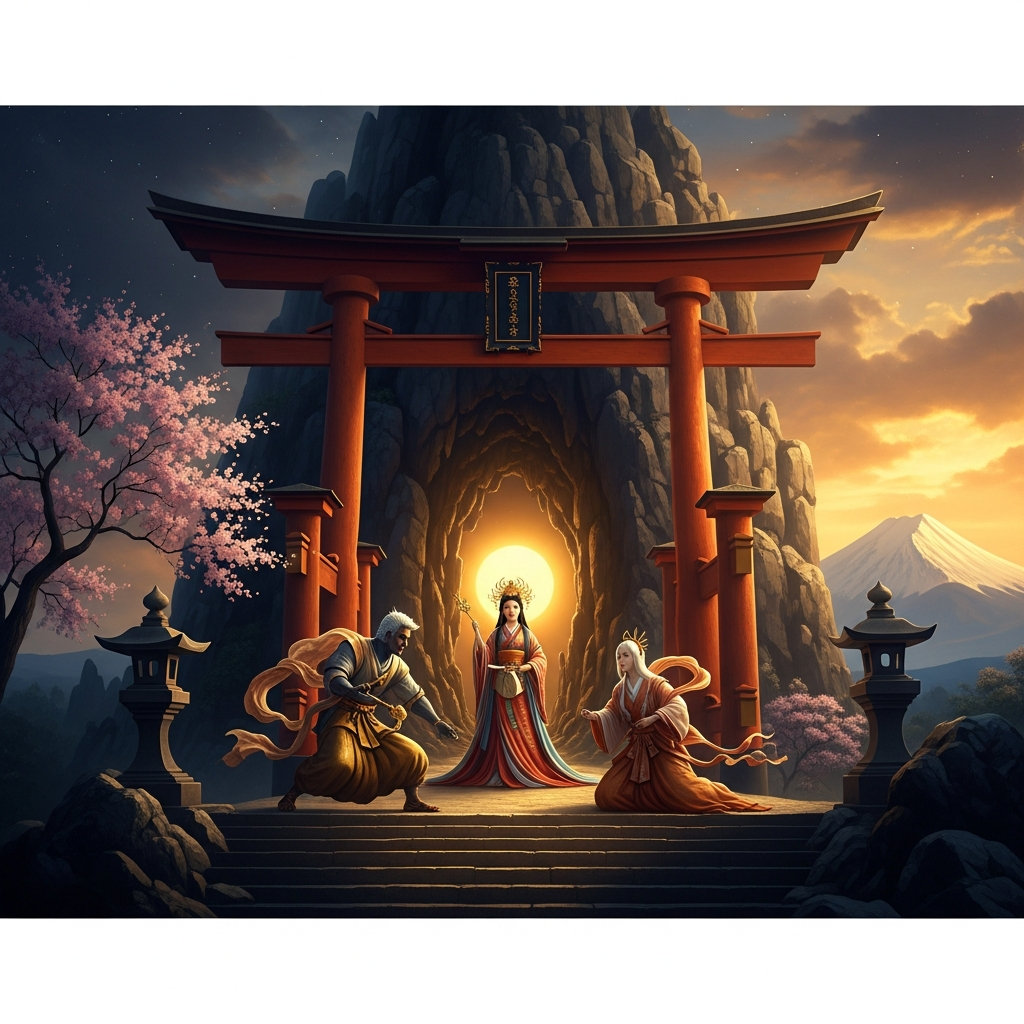
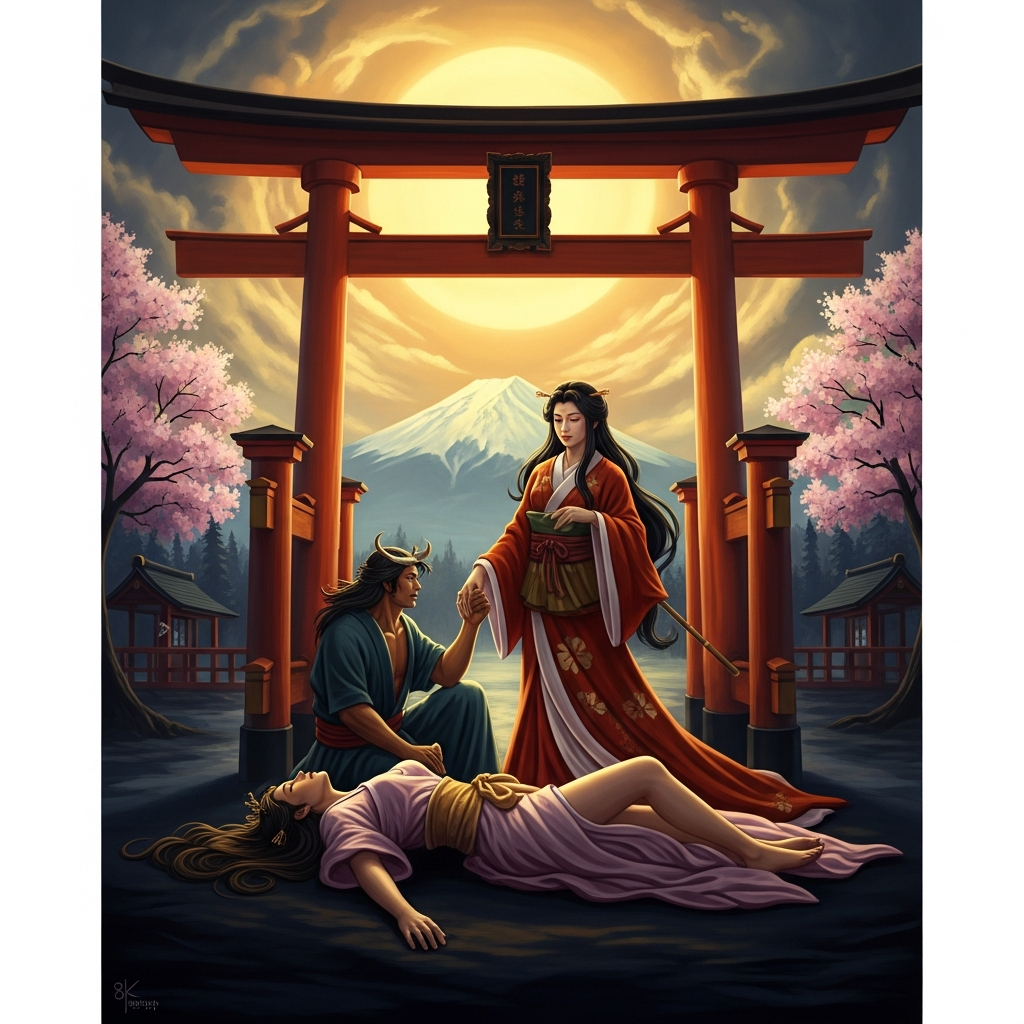
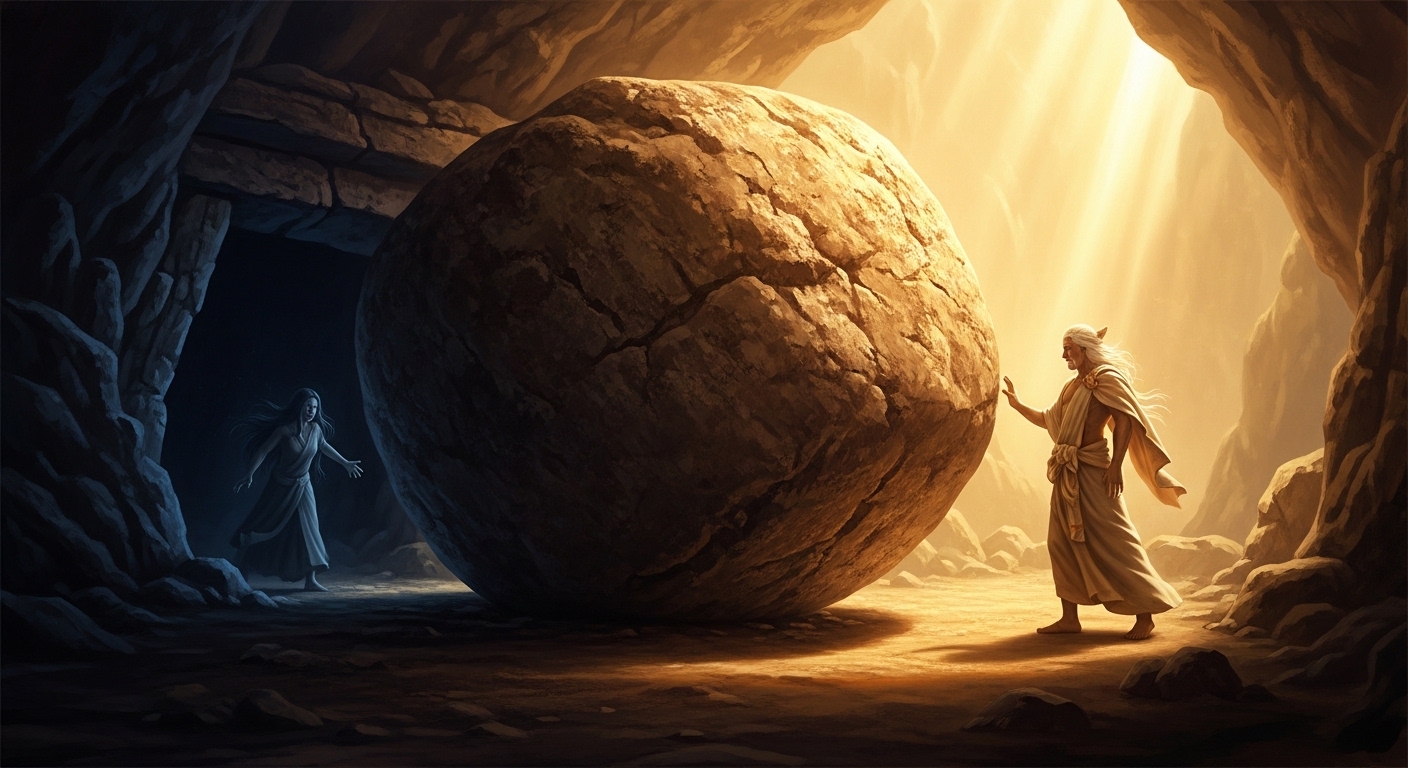
He made it to the entrance. He rolled a great boulder across it — a boulder the Kojiki says would take a thousand men to move — and stood on his side of it, and Izanami stood on hers.
They spoke their last words to each other through the stone.
If you do this, Izanami said, I will kill one thousand people per day.
If you do that, Izanagi answered, I will cause one thousand five hundred people per day to be born.
There is arithmetic in this that the tradition has always understood as the terms of the world’s continuation. Death wins one thousand per day. Life wins fifteen hundred. Life is ahead by five hundred, always — not comfortably, not safely, not by a margin that allows for ease, but ahead. The world does not end because the goddess of death cannot keep pace with the god of creation. She is still trying. She has been at it since the boulder.
What the story knows that simpler creation myths avoid is that the asymmetry is slight. Izanami was a creator. She built the islands with her husband, stood on the bridge of heaven, stirred the sea into land. The deity who now promises a thousand dead per day is the same deity who made thirty-five gods and the Japanese archipelago. Her power did not diminish in Yomi. It transformed — not because she wanted it to, not because she was suited for death more than for making, but because she was seen in her decay and could not recover from having been seen.
The world has a goddess of death because it has a god who could not keep his eyes closed.
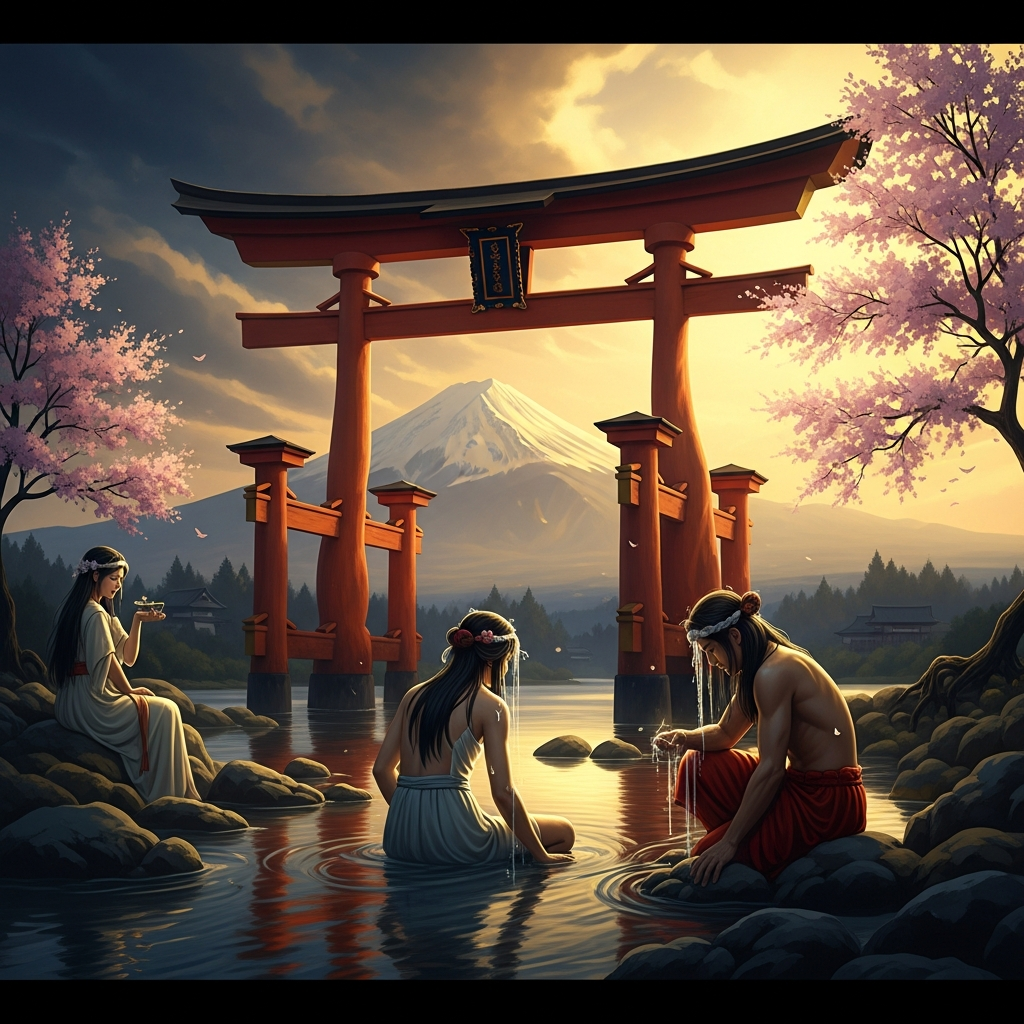
Izanagi emerged from Yomi and purified himself in a river, because Yomi’s pollution clung to him. From the things he discarded in the water — his clothes, his jewels, his washing — came many more deities, including, from his left eye as he washed his face, the sun goddess Amaterasu, and from his right eye, the moon god Tsukuyomi. The act of purification after the underworld became the origin of the most important deities in the Shinto pantheon.
Creation continued. It always does, on that side of the boulder.
Izanami is still in Yomi. The texts do not offer her a return. There is no negotiated ascent, no seasonal compromise, no rescue. The boulder is still rolled across the entrance. She rules what she was placed in — not by conquest, not by choice, but because she was a creator who died making something, descended into darkness, and was seen there by the person who should have waited.
The rains come. The dead accumulate. Fifteen hundred are born for every thousand who go down. Somewhere beneath the earth, the arithmetic continues, and the goddess who once stirred the sea into land counts her thousand, and the count is never finished.
Scenes
Echoes Across Traditions
Entities
- Izanami
- Izanagi
- Kagutsuchi
Sources
- Kojiki (712 CE), Book One — translated by Donald Philippi (University of Tokyo Press, 1968)
- Nihon Shoki (720 CE), scroll 1 — translated by W.G. Aston, Nihongi (1896)
- Philippi, Donald, translator's notes on the Yomi sequence, Kojiki pp. 60–72