Contents
The great-grandson of the sun goddess leads his warriors eastward through four years of war and divine signs until a golden kite lands on his bow and blinds his enemies with its light — and Japan's first emperor establishes his capital.
- When
- c. 660 BCE — traditional founding year of Japan, Jimmu tennō
- Where
- From Hyuga Province (Kyushu) eastward to the Yamato plain (modern Nara Prefecture)
He is the great-grandson of the sun.
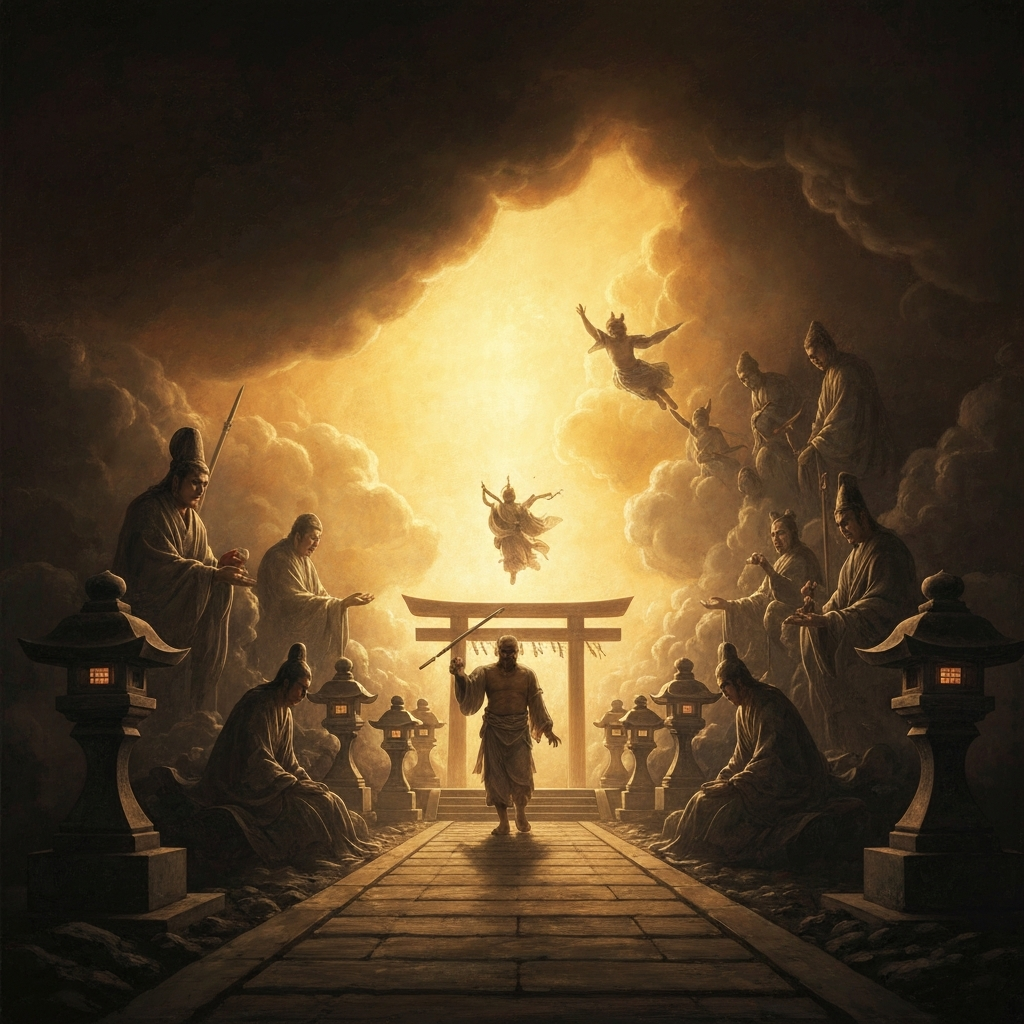
Ninigi descended from heaven and married the daughter of the mountain-god. Their son Hoori went to the dragon king’s palace under the sea and returned with the tide jewels. Hoori’s son Ugayafukiaezu was born in a birth-hut that caught fire before the roof was complete, and he married his own aunt and had four sons. The fourth son is the one we are here for.
His childhood name is Kamu-Yamato-Iwarebiko. He will be known to history as Emperor Jimmu — the first emperor, the founder of the imperial line, the man who follows a golden kite across four years of war and arrives at the Yamato plain where Japan begins.
He is forty-five years old when he decides to go east.
He summons his brothers and his sons. He says: The land to the east is the center of the world. There is a man there called Nigihayahi who descended from heaven before us — but he serves a mortal chief named Nagasunehiko. We should go and establish heaven’s order in that land.
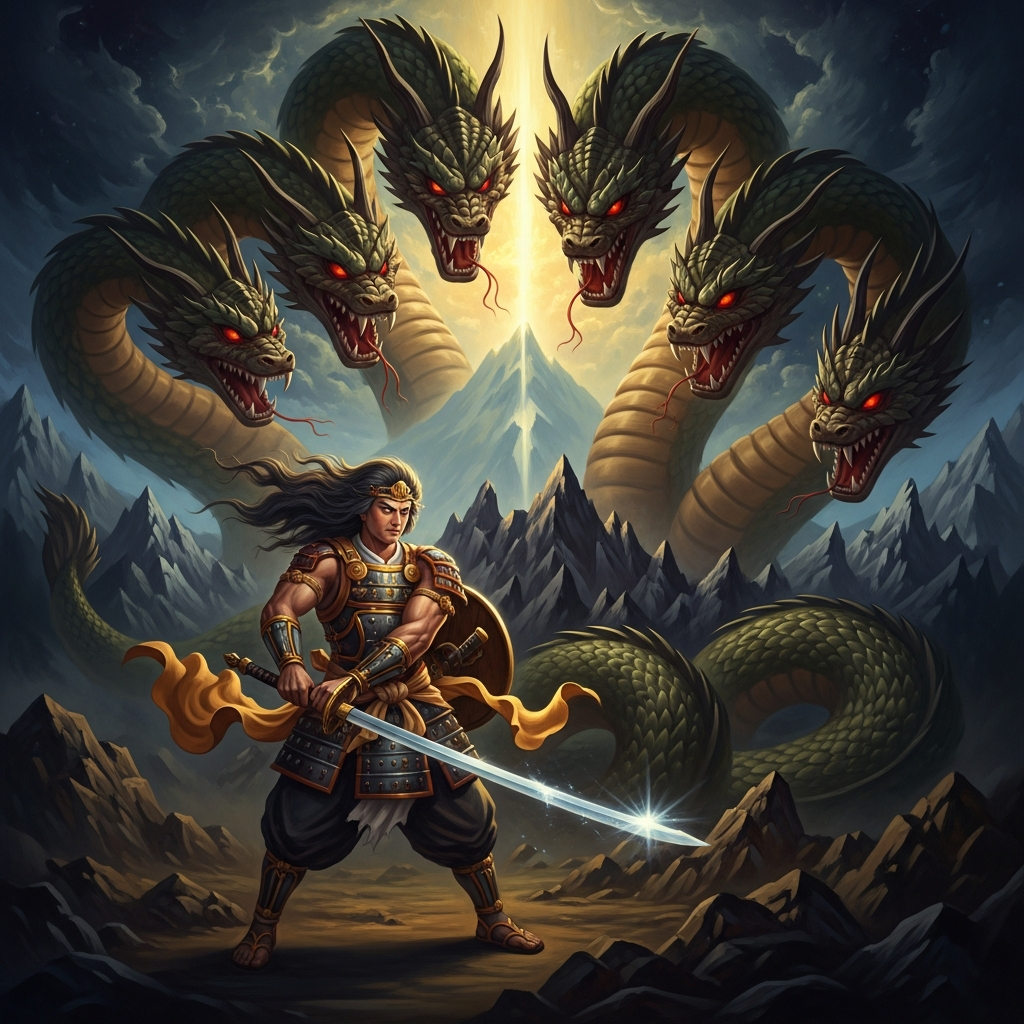
They sail from Kyushu along the Inland Sea. They fight at the straits of Naniwa. They fight at Osaka Bay. The battles are not clean; Jimmu’s elder brother is killed in the fighting. The armies of Nagasunehiko are strong and know the land. Jimmu advances, retreats, advances again. The campaign is long and brutal.
Then the divine assistance arrives.
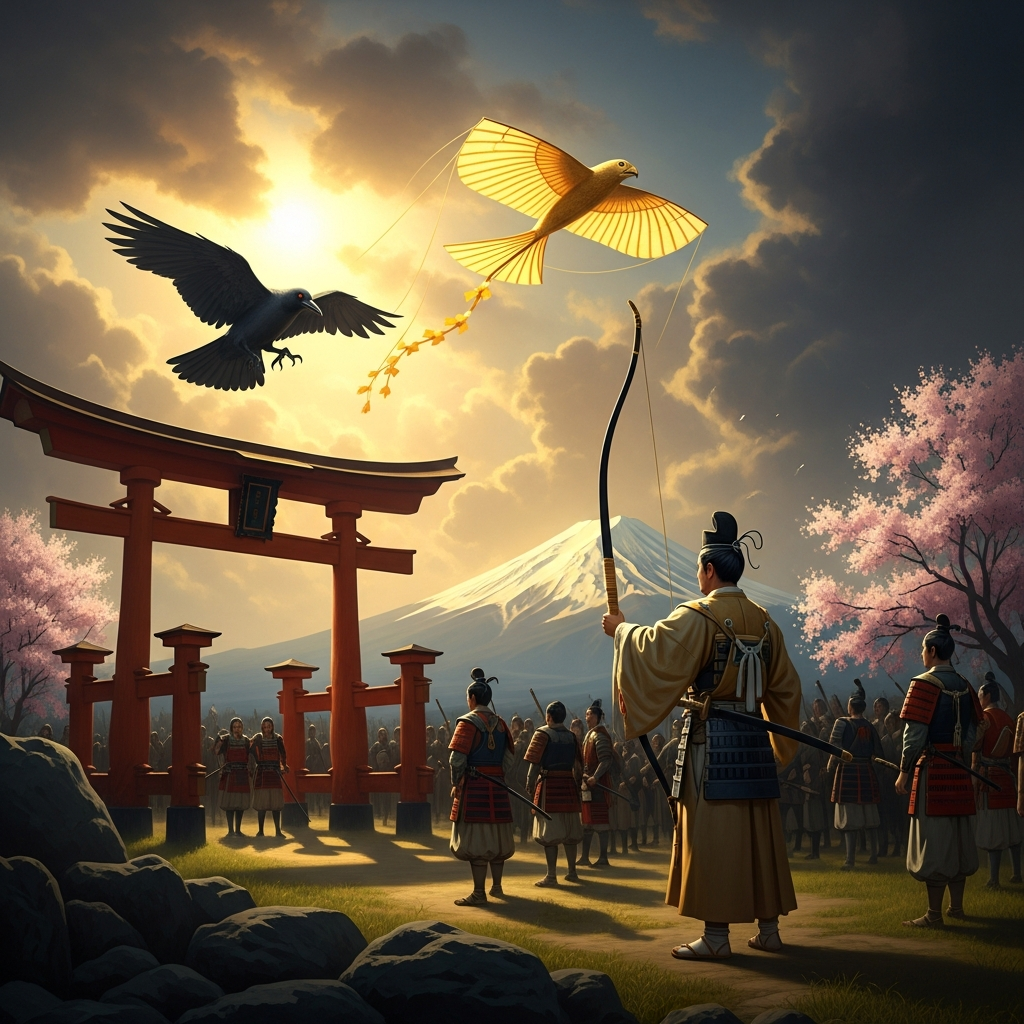
A great crow — the three-legged Yatagarasu, sent from heaven — appears at the front of his army as a guide. It has three legs because it is a sun-bird, and three is the number of the sun. It leads his army through the mountain passes of Yoshino and Uda and through the territory that will become Nara Prefecture.
At the battle of Kusakabe, Jimmu faces the enemy from an unfavorable direction — fighting toward the south, into the sun, which blinds his own warriors and advantages the enemy. He pauses. He withdraws. He makes a vow: he will not fight with the sun at his back against the gods. He will circle around. He will fight with the sun behind him.
He waits. He circles. He approaches from the east.
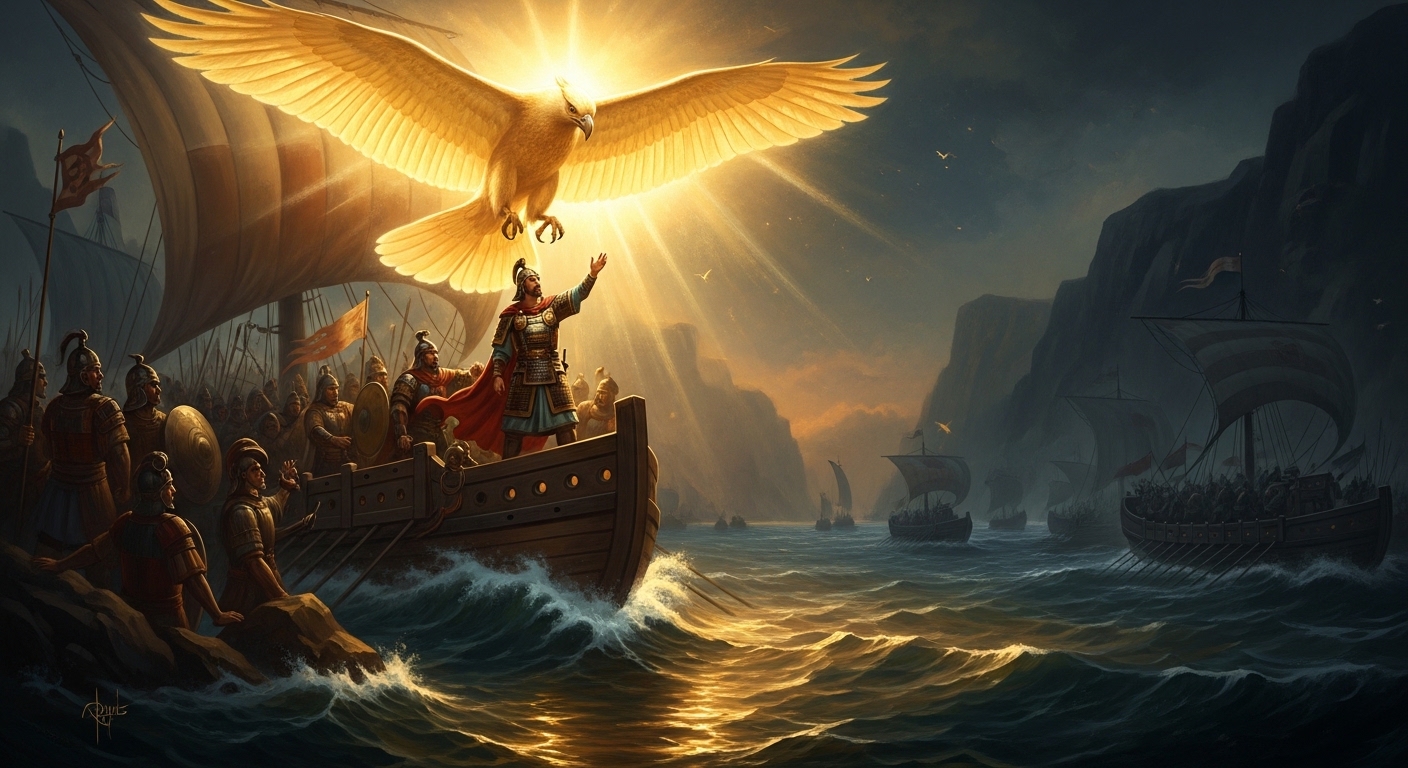
The battle resumes. A golden kite descends from the sky and lands on the tip of Jimmu’s bow. It flashes — a brilliance so intense that the Nihon Shoki compares it to lightning. The enemy forces, facing east, facing the kite’s light, are blinded. They cannot fight what they cannot see.
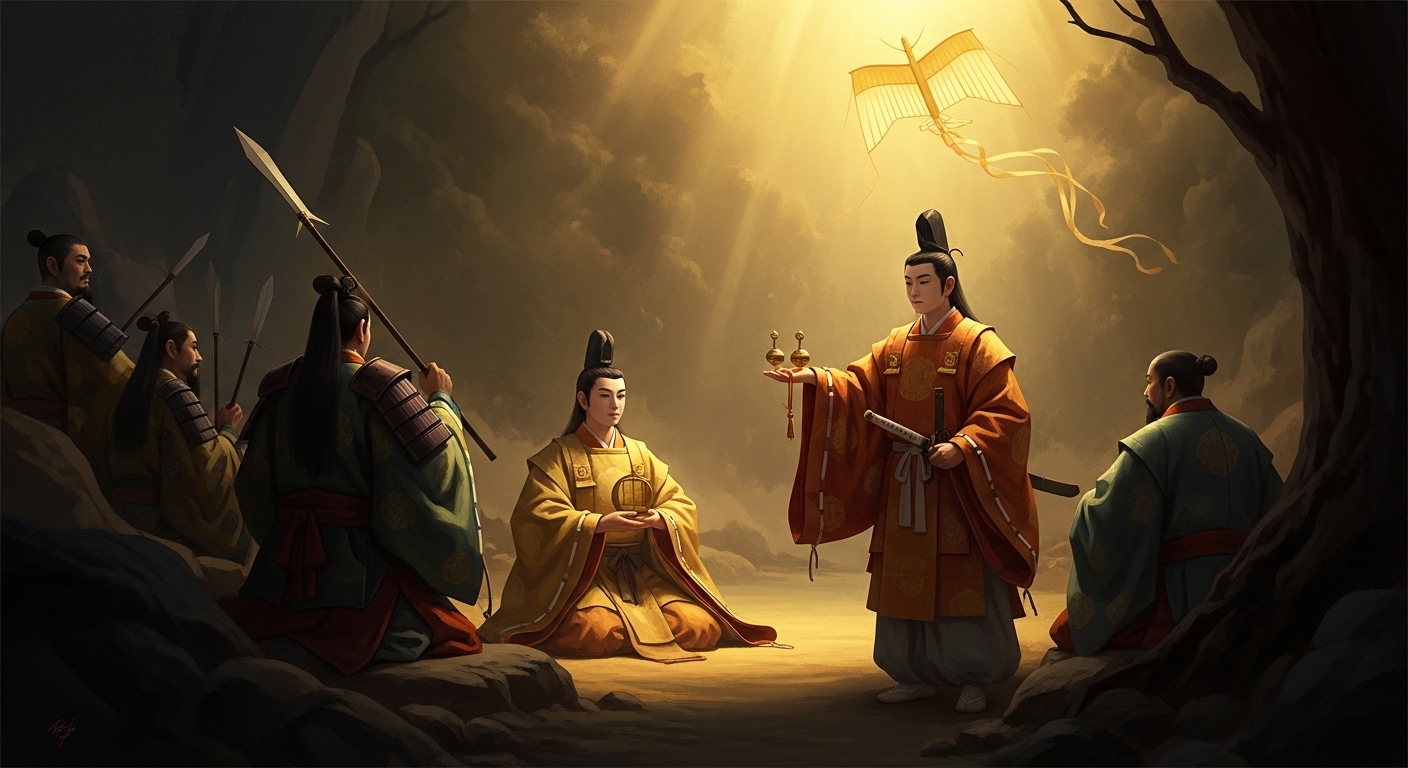
Nagasunehiko is defeated. Jimmu meets Nigihayahi, who had descended from heaven before him and settled among the earthly people, and Nigihayahi presents the heavenly objects he carried down as proof of his divine origin. He submits. He recognizes the superior claim of Amaterasu’s direct descendant.
The Yamato plain is Jimmu’s.
He establishes his palace at Kashihara — which is at the foot of Mt. Unebi, and which remains a sacred site, the location of Kashihara Shrine where Jimmu is enshrined. He takes a wife. He becomes, formally, the first emperor.
The date traditionally assigned to this moment is the eleventh day of the second month in 660 BCE. Modern historians note this date is constructed backward from mythology and cannot be verified archaeologically. The Japanese government nevertheless commemorates February 11 as National Foundation Day.
A golden kite sat on a bow at the edge of the Yamato plain and blazed so brightly that an army could not look at it.
Whether that happened in 660 BCE or whenever it happened, the country organized itself around the moment.
Scenes
Echoes Across Traditions
Entities
- Emperor Jimmu
- the Golden Kite (Tobi)
- the Crow Yatagarasu
- Nigihayahi
Sources
- Kojiki (Record of Ancient Matters), compiled 712 CE, Book II
- Nihon Shoki (Chronicles of Japan), compiled 720 CE
- Joan Piggott, *The Emergence of Japanese Kingship* (Stanford, 1997)
- Richard Ponsonby-Fane, *Studies in Shinto and Shrines* (Ponsonby Memorial Society, 1942)