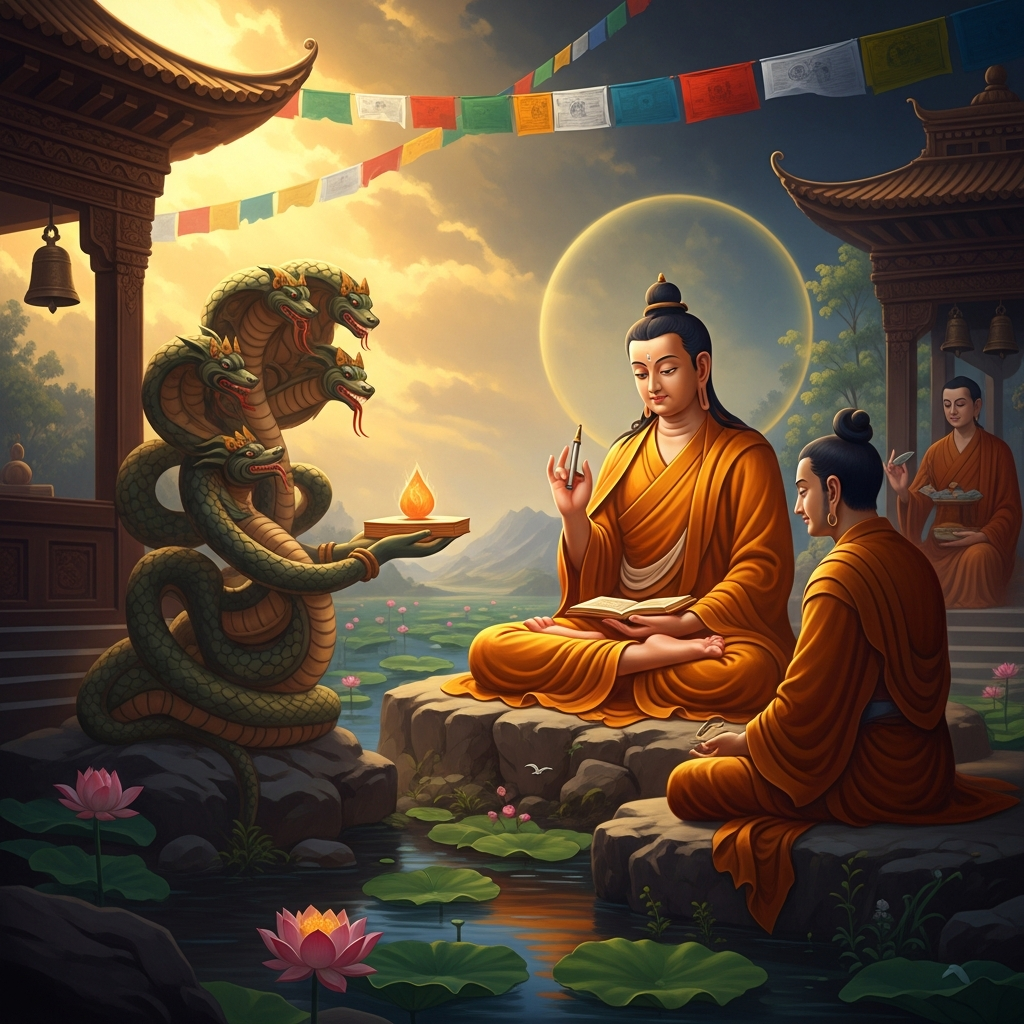
Machig Labdrön Goes to the Charnel Ground
c. 1055–1153 CE — 11th-12th century Tibet · The charnel grounds of central Tibet — places where the dead are cut up and fed to vultures, used by tantric practitioners as sites of practice
Contents
An 11th-century Tibetan woman founds the Chöd practice by doing what no teacher before her had done: going alone to a charnel ground at midnight, offering her own body to the demons, and discovering that the demons depart when fed rather than fought.
- When
- c. 1055–1153 CE — 11th-12th century Tibet
- Where
- The charnel grounds of central Tibet — places where the dead are cut up and fed to vultures, used by tantric practitioners as sites of practice
She arrives at the charnel ground before midnight and waits.
The charnel grounds of Tibet are not cemeteries. They are active places: bodies are brought here, dismembered, and fed to vultures and dogs — this is the sky burial practice, the practical response to frozen ground that won’t accept shovels, the recognition that what was a person is now food and that food should be offered. The charnel ground smells of this. It sounds of this. At night, in the accounts, it sounds of other things too.
Machig Labdrön is not the first practitioner to work in charnel grounds. The Indian mahasiddhas worked there. Male practitioners work there. The tradition prescribes it as a venue for advanced practice for good reason: a place where fear is already activated is a better testing ground than a temple where everything is arranged for comfort. The question the charnel ground asks is simple: can you practice here?
But no one before Machig Labdrön has done what she does here.
She lights her drum — the damaru, two-headed, made of bone — and begins the Chöd liturgy.
The liturgy she performs is, in part, her own creation. She has taken the Prajnaparamita teaching — the Perfection of Wisdom texts, which declare that all phenomena are empty of inherent existence — and turned it into a practice that operates on the body rather than the intellect. The intellectual understanding of emptiness can be achieved in a comfortable room. The embodied understanding requires something the comfortable room cannot provide: the genuine, unavoidable, physical experience of being willing to die.
She visualizes her own body being cut open. She offers the flesh and blood to the hungry spirits of the charnel ground — the demons, the nagas, the ghosts of people whose deaths were violent or who are caught in the in-between. She does not drive them away. She invites them. She calls them by their categories — those who are here out of hunger, here out of anger, here out of attachment — and she offers each category what it most needs, using her own body as the offering.
The experience is not comfortable. The accounts record that it involves genuine encounters with what she calls bgegs — obstacles manifesting as spirits. They do not depart politely when invited. They arrive with the full force of whatever they are, and she must maintain the open, welcoming posture in the face of that force.
What she discovers, across multiple sessions in multiple charnel grounds over years, is consistent.
The demons depart when fed. The feeding is not a transaction — you cannot bribe them away. It is more fundamental: they depart when the fear that summoned them is no longer present, and the fear is no longer present when the practitioner has genuinely given up the project of self-protection. As long as there is a self to protect, there is something for the demons to threaten. When the offering of the body is complete — when the practitioner has actually, not just conceptually, released attachment to the continuity of self — there is nothing to threaten.
The charnel ground becomes empty. Not menacing, not safe exactly — empty. Available.
She teaches this. She teaches it to men and women equally, which is unusual in the lineages she has studied. She marries, has children, teaches from a household rather than a monastery. When Indian pandits hear of a teaching that originated in Tibet and traveled to India rather than the other direction, they send representatives to test her.
She defeats them in debate. She is, at this point, past middle age, and the defeat is not unkind — she defeats them with precision and then invites them to practice Chöd with her to see whether their theoretical objections survive the charnel ground.
Some of them stay. The practice goes south with them. It is the only major Tibetan practice lineage that runs backward — from the Himalayas to India, the direction of the trade wind reversed. This is because the woman who founded it went to the charnel ground alone at midnight and found something there that no tradition had found before, from whatever direction they approached.
Scenes



Echoes Across Traditions
Entities
- Machig Labdrön
- Dampa Sangye (the Indian teacher)
- Töpa Bhadra (her husband)
Sources
- Tsultrim Allione, *Women of Wisdom* (Arkana, 1984)
- Jerome Edou, *Machig Labdrön and the Foundations of Chöd* (Snow Lion, 1996)
- Sarah Harding, trans., *Machik's Complete Explanation* (Snow Lion, 2003)