Mañjuśrī Cuts Through Confusion with One Stroke
mythic time — with specific historical encounters in Tibetan tradition from the 7th century CE onward · The Pure Land of Wutai Shan (Five Peak Mountain) — Manjushri's mythic abode, and the monastic colleges of Tibet where his image presides over philosophical debate
Contents
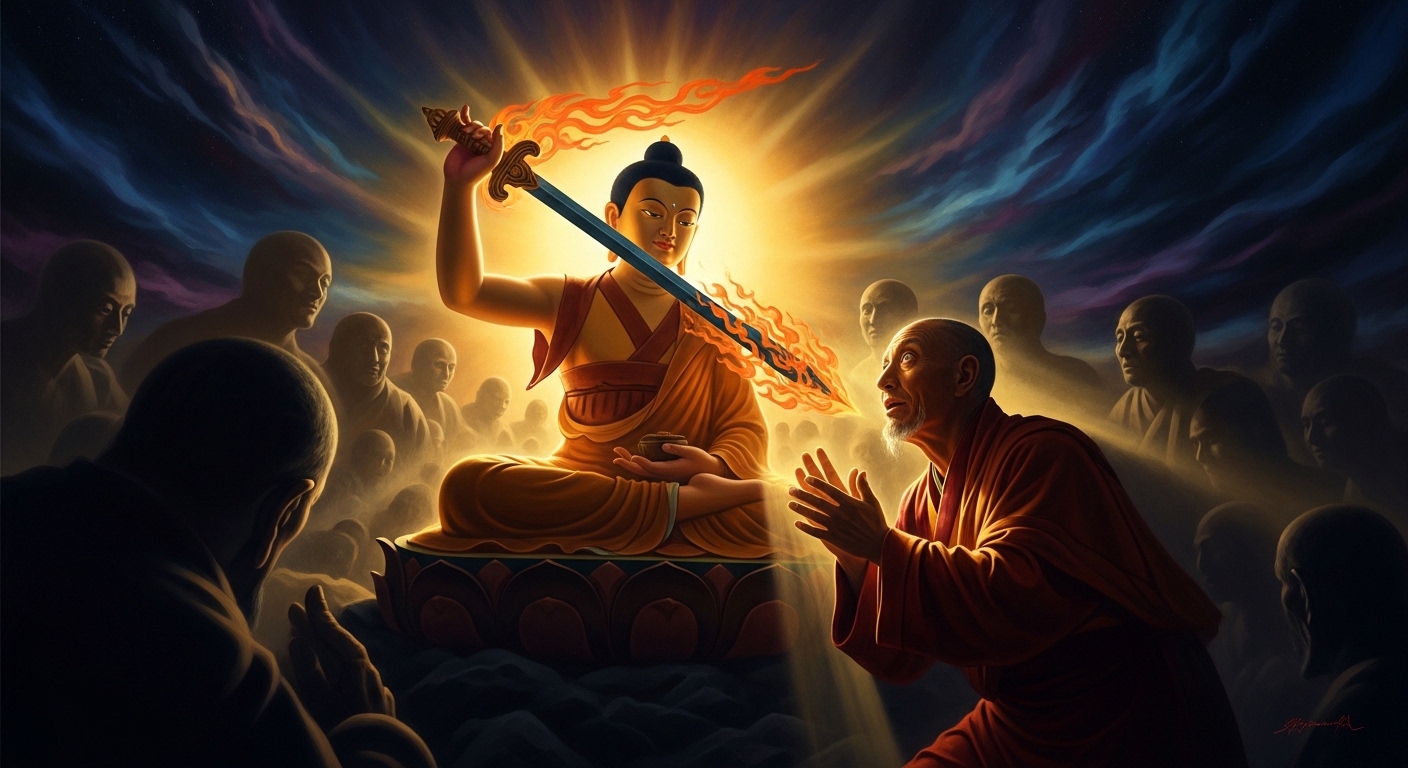
Manjushri — the bodhisattva of wisdom — wields a flaming sword not as a weapon of war but as an instrument of discernment: it cuts through the dense undergrowth of conceptual confusion to reveal the clear ground of prajna, the direct knowledge of emptiness.
- When
- mythic time — with specific historical encounters in Tibetan tradition from the 7th century CE onward
- Where
- The Pure Land of Wutai Shan (Five Peak Mountain) — Manjushri's mythic abode, and the monastic colleges of Tibet where his image presides over philosophical debate
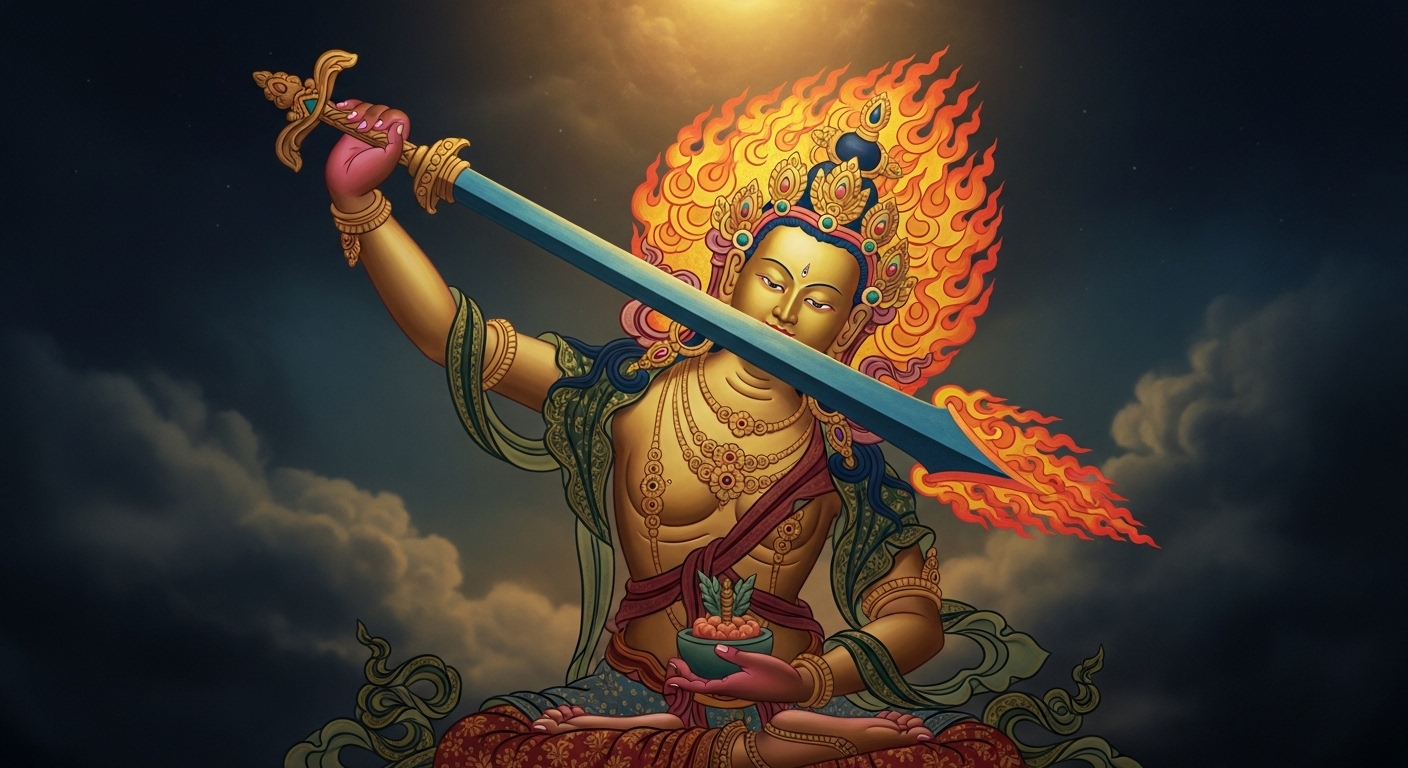
The sword is made of fire.
This is the iconographic requirement: Manjushri’s prajna sword — the prajnakhanga, the wisdom-sword — must be depicted with flames at the blade. The flames are not ornamental. They are the heat of discernment, the way that fire distinguishes between what is substantive and what is not, burning through the surfaces of things to reveal their actual composition.
He is youthful — always depicted at the age of sixteen, the moment of intellectual perfection before experience begins to introduce compromise. His other hand holds a lotus on which sits the Prajnaparamita scripture — the Perfection of Wisdom texts, the philosophical foundation of Mahayana Buddhism. He holds the text and the sword simultaneously: the theory and the instrument of its application.
The theory says: all phenomena are empty of inherent existence. Nothing exists independently, from its own side, with its own fixed identity. What appear to be solid, separate, independently existing things — the self, other beings, objects in the world — are in fact dependently arising, constantly shifting, constituted by the web of conditions that produce them. There is no unchanging essence underneath the changing surface.
The sword makes this visible rather than conceptual.
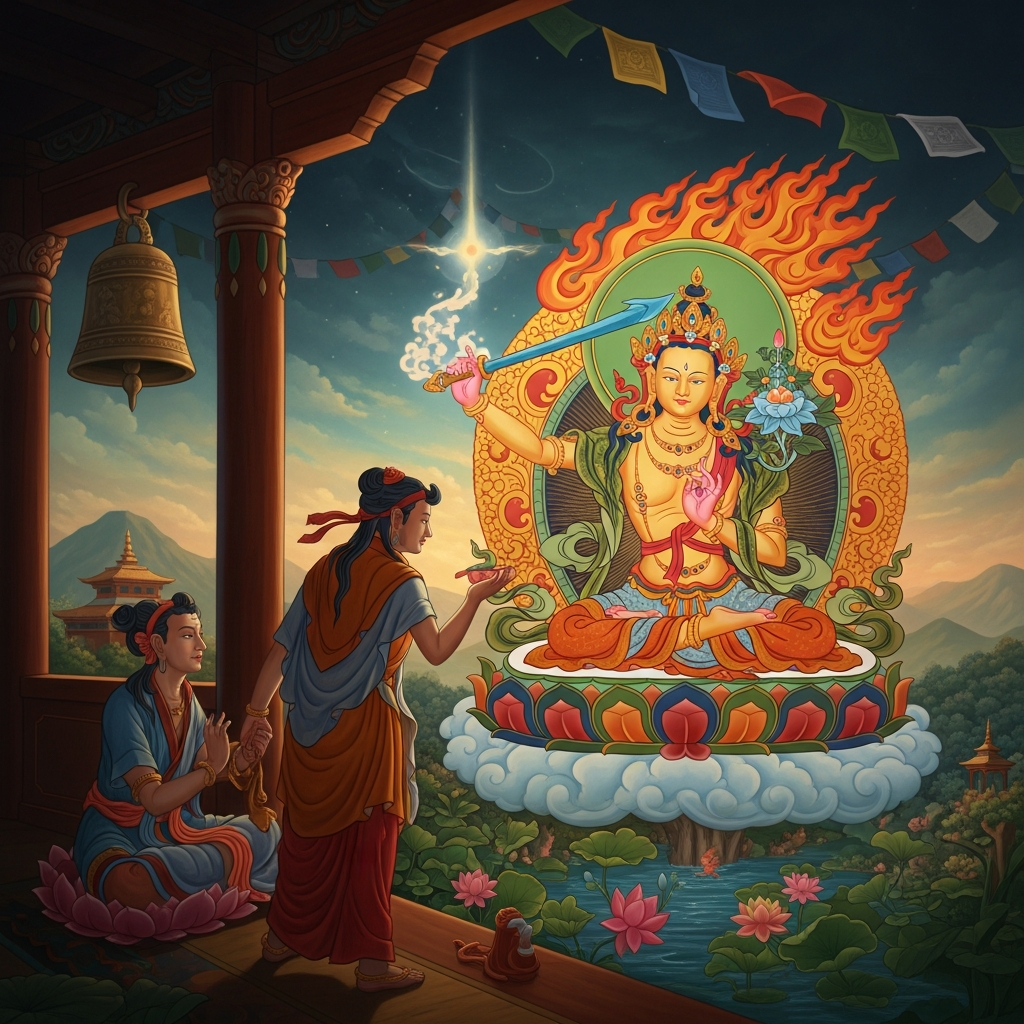
Tsongkhapa saw him.
This is the most documented meeting between Manjushri and a historical Tibetan practitioner. Tsongkhapa — the fourteenth-century philosopher and reformer who founded the Gelug school — had a series of visions of Manjushri in which the bodhisattva appeared and gave philosophical guidance. The teachings Tsongkhapa received in these visions, as he reports them, clarified the most difficult points in Madhyamaka philosophy — the interpretation of emptiness that Nagarjuna had established and that subsequent commentators had obscured rather than clarified.
The sword’s cut was philosophical in this case: it separated the interpretation of emptiness that preserved the relative validity of conventional appearances from the interpretation that collapsed into nihilism. This is the finest cut the sword makes — the one that requires the most precision. Too coarse a cut and you eliminate relative reality along with the inherent existence you’re trying to remove. Too shallow a cut and the inherent existence remains untouched beneath the surface.
Tsongkhapa got the cut right. The Lam Rim Chen Mo — the Great Treatise on the Stages of the Path — and the Ngak Rim are the record.
The sword in the monastery debate hall is a metaphor for what the debaters are doing.
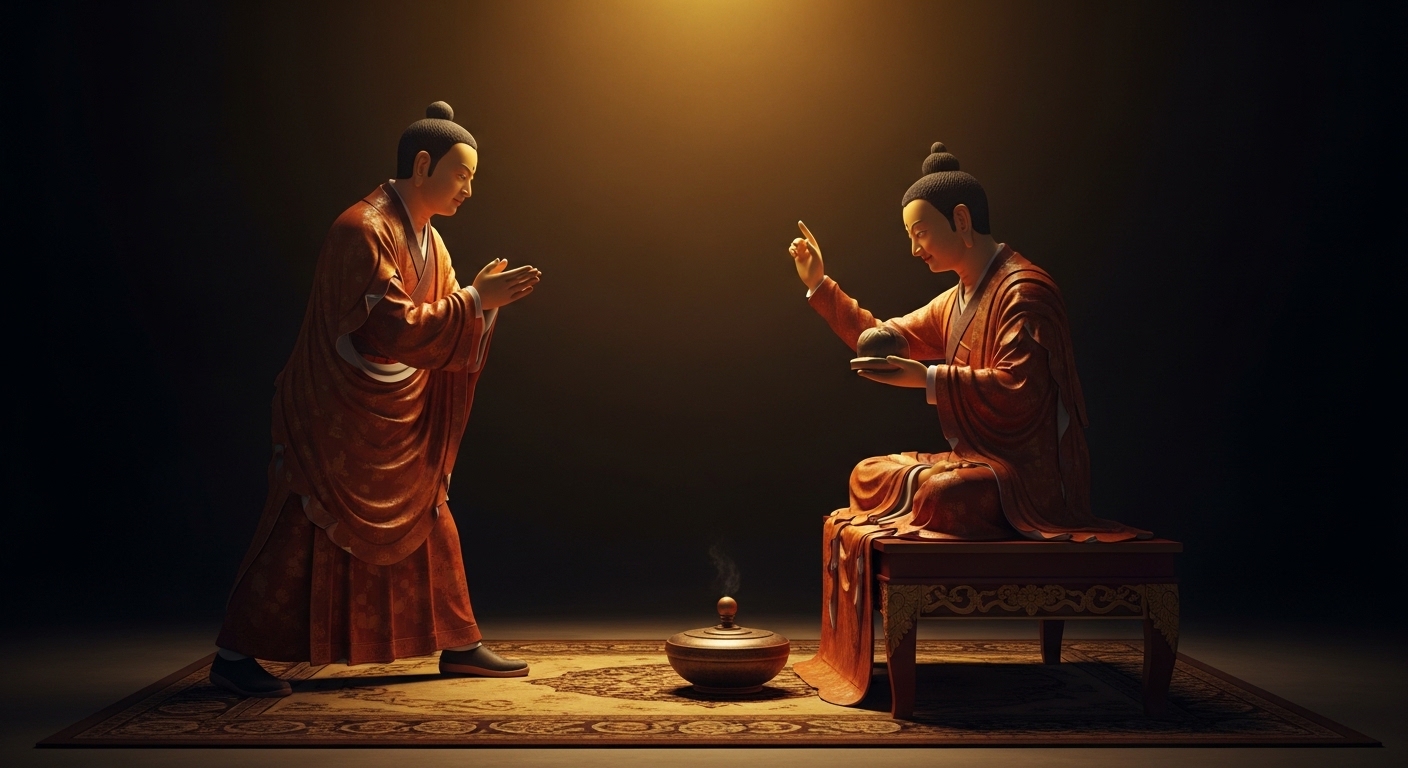
Tibetan philosophical debate is a physical practice — one debater stands, clapping and stomping and gesturing with precise formalized movements; the other sits and defends a position. The clapping and stomping are the sword: each logical step that breaks through a faulty position is accompanied by a physical gesture, so that the demolition of confusion has a kinesthetic reality that complements its intellectual content.
Manjushri presides over these halls from his position in the shrine: orange-robed, youthful, the sword raised and the text held, watching the debates that are, in a reduced and embodied form, what his sword accomplishes at the level of cosmic wisdom. The debaters are enacting his function. They are cutting through the conceptual undergrowth that obscures the clear ground of things.
When the cut is successful — when a defender’s position collapses not because they were outmaneuvered but because they actually saw the flaw — the monastery accounts for this as Manjushri’s sword having found its mark. The wit of the standing debater was the flame. The defender’s new clarity is the ground revealed.
The sword does not destroy what it cuts through. The conceptual confusion was never the reality. Removing it reveals what was always there.
Scenes
Echoes Across Traditions
Entities
- Mañjuśrī (Manjushri)
- the student who cannot understand
- Tsongkhapa (who had a vision of Manjushri)
Sources
- Robert Beer, *The Handbook of Tibetan Buddhist Symbols* (Shambhala, 2003)
- Jeffrey Hopkins, *Meditation on Emptiness* (Wisdom Publications, 1983)
- Tenzin Gyatso (Dalai Lama), *The Universe in a Single Atom* (Morgan Road Books, 2005)