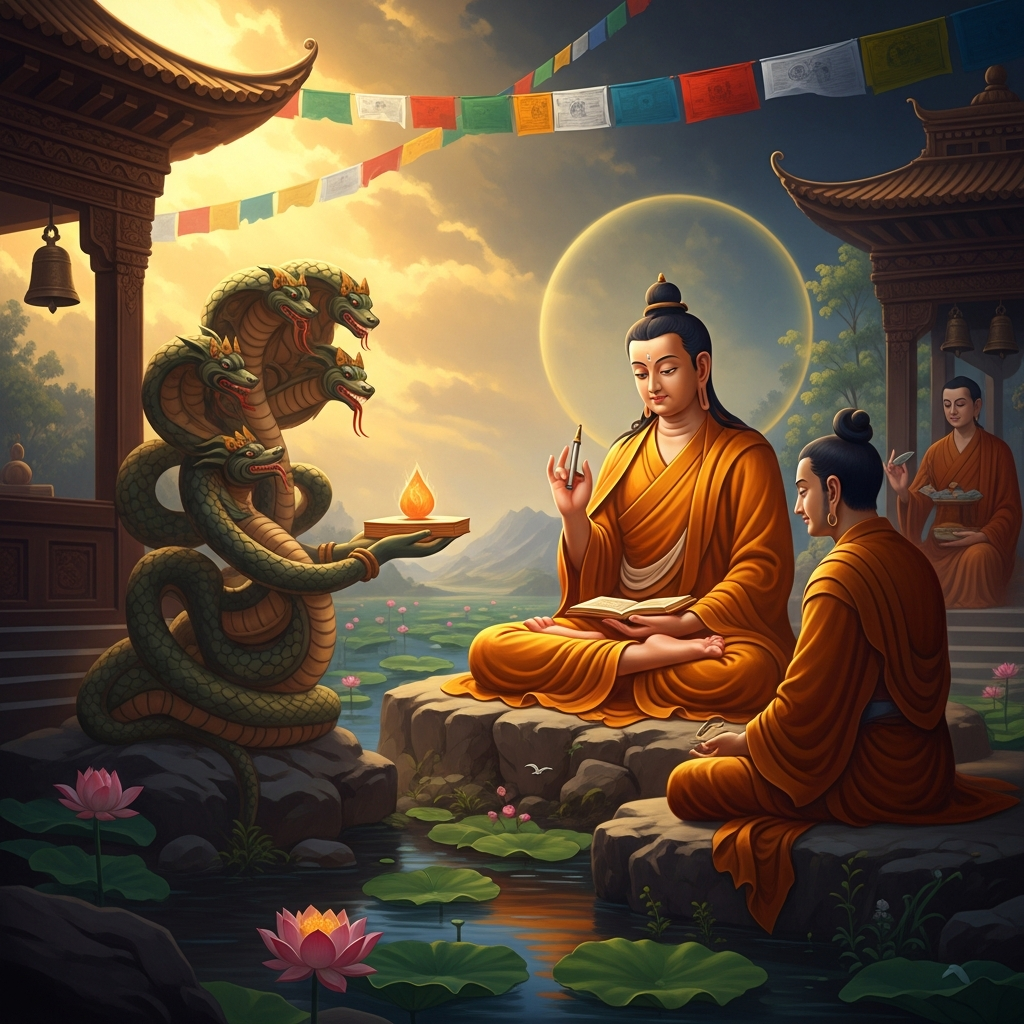
Marpa Strikes His Student and Weeps
c. 1074 CE — late 11th-century Tibet, Lhodrak district · Marpa's estate at Drowolung, Lhodrak, southern Tibet — the translator's compound with its barley fields and teaching hall
Contents
The translator Marpa beats Milarepa in front of the assembled students, then is found alone weeping — his fierceness public, his love secret, both equally necessary for the transmission he is trying to accomplish.
- When
- c. 1074 CE — late 11th-century Tibet, Lhodrak district
- Where
- Marpa's estate at Drowolung, Lhodrak, southern Tibet — the translator's compound with its barley fields and teaching hall
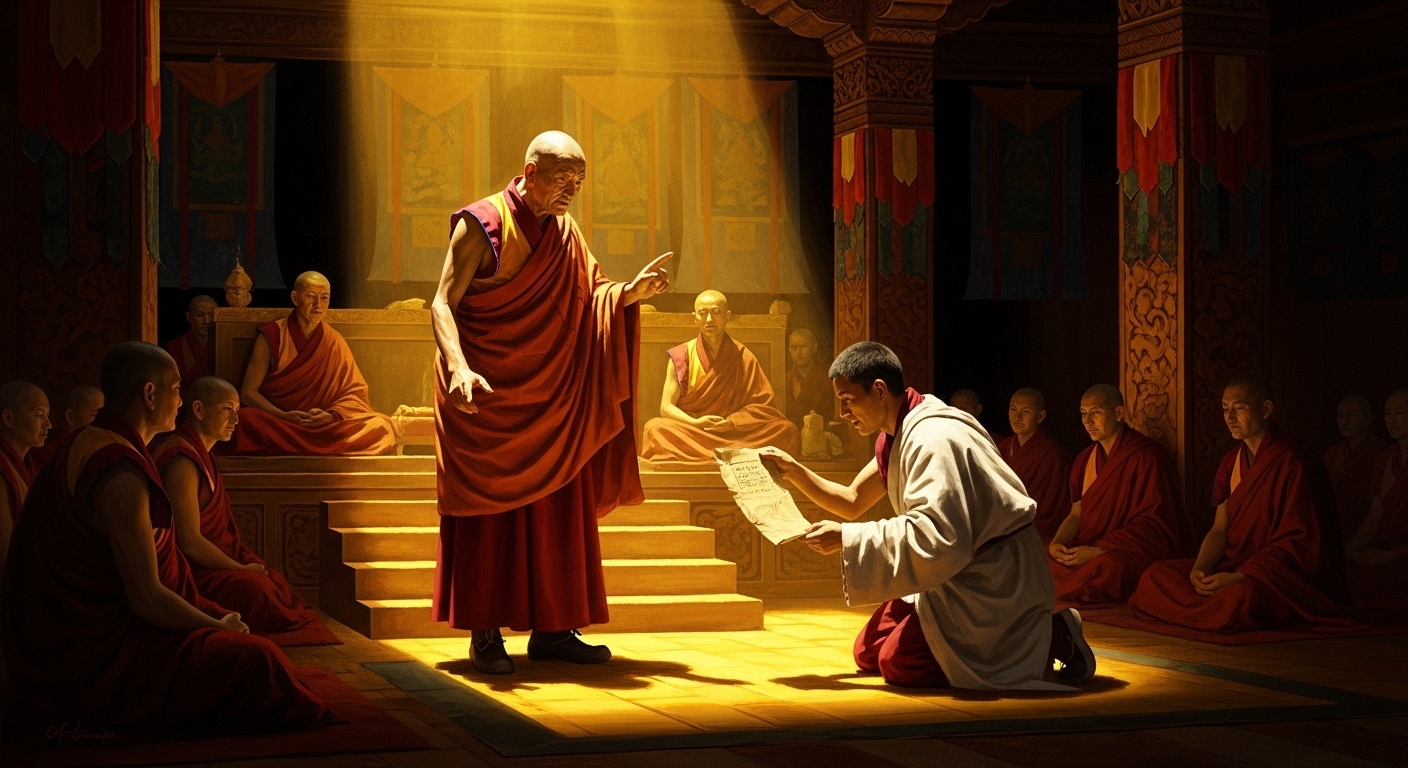
Marpa is teaching in the main hall when Milarepa arrives with a forged letter.
Dakmema has written the letter — she has seen her husband refuse Milarepa entrance to the teachings too many times, watched the young man’s suffering grow past what she can justify, and forged Marpa’s handwriting to get Milarepa admitted to a teaching group. She means well. She has always meant well toward Milarepa in proportion to her husband’s meanness, and the disproportion has become a private arrangement: she softens what he hardens; she opens what he closes.
Marpa recognizes his wife’s handwriting in his own name. He says nothing.
He waits until the teaching is established, until the assembled students are settled and attentive, until Milarepa has a moment of believing that this time it will work, that this time the teaching will include him. Then Marpa stops the teaching and looks at Milarepa and begins to speak. He speaks carefully and at length about the offense of forging a teacher’s correspondence. He speaks about the disruption this causes to the sacred relationship between guru and student. He speaks about what kind of character produces this kind of deception.
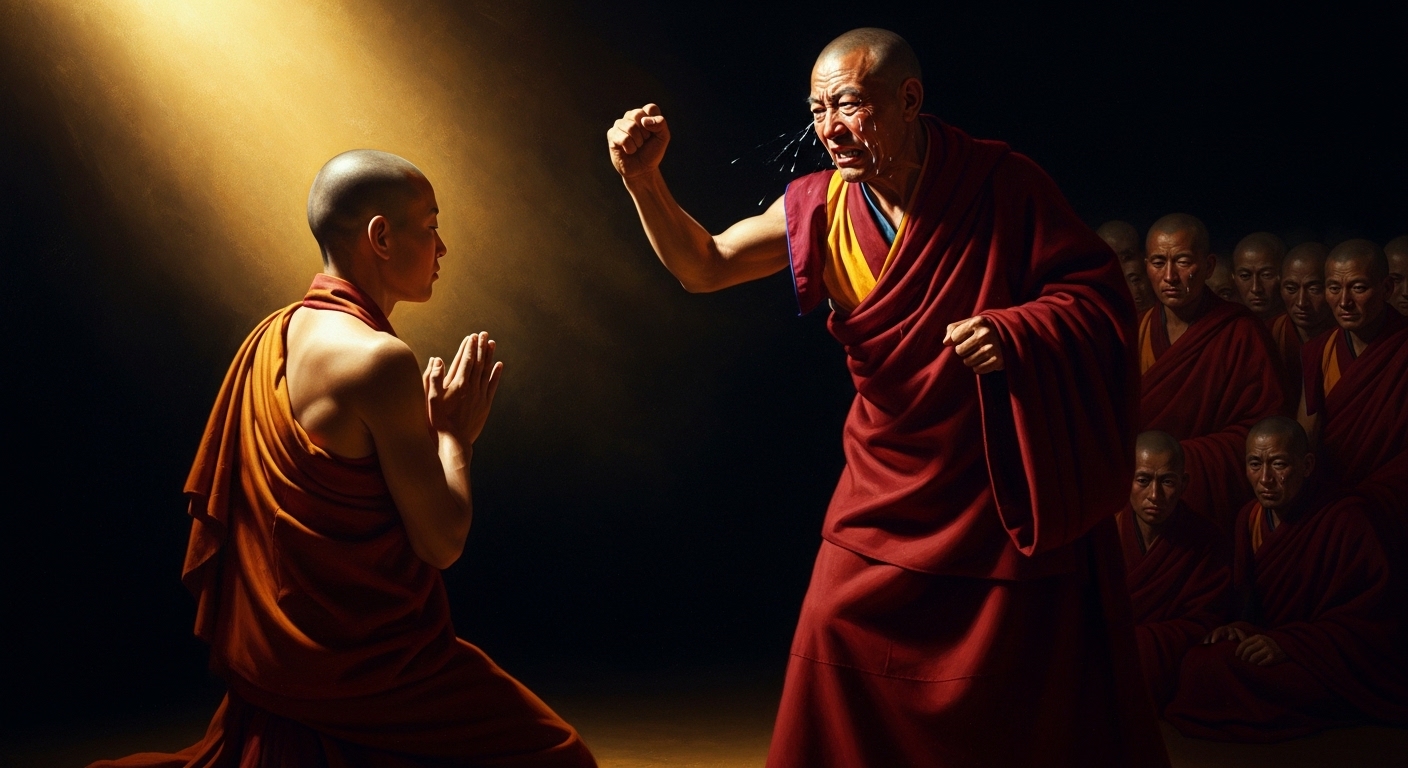
Then he strikes him.
Milarepa does not fight back. He does not weep in front of the assembly. He stands and takes it and then leaves the hall with the particular posture of a man who has learned, through years of concentrated experience, that the responses available to most people are not available to him.
The other students are disturbed. Several of them come from ordinary backgrounds — not from the burden of mass murder, not from years of black magic, not from the particular weight that Milarepa carries. They find Marpa’s treatment inexplicable. They try to explain it to themselves as pedagogy, but the explanation doesn’t quite reach, and several of them are secretly frightened that they might be next.
Ngokpa, one of Marpa’s other principal students, finds Milarepa afterward and offers sympathy. This is the wrong gesture at the wrong moment, and Ngokpa knows it even as he makes it — but watching someone receive cruelty without responding to it produces a kind of unbearable desire to offer something.
Milarepa sits with his back against the stone wall of the compound and says nothing.
What Dakmema sees that evening is different from what the assembly saw.
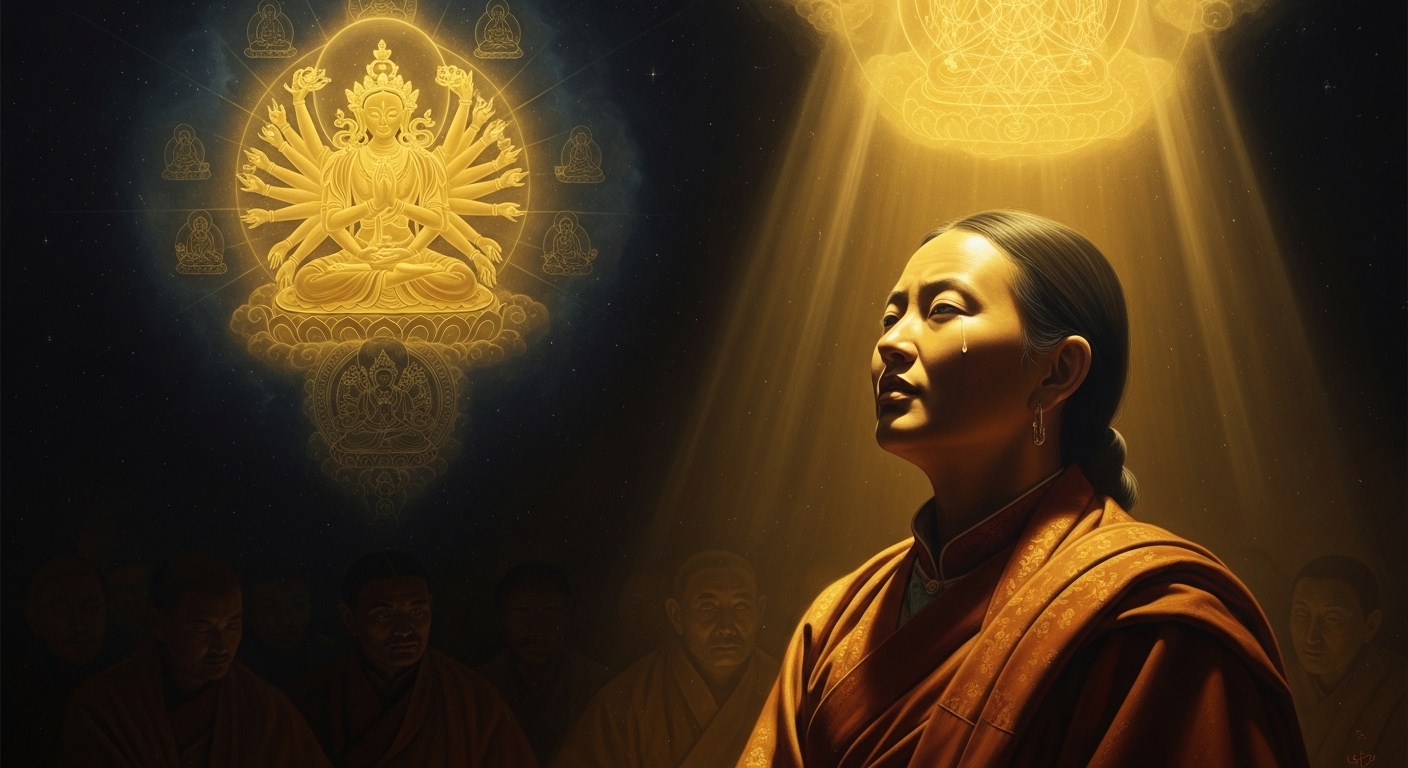
She finds Marpa alone in his room. He is sitting on his meditation cushion with his face in his hands. He is weeping. Not quietly — genuinely, deeply, the way a person weeps when they believe no one is watching. She stands in the doorway. He does not hear her.
What she understands, watching him, is the structure of what he is doing to Milarepa. The cruelty is precise. It is aimed at specific residues of pride, of self-pity, of the ordinary human tendency to believe that suffering entitles one to consideration. These residues are not sins; they are simply obstructions, the way a clogged pipe is not evil but must be cleared before water can flow. The beatings and the refusals and the forged-letter exposure are clearing operations.
The tears are because clearing operations hurt. Not Milarepa only — Marpa as well. The teacher who does this must hold the student’s pain and the necessity of the pain simultaneously, must love the student fiercely enough to continue inflicting what looks from the outside like cruelty, must refuse to be softened by tears or deflected by the student’s very real suffering.
This is what Dakmema sees: a man crying because he loves his student too much to stop hurting him.
She does not enter the room. She goes back to the kitchen and makes tea. In the morning, Marpa will stand again in the teaching hall, and his face will show nothing of this evening. He will be as hard as the stones his student carries. The teaching requires it.
But the tears were real. And they are part of the transmission too — though Milarepa will not know them until much later, when he becomes a teacher himself and discovers that the inside of a fierce teaching looks nothing like its outside.
Scenes
Echoes Across Traditions
Entities
- Marpa Lotsawa
- Dakmema (Marpa's wife)
- Milarepa
- Ngokpa
- Tsurtön
Sources
- Tsangnyön Heruka, *The Life of Milarepa*, trans. Lobsang P. Lhalungpa (Shambhala, 1984)
- Chogyam Trungpa, *Cutting Through Spiritual Materialism* (Shambhala, 1973)
- Reginald Ray, *Secret of the Vajra World* (Shambhala, 2001)