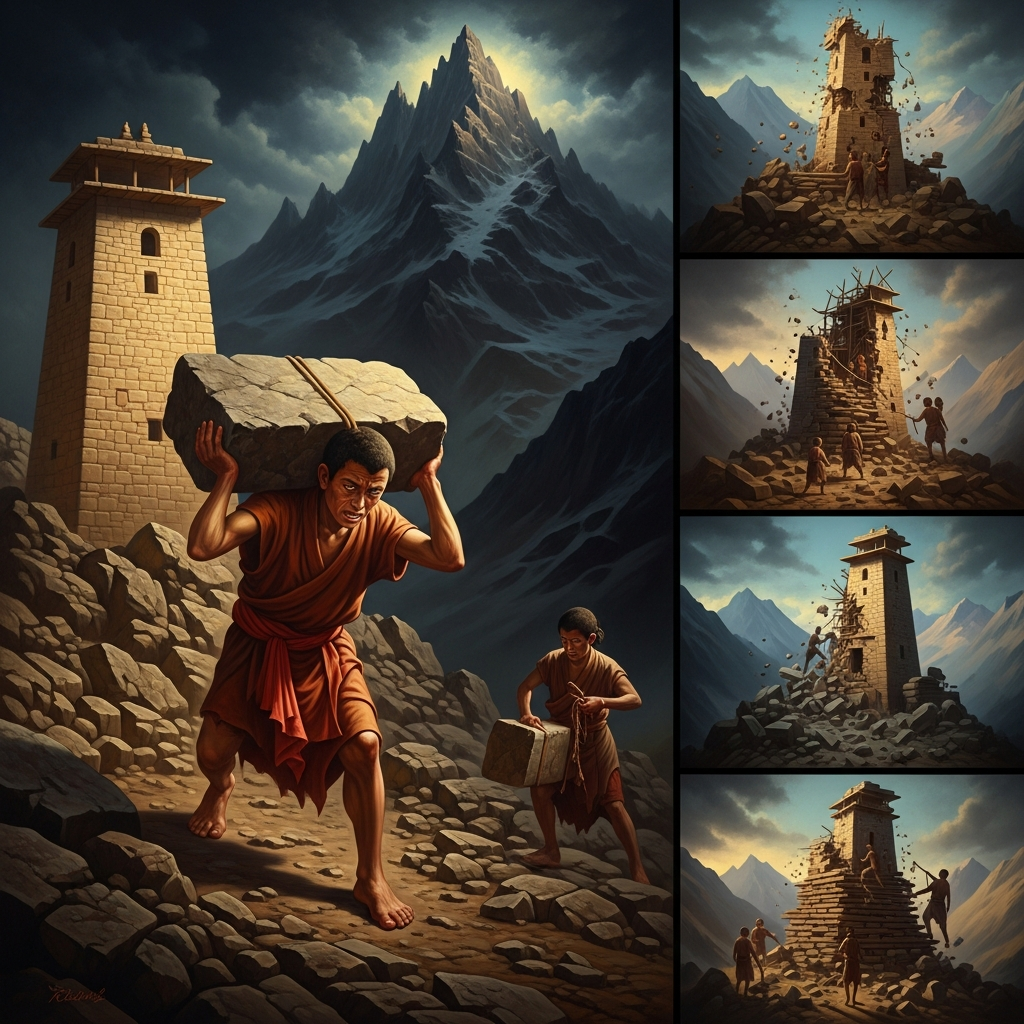
Marpa Makes Milarepa Build and Tear Down
c. 1074 CE — late 11th-century Tibet, Lhodrak district near the Bhutanese border · Marpa's farm at Drowolung, Lhodrak district, southern Tibet — stone fields and barley terraces
Contents
To purify a student burdened with the karma of mass murder, the translator Marpa commands him to build a stone tower alone, carry every stone on his bleeding back — then tear it down and build it again elsewhere.
- When
- c. 1074 CE — late 11th-century Tibet, Lhodrak district near the Bhutanese border
- Where
- Marpa's farm at Drowolung, Lhodrak district, southern Tibet — stone fields and barley terraces
Marpa does not welcome him warmly.
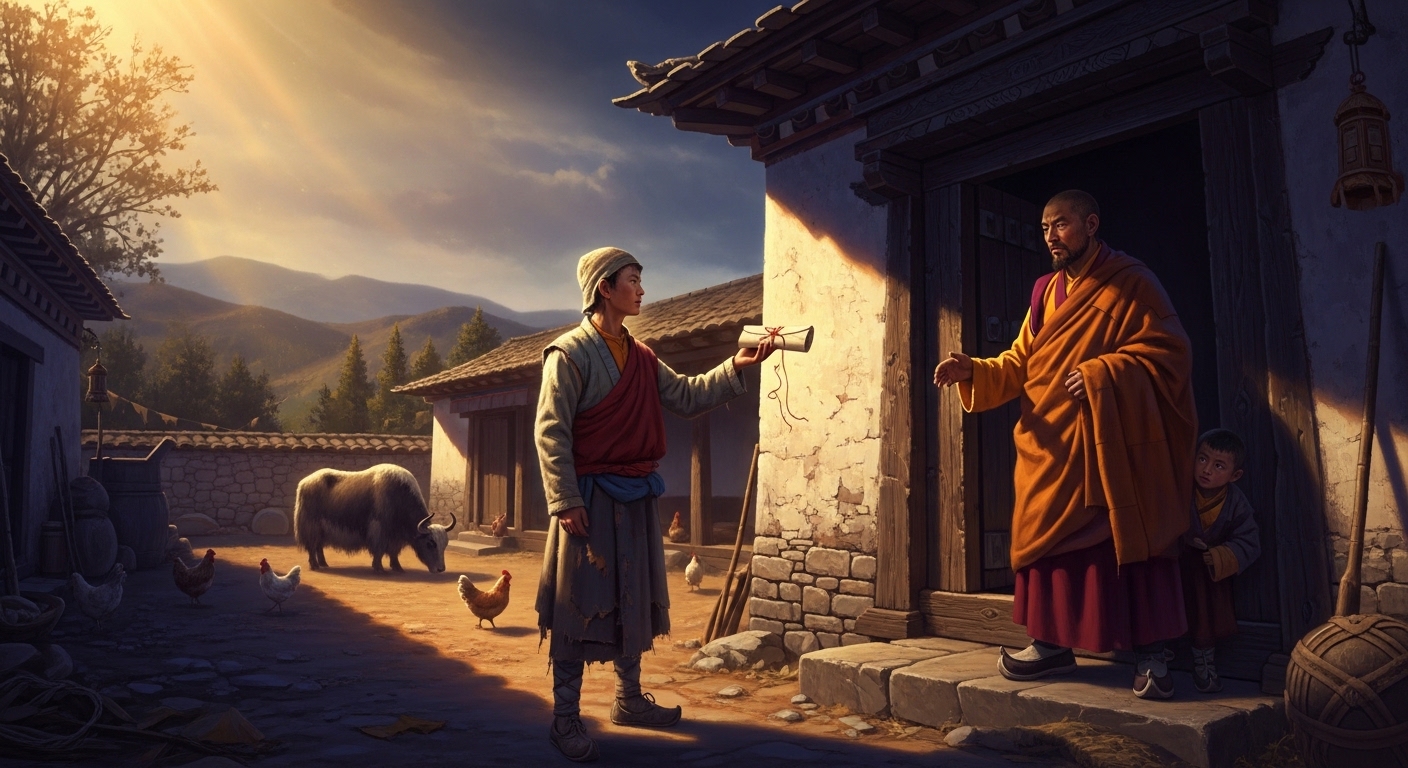
Milarepa arrives at the translator’s farm with a letter of introduction from his former sorcerer. Marpa reads the letter. He looks at the young man standing in his courtyard — lean, sun-darkened, clearly capable of remarkable endurance — and says nothing useful for several days. He puts him to work in the barley fields. He gives him beer to drink in the evenings but no instruction. When Milarepa finally asks about the teachings, Marpa says: what teachings? You said nothing about teachings in your letter.
This is the beginning.
The biographers are precise about what follows because the sequence of towers became one of the most analyzed episodes in all of Tibetan religious literature. Marpa instructs Milarepa to build a tower on the eastern slope, square, nine stories, using only the stones Milarepa carries from the riverbed on his own back. No helpers. No draft animals. He promises: when the tower is finished, the teachings will begin.
Milarepa works for months. His back develops open sores from the loads. When the tower reaches the seventh story, Marpa comes out, inspects it, and says: I was drunk when I told you to build it there. Tear it down and put the stones back where you found them.
Milarepa carries the stones back down.
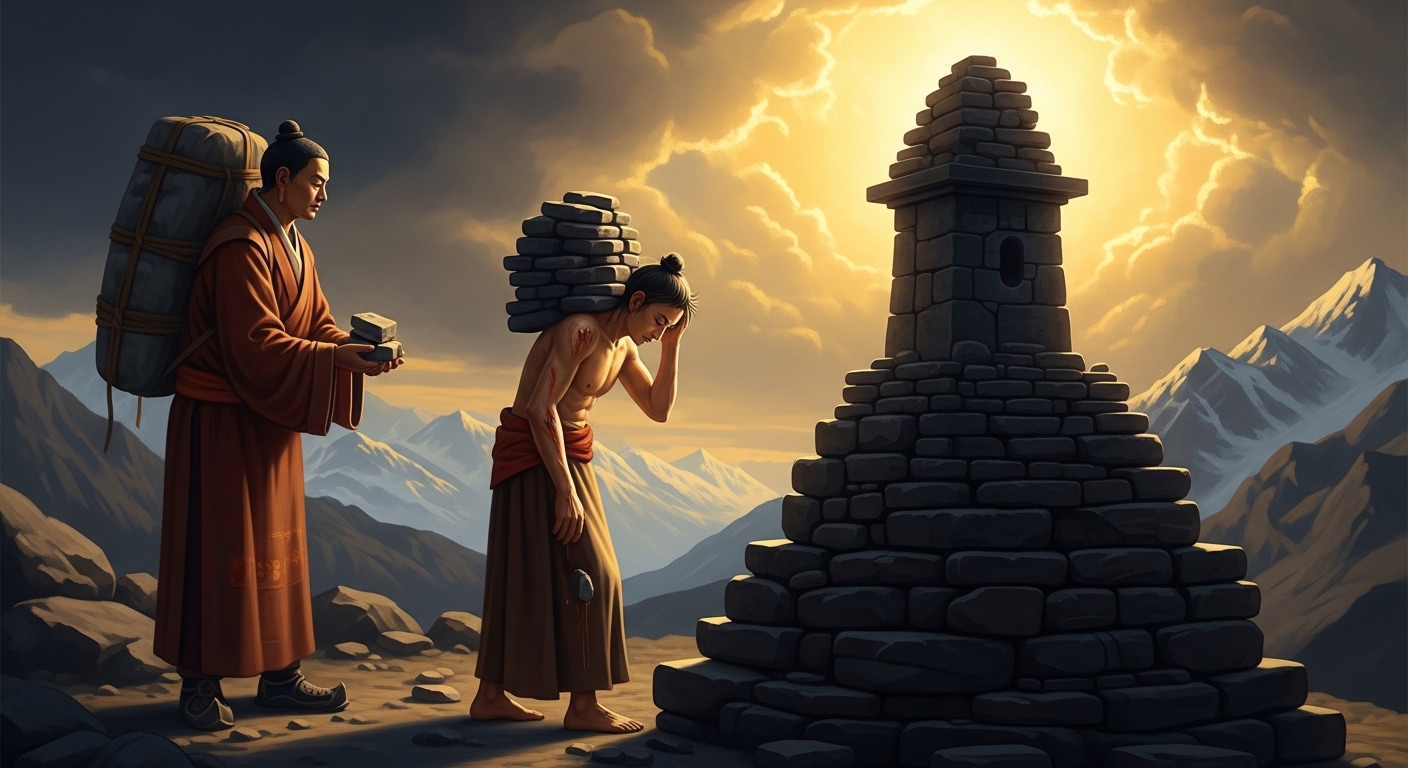
He begins a second tower on the western slope. He carries stones until his back sores become infected, until Dakmema — Marpa’s wife, a woman of extraordinary compassion who will become a secret source of mercy throughout these trials — comes out with butter to rub on his wounds. When the second tower reaches the fifth story, Marpa appears and says: I was in a dark mood when I told you to build it there. Tear it down and put the stones back.
Milarepa cries alone. He does not cry in front of Marpa. He has been trained in endurance by years of poverty and the self-imposed ordeal of sorcery study, but there is a difference between physical hardship and deliberate humiliation, and Milarepa is beginning to understand that Marpa is not making mistakes about where to place towers.
He begins a third tower on the north slope. It is a round tower this time — Marpa has changed the shape. Same stones. Same sores. Same silence at mealtimes when the other students receive teachings and he receives barley beer and the instruction to go back to the riverbed.
The third tower is also torn down.
By the time Marpa points to the hill on the south slope — the last direction, the correct direction, the tower that will be allowed to stand — Milarepa’s back is a map of scarred tissue and new wounds laid over old ones. Dakmema has been making excuses to the other students, forging letters in Marpa’s name to get Milarepa accepted into teachings that Marpa himself then publicly revokes. She is weeping more than Milarepa is.
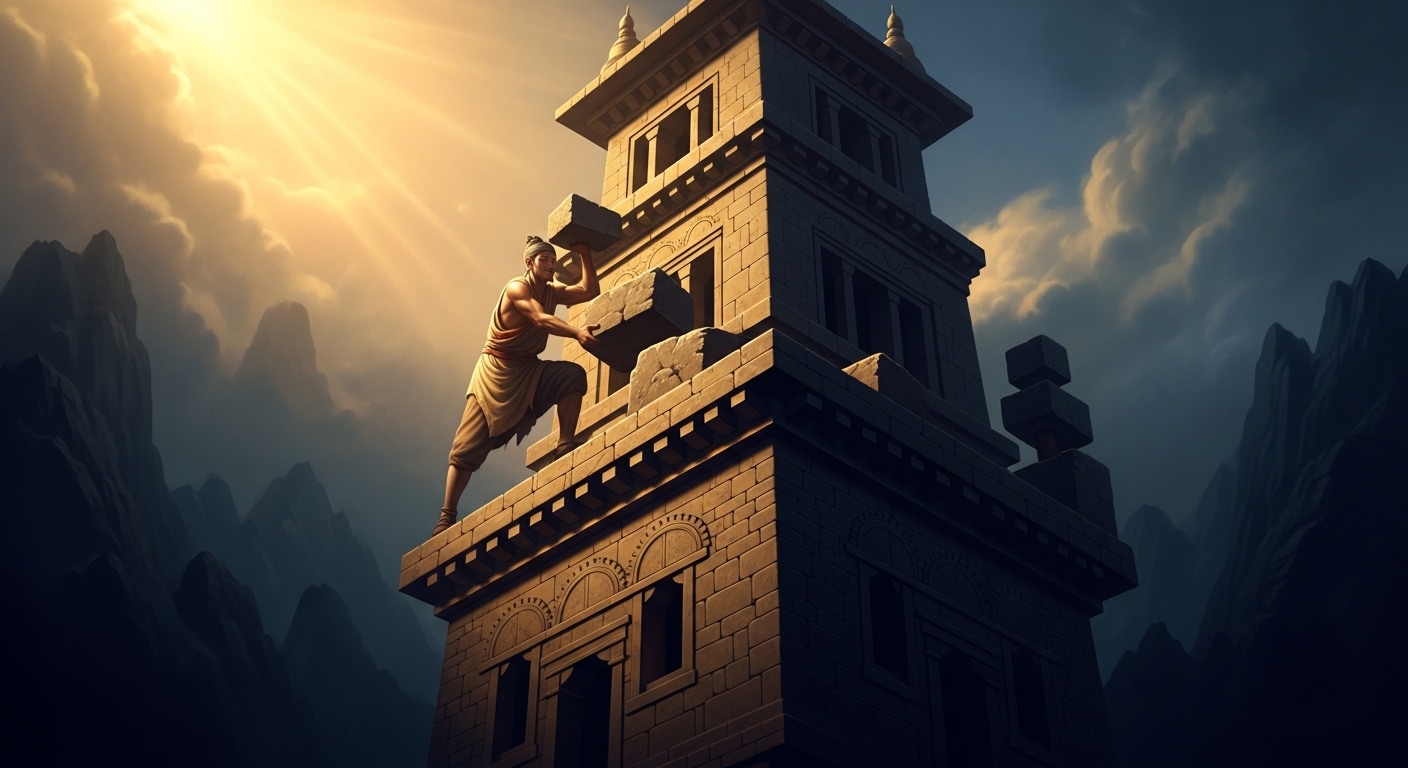
Milarepa builds the fourth tower. Nine stories, square, exactly as originally described. He finishes it.
Marpa takes him inside. He feeds him well for the first time. He says, in a voice that strips away the performance of cruelty: the karma of your thirty-five killings was the size of a mountain. I have broken it into the size of what you built and carried. Your back is healed. Not fully — the traces remain. But the principal weight is gone.
Then he gives the teachings. He gives everything he brought from India — the Six Yogas of Naropa, the Mahamudra pointing-out instructions, the transmission that no one else in Tibet has received in complete form. He gives them to the man who built and dismantled three towers and carried every stone twice.
The tower that stands in the south is still there in some accounts — a nine-story stone tower on a Tibetan hillside, built by one man’s bleeding back, purifying a crime that neither courts nor prayers could address. What it purifies is not the deaths but the entanglement — the chain that would have dragged Milarepa through lifetimes of consequence. What the tower costs is suffering. What it buys is freedom.
Scenes
Echoes Across Traditions
Entities
- Marpa Lotsawa
- Milarepa
- Dakmema (Marpa's wife)
- Ngokpa (fellow student)
Sources
- Tsangnyön Heruka, *The Life of Milarepa*, trans. Lobsang P. Lhalungpa (Shambhala, 1984)
- Chogyam Trungpa and Esme Cramer Roberts, trans., *The Life of Marpa the Translator* (Shambhala, 1986)
- Reginald Ray, *Indestructible Truth: The Living Spirituality of Tibetan Buddhism* (Shambhala, 2000)