Mercury Leads Souls Down the Long Road
Throughout Roman mythological time — Mercury as psychopomp is present from earliest Roman tradition · The roads between the living and dead worlds — everywhere, but particularly the crossroads where Mercury's shrines stood
Contents
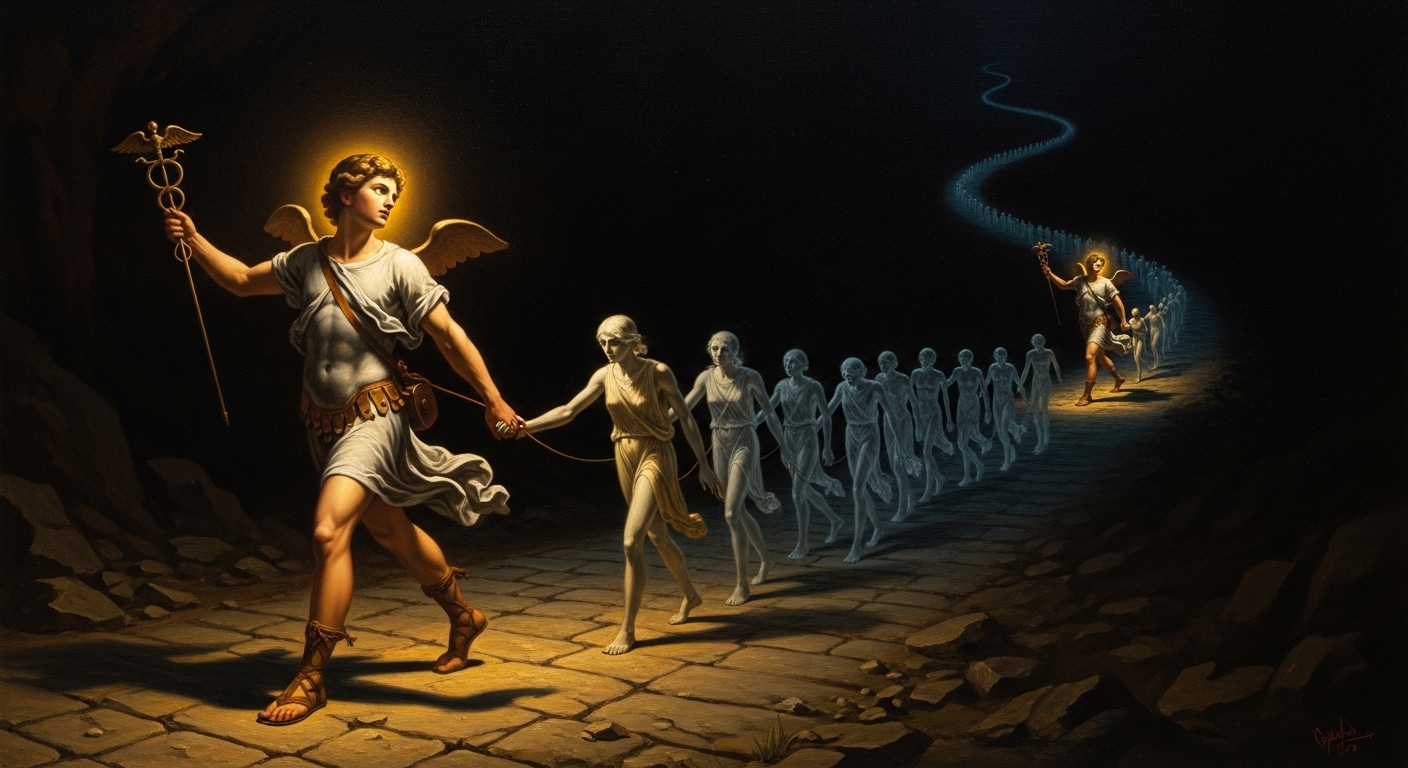
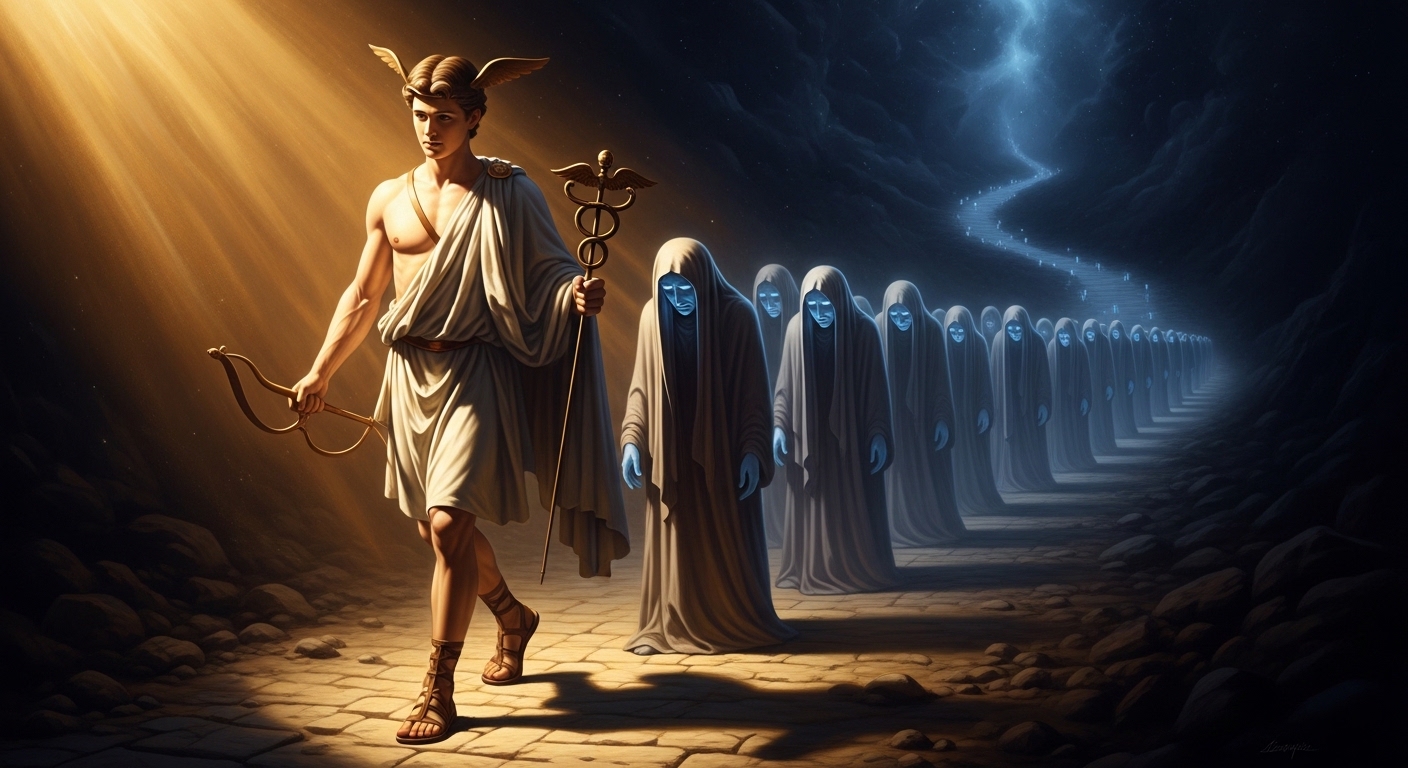
Mercury, the Roman god of travel, commerce, and eloquence, carries a caduceus that can lull the living to sleep and wake the dead — and he uses it to guide the souls of the newly dead down to the underworld.
- When
- Throughout Roman mythological time — Mercury as psychopomp is present from earliest Roman tradition
- Where
- The roads between the living and dead worlds — everywhere, but particularly the crossroads where Mercury's shrines stood
The caduceus can do two things.
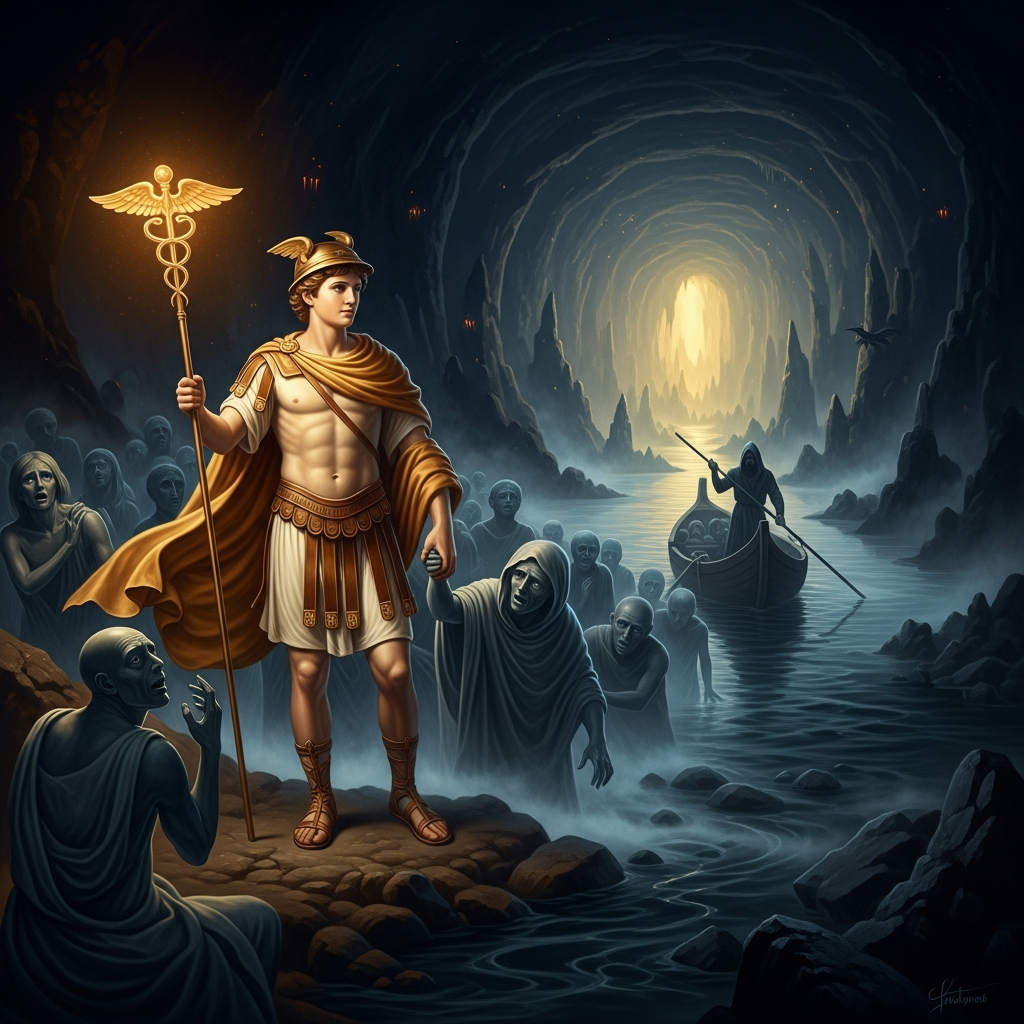
In his left hand Mercury carries the herald’s staff — two serpents twined around a central rod, wings at the top. Touch it to the eyes of the living and they sleep. Touch it to the eyes of the dead and they wake — not back to life, but to the clarity of the recently dead, capable of understanding where they are going. He uses it in both directions, at the boundary between sleeping and waking, between life and death, because Mercury is the god of thresholds and no threshold is more absolute than this one.
He is young in all his representations — eternally youthful, wearing the winged sandals and the winged helmet that allow him to move between realms as easily as he moves between cities. He is the messenger of the gods, which means he travels where no other god regularly goes: from Olympus to earth, from earth to the underworld, from the world of the living to Charon’s boat on the Styx.
Horace’s hymn to Mercury opens with his character precisely drawn.
Cunning Mercury, grandson of Atlas, who with craft shaped the rough sounds of early humans into graceful speech — he is the god of eloquence before he is the god of commerce. He made language. He then made the lyre, stealing it from Apollo while still an infant and offering it back as a gift to avoid punishment. He is the god who turns raw material into refined expression: the noise of the human larynx into poetry, the exchange of goods into the concept of money, the chaos of travel into the organization of roads.
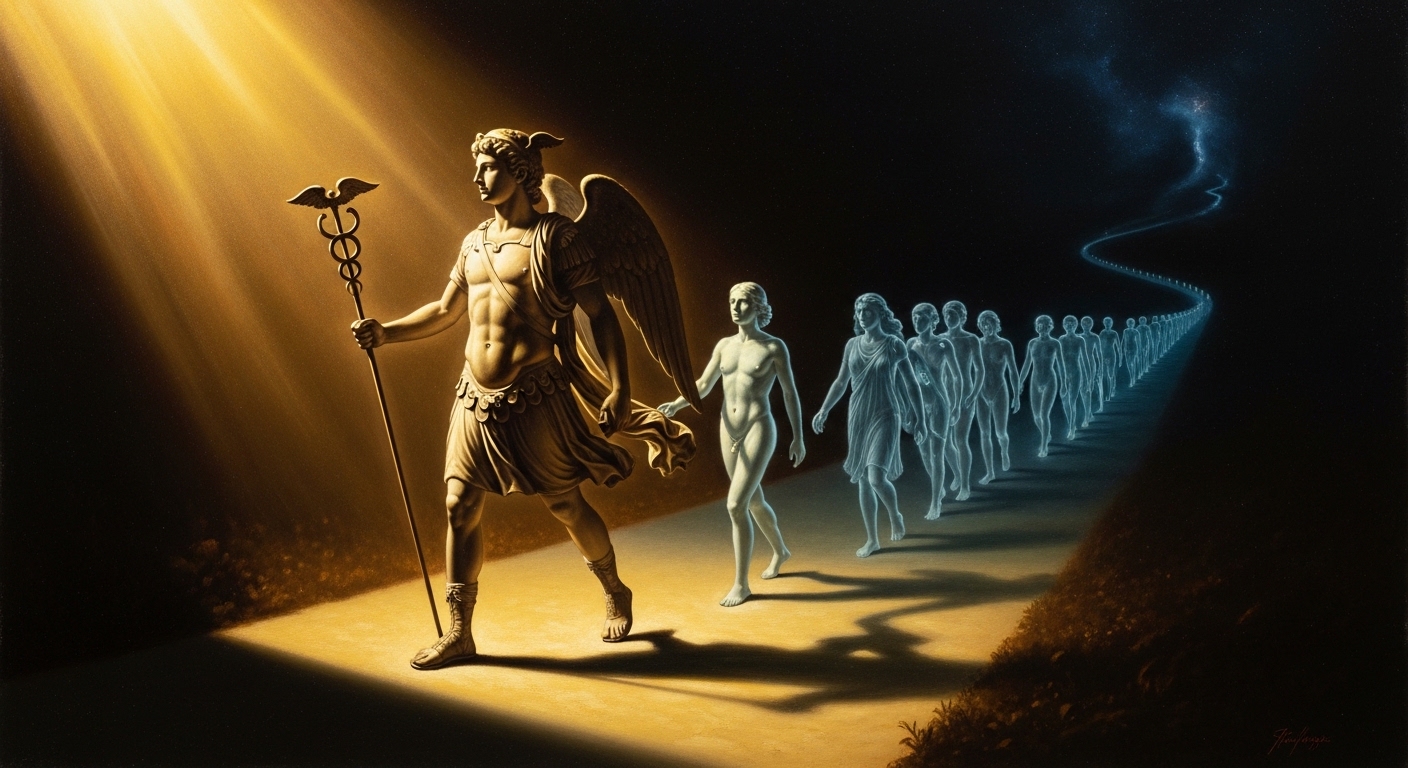
He is also — Horace says this directly — the one who using his golden rod guides the souls of the pious below, down to the pale throngs of the underworld.
The combination is not contradictory to the Roman mind. The qualities that make Mercury good at commerce — quickness, fluency, the ability to move between parties and translate their needs into mutually acceptable terms — are the same qualities that make him good at guiding the dead. Death is a negotiation. The soul must cross a boundary it cannot cross alone. It needs an intermediary who knows both sides of the transaction.
Mercury knows both sides. He is the god who has made that crossing more times than he can count.
Virgil shows Mercury in action twice in the Aeneid.
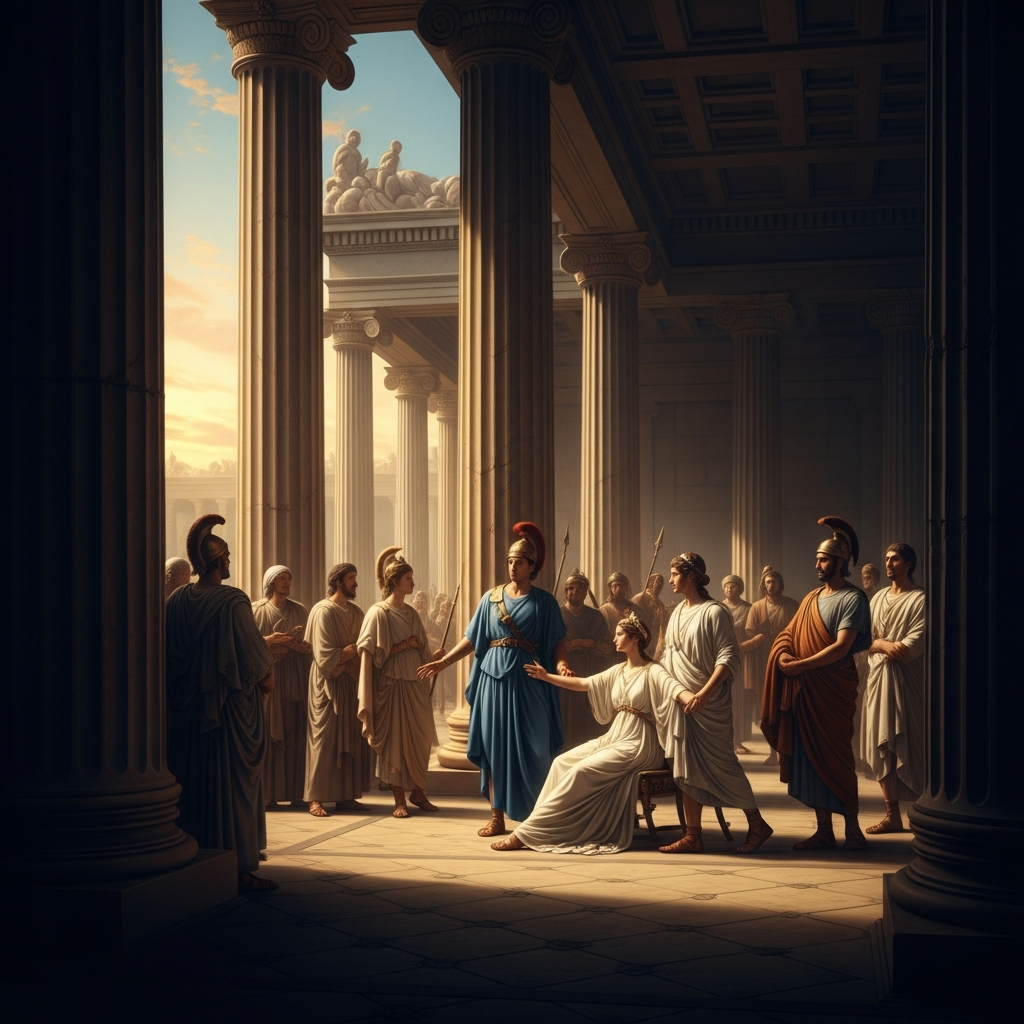
First, he is sent by Jupiter to Aeneas in Carthage — descending from Olympus in a passage of extraordinary visual power, the god with his winged hat and sandals touching Atlas’s mountain and then skimming the sea surface and finally standing before Aeneas with the face of a young man and the authority of heaven, delivering the message that changes everything: Leave.
Second, at the death of Dido — who kills herself as Aeneas’s fleet disappears over the horizon — Juno, out of pity, sends Iris to cut the strand of hair that keeps the dying woman attached to her body. And immediately after Iris departs, Mercury is implied: he who led the living Hermes-Aeneas into the underworld to find his father is the same Mercury who, by the logic of the story, now leads the dead Dido down the road she could not walk while she lived.
Virgil does not say this explicitly. He does not need to. The reader knows where the dead go and who takes them there.
His commerce function is the Romans’ own addition.
The Greeks gave Hermes commerce and craft but not Mercury’s specific identity with the merx — the goods of the market, the mercator, the merchant. Rome’s expansion as a trading city made Mercury the patron of the Mons Aventinus market, where a spring sacred to him offered merchants the chance to bless their stock and their scales. His festival on May 15th was particularly celebrated by traveling merchants and tradesmen.
The combination of commerce and death in a single deity is not arbitrary. Both involve the movement of things across boundaries. Both require an intermediary whose job is to facilitate passage, to know the rules of the crossing, to ensure that what is owed is paid and what is promised is delivered. The merchant and the psychopomp are both guides at thresholds.
Mercury moves. That is his essential nature. He is the god of movement itself — of messages delivered, of goods exchanged, of souls conducted. Where others stand in their temples and receive offerings, Mercury is always on the road, always between one place and another, always in the liminal moment between departure and arrival.
He is the fastest of the gods. He is the most reliable. He arrives with the news the gods need delivered and the souls the underworld needs conducted, and he does not linger at either end.
There is a road between the living and the dead. Mercury walks it daily, in both directions. He knows every mile.
Scenes
Echoes Across Traditions
Entities
- Mercury
- Hermes
- Charon
- the dead souls
- Jupiter
- the caduceus
Sources
- Virgil, *Aeneid* IV.238-278 — Mercury delivers Jupiter's command to Aeneas; IV.695-705 — Mercury leads Dido's soul
- Horace, *Odes* I.10 (c. 23 BCE) — the hymn to Mercury
- Ovid, *Metamorphoses* XI.1-84 — Mercury and the death of Orpheus
- Apuleius, *Golden Ass* VI.18-19 (c. 160 CE)