Milarepa Turns Green from Nettles
c. 1080–1100 CE — late 11th and early 12th century Tibet, high Himalayan cave retreats · Drakar Taso cave in Lapchi Snow Mountain, Milarepa's principal retreat — altitude above 4,500 meters, permanent snow outside the cave entrance
Contents
Having received Marpa's full transmission, Milarepa retreats to high Himalayan caves and subsists for years on nothing but boiled nettles, until his hair, skin, and eyes turn the color of the plant — and he achieves enlightenment in a single lifetime.
- When
- c. 1080–1100 CE — late 11th and early 12th century Tibet, high Himalayan cave retreats
- Where
- Drakar Taso cave in Lapchi Snow Mountain, Milarepa's principal retreat — altitude above 4,500 meters, permanent snow outside the cave entrance
He goes to the cave with almost nothing.
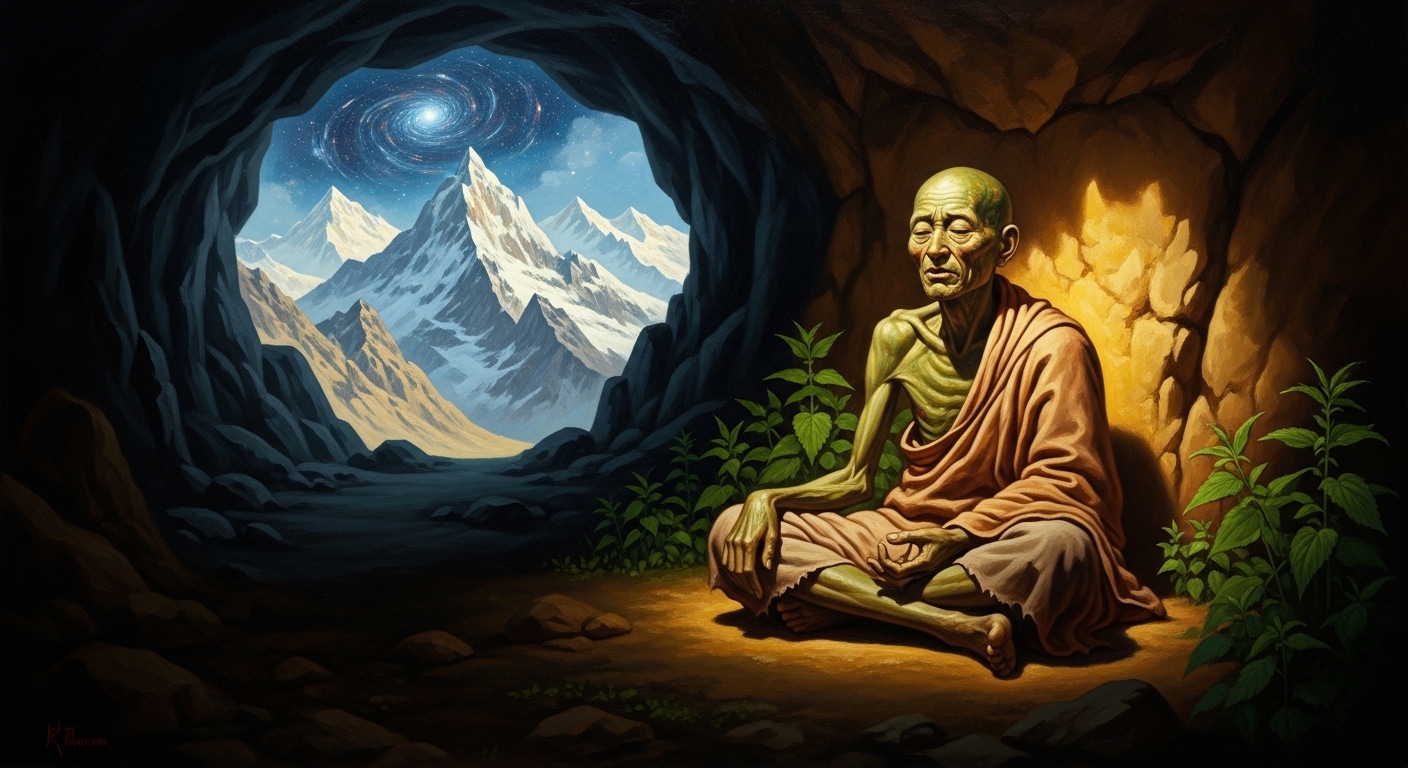
After Marpa gives the teachings, Milarepa retreats to the high country. He has instructions for practice — complex, demanding, requiring years of sustained effort — and he has the memory of thirty-five deaths, which functions as fuel. He finds a cave above the treeline in the Lapchi region, near the border with Nepal, at an altitude where the air is thin enough to make simple walking effortful. The cave is cold. The view is spectacular in the way that only mountain views at extreme altitude are spectacular: vast, indifferent, the sky impossibly dark blue even at midday.
He has no food stores. He has, growing in the cracks near the cave entrance, nettles. He learns to gather them, boil them, drink the broth. This is his diet for years. Not days. Not months. The biographers say years, and the evidence of the story supports the claim: the nettles work on his body over time, gradually. His hair turns green. His skin takes on a greenish cast. When his sister Peta finally tracks him down — she has heard rumors about a hermit in the mountains who might be her brother — she arrives to find a figure who looks barely human, thin to the edge of transparency, draped in rags, his face the color of spring grass.
She weeps. She has brought cloth and food. She begs him to eat properly.
He eats what she brings. He is grateful. He explains, patiently, why he cannot stop.
The explanation is doctrinal and also personal. The doctrine says: the human body in this lifetime, combined with the complete Vajrayana teachings, is sufficient for full liberation. But only if the practice is done completely. A practice done halfway produces a halfway result. A practice done completely — which means continuously, without the interruptions of comfort, socializing, status-seeking, or ordinary life — produces complete liberation.
The personal reason is simpler: he has thirty-five deaths behind him and only this one lifetime to work with what Marpa gave him.
His sister returns with fine wool cloth. She finds him wearing it, but she finds it changed: he has sewn it into a shape that accommodates practice postures, not warmth or beauty. She is frustrated with him. She says: you practice like a corpse in a charnel ground. He says: I practice like a man who has very little time.
He is correct that he has very little time, though not in the way she means. The Hundred Thousand Songs — the collection of his teachings in verse, recorded by his students — are full of the songs he sang in these cave years: long, intricate, funny, precise, devastating. The nettles appear in them often. The green body appears. The cold appears. But what dominates is not suffering — it is something that the translation tradition renders variously as rigpa, as wakefulness, as the recognition of the nature of mind.
The green body is the proof that the practice is real.
This is not metaphor. In the Tibetan understanding, sustained practice of tummo (inner heat yoga) and the other completion-stage techniques produces measurable changes in the physical body. Milarepa’s greenness is a side effect of the nettles, yes, but it is also testimony: no one turns green from nettles unless they have been eating nothing else for years. The body itself becomes the documentation.
When hunters arrive at the cave — this scene appears in several of the songs — they find a green figure sitting motionless in the dark and assume he is a demon. When they throw stones at him, he sings. The songs stop them. There is something in the songs that cuts through the ordinary human tendency to continue throwing stones at strange green figures in dark caves.
He spends years this way. He spends enough years that when he finally emerges and begins teaching, his students — Rechungpa, Gampopa, and others — find a teacher who has gone so far into the territory that his return itself is a transmission. The Kagyu lineage that descends from Milarepa is sometimes called the “practice lineage” — not because other lineages don’t practice, but because Milarepa established that practice is not preparation for something else. The cave, the nettles, the green skin: these are the teaching, not the preamble.
He comes down from the mountains. He sings. The songs are still being sung.
Scenes


Echoes Across Traditions
Entities
- Milarepa
- Peta (his sister)
- Rechungpa (his disciple)
- Zesay (his childhood betrothed)
Sources
- Garma C.C. Chang, trans., *The Hundred Thousand Songs of Milarepa* (Shambhala, 1999)
- Tsangnyön Heruka, *The Life of Milarepa*, trans. Lobsang P. Lhalungpa (Shambhala, 1984)
- Matthieu Ricard, trans., *The Life of Shabkar* (SUNY Press, 1994)