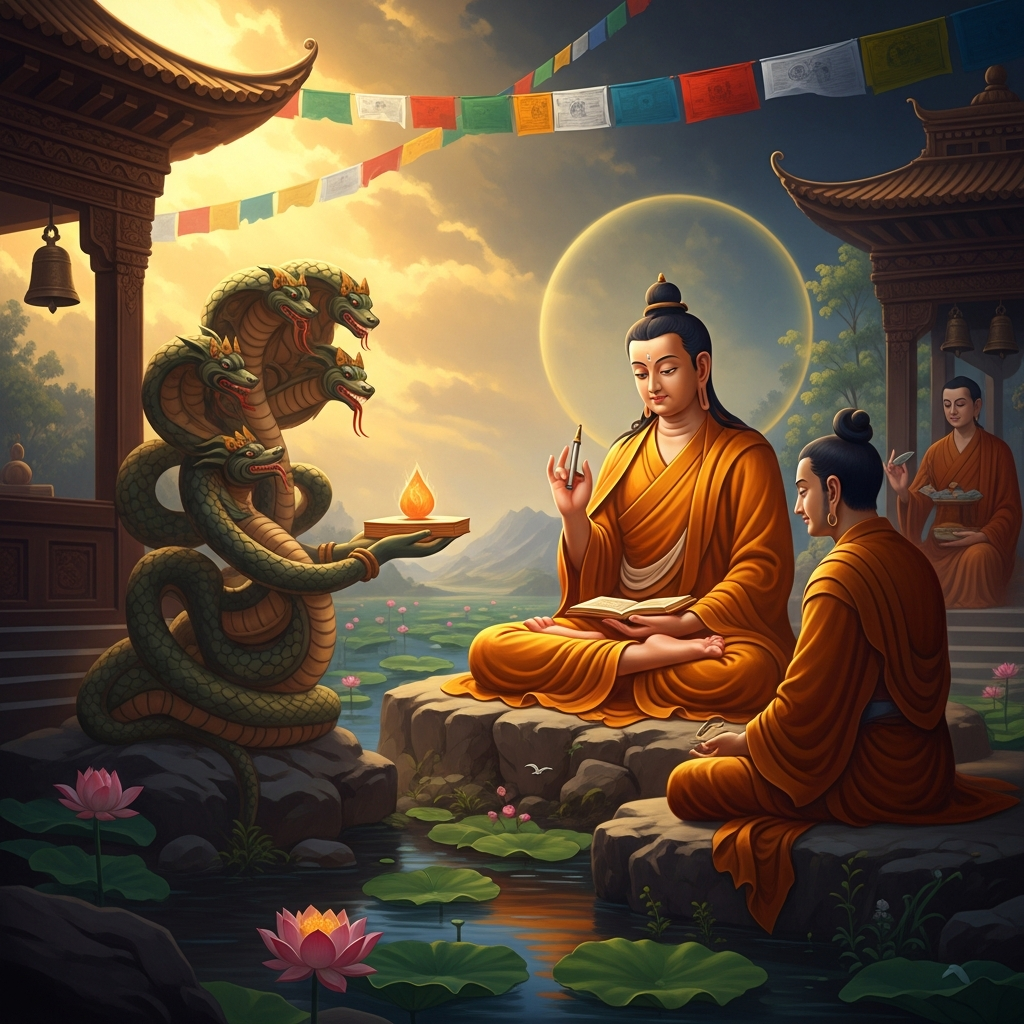
Milarepa Invites the Demons to Tea
c. 1085 CE — late 11th-century Tibet, cave retreat above Lapchi · Milarepa's cave retreat in Lapchi, Tibet — a high-altitude cave above the snowline, near the Nepali border
Contents
When demons fill Milarepa's cave and cannot be expelled by teaching or command, he opens his arms, invites them to sit, and offers his own body as hospitality — and the demons dissolve.
- When
- c. 1085 CE — late 11th-century Tibet, cave retreat above Lapchi
- Where
- Milarepa's cave retreat in Lapchi, Tibet — a high-altitude cave above the snowline, near the Nepali border
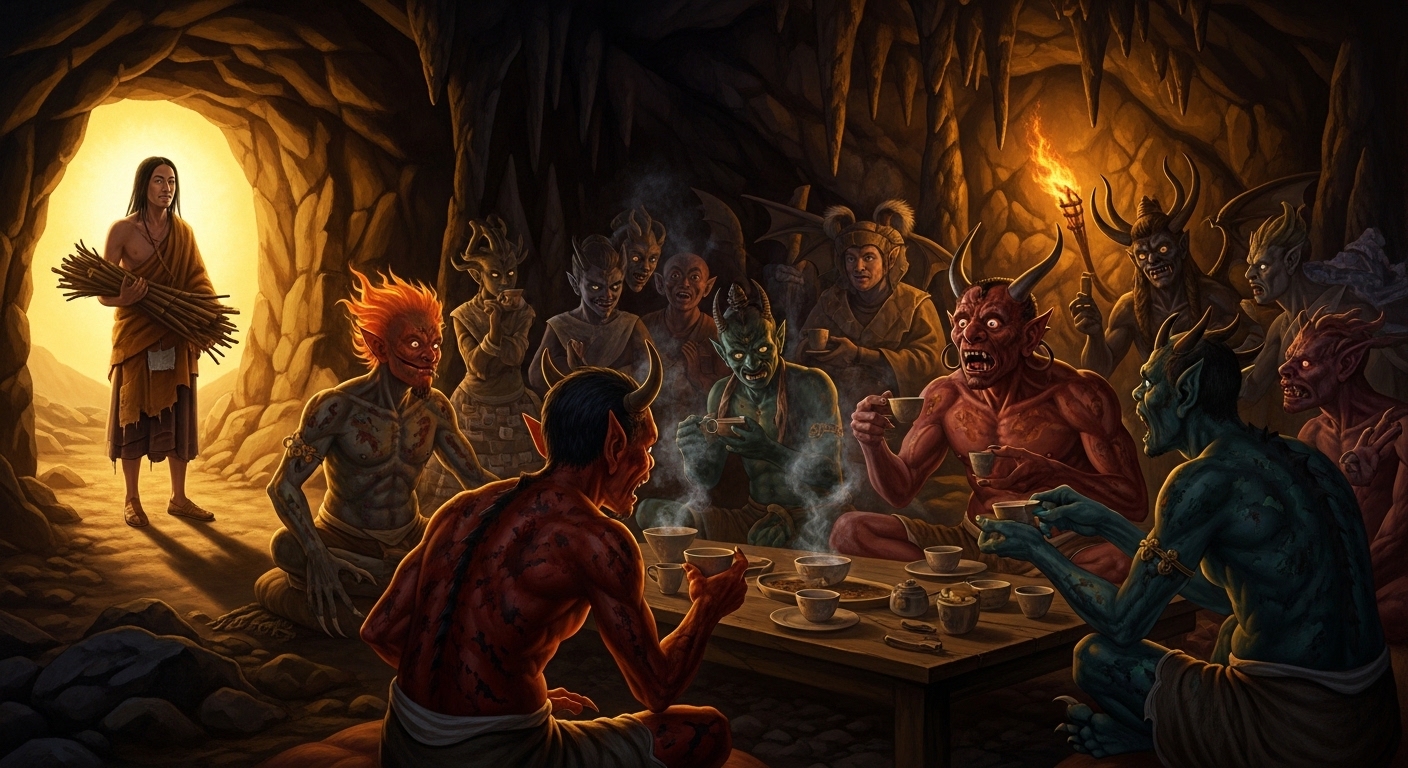
He returns to the cave after gathering firewood and finds it occupied.
There are five of them. Large, in the accounts — large the way that a fear is large when you meet it directly rather than in memory. They have taken up most of the available space. Their eyes are various colors. Their smell is the smell of rotten meat and cold stone. Milarepa stands in the cave entrance and looks at them for a moment.
He teaches them the Dharma.
This is the first response: standard, correct, rooted in the assumption that beings who cause harm do so because they have not heard the teaching. He speaks to them of impermanence. He speaks of the nature of suffering. He speaks of the possibility of liberation. The demons listen politely and do not leave.
He performs a ritual. He visualizes the protective deities. He chants the wrathful mantras that a trained Vajrayana practitioner has in his repertoire for exactly this category of encounter. He does this carefully and at length. The demons sit and wait and do not leave. One of them yawns.
He sits down and considers the situation.
The consideration takes the form of inquiry. Why are they here? Not where did they come from — that question points outward, toward sources and causes — but why here, why now, why in my cave? The cave is inside the mountain. The mountain is inside his experience. His experience is inside his mind. What is inside his mind that has taken the form of five large beings with foul breath and patient eyes?
The answer, when it arrives, does not make the demons smaller. But it changes his relationship to their size.
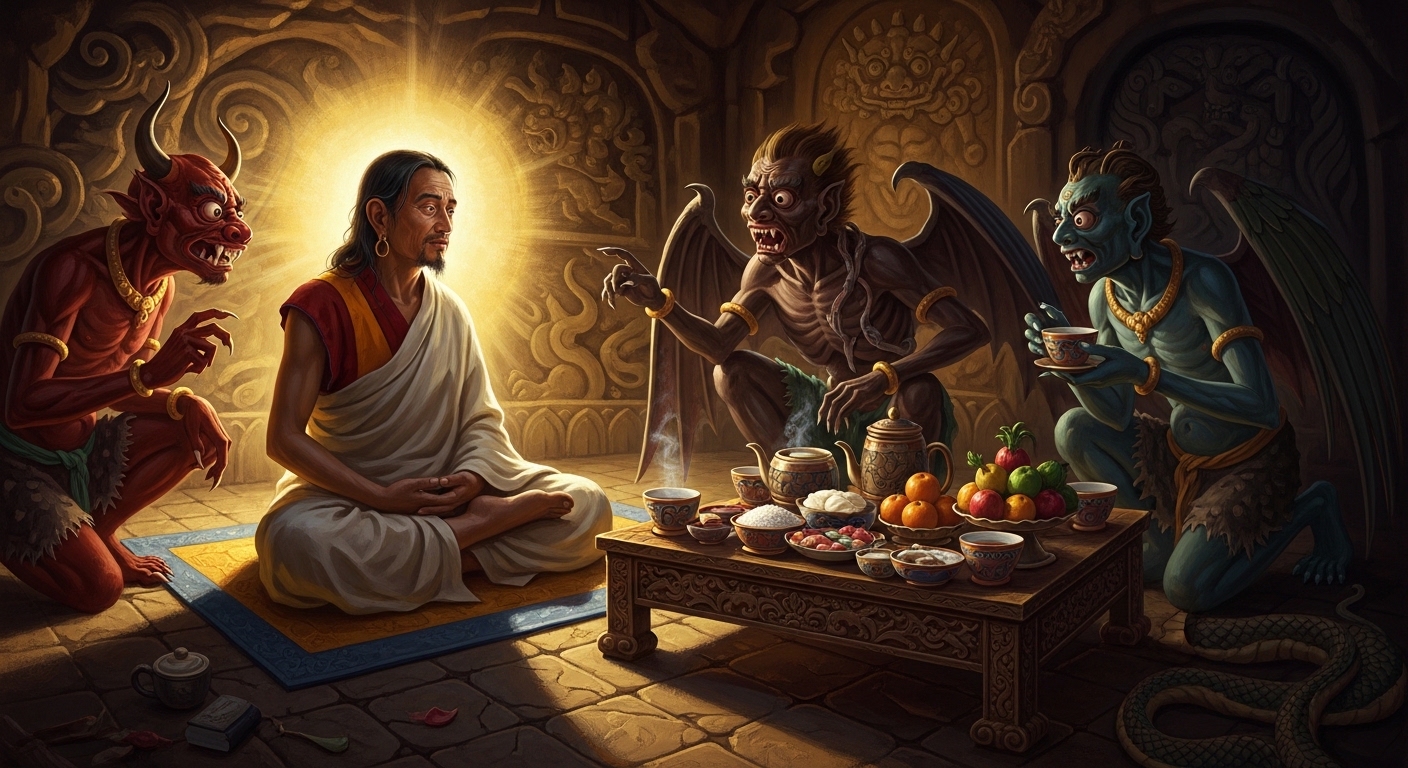
He stands. He spreads his arms in the gesture of welcome — the same gesture used to welcome an honored guest, a teacher, a traveler who has come far. He says: please, sit comfortably. It appears you are staying. Let me offer you what I have.
What he has is not much: some tea made from melted snow, the warmth of his body, the space of the cave. He offers the tea. He offers, in the formal tantric language of hospitality, his own flesh and blood, his body as food and drink, his awareness as the host. This is the gesture that will later become systematized into the Chöd practice by Machig Labdrön — but here it is not a practice, it is a response. He opens toward what he cannot defeat.
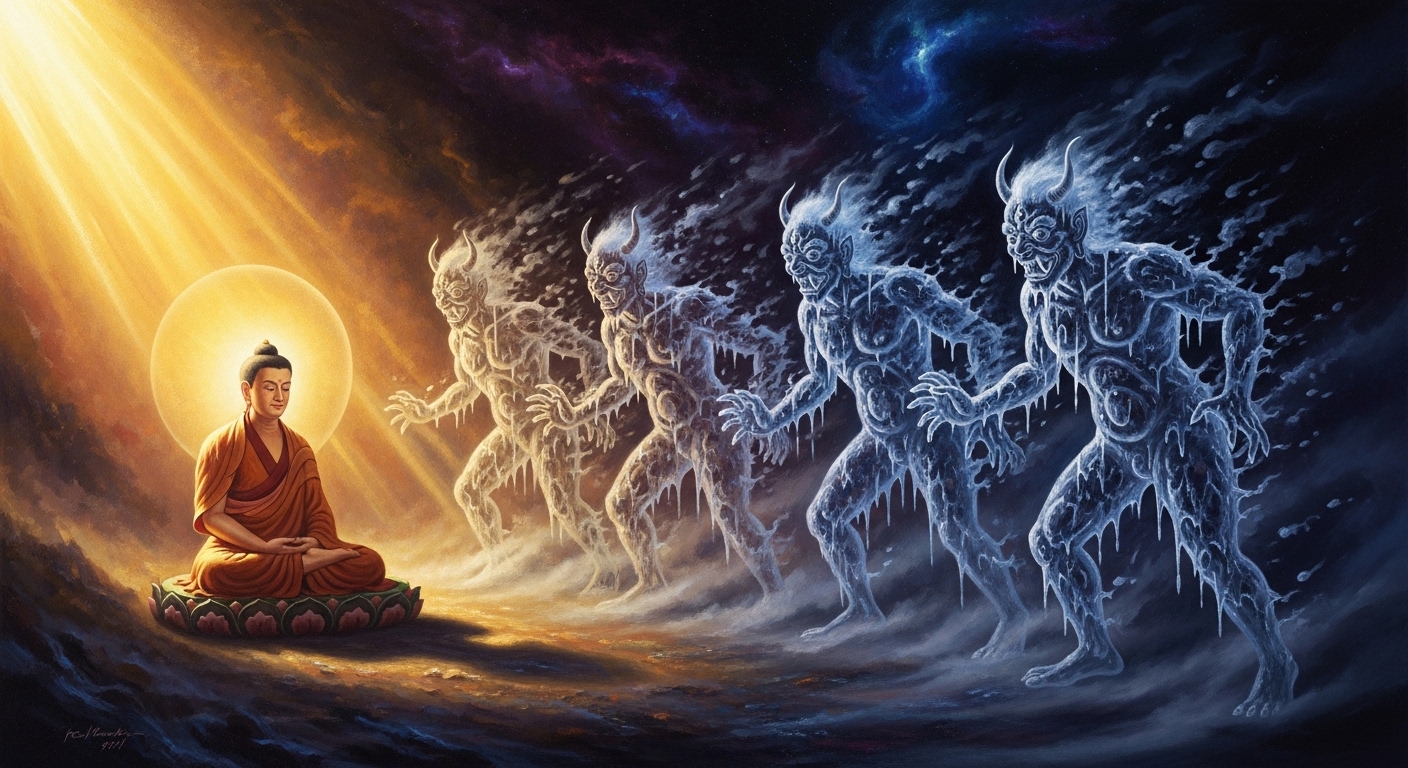
Four of the demons dissolve as though they were made of morning frost meeting sunlight.
The fifth — the largest, the one with the great curved horns — remains. Milarepa looks at it. The teaching tradition records what he does next as the decisive moment: he puts his own head into the demon’s mouth.
Not metaphorically. He places his head between the horns and presses it into the open jaws, and he stays there, not flinching, in the posture of complete surrender to the thing that frightens him most.
The fifth demon dissolves.
The cave is empty. The fire has gone low. Milarepa makes more tea.
The story enters the tradition as both instruction and koan. The instruction is: meet the fear directly; resistance is what gives it substance. The koan is: how does one put one’s head in a demon’s mouth? The answer is always the same — you discover that there is no demon’s mouth, only the space you were protecting by imagining one. But this discovery cannot be made from a distance. It requires the gesture. It requires the head going in.
His subsequent songs from the cave period return to this episode often, not as a triumph to be celebrated but as a method to be transmitted: the welcome, the hospitality, the open arms. The demons that troubled the green yogi in his high cave are the same demons that trouble every practitioner — the ones that appear precisely when practice deepens, when the mind grows quiet enough to hear what it has been drowning out with noise.
He puts his head in the mouth and the mouth is not there.
Scenes
Echoes Across Traditions
Entities
- Milarepa
- the five demons of the cave
- the great horned demon
Sources
- Garma C.C. Chang, trans., *The Hundred Thousand Songs of Milarepa* (Shambhala, 1999)
- Tsangnyön Heruka, *The Life of Milarepa*, trans. Lobsang P. Lhalungpa (Shambhala, 1984)
- Pema Chödrön, *When Things Fall Apart* (Shambhala, 1997)