Guru Rinpoche Subdues the Tibetan Demons
c. 762–779 CE — 8th-century Tibet, imperial Tibetan period · Samye, Tibet — the site of the first monastery in Tibet, in the Brahmaputra river valley east of Lhasa
Contents
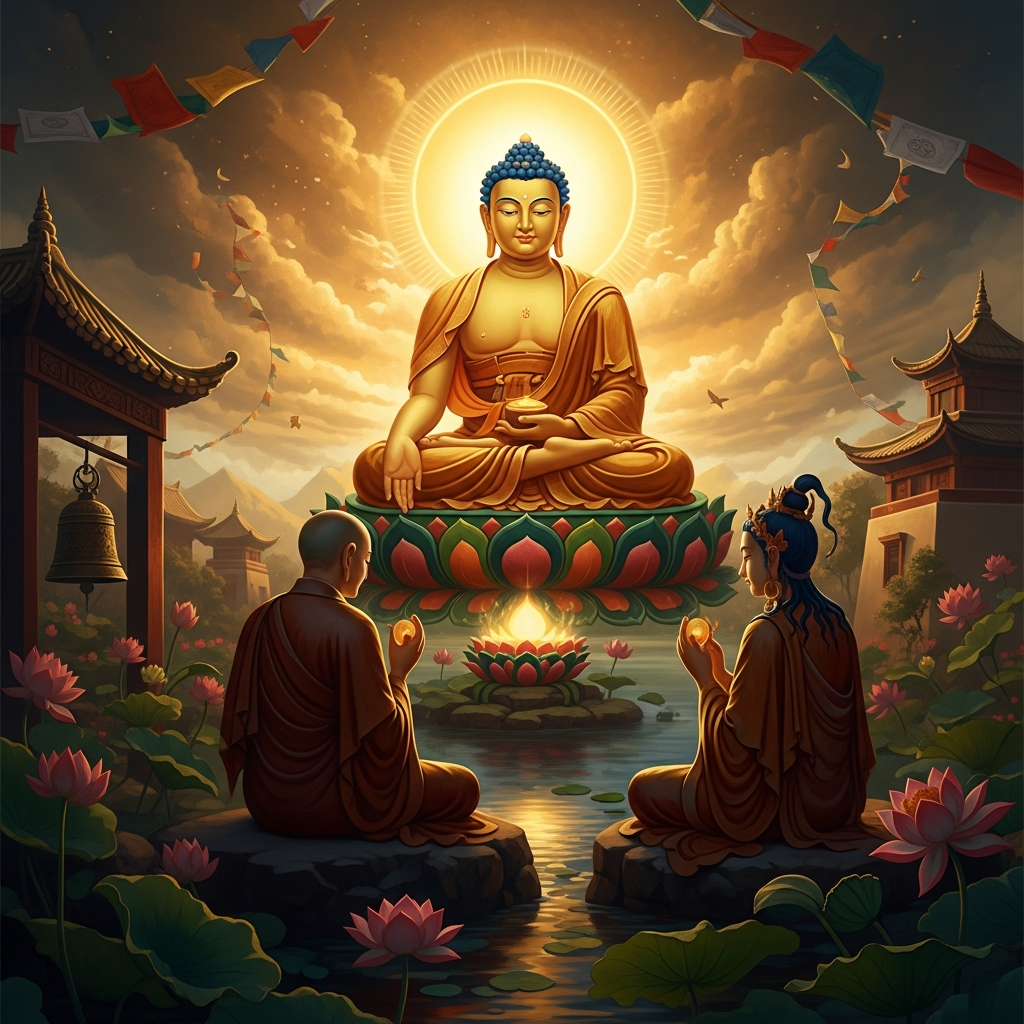
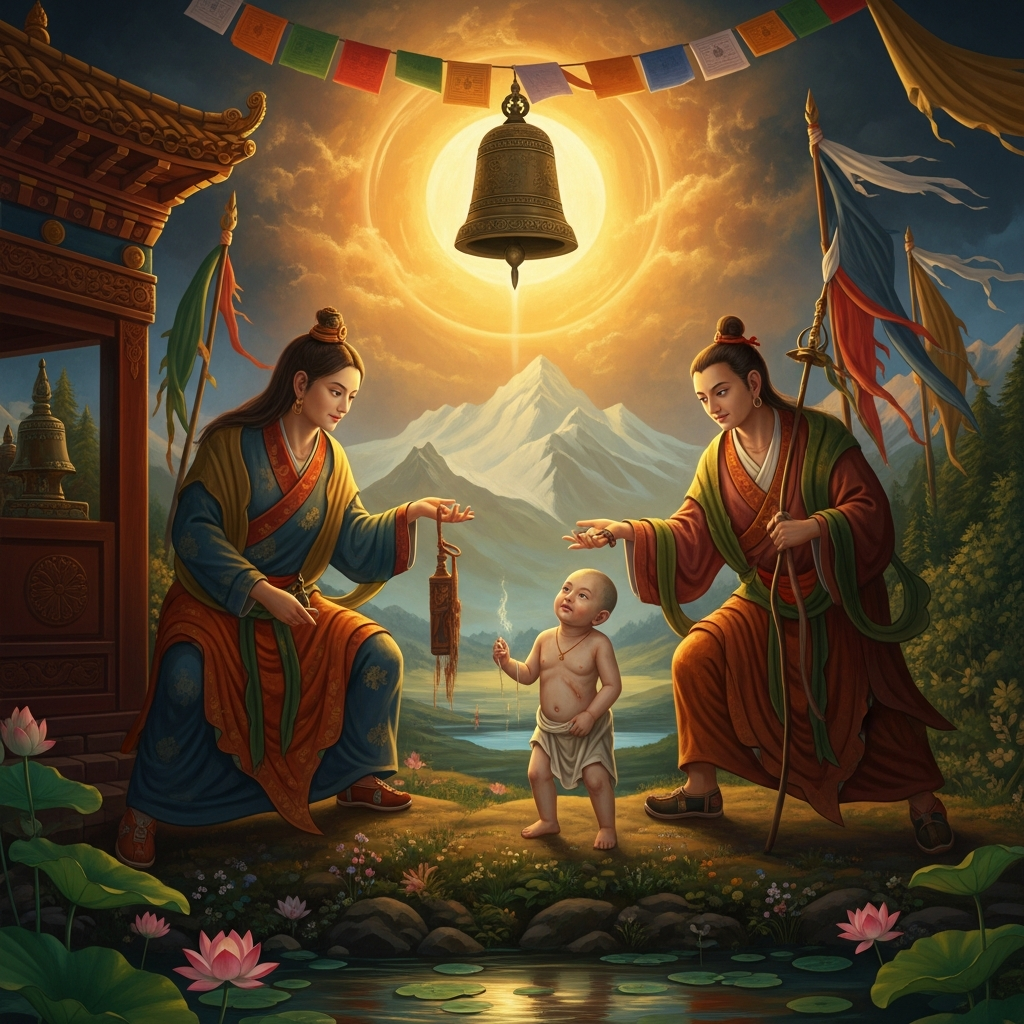
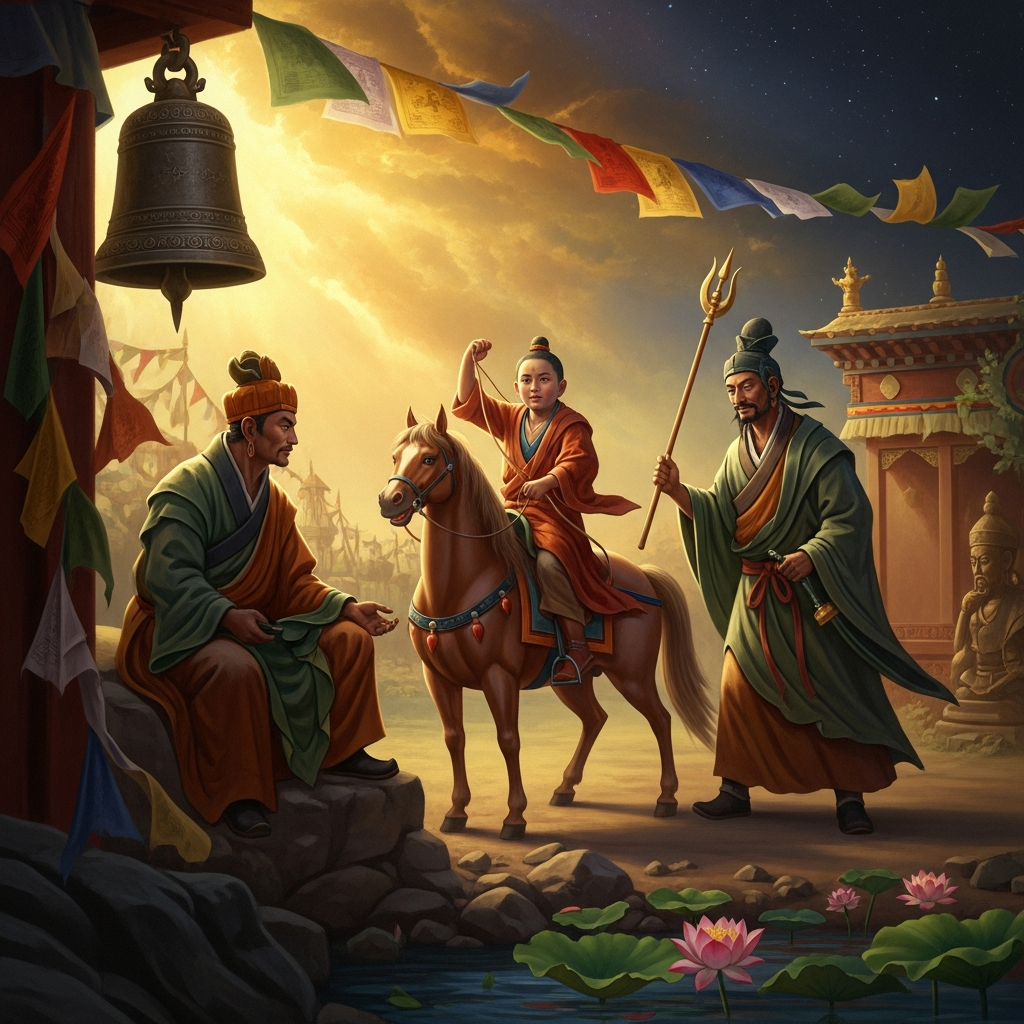
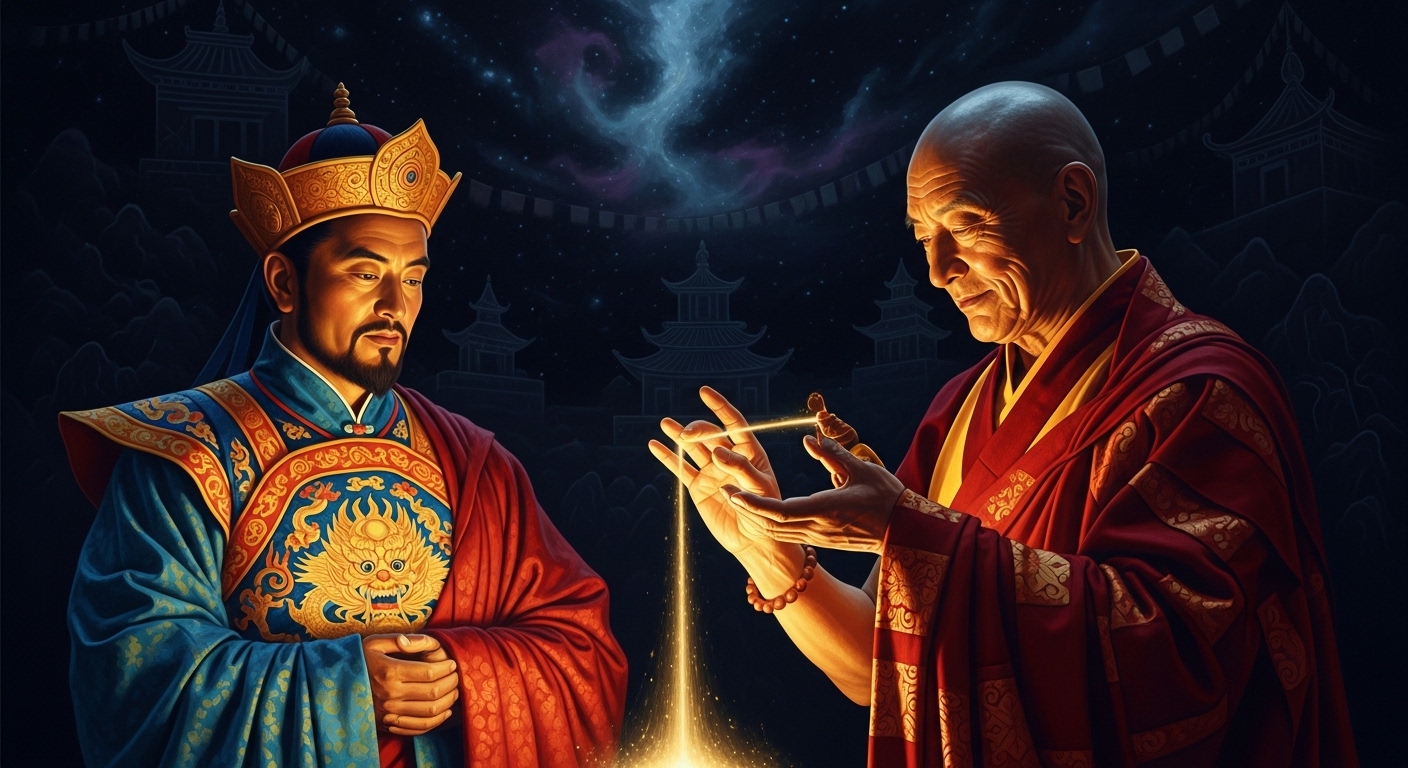
When the Dharma King Trisong Detsen brings Guru Rinpoche from India to consecrate the first Tibetan monastery, the native demons and spirits of the land resist — and Padmasambhava defeats each one by transmuting its energy into a protector of the Dharma.
- When
- c. 762–779 CE — 8th-century Tibet, imperial Tibetan period
- Where
- Samye, Tibet — the site of the first monastery in Tibet, in the Brahmaputra river valley east of Lhasa
The monk Śāntarakṣita arrives first and fails.
He is India’s most distinguished Buddhist philosopher — a man of absolute integrity and genuine realization, the abbot of Nalanda. King Trisong Detsen has invited him to Tibet to establish Buddhism, to build the first monastery at Samye. Śāntarakṣita begins laying foundations. The spirits of the land tear them down in the night. He tries again; they tear it down again. He does not have the necessary relationship with the Tibetan spirits — he knows how to teach the Dharma, but he does not know how to speak to the indigenous powers of the high plateau, the nāgas of the mountains, the dü and tsen and gongpo who have inhabited this land since before India knew Tibet’s name.
Śāntarakṣita tells the king: you need Padmasambhava.
Padmasambhava is not easy to locate. He moves through the world in a way that confounds ordinary tracking. He is from Oḍḍiyāna in the northwest, a land that may be the Swat Valley — a country at the intersection of Buddhism, Shaivism, and the old shamanic traditions of Central Asia. He has studied with human and non-human teachers. He has eight manifestations, eight names, eight aspects. He carries a khatvanga staff from which tiny skulls dangle. He arrives at the Tibetan border already knowing why he has been sent for.
At the border the first spirits come out to test him.
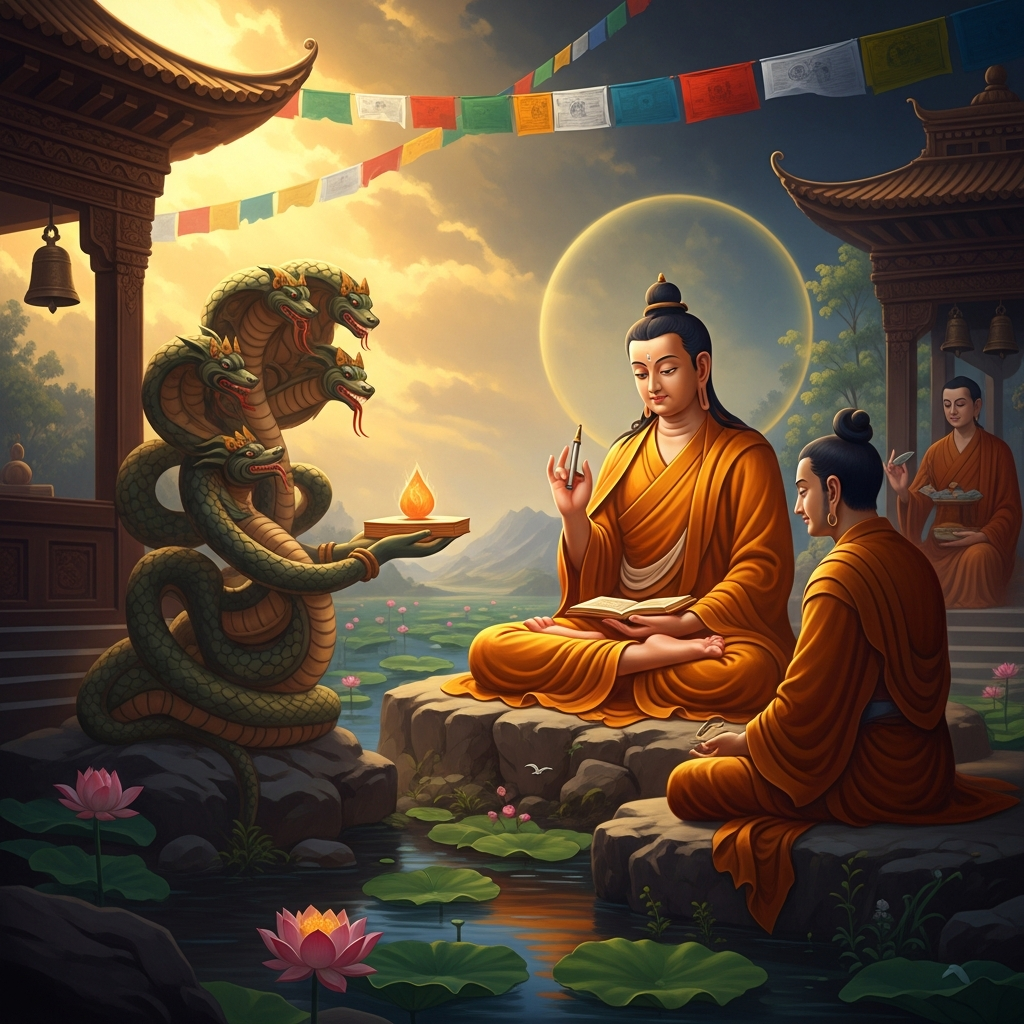
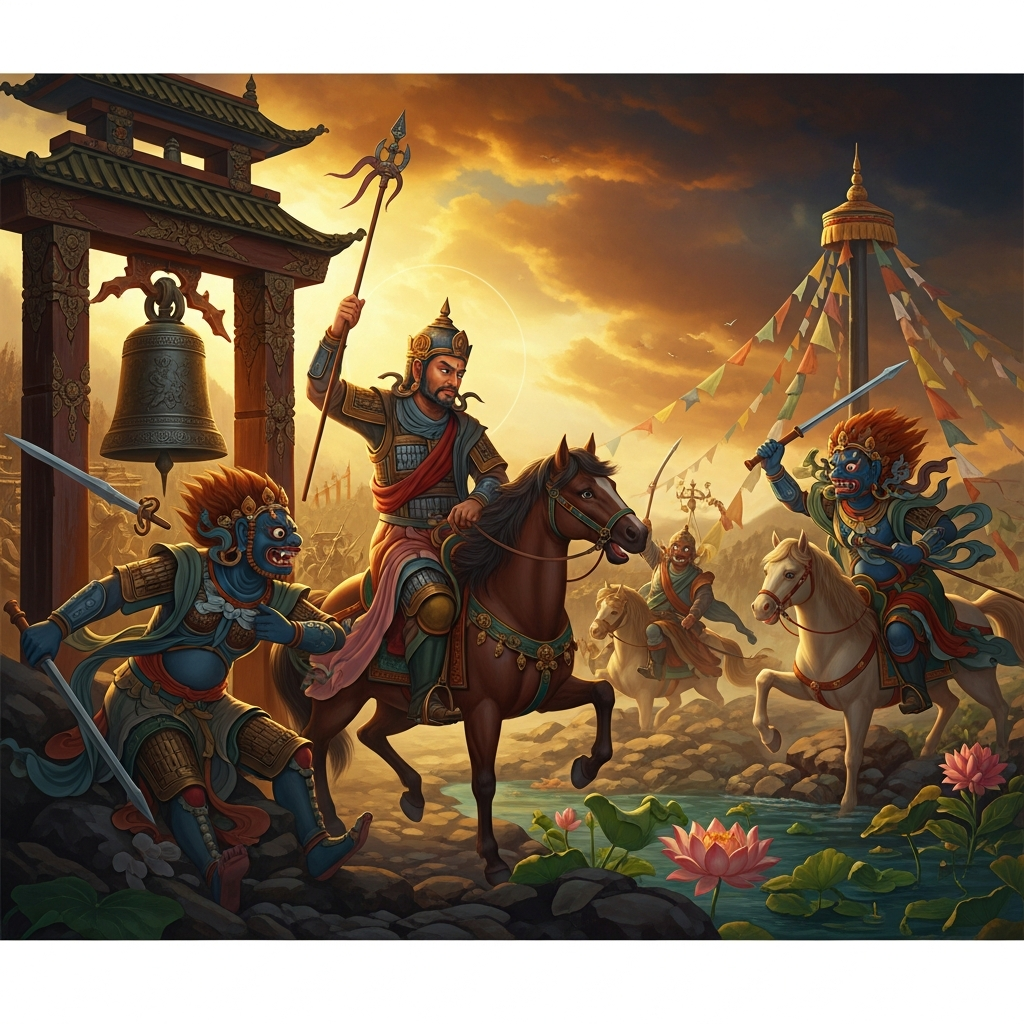
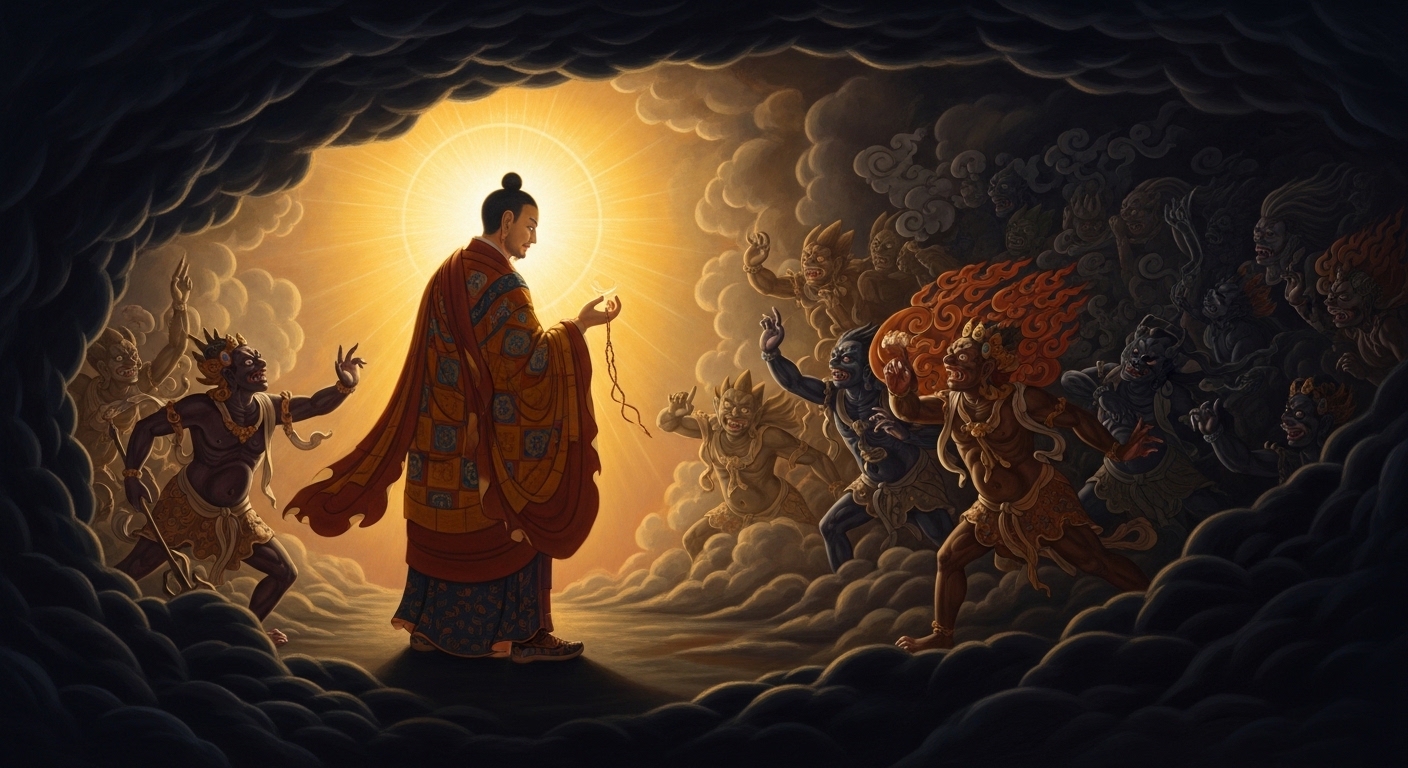
The nāgas of the mountain passes coil in the road. Padmasambhava looks at them. He does not perform the ritual that drives spirits away. He performs the ritual that binds them into service — the wrathful hung syllable, the mudra of power, the visualization of himself as Vajrakilaya, the deity whose triangular iron stake can pin any spirit to earth. The nāgas submit. He makes them vow. He gives them, in exchange for the vow, a protected role: guardians of the passes, attendants of the monastery, protectors whose power is now pointed toward the Dharma rather than against it.
He does this systematically. The great mountain goddess Gongkar Wangchuk, who has been storming the construction site with hail and earthquake — Padmasambhava meets her at her mountain, receives her attack without flinching, and transforms it. She becomes Palden Lhamo, one of the great protectors of Tibetan Buddhism, still active, still fierce, her energy unchanged but her orientation reversed.
The Twelve Tenma goddesses who rule different regions of Tibet are subdued one by one. Each one becomes a Dharma protector. Each subjugation follows the same pattern: the spirit attacks, Padmasambhava manifests in a form equal to or exceeding the spirit’s power, there is a confrontation in which the spirit discovers it cannot win, and then there is the vow and the integration.
The foundation of Samye monastery holds.
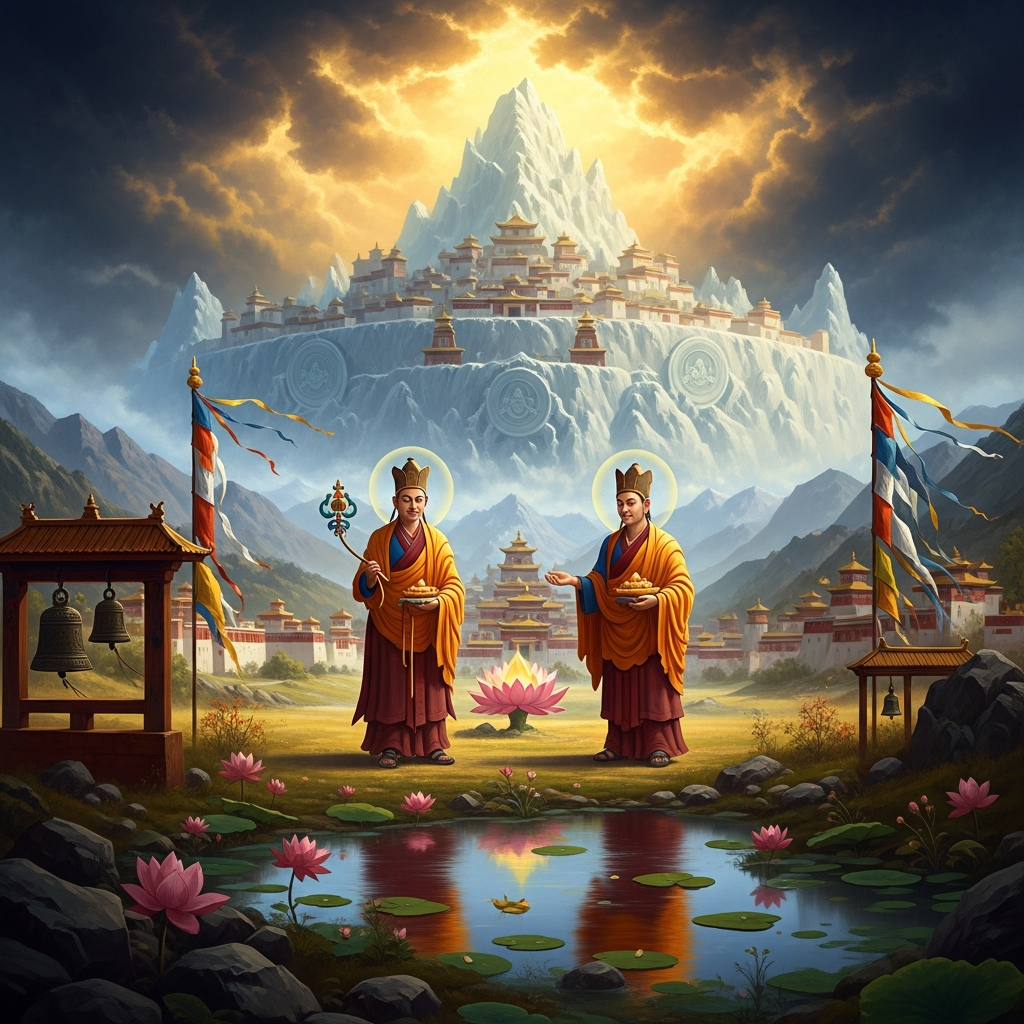
Śāntarakṣita performs the consecration. The king watches. The monastery rises in three stories, representing the three realms of Buddhist cosmology, and its style combines Indian, Chinese, and Tibetan architectural elements — a building that is itself a statement about synthesis, about the bringing together of traditions that had previously been separate.
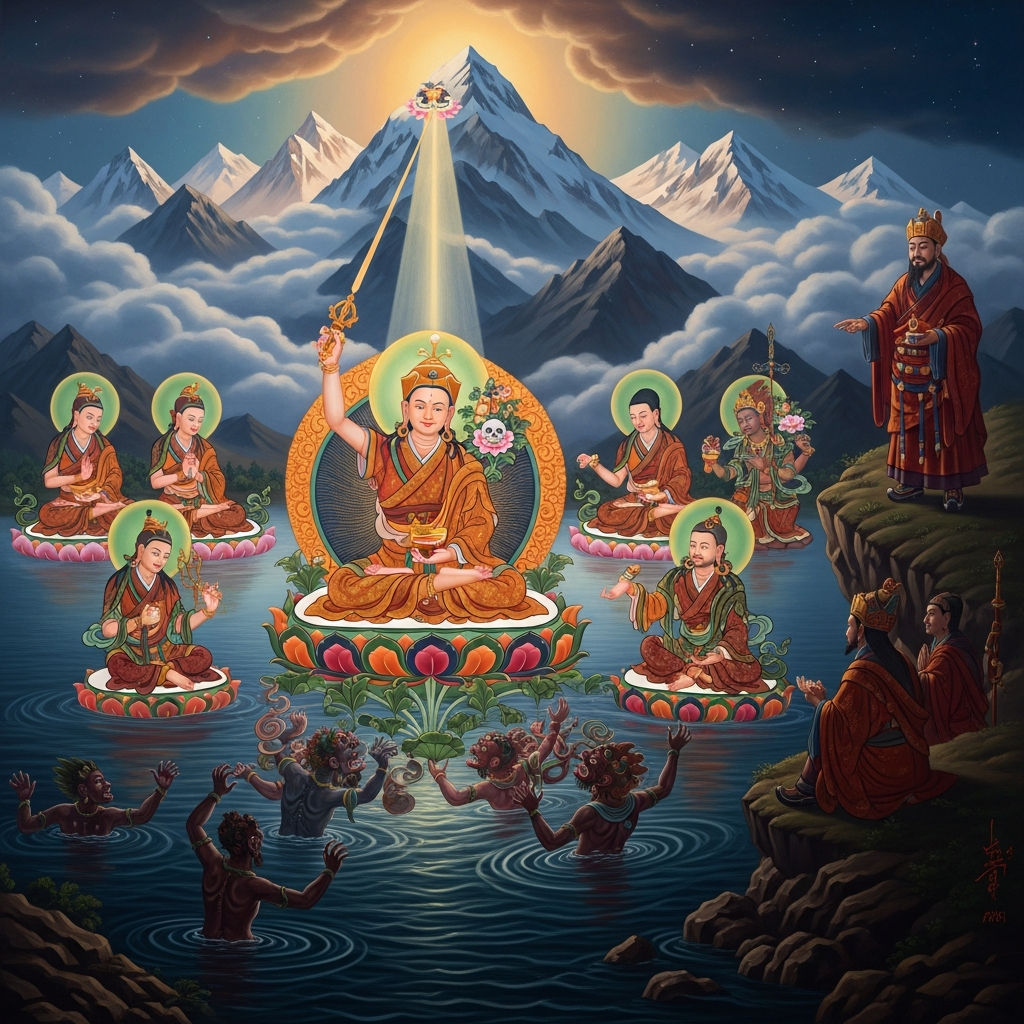
Padmasambhava travels through Tibet after this, hiding teachings in rocks and lakes and caves — the terma treasures that will be discovered by revelation in future centuries when the teachings are needed. He is planting a library in the landscape. He is making the land itself a vehicle of transmission.
What he has accomplished at Samye is something the straightforward method of Śāntarakṣita could not: he has made the Tibetan land Buddhist from the inside. The spirits are still there. Their power is unchanged. But they have been turned, the way a river is turned by a skilled engineer — not blocked, not eliminated, redirected. The new monastery stands in a landscape that was hostile to it and is now protective of it, because the hostility and the protection were always the same energy, requiring only the right practitioner to reveal the transformation.
He leaves Tibet eventually, departing from a cliff in the southwest and dissolving into rainbow light. But the vows he extracted from the mountain spirits still hold. The Tibetan plateau remains, by his arrangement, a protected field.
Scenes
Echoes Across Traditions
Entities
- Padmasambhava (Guru Rinpoche)
- King Trisong Detsen
- Śāntarakṣita
- the nāgas of the land
- the demons of the Tibetan highlands
Sources
- Yeshe Tsogyal, *The Lotus-Born: The Life Story of Padmasambhava*, trans. Erik Pema Kunsang (Rangjung Yeshe, 1993)
- Dudjom Rinpoche, *The Nyingma School of Tibetan Buddhism* (Wisdom Publications, 1991)
- Tenzin Wangyal Rinpoche, *Wonders of the Natural Mind* (Snow Lion, 2000)