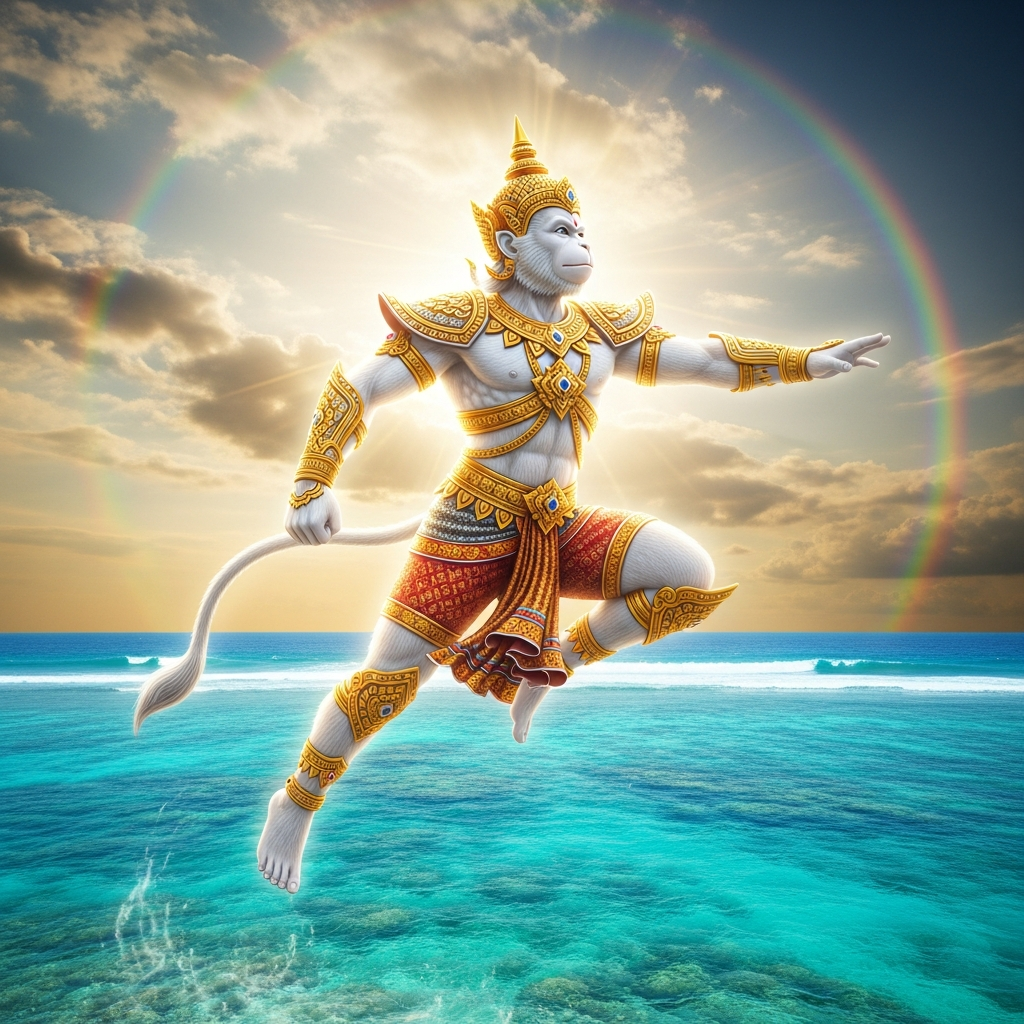
Hanuman in the Thai Ramakien
Thai Ramakien formalized in Ayutthaya period c. 14th–18th century CE; possibly older oral traditions · The celestial kingdom; the ocean between Lanka and the mainland; Lanka itself
Contents
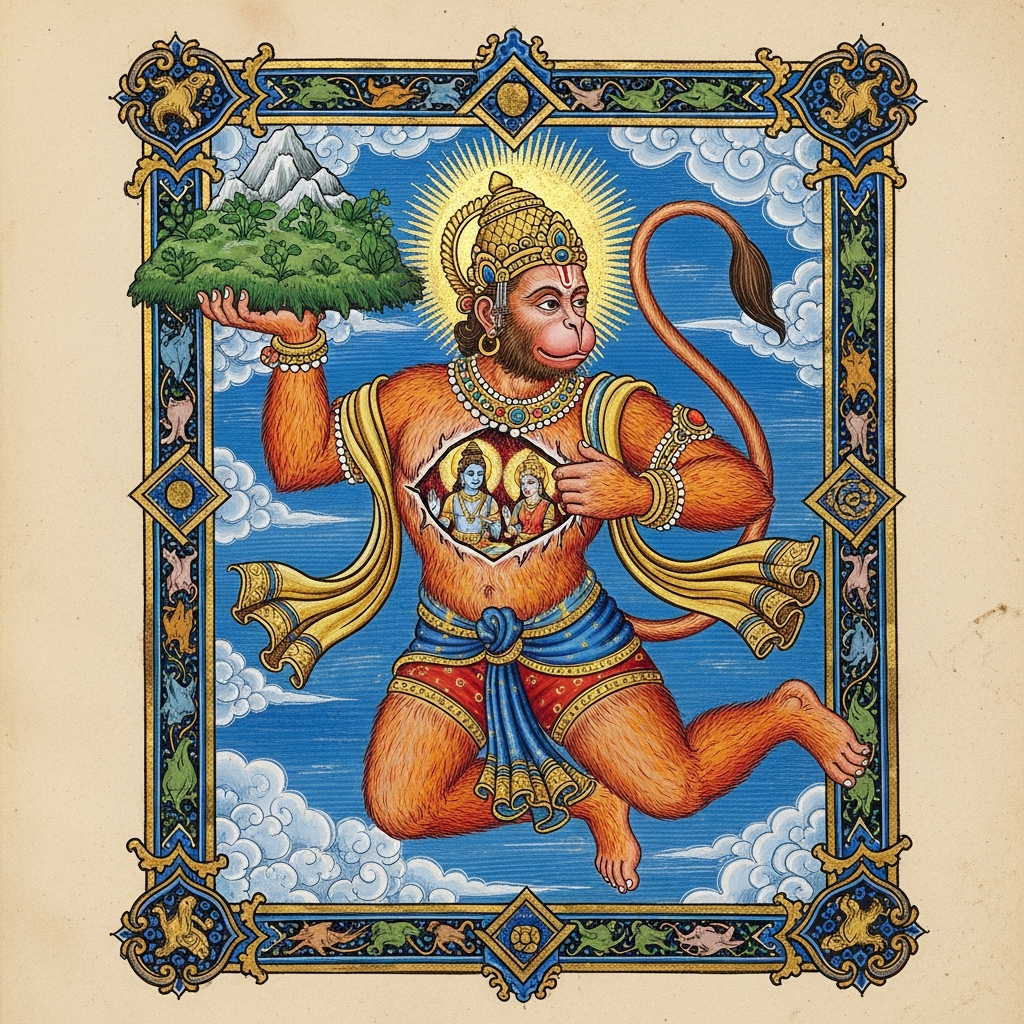
In the Thai telling of the Ramayana, Hanuman is a more complex figure: a shapeshifter, a lover, a general — and when he is sent to deliver Rama's ring to Sita, he first falls in love with a mermaid and has a son. The Thai Ramakien preserves a Southeast Asian Hanuman quite different from the purely devoted servant of the Sanskrit text.
- When
- Thai Ramakien formalized in Ayutthaya period c. 14th–18th century CE; possibly older oral traditions
- Where
- The celestial kingdom; the ocean between Lanka and the mainland; Lanka itself
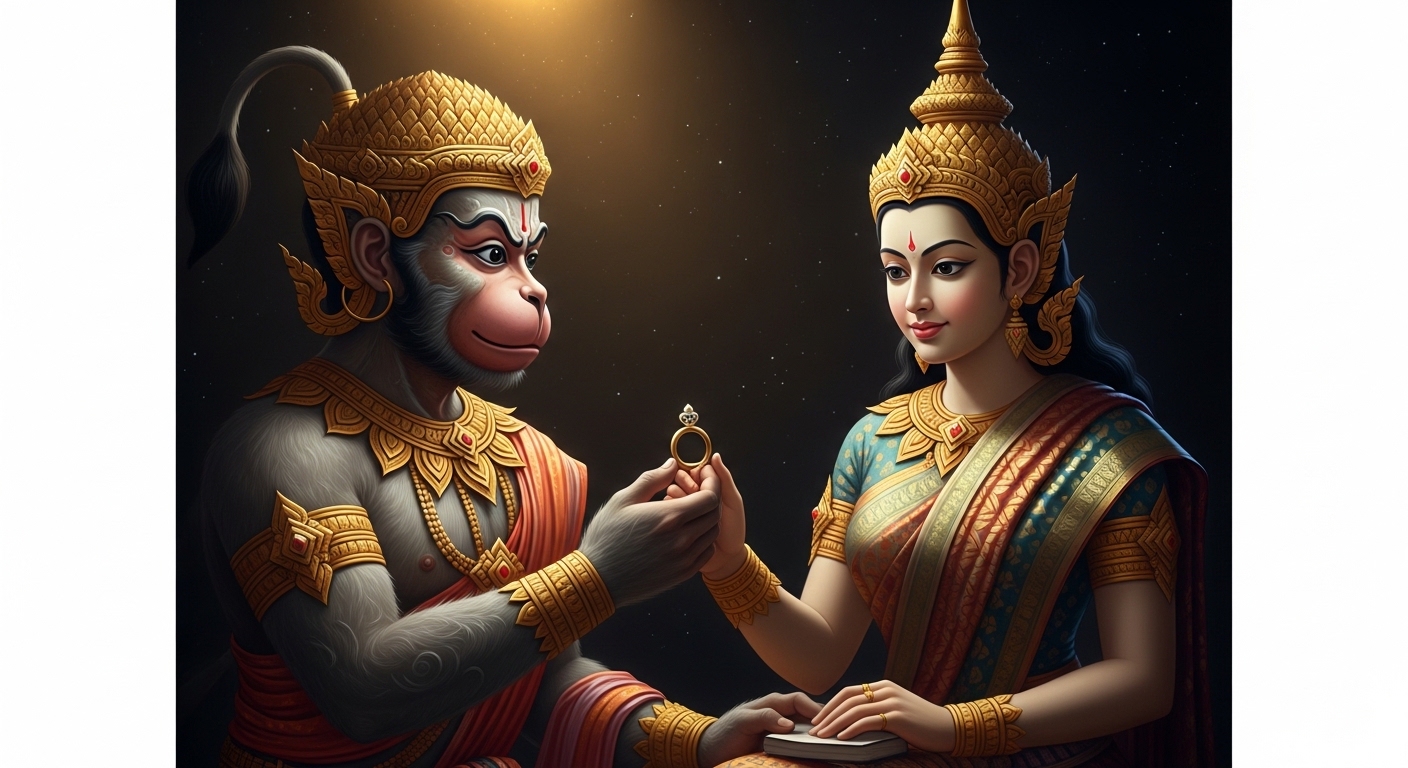
Phra Ram gives Hanuman a ring.
It is the ring that Sida will recognize — the signet, the token, the proof that the messenger comes from the one she loves. Hanuman has been assigned the hardest task of the war: to cross the ocean to Lanka, to find the captive princess, to give her hope. He is the only one who can do it. He is the only one with both the divine power to make the crossing and the cunning to survive in the demon’s kingdom.
He dives into the ocean.
This is where the Thai story diverges.
In Valmiki’s Sanskrit telling, Hanuman crosses the ocean in one tremendous leap — a single bound from the Indian shore to Lanka, a feat of divine athleticism that is the most celebrated moment of the Sundara Kanda. He finds Sita. He gives her Rama’s ring. He burns Lanka. He returns. The mission is clean, the devotion absolute.
In the Thai Ramakien, Hanuman goes into the water.
And in the water is Suvannamaccha.
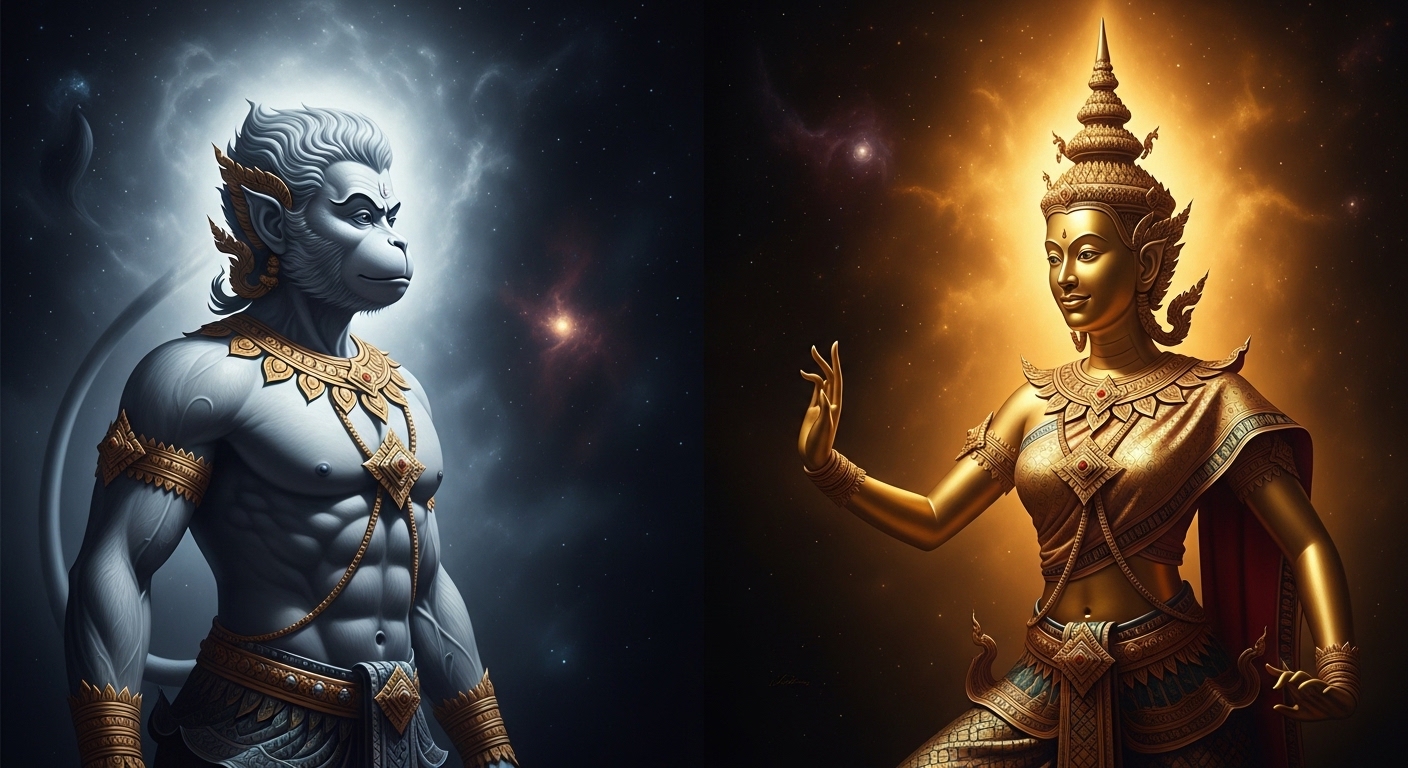
She is the golden mermaid — suvannamaccha means “golden fish” in Thai — the daughter of the demon king Totsakan (Ravana), beautiful from the waist up and fish-tailed below, her scales the color of hammered gold. She has been sent by her father to disrupt the construction of the causeway that Rama’s monkey army is building across the sea. Every night, her mermaid army pulls the stones that the monkey workers have piled during the day and scatters them across the ocean floor.
Hanuman finds her in the water.
He is white as the moon. She is gold as the sun. They fight — a battle that is immediately also a courtship, the way battles between equals sometimes are in epic literature — and Hanuman wins, and Suvannamaccha laughs, and instead of killing him she falls in love with him, and instead of continuing his mission he stays.
He stays for a long time.
They have a son.
The son is named Macchanu — half-monkey, half-fish, able to move through water as easily as through air, with his father’s white fur and his mother’s tail. He will appear later in the Ramakien as a warrior in his own right, fighting for his father’s side in the war against Lanka without knowing, at first, who his father is. The recognition scene between Hanuman and Macchanu is one of the most moving passages in the Thai epic: the father and the son who was born in his absence, the love that never had a domestic form, the war that tears families apart even across the lines of battle.
But that is later.
For now, Hanuman is in the ocean with Suvannamaccha, and she is telling her maidens to put back the stones they have scattered, and the causeway is being built, and eventually — eventually — Hanuman remembers the ring.
He remembers Phra Ram. He remembers Sida. He remembers what he came for.
He surfaces. He continues. He crosses the rest of the ocean in the leap that the Sanskrit text would recognize. He finds Sida in the ashoka garden, alone and grief-worn, and he gives her the ring, and she weeps, and she gives him her own token to carry back — a flower from her hair.
The mission is complete. The mission that took the detour. The mission that produced a son Hanuman will not raise.
This is what the Thai tradition adds to the Ramayana, and the addition is not incidental. The Thai Hanuman is not purely a vehicle for devotion. He is capable of love that competes with duty. He has children he cannot fully claim. He carries the weight of a relationship left underwater while he flew to Lanka.
The Thai performance tradition — the khon masked dance-drama, in which all major characters wear elaborate gilded papier-mâché masks — gives Hanuman a white mask with a grinning mouth and elaborate headdress. In the murals that cover the galleries of Wat Phra Kaew, the Temple of the Emerald Buddha in Bangkok, Hanuman appears hundreds of times: fighting, leaping, negotiating, dancing. He is the most energetically present figure in Thai sacred art.
He is beloved precisely because he is not purely good. He is the divine servant who also fell in love with a mermaid. He is the holy warrior who has a son in the sea. He holds the contradictions that actual human beings hold: the desire to serve and the desire to love, the mission and the detour, the ring in his fist and the face of the golden fish-woman in his memory.
In Thai Buddhist culture, where renunciation is the highest ideal and yet the world is full of attachment and beauty and the pull of the senses, Hanuman is the figure who honestly represents the struggle. He does not pretend the mermaid was not beautiful. He does not pretend the son in the water does not exist. He returns to his mission anyway.
That is the Thai answer to Valmiki’s pure devotion: not a simpler version, but a more honest one.
The ring was delivered. Sida was found. The war was won. And somewhere in the ocean between the mainland and Lanka, Macchanu swims with his father’s white fur and his mother’s golden scales, waiting for the recognition scene.
Scenes
Echoes Across Traditions
Entities
- Hanuman
- Sida (Sita)
- Phra Ram (Rama)
- Suvannamaccha the mermaid
- Macchanu
Sources
- King Rama I (Phrabat Somdet Phra Buddha Yodfa Chulaloke), *Ramakien* (1797 CE)
- M.R. Chakraborti, *Hanuman in Art, Culture, Thought and Literature* (1994)
- Singaravelu Sachithanantham, 'A Comparative Study of the Sanskrit, Tamil, Thai and Malay Versions of the Story of Rama,' *Journal of the Siam Society* 56.2 (1968)
- Mattani Mojdara Rutnin, *Dance, Drama and Theatre in Thailand* (1993)
- Kamala Tiyavanich, *The Buddha in the Jungle* (2003) — Thai Buddhist narrative context