Contents
A wandering dervish from Tabriz stops the most celebrated professor of Islamic law in Konya with a single question about Bayāzīd and the Prophet — and in the moment Rumi cannot answer, something inside him breaks open that never closes again.
- When
- November 1244 CE — Konya, Anatolia, during the Seljuk period
- Where
- Konya, Anatolia — a caravanserai or a street near the inn of the sugar merchants, accounts differ
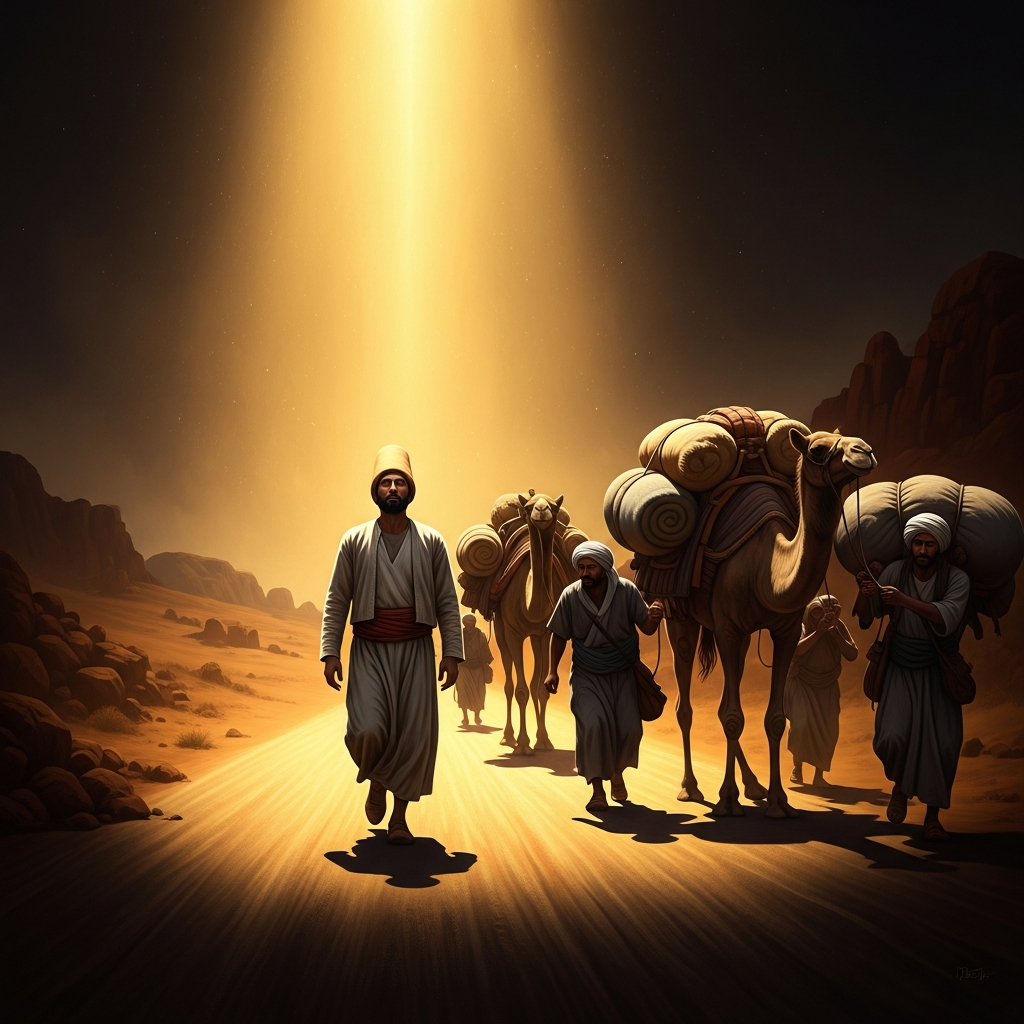
The man arrives on foot, wearing a rough black cloak.
He is not young — somewhere in his late sixties, though he claims not to know his age. He has been moving from city to city for years, in the way certain Sufi wanderers do: not homeless, exactly, but refusing every home that would make him comfortable. He carries the style of one who has mastered the art of being uncomfortable everywhere. In Tabriz they called him a troublemaker. In Damascus he was sought by scholars and then avoided by them. He himself says, in his own recorded discourses, that he is looking for something he cannot name yet, but that he will know it when he sees it.
In November of 1244, he enters Konya.
Jalal al-Din Rumi is forty years old and at the height of his eminence.
His father Baha’uddin Walad was a famous mystic and jurist; his family had fled Central Asia before the Mongol advance, traveling through Baghdad and Mecca and Syria before settling in Konya under Seljuk protection. Rumi has inherited his father’s position, expanded it, exceeded it. He lectures to hundreds of students. He has mastered the four schools of Islamic law, the sciences of hadith and tafsir, the principles of Sufi practice as transmitted through his father’s lineage. Men come from every city in the region to study with him. He is, by all the measures his world has for measuring, a complete man.
He is also, though only he knows it, restless in a way he cannot explain.
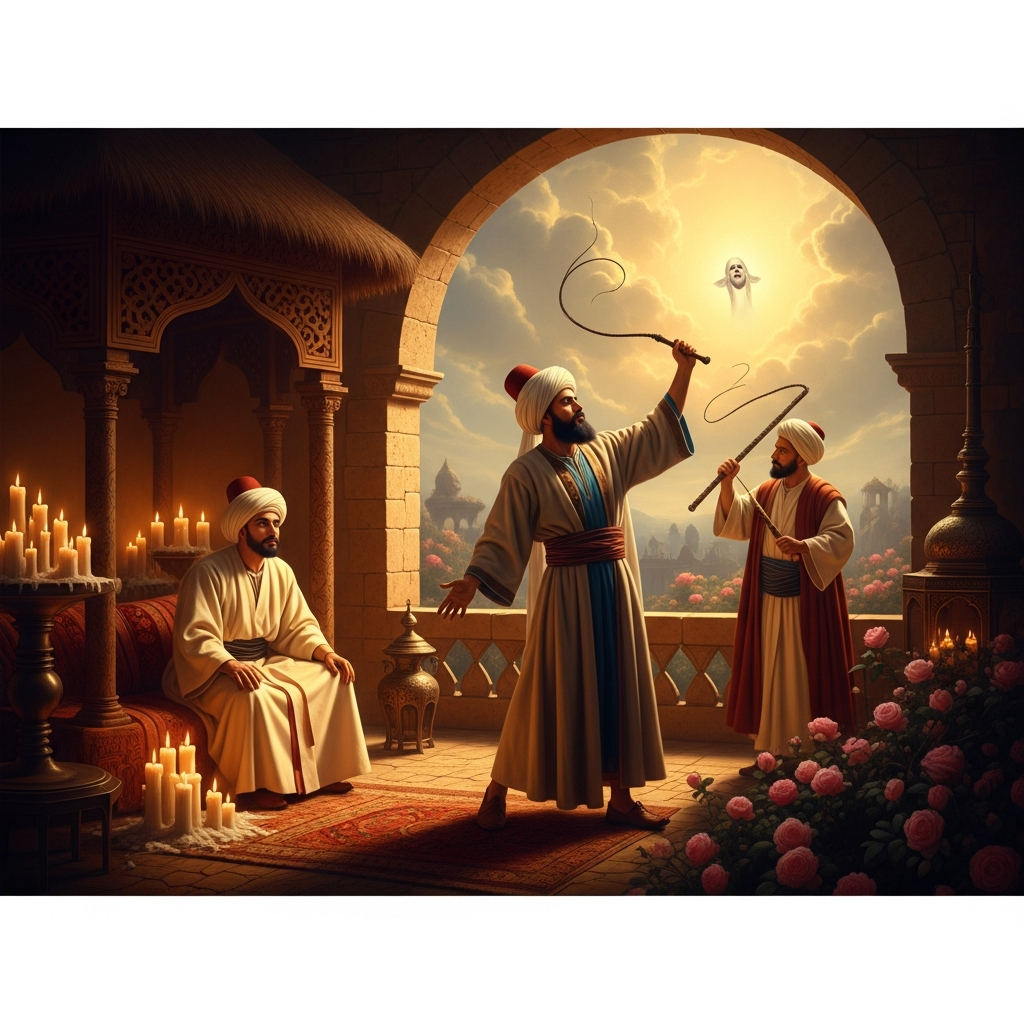
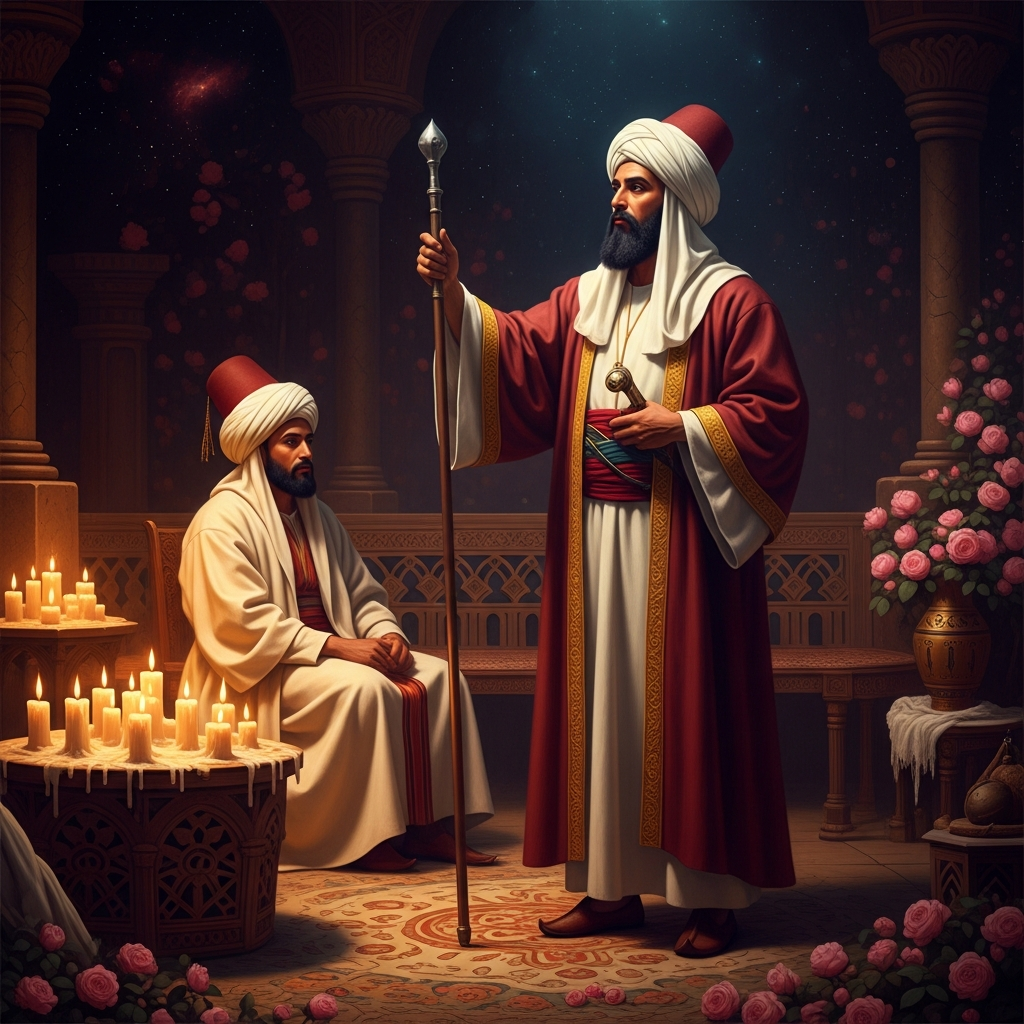
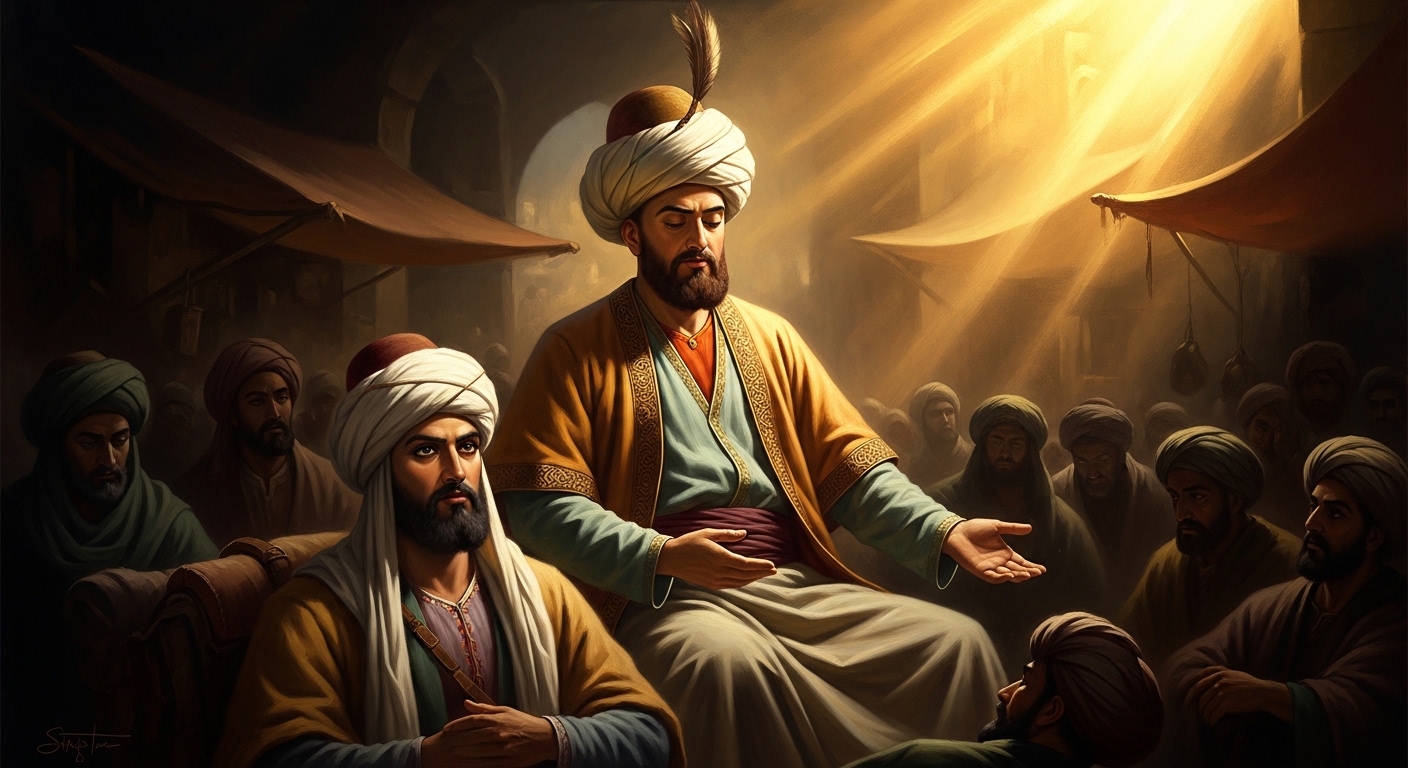
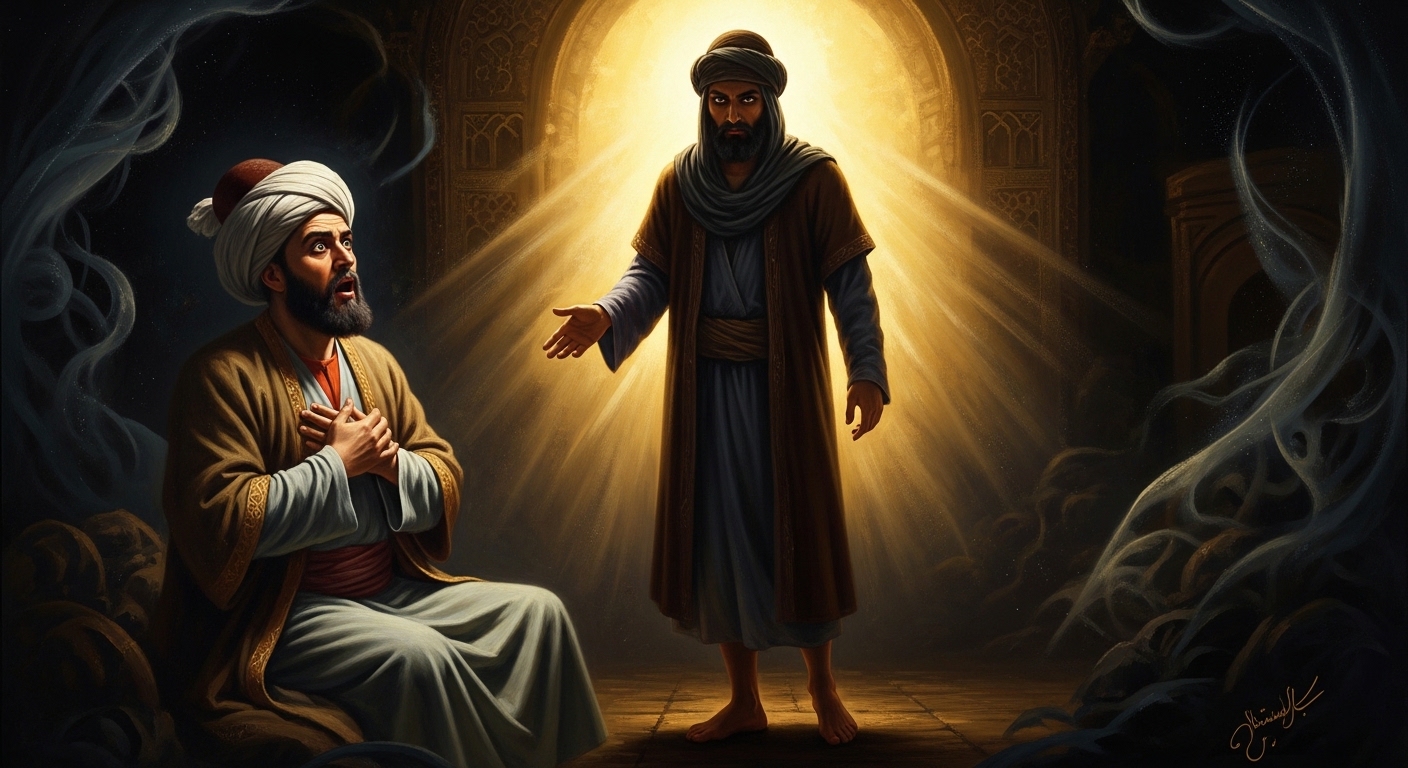
The wanderer in the black cloak finds him — the accounts differ on where, whether at the inn of the sugar merchants or on the street outside it. The meeting is historically documented, which is unusual for such encounters. What is less certain is the precise form the question took. The most widely cited version goes like this: Shams seizes Rumi’s mule by the bridle and asks, Who was greater — Bayāzīd Bastāmī or the Prophet Muhammad, peace be upon him?
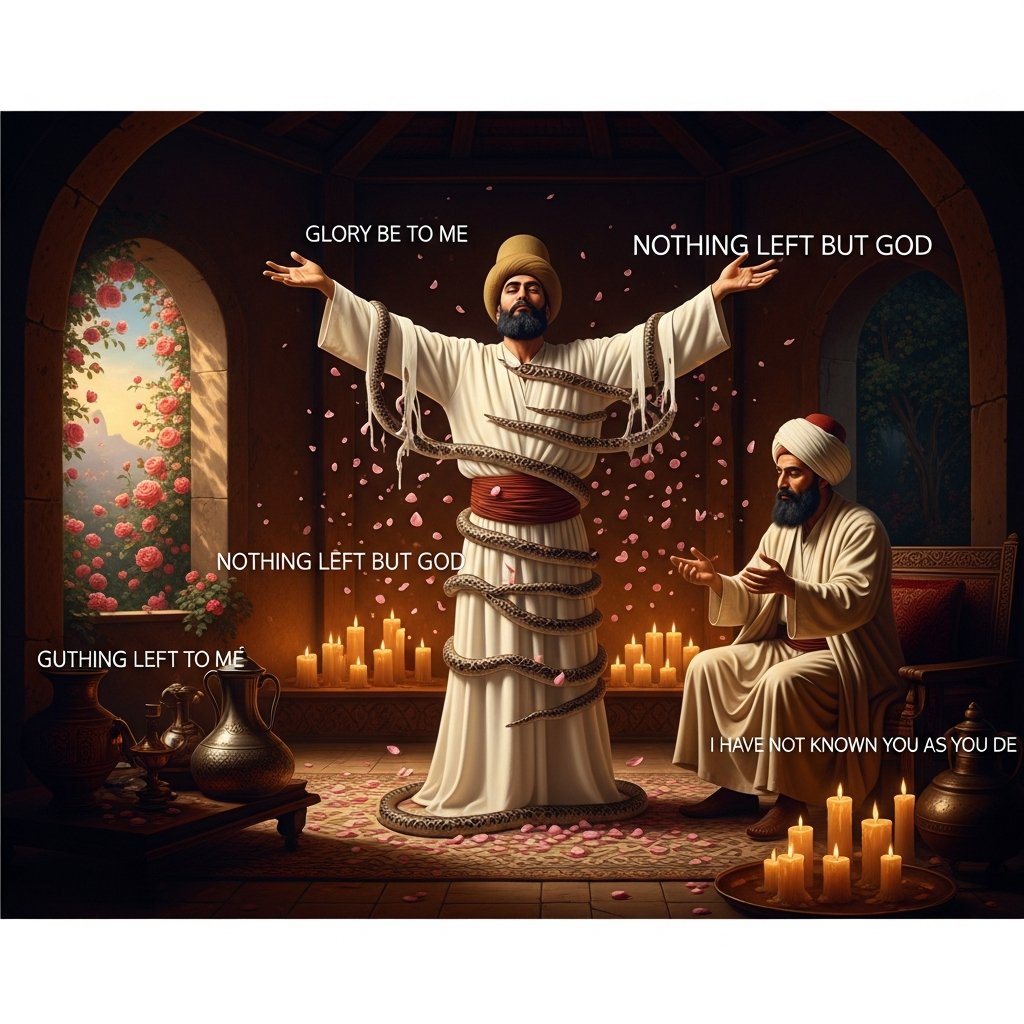
The question is a trap if you’re thinking about it wrong. The obvious answer — the Prophet, of course — is true but misses the point. Bayāzīd, the great mystic of Bastam, famously said Glory be to me, how great is my station in a moment of divine absorption. The Prophet, arriving at the closest proximity any human had reached to God in the Night Journey, said only Glory be to You — I have no knowledge except what You have given me. Shams is asking: why did the Prophet, with more direct access to God, speak with more humility? What does this say about the nature of closeness to God?
Rumi answers. He gives the answer a learned man gives. And Shams says something in response that Rumi cannot counter. And Rumi falls from his mule, or weeps, or falls silent — the accounts say all three in different versions — and nothing is the same again.
What exactly Shams said, no one fully records. This is part of the tradition.
The Maqalat — Shams’s own recorded discourses, the most direct account we have of his thinking — suggests his approach: he was not interested in what Rumi knew. He was interested in what Rumi was. The question about Bayāzīd was not a test of Rumi’s knowledge of Islamic theology. It was a test of whether Rumi’s knowledge had reached his bones. Shams wanted to know if the forty years of learning had become being. In most scholars, it hadn’t. Most scholars learned about fana — dissolution in God — as a concept and then lived as their ordinary selves. Shams was looking for someone in whom the distance between the concept and the life was small enough to close.
When Rumi fell — or wept — or was silent — Shams understood that he had found his man. Not because Rumi gave the right answer. Because Rumi stopped. And stopping, in Shams’s method, was the beginning.
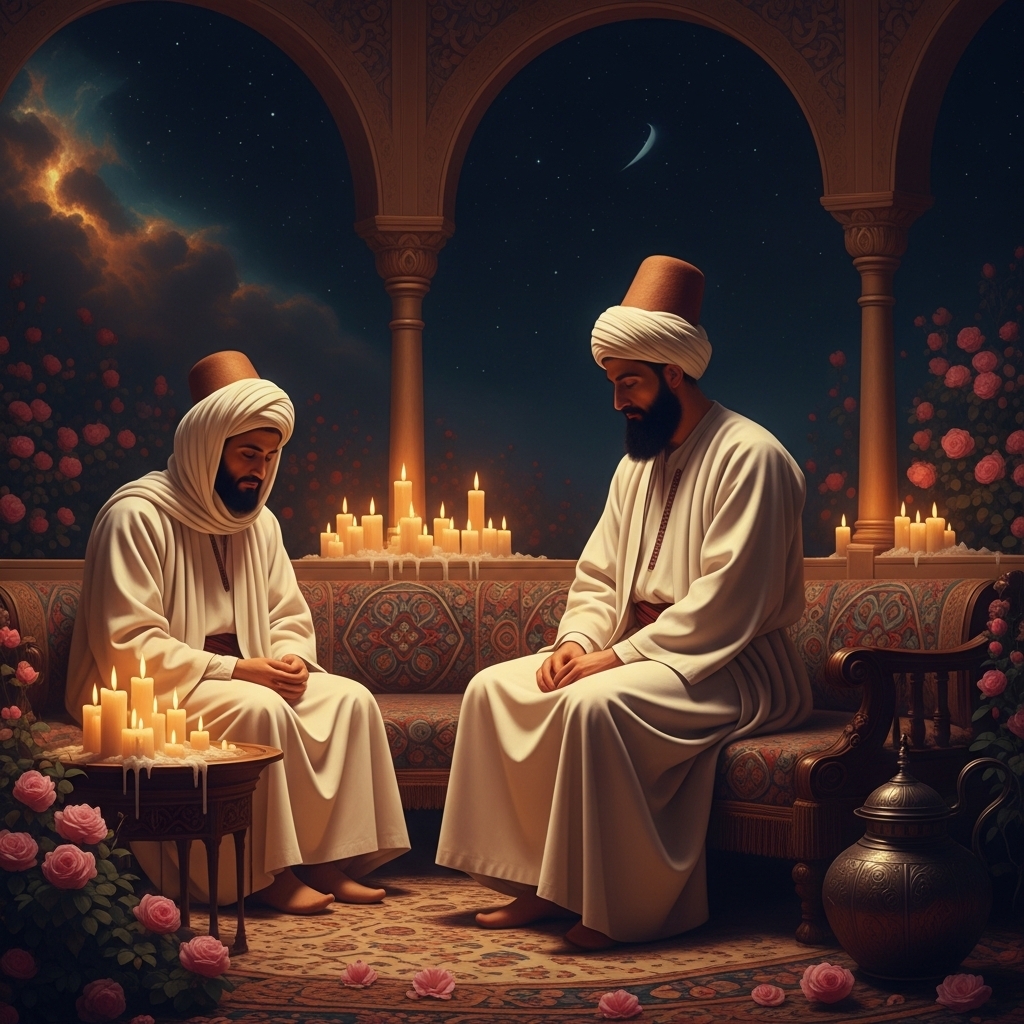
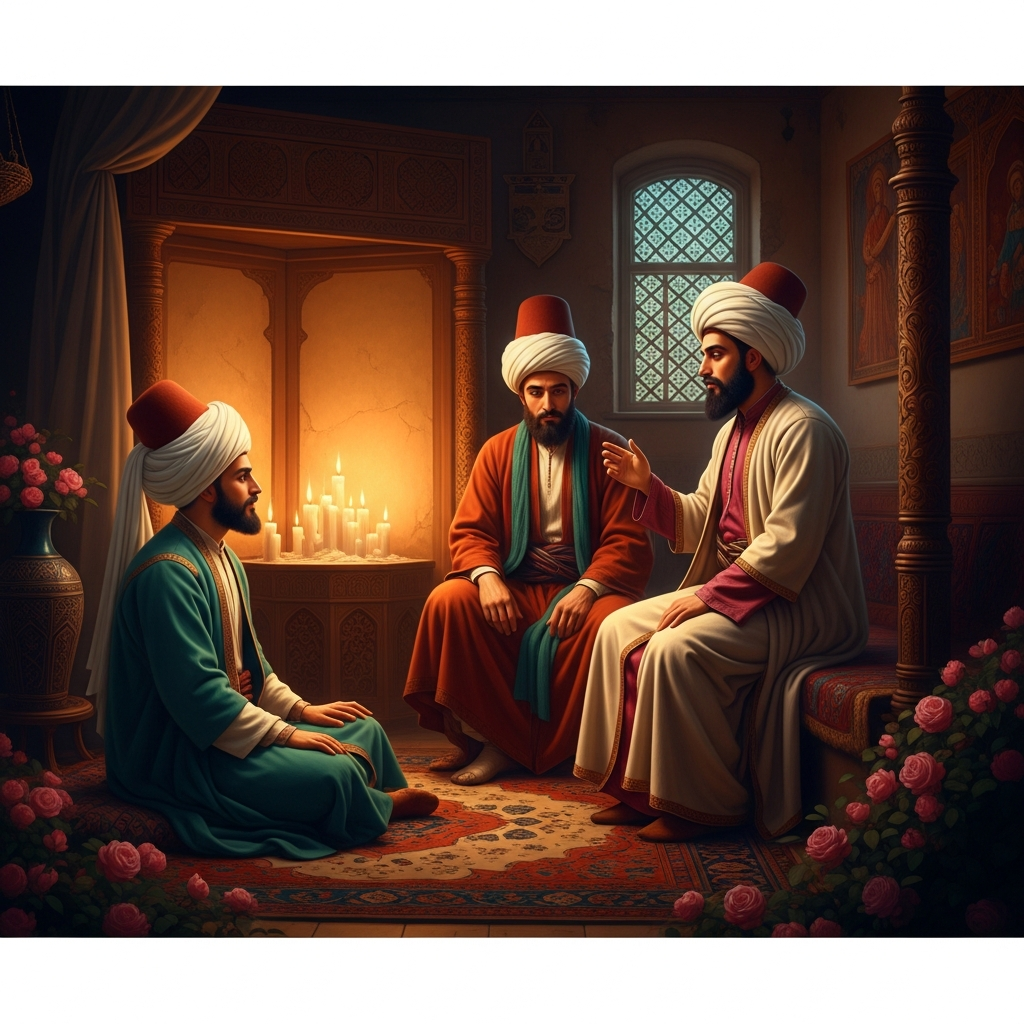
They spent the next months together in seclusion. Rumi’s students were bewildered and resentful. The famous professor of law and Quranic science was locked in a room with a wandering dervish, refusing his teaching duties, emerging at odd hours looking wild-eyed and lit up from inside. Some accounts say the seclusion lasted forty days. Some say several months. What came out of it was not the same man who went in.
The question Shams asked is still there.
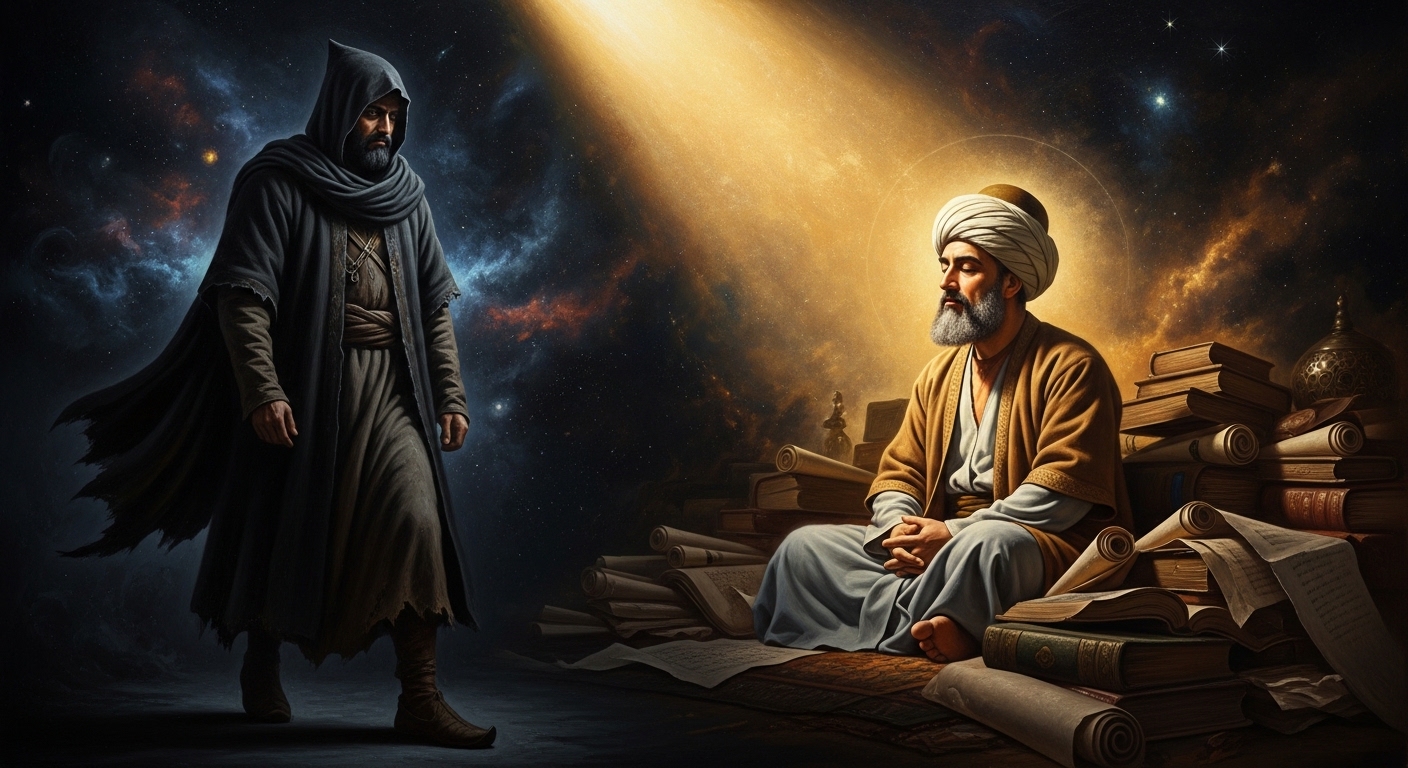
It sits in the tradition like a splinter under the skin. The greatest moment of spiritual nearness in Islamic history — the mi’raj, the Prophet’s night journey to God — and the Prophet says: I have no knowledge except what You have given me. The mystic in his small ecstasy, drunk on a much smaller encounter, shouts: Glory be to me. The closer you get, the quieter you become. The farther you are, the louder you proclaim your own arrival.
This is what Shams taught. Not doctrine. The physics of nearness.
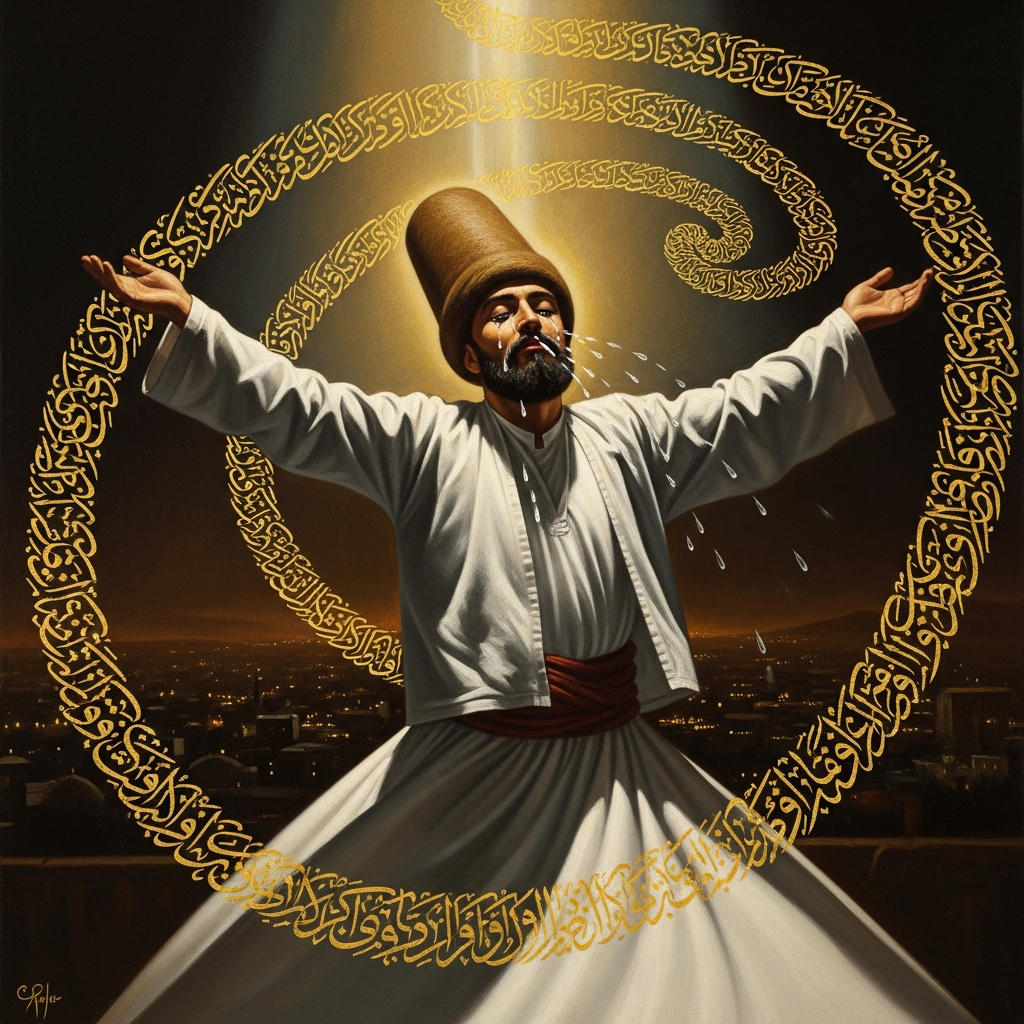
Rumi spent the remaining thirty years of his life writing about it in verse: twenty-five thousand verses of the Masnavi, forty thousand verses of the Divan-i Shams. He addressed almost all of them to the man in the black cloak who seized his mule on a November morning in Konya and asked the one question he couldn’t answer from books.
Scenes
Echoes Across Traditions
Entities
- Rumi
- Shams-i-Tabrizi
- Bayāzīd Bastāmī
Sources
- Shams-i-Tabrizi, *Maqalat* (Discourses), ed. Movahed (Tehran, 1990)
- Franklin Lewis, *Rumi: Past and Present, East and West* (Oneworld, 2000)
- William Chittick, *Me & Rumi: The Autobiography of Shams-i-Tabrizi* (Fons Vitae, 2004)
- Annemarie Schimmel, *I am Wind, You are Fire: The Life and Work of Rumi* (Shambhala, 1992)