Combat Profile
Sema of the Spheres
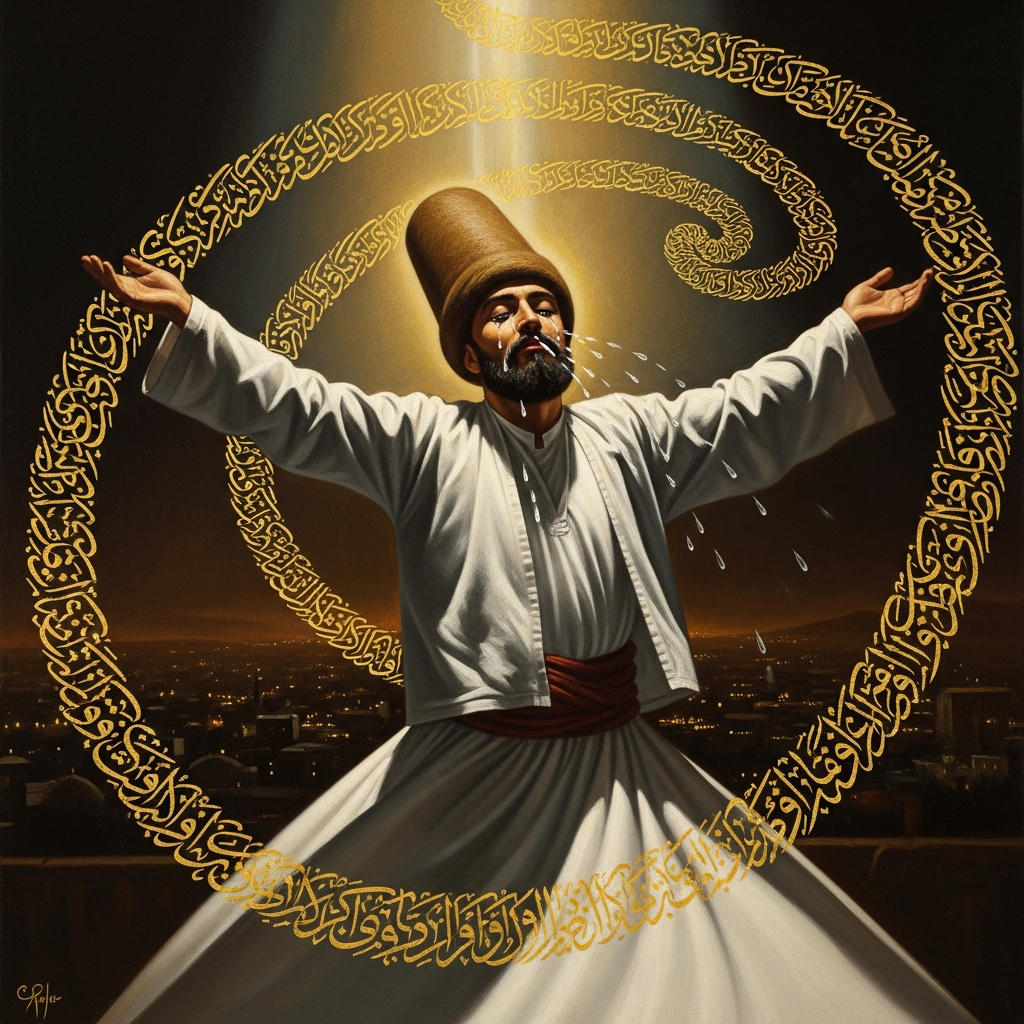
Rumi turns and the cosmos turns with him; all who witness the rotation fall into ecstatic remembrance and cannot help but love what they had previously merely worshipped.
Reed-Voice
Rumi's words, in any language, in any age, continue to convert the listener; his *Mathnawi* is called by Sufis "the Quran in Persian."
Jalal al-Din Muhammad Rumi (1207-1273) was a sober Persian jurist and theologian in the city of Konya, Anatolia, until he met the wandering dervish Shams al-Tabriz in 1244. The meeting destroyed him and remade him. For three years the two were inseparable, withdrawing into private spiritual conversation that drew the jealousy of Rumi’s students; Shams disappeared (was perhaps murdered), and Rumi, in unbearable grief, became a poet. The Divan-i Shams-i Tabrizi (the lyric poems) and the Mathnawi (the six-volume narrative epic) poured out of him over the next decades — over 60,000 verses, the entire mystical literature of Persian Islam refracted through one man’s loss.
In Sufi mythography Rumi is more than a poet. He is the saint who became love — who rotated his very body around the divine axis (the founding gesture of the Mevlevi sema, the whirling dervishes) and whose tomb at Konya remains one of the great pilgrimage sites of Islam. His opening lines — “Listen to the reed, how it complains, telling the tale of separations” — define the entire Sufi cosmology: the soul is a reed cut from the riverbed of God, and its music is the wail of return.
Biblical Parallels: Rumi’s transformation by Shams parallels the Song of Songs — the bride consumed by love of the bridegroom — and the John of the Cross / Teresa of Avila tradition of the dark night and the spiritual marriage. His insistence that love, not law, is the engine of religion echoes Paul’s hymn in 1 Corinthians 13. His grief-into-song trajectory mirrors David’s psalms of lament. Christian Hesychasts (the Athonite monks who pray the Jesus Prayer in rhythm with the breath) practice a parallel rhythmic dhikr.
Cross-Tradition: Rumi parallels the Hindu bhakti poets — Mirabai, Tukaram, Kabir, Chaitanya — who likewise burned with love for a personal God. The whirling sema parallels the trance-dance of Korean shamans, the Sufi-derived zikr dances of West Africa, and the Hasidic ecstatic dance of the Baal Shem Tov. His pairing with Shams resembles the Zen tradition of the koan relationship — a master who breaks the disciple open by force of presence.
2 min read