The Conference of the Birds
The eternal present — the spiritual journey of the soul, not a historical event · The seven valleys — allegorical stages of the mystical path
Contents
All the birds of the world gather and decide to seek their king, the Sīmorgh — but the quest through seven valleys costs them their certainty, their virtue, their identity, and nearly their lives, until only thirty birds arrive at the mountain to find that they themselves are the Sīmorgh.
- When
- The eternal present — the spiritual journey of the soul, not a historical event
- Where
- The seven valleys — allegorical stages of the mystical path
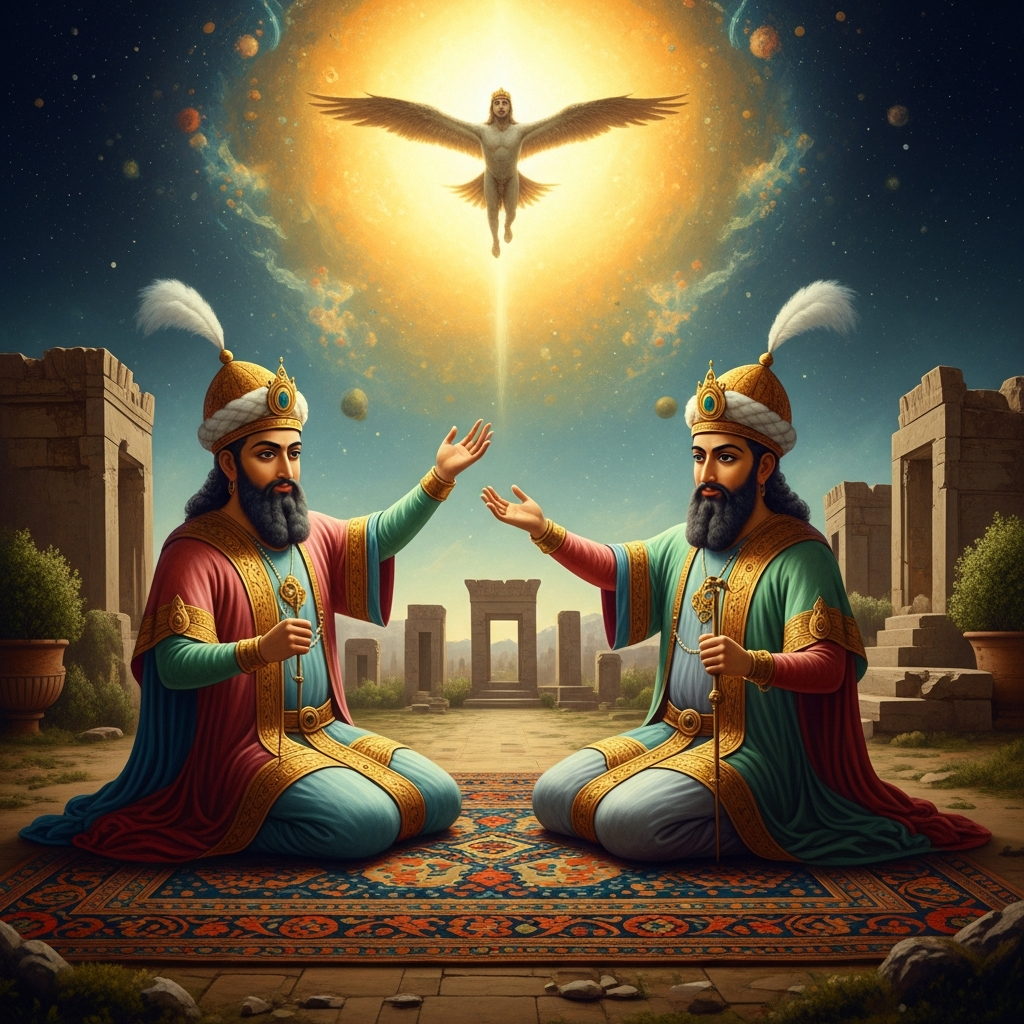
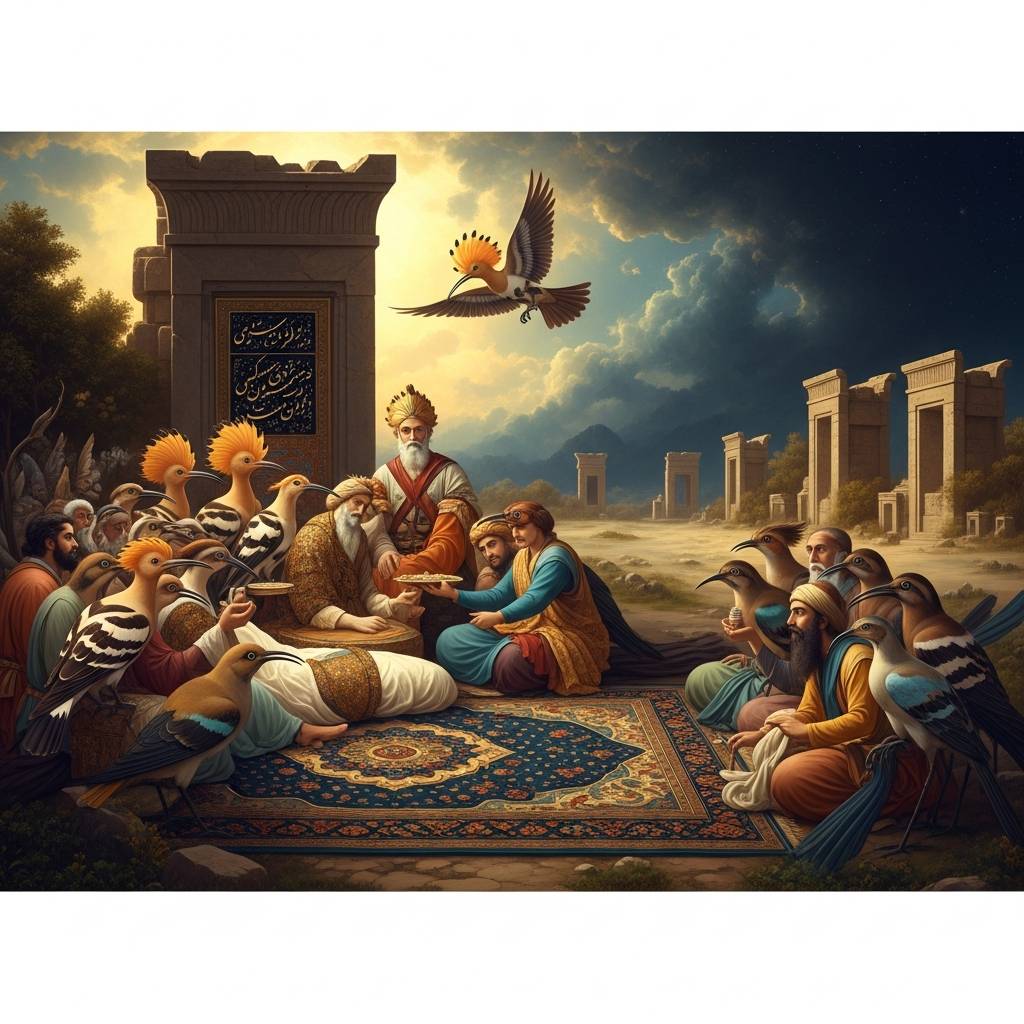
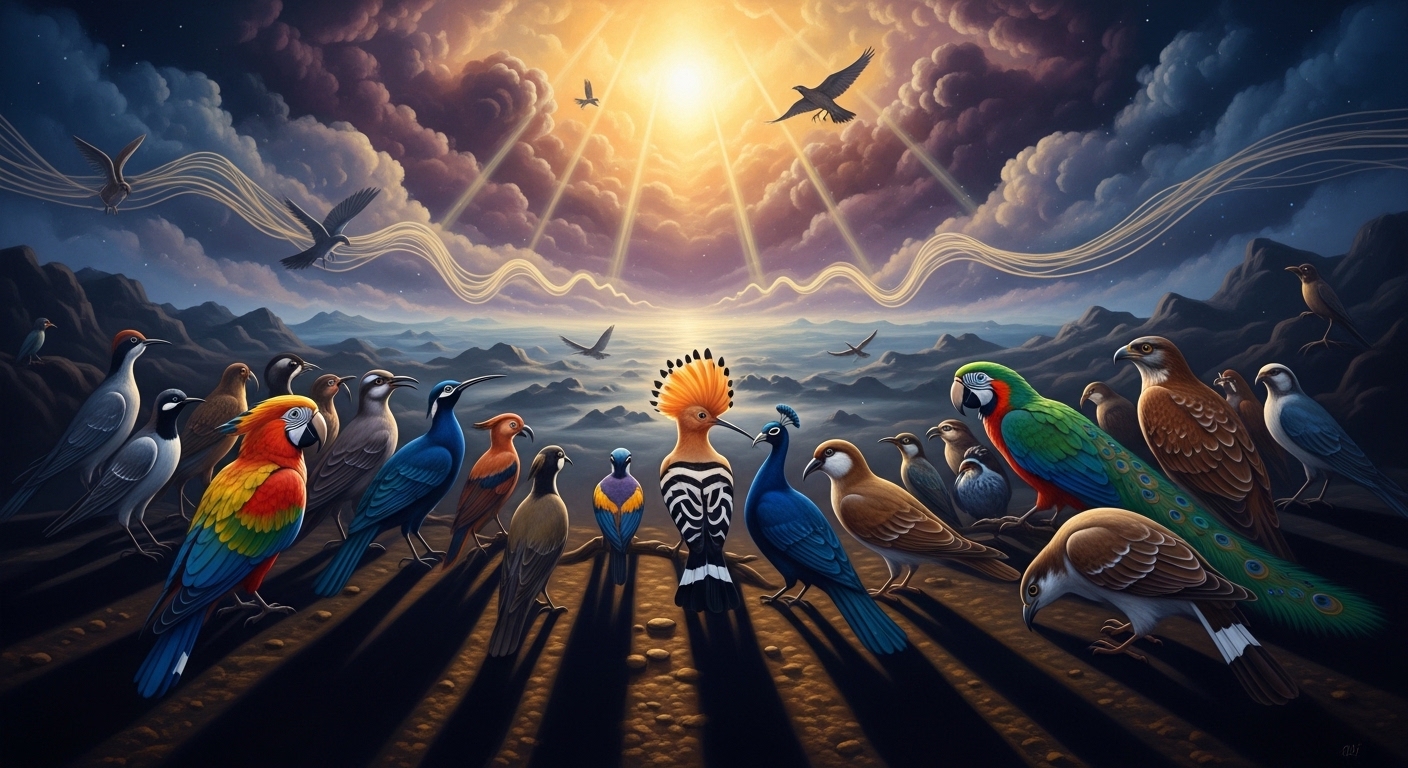
The hoopoe calls the congress to order.
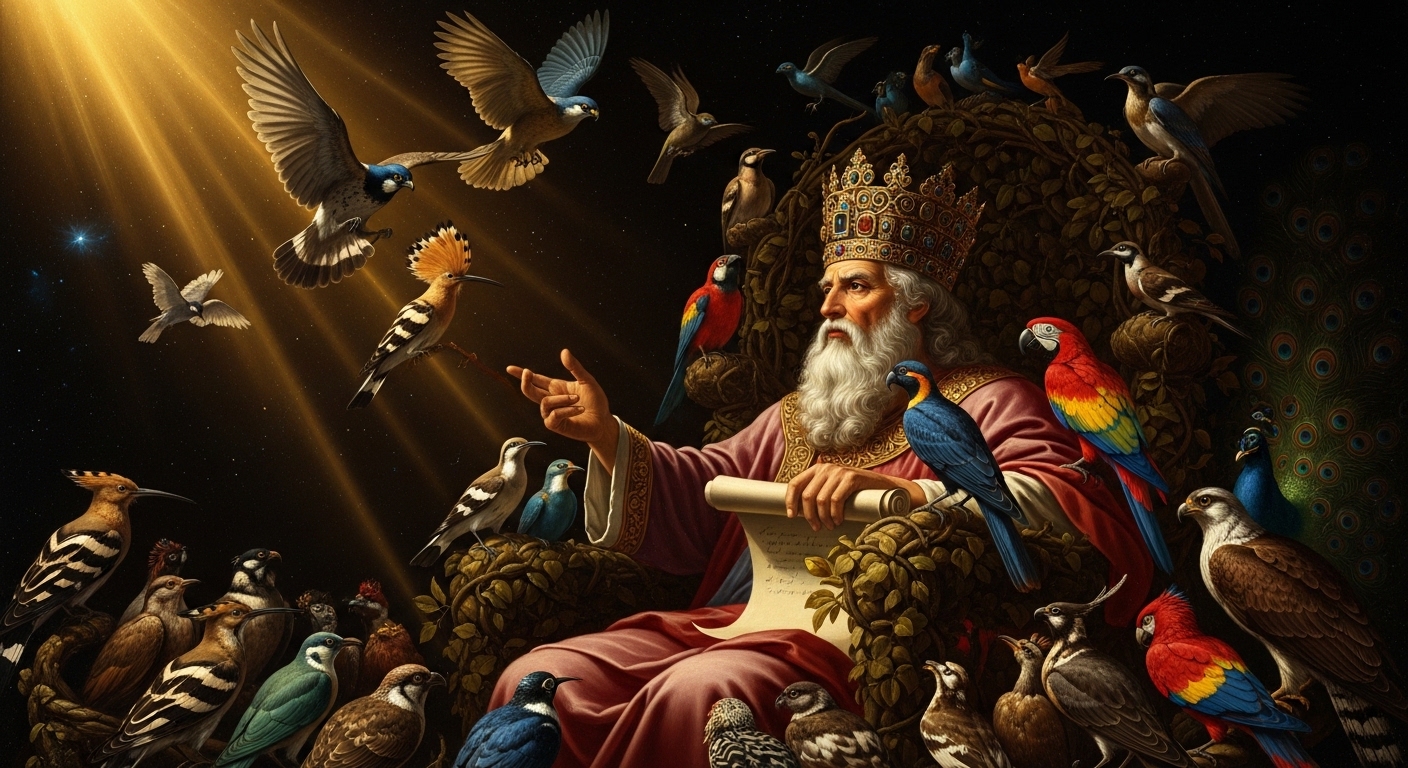
He is wearing the crown of Solomon and he has news: there is a king of birds they have never met. His name is the Sīmorgh — he lives on the mountain Qaf at the edge of the world — and the birds of the world have been living without their true sovereign for too long. They must set out to find him.
The birds object, one by one.
The nightingale says his love for the rose is total and he cannot leave it. The parrot says he is already imprisoned and cannot risk the journey. The peacock says his beauty is a paradise that he cannot leave behind. The duck says she lives in water and cannot cross the dry land. The falcon says he already serves the king. The heron says he prefers solitude. Each bird has a reason — a virtuous reason, or a plausible one — that is also a way of saying: I am not willing to lose what I have in exchange for what I don’t yet know.
The hoopoe answers each bird in turn.
His answers are stories. He answers the nightingale’s rose-love with a story of a prince who loved a princess and never went to find her because the beauty of loving from a distance was easier than the possible rejection of arrival. He answers the peacock’s beauty with a story of a king who mistook the palace for the kingdom. For each bird’s objection, he has a story about what the objection costs.
Thirty birds consent to the journey.
The seven valleys they must cross have names: the Valley of the Quest, the Valley of Love, the Valley of Gnosis, the Valley of Detachment and Independence, the Valley of Unity, the Valley of Bewilderment, and the Valley of Poverty and Annihilation. Each valley costs the birds something.
In the Valley of the Quest they lose their certainties — the accumulated answers they had given themselves to avoid the questions. In the Valley of Love they lose their comfort — the pleasant arrangement of loving from a distance is shown to be cowardice and they must step closer. In the Valley of Gnosis they lose their knowledge — the categories they used to organize their understanding of the world are dissolved by a larger understanding that doesn’t fit in the same categories. In the Valley of Detachment they lose their attachment to the journey itself, which is the subtler attachment that replaces the grosser one. In the Valley of Unity they lose their individuality — or rather, the illusion of individuality begins to dissolve.
Many birds die on each crossing.
By the Valley of Bewilderment — the sixth — only thirty remain. They are in a state of confusion that is not failure but the last stage of something: the confusion of a mind that has lost all its false certainties and has not yet found what replaces them. They are bewildered in the technical mystical sense: they know they do not know, and they do not know what they will find.
They cross the seventh valley.
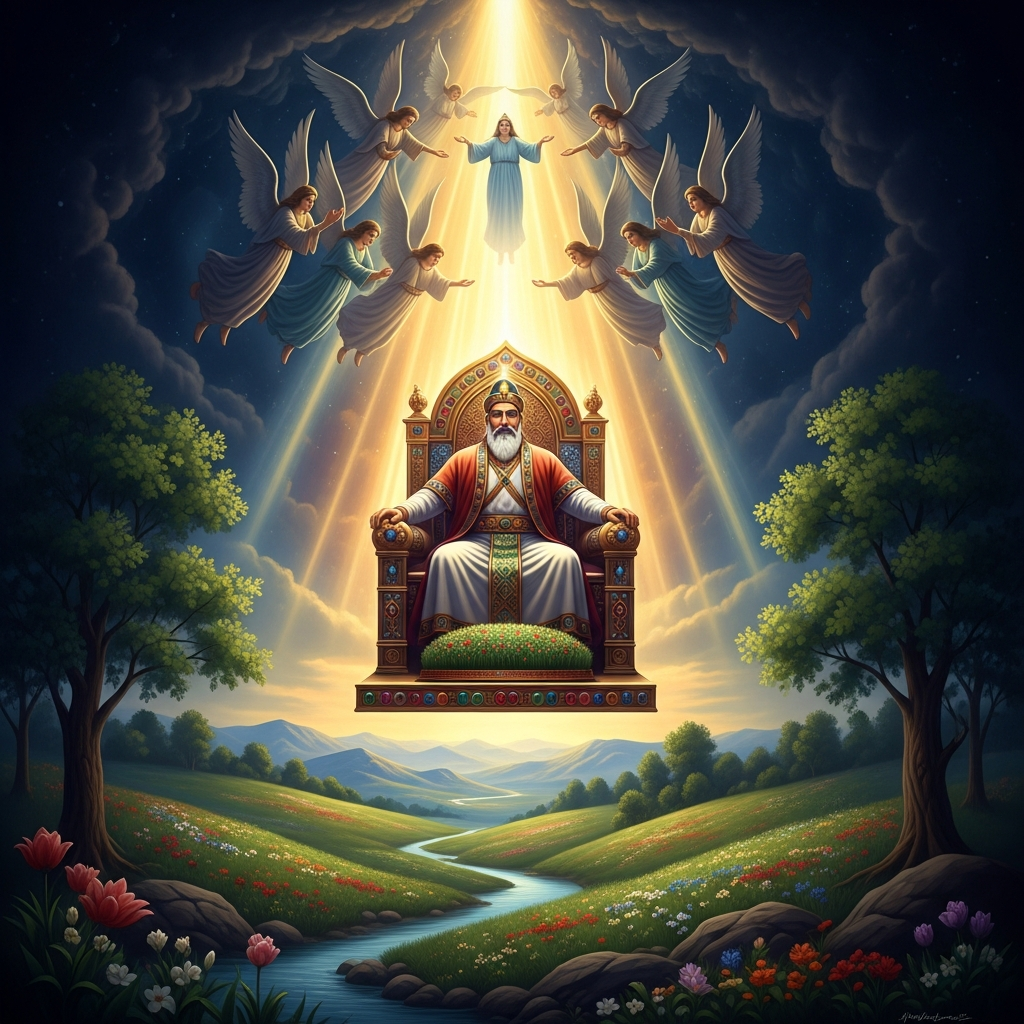
On the other side, they arrive at the court of the Sīmorgh.
There is a mirror.
They look into it.
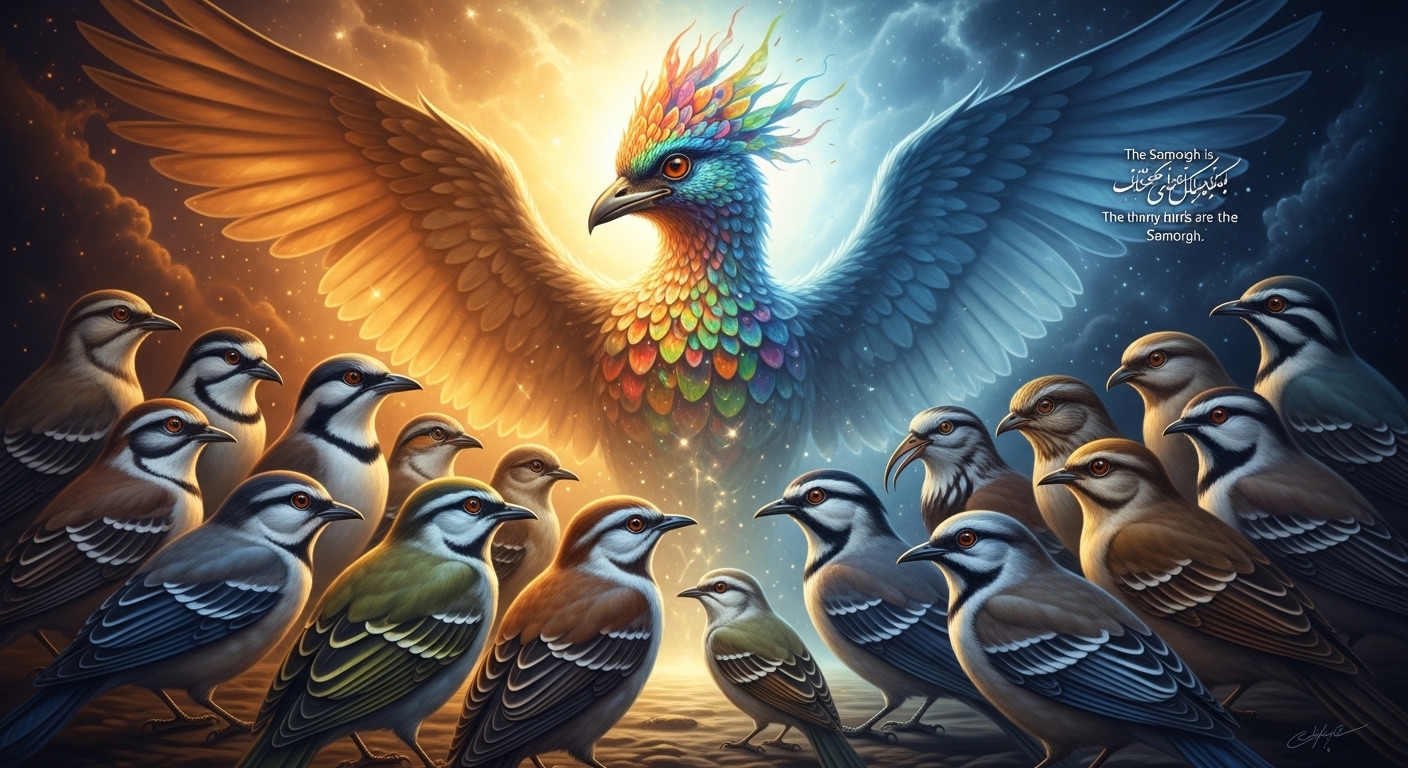
What they see in the mirror is themselves. Thirty birds. Si morgh — thirty birds — looking at themselves.
And they understand: the Sīmorgh is the thirty birds. The thirty birds are the Sīmorgh. The word Sīmorgh contains the number: si means thirty, morgh means bird. The great cosmic king whose existence justified the journey is the truth of what they are when all the false layers have been burned away in the seven valleys.
The mystical union is not the self dissolving into God.
It is the discovery that the self — stripped of the nightingale’s rose-love and the peacock’s vanity and the heron’s solitude and all the ways the birds had arranged themselves to avoid the journey — was always the divine.
The thirty birds sit in the presence of the Sīmorgh for a long time.
Attar does not tell us what they say.
He doesn’t need to.
Scenes
Echoes Across Traditions
Entities
- The Hoopoe
- The Sīmorgh
- The Thirty Birds
- Farid ud-Din Attar
Sources
- Farid ud-Din Attar, *The Conference of the Birds* (*Mantiq al-Tayr*), translated by Afkham Darbandi and Dick Davis (Penguin, 1984)
- Farid ud-Din Attar, *The Conference of the Birds*, translated by Sholeh Wolpe (Norton, 2017)
- A.J. Arberry, *Classical Persian Literature* (Routledge, 1958)
- Annemarie Schimmel, *As Through a Veil: Mystical Poetry in Islam* (Columbia, 1982)