
Tilopa Grinding Fish: The Hidden Teacher
c. 988–1069 CE — late 10th-century India, Bengal · Bengal, India — market stalls, river ghats, the low quarters of Bengali cities where sesame is ground and fish are caught
Contents
The greatest tantric master of 10th-century India lives unrecognized as a sesame grinder and a prostitute's attendant, grinding his curd and grinding away the illusion that enlightenment requires special circumstances.
- When
- c. 988–1069 CE — late 10th-century India, Bengal
- Where
- Bengal, India — market stalls, river ghats, the low quarters of Bengali cities where sesame is ground and fish are caught
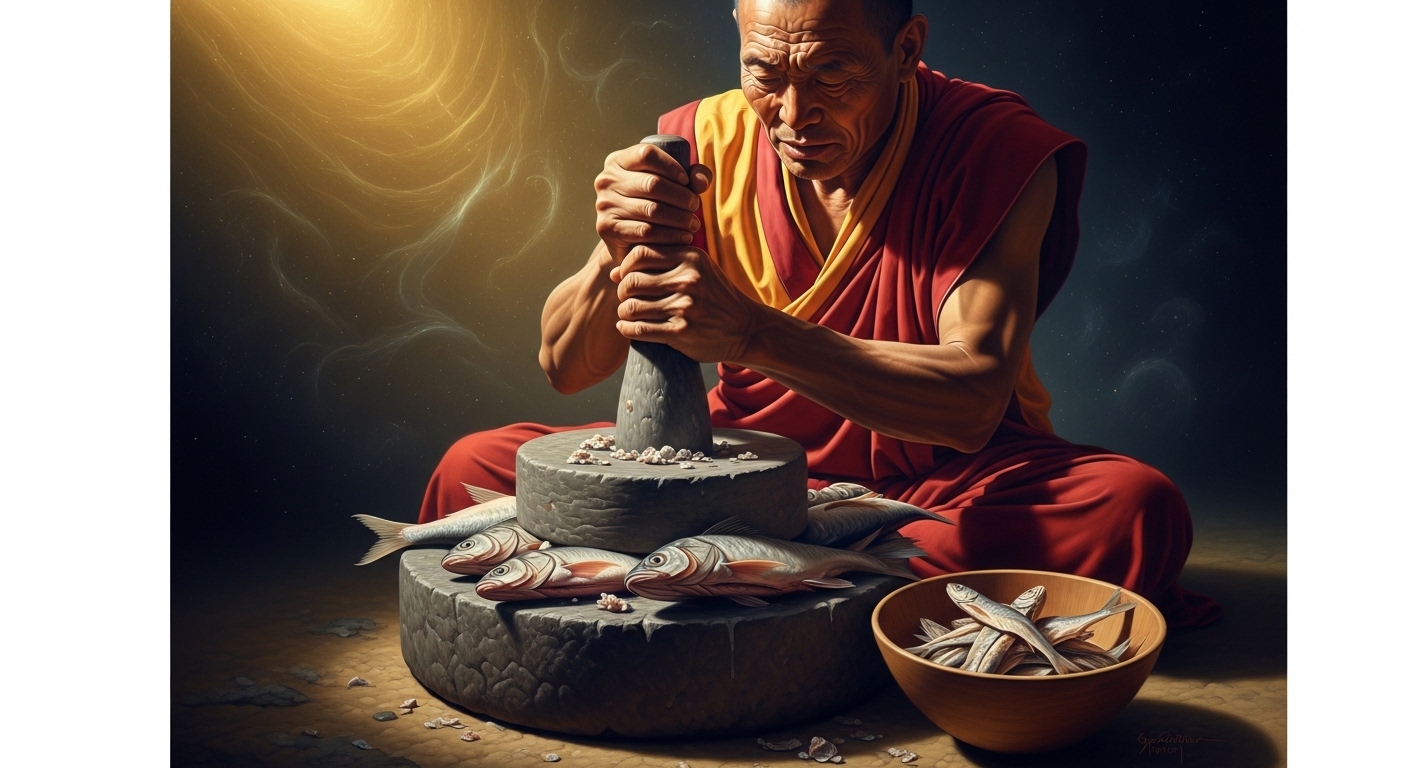
He is grinding sesame.
This is what he does in the mornings: he sits at the stone grinding wheel in the market section of the Bengali city, and he grinds sesame seeds into oil, and the stone turns, and the oil comes out, and the customers pay him the minimal wage appropriate to someone who grinds sesame in a market. He is a small man. He is not young. He grinds efficiently.
In the evenings he attends a prostitute.
The prostitute is a senior woman in the quarter. She requires an attendant for certain errands — carrying things, waiting outside, the small social necessities of her work. Tilopa provides these services without complaint. He is paid. He sleeps where the attendants sleep.
Nobody in the market and nobody in the quarter knows that Tilopa has spent twelve years in strict retreat practicing the Mahamudra instructions he received directly from the primordial Buddha Vajradhara — that he is the living apex of a transmission that cannot be found anywhere else in India, that the grinding stone and the prostitute’s errands are not his circumstances but his deliberate choice.
The choice is doctrinal.
The Mahamudra teaching that Tilopa holds says: the nature of mind is already present, already clear, already liberated. What obscures it is not circumstance but relationship to circumstance — the tendency to divide experience into worthy and unworthy, into practice and non-practice, into the sacred and the profane. Tilopa has recognized that these distinctions are projections. He has taken up the most disregarded work he can find in order to demonstrate — to himself, to no audience yet — that the recognition survives grinding sesame. That it survives carrying packages for a woman the religious establishment would not admit through the front door.
He grinds for years. He eats what he earns grinding. He sleeps in the attendants’ quarters. He does not teach anyone because no one has come who is ready to receive the teaching. He is patient in this the way the grinding stone is patient: the stone does not decide when the sesame is adequately ground; it grinds until the grinding is done.
Nāropa arrives eventually, after his twelve trials.
He finds Tilopa where Tilopa always is: at the grinding stone, working. Nāropa is not, at this point, easily shocked. He has jumped from cliffs, stolen from weddings, done things at Tilopa’s direction that no Indian scholar would recognize as connected to Buddhist practice. He sits beside the grinding stone and asks for the teaching.
Tilopa gives it while grinding. Not as performance — he gives it and grinds, the way any craftsman talks while working, the way the hands do one thing and the mouth does another, and neither interferes with the other. The transmission of Mahamudra does not require a throne, a hall, an audience. It requires only the pointing-out and a student capable of recognizing what is pointed to.
When it is done, Tilopa goes back to grinding. The stone turns. The oil comes out.
What he has transmitted to Nāropa — and through Nāropa to Marpa, and through Marpa to Milarepa, and through Milarepa to the Kagyu lineage that still carries it — is precisely what the grinding stone taught him: that the ultimate nature of mind does not reside in any special state, in any exalted circumstance, in any activity more sacred than sesame grinding. The liberation he achieved in twelve years of retreat was confirmed and expressed in twelve years of market work. You cannot have one without the other.
The fish he eats raw, famously, are the living fish of Bengal’s rivers — a deliberate violation of the gentle monastic norm. Not cruelty: demonstration. The rules that govern the practitioner who is still practicing are not the rules of the practitioner who has arrived. When you have arrived, you can eat fish. When you have arrived, the fish know it and cooperate.
Or so the tradition says. The grinding stone, in any case, did not object.
Scenes


Echoes Across Traditions
Entities
- Tilopa
- the prostitute Tilopa serves
- Nāropa
Sources
- Keith Dowman, trans., *Masters of Mahamudra* (SUNY Press, 1985)
- Chogyam Trungpa, *Illusion's Game: The Life and Teaching of Naropa* (Shambhala, 1994)
- Herbert Guenther, *The Life and Teaching of Naropa* (Oxford University Press, 1963)