The Inner Fire That Melts Snow from the Body
systematized by Naropa c. 1000 CE — practiced continuously in the Kagyu, Nyingma and other schools to the present day · The high Himalayas — above-treeline caves in western Tibet, Lapchi, Kailash region, any location cold enough to make the test unambiguous
Contents
Tummo — inner heat yoga, one of the Six Yogas of Naropa — is the practice in which the yogi generates such intense heat through breath, visualization, and body-lock techniques that they can sit naked in freezing Himalayan winters and dry soaking sheets with body heat alone.
- When
- systematized by Naropa c. 1000 CE — practiced continuously in the Kagyu, Nyingma and other schools to the present day
- Where
- The high Himalayas — above-treeline caves in western Tibet, Lapchi, Kailash region, any location cold enough to make the test unambiguous
The visualization begins at the navel.
A flame, no larger than a sesame seed, orange-red at the center, sits in the central channel at the level of the navel. The central channel runs from the crown of the head to the base of the spine, and the flame at the navel is the beginning of the entire system of the subtle body that tummo practice engages.
The practitioner breathes. On the in-breath, a specific technique fills the lower belly with air — pressing down from above with a slight contraction, pulling up from below with another. The two pressures meet at the navel. The flame at the navel, receiving the compressed air, grows.
This is the first stage. The instruction sounds simple; the execution requires years of practice to stabilize. The flame must be genuinely felt, not merely imagined. The difference between a visualization that is a concept and a visualization that is a sensation is the difference between studying fire and being warm.
The winter tests at the monastery documented the external results.
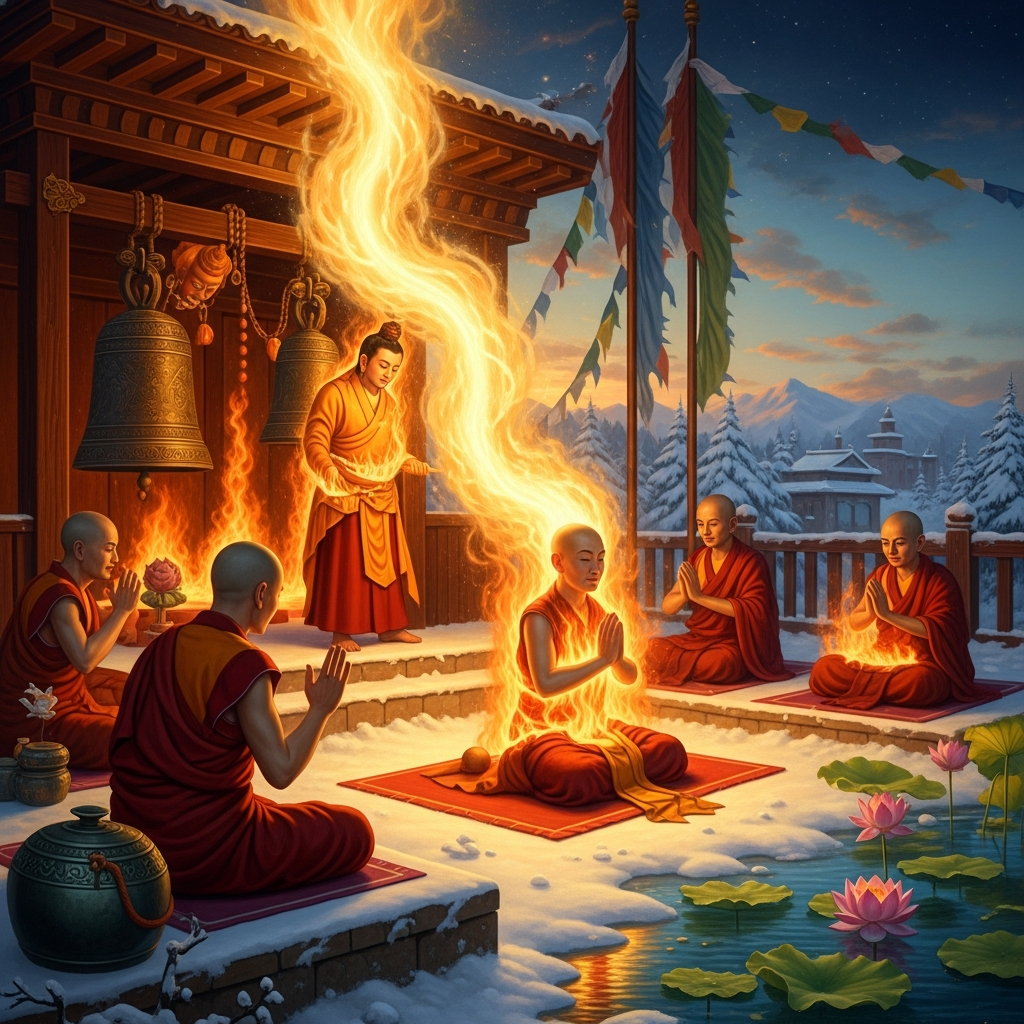
The Kagyu tradition, particularly, has formalized tummo practice into competitions held in the winter. Practitioners who have reached sufficient stability in the practice sit beside a frozen lake or in the open air at altitude on winter nights with wet sheets draped over their naked bodies. The test is simple: how many sheets can be dried? The heat the practitioner generates dries the sheets through evaporation. The record is documented.
Herbert Benson’s team from Harvard Medical School traveled to the Himalayan region in the 1980s and documented the same effects with thermometers: practitioners trained in tummo could raise the temperature of their fingers and toes by up to seventeen degrees Fahrenheit through the meditation alone, without any increase in overall metabolic rate consistent with ordinary physical exertion.
The documentation proves the mechanism is real. It does not address what is interesting about the mechanism: why would awakened awareness require the practitioner to be warm?
The answer in the Six Yogas is that tummo is not about warmth.
Warmth is a side effect. The primary effect is the dissolution of the conceptual barriers between the practitioner’s ordinary consciousness and the subtle consciousness that underlies it. The subtle body’s central channel is ordinarily closed — blocked at specific points by the conceptual knots that correspond to the ego’s defensive architecture. The tummo practice, by generating heat at the navel and driving it up the central channel, opens these knots.
When the knots open, something flows through that is not heat in the ordinary sense. The tradition calls it tig le — drops, or bliss, or the concentrated essence of awareness. The bliss that arises when the central channel is open is not pleasure in the ordinary sense. It is the recognition of the nature of mind, experienced in the body as what the texts call “bliss-emptiness inseparable” — the inseparability of the warmth of awareness and the spaciousness of its empty nature.
Milarepa’s green body was maintained in the cold cave by this mechanism. The single blanket was enough not because the cave wasn’t cold but because the practice was warm. The cold was part of the practice — the external cold against which the inner fire is tested, the condition that makes the test unambiguous.
The navel flame grows. The channels open. The snow on the bare shoulders melts. The yogi sits in the winter at altitude, naked, alive, warm.
Scenes



Echoes Across Traditions
Entities
- Milarepa (the most famous practitioner)
- Naropa (who systematized the practice)
- the Karmapa's monks at winter competitions
- the contemporary researchers who have documented the practice
Sources
- Glenn Mullin, *Readings on the Six Yogas of Naropa* (Snow Lion, 1997)
- Garma C.C. Chang, *Teachings of Tibetan Yoga* (University Books, 1963)
- Herbert Benson et al., 'Body Temperature Changes During the Practice of g-Tummo Yoga,' *Nature* 295 (1982)