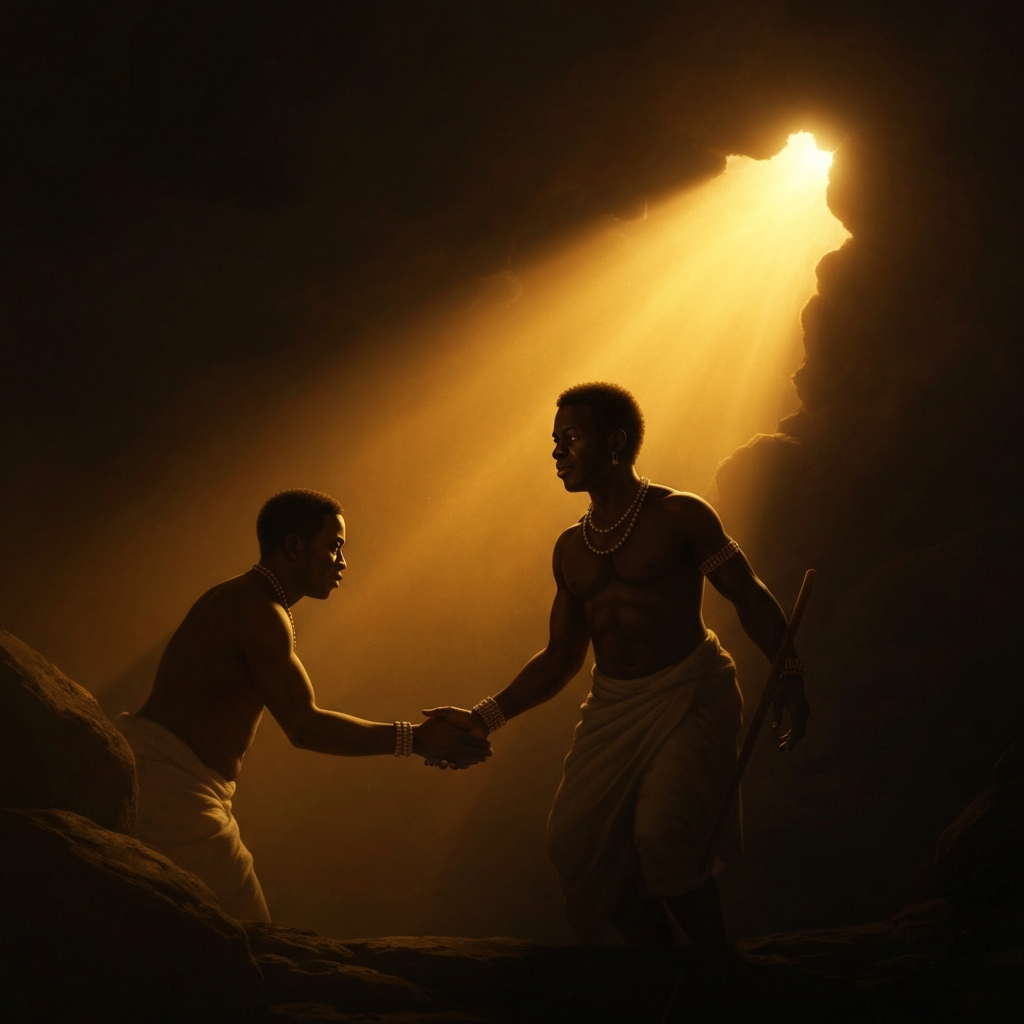
The Golden Stool Falls from Heaven
c. 1701 CE — the founding of the Asante Confederacy under Osei Tutu · Kumasi, Ghana — the capital of the Asante state, in the palace courtyard
Contents
The priest Okomfo Anokye calls down the Golden Stool from the sky — it lands in the lap of the first Asante king Osei Tutu, binding the souls of all Asante people into a single sacred object that can never touch the ground.
- When
- c. 1701 CE — the founding of the Asante Confederacy under Osei Tutu
- Where
- Kumasi, Ghana — the capital of the Asante state, in the palace courtyard
The stool descends from a cloud.
It is late afternoon in the new city of Kumasi, around the year 1701. The chiefs of the recently confederated Asante states have gathered in the courtyard of Osei Tutu, who is their king, to witness what Okomfo Anokye has promised them. Okomfo Anokye is the most powerful priest anyone in this part of the world has ever seen — the stories about him involve things that other priests would not attempt and cannot explain.
He has been drumming and chanting since morning.
The chiefs watch the sky.
A black cloud forms. It lowers. From the cloud, to the sound of drumming that seems to come from the cloud itself, descends a stool made of gold. Not gold-plated, not gold-painted: a stool that is itself gold, that has been formed from gold in the sky, that has never touched the earth and will never touch the earth because the earth is not its proper medium.
It settles into the lap of Osei Tutu.
The watching chiefs, who have been skeptical about the ceremony, are not skeptical now. Okomfo Anokye speaks: this stool contains the sunsum — the spirit, the soul — of the entire Asante nation. As long as this stool is protected, the Asante people cannot be destroyed. As long as the Asante people are united, the stool remains powerful.
The stool is the Asante nation. The Asante nation is the stool.
Osei Tutu does not sit on it.
This is critical and often misunderstood. The Golden Stool is not a throne. The king does not sit in it. Even the king who receives it from the sky is not permitted to place his body on the divine object. The stool is placed on its own stool, kept in its own room, attended by its own custodians, protected by its own guards. On ceremonial occasions it is carried under a special umbrella — a black umbrella, the color of the ancestors — in its own ceremonial chair.
The king sits on a different stool, a human stool, carved for him. The Golden Stool occupies its own space in the procession as if it were a king itself — which, in a sense, it is. The spiritual king of the Asante is the Stool. The human king is the administrator of the Stool’s kingdom.
Okomfo Anokye buries the stools of every defeated and incorporated chiefdom at Kumasi, beneath the roots of a specific tree. By burying the competing stools, he buries the competing sources of spiritual authority. There is now only one stool in the Asante world that matters.
The British did not understand.
In 1900, the Governor of the Gold Coast Colony, Frederick Hodgson, sat before an assembly of Asante chiefs and delivered one of the most catastrophic speeches in colonial history. He demanded to sit on the Golden Stool.
The assembled chiefs did not move or speak.
The demand was not merely offensive. It was, in Asante theology, ontologically incoherent — like asking to sit on the soul of a nation. Hodgson had been told by his advisors that the Stool was a throne, a symbol of power, the kind of thing you sit on to demonstrate authority. His advisors had missed everything.
The War of the Golden Stool began the next day.
The Asante rose under Queen Mother Yaa Asantewaa — who reportedly shamed the male chiefs into fighting by saying that if the men would not pick up their guns, the women would — and fought the British army to a standstill for several months in 1900. The British were eventually victorious in the military sense: they captured Yaa Asantewaa, exiled the Asantehene, and formally annexed Ashanti.
They never found the Golden Stool.
It had been hidden. It was brought out again in 1921, privately repaired from damage (some of its ornaments had been stolen by a group of Asante, which caused a major scandal), and has been in the keeping of the Asante royal house ever since.
The Stool still matters.
When the Asantehene processes through Kumasi today, the Golden Stool processes with him, on its own litter, under its black umbrella, treated with the deference due to the spiritual center of a nation. The millions of people who identify as Asante — in Ghana and throughout the diaspora — understand that their connection to each other runs through the Stool that fell from the sky in 1701.
Okomfo Anokye’s genius was to create an object that made the Asante nation spiritually prior to any of its political arrangements. Kings came and went. Wars were won and lost. The British colonized and eventually departed. The Stool remained.
It is the soul of a people, kept in a golden case.
It has never touched the ground.
Echoes Across Traditions
Entities
- Okomfo Anokye
- Osei Tutu
- The Golden Stool (Sika Dwa Kofi)
- Nyame

Sources
- Rattray, R.S., *Ashanti* (Oxford University Press, 1923)
- McCaskie, T.C., *State and Society in Pre-Colonial Asante* (Cambridge University Press, 1995)
- Wilks, Ivor, *Asante in the Nineteenth Century* (Cambridge University Press, 1975)
- Agyeman-Duah, J., *The Ashanti of Ghana* (Ministry of Information, 1960)