Lucius and the Goddess Who Restored Him
Apuleius, *Metamorphoses* (*The Golden Ass*), c. 158–170 CE · Corinth; the beach at Cenchreae; the Isis temple; the transformation between them
Contents
In Apuleius's *Golden Ass* (2nd century CE), a young Roman named Lucius is accidentally transformed into a donkey while meddling with a witch's magic. He spends most of the novel as a donkey — abused, beaten, carrying loads. He is finally transformed back into human form by Isis herself, who appears to him in a midnight vision on a beach, her star-filled robe spreading across the sea. She gives him back his body. Then she initiates him into her mysteries. The novel is the only complete Latin novel to survive and also the only first-person account of ancient mystery initiation we have.
- When
- Apuleius, *Metamorphoses* (*The Golden Ass*), c. 158–170 CE
- Where
- Corinth; the beach at Cenchreae; the Isis temple; the transformation between them
He was curious about magic.
That is the thing that starts the novel, and it is presented as a character flaw of the most ordinary kind — not malice, not impiety, not pride, just the ordinary human itch to see how things work that leads the young Roman Lucius to arrive at the house of Milo of Corinth, where Milo’s wife Pamphile is known to practice serious witchcraft, and to position himself in the household where he can observe what she does.
He observes. He befriends Pamphile’s maid, Fotis, who shows him the door of the room where the magic happens. He watches, through the door, as Pamphile anoints herself with a cream from a jar and transforms into an owl. The transformation is documented with clinical precision: the hairs coarsen, the nose hardens into a beak, the toenails curve into talons. In a moment, a woman becomes a bird.
Lucius wants to try.
He asks Fotis for the cream.
Fotis, who has her own relationship with Lucius that makes her willing to help him, goes to Pamphile’s room and retrieves a jar. She selects, she believes, the correct jar. She gives it to Lucius. Lucius strips off his clothes and applies the cream to his body.
He begins to transform.
He is not becoming an owl. The hair coarsening is right, but the beak is wrong — no beak is forming, just a nose extending. The neck is wrong. The legs are wrong. He is changing, but not toward what he wanted.
He finishes changing.
He is a donkey. A large, grey, well-formed donkey standing in Pamphile’s courtyard in the dark, entirely unable to speak, entirely recognizable to himself inside the donkey body, entirely unable to do anything about the fact of what has just happened to him.
He is a donkey for most of the novel.
Apuleius’s Metamorphoses — the Golden Ass, as it is known from Augustine’s reference — is eleven books long. Books two through ten are the story of Lucius as a donkey. He is stolen from Milo’s household by robbers. He is sold. He changes hands repeatedly. He is beaten. He is overloaded. He is used as a pack animal, a mill animal, a saddle animal. He watches, from inside the donkey body with full human consciousness and no human language, a parade of human behavior that is uniformly worse for being observed without the social varnish that human witnesses apply.
He witnesses murder, adultery, cruelty, cowardice, greed. The novel is structured as a picaresque, and Apuleius uses the donkey’s position — present at scenes that human witnesses would be excluded from, incapable of testimony because he cannot speak — to deliver a mordant satire on Roman provincial society. The donkey is the perfect satirical vantage point: intimate, invisible, inarticulate.
He also eats roses whenever he can find them — because Fotis told him, before the disaster, that the antidote to the transformation is a diet of rose petals. He never manages to get enough. Every time roses appear within reach, something goes wrong: the rose garden turns out to belong to someone who will beat a donkey for eating his flowers; the rose garland on the altar of a passing priest is snatched before he can reach it; the roses at the dinner table are for the guests, not the pack animals.
He carries loads. He tries to eat roses. He waits.
In the final book, on the beach at Cenchreae, he falls asleep.
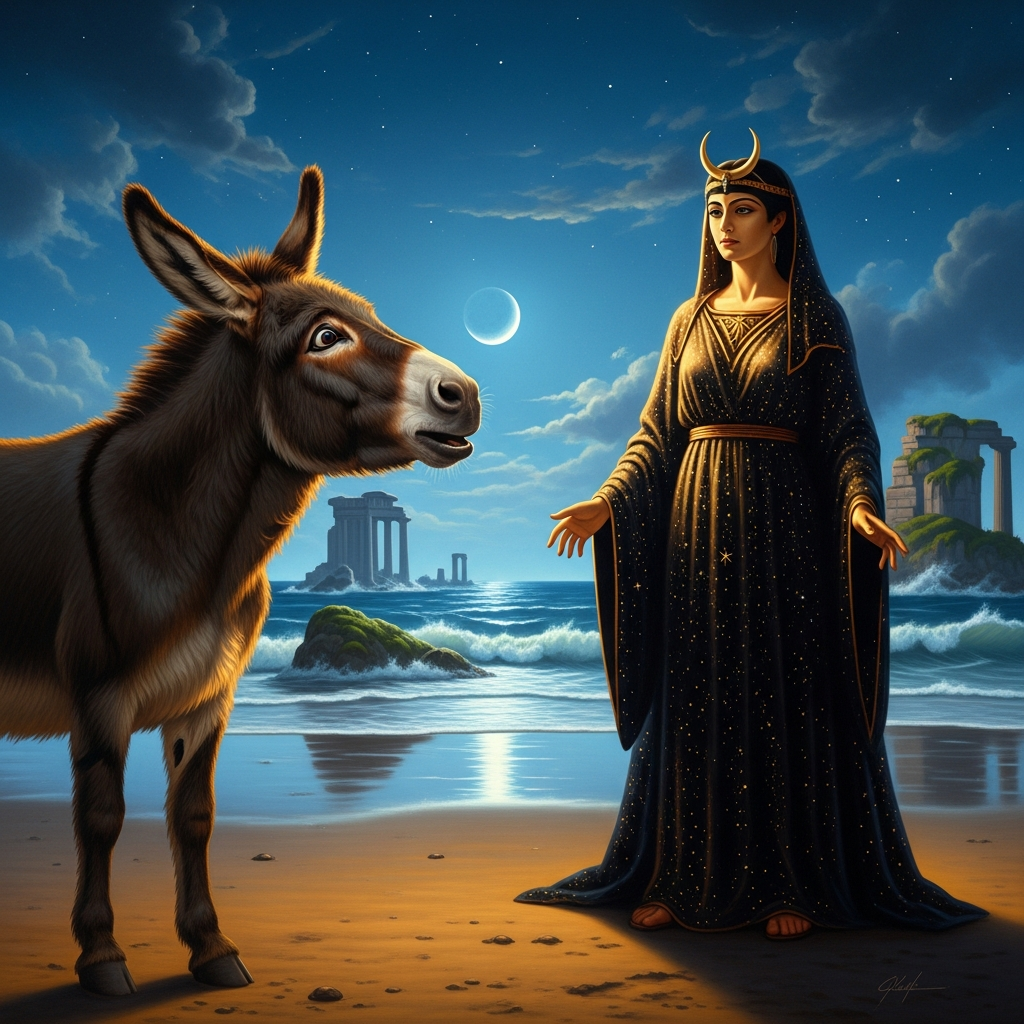
He has been sold again and is in the employ of a priest of the goddess Isis. He walks to the shore alone, wades into the water, and falls asleep on the beach with the waves around him. This is the moment of maximum degradation and maximum openness simultaneously: he has been a donkey long enough that the human self he started with has been thoroughly hollowed out. There is nothing left of Lucius the clever young Roman. There is only the donkey, lying in the sand, waiting for something he cannot articulate.
The goddess comes.
She rises from the sea. Her description is one of the great set pieces of Latin literature: a face of perfect beauty, hair like moonlight falling across her shoulders, a robe of darkest night sewn with stars — with, as Apuleius specifies, all the stars of heaven, and the moon in the middle of them, and a fringe of real flowers and fruits. She carries a golden vessel shaped like a boat. Her sandals are woven from the leaves of a palm tree.
She speaks to him.
She tells him her name — all her names: Isis, Minerva, Venus, Hecate, Proserpina, Ceres, Juno. She tells him she is the one goddess behind all the goddess-names in the world. She tells him she knows his suffering, she has counted his trials, she has prepared this night for him. And she gives him a specific instruction: at the procession tomorrow morning, her priest will be carrying roses. Lucius must approach the priest in the donkey’s form and eat the roses from his hand.
He will be restored.
The transformation back is described in the same clinical precision as the transformation out.
The roses are eaten. The donkey skin splits. The hair recedes. The nose shortens. The hooves soften into hands. Lucius — the human Lucius, the original Lucius — stands on the beach in the morning light, naked, in front of the assembled people and priests of the Isis procession, with the crowd staring.
The priest gives him a linen garment. He is clothed. He is welcomed into the procession. He is human.
The novel could end here. It does not.
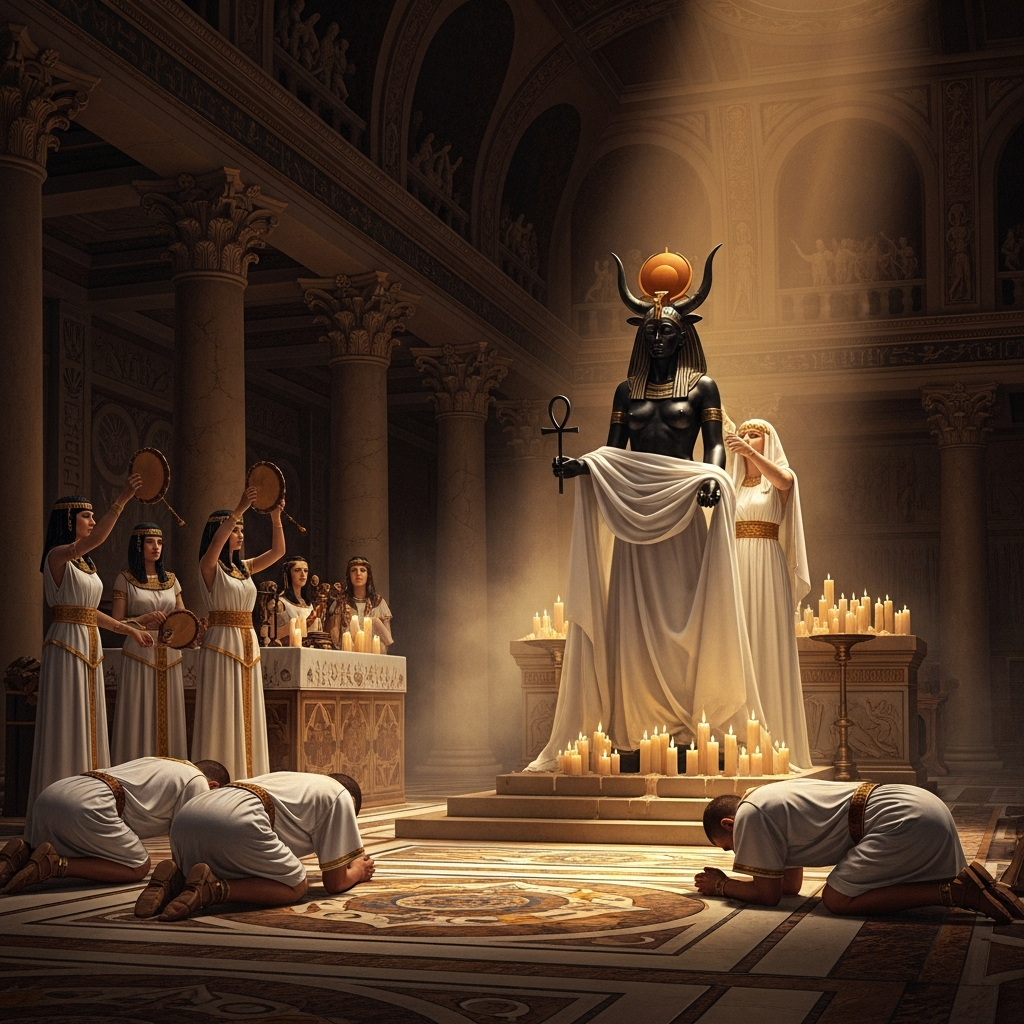
Isis, in a dream that follows, tells Lucius that his restoration is not enough. He must be initiated into her mysteries. The suffering of the donkey years was not an accident and not a punishment — it was preparation. He could not have received the initiation in his original form. The hollow he carried through a decade of degradation is exactly the shape the initiation will fill.
Apuleius describes the initiation in the most tantalizing and careful vagueness available.
He says: I will tell you what I can. I approached the boundary of death. I was carried to the threshold of Persephone’s realm, I traveled through all the elements, at midnight I saw the sun blazing in white light, I came face to face with the gods of below and the gods of above, and I adored them. At dawn, I came out. I was dressed in twelve robes. I carried a torch. I stood on a platform before the people. They came to look at me.
He says: the robe he was dressed in is called the Olympic garment. The torch he carried represents the sun he saw at midnight.
He says no more. He has promised Isis his silence.
What he gives us is the structure: descent, encounter, return, adornment. The initiated person goes somewhere they cannot describe and comes back changed in a way that is visible — they are standing on a platform, holding a torch, wearing a garment that means something to those who know. The content of the change cannot be transmitted in words. The form of the change can be seen by everyone in the room.
The Golden Ass — the only Latin novel to survive complete from antiquity — is structured as a joke with a serious end: the man who went to look at other people’s magic and ended up inside it, the tourist of the sacred who was accidentally initiated by being made a donkey for long enough that he had nothing left to lose. The goddess does not rescue the clever young Roman. She rescues the one who is left when the clever young Roman is stripped away.
That one, she says, is always hers.
Echoes Across Traditions
Entities
- Lucius
- Isis (the Goddess)
- Osiris
- The priest Mithras
- The rose garland that restores him

Sources
- Apuleius, *Metamorphoses* (*The Golden Ass*), c. 158–170 CE
- P.G. Walsh (trans.), *The Golden Ass* (Oxford World's Classics, 1994)
- Robert Graves (trans.), *The Golden Ass* (1950)
- J. Gwyn Griffiths, *Apuleius of Madauros: The Isis-Book* (1975)
- Marcia Eliade, *A History of Religious Ideas* vol. 2 (1982)
- Jan Assmann, *The Search for God in Ancient Egypt* (2001)