Isis in Rome: The Goddess Who Conquered Her Conquerors
Isis cult arrived in Rome c. 80 BCE; Senate bans 59–48 BCE; widespread by 1st century CE · Rome; Naples; Pompeii (the Isis temple survived Vesuvius almost intact); the entire Roman Empire
Contents
The Roman Senate banned the cult of Isis four times. They kept having to un-ban it because the people — especially women — kept rebuilding her temples. By the 1st century CE, Isis had temples in Rome, Naples, Pompeii, London, and Cologne. Her priests shaved their heads, wore white linen, and carried her image in daily processions. She was the goddess who understood grief — who had found every piece of Osiris's dismembered body — and the Empire couldn't compete with that.
- When
- Isis cult arrived in Rome c. 80 BCE; Senate bans 59–48 BCE; widespread by 1st century CE
- Where
- Rome; Naples; Pompeii (the Isis temple survived Vesuvius almost intact); the entire Roman Empire
The Senate voted to tear down her temples in 59 BCE.
The vote was not unanimous, and it was not the first time. The Roman Senate had been periodically suppressing the cult of Isis since the 70s BCE, when her shrines first appeared in the neighborhoods around the Capitoline Hill. The suppressions followed a consistent pattern: the Senate voted, the aediles went to the workers and found no one willing to strike the first blow with an axe, the consuls seized the axes themselves and personally initiated the demolition, the temples came down. Then, within a few years, the temples were rebuilt by neighborhood associations, private donors, and the persistent pressure of devotees who did not accept the Senate’s jurisdiction over their goddess.
The Senate voted to suppress the cult again in 58 BCE, 53 BCE, and 48 BCE.
The temples kept coming back.
The Senate’s objections were multiple and mostly political.
Isis was eastern. She came from Egypt, the most ancient and most theologically intimidating civilization the Romans knew, and her cult arrived in Rome through the commercial channels that connected the Mediterranean world — traders, sailors, freedmen, slaves, and the Egyptian merchants who settled in Italian port cities in the 2nd and 1st centuries BCE. Her rituals were conducted in a language most Romans could not understand. Her priests were visibly foreign: shaved heads, white linen robes, the sistrum that rattled in a way unlike any Roman instrument.
More troubling than the foreignness was the intimacy. Roman state religion was civic — conducted in public, in Latin, by magistrates performing their religious duties as part of their civic functions. The gods received sacrifice and honor; in return, they maintained the pax deorum, the peace of the gods, that kept the state functioning. This was a transactional, civic, impersonal arrangement. The relationship between a Roman magistrate and Jupiter was approximately the relationship between a Roman citizen and the Roman state: formal, respectful, and not intimate.
Isis required something else.
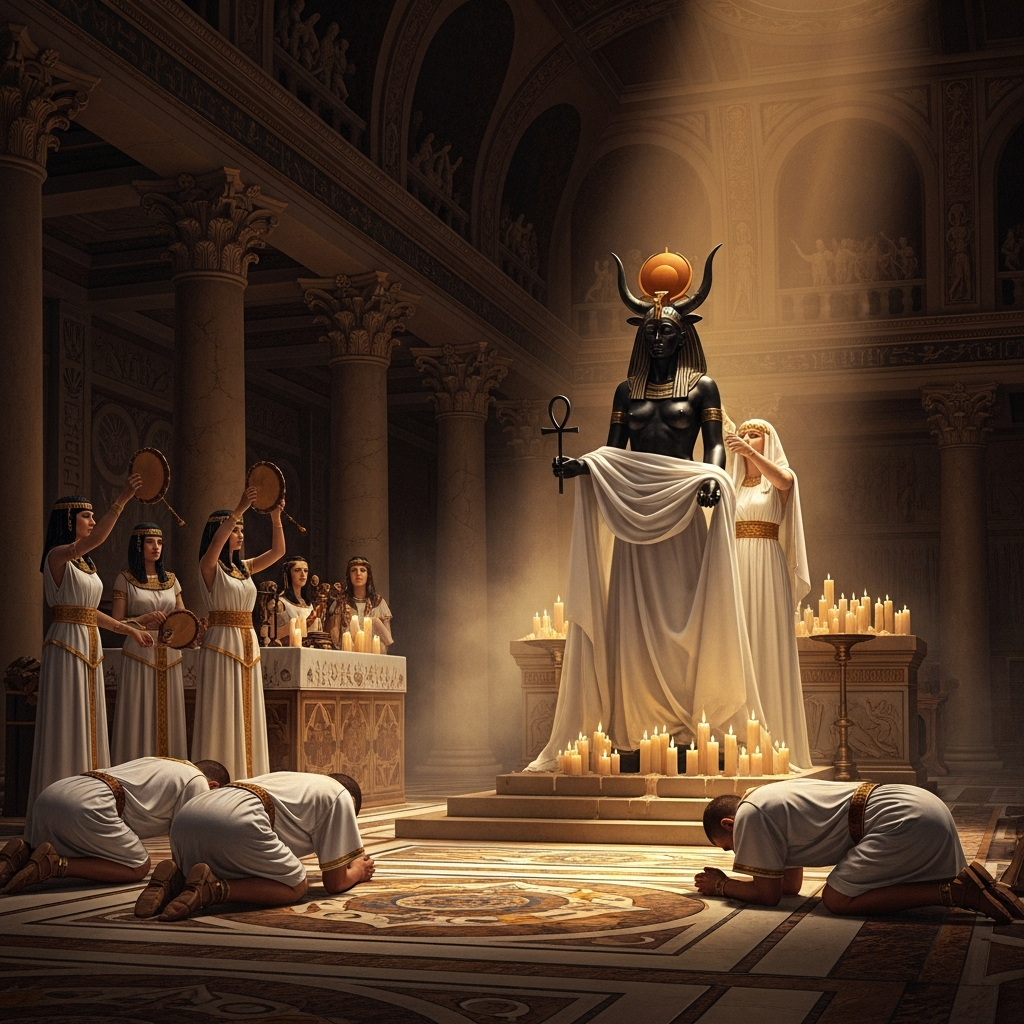
Her priests opened her temple every morning with a ceremony of awakening: the goddess’s image was uncovered, incense was lit, water from the Nile was presented, the goddess was invited to return to the world of the living for another day. The ceremony assumed a goddess who was present in a personal sense — not merely honored but attended, not merely invoked but encountered. Twice daily, the rites were performed. The priests who performed them were ordained through a long process of initiation, devoted to the goddess as a life commitment, not a civic duty.
Her lay devotees were not performing civic obligation. They were in love with a goddess who had suffered.
The suffering was the key.
Isis was the goddess who had lost everything.
Osiris — her husband, her king, her twin born from the same womb — had been murdered by his brother Set, who sealed his body in a coffin, threw it in the Nile, and later dismembered the body into fourteen pieces scattered across Egypt. Isis searched. In some accounts she searched for years. She found the pieces, one by one, and assembled them — all but one, the phallus, which had been swallowed by a Nile fish — and breathed life back into the reconstituted body long enough to conceive Horus, the heir.
This is a story about a wife who refuses to accept her husband’s death. Who goes to every corner of the world to find what was taken. Who reassembles what was scattered and defeats death by the force of her love. In a Roman world where death was everywhere — empire runs on death, and the first century BCE was drenched in it, from the slave wars to the civil wars to the ordinary mortality of disease and childbirth — this was not a foreign mythology. It was the most local story in the world.
Women who had lost children, who had lost husbands, who had lost the children they were carrying before they could be born — these women knew exactly what it meant to search for what was scattered. They recognized the goddess. They built the temples. They built them again after every Senate vote.
Cleopatra VII understood this.
The last Ptolemaic ruler of Egypt, the last ruler of the Macedonian dynasty that had governed Egypt since Alexander’s death, Cleopatra presented herself publicly as Isis incarnate from early in her reign. The identification was not metaphorical. She appeared in the regalia of the goddess. She received supplication as the goddess. She presented her son Caesarion — whose father was Julius Caesar — as Horus, the divine heir born from the union of goddess and king. When she appeared before Mark Antony at Tarsus in 41 BCE, she arrived on a gilded barge, dressed as Aphrodite, which is to say dressed as Isis in her Greek aspect, with her attendants costumed as sea-nymphs.
The Senate’s hostility to the Isis cult intensified during the period of Antony and Cleopatra’s alliance. The goddess and the Egyptian queen had merged — the ban on the temples in Rome in 48 BCE was partly a political statement about Cleopatra’s claim to be Isis on earth. When Antony and Cleopatra were defeated at Actium in 31 BCE and both died in 30 BCE, Augustus conducted an aggressive erasure of their religious claims. The Isis temples were again ordered removed.
The temples came back.
By the time of Caligula — emperor 37–41 CE — the Senate had accepted defeat.
Caligula, whose relationship to conventional Roman religion was complex, formalized the cult of Isis as a Roman state cult. He built or restored a major Iseum on the Field of Mars. The temple was enormous, well-funded, and prominent. The daily ceremonies of the goddess’s awakening were conducted with imperial sponsorship. The priesthood was regularized within Roman institutional structures.
Isis had arrived.
At Pompeii, the evidence is particularly vivid.
The Isis temple at Pompeii survived the eruption of Vesuvius in 79 CE almost intact — rebuilt only a decade before the eruption after the earthquake of 62 CE, with a dedicatory inscription from the family of Numerius Popidius Celsinus, a freed slave’s son who funded the rebuilding as an act of thanks to the goddess. The temple complex contained a sanctuary for the sacred water, an initiation room, wall paintings of Isis myths, and evidence of daily ritual practice.
When the volcanic ash preserved Pompeii, it preserved the Isis temple in a state of mid-service interruption: the priests had been preparing for the morning ritual when Vesuvius erupted. The sacred vessels were on the altar. The linen was laid out. The water had been drawn.
In London, in Cologne, in York, in Carthage, the same daily ceremony was being conducted the same morning.
The Isis iconography did not die with paganism.
The image of Isis nursing the infant Horus — standing or seated, the child at her breast, the mother’s gaze directed outward at the worshiper — appears in Egyptian religious art from the 7th century BCE onward. By the time Christian art began producing images of the nursing Madonna in the 3rd and 4th centuries CE, the iconographic tradition was nine hundred years old. Art historians have documented the direct inheritance of pose, attribute, and gesture from Isis lactans to Maria lactans.
The star-crowned queen of heaven. The woman who intercedes between human grief and divine indifference. The mother at the body of her dead son. These images carry a continuous load of meaning from Isis through Mary — not because the Christians copied the pagans, but because the images hold something true about grief and love and the maternal divine that every generation recognizes when it sees it.
The Senate banned her temples four times and could not make it stick. Theophilus of Alexandria destroyed the Serapeum in 391 CE and could not erase her face. She moved into the new religion the way water moves through stone: not by force, but by finding every available path.
Echoes Across Traditions
Entities
- Isis
- The Isiac priests (pastophori)
- The daily ritual of awakening the goddess
- Cleopatra VII (who identified as Isis incarnate)
- Emperor Caligula (who promoted her cult)

Sources
- Diodorus Siculus, *Library of History* I.11–22 (c. 60–30 BCE)
- Plutarch, *On Isis and Osiris* (c. 100 CE)
- Apuleius, *Metamorphoses* XI (c. 158–170 CE)
- Ramsay MacMullen, *Paganism in the Roman Empire* (1981)
- Sharon Kelly Heyob, *The Cult of Isis Among Women in the Graeco-Roman World* (1975)
- Jan Assmann, *The Search for God in Ancient Egypt* (2001)
- Mary Beard, John North, Simon Price, *Religions of Rome* vol. 1 (1998)