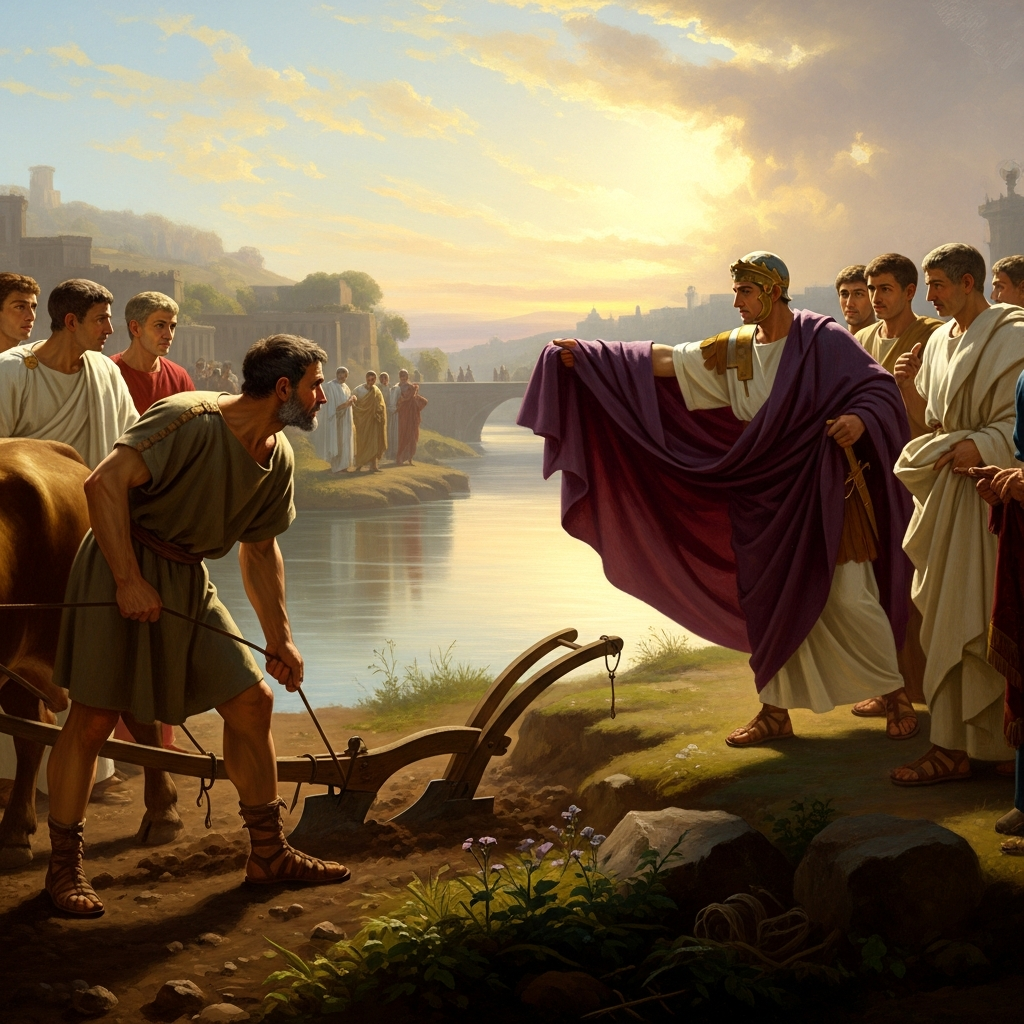
Cincinnatus from the Plow
458 BCE — early Roman Republic, the wars with the Aequi and Volsci in the central Italian highlands · Cincinnatus's four-iugera farm across the Tiber from Rome (the Prata Quinctia, the Quinctian Meadows); Mount Algidus where the Roman army was trapped
Contents
Rome's army is surrounded in a mountain pass. The Senate sends messengers across the Tiber to find Cincinnatus, a former consul living on a four-acre farm. They find him plowing, his tunic off, sweat on his back. They tell him to put on his toga; he asks his wife to bring it. They name him dictator. Sixteen days later he has saved the army, returned to Rome in triumph, resigned the dictatorship, and gone back to his plow.
- When
- 458 BCE — early Roman Republic, the wars with the Aequi and Volsci in the central Italian highlands
- Where
- Cincinnatus's four-iugera farm across the Tiber from Rome (the Prata Quinctia, the Quinctian Meadows); Mount Algidus where the Roman army was trapped
The senators cross the Tiber at dawn.
There is no bridge here yet — the Pons Sublicius is downriver — and they take a small ferry across to the right bank, the rural side, the side of farms and pasture where Romans of small property still keep four iugera and a yoke of oxen and pretend the city has not yet swallowed the country. The men in the ferry are wearing the toga praetexta of senators, with the purple stripe, and they look out of place. They are looking for a man named Cincinnatus.
They find him in his field.
His tunic is off. He is naked from the waist up — the way a Roman farmer works in summer — and he is leaning into a wooden plow behind two oxen, breaking the soil for the next planting. The sweat is running down his back. There is dirt on his arms to the elbow. He sees the senators on the path and stops the oxen and stands there, leaning on the plow handle, waiting.
The lead senator clears his throat.
Put on your toga, he says, and listen to what we have come to say.
Cincinnatus calls his wife.
Her name is Racilia. She comes out of the small farmhouse with the toga over her arm — the white wool, the stripe — and she helps him into it on the path beside the plow. He wipes his face with the corner of it. He does not bathe; there is no time. He asks the senators what has happened.
They tell him.
The Roman army — under the consul Minucius — has been surrounded by the Aequi at Mount Algidus, in the highland passes east of Rome. The Aequi have built a wall of earth around the Roman camp. The army is going to die there in days. There is no force in the city large enough or fast enough to break through. The Senate has voted to appoint a dictator — the office of last resort, the magistrate with absolute power for six months, used only in mortal emergencies — and the Senate has chosen him.
Cincinnatus.
He is sixty years old. He is a former consul. He has lost most of his property to a fine paid on behalf of his exiled son, which is why he is plowing four iugera with his own hands instead of supervising slaves on a hundred. The senators have come for him because Rome cannot find a younger man it trusts more.
He stands in his toga in the middle of his half-plowed field and accepts.
He goes to Rome the same day.
The dictator’s escort meets him at the river — twenty-four lictors with the fasces, the bundles of rods around an axe that mean a magistrate may flog or kill. He walks into the city behind them and immediately suspends ordinary government. He calls a iustitium, a halt to civil business; he closes the courts, closes the shops, orders every man of military age to be in the Field of Mars by sunset with five days’ rations and twelve stakes for entrenchment.
Every man in the city.
By that evening the Field of Mars is full. The army that did not exist in the morning marches at midnight. Cincinnatus is at the head of it, sixty years old, in armor he has not worn in a decade, riding through the dark toward the highlands where the Roman army is dying.
He reaches Mount Algidus before dawn.
He arrays his men in a circle around the Aequian wall — the wall that is keeping the Roman army in — and he has them dig their own trench around it from the outside. The Aequi, who have been besieging Minucius for days, find themselves between two Roman armies and a circle of stakes they did not see being driven into the ground in the dark.
Cincinnatus orders the assault.
The Aequian army, caught between Minucius’s men breaking out of the inner camp and Cincinnatus’s relief force pressing in from outside, breaks and surrenders within hours. The general of the Aequi is captured. The army of the Aequi is sent under the yoke — the jugum, three spears arranged in an arch under which a defeated army has to walk one by one, helmets off, weapons surrendered, in the worst humiliation the Romans know how to perform.
The Roman army inside the circle is alive.
Minucius is alive — and Cincinnatus, with the constitutional power to do whatever he chooses to a consul who has nearly lost the city’s army, takes Minucius’s eagles and his command and demotes him to legate. He does not destroy him. He does not punish him further. He returns to Rome with the army in two days.
He celebrates a triumph.
The Romans line the Sacra Via and watch the dictator who came from the plow ride through the city behind the captured Aequian standards and the chained general of the enemy. The triumph is the city’s highest civic ritual — a victory parade, a religious procession, an offering at the Capitoline temple — and Cincinnatus performs it correctly, completely, in the order the priests prescribe.
Then he resigns.
His office is dictator. His term is six months. He has held it for fifteen days. He stands in front of the Senate the day after the triumph and lays down the dictatorship. The lictors with the fasces walk away from him. He is a private citizen again.
He gathers his things. He walks back across the Tiber. He goes to his small farm — the same four iugera, the same farmhouse, the same plow standing in the half-finished furrow where he left it sixteen days earlier — and he puts the toga away and picks up the plow handle and goes back to work.
The Aequi will not threaten Rome again for a generation.
The Senate sends for him a second time.
He is eighty years old. There is a conspiracy inside Rome — the patrician Spurius Maelius, who has been distributing free grain to the plebs and is suspected of buying their loyalty to make himself king — and the Senate, terrified of the word king in the way only the Roman Senate can be, votes to appoint a dictator a second time. They cross the river a second time. They find Cincinnatus, now eighty, still on the same farm.
He goes again.
He handles the crisis — Spurius Maelius is killed by his master of horse, Servilius Ahala, in the Forum; Cincinnatus does not himself draw the sword — and again, when the danger is over, he resigns within weeks and walks back across the Tiber to his plow.
He dies on the farm.
The land is called, afterward, the Quinctian Meadows, the Prata Quinctia, after his family name — Lucius Quinctius Cincinnatus — and the Romans never forget which man they are remembering when they walk past it.
Livy writes the story in the early empire — when the Roman aristocracy was watching, with a certain amount of dread, the office of dictator slowly become permanent under another name. Augustus had refused the title in 22 BCE; Caesar had been killed in part for accepting it. The figure of Cincinnatus — the dictator who took the office for fifteen days and then walked back to his plow — was, by Livy’s time, a kind of accusation against the present. He is the magistrate the Republic was supposed to produce and was no longer producing.
The image of him at the plow — toga over the tunic, the lictors with the fasces standing on the path while his wife brought out the formal cloak — became the visual shorthand for civic virtue in Roman art and literature. Cicero called it the most beautiful picture of antiquity. The figure is not the soldier and not the statesman; it is the citizen, the man who can be summoned and who can return.
Two thousand years later, after the American Revolution, the Continental Army officers who served under George Washington founded the Society of the Cincinnati to commemorate the resemblance — Washington, like Cincinnatus, had refused to take more power than the emergency needed and had gone back to his farm. The city of Cincinnati was named for the society. The story migrated.
The deepest line in Livy is the smallest detail. The plow is left in the furrow. He does not finish the row before he goes. He comes back, sixteen days later, and picks up where he left off. The interruption was the Republic; the work was the field. He understood which one was supposed to be permanent.
Echoes Across Traditions
Entities
- Lucius Quinctius Cincinnatus
- Minucius
- The Senate
- The Aequi
Sources
- Livy, *Ab Urbe Condita* 3.26-29 (c. 27 BCE - 9 CE)
- Dionysius of Halicarnassus, *Roman Antiquities* 10.23-25
- Florus, *Epitome* 1.5
- Cicero, *De Senectute* 16.56


