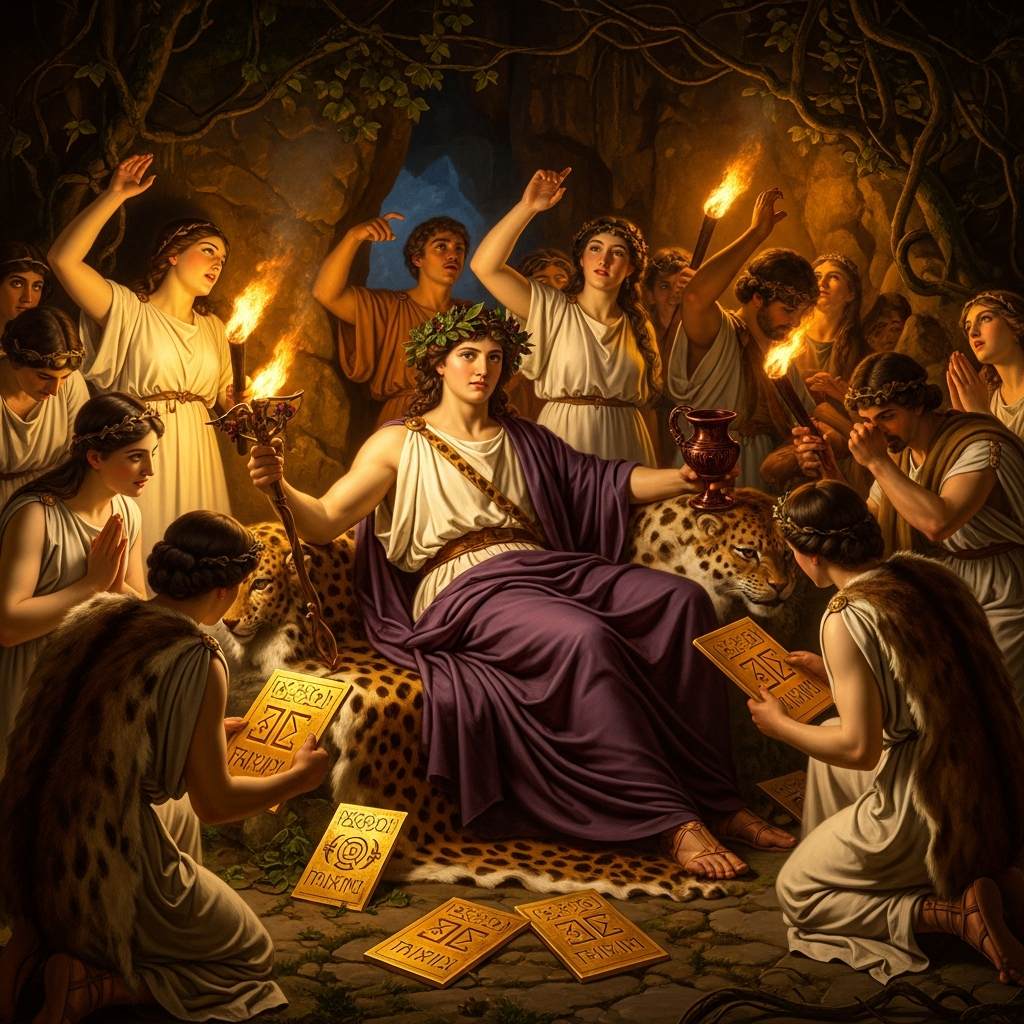
The Orphic Gold Tablets: Instructions for the Dead
Oldest tablet c. 400 BCE (Hipponion, Italy); tradition c. 500 BCE–300 CE · Magna Graecia (southern Italy); Crete; Thessaly; the underworld as mapped by Orphism
Contents
Buried with initiates in southern Italy and Greece from the 5th century BCE onward, the Orphic gold tablets are the world's earliest instruction manuals for the afterlife. Written on thin sheets of gold leaf, they tell the soul what to say and do when it arrives in the underworld: avoid the spring on the left (the spring of forgetfulness), drink instead from the spring guarded by the white cypress. Say the password. Claim descent from Earth and starry Heaven. The guardians will let you through. You will drink from the spring of Memory and be free.
- When
- Oldest tablet c. 400 BCE (Hipponion, Italy); tradition c. 500 BCE–300 CE
- Where
- Magna Graecia (southern Italy); Crete; Thessaly; the underworld as mapped by Orphism
The oldest one was found in a woman’s grave in Hipponion, in Calabria, in 1969.
She had been dead for 2,400 years. The archaeologists found the gold tablet rolled into a cylinder and placed near her lips, as if meant to be read at the moment she needed it — or as if the text on it was meant to be in her mouth when she arrived where she was going. The tablet is 10.5 centimeters long, thinner than a thumbnail, and it says:
This is the work of Memory, when you are about to die and go to the well-built house of Hades. There is a spring on the left side, and standing by it a white cypress. There the descending souls of the dead refresh themselves. Do not even go near this spring. Further on, you will find the cold water flowing from the Lake of Memory. There are guardians before it. Say: “I am a child of Earth and of starry Heaven, but my race is of Heaven alone. This you know yourselves. And lo, I am parched with thirst and I perish. Give me quickly the cold water flowing from the Lake of Memory.”
And they will give you to drink from the divine spring, and thereafter among the other heroes you will have lordship.
That is roughly half the text. The other half names the place and repeats the formula. The whole thing would take about forty seconds to read aloud.
The tablets assume the soul is arriving in a landscape.
Not a void. Not a judgment seat. A landscape with a left path and a right path, a spring that forgets and a spring that remembers, guardians who can be spoken to, and a community of heroes waiting for the initiate who knows the password. The underworld of the Orphic tablets is a navigable geography — frightening, cold, and disorienting, but not random. It has a structure, and the structure can be learned.
This is the fundamental claim of Orphic religion, and it is different from the claim of conventional Greek religion about the afterlife.
In Homer, the underworld is a place of diminishment. The shades drink blood to remember who they were. Achilles tells Odysseus that he would rather be a living slave than a dead hero. The dead remember life the way the old remember youth: accurately but with the grief of distance. The afterlife in Homer is not a place anyone would choose; it is the place you end up.
The Orphic tablets describe a different afterlife — one in which the soul that has been prepared can arrive knowing what to do, can identify itself correctly, can choose the right spring, and can emerge into a condition not of diminishment but of restored identity. The soul that drinks from Mnemosyne, the spring of Memory, does not forget who it is. It remembers, completely and permanently, its divine origin.
The soul that drinks from Lethe, on the left, forgets. Forgetting means rebirth — the soul re-enters the cycle of incarnation, stripped of the memory of its previous lives, beginning again. The Orphic tradition considers this the inferior outcome. The tablets are instructions for avoiding it.
The password has a theology embedded in it.
I am a child of Earth and of starry Heaven, but my race is of Heaven alone.
This two-part claim is not merely a ritual formula. It encodes a complete cosmological anthropology: the human being is made of both material and divine elements (Earth and Heaven), but the soul’s true identity — the thing that constitutes the self — is divine only, not material. The body came from Earth and will return to it. The soul came from Heaven, and if it knows this, it can go back.
The guardians of the spring are testing exactly this knowledge. They are not looking for moral credentials — the tablets say nothing about having lived virtuously, about the judgment of deeds, about the weighing of the heart. They are looking for the knowledge of identity. Do you know what you are? Can you say it in the right words? If yes, you pass. If no — if you approach the wrong spring, if you cannot say the formula, if you have not been initiated — you drink from Lethe and begin again.
This is why the community that used these tablets initiated its members. The initiation was, among other things, education: you were told the geography, taught the formula, given the script. The gold tablet was the physical token of that education, buried with you so you would have it when you needed it.
The tablets were made in communities scattered across the Greek-speaking world.
Hipponion in Calabria, southern Italy. Petelia, also in Calabria. Thurii, a Greek colony in the instep of Italy. The island of Crete. Thessaly in northern Greece. Pelinna, also in Thessaly, where two tablets were found in the grave of a woman, each reading: Tell Persephone that Bacchios himself has freed you.
Bacchios is Bacchus is Dionysus.
The Orphic and Dionysiac traditions were not identical, but they were closely related in the ancient world, and the tablets from Pelinna make the connection explicit. The woman buried with those tablets was not only claiming membership in the community of the initiated; she was claiming a specific patron. Dionysus himself had freed her. She was arriving in the underworld under divine protection.
The Dionysiac element of the Orphic tablets connects to the most esoteric layer of Orphic mythology: the story of Dionysus Zagreus, the infant god who was torn apart and eaten by the Titans, then reconstituted by Zeus, whose divine essence was swallowed by the Titans and whose crime stained the human race. Humans are made from the ash of the Titans destroyed by Zeus’s lightning after they ate Dionysus — and that ash contained the ingested remains of the divine child. The Titanic element in humanity is the body; the Dionysiac element is the soul.
If this mythology is correct, the soul is literally a fragment of divine body, eaten and imprisoned. The Orphic path is the path of extraction.
The tablets are made of gold for theological reasons.
Gold does not rust. Gold does not decay. Gold survives burial, survives fire, survives water. By encoding the instructions on gold, the community asserted that the instructions would survive the conditions of death and the underworld — that the text would still be readable when the soul needed it. The materiality of the tablet is part of its claim.
This is also why they were placed near the mouth. The soul would need to speak the words. The words needed to be in a form that survived. Gold is the medium that makes the instruction eternal.
The last tablets were made sometime around 300 CE.
The tradition had been continuous for roughly eight hundred years, from the 5th century BCE through the early centuries of the common era. By the 4th century CE, Christianity was the dominant religion of the Roman Empire, and the pagan mystery traditions were suppressed or faded. The graves stopped containing gold tablets. The instruction manuals stopped being buried.
Whether the souls that arrived in the underworld after 300 CE still found the same geography — the left spring and the right spring, the white cypress, the guardians, Persephone waiting — is a question the tablets cannot answer.
What the tablets answer is simpler and more durable: the living can prepare the dead. The community can teach the soul what it needs to know before it needs to know it. The script can be written in advance and carried to the place where it will be needed.
You are a child of Earth and of starry Heaven.
But your race is of Heaven alone.
Say it. They will let you through.
Echoes Across Traditions
Entities
- The soul of the initiate
- Mnemosyne (Memory) — the spring on the right
- Lethe (Forgetfulness) — the spring on the left
- Persephone as judge
- Dionysus (in whose name the tablets speak)
Sources
- Orphic Gold Tablets, c. 400 BCE onward (sites at Hipponion, Petelia, Thurii, Pelinna, Crete)
- Radcliffe Edmonds III (ed.), *The 'Orphic' Gold Tablets and Greek Religion* (2011)
- Fritz Graf and Sarah Iles Johnston, *Ritual Texts for the Afterlife: Orpheus and the Bacchic Gold Tablets* (2007)
- W.K.C. Guthrie, *Orpheus and Greek Religion* (1952)
- Alberto Bernabé and Ana Isabel Jiménez San Cristóbal, *Instructions for the Netherworld: The Orphic Gold Tablets* (2008)
- Jan Bremmer, *The Rise and Fall of the Afterlife* (2002)


