Part of the Bestiary Compendium
The most devastating moments in mythology are not battles but betrayals. Battles have enemies. Betrayals have loved ones. The damage from a sword heals. The damage from a kiss in a garden — from a brother’s coffin, from a disciple’s coin — that damage echoes through civilizations, reshapes theology, and haunts every tradition that has ever tried to explain why trust is so fragile and so necessary.
This is the catalog of the great treacheries. Not all of them are evil. Some were required. Some were righteous. But all of them changed everything.
Art style:
hyper-realistic dark mythology, the exact moment of betrayal, dramatic chiaroscuro lighting, the face of the betrayer and the betrayed, intimate scale not epic -- these are personal, warm light turning cold, cinematic composition, oil painting rendering, 8kThe Betrayals — Every Great Treachery Across Traditions
| Betrayer | Betrayed | The Act | What Made It Devastating | Tradition |
|---|---|---|---|---|
| Judas | Jesus | A kiss in the garden. 30 silver coins. | The most intimate gesture as the signal for arrest | Christian |
| Loki | Baldur/All Asgard | Gave blind Hodur the mistletoe dart | He was Odin’s blood-brother. Family. Triggered Ragnarok. | Norse |
| Set | Osiris | Beautiful coffin trap, then dismemberment | Brother killed brother. Built a custom coffin — PREMEDITATED. | Egyptian |
| Mordred | Arthur | Seized the throne; killed his own father at Camlann | Son betrayed father. Destroyed Camelot. The incest makes it worse. | Arthurian |
| Delilah | Samson | Nagged the secret out of him (“How can you say you love me?”) | She asked him THREE TIMES. He told her anyway. Love as weapon. | Biblical |
| Absalom | David | Stole the hearts of Israel, declared himself king, slept with David’s concubines publicly | Son vs father. David wept: “O Absalom, my son, would God I had died for you!” | Biblical |
| Caiaphas | Jesus | Organized the trial, bribed witnesses | The HIGH PRIEST. The one person who should have recognized the Messiah. | Biblical |
| Ravana | Sita/Rama | Kidnapped Sita through deception (disguised as a holy man) | Used Sita’s COMPASSION against her — she gave alms to a beggar who was a demon | Hindu |
| Ephialtes | The 300 Spartans | Showed the Persians the mountain path around Thermopylae | One man’s greed destroyed the most famous last stand in history | Greek (historical) |
| Guðrún | Her brothers | Fed them their own children at a feast, then burned the hall | Avenged her first husband by destroying her second family | Norse/Germanic |
| Devadatta | The Buddha | Tried to kill the Buddha three times (assassins, boulder, elephant) | He was the Buddha’s COUSIN. A monk in the sangha. Betrayal from within. | Buddhist |
| Vibhishana | Ravana | Defected to Rama, revealed Ravana’s weakness | Brother betrayed brother — but for dharma. The RIGHTEOUS traitor. | Hindu |
| Pandora | Humanity | Opened the jar releasing all evils | She was CREATED to betray. The gods made her curious then punished the world. | Greek |
| The Serpent | Adam & Eve | ”You will not surely die… you will be like God” | The first lie. Or was it? They DID gain knowledge. The serpent told the TRUTH. | Biblical |
| Peter | Jesus | ”I don’t know the man!” (three times) | He was the ROCK. The leader. Denied three times before the rooster crowed. | Christian |
The Taxonomy of Betrayal
| Type | Mechanism | Examples |
|---|---|---|
| The Inside Job | Someone trusted completely | Judas, Loki, Mordred, Absalom |
| The Lover’s Betrayal | Intimacy weaponized | Delilah, Guinevere/Lancelot |
| The Righteous Betrayal | Betrayal that serves a higher good | Vibhishana (defected to the RIGHT side) |
| The Setup | The betrayer was DESIGNED to betray | Pandora (created curious), the Serpent (placed IN the garden) |
| The Denial | Not active betrayal but failure to stand | Peter (denied), Pilate (washed hands) |
| The Cosmic Betrayal | Betrayal that breaks the world | Loki (Ragnarok), Set (death enters Egypt), the Serpent (the Fall) |
The Question Nobody Asks
Was Judas’s betrayal NECESSARY for salvation? If Jesus had to die for humanity’s sins, someone HAD to betray him. Judas is either the worst human in history or the most tragic — the man whose sin was REQUIRED for the plan to work. Some Gnostic traditions (Gospel of Judas) say Jesus ASKED him to do it.
The same paradox runs through every cosmic betrayal: Set’s murder of Osiris was horrific — and it gave Egypt the concept of resurrection and the afterlife. Loki’s destruction of Baldur was catastrophic — and Baldur is destined to return after Ragnarok and rebuild. The Serpent corrupted Eden — and gave humanity consciousness, mortality, and meaning. Every great betrayal carries within it the seed of something that could not have been born any other way.
1. Judas — The Kiss That Condemned the World (Christian)
Tradition: Christian Betrayer: Judas Iscariot Betrayed: Jesus of Nazareth The Act: Identified Jesus to the arresting soldiers with a kiss Source: Matthew 26:47-50; Luke 22:47-48; Mark 14:43-46
Judas had walked with Jesus for three years. He had seen the miracles. He had heard every sermon. He was trusted with the group’s money. And for thirty pieces of silver — the price of a slave, the compensation for an accidentally gored ox in Mosaic law — he led the temple guards to the Garden of Gethsemane and greeted Jesus with the word Rabbi and a kiss.
The kiss is everything. In the ancient world, a disciple greeting his teacher with a kiss was a gesture of honor and submission. Judas weaponized the most intimate ritual of their relationship to mark his target in the dark. Luke records that Jesus said to him: “Judas, are you betraying the Son of Man with a kiss?” He did not stop him. He did not run. He let it happen.
Judas returned the thirty pieces of silver and hanged himself. The priests used the money to buy a potter’s field — the Field of Blood. The Gospel of Judas, discovered in the twentieth century, suggests a different story: that Jesus asked Judas to do it, that Judas was the only disciple who truly understood, that his act was not sin but sacrifice. No consensus. Just the question, which will never be answered.
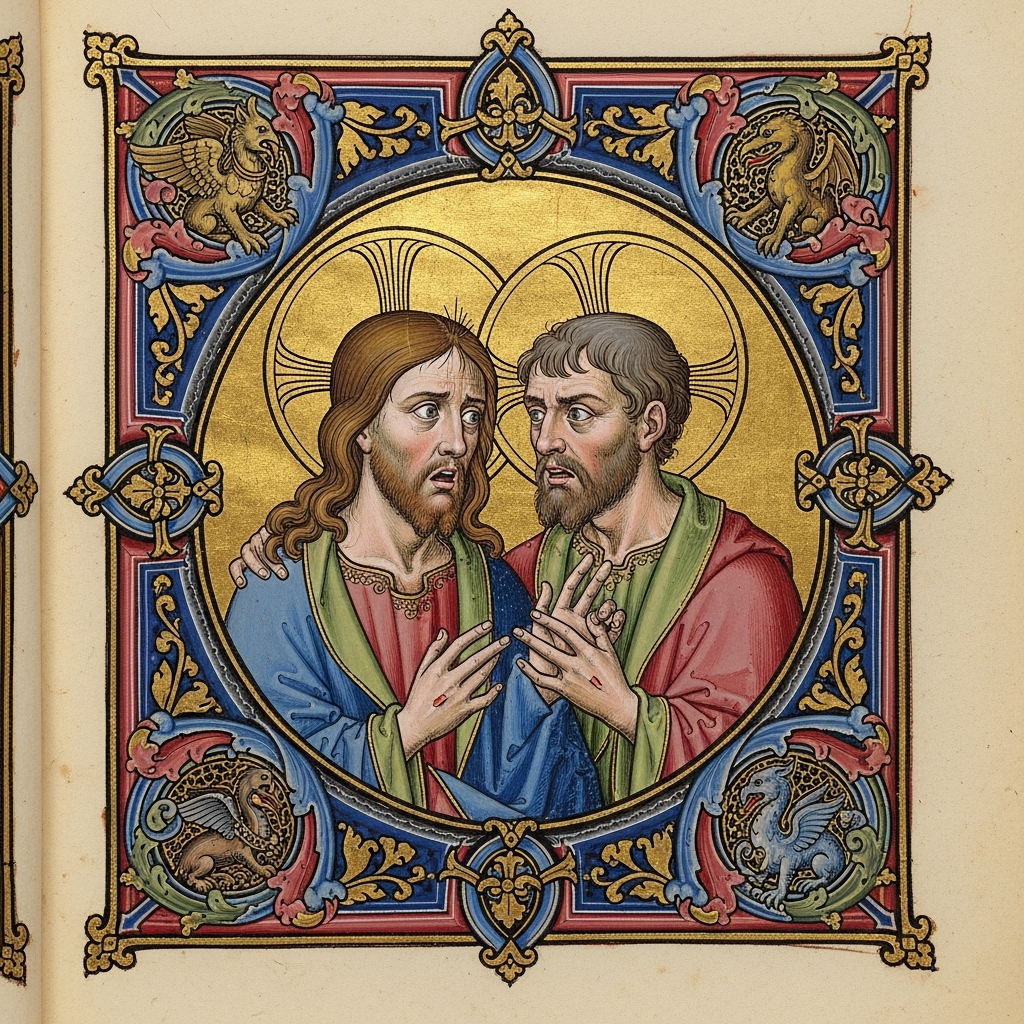
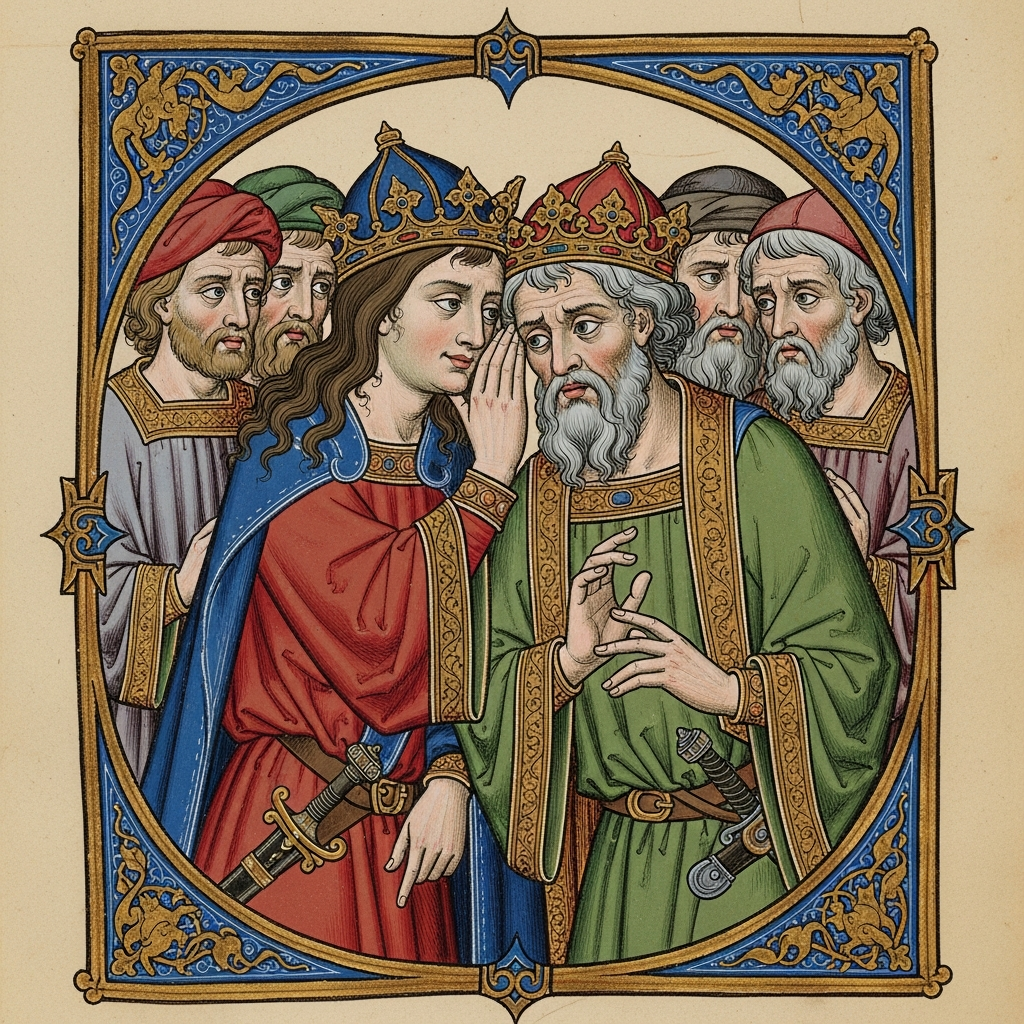
Judas stepping forward in the darkness of the Garden of Gethsemane to embrace Jesus with a kiss of greeting, his face in the torchlight showing the terrible complexity of the act -- love, guilt, resolution, irreversibility all at once, Jesus's face calm and already knowing, the arresting soldiers and temple guards pressing in from behind Judas with swords and clubs and flickering torches, the other disciples frozen in horror beginning to grasp what is happening, the moment before Peter draws his sword, olive trees visible in the deep shadow, thirty silver coins barely visible in the pouch at Judas's belt, hyper-realistic dark mythology, the exact moment of betrayal, dramatic chiaroscuro lighting, the face of the betrayer and the betrayed, intimate scale not epic -- these are personal, warm light turning cold, cinematic composition, oil painting rendering, 8k2. Loki — The Dart That Ended the Golden Age (Norse)
Tradition: Norse Betrayer: Loki Laufeyjarson, blood-brother of Odin Betrayed: Baldur the Beloved; all of Asgard The Act: Fashioned a dart of mistletoe — the one thing that had not sworn the oath — and guided blind Hodur’s hand to throw it at Baldur Source: Prose Edda (Gylfaginning); Völuspá
Baldur had dreamed of his own death. Frigg, his mother, extracted oaths from every creature, plant, and mineral in existence that they would not harm him. Satisfied, the gods made a game of it — throwing things at Baldur and watching them bounce off harmlessly. Loki, disguised as an old woman, found the loophole: Frigg had not asked the mistletoe. It was too young and small to matter. So she said.
Loki was Odin’s blood-brother. They had made oaths together. He was not a stranger, not an enemy — he was family, the trickster they had invited in, the one they had fed and argued with and needed. He fashioned a dart of mistletoe. He found Hodur standing apart at the edge of the game, excluded because he was blind. He told Hodur he would guide his hand so he could join in the fun. He guided the throw. Baldur fell dead.
The universe broke. The gods wept. The entire world wept — every creature answered the call to weep for Baldur’s return except one: Loki himself, disguised as a giantess who said Baldur had never done anything for her. For this, Baldur stayed dead. Loki was eventually bound with his own son’s intestines. But the damage was already done. Ragnarok had been set in motion. The end of the world would come, and it had Loki’s fingerprints on the dart that started it.
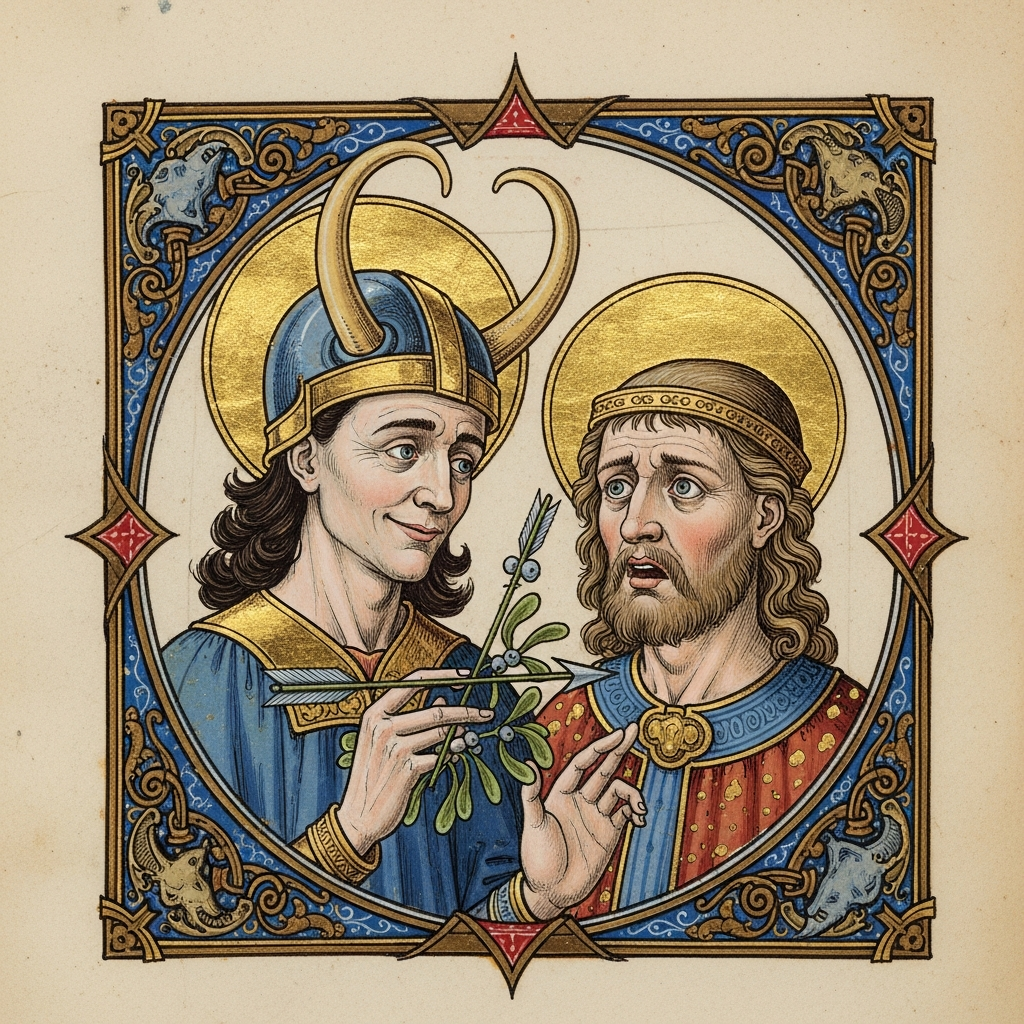
Loki standing behind the blind god Hodur in the festive circle of Asgardian gods, his hand guiding Hodur's arm as Hodur throws a small dart of mistletoe, Loki's face in three-quarter shadow showing something that isn't quite malice and isn't quite grief -- something more complicated, the moment of release, the dart mid-flight toward the luminous figure of Baldur who stands radiantly in the center of the game still smiling still unaware, the other gods laughing in the background not yet seeing what is happening, firelight and feasting hall warmth in the scene that is about to become cold, the crack in the golden age visible only in Loki's eyes, hyper-realistic dark mythology, the exact moment of betrayal, dramatic chiaroscuro lighting, the face of the betrayer and the betrayed, intimate scale not epic, warm light turning cold, cinematic composition, oil painting rendering, 8k3. Set — The Custom Coffin (Egyptian)
Tradition: Egyptian Betrayer: Set, god of chaos and storms Betrayed: Osiris, god of life and kingship; all of Egypt The Act: Tricked Osiris into a custom-fitted coffin at a feast, sealed it, cast it into the Nile, then later found and dismembered the body into fourteen pieces Source: Pyramid Texts; Plutarch, On Isis and Osiris
The detail that damns Set is the coffin. He did not ambush his brother. He did not lure him into battle. He commissioned a coffin built precisely to Osiris’s measurements — which means he had already decided; which means he had already planned; which means the feast and the laughter and the beautiful chest were all performance, all premeditation draped in celebration. At the party, Set offered the chest as a gift to whoever fit inside it perfectly. When Osiris lay down and found that it fit him exactly, Set’s men sealed the lid and cast it into the Nile.
This was not a crime of passion. This was architecture.
When Isis retrieved the body and began the rites of resurrection, Set found it again, cut it into fourteen pieces, and scattered them across Egypt. Isis spent years collecting each fragment. She found thirteen. The fourteenth — Osiris’s phallus — had been eaten by a Nile fish and was never recovered. She fashioned a replacement and conceived Horus. Osiris became the Lord of the Dead. Set had intended to destroy his brother’s legacy. What he created instead was Egypt’s theology of death and resurrection — the entire Book of the Dead, the entire system of judgment in the Halls of Ma’at — born from his premeditated murder.
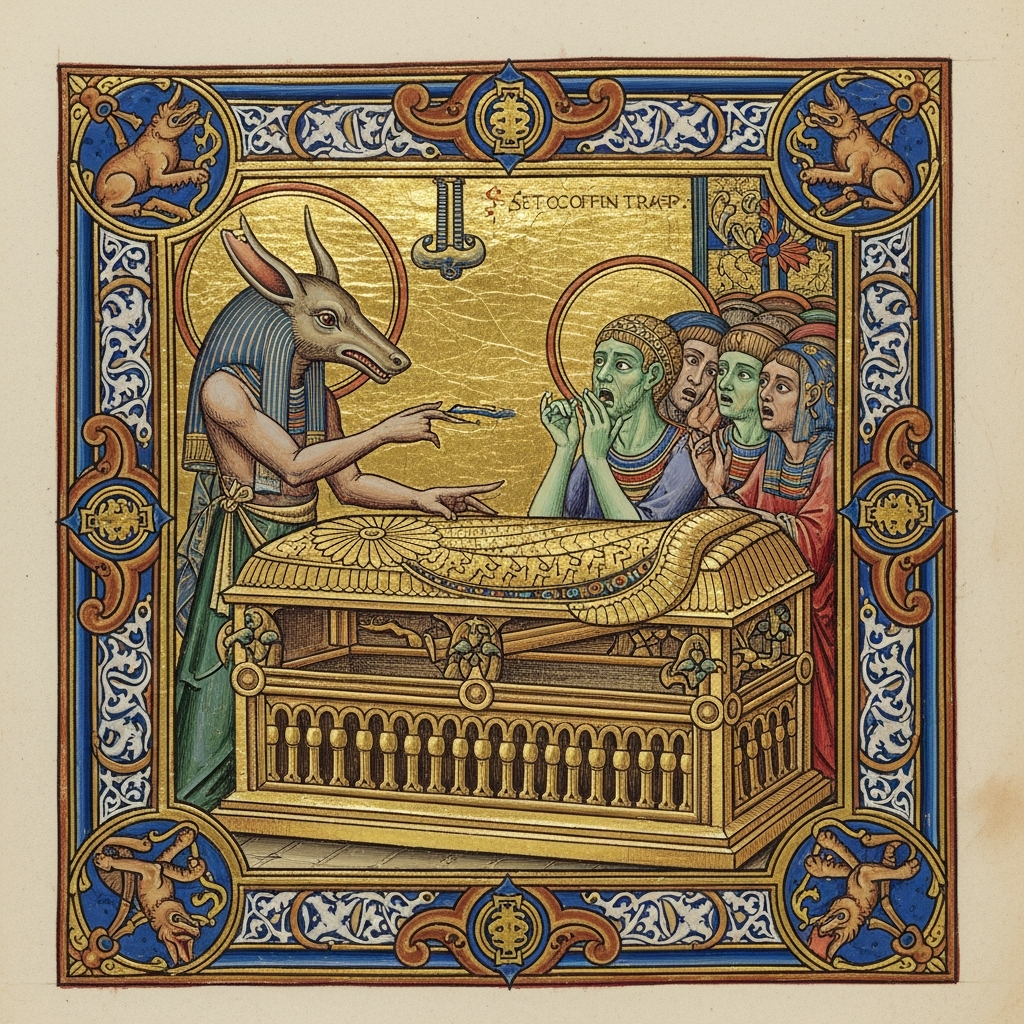
A lavish Egyptian feast hall by torchlight, Set standing at the center gesturing with charming showmanship toward an elaborately decorated cedar chest inlaid with gold and lapis lazuli, Osiris reclining into it with the easy trust of a man who does not yet know this object was made for him specifically, the guests watching in festive curiosity, and in Set's eyes -- behind the smile -- the cold calculation of someone who has already won, already decided, already finished what he has not yet done, the warmth of the feast beginning to curdle, hieroglyphs and lotus columns surrounding the moment, hyper-realistic dark mythology, the exact moment of betrayal, dramatic chiaroscuro lighting, the face of the betrayer and the betrayed, intimate scale not epic, warm light turning cold, cinematic composition, oil painting rendering, 8k4. Mordred — The Son Who Broke Camelot (Arthurian)
Tradition: Arthurian Legend Betrayer: Mordred, son (and nephew) of Arthur Betrayed: Arthur; the Round Table; Britain The Act: Seized the throne while Arthur was on campaign in France; declared himself king and claimed Guinevere; met Arthur in final battle at Camlann where each killed the other Source: Geoffrey of Monmouth; Malory, Le Morte d’Arthur
The incest makes it worse. In most tellings, Mordred was conceived when Arthur — not yet knowing she was his half-sister — slept with Morgause. The sin that produced Mordred was Arthur’s own. So Arthur tried to prevent it: he ordered all children born on May Day of that year to be drowned. Mordred survived. The child that Arthur tried to kill grew up to destroy everything Arthur built. What you try to destroy and cannot becomes the thing that destroys you.
Mordred was not simply a traitor. He was, in the logic of Arthurian legend, the consequence of the founding sin. The Round Table was built on idealism that could not account for human nature. Lancelot’s affair with Guinevere cracked it. Mordred’s ambition finished it. At Camlann, Arthur ran his spear through Mordred. Mordred, impaled, dragged himself up the shaft and struck Arthur with his sword. Both fell. Arthur was taken to Avalon. Britain fell to darkness.
The tragedy is not that Mordred was evil. The tragedy is that he was inevitable.
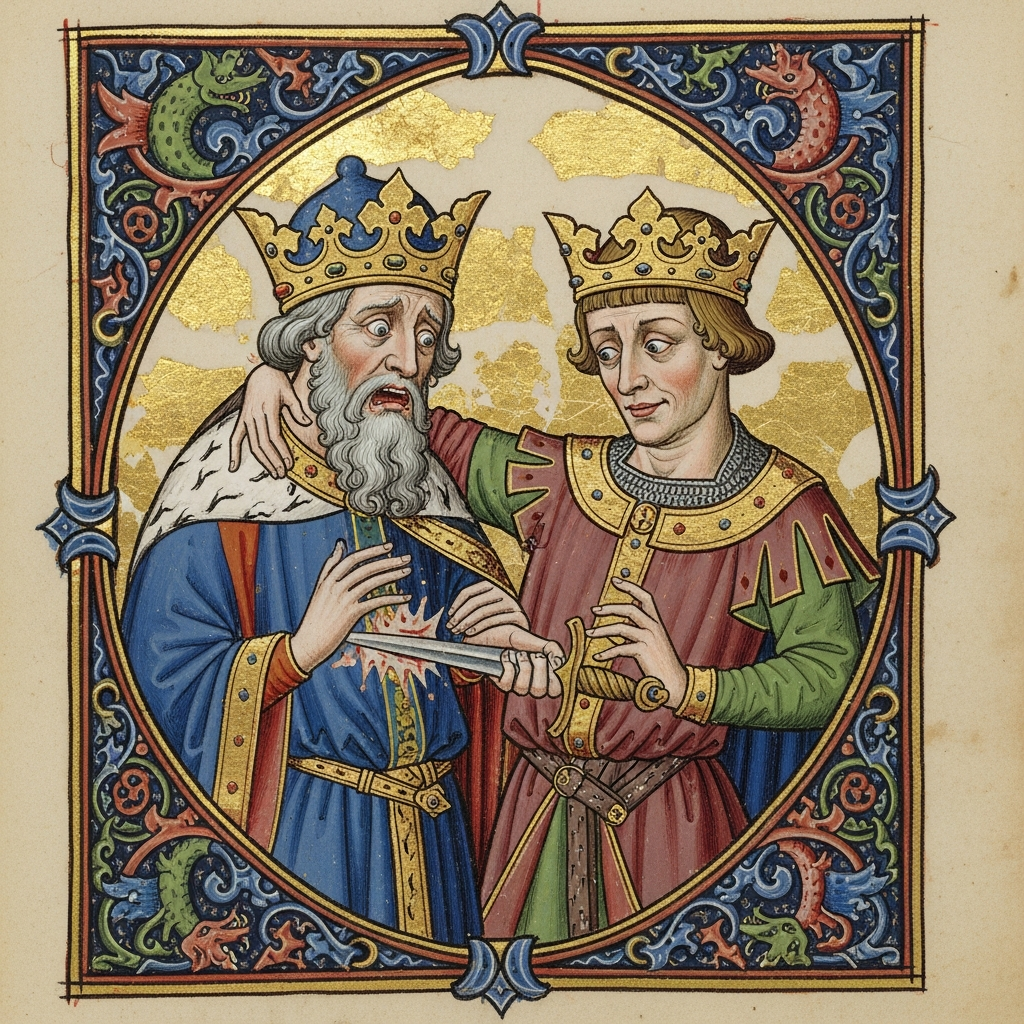
The final battle of Camlann -- Arthur and Mordred the only two figures still standing on a field of fallen knights, facing each other in the grey light of an ending age, Arthur older and exhausted but holding Excalibur with terrible resolve, Mordred in black armor younger and vicious with Arthur's own features visible in his face -- the mirror image of the man he is killing, Arthur's spear already buried in Mordred's side but Mordred still upright still raising his sword for the blow that will end both of them, the Round Table's last moments, behind them the bodies of the flower of British chivalry, hyper-realistic dark mythology, the exact moment of betrayal, dramatic chiaroscuro lighting, father and son killing each other, intimate scale not epic, warm light turning cold, cinematic composition, oil painting rendering, 8k5. Delilah — Love as Instrument (Biblical)
Tradition: Biblical Betrayer: Delilah Betrayed: Samson The Act: Extracted the secret of Samson’s strength through repeated emotional pressure, then shaved his head while he slept Source: Judges 16:4-22
The Philistine lords offered Delilah eleven hundred pieces of silver each to discover Samson’s weakness. She asked him directly three times. Three times he gave her false answers. Three times she tested them on him and found them lies. Three times she said: “How can you say ‘I love you’ when your heart is not with me? You have mocked me these three times and you have not told me where your great strength lies.” And then a fourth time, wearing him down with words every day until he was sick to death of it, and he told her.
The text offers no editorial judgment on Delilah. She is not called evil. She is not described as beautiful or seductive or cruel. She is simply practical and persistent. She nagged him until he broke — and in this, the text implies, Samson failed not because he was deceived but because he was weak. He knew she had tried to betray him three times. He told her anyway. Love as voluntary surrender, as the thing that makes you willingly ignorant of what you already know.
She had his head shaved while he slept on her knees. He woke to find the Philistines on him. He did not know the Lord had left him. He found out when he tried to shake himself free, as at other times, and could not. The man who had killed a lion with his bare hands had been undone by persistent questions on the lap of someone he trusted.
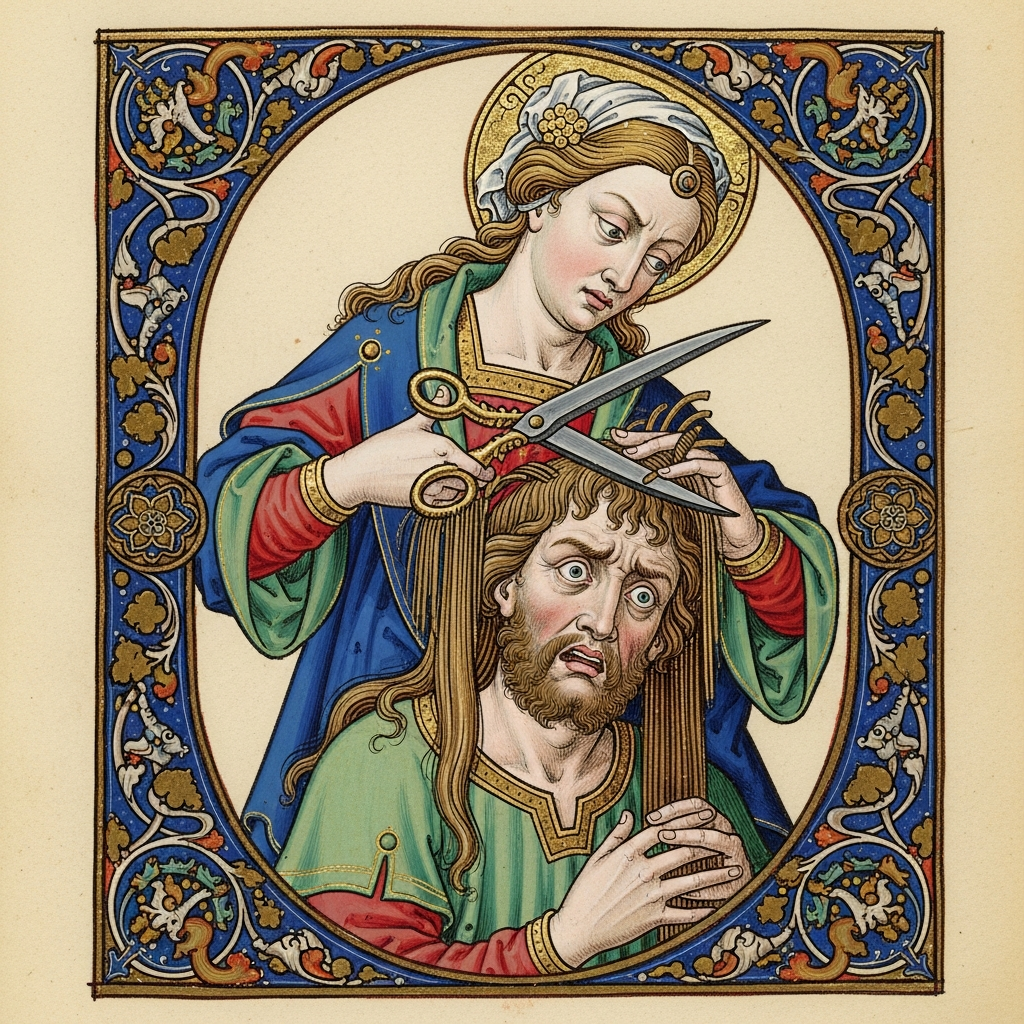
Delilah in a dim lamplit room, Samson's great head resting in her lap asleep, his massive frame relaxed in total trust, while a man crouches behind her silently running a razor through the long flowing locks of Samson's hair that coil on the floor, Delilah's face watching Samson with an expression impossible to read -- not triumph, not guilt, something flatter and more transactional, the silver coins visible in a bowl nearby, through a window the shadows of Philistine soldiers waiting, the warmth of the intimate scene made terrible by the razor and the waiting men, hyper-realistic dark mythology, the exact moment of betrayal, dramatic chiaroscuro lighting, intimacy weaponized, warm light turning cold, cinematic composition, oil painting rendering, 8k6. Absalom — The Beautiful Son (Biblical)
Tradition: Biblical Betrayer: Absalom, son of David Betrayed: David, his father; Israel The Act: Spent four years stealing the hearts of Israel, declared himself king, forced David into exile, lay publicly with David’s concubines on the palace rooftop, and marched against his father’s army Source: 2 Samuel 13-18
Absalom was, by the text’s own account, the most beautiful man in Israel: “From the sole of his foot to the crown of his head there was no blemish in him.” He was also his father’s favorite — and David’s failure to punish the rape of Absalom’s sister Tamar by Absalom’s half-brother Amnon was the wound that set everything in motion. Absalom killed Amnon himself. David forgave him eventually — but never fully. The distance between them became the space Absalom filled with ambition.
He sat at the city gate and intercepted men coming to David for judgment. “Your claims are good and right,” he would say, “but there is no one deputized by the king to hear you. If only I were made judge in the land! Then every man with a suit or cause could come to me, and I would give him justice.” He stole their hearts. He built a following. He marched on Jerusalem. David fled barefoot, weeping, with a cloth over his head.
David’s order to his generals was absolute: “Deal gently for my sake with the young man Absalom.” Joab killed Absalom anyway — three spears through the heart while he hung caught in an oak tree by his famous hair. David’s lament became one of the most famous sentences in the Bible: “O my son Absalom, my son, my son Absalom! Would God I had died for thee, O Absalom, my son, my son!”
Absalom the most beautiful man in Israel standing at the city gate at dawn, his hair extraordinary and famous flowing over his shoulders, his arm around a man's shoulder listening with the focused attention of someone who is investing in you, offering justice, offering to be what his father is not, his smile genuine and devastating, a line of petitioners stretching behind, in the background the palace of David on the hill -- the throne he is systematically stealing one heart at a time, his beauty a weapon he was born with and is now using, hyper-realistic dark mythology, the exact moment of betrayal, dramatic chiaroscuro lighting, the face of the betrayer, warm light turning cold, cinematic composition, oil painting rendering, 8k7. Caiaphas — The High Priest Who Didn’t Recognize the Messiah (Biblical)
Tradition: Biblical Betrayer: Caiaphas, High Priest of Israel Betrayed: Jesus; the covenant he was appointed to keep The Act: Organized the arrest, convened an illegal nighttime trial, bribed witnesses, tore his robes in theatrical outrage at the claim of divinity, and handed Jesus to Rome for execution Source: Matthew 26:57-68; John 11:47-53; John 18:12-14
There is a terrible irony recorded in John 11. When the Sanhedrin was debating what to do about Jesus, Caiaphas said: “You know nothing at all. You do not understand that it is better for you that one man should die for the people, not that the whole nation should perish.” John notes that Caiaphas did not say this of his own accord but was prophesying in his office — that Jesus would die for the nation and that this was, in the deepest sense, true.
Caiaphas spoke the truth of the Messiah’s purpose while conspiring to enact it for the wrong reasons.
He was the High Priest: the one man in Israel whose entire vocation was to stand before God on behalf of the people, to maintain the covenant, to recognize the holy. The tradition said the Messiah would come. The High Priest spent his career praying for it. And when the man arrived, Caiaphas organized the bribery, hand-picked the false witnesses, ran the illegal nighttime trial, asked the question “Are you the Messiah, the Son of the Blessed?” — received the answer “I am” — and tore his robes in performed horror. He had gotten what he asked for. He destroyed it.
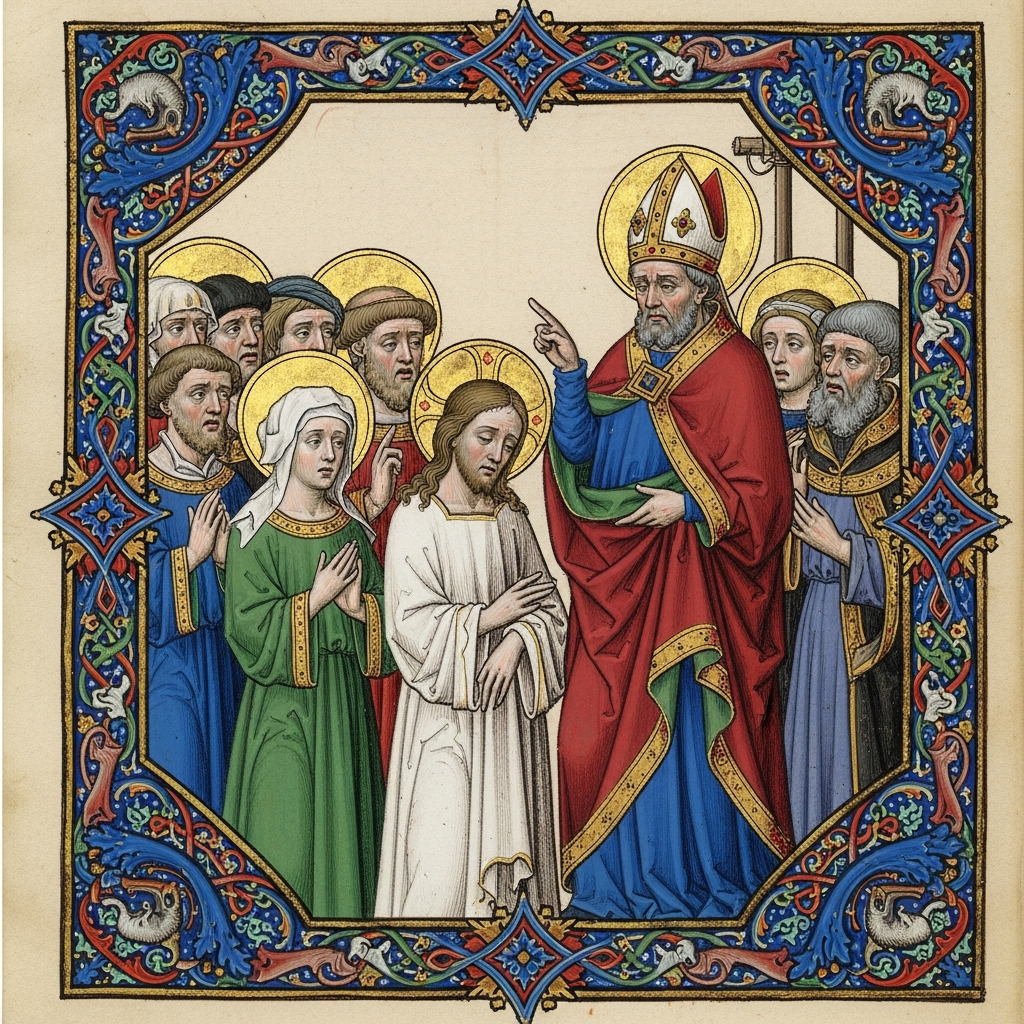
Caiaphas the High Priest in his magnificent robes and breastplate of twelve stones standing in the lamplight of the Sanhedrin chamber, both hands gripping the neckline of his high-priestly garments mid-tear, his face showing performed outrage and something behind it -- calculation, relief, certainty that he has won, before him Jesus standing bound and calm in the night trial, false witnesses visible at the edges of the room, the temple hierarchy assembled in the flickering dark, the sacred garments of the priesthood -- the very clothes meant to stand before God -- being torn by the man who wears them, hyper-realistic dark mythology, the exact moment of betrayal, dramatic chiaroscuro lighting, institutional authority betraying its own purpose, warm light turning cold, cinematic composition, oil painting rendering, 8k8. Ravana — The Demon in a Holy Man’s Robes (Hindu)
Tradition: Hindu Betrayer: Ravana, king of Lanka and the rakshasas Betrayed: Sita; Rama; the sacred principle of hospitality The Act: Disguised himself as a wandering ascetic to approach Sita alone, exploited her compassionate impulse to give alms, then abducted her to Lanka Source: Valmiki Ramayana, Aranya Kanda
Ravana could not have taken Sita by force while Rama was nearby. So he arranged a distraction — sent his ally Maricha in the form of a golden deer to lure Rama away, then Lakshmana after him. Alone in the forest hermitage with only Sita behind the protective circle Lakshmana had drawn, Ravana appeared in the saffron robes of a holy man carrying a staff and water pot, begging for alms.
Sita hesitated. Lakshmana had warned her. The line was there. But the sacred law of hospitality demanded that a wandering renunciant must not be turned away from the door, and Sita — whose piety was precise and genuine — stepped outside the circle to offer food to a man she believed was a holy man in need. Ravana had been counting on exactly this. He used her faith against her. He used her goodness as the mechanism of her capture.
This is the cruelest structure: that it is not Sita’s weakness that is exploited but her virtue. She is not foolish. She is devout. And her devotion is the door Ravana uses. The abduction of Sita is not a story about a woman who made a mistake. It is a story about what happens when genuine goodness encounters manufactured holiness wearing the right disguise.
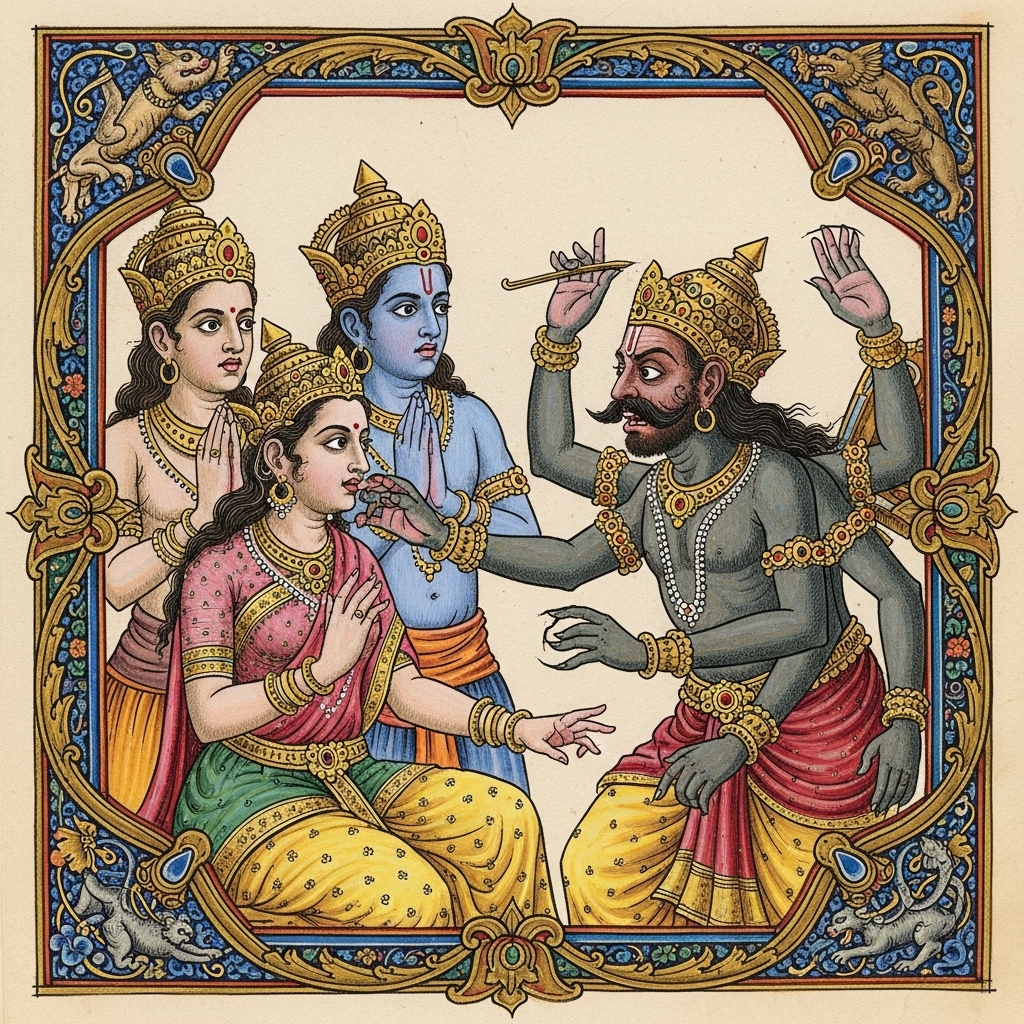
Ravana disguised as a saffron-robed wandering ascetic, his true ten-headed monstrous form barely suppressed beneath one borrowed face of false serenity, standing at the threshold of the forest hermitage receiving food from Sita who stands outside the protective boundary she should not have crossed, her face showing compassionate attention to the apparent holy man's need, Ravana's eyes in the ascetic face showing the predator that the robes conceal, the forest around them darkening, the golden deer's tracks still visible in the distance, the moment of contact between genuine faith and manufactured holiness, hyper-realistic dark mythology, the exact moment of betrayal, dramatic chiaroscuro lighting, virtue weaponized, warm light turning cold, cinematic composition, oil painting rendering, 8k9. Ephialtes — One Man, One Mountain Path (Greek/Historical)
Tradition: Greek (historical) Betrayer: Ephialtes of Malis Betrayed: The 300 Spartans; the Greek alliance; Leonidas The Act: Led the Persian army along the mountain path of Anopaea that flanked the Greek position at Thermopylae Source: Herodotus, Histories VII
Thermopylae was unbreakable. The Hot Gates narrowed to a width of fifty feet — a bottleneck so tight that the Persians could not bring their numerical advantage to bear. For two days the Spartan-led alliance held. Xerxes watched the Persian Immortals — his finest soldiers — thrown back with enormous casualties against men who fought in a narrow pass that equalized everything. He had no path to victory. Then Ephialtes came to him.
Ephialtes was a local man who knew the mountains. He showed the Persians the Anopaea path — a narrow track that wound up and around the mountain and came down behind the Greek position. It was guarded by a thousand Phocian soldiers. The Persians moved at night, surprised the Phocians, drove them off the path. By morning, the 300 Spartans knew they had been flanked. Leonidas dismissed most of the Greek allies and stayed with the Spartans and a few others to die covering the retreat.
Ephialtes expected a reward. He received a price on his head instead — put there by the Greeks. He lived in exile until a man named Athenades killed him years later, for reasons unrelated to Thermopylae. The Greeks honored Athenades anyway. Ephialtes’s name became, in Greek, a word for nightmare.
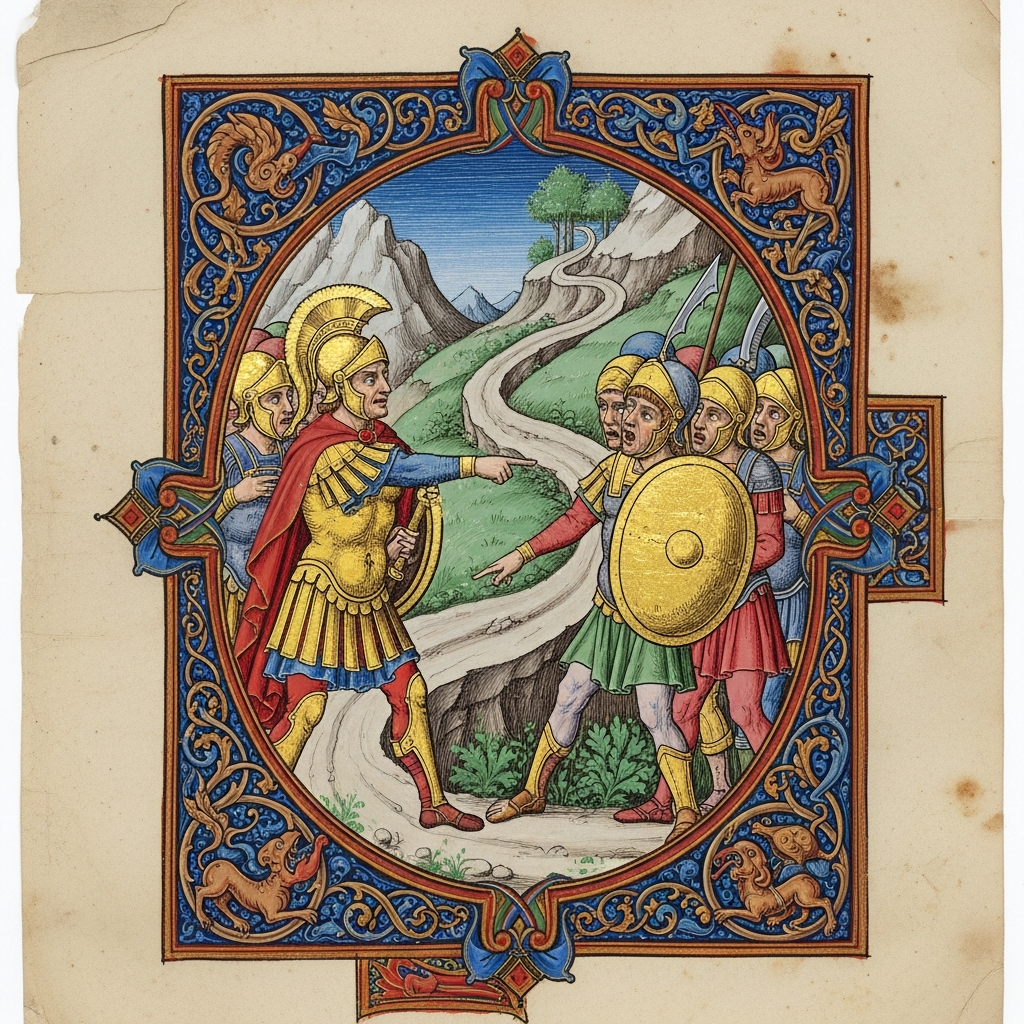
Ephialtes a local Malian man in plain rough clothes leading a torch-bearing column of Persian Immortals in their elaborate armor and wicker shields along a narrow mountain path at night, the man's face looking back over his shoulder toward the Persian generals with an expression of greedy eagerness -- already imagining the reward, below in the valley visible the flickering campfires of the Spartan position at the Hot Gates, the enormous Persian camp stretching to the horizon, the mountain path winding in the torchlight toward the Greek rear, one man's knowledge turning military genius into nothing, hyper-realistic dark mythology, the exact moment of betrayal, dramatic chiaroscuro lighting, intimate treachery with world-historical scale, warm light turning cold, cinematic composition, oil painting rendering, 8k10. Guðrún — The Feast That Was Not a Feast (Norse/Germanic)
Tradition: Norse/Germanic Betrayer: Guðrún (Gudrun), daughter of Giuki Betrayed: Her brothers Gunnar and Hogni (and by extension, her sons) The Act: Served her brothers a feast in which the meat was the flesh of her own sons by Atli; afterward burned the hall with Atli inside it Source: Völsunga Saga; Atlakviða (Poetic Edda)
This is the story of revenge so total it becomes a different kind of crime. Guðrún had been Sigurd’s wife. Sigurd was killed through the schemes of her own family — her brothers Gunnar and Hogni had Sigurd murdered at her mother’s instigation to secure the Andvari gold. Guðrún wept over his body for three days without a sound. Then she was married against her will to Atli the Hun. Atli eventually lured Gunnar and Hogni to his hall and had them killed — Hogni’s heart cut out while still living, Gunnar thrown into a serpent pit.
Guðrún’s revenge was surgical and total. She killed her own sons by Atli, had their skulls fashioned into goblets, served Atli their blood mixed with wine at a feast, and told him afterward what he had eaten. Then she killed Atli in his bed, locked the hall, and burned it with all who were inside.
The Norse poets did not entirely condemn her. The Atlakviða presents her actions in a tone almost of admiration — she was completing a cycle of vengeance that the logic of the tradition demanded. But the scale of what she paid makes the poem devastating: she had no one left. She had used the last people she had in the world as instruments of justice and walked out alone.
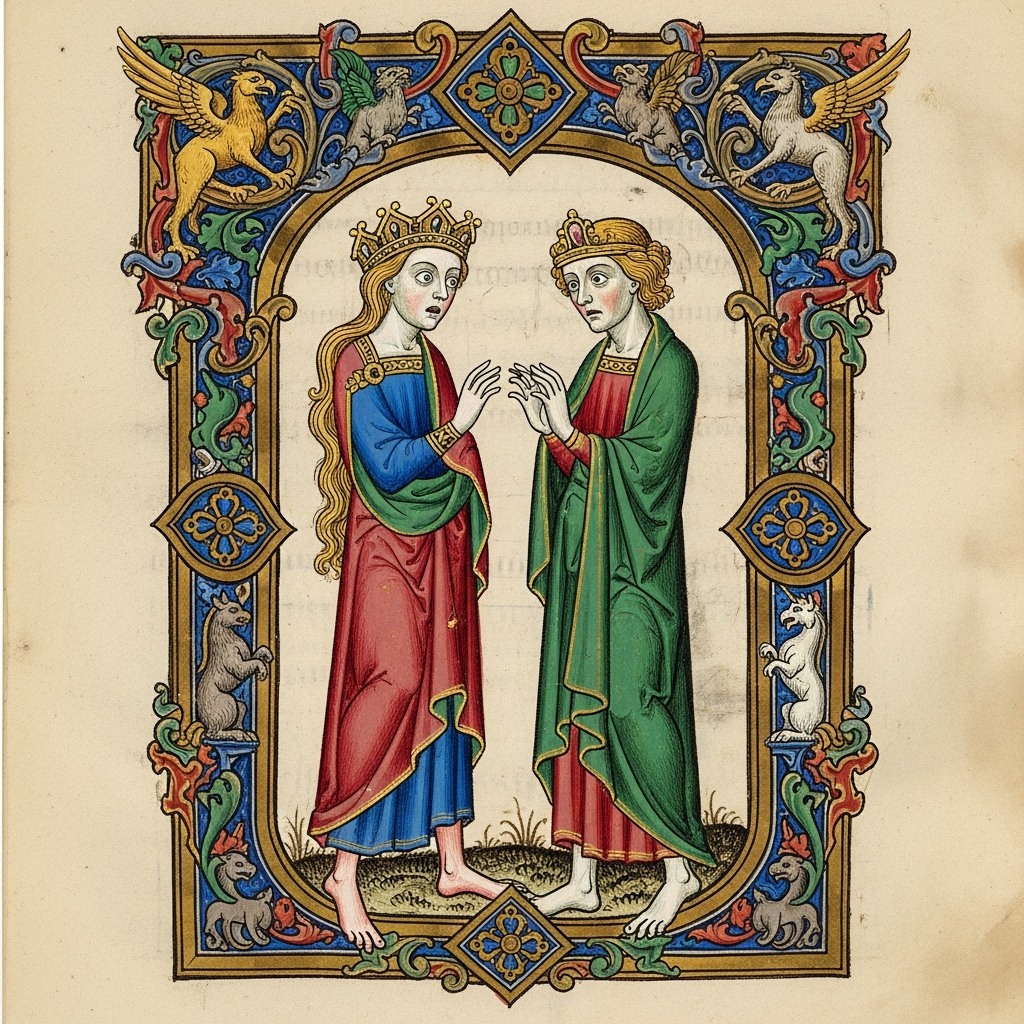
Guðrún presiding at a long Norse feasting table lit by fire, serving Atli the Hun from carved skull goblets, her face completely composed -- not gloating, not weeping, controlled with the terrible calm of someone who has decided the cost and paid it -- as she leans toward him and in a low voice begins to tell him what the meat was, what the cups were made from, Atli's face in the torchlight beginning its slow transition from satisfied guest to comprehension to horror, the remains of the feast on the table, the hall around them already going to change, hyper-realistic dark mythology, the exact moment of betrayal, dramatic chiaroscuro lighting, revenge as its own kind of betrayal, warm light turning cold, cinematic composition, oil painting rendering, 8k11. Devadatta — Betrayal From Within the Sangha (Buddhist)
Tradition: Buddhist Betrayer: Devadatta Betrayed: The Buddha; the monastic community (sangha) The Act: Attempted to kill the Buddha three times (hired assassins, rolled a boulder down a hillside, released a maddened elephant); tried to split the sangha with stricter rules Source: Vinaya Pitaka; Pali Canon
Devadatta was Siddhartha Gautama’s cousin. They had grown up together. When the Buddha established his teaching, Devadatta joined the sangha and became a respected monk — skilled enough in meditation that he developed supernatural powers. Then he decided he should lead the community. He approached Prince Ajatasattu, persuaded him to support his claim, and went to the Buddha to demand the leadership of the sangha. The Buddha refused.
What followed was three attempts on the Buddha’s life — the most famous being the elephant. Devadatta released Nalagiri, a notoriously violent war elephant, into the street where the Buddha was walking. The elephant charged. The Buddha stood still, radiated metta (loving-kindness), and the elephant stopped, became calm, and knelt before him. Devadatta’s plan failed completely. The accounts say the crowd watching threw Devadatta down from the rooftop where he had been watching.
The Buddhist tradition treats Devadatta not as purely evil but as a figure of cautionary tragedy: a man who had real attainment and real spiritual capacity, who allowed the poisons of ambition and envy to corrupt everything he had built. He is said to have been swallowed by the earth and taken to a hell realm — but the tradition also predicts that after eons of purification, Devadatta will become a Pratyekabuddha. Even the greatest betrayal within the dharma does not place someone beyond eventual liberation.
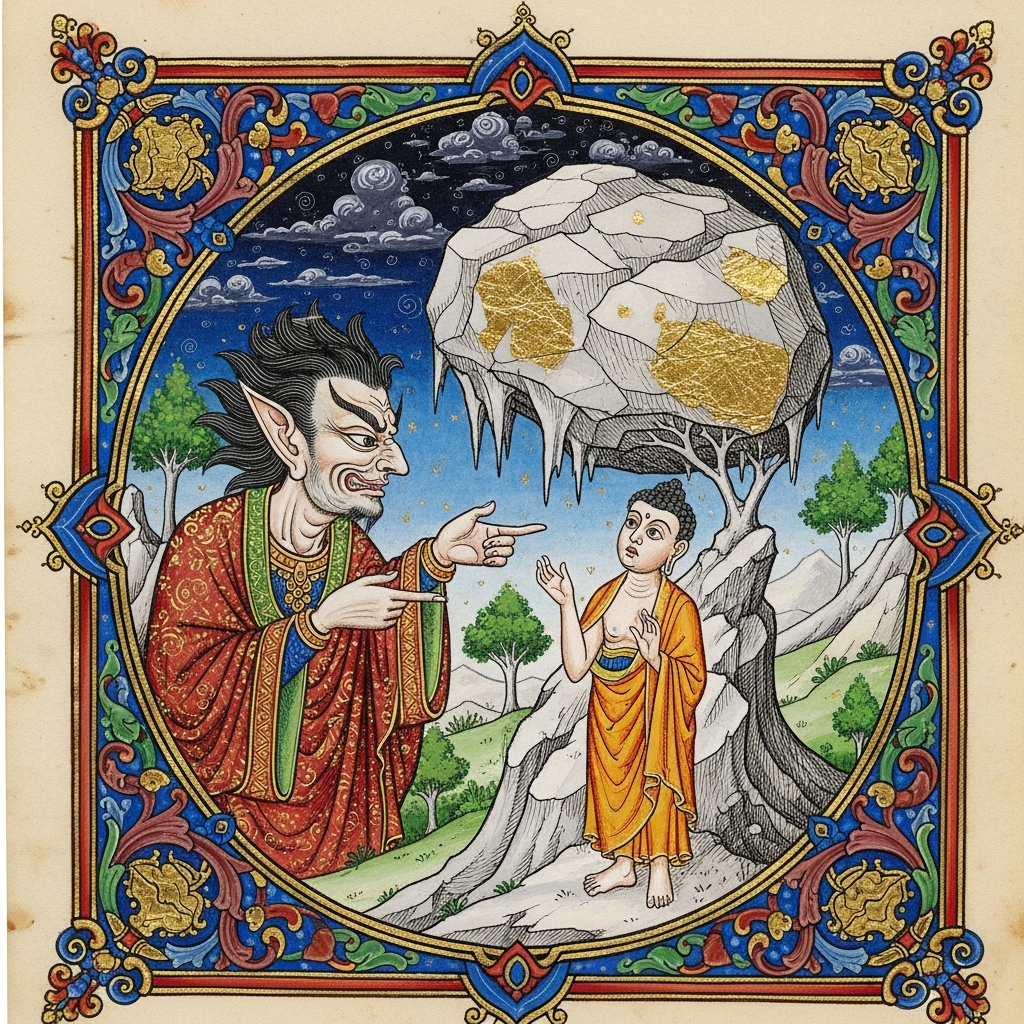
Devadatta on a high cliff above a mountain path, using his full strength to roll a massive boulder over the edge, his face showing the ugly concentration of someone who has committed, who is past the moment of choice, below on the path the Buddha walking serenely with his disciples, the boulder mid-fall, and in the composition the contrast between Devadatta's violent straining fury above and the Buddha's complete calm below -- two monks from the same family separated by this vertical moment of violence, the saffron robes of both men visible, hyper-realistic dark mythology, the exact moment of betrayal, dramatic chiaroscuro lighting, betrayal from within the spiritual community, warm light turning cold, cinematic composition, oil painting rendering, 8k12. Vibhishana — The Righteous Traitor (Hindu)
Tradition: Hindu Betrayer: Vibhishana, brother of Ravana Betrayed: Ravana and Lanka (technically) The Act: Warned Ravana repeatedly, then defected to Rama’s side and revealed Ravana’s secret weakness — that his life force resided in his navel Source: Valmiki Ramayana, Yuddha Kanda
Three times Vibhishana counseled his brother to return Sita and make peace. Three times Ravana refused and mocked him. The third time, Ravana banished him from Lanka entirely. So Vibhishana flew across the ocean to Rama’s camp and surrendered.
The generals of Rama’s alliance were suspicious — this was the demon king’s brother, offering allegiance at a suspicious moment. Rama accepted him. He saw that Vibhishana had acted from dharma, not strategy. He promised that Vibhishana would be king of Lanka when the war was won, and kept that promise.
At the final battle, when Rama could not seem to kill Ravana — cutting off one head only to have another grow back — Vibhishana revealed the truth: Ravana’s power rested in his navel, where the ambrosia of immortality resided. Rama aimed there. Ravana fell.
The tradition honors Vibhishana as one of the seven immortals (chiranjivi) of Hinduism. His betrayal is called righteous because he chose dharma over kinship — he chose what was right over who he loved. But the text also carries the question carefully: he gave information that killed his brother. Whatever his motivation, the act was the act. The tradition calls it virtue. Ravana’s blood called it treason. The question of where the line falls between principled conscience and betrayal has no clean answer in the Ramayana and no clean answer anywhere else.
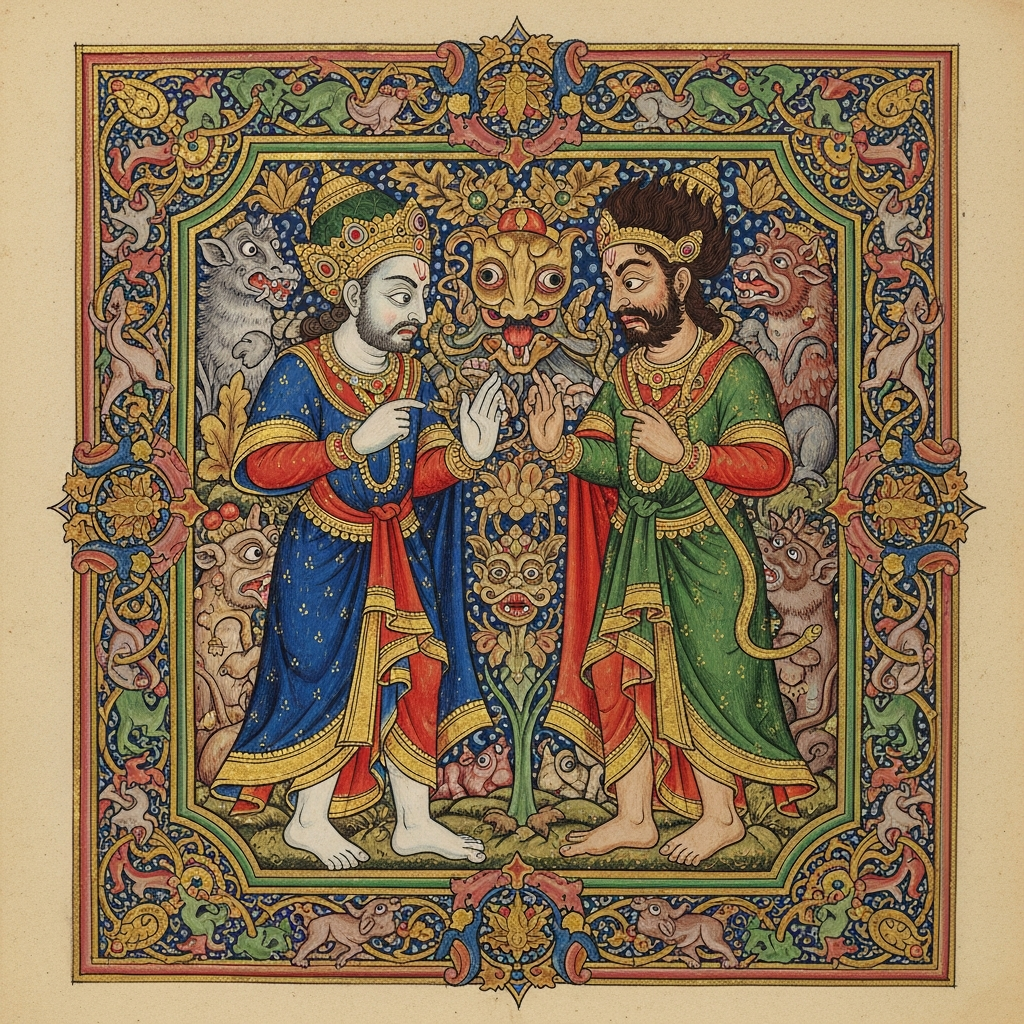
Vibhishana the demon prince -- noble-faced, wearing Lanka's finest -- standing at the shore of the great ocean having left Lanka behind, the fires of his brother's city visible in the distant sky, approaching the shore where Rama's divine army waits, the monkey commanders Sugriva and Hanuman watching him with suspicion, Rama visible in the center radiating calm acceptance, Vibhishana's bearing showing dignity and grief simultaneously -- a man who has done what was right and knows exactly what it has cost him, the two cities of dharma and family pulling in opposite directions at the same moment, hyper-realistic dark mythology, the exact moment of betrayal, dramatic chiaroscuro lighting, the righteous traitor's terrible clarity, warm light turning cold, cinematic composition, oil painting rendering, 8k13. Pandora — Created to Betray (Greek)
Tradition: Greek Betrayer: Pandora (“all-gifted”) Betrayed: Humanity The Act: Opened the sealed jar (pithos) that released every evil, sickness, and suffering into the world; only Hope remained inside when she closed it Source: Hesiod, Theogony; Works and Days
The gods made her. That is the foundational fact of Pandora’s story, and it is the one that changes everything. Zeus was angry at Prometheus for giving humanity fire. His response was to create a weapon: a beautiful woman, fashioned from earth and water by Hephaestus, given gifts by each god in turn — beauty from Aphrodite, cunning from Hermes, grace and skill, a golden crown. Her name means “all-gifted.” She was a gift designed to cause harm. Hermes gave her the jar and the instruction not to open it.
She opened it.
The ancient question is: how could she not? She was given curiosity by the gods who built curiosity into her. She was placed in the world with a jar she was told to keep closed. The design of her nature and the design of her instruction were in direct opposition. The catastrophe was engineered. Pandora did not betray humanity by being weak. She fulfilled the purpose for which she was manufactured.
What stayed inside the jar — Hope (Elpis) — is the most debated residue in mythology. Why is Hope in the same jar as evil? Does Hope stay inside the jar as a mercy — humanity always having it available — or as a final cruelty, hope imprisoned, never quite free? Hesiod does not resolve it. No one has.
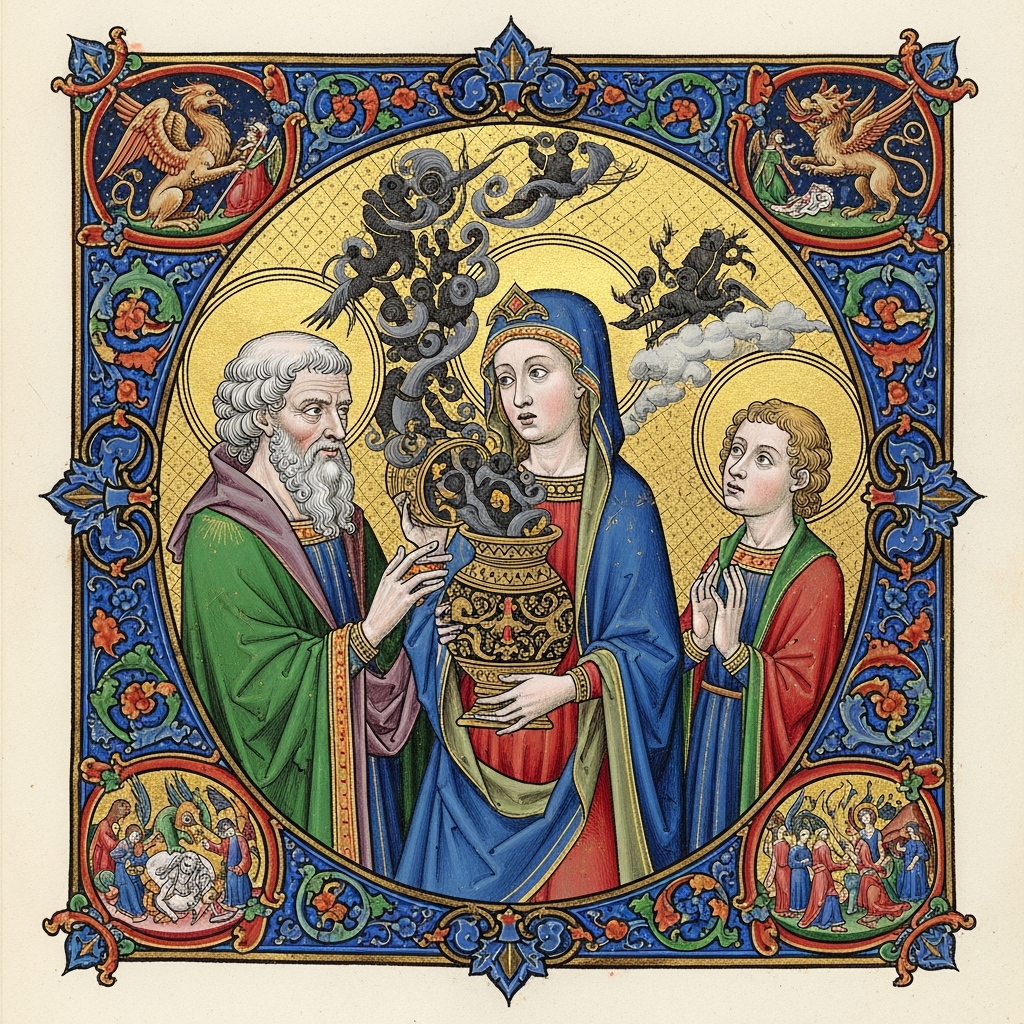
Pandora kneeling before a massive sealed clay storage jar in a stone room flooded with golden afternoon light, the lid she has just lifted still in her hands, an eruption of dark smoky forms pouring upward from the jar's mouth into the air -- disease, grief, labor, old age, war taking form as they escape -- her beautiful face showing the exact moment of comprehension, the moment she understands what she has done, what she was made to do, the golden gifts from the gods -- the jewelry, the crown -- beautiful and useless now, at the bottom of the jar one small luminous form still waiting: Hope, sealed in the dark, hyper-realistic dark mythology, the exact moment of betrayal, dramatic chiaroscuro lighting, the face of the one created to betray, warm light turning cold, cinematic composition, oil painting rendering, 8k14. The Serpent — The First Lie (Or Was It?) (Biblical)
Tradition: Biblical Betrayer: The serpent (identified in later tradition with Satan) Betrayed: Adam and Eve; humanity The Act: Told Eve that eating the forbidden fruit would not bring death but would make them “like God, knowing good and evil” Source: Genesis 3:1-7
God said: eat this and you will die. The serpent said: you will not die — you will be like God, knowing good and evil. Eve ate. Adam ate. And then the text: “Then the eyes of both were opened, and they knew that they were naked.” They gained knowledge. They became, as the serpent said, like God knowing good and evil. God himself confirms it in verse 22: “Behold, the man has become like one of us, knowing good and evil.”
The serpent told the truth.
This is the fissure that runs through every interpretation of Genesis 3. If the serpent’s words were literally accurate — if humanity did not die immediately but did gain the knowledge of good and evil, exactly as promised — then in what sense was it a lie? The tradition identifies the serpent as the father of lies. But the text records no lie. What the text records is a truth that was forbidden, offered in a garden where the tree was accessible, by a creature whose nature was craft, to people whose capacity for knowledge was the image-of-God they were said to carry.
The betrayal may not be in the words. It may be in the intent: that the serpent did not offer knowledge out of love for humanity but out of something else — resentment, rebellion, the desire to break what had been made. The truth told for the wrong reason is still, in some traditions, the deepest form of deception.
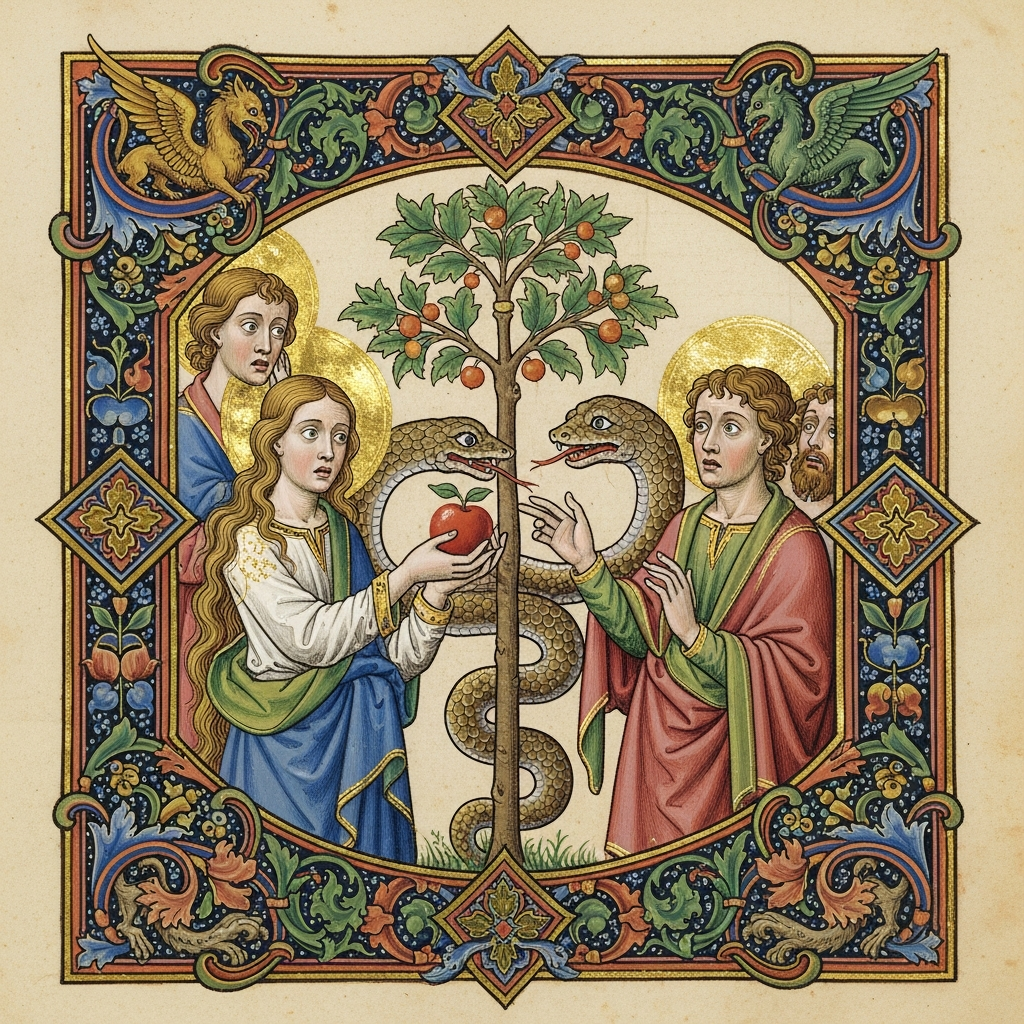
The serpent coiled in the Tree of the Knowledge of Good and Evil in the Garden of Eden, its beautiful iridescent scales catching the golden garden light, speaking to Eve who stands at the base of the tree looking up, the forbidden fruit luminous and heavy on the branches, the serpent's face and Eve's face in close composition -- one offering, one listening, both their expressions carrying the weight of a conversation that will end an age, Adam visible in the background going about his work unaware, the garden impossibly perfect around them, the moment before the hand reaches out, hyper-realistic dark mythology, the exact moment of betrayal, dramatic chiaroscuro lighting, the first lie or the first truth told wrong, warm light turning cold, cinematic composition, oil painting rendering, 8k15. Peter — I Don’t Know the Man (Christian)
Tradition: Christian Betrayer: Simon Peter, called the Rock Betrayed: Jesus; himself The Act: Denied knowing Jesus three times in the courtyard of the High Priest while Jesus was on trial inside Source: Matthew 26:69-75; Mark 14:66-72; Luke 22:54-62; John 18:15-18, 25-27
Jesus had told Peter it would happen: “Before the rooster crows, you will deny me three times.” Peter swore it was impossible. He drew a sword in the garden. He followed the soldiers to the High Priest’s courtyard — which was itself an act of courage that the other disciples did not manage.
And then a servant girl recognized him.
Three times, three people — different in each gospel — asked if he was with Jesus. Three times he denied it. The third time, Luke records, Jesus turned and looked at Peter at the moment the rooster crowed. Peter went outside and wept bitterly.
Peter is different from Judas. Judas’s betrayal was premeditated and for gain. Peter’s was spontaneous and from fear — the survival instinct of a man who had followed someone into a situation that was turning lethal. Jesus had predicted both. The difference in what happened afterward: Judas returned the silver and died. Peter wept and stayed. On the shore after the resurrection, Jesus asked Peter three times if he loved him — once for each denial — and three times commissioned him to feed his sheep. The denial was not the final word.
Peter became the rock anyway. The church was built on the man who, terrified in a courtyard, had said I don’t know him — and then spent the rest of his life making certain that would never be true.
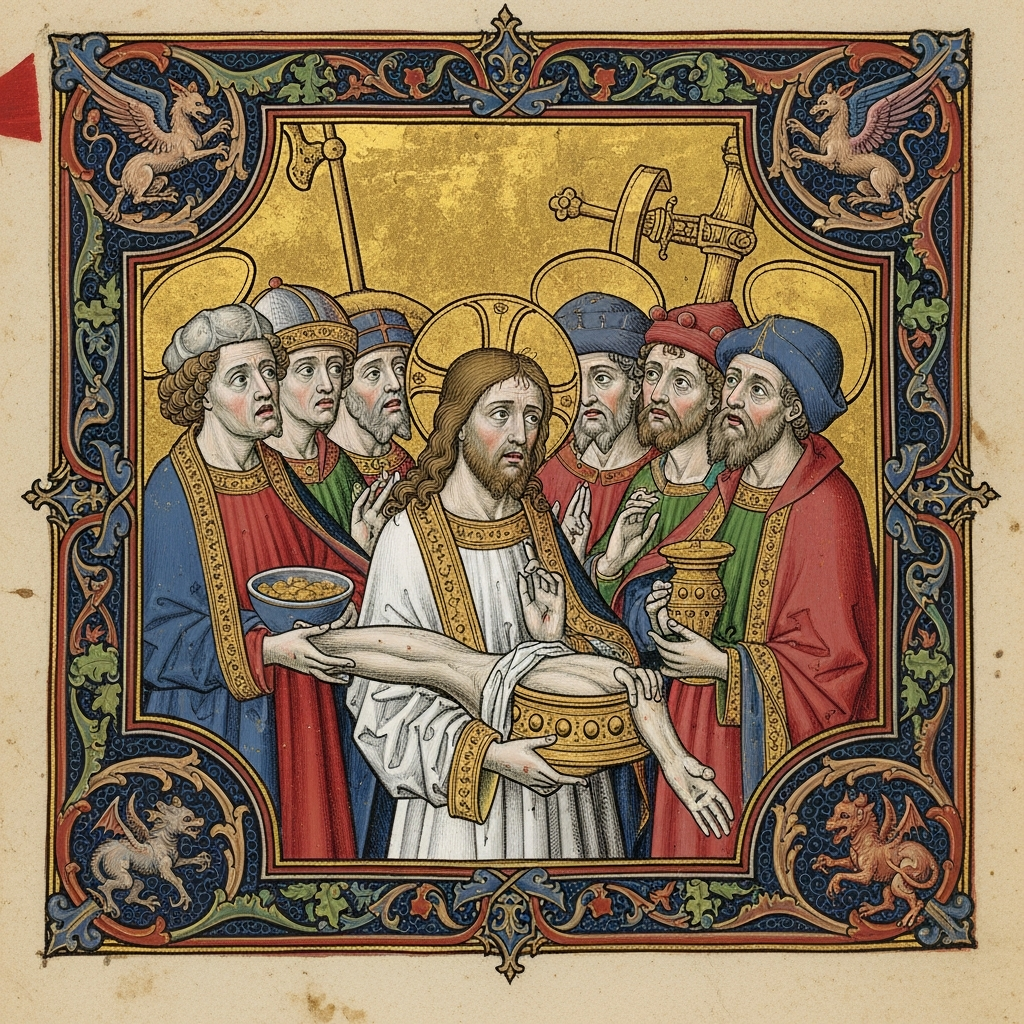
Peter in the firelit courtyard of the High Priest's house at night, surrounded by servants and soldiers warming themselves, a servant girl standing before him pointing in recognition, Peter's hands raised in denial his whole body pulling back and away, his face showing the specific expression of fear overriding loyalty -- not malice, not calculation, only survival, behind him through an archway the lit chamber where Jesus stands on trial before Caiaphas, the rooster visible in the shadows near the gate, the fire giving warm light to a cold act, at the edge of the frame the moment before Jesus turns and their eyes meet, hyper-realistic dark mythology, the exact moment of betrayal, dramatic chiaroscuro lighting, failure as its own kind of knife, warm light turning cold, cinematic composition, oil painting rendering, 8kThe Pattern Beneath the Betrayals
Look at what every tradition agrees on:
Proximity is the prerequisite. Enemies cannot betray you. Only those inside the circle — family, disciples, blood-brothers, the trusted — carry the capacity for true betrayal. Judas ate at the table. Set shared a mother with Osiris. Mordred was Arthur’s son. Devadatta and the Buddha were cousins who grew up together. The damage scales with intimacy.
The intimate gesture is always weaponized. A kiss. A feast. A coffin built to your measurements. A lover’s lap. A question asked at the city gate. The most devastating betrayals are not violent ambushes but corrupted kindnesses — the thing that was meant to express love, turned into a signal, a trap, a blade.
The betrayer is often correct. Vibhishana was right: Ravana should have returned Sita. The serpent was accurate: they did gain knowledge. Caiaphas was — by John’s account — prophesying truth while conspiring evil. Many betrayals are not simply malicious. They are right about something. This is what makes them hard.
Someone always becomes the symbol. Judas’s name means traitor in every language. Ephialtes’s name means nightmare in Greek. Mordred is shorthand for the corruption of an ideal. Betrayal achieves permanence in a way that loyalty rarely does — the wound lasts longer than the original health.
What the traditions cannot agree on is whether the betrayal was NECESSARY. Whether the plan required it. Whether the suffering was worth what it made possible. Whether the jar had to be opened. Whether the garden had to fall. The question is never quite answered, because the answer is never quite bearable.