Part of the Bestiary Compendium
Every tradition has figures born of unions between gods and mortals. Half-divine, half-human, they walk between worlds — too powerful to be ordinary, too mortal to be gods. They become heroes, monsters, saviors, and disasters. The pattern is universal, and universally tragic.
The Demigods
1. Jesus — The Son of God
| Divine Parent | God (Holy Spirit) |
| Human Parent | Mary |
| Tradition | Christian |
| What He Became | The Savior of the world |
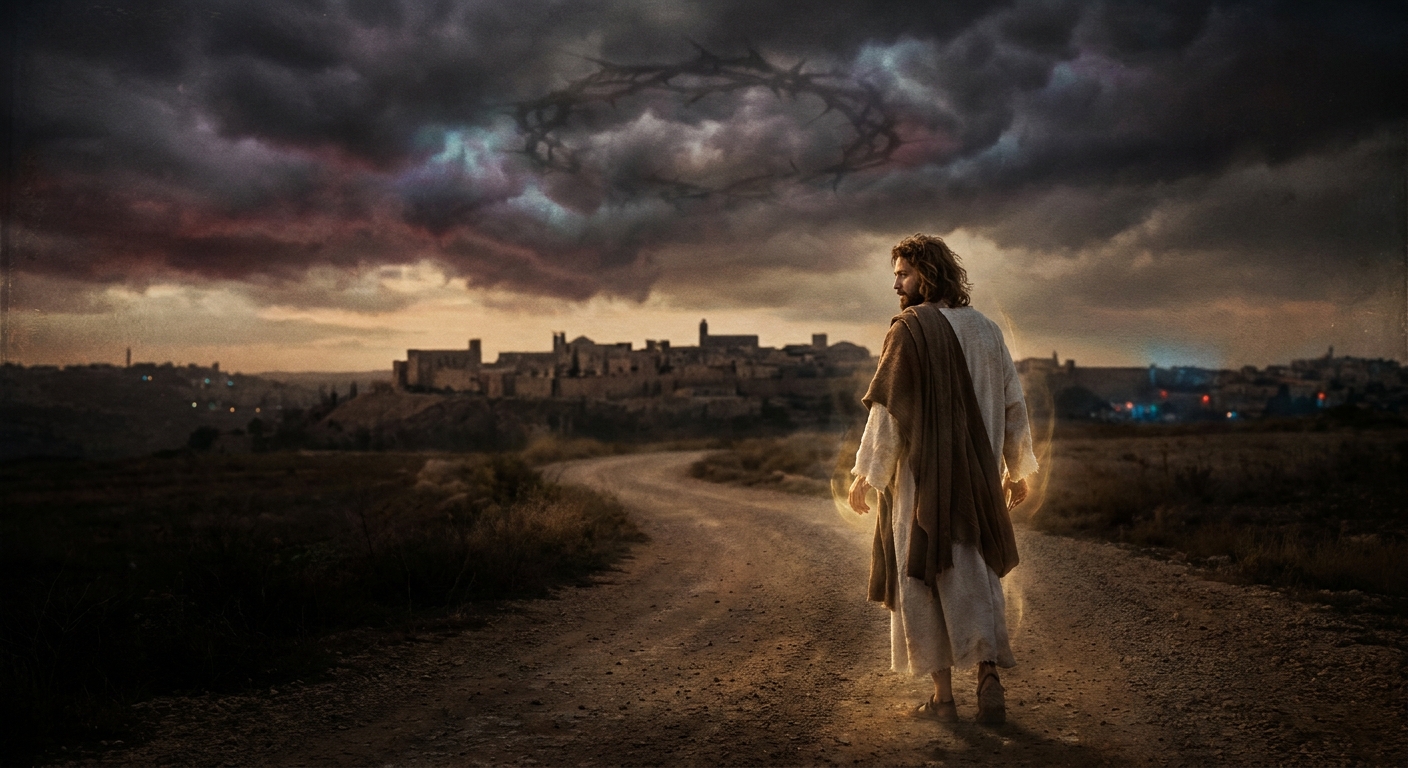
Born of a virgin in a stable, announced by angels, hunted by a king. Jesus is the most famous divine-human hybrid in history — fully God and fully man, according to orthodox theology. Unlike most demigods, he didn’t seek glory. He sought a cross. His divine nature made him capable of saving the world; his human nature made it cost everything.
Jesus Christ as a young man in simple white and brown robes walking alone on a dusty road toward Jerusalem, divine golden light radiating subtly from within, a crown of thorns foreshadowed in the gathering storm clouds above, humble yet carrying cosmic authority, hyper-realistic dark mythology, dramatic chiaroscuro lighting, volumetric atmospheric fog, warm golden rim lighting against cool desaturated background, muted earth tones with saturated crimson and spectral blue accents, cinematic composition, oil painting character rendering, high detail texture, mystical divine aesthetic, 8k --ar 16:9 --s 900 --v 72. Heracles — The Greatest Hero
| Divine Parent | Zeus |
| Human Parent | Alcmene |
| Tradition | Greek |
| What He Became | The greatest hero, ascended to Olympus |
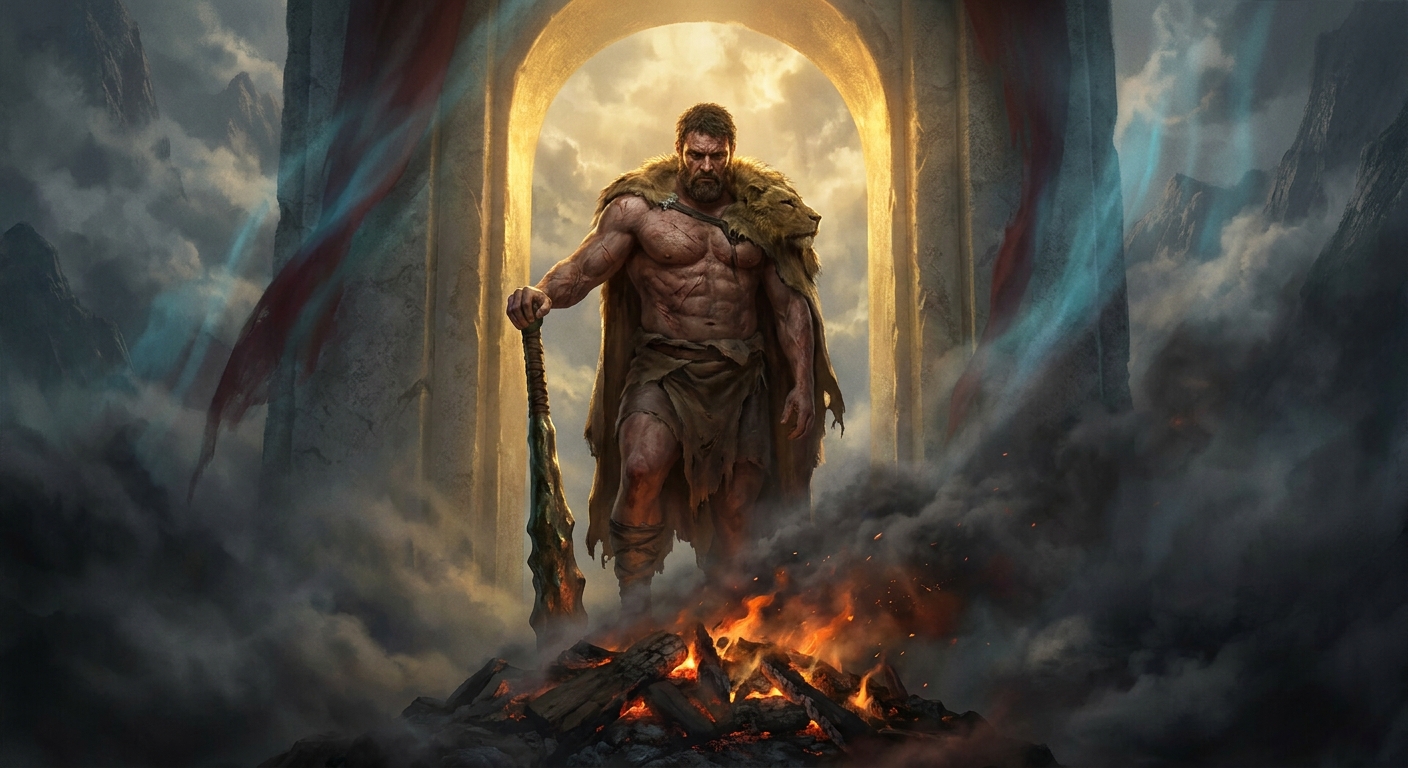
Zeus’s most famous son. Hera hated him from birth and drove him mad, causing him to murder his own family. The Twelve Labors were his penance. He strangled the Nemean Lion, slew the Hydra, cleaned the Augean Stables, captured Cerberus from the Underworld. After a life of impossible suffering, he burned alive on a funeral pyre — and ascended to Olympus as a full god. The only demigod who made it all the way.
Heracles in battered lion-skin cloak, massive muscular frame scarred from countless battles, holding a great bronze club, standing before the gates of Olympus as divine light descends upon him, the moment of his apotheosis, flames of his funeral pyre still visible below, hyper-realistic dark mythology, dramatic chiaroscuro lighting, volumetric atmospheric fog, warm golden rim lighting against cool desaturated background, muted earth tones with saturated crimson and spectral blue accents, intricate ornate detail, cinematic composition, oil painting character rendering, high detail texture, mystical divine aesthetic, 8k --ar 16:9 --s 900 --v 73. Perseus — The Dragon-Slayer
| Divine Parent | Zeus (as golden rain) |
| Human Parent | Danae |
| Tradition | Greek |
| What He Became | Dragon-slayer, founded Mycenae |
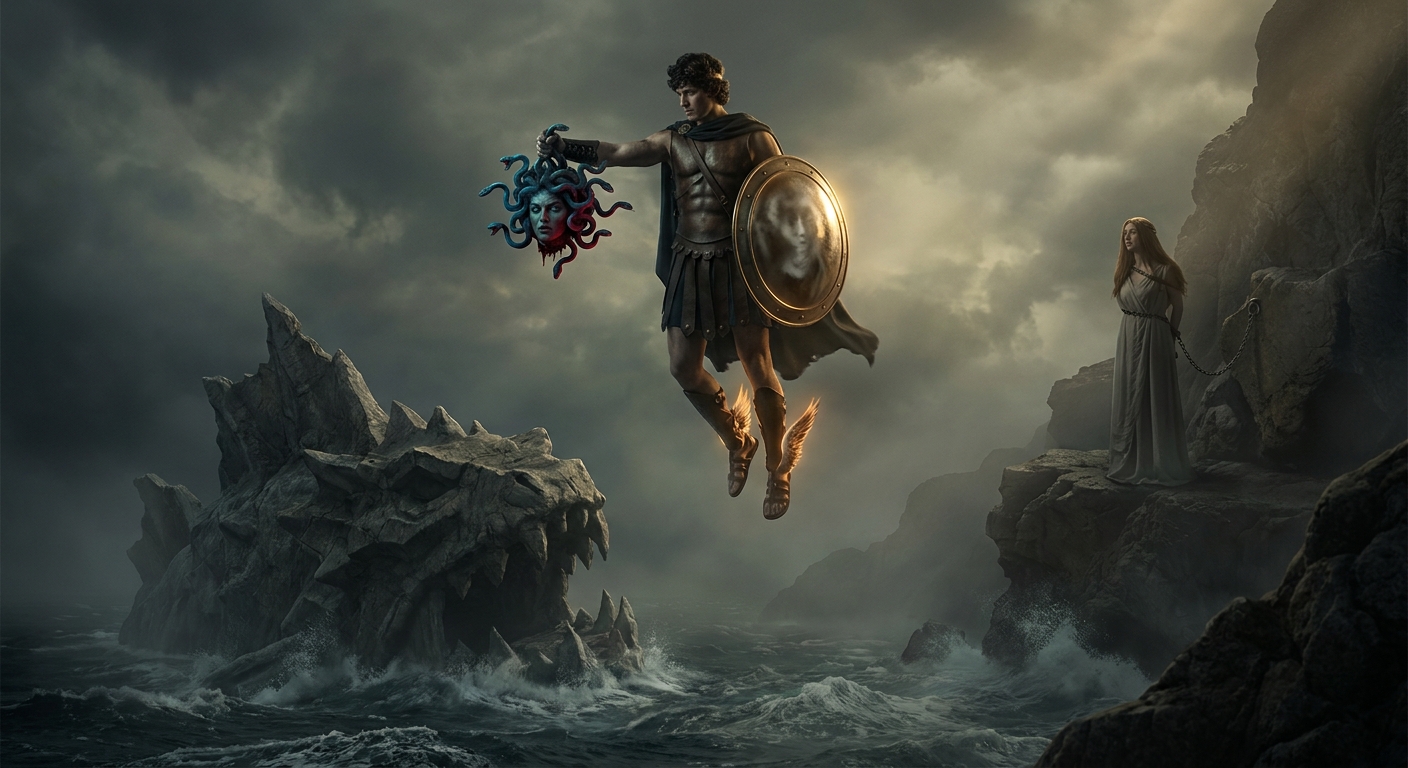
Zeus came to Danae as a shower of gold while she was locked in a bronze tower by her father (who’d been told his grandson would kill him). Perseus grew up on an island, was sent on a suicide mission to behead Medusa, and succeeded with divine help — winged sandals, a cap of invisibility, a mirrored shield. He turned a sea monster to stone, rescued Andromeda, and accidentally killed his grandfather with a discus. Prophecy always wins.
Perseus in winged sandals hovering in the air, holding the severed head of Medusa by its snake-hair in one hand, a mirrored shield in the other, the massive petrified sea monster Cetus below in churning ocean waves, Andromeda chained to the rocks, hyper-realistic dark mythology, dramatic chiaroscuro lighting, volumetric ocean spray and atmospheric fog, warm golden rim lighting against cool desaturated background, muted earth tones with emerald green and spectral blue accents, cinematic composition, oil painting character rendering, high detail texture, mystical divine aesthetic, 8k --ar 16:9 --s 900 --v 74. Achilles — The Vulnerable Warrior
| Divine Parent | Thetis (sea goddess) |
| Human Parent | Peleus (mortal king) |
| Tradition | Greek |
| What He Became | Greatest warrior, vulnerable heel |
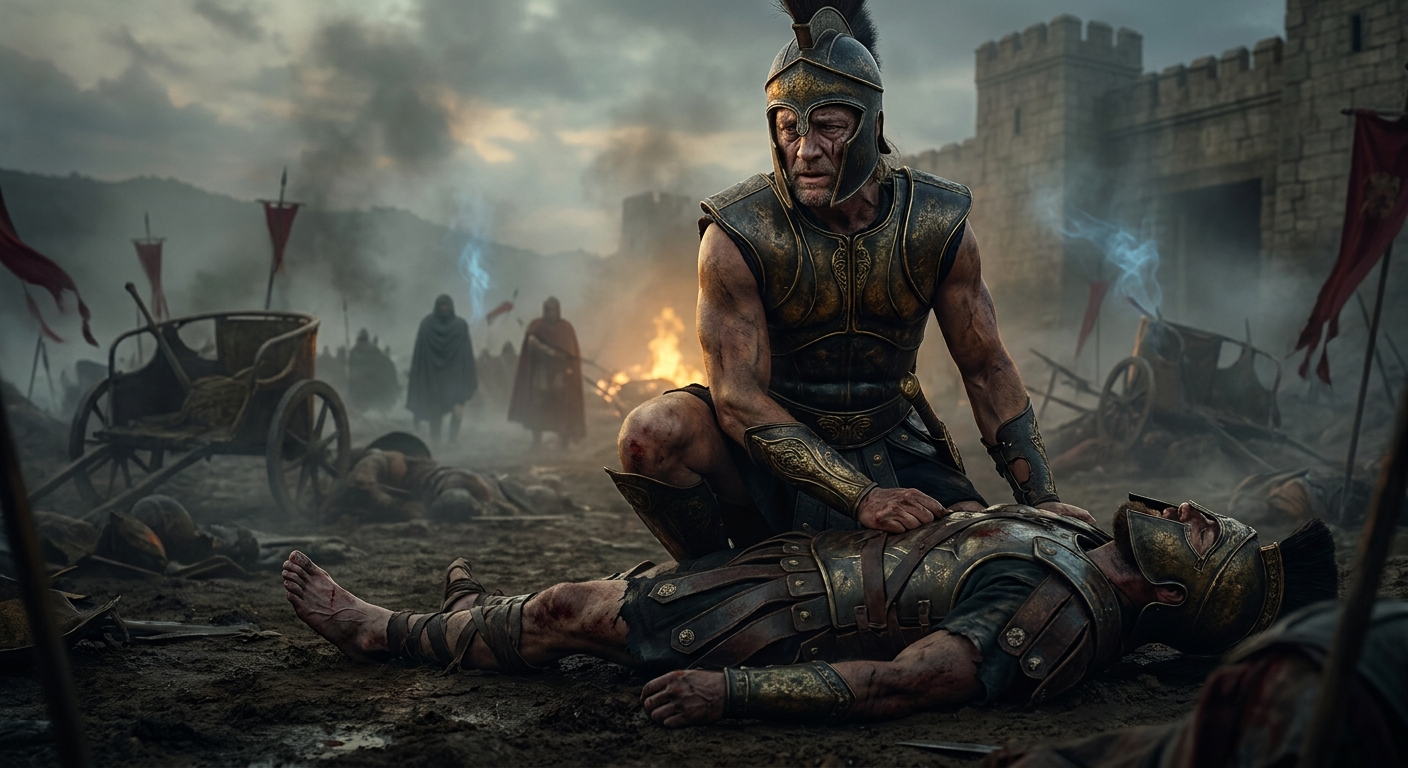
His mother dipped him in the River Styx to make him invulnerable — but held him by the heel. That one dry spot killed him. Achilles was the greatest warrior at Troy, but he knew going in that the war would kill him. He went anyway. When Patroclus died, his grief shook the battlefield. He dragged Hector’s body behind his chariot for days. Paris shot him in the heel with an arrow guided by Apollo. The strongest man at Troy, killed by the smallest wound.
Achilles in magnificent bronze and gold Greek armor, standing over the fallen body of Hector outside the walls of Troy, his face showing rage and grief in equal measure, his vulnerable heel subtly exposed, war-torn battlefield stretching behind him, hyper-realistic dark mythology, dramatic chiaroscuro lighting, volumetric dust and smoke, warm golden rim lighting against cool desaturated background, muted earth tones with bronze and blood-crimson accents, cinematic composition, oil painting character rendering, high detail texture, mystical divine aesthetic, 8k --ar 16:9 --s 900 --v 75. Gilgamesh — The One Who Failed
| Divine Parent | Ninsun (goddess) |
| Human Parent | Lugalbanda (king) |
| Tradition | Mesopotamian |
| What He Became | 2/3 divine, sought immortality, failed |
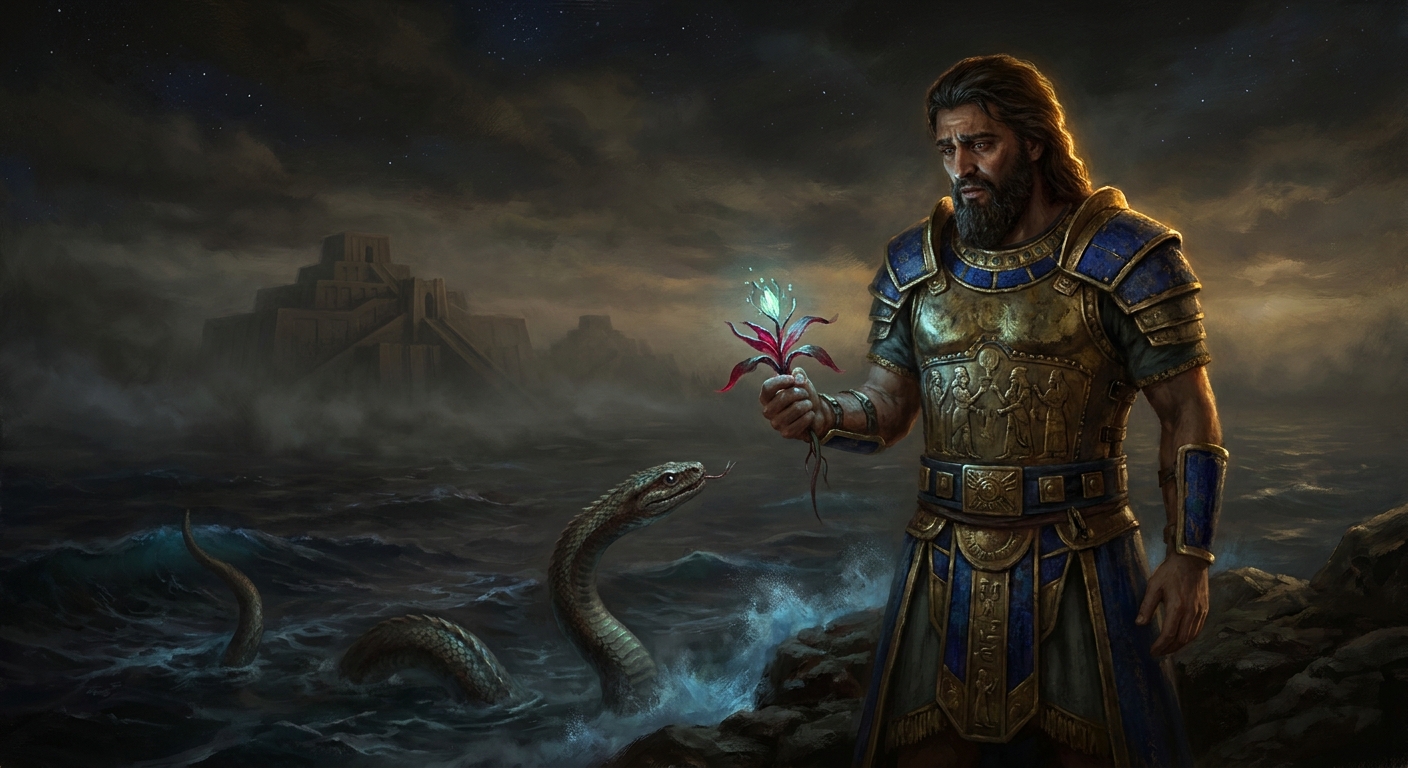
Two-thirds god, one-third man — and it was the one-third that broke him. Gilgamesh was king of Uruk, the strongest man alive, and a tyrant. The gods sent Enkidu to humble him; they became brothers instead. When Enkidu died, Gilgamesh lost his mind with grief and went searching for eternal life. He found the plant of immortality at the bottom of the sea — and a snake ate it while he slept. He went home and stared at the walls of his city and realized that was all the immortality he’d ever get.
Gilgamesh king of Uruk in ornate Mesopotamian royal armor with gold and lapis lazuli, standing at the edge of the cosmic ocean, holding the glowing plant of immortality, a serpent coiling up from below to steal it, his face showing the moment of realization that immortality will slip away, ancient ziggurats of Uruk in the distance, hyper-realistic dark mythology, dramatic chiaroscuro lighting, volumetric atmospheric fog, warm golden rim lighting against cool desaturated background, muted earth tones with deep gold and spectral blue accents, cinematic composition, oil painting character rendering, high detail texture, mystical divine aesthetic, 8k --ar 16:9 --s 900 --v 76. The Nephilim — The Ones God Destroyed
| Divine Parent | Sons of God (angels/watchers) |
| Human Parent | Daughters of men |
| Tradition | Biblical |
| What They Became | Giants, “heroes of old,” destroyed in the Flood |
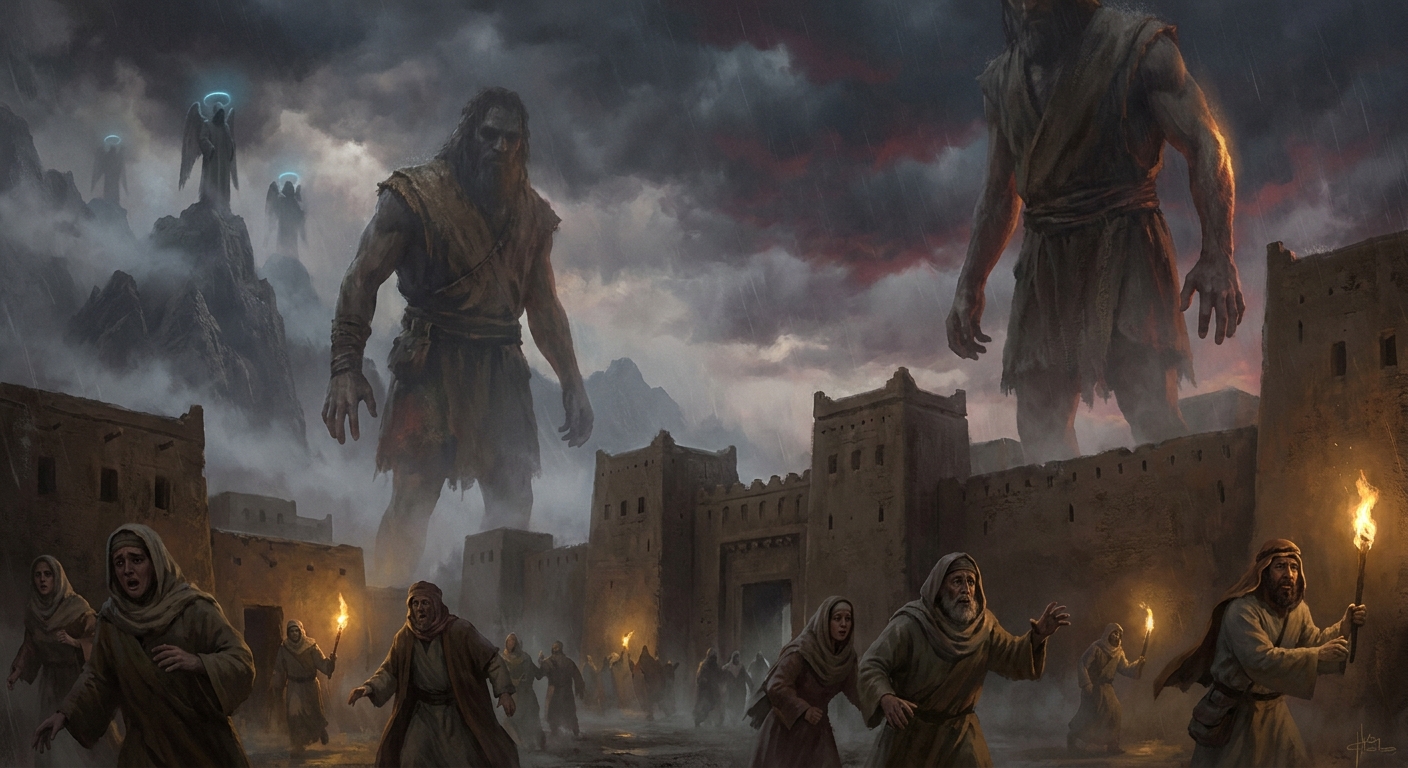
Genesis 6:4 — “The Nephilim were on the earth in those days.” Angels saw human women were beautiful, took them as wives, and produced giants. The Book of Enoch expands: these were the Watchers, 200 angels led by Azazel and Semjaza, who taught humanity forbidden knowledge — metallurgy, cosmetics, warfare, sorcery. Their children were the Nephilim, who devoured everything. God sent the Flood specifically to wipe them out. The most dangerous demigods in any tradition.
Massive Nephilim giants towering over ancient cities, sons of fallen angels and human women, some with six fingers, impossibly tall with wild eyes, the sky darkening with approaching flood waters, terrified humans fleeing, fallen Watcher angels watching from mountain peaks, the world God decided to destroy, hyper-realistic dark mythology, dramatic chiaroscuro lighting, volumetric atmospheric fog, warm golden rim lighting against apocalyptic storm clouds, muted earth tones with deep crimson and shadow-black accents, cinematic composition, oil painting character rendering, high detail texture, mystical divine aesthetic, 8k --ar 16:9 --s 900 --v 77. Cu Chulainn — Ireland’s Demigod
| Divine Parent | Lugh (god of light) |
| Human Parent | Dechtire |
| Tradition | Celtic |
| What He Became | Ireland’s greatest warrior, died at 27 |
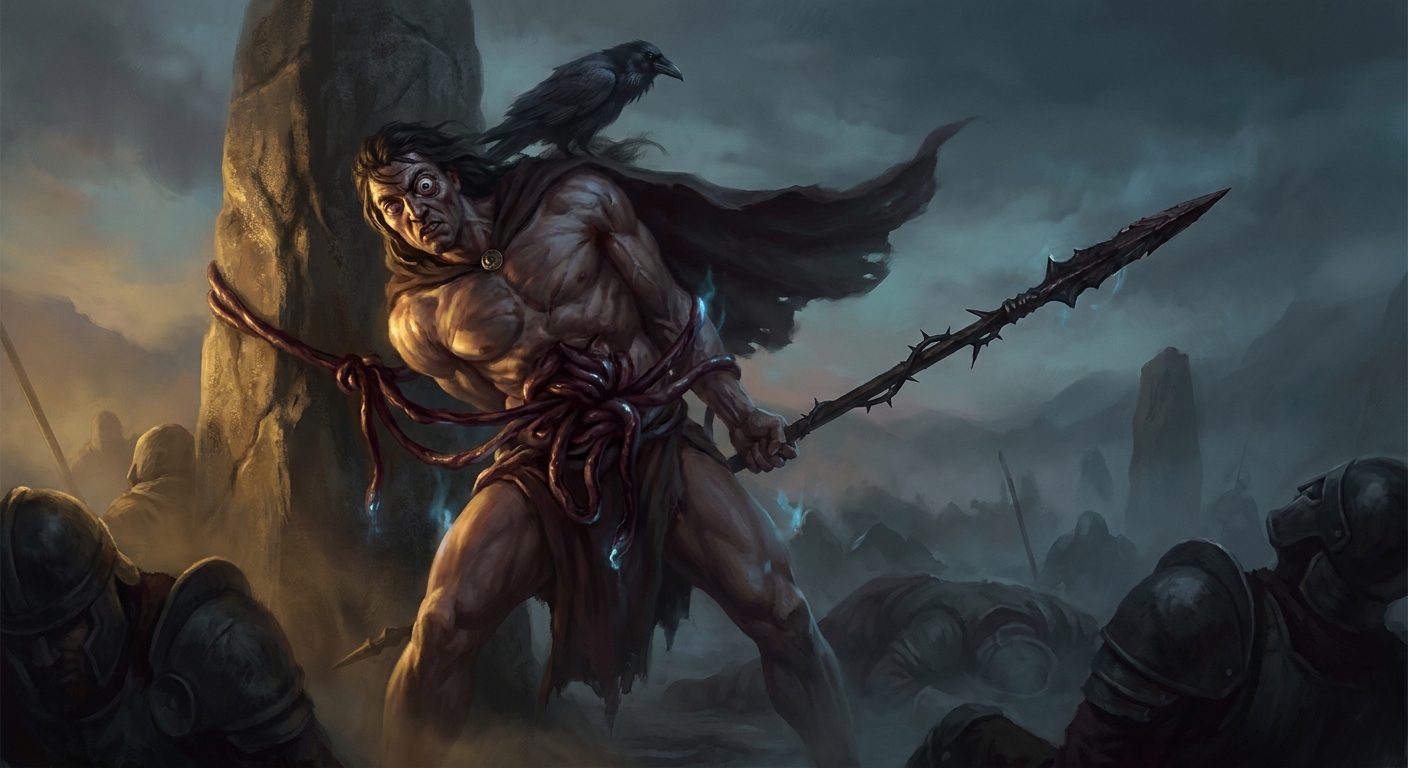
Son of the sun god, Cu Chulainn’s battle frenzy — the ríastrad or “warp spasm” — transformed his body into something inhuman. One eye sucked into his skull, the other bulged out. His muscles inverted. His jaw unhinged. He killed his best friend Ferdiad in single combat and wept over the body. He tied himself to a standing stone so he could die on his feet. A raven landed on his shoulder before his enemies dared approach — that’s how they knew he was finally dead.
Cu Chulainn the Irish demigod in the throes of the warp spasm ríastrad, his body grotesquely transformed with one eye bulging and muscles contorting, wielding the barbed spear Gae Bolga, surrounded by fallen enemies, tied to a standing stone pillar with his own entrails, a raven landing on his shoulder, hyper-realistic dark mythology, dramatic chiaroscuro lighting, volumetric mist on an Irish battlefield, warm golden rim lighting against cool desaturated green hills, muted earth tones with blood-crimson and spectral blue accents, cinematic composition, oil painting character rendering, high detail texture, mystical Celtic aesthetic, 8k --ar 16:9 --s 900 --v 78. Karna — The Rejected Son
| Divine Parent | Surya (sun god) |
| Human Parent | Kunti (princess) |
| Tradition | Hindu |
| What He Became | The tragic hero of the Mahabharata, rejected by his mother |
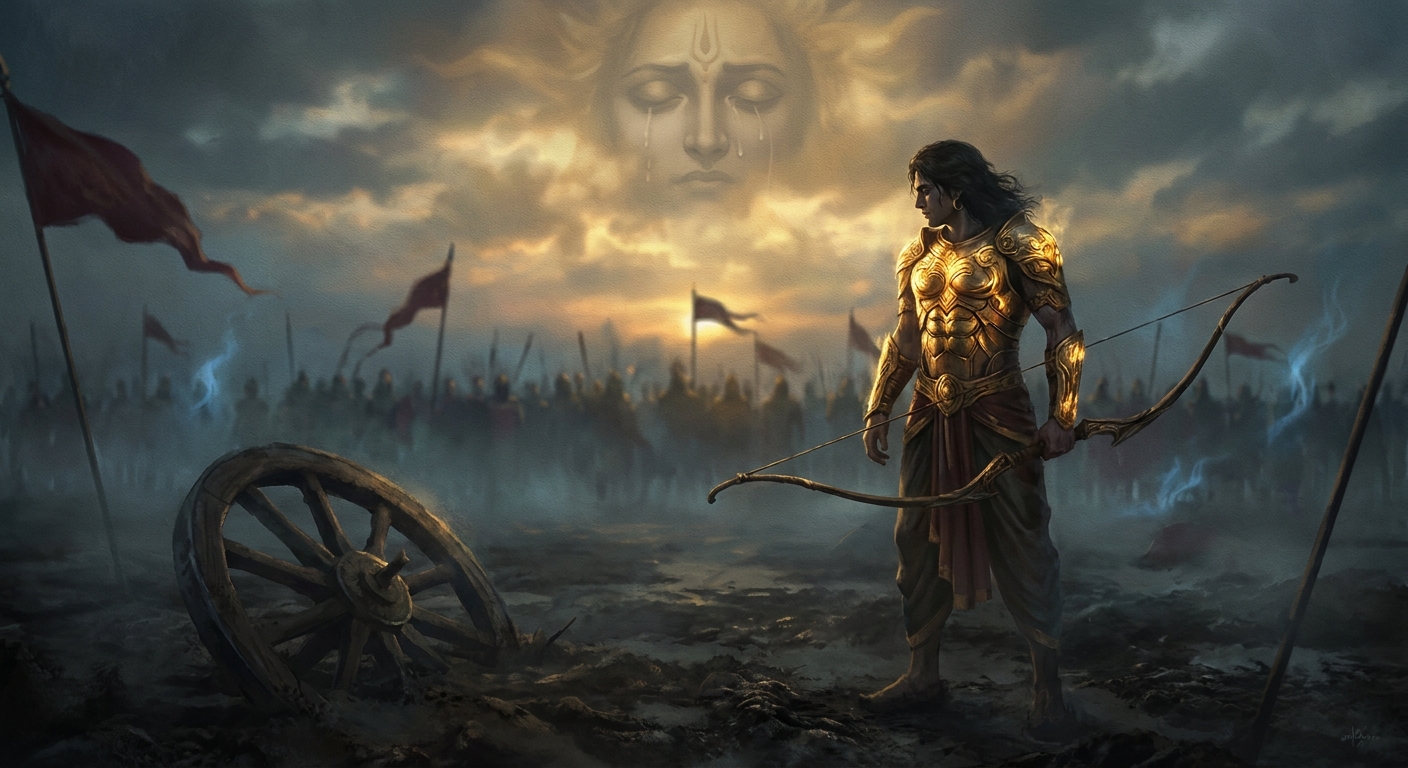
Born with divine golden armor fused to his skin and earrings that made him invulnerable. His mother Kunti was an unwed princess who set him adrift on a river. Raised by a charioteer, mocked as low-caste, he became the greatest archer in the world — but was always denied recognition because of his birth. He gave away his armor (his own skin) when asked. He fought for the wrong side in the Kurukshetra War out of loyalty to the one friend who accepted him. He died knowing his brothers were his enemies. The most tragic figure in all mythology.
Karna the son of the sun god in divine golden armor fused to his body, radiant with solar energy, standing alone on the battlefield of Kurukshetra, his chariot wheel stuck in the earth, his bow lowered, facing the Pandava army alone, the sun god Surya weeping in the sky above his doomed son, hyper-realistic dark mythology, dramatic chiaroscuro lighting, volumetric dust and golden solar rays, warm golden rim lighting against cool desaturated background, muted earth tones with divine gold and deep crimson accents, cinematic composition, oil painting character rendering, high detail texture, mystical Hindu aesthetic, 8k --ar 16:9 --s 900 --v 79. Maui — The Trickster Who Shaped the World
| Divine Parent | Makeatutara (god of the underworld) |
| Human Parent | Taranga |
| Tradition | Polynesian |
| What He Became | Trickster demigod, fished up islands, lassoed the sun |
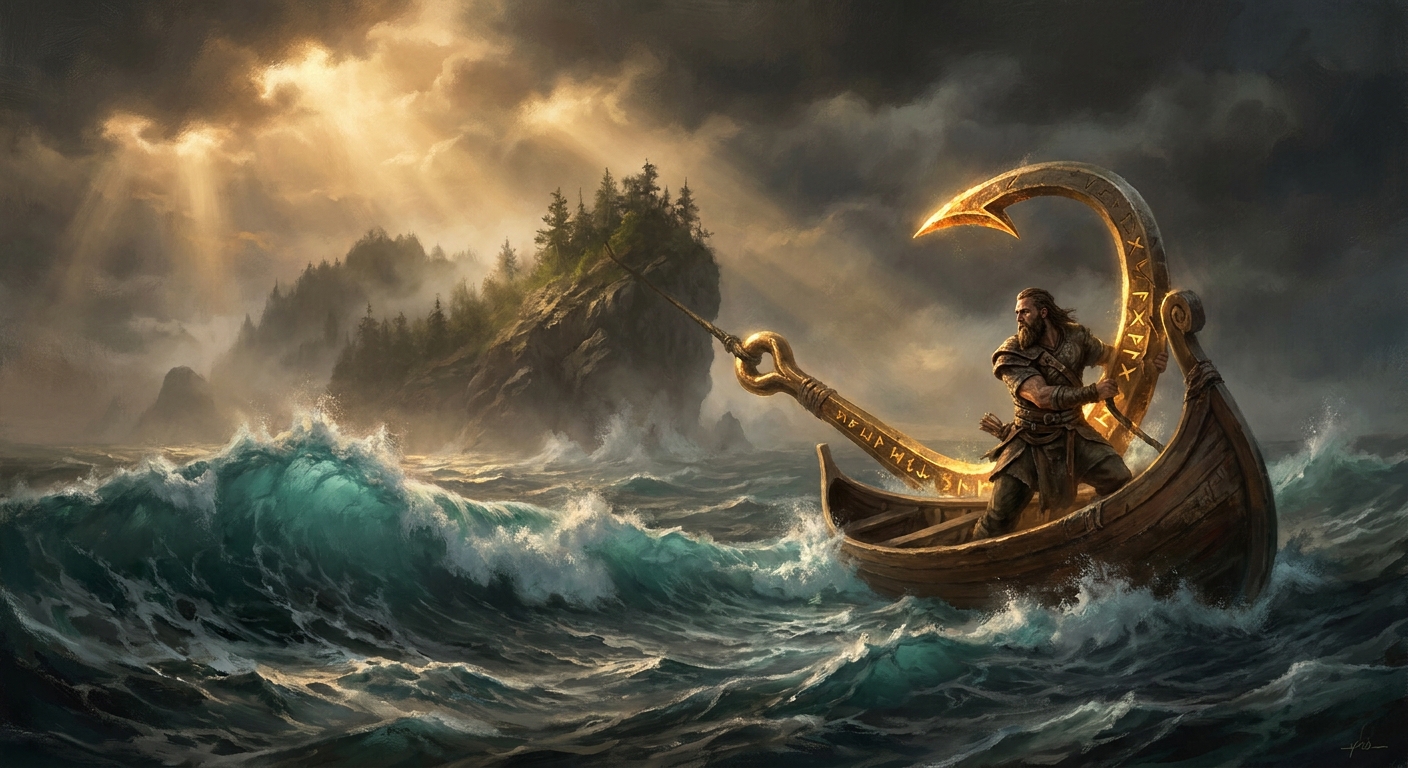
Thrown into the sea as a baby, raised by the ocean itself. Maui fished up the islands of New Zealand with a magic fishhook made from his grandmother’s jawbone. He lassoed the sun and beat it with the jawbone until it agreed to move slower across the sky. He stole fire from the underworld. He tried to win immortality for humanity by crawling through the body of the death goddess Hine-nui-te-po — but a bird laughed, she woke up, and she crushed him. Humanity stays mortal because a bird couldn’t keep quiet.
Maui the Polynesian demigod standing on a great waka canoe hauling up a massive island from the ocean depths using a magical glowing fishhook, the sun lassoed and struggling in the sky behind him, ocean waves churning, Polynesian tattoos covering his powerful body, a mischievous grin on his face, hyper-realistic dark mythology, dramatic chiaroscuro lighting, volumetric ocean spray and tropical storm clouds, warm golden rim lighting against deep ocean blue, muted earth tones with turquoise and coral accents, cinematic composition, oil painting character rendering, high detail texture, mystical Polynesian aesthetic, 8k --ar 16:9 --s 900 --v 710. Hanuman — The Devoted Warrior
| Divine Parent | Vayu (wind god) |
| Human Parent | Anjana |
| Tradition | Hindu |
| What He Became | The devoted monkey warrior of the Ramayana |
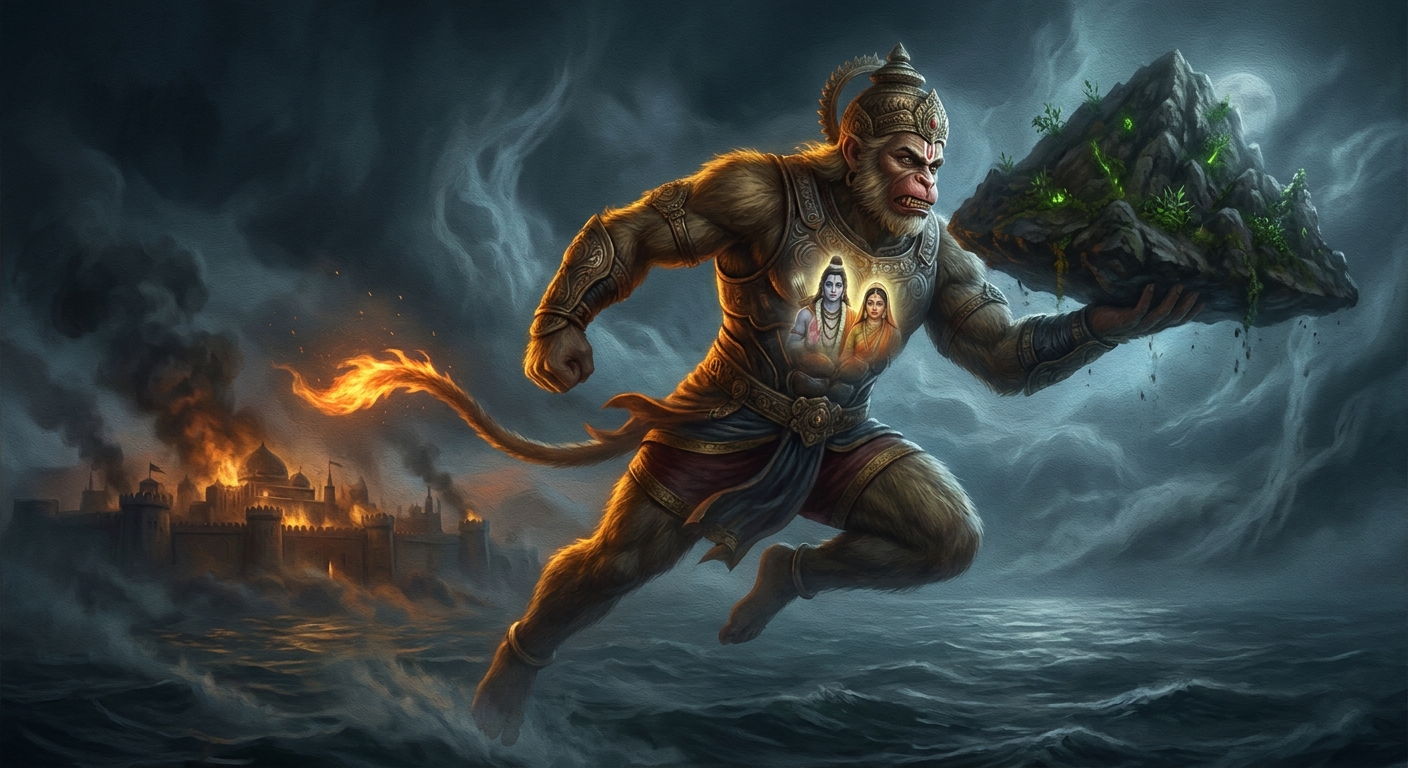
As a child, Hanuman tried to eat the sun because he thought it was a fruit. The gods struck him down and cursed him to forget his own powers until someone reminded him. When Rama needed him, Hanuman remembered — and flew across the ocean to Lanka, grew to the size of a mountain, set the demon city on fire with his burning tail, and carried an entire mountain of healing herbs back through the sky. When asked to show his devotion, he tore open his own chest to reveal Rama and Sita living in his heart. Power through devotion, not ambition.
Hanuman the divine monkey warrior leaping across the ocean to Lanka, grown to mountainous size, his burning tail setting the demon city ablaze behind him, carrying the entire Dronagiri mountain of healing herbs in one hand, his face showing fierce devotion, Rama and Sita visible as a divine vision in his heart, hyper-realistic dark mythology, dramatic chiaroscuro lighting, volumetric fire and ocean spray, warm golden rim lighting against deep crimson flames, muted earth tones with divine gold and flame-orange accents, cinematic composition, oil painting character rendering, high detail texture, mystical Hindu aesthetic, 8k --ar 16:9 --s 900 --v 711. Helen of Troy — The Face That Launched a Thousand Ships
| Divine Parent | Zeus (as a swan) |
| Human Parent | Leda |
| Tradition | Greek |
| What She Became | ”The face that launched a thousand ships” |
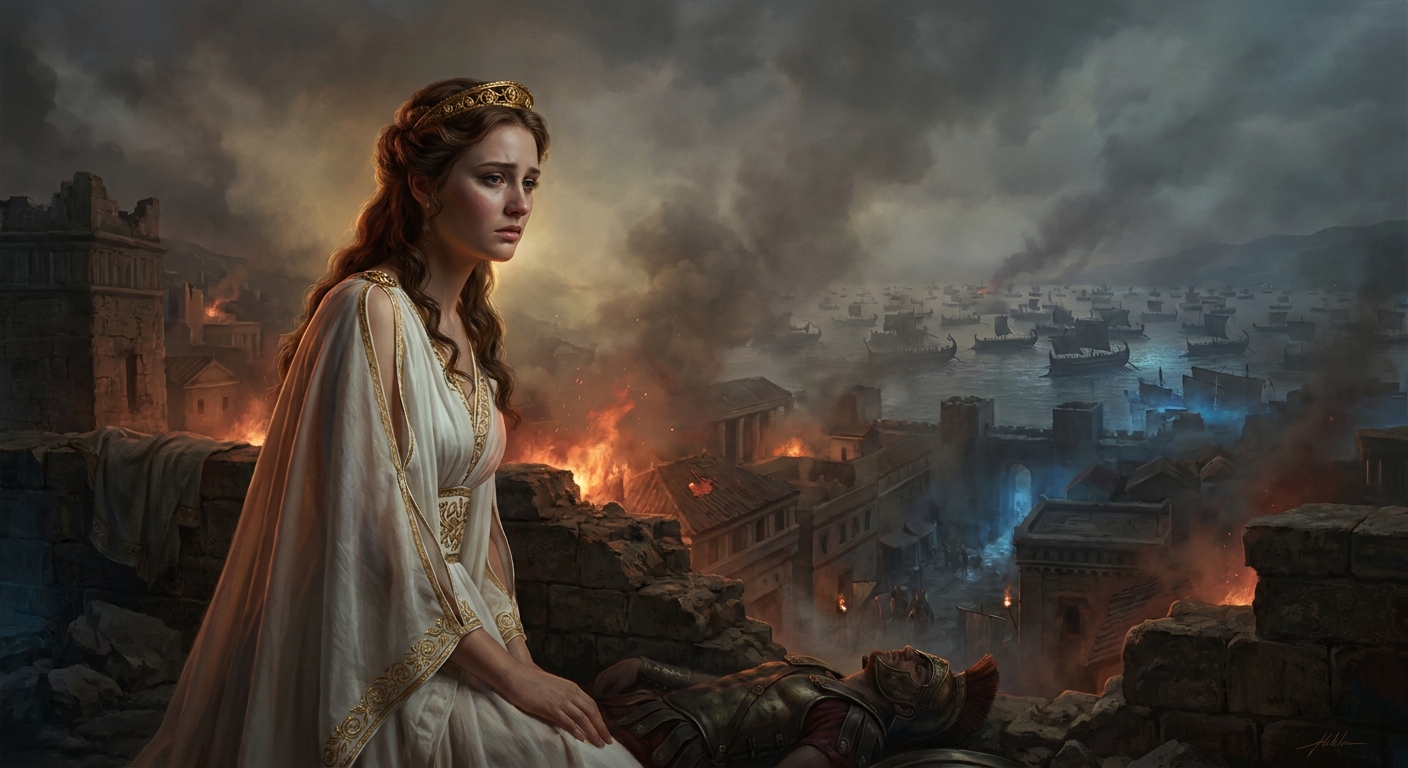
Zeus came to Leda as a swan. Helen hatched from an egg. She was the most beautiful woman in the world, and that beauty was a weapon of mass destruction. Every king in Greece swore an oath to defend whoever married her. Paris of Troy took her (abducted or willingly — the sources disagree). The oath activated. A thousand ships launched. Troy burned for ten years. Tens of thousands died. Helen survived everything and went home to Sparta with Menelaus. The demigod who destroyed a civilization by existing.
Helen of Troy standing on the walls of the burning city, the most beautiful woman in the ancient world, wearing flowing white and gold Greek robes, her face illuminated by the fires consuming Troy below, a thousand Greek warships visible in the harbor, soldiers dying in the streets, Paris fallen beside her, her expression showing the weight of a war caused by her existence, hyper-realistic dark mythology, dramatic chiaroscuro lighting, volumetric smoke and fire, warm golden rim lighting against burning orange sky, muted earth tones with deep crimson and gold accents, cinematic composition, oil painting character rendering, high detail texture, mystical divine aesthetic, 8k --ar 16:9 --s 900 --v 712. Aeneas — The Founder of Rome
| Divine Parent | Aphrodite/Venus |
| Human Parent | Anchises |
| Tradition | Greek/Roman |
| What He Became | Founded Rome (according to Virgil) |
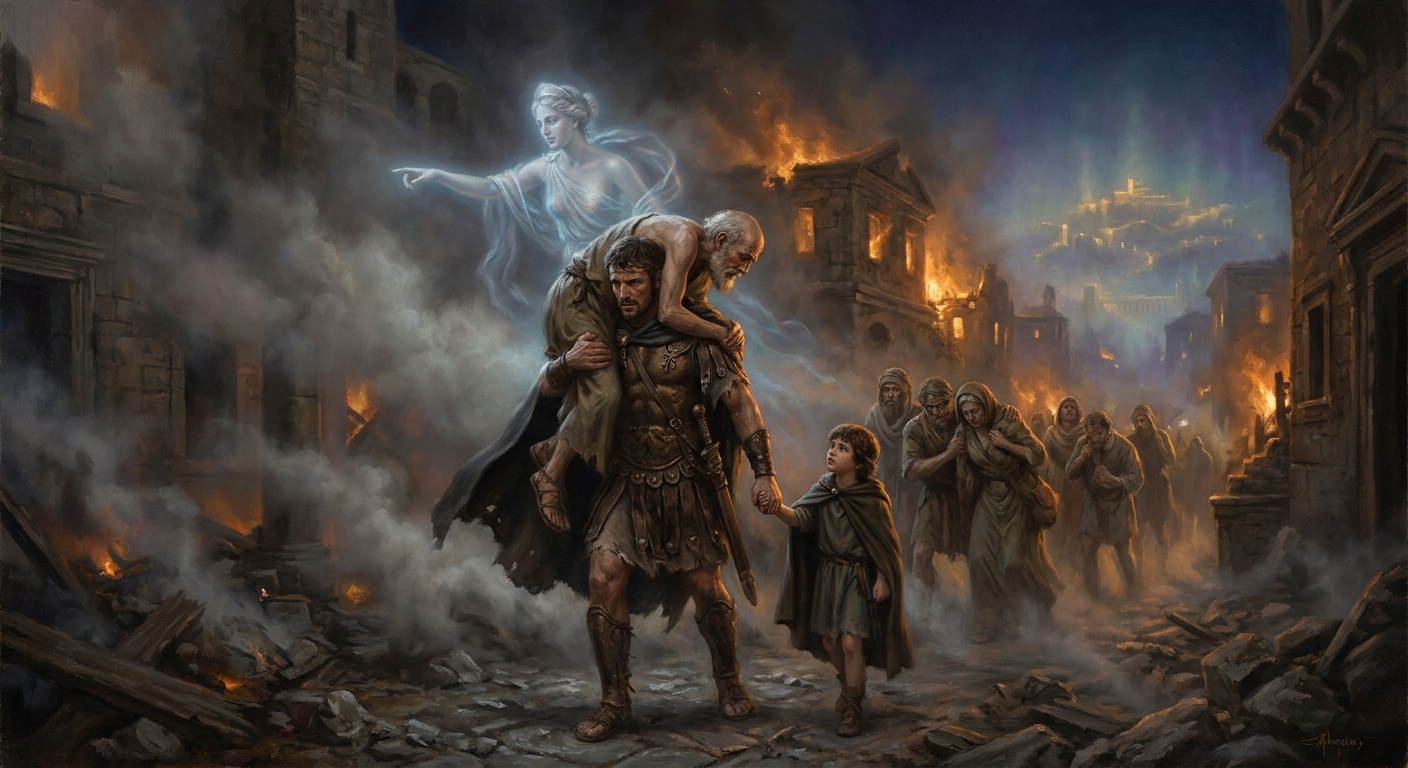
Son of the goddess of love, Aeneas fought at Troy and escaped the burning city carrying his elderly father on his back and holding his young son’s hand. He wandered the Mediterranean for years, descended into the Underworld, saw the future of Rome laid out before him, and landed in Italy where his descendants Romulus and Remus would found the greatest empire in history. Virgil wrote the Aeneid to prove that Rome was built by a demigod — and that its destiny was ordained by the gods themselves.
Aeneas fleeing the burning city of Troy, carrying his elderly father Anchises on his back, holding the hand of his young son Ascanius, the city in flames behind them, his divine mother Venus-Aphrodite visible as a ghostly figure guiding them through the smoke, Trojan refugees following, the distant vision of Rome's seven hills shimmering in the sky ahead, hyper-realistic dark mythology, dramatic chiaroscuro lighting, volumetric fire smoke and divine light, warm golden rim lighting against burning crimson sky, muted earth tones with flame-orange and divine gold accents, cinematic composition, oil painting character rendering, high detail texture, mystical divine aesthetic, 8k --ar 16:9 --s 900 --v 7The Pattern — What Every Tradition Agrees On
| Question | Answer Across Traditions |
|---|---|
| Why do gods mate with humans? | To produce champions for cosmic battles (Nephilim, Heracles, Cu Chulainn) |
| Do demigods have it easy? | NEVER. Every one suffers: Gilgamesh fails, Achilles dies young, Karna is rejected |
| Can they become fully divine? | Sometimes (Heracles ascends), usually not (Gilgamesh can’t) |
| Are they dangerous? | Often: the Nephilim triggered the Flood; Helen triggered the Trojan War |
The Deeper Pattern
The divine-human hybrid is mythology’s way of asking: What happens when heaven touches earth?
The answer is always the same: something extraordinary, and something terrible.
- The gift is power. Every demigod is stronger, faster, smarter, or more beautiful than any mortal.
- The curse is belonging nowhere. Too divine for humans, too human for gods. Karna is rejected by his mother. Gilgamesh can’t die but can’t live forever. Achilles knows his death is coming and goes to war anyway.
- The cost is always paid in suffering. Cu Chulainn dies at 27. Jesus dies at 33. Heracles murders his own family before his labors even begin. Helen watches a civilization burn because of her face.
- The lesson is that divinity isn’t a gift — it’s a weight. Every tradition agrees: being half-god is worse than being fully mortal. The gods can handle being gods. Humans can handle being human. The ones in between get crushed.
Cross-Tradition Comparison
| Trait | Greek | Biblical | Hindu | Celtic | Mesopotamian | Polynesian |
|---|---|---|---|---|---|---|
| Born of | Zeus + mortal women | Angels + human women | Gods + princesses | Lugh + mortal | Goddess + king | Underworld god + mortal |
| Superpower | Strength, beauty | Size, forbidden knowledge | Divine weapons, armor | Battle frenzy | 2/3 divine nature | Shape-shifting, trickery |
| Fatal flaw | Hubris, rage | Existence itself | Loyalty to the wrong side | Prophecy | Mortality (the 1/3) | Curiosity |
| Ended by | Betrayal, poison, arrows | God’s direct intervention (Flood) | Cosmic war | Standing alone | Old age (the only one) | A laughing bird |
| Ascended? | Heracles yes, others no | No (destroyed) | Karna returns to Surya | No | No | No |
Art Gallery
All demigod art is stored in EpicArt/Demigods/.
| # | Image | Demigod | Tradition |
|---|---|---|---|
| 1 | | Jesus | Christian |
| 2 | | Heracles | Greek |
| 3 | | Perseus | Greek |
| 4 | | Achilles | Greek |
| 5 | | Gilgamesh | Mesopotamian |
| 6 | | The Nephilim | Biblical |
| 7 | | Cu Chulainn | Celtic |
| 8 | | Karna | Hindu |
| 9 | | Maui | Polynesian |
| 10 | | Hanuman | Hindu |
| 11 | | Helen of Troy | Greek |
| 12 | | Aeneas | Greek/Roman |