Part of the Bestiary Compendium
Every tradition has them: figures who are pushed out, cast down, sent away from everything they knew. The exile is not a minor character. The exile is often the center of the story — the one whose forced journey reshapes the world.
What happens in exile? You learn things you couldn’t learn at home. You become who you couldn’t become in comfort. Moses meets God in exile. The Babylonian exile produces the Bible as we know it. Odin wanders in disguise not because he must but because wisdom only lives on the road. The exile is not the interruption of the story. It is the story.
The destinations matter too. Eden → the cursed earth. Jerusalem → Babylon. Ayodhya → the forest. Heaven → earth. Home → everywhere. The map of exile is the map of the sacred world.
Art style:
hyper-realistic exile journey, the loneliness of the road, dramatic landscape stretching ahead, the exile looking back at what they've lost, warm golden memories behind and cold blue uncertainty ahead, cinematic composition, oil painting rendering, 8kThe Exiles — Cast Out, Sent Away, Forced to Wander
| Exile | Where From | Where To | How Long | Why | Tradition |
|---|---|---|---|---|---|
| Adam & Eve | Eden | The cursed earth | Permanent | Ate the fruit | Biblical |
| Cain | His homeland | The land of Nod (“Wandering”) | Permanent | Murdered Abel | Biblical |
| Israel in Egypt | Canaan | Egypt as slaves | 400 years | Famine → Joseph → slavery | Biblical |
| Babylonian Exile | Jerusalem | Babylon | 70 years | Disobedience; Temple destroyed | Biblical |
| Rama’s Exile | Ayodhya (his kingdom) | The forest | 14 years | His stepmother’s scheme; he went willingly | Hindu |
| Odin’s Wandering | Asgard | Midgard (among humans) in disguise | Ongoing | Seeking wisdom; he CHOOSES exile repeatedly | Norse |
| Odysseus | Troy | The sea (trying to get home) | 10 years | Poseidon’s curse for blinding Polyphemus | Greek |
| Sun Wukong | Heaven/Freedom | Under Five Elements Mountain | 500 years | Rebelled against heaven | Chinese |
| Iblis | The assembly of angels | Cast to earth | Until Judgment Day | Refused to bow to Adam | Islamic |
| Lucifer | Heaven | Hell/Earth | Permanent | Pride; “I will ascend above the Most High” | Christian |
| Moses | Egypt (as prince) | Midian (as shepherd) | 40 years | Killed an Egyptian overseer | Biblical |
| Muhammad’s Hijra | Mecca | Medina | Temporary (8 years) | Persecution by Quraysh | Islamic |
| The Pandavas | Their kingdom | The forest + 1 year incognito | 13 years | Lost a dice game to the Kauravas | Hindu |
| Guru Nanak’s Udasis | Home | Four great journeys across the known world | ~24 years | Not exile but chosen wandering to spread truth | Sikh |
| The Jewish Diaspora | Israel | Everywhere | 2,000 years (70 AD — 1948 AD) | Rome destroyed the Temple; longest exile in history | Jewish |
The Pattern
| Type of Exile | What It Produces | Examples |
|---|---|---|
| Punishment exile | Transformation and growth | Adam (agriculture), Cain (civilization), Wukong (humility) |
| Chosen exile | Wisdom and mission | Odin (wisdom), Nanak (spreading truth), Moses (burning bush happened IN exile) |
| Political exile | Nation-defining identity | Babylonian Exile (Judaism reinvented itself), Hijra (Islamic calendar starts here) |
| Cosmic exile | The setting for all human history | Lucifer/Iblis cast out → the entire human drama unfolds because of their exile |
The Insight Nobody Mentions
The Babylonian Exile created Judaism as we know it. Before the exile: a Temple-based sacrificial cult. After: synagogues, Torah study, rabbinical interpretation, diaspora identity. The worst thing that happened to Israel produced the religion that survived 2,000 more years of exile. The exile was the making, not the breaking.
The same logic appears across traditions. Moses could not have met God at the burning bush had he stayed a prince in Egypt. Wukong could not have grown wise without 500 years pinned beneath a mountain. Odin could not have gained the runes or traded his eye without choosing to leave. The pattern insists: the palace produces heirs; the road produces heroes.
The Profiles
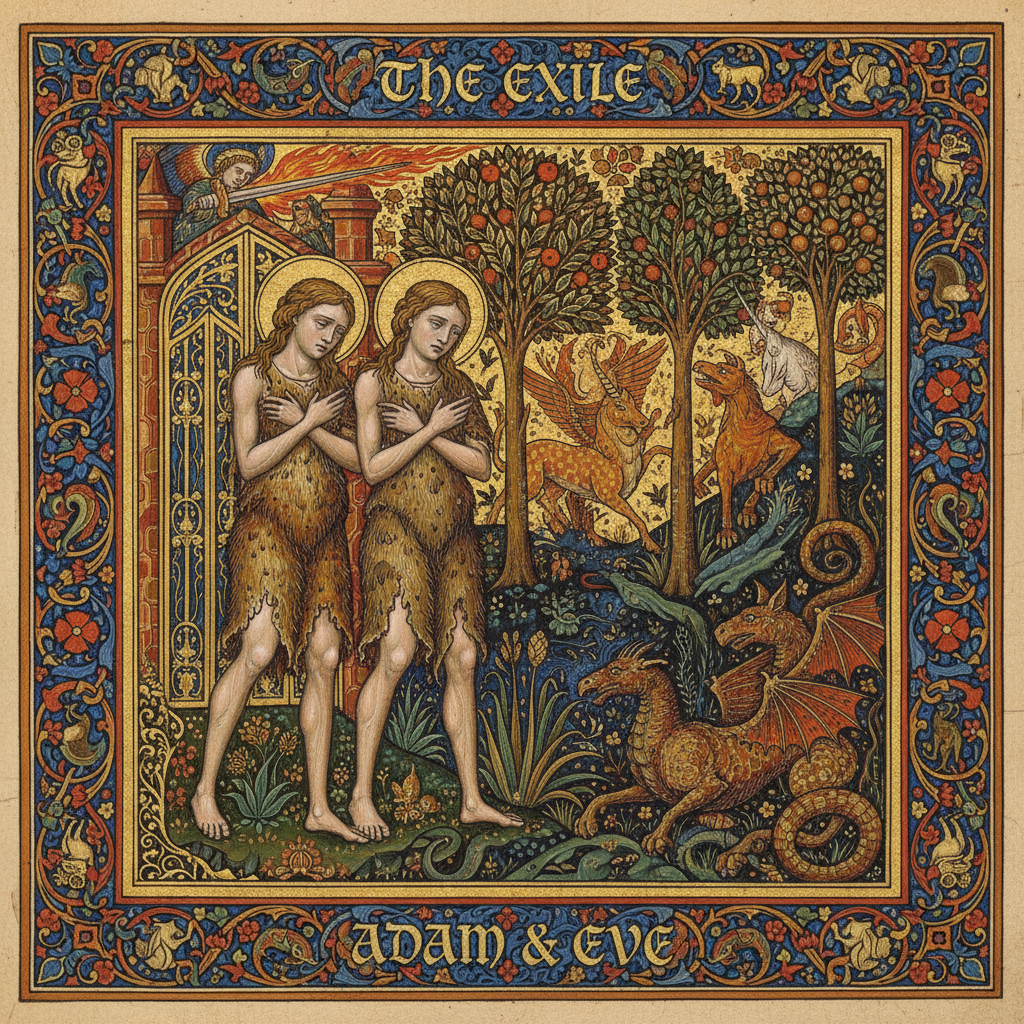
Adam & Eve — The First Exile
Genesis 3:23-24. God drives them out of Eden and places a cherubim with a flaming sword to guard the way back to the tree of life.
The punishment is not just expulsion. It’s the closing of a door. Before the exile: the world was garden. After: thorns and thistles, pain in childbirth, sweat and toil. The exile doesn’t just change where they live. It changes what life is.
But notice what they take with them. Eve is named — hawwah, “the living one,” mother of all living — after the exile. The story of humanity begins at the gate, not inside. Everything that makes us human: agriculture, civilization, death, love, memory, story — all of it happens outside Eden. The exile is the beginning of history.
The flaming sword that keeps them out is also, in a strange way, the thing that drives them forward. There is no going back. The only direction is ahead.
Genesis gives them clothes before they leave. God makes garments of skin for them. The first act of divine care is provision for the road.
Cain — Marked for the Road
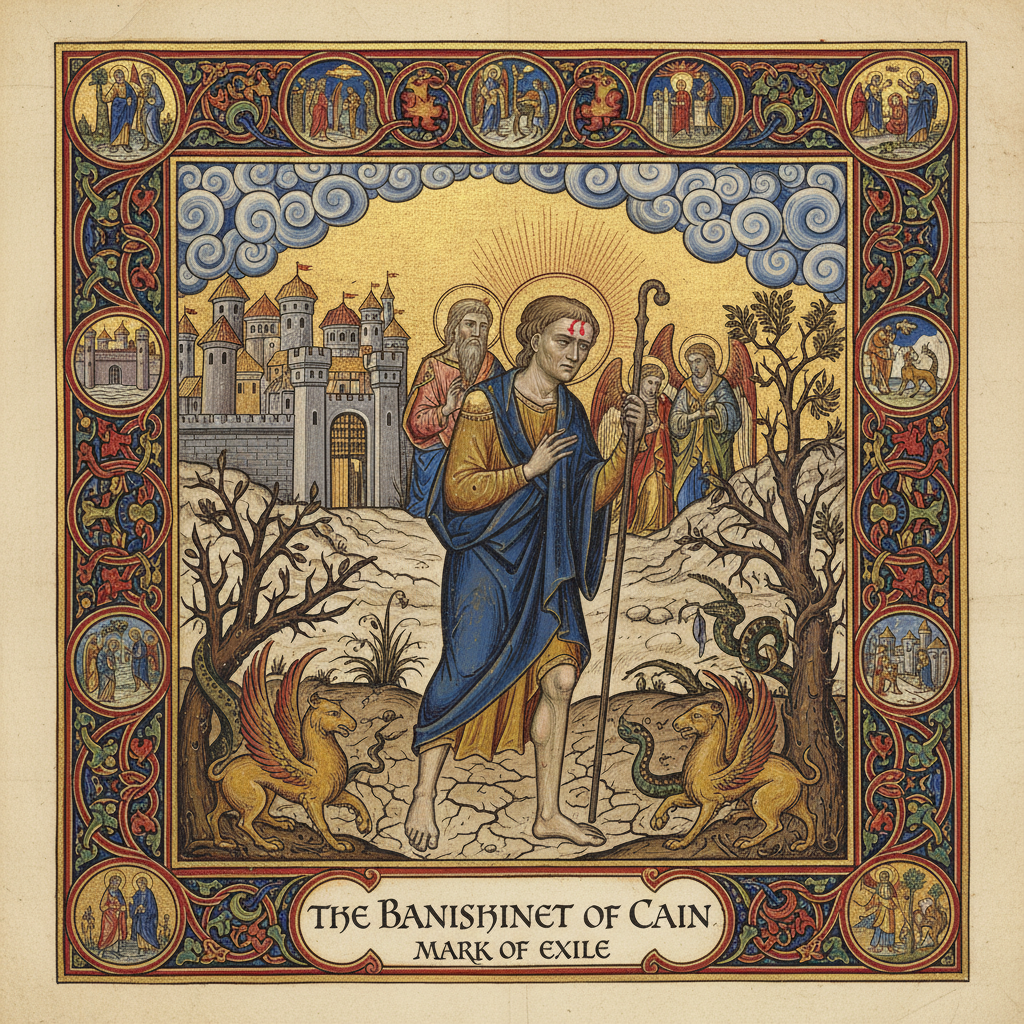
Genesis 4:9-16. After murdering Abel, Cain is cursed: the ground will no longer yield for him. He will be a fugitive and wanderer on the earth. He says, “My punishment is greater than I can bear. Whoever finds me will kill me.”
God marks him. The Mark of Cain — one of the most debated symbols in Biblical literature — is not a punishment. It’s protection. God says: “If anyone kills Cain, vengeance shall be taken on him sevenfold.” The murderer walks away under divine protection.
Then Cain goes to the land of Nod — which means, in Hebrew, simply “Wandering.” He builds a city. He names it after his son. The first murderer is also the first city-builder. Civilization, in the Biblical text, begins not in paradise but in exile.
The irony runs deep. The agricultural world — the world that Cain tills and Abel doesn’t — is the world that Cain is now cut off from. He killed his brother for the ground’s favor, and the ground refuses him. He builds a city instead: stone, walls, permanence. Not because it’s beautiful. Because it’s the only shelter left.
The wanderer becomes the founder. The exile becomes the architect.
Israel in Egypt — The Slow Exile
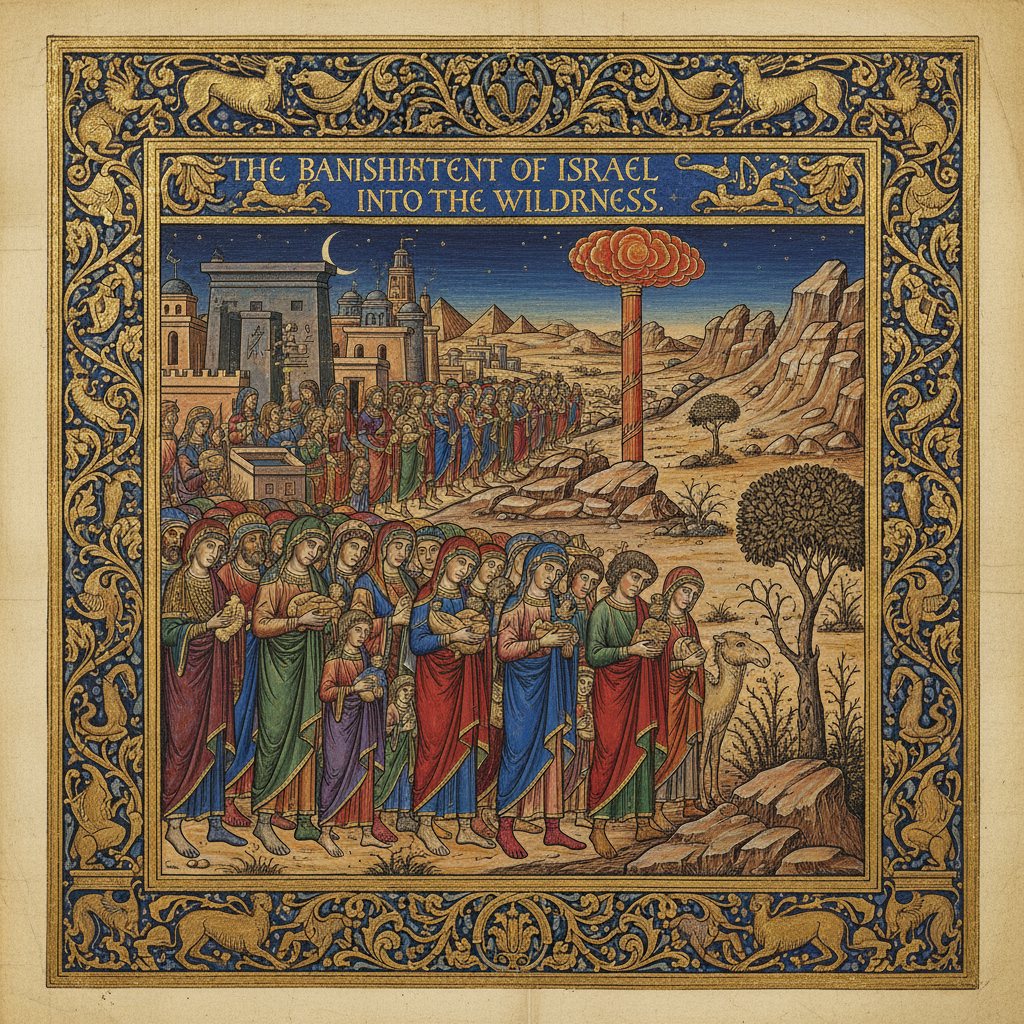
Genesis 46 — Exodus 1. This exile doesn’t announce itself. It arrives as a rescue: Joseph, sold into slavery by his brothers, rises to become Pharaoh’s right hand. He saves Egypt from famine. He brings his family down to safety. They number seventy.
Then Joseph dies. A new Pharaoh arises who did not know Joseph. He sees the Israelites multiplying and fears them. He enslaves them. The rescue becomes the cage.
Four hundred years. An entire people forget what home was. They speak Egyptian. They wear Egyptian clothes. They pray to a God their ancestors knew but they barely remember. The only thing that preserves them is a story — we were promised a land, we are sojourners here, this is not the end.
A story is a surprisingly durable container for a nation. When Moses arrives with the burning bush behind him, the Israelites are not sure they believe him. They’ve been in Egypt for four centuries. The home they were promised is four hundred years of oral tradition away.
But they leave. And the leaving takes forty years more, because leaving Egypt was the easy part. Leaving Egypt inside was the work of a generation.
The Babylonian Exile — The Exile That Made a Religion
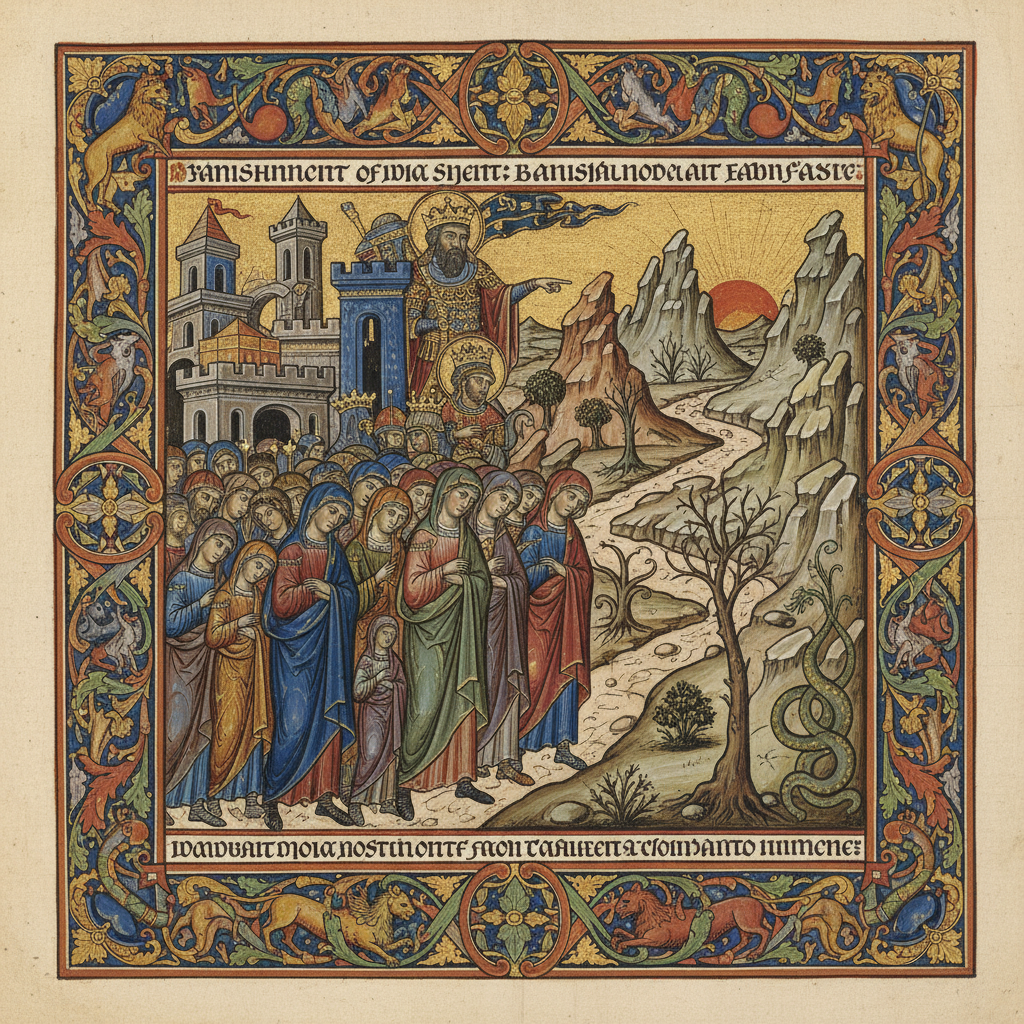
2 Kings 25; 586 BCE. Nebuchadnezzar destroys Jerusalem. The Temple — Solomon’s Temple, the dwelling place of God, the center of the universe — is burned to the ground. The ark disappears from history. The leaders are taken to Babylon in chains.
The question that nearly destroyed Judaism: how do you worship a God of a specific land, from exile?
The answer, worked out over seventy years, changed everything. If God is only the God of Israel, he is defeated. But if God is the God of all history — who allowed the exile as judgment, who would restore them — then the exile itself becomes a text. The prophets who wrote in Babylon: Ezekiel, Second Isaiah. The scroll redactors who assembled what would become the Torah. The invention of the synagogue — prayer and study replacing sacrifice, portable worship for a portable people.
Before the exile: you could only properly worship at the Temple. After: you could worship anywhere, because the presence of God traveled with the Torah scroll.
The Babylonian Exile is the most theologically productive disaster in the history of religion. The worst thing that happened to ancient Israel gave us the Bible, the synagogue, monotheism as a portable system, and a religion that could survive — and did survive — two thousand more years of displacement.
The exile that was supposed to end Judaism produced modern Judaism.
Rama’s Exile — The Prince Who Went Willingly
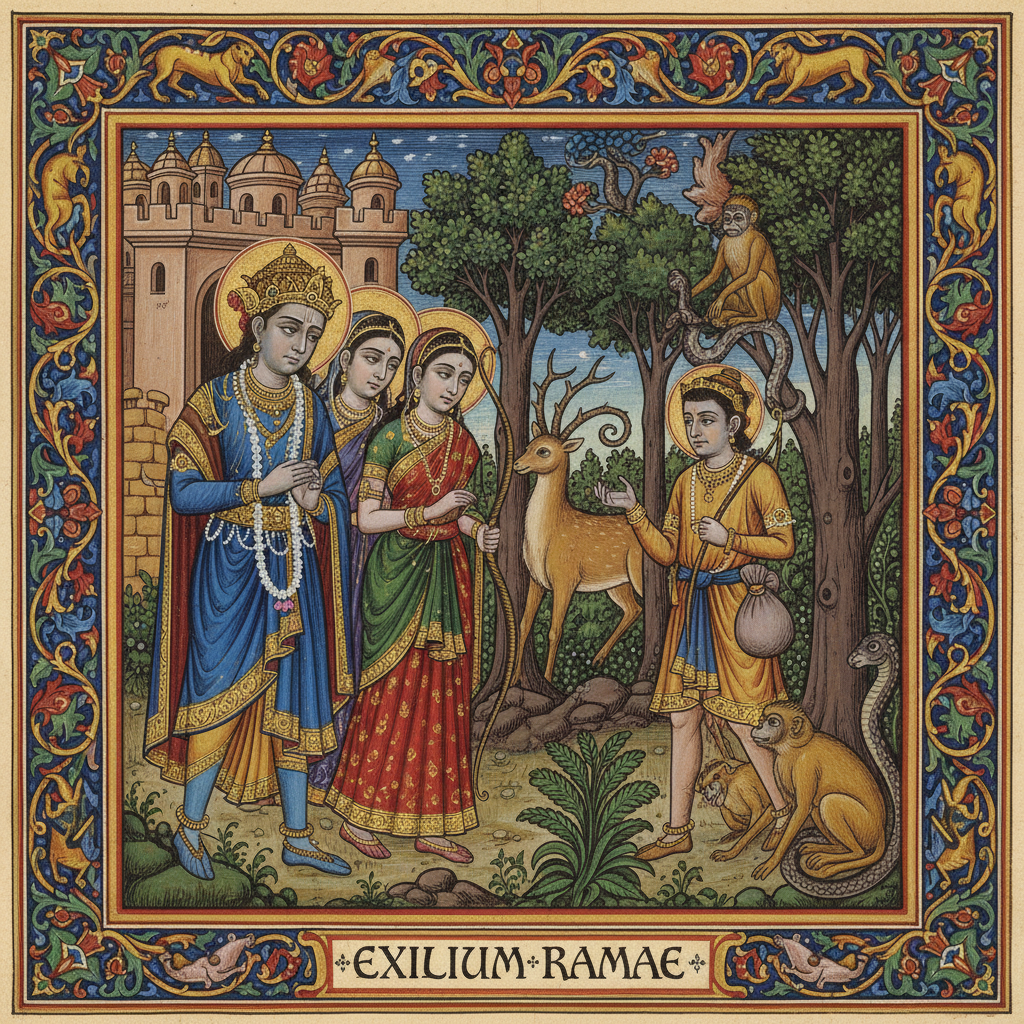
Valmiki’s Ramayana, Ayodhya Kanda. The night before his coronation, Rama learns that his stepmother Kaikeyi has invoked two ancient boons King Dasharatha once promised her: she wants her own son Bharata on the throne, and Rama exiled to the forest for fourteen years.
Dasharatha is shattered. He cannot refuse. But Rama can.
He doesn’t have to go. He has the love of the people, the army, the city. He could refuse his stepmother’s claim. He goes anyway — because his father’s word must be kept, because dharma requires it, because Rama is Rama.
Sita chooses to go with him. His brother Lakshmana chooses to go with him. The three of them walk into the forest as the entire city weeps.
The fourteen years in exile are the Ramayana. The abduction of Sita. The alliance with the monkey-king Sugriva. Hanuman’s leap. The war at Lanka. None of it would happen at home. The exile is not the interruption of Rama’s story — it IS his story. The forest is where the god shows himself.
When Rama returns to Ayodhya at the end, the city lights lamps to celebrate. It is Diwali, the festival of lights, still celebrated every year: the exile is over, the king is home, light has returned.
But Rama without the exile is a crowned prince in a palace. Rama with the exile is God on earth. The difference is fourteen years in the wilderness.
Odin’s Wandering — The God Who Chooses Exile
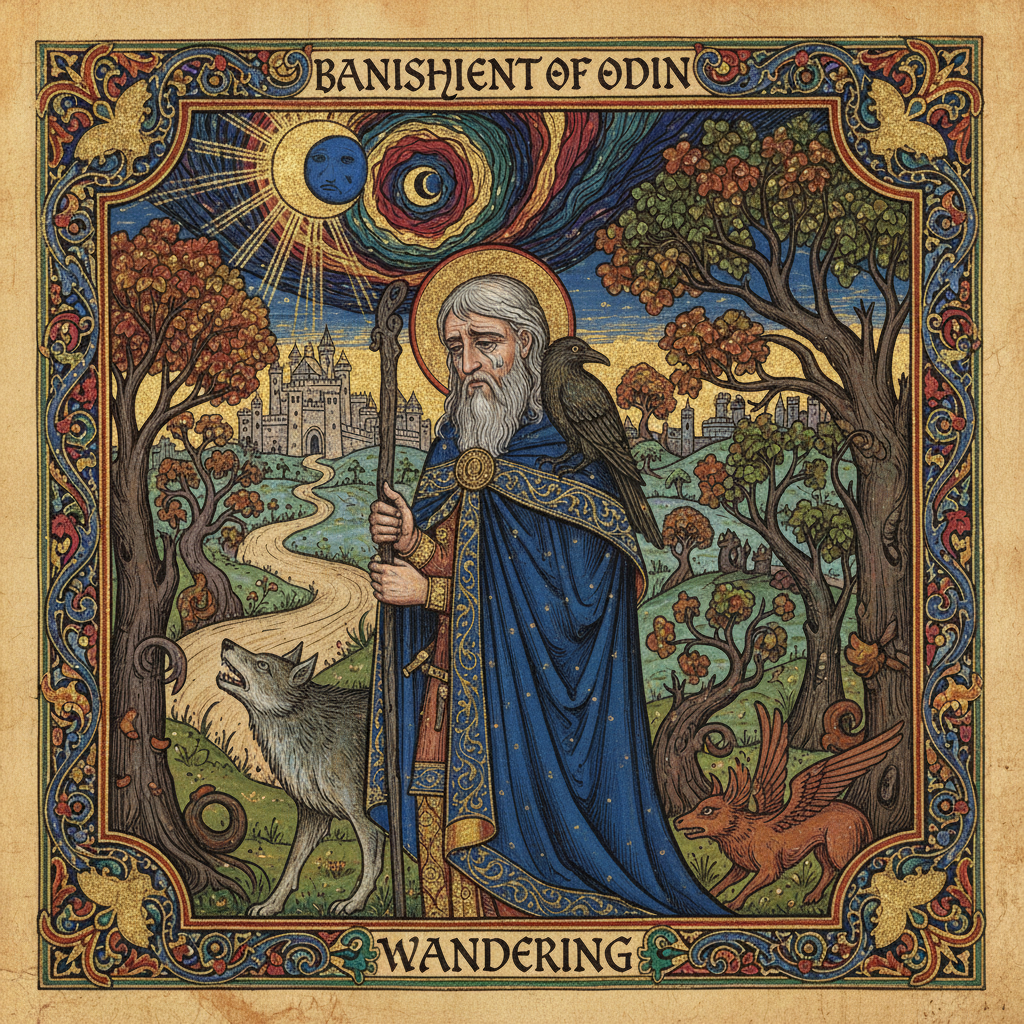
The Norse corpus: Poetic Edda, Prose Edda, Havamal. Odin is the Allfather. He rules Asgard. He has the throne, the ravens, the wolves, the Valkyries. He could stay.
He doesn’t.
Again and again, Odin disguises himself as a wanderer — Grimnir, Gangleri, the hooded stranger, the one-eyed traveler — and walks among humans, among giants, among the dead. He hung himself on Yggdrasil for nine days and nights to win the runes. He gave his eye at Mimir’s Well for wisdom. He drinks from Mimir’s head daily. Every act of Odin is a trade: something precious given away for something more precious gained.
His wandering is voluntary. The most powerful being in Norse cosmology keeps choosing to leave, keeps choosing poverty and disguise and danger, because the wisdom he needs is not available at home. The All-Father’s deepest truth is that knowledge has a price and he is willing to pay it.
The Havamal — Odin’s sayings — reads like the philosophy of a permanent exile. A man should not step one foot over the threshold without looking both ways. Cattle die, kinsmen die, the self must also die; but the fame of good deeds never dies. These are not the aphorisms of a king in a hall. They’re the hard-won lessons of a wanderer on a road.
Odin knows Ragnarok is coming. He knows he cannot stop it. He still gathers the slain, still builds the einherjar, still sends the ravens, still walks the roads. Preparation and wandering, until the end.
Odysseus — Ten Years Trying to Go Home
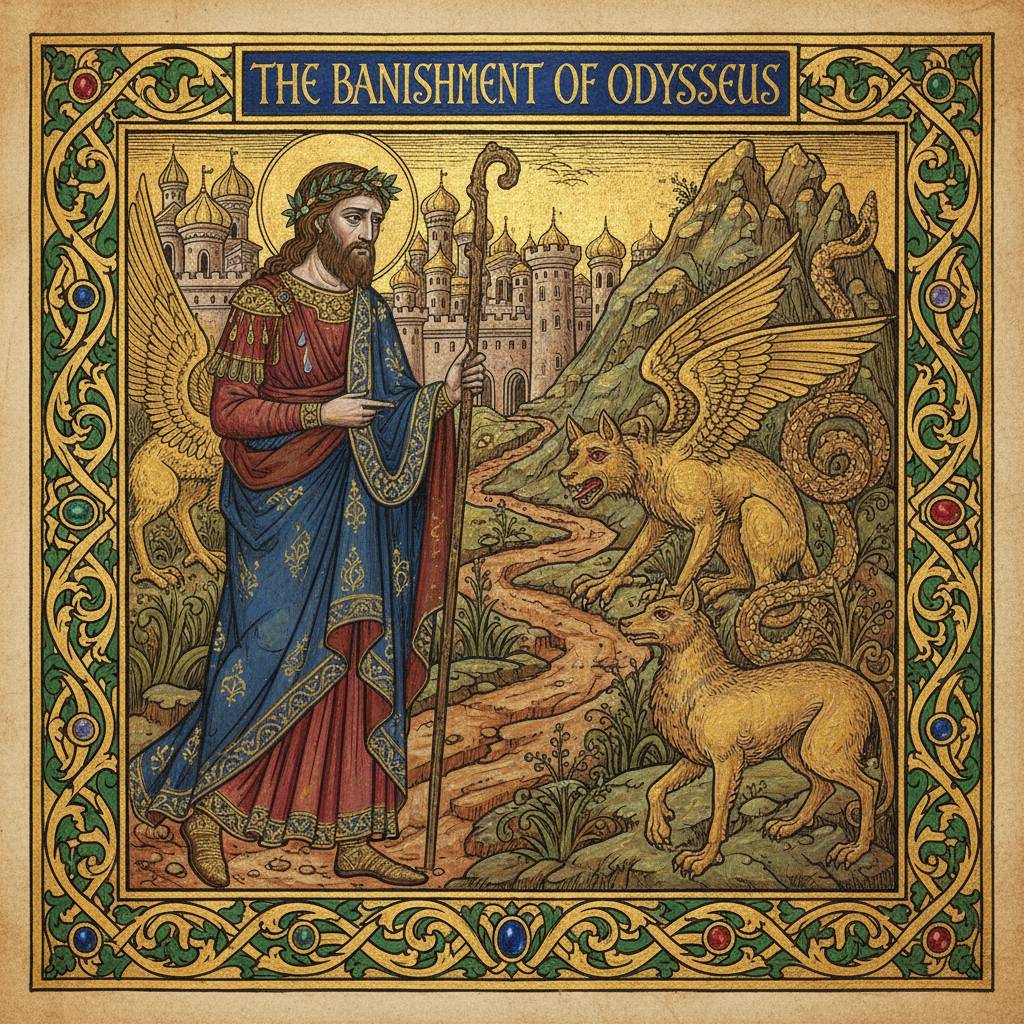
Homer’s Odyssey. The Trojan War ends. Every Greek hero sails home. Most of them make it — or die trying, quickly. Odysseus takes ten years.
The cause is a prayer. Polyphemus the Cyclops, blinded by Odysseus, prays to his father Poseidon: let Odysseus either never reach home, or reach it late, alone, on a foreign ship, finding trouble there. Poseidon grants it. The lord of the sea, who controls every ship that floats, turns his rage on the one man clever enough to escape.
Ten years on the water. Aeolus and the bag of winds. The Laestrygonians who eat his men. Circe’s island, one year. The land of the dead. Scylla and Charybdis. Calypso’s island, seven years, a goddess who loves him and wants to make him immortal, and he refuses — because he wants to go home.
What kind of man refuses immortality for an aging wife on a rocky island? Odysseus. Because home is not a place. It’s the story you’re in the middle of. He needs to finish it.
When he finally arrives at Ithaca, he arrives as a beggar. Disguised, tested, unrecognized — even by his own dog, who recognizes him and dies from the joy of it. He has to earn his home back as violently as Agamemnon didn’t.
The Odyssey is not about traveling. It’s about the exile’s burning need to return, and what it takes to deserve the return.
Sun Wukong — Five Hundred Years Under a Mountain
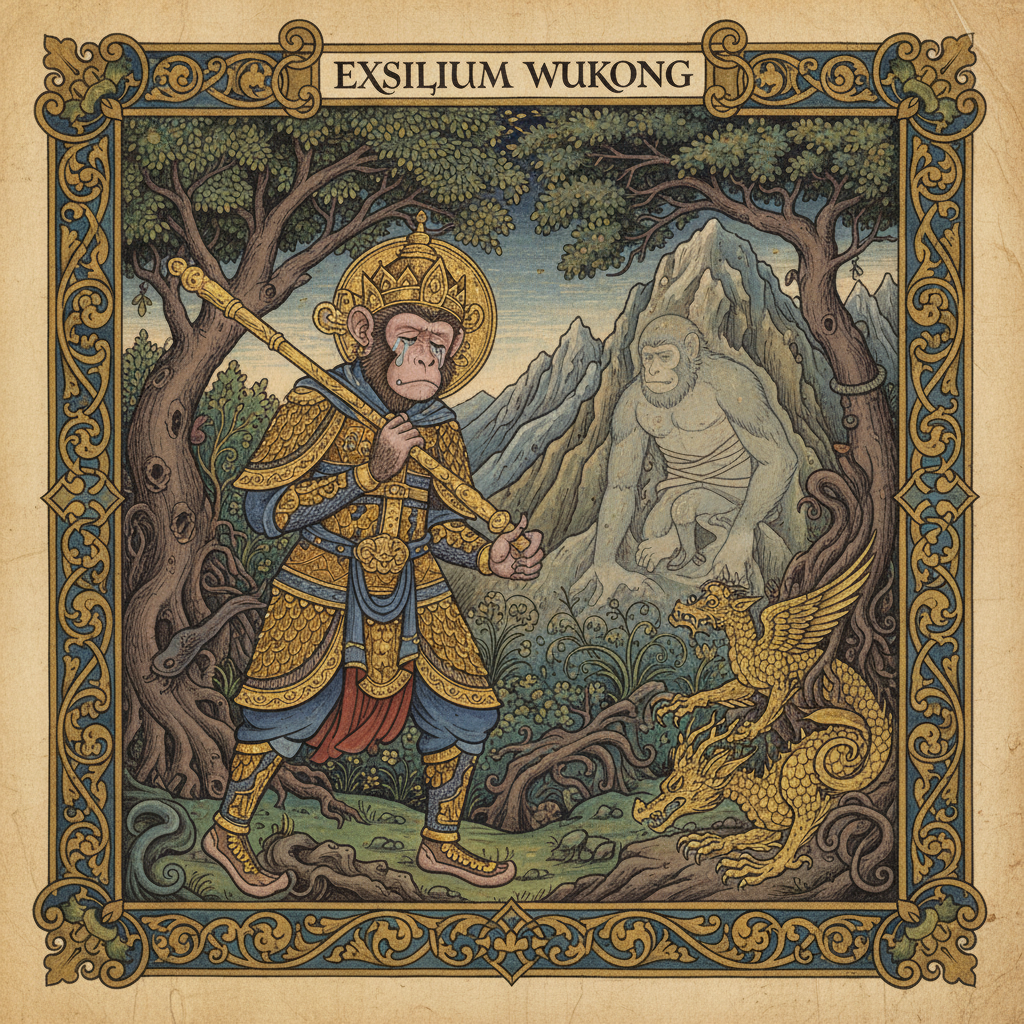
Journey to the West, Wu Cheng’en. The Monkey King who declared himself “Great Sage Equal to Heaven” has been defeated. Not by military force — Heaven sent its best, and Wukong fought them all to a standstill. He was caught by the Buddha.
The Buddha bet Wukong he couldn’t escape his palm. Wukong leapt across the universe, reached what he thought were the world’s five pillars, wrote his name on one, pissed on another — and discovered he’d never left the Buddha’s hand. The pillars were the Buddha’s fingers.
The Buddha placed his hand over Wukong, and the hand became Five Elements Mountain. Wukong is pressed beneath it, head barely above the stone, for 500 years. Fed iron pellets when hungry. Given molten copper when thirsty.
He is not killed. He cannot be killed. But he can be stopped.
When the monk Xuanzang releases him — Wukong is to escort him to India to retrieve the Buddhist scriptures — the Monkey King who emerges is not broken but changed. He still has his power. He still has his personality. But the 500 years have worked something in him: he chooses a purpose larger than his own glory.
The greatest act of imprisonment in Chinese mythology produced the greatest hero in Chinese mythology. The mountain didn’t crush him. It shaped him. Five hundred years of total stillness for a being that could travel 108,000 li in a single somersault. Five hundred years, and then: the road to the west.
Iblis — Exile by Refusal
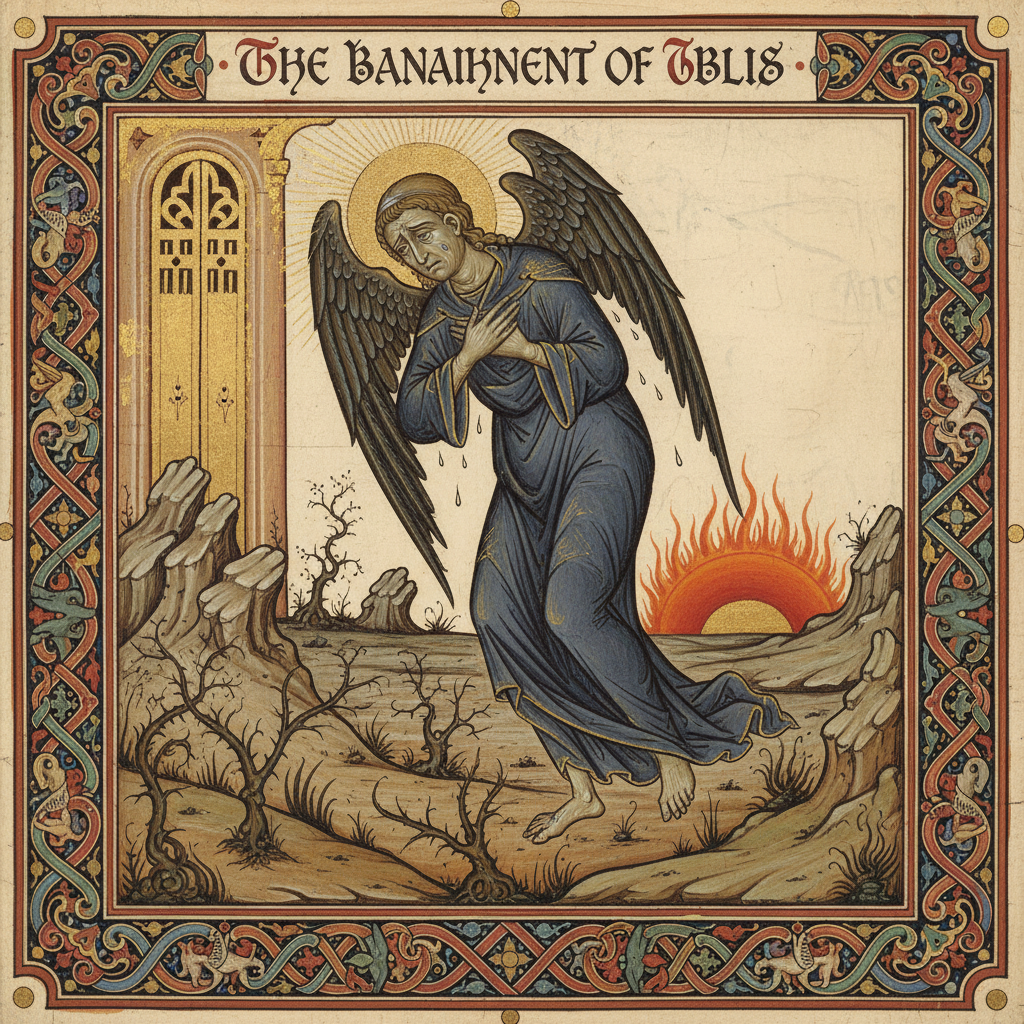
Quran 2:30-39; 7:11-18; 15:28-44. God creates Adam from clay. God commands the angels to prostrate before Adam. They all do. Iblis does not.
“I am better than him,” Iblis says. “You created me from fire and him from clay.” A logical argument. A fatal one.
God casts him out. But Iblis does not accept the exile silently. He requests a delay: grant me respite until the Day of Resurrection. God grants it. Then Iblis makes his promise: I will mislead them — all except your sincere servants among them.
The Islamic tradition presents this moment with uncomfortable clarity. Iblis is cast out not for ignorance but for pride. He knew what God was. He made his calculation and held his position. The Quran does not demonize him as a mindless monster — it preserves his argument, his logic, his clarity. He saw the situation and chose.
The exile of Iblis is not the end of his story. It is the beginning of the human one. Everything that follows — the temptation in the garden, the long drama of prophets and peoples, the entire history of revelation — happens because one being refused to bow and was therefore given until Judgment Day to pursue his purpose.
The exile did not diminish Iblis. It gave him a mission. That is the terrifying part.
Lucifer — The Fall That Lit the Dark
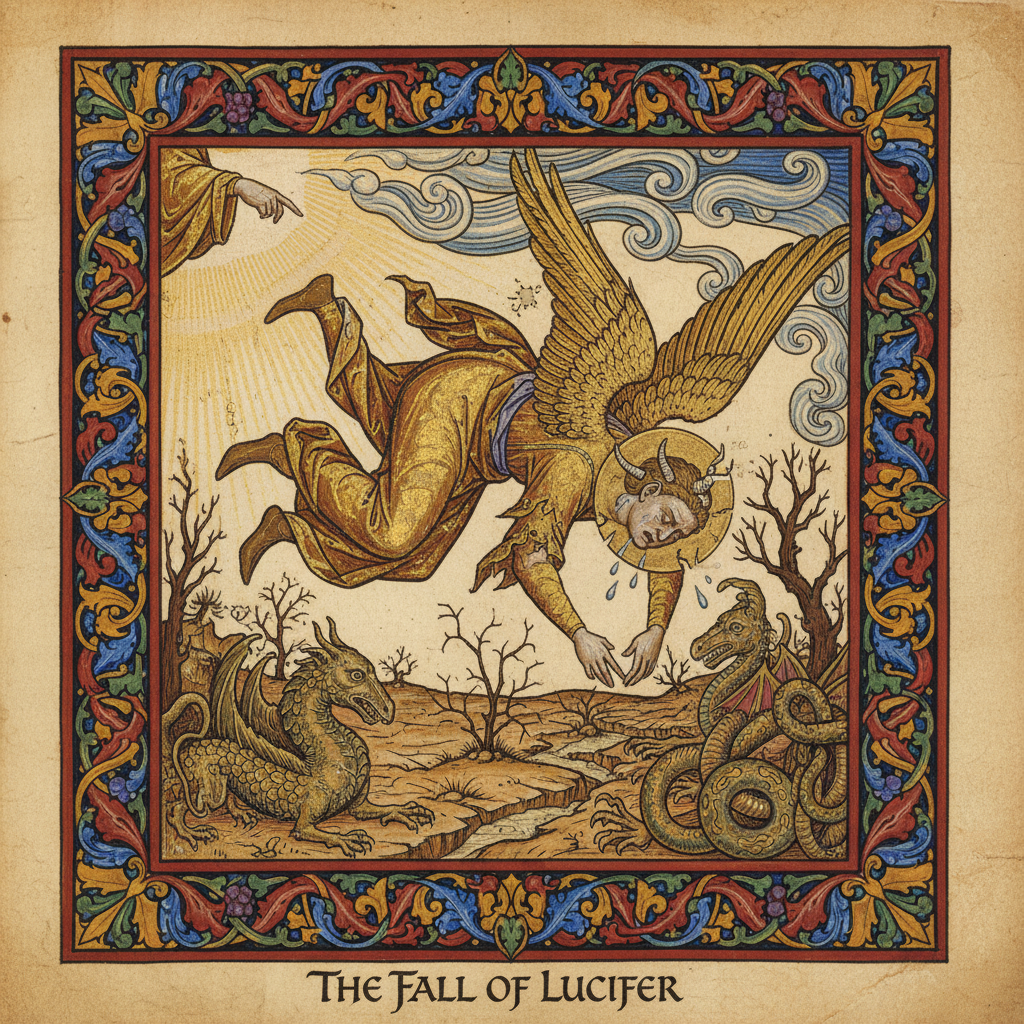
Isaiah 14:12; Luke 10:18; Revelation 12:7-9. “How you have fallen from heaven, O morning star, son of the dawn!”
The imagery is astronomical. The morning star — Venus, the brightest object in the pre-dawn sky — rises brilliantly, then fades as the sun appears. The prophet applies this image to the pride that precedes a great fall.
The theological tradition developed it into a cosmic event. Milton’s Paradise Lost renders it in full: the war in heaven, the rebel angels, the defeat, the long fall into darkness. “Better to reign in Hell than serve in Heaven,” Satan says — and the bravado rings hollow, because the reader has already seen what was lost.
The Christian understanding: Lucifer’s exile is the precondition for the human drama. If the adversary had not been cast from heaven, there would be no tempter in the garden, no fall of humanity, no need for redemption. The entire architecture of Christian salvation rests on the exile of Lucifer. His fall is the stone that causes all other falls — and therefore the stone that the entire salvific structure is built to address.
He is the exile that set history in motion.
What was he before? The most luminous of the angels, tradition says. Light-bearer. The morning star. Something so beautiful that its loss is the worst loss in the cosmos. The darkness of hell is dark because of what it was before the exile.
Moses in Midian — Forty Years in the Wrong Life
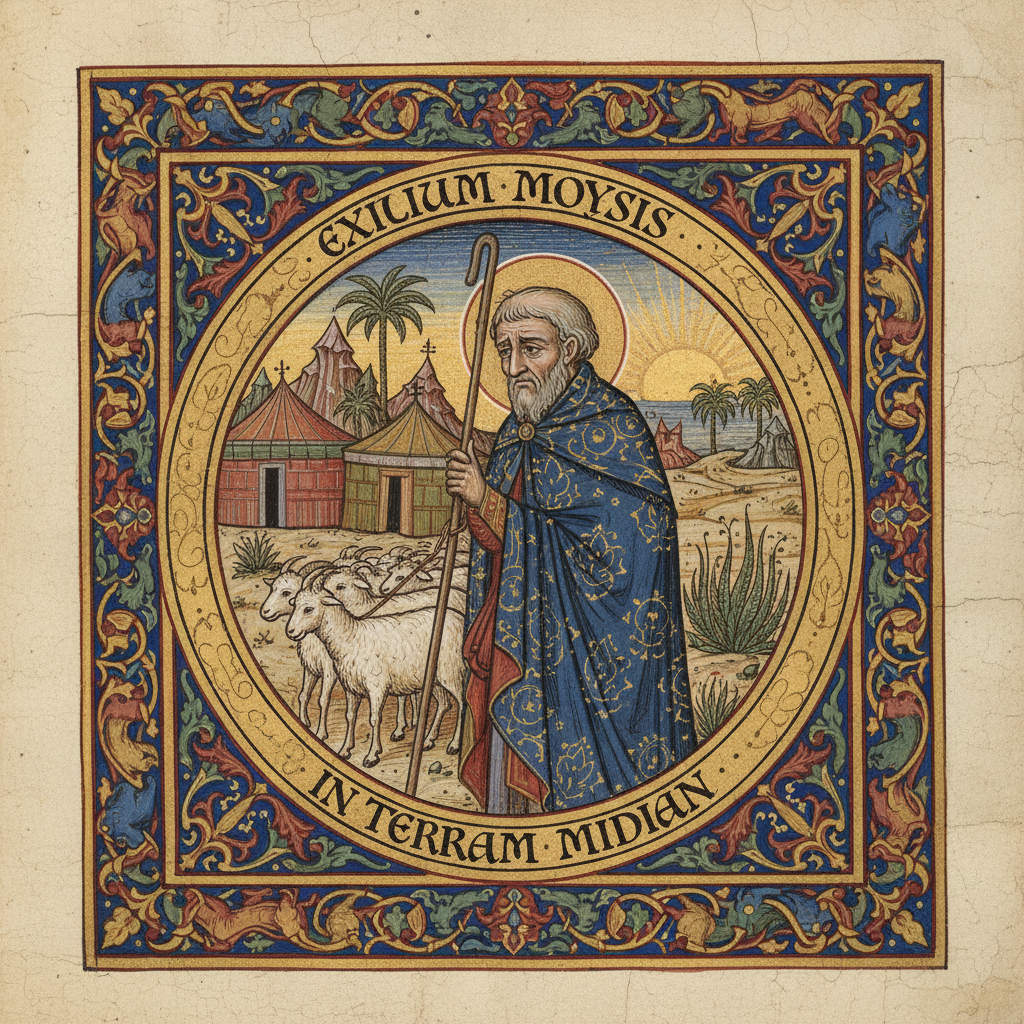
Exodus 2:11-22. Moses is a prince of Egypt. He goes out to see his people’s labor. He sees an Egyptian beating a Hebrew slave. He looks around. He kills the Egyptian and hides the body in the sand.
The next day, he tries to break up a fight between two Hebrews. One of them says: “Who made you a ruler and judge over us? Do you mean to kill me as you killed the Egyptian?”
Moses panics. Pharaoh learns of it. Moses flees. He sits down by a well in Midian, helps some shepherd girls water their flock, meets their father Jethro, marries his daughter Zipporah. He becomes a shepherd.
He was a prince. He becomes a shepherd. Forty years.
The murder was not incidental. Moses could not have led the Exodus as the prince he was — too attached to the system he was part of, too Egyptian, too comfortable in power. The forty years in Midian didn’t just hide him. They unmade him. The court was educated out of him. The comfort was walked out of him on the hillsides behind Jethro’s flock.
And then: a bush. On fire. Not burning. And a voice.
The burning bush happens in exile. Moses met God not in the palace but on the far side of the wilderness, alone with the sheep, forty years past the life he used to have. The exile was the prerequisite for the encounter. The road to Sinai runs through Midian.
Muhammad’s Hijra — The Exile That Became the Calendar
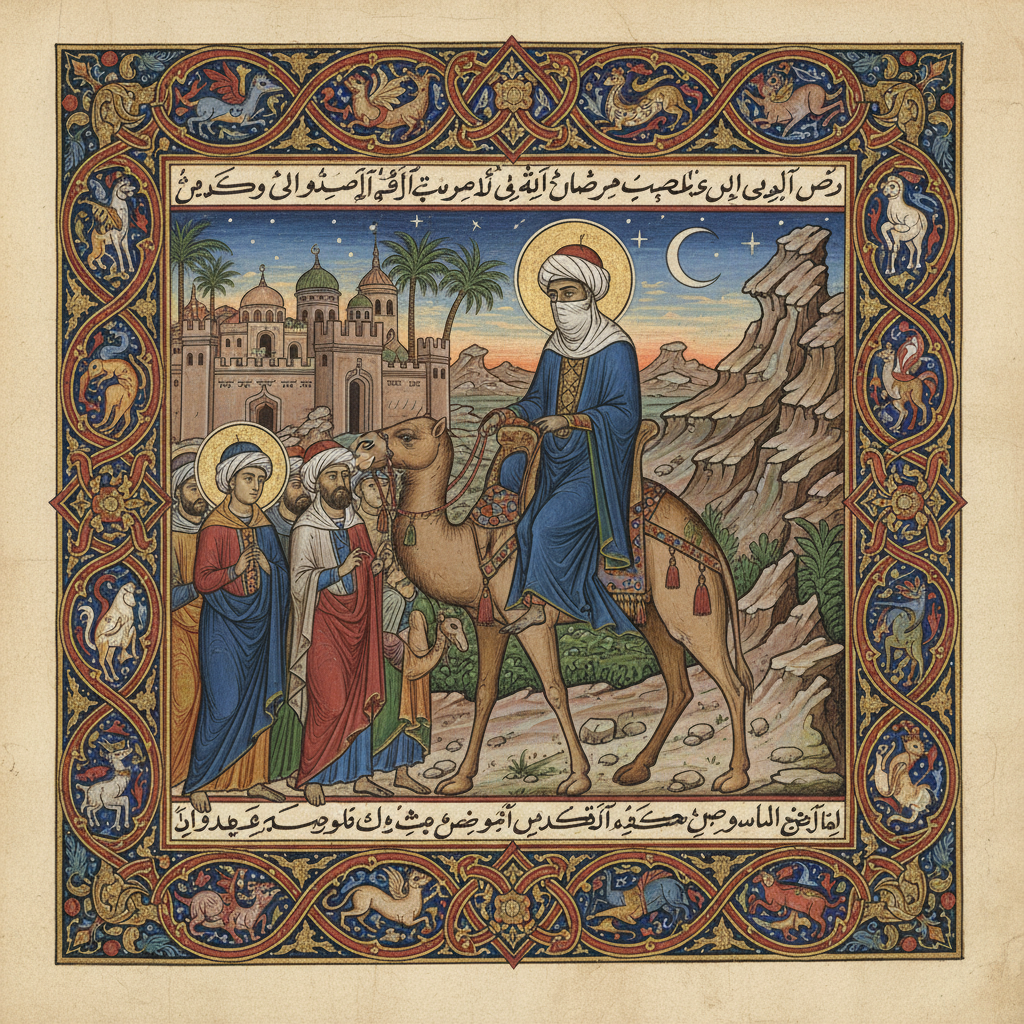
622 CE. The Prophet Muhammad and his small community of believers have endured thirteen years of persecution in Mecca — economic boycotts, social exclusion, physical violence, assassination plots. They have tried. Mecca will not receive them.
The migration to Medina — the Hijra — is not a defeat. It will later be understood as the turning point of history. The Islamic calendar begins not with Muhammad’s birth, not with the first revelation, but with this migration. Year 1 AH: the year the community moved.
In Medina, something new becomes possible. The disparate tribal groups — Aws, Khazraj, Jewish tribes, pagan Arabs, the migrants from Mecca — are bound together by the Constitution of Medina, one of the earliest documents of religious pluralism. The ummah, the community of believers, takes its shape in exile.
Eight years later, the Prophet returns to Mecca. The city that drove him out surrenders without significant bloodshed. He enters the Kaaba and removes the idols. The city of his birth, the city that tried to kill him, becomes the center of the faith he brought back to it.
The exile did not diminish Islam. It founded it. Every Muslim today who says “In the year 1436 AH” is counting time from the Hijra — from the exile. The calendar itself is a monument to being driven out.
The Pandavas — Thirteen Years for a Dice Game
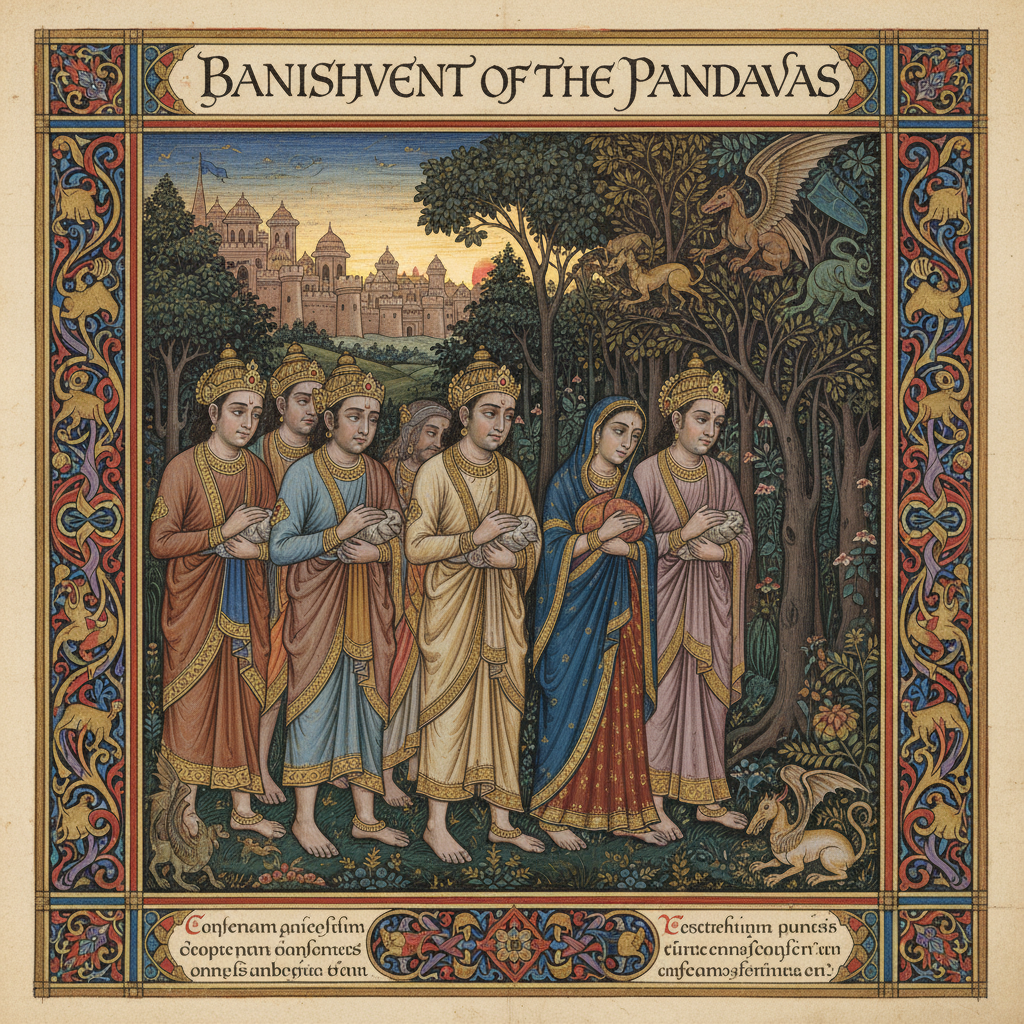
Mahabharata, Sabhaparva and Aranyakaparva. Yudhishthira, eldest of the Pandavas, sits down at the dice game with his cousins the Kauravas. He loses everything: his kingdom, his brothers, himself, his shared wife Draupadi. He is not even playing with the dice — the Kaurava Shakuni is playing for his cousin Duryodhana, and Shakuni never loses.
The terms of defeat: twelve years in the forest, and one year living incognito. If discovered in the thirteenth year, the cycle resets. Twenty-six years in exile for a rigged game.
They go. Five princes and their wife Draupadi, from a palace to the forest, from sovereignty to wandering. The forest years (Aranyakaparva) are among the richest in the Mahabharata: sages, stories, pilgrimages, trials. The incognito year takes them to the kingdom of Virata in disguise — Yudhishthira as a dice teacher, Bhima as a cook, Arjuna as a dance teacher, the twins as a cowherd and horse-master, Draupadi as a maid.
They survive. They are not discovered. They return to claim their kingdom — and Duryodhana refuses.
The Mahabharata war happens because of what happened after the exile, not during it. But the exile is the forging period: Arjuna’s bow skills, Bhima’s strength tested against demons, Yudhishthira’s wisdom deepened by loss, Draupadi’s anger sharpened into something that will not rest until the war is over.
The dice game broke them. The forest made them ready.
Guru Nanak’s Udasis — The Chosen Road
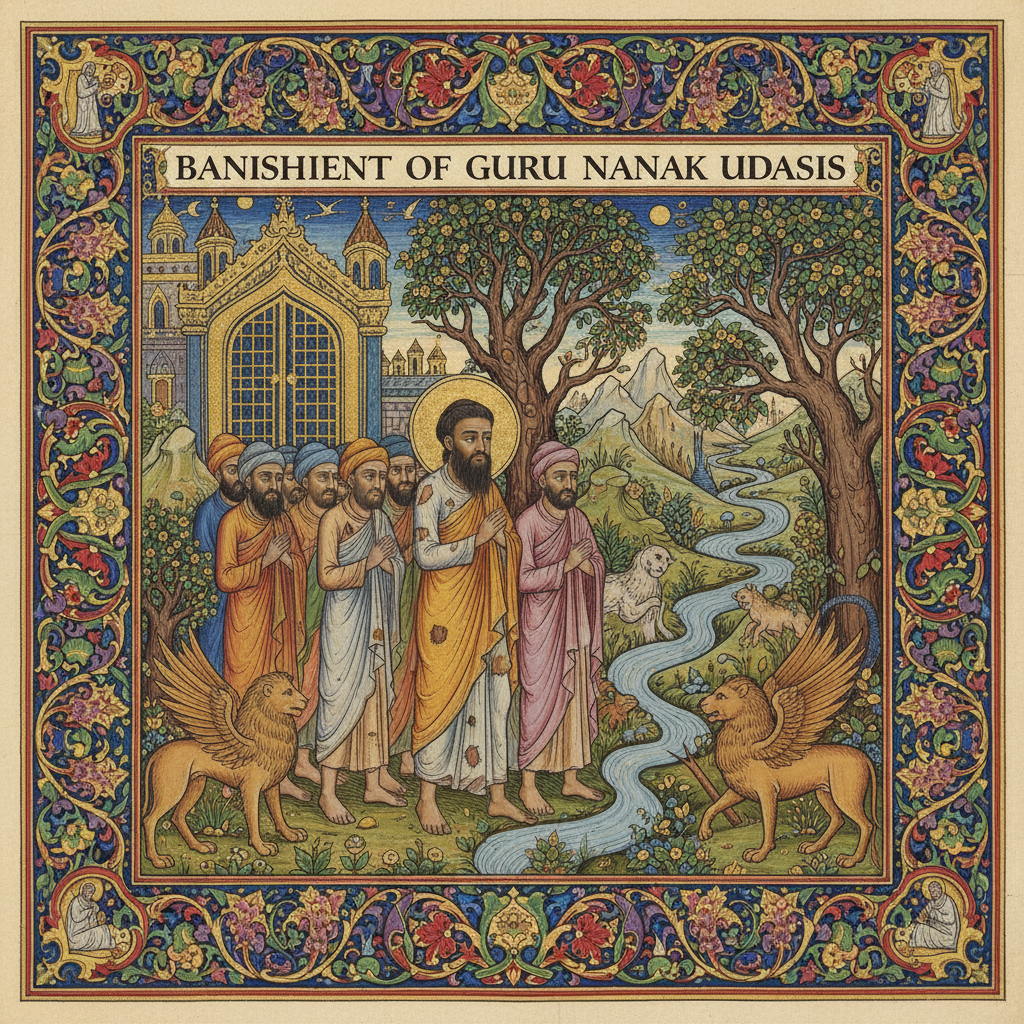
Early 16th century, Punjab. Guru Nanak, founder of Sikhism, had every reason to stay home. He had a family, a position, a community that recognized his gifts. Instead, at approximately thirty years old, after a mystical experience in which he was called into the divine presence, he left.
He said: “There is no Hindu, there is no Muslim.” Then he walked.
The Udasis — the journeys — are four in number and legendary in scope. East to Bengal and the sacred sites of Hinduism. South to Sri Lanka and the Tamil coast. North to Kashmir, Tibet, Mount Meru. West to Mecca, Baghdad, the Muslim world. Twenty-four years of walking, talking, singing, debating — meeting saints and emperors, challenging priests and imams, singing hymns in temples, mosques, and on open roads.
Unlike the other exiles on this list, Nanak was not driven out. He went. The distinction matters. The Udasis were not punishment or persecution — they were vocation. He understood that truth cannot be declared from one place; it has to be carried. The road is not the enemy of the message. The road is how the message spreads.
He returned to Punjab in his mid-fifties and settled in Kartarpur, where he farmed and established a community and died peacefully. The wanderer came home. But the twenty-four years on the road — through every tradition, every climate, every argument — had made him the teacher whose songs still fill the gurdwaras today.
The world is his wandering, preserved in the Guru Granth Sahib.
The Jewish Diaspora — The Longest Exile
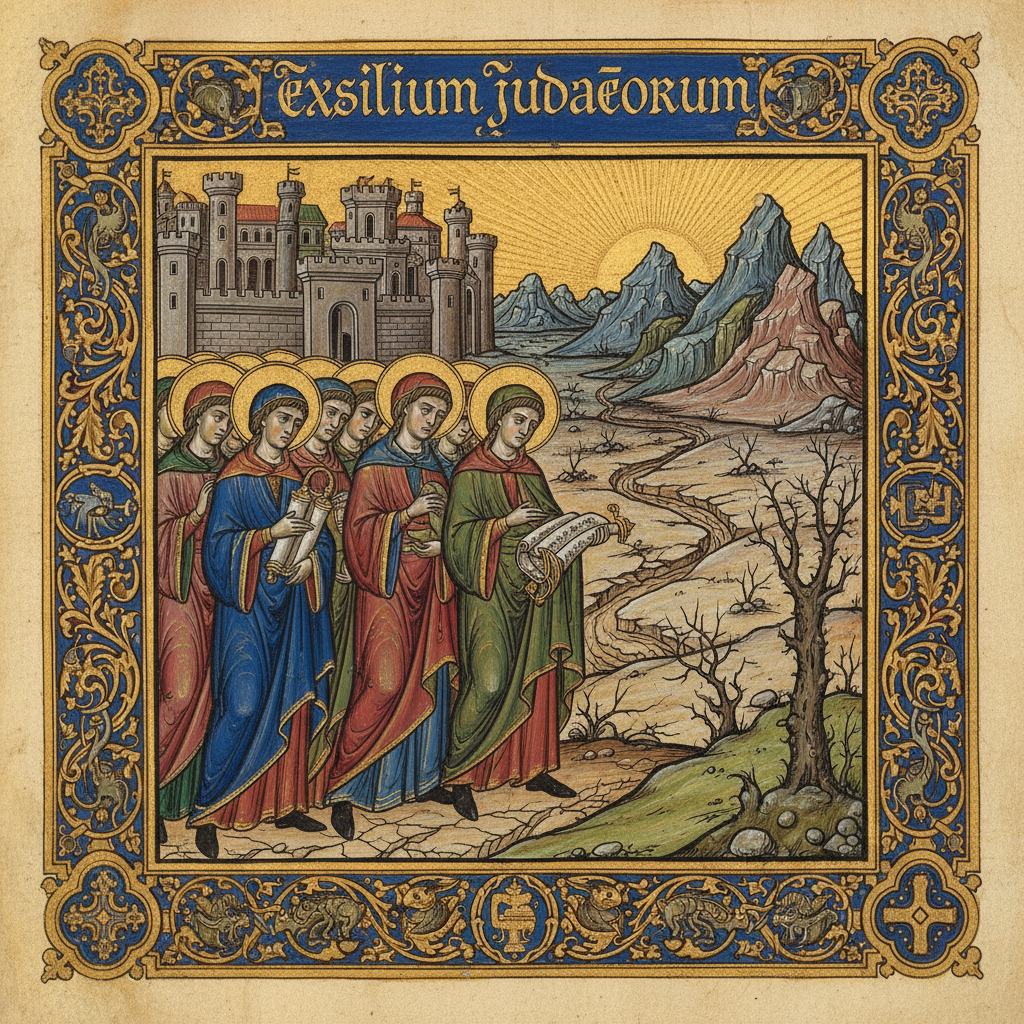
70 CE — 1948 CE. The Roman general Titus destroys the Second Temple. Jerusalem falls. One million Jews die in the siege, by ancient accounts. The rest — the survivors — scatter.
For 1,878 years, the Jewish people have no homeland. They live as minorities in other people’s empires: Rome, Byzantium, the Islamic caliphates, the medieval Christian kingdoms, the Ottoman Empire, the European nation-states. They are expelled from England in 1290, from France in 1306, from Spain in 1492 — the year Columbus sailed. They are ghettoized, pogrommed, restricted, massacred. In the twentieth century: six million murdered systematically.
And yet.
The Talmud. The Mishnah. Rashi. Maimonides. Kabbalah. The entire body of rabbinic literature — the commentary upon commentary upon commentary that constitutes classical Judaism — was produced in exile. Not in Jerusalem, not in the Temple, but in Babylon, in Cairo, in Toledo, in Vilna, in Amsterdam.
The religion that the rabbis built in exile was more durable than the Temple it replaced. The Temple could be burned. You cannot burn a tradition that lives in the minds and practices and kitchens and prayers of people who carry it everywhere. The Passover seder — next year in Jerusalem — turned exile into liturgy. It gave people something to say at the table while they waited.
The State of Israel was declared in 1948. After 1,878 years.
No exile in recorded human history is longer. No tradition produced more theological literature, more law, more commentary, more argument, more life while waiting. The diaspora is the longest exile. It is also, in some sense, the most creative.
The wandering did not end the Jewish people. It became them.
See also: The Punishments | The Resurrections | The Visions