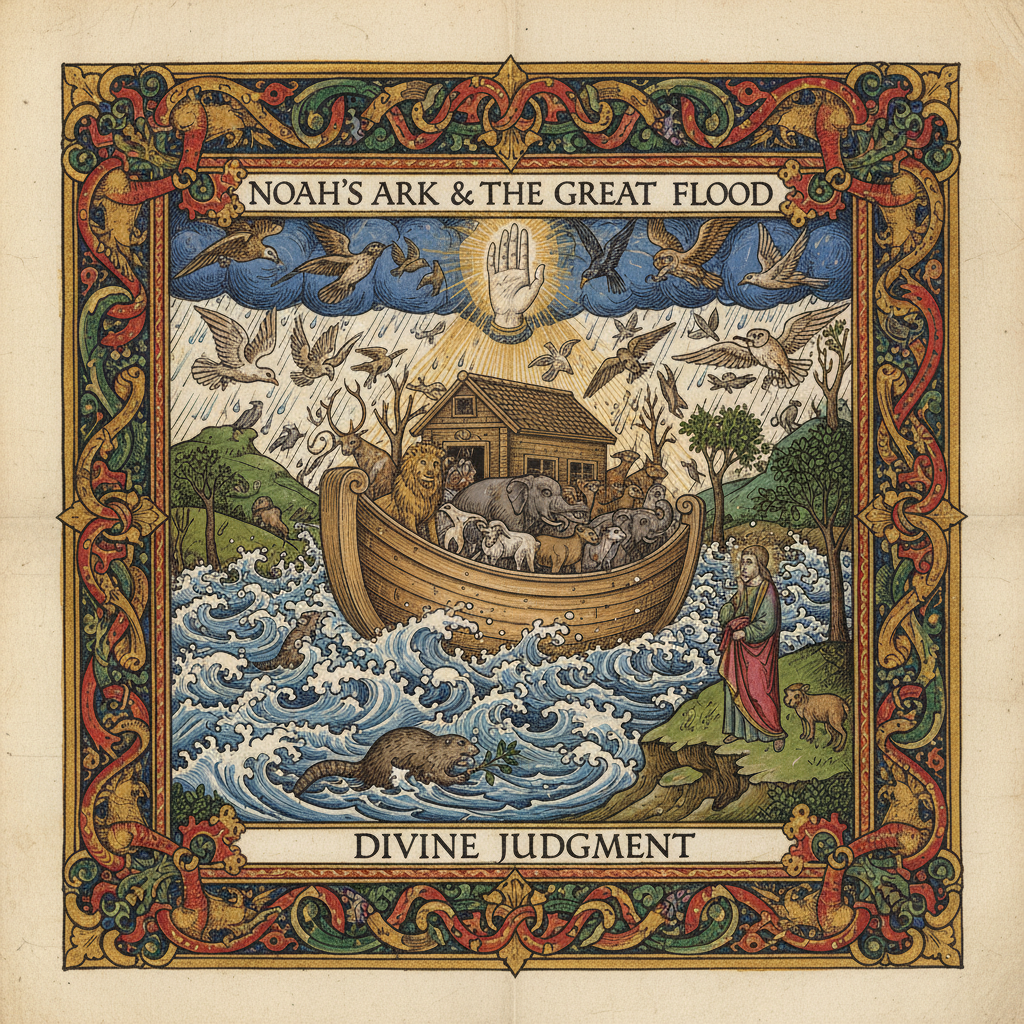
Part of the Bestiary Compendium | See also: Mesopotamian Entities | Parallel Texts
What this document is: A verse-by-verse forensic comparison of the great flood narratives across seven traditions. Not summaries. Not “this is similar to that.” The actual words, placed side by side, analyzed for structural, theological, and cultural divergence. Seven civilizations, one catastrophe — or one archetype of catastrophe — filtered through seven entirely different understandings of what a god wants from humanity.
The Seven Traditions
| Tradition | Flood Hero | Vessel | Divine Agent | Estimated Date |
|---|---|---|---|---|
| Sumerian | Ziusudra | A great boat | Enki / An (Anu) | ~1600 BCE (Eridu Genesis) |
| Babylonian | Atrahasis | A multi-decked boat | Enlil (destroys) / Enki (saves) | ~1700 BCE (Atrahasis Epic) |
| Mesopotamian/Gilgamesh | Utnapishtim | Cube-shaped boat, 120 cubits | Enlil (destroys) / Enki (saves) | ~1100 BCE (Gilgamesh Tablet XI) |
| Biblical | Noah | Rectangular ark, 300 × 50 × 30 cubits | YHWH | ~6th–5th c. BCE (Genesis 6–9) |
| Hindu | Manu | A great ship towed by a divine fish | Matsya (Vishnu avatar) | ~800 BCE (Shatapatha Brahmana) |
| Greek | Deucalion & Pyrrha | A chest/ark (larnax) | Zeus (destroys) / Prometheus (warns) | ~700 BCE (Hesiod); ~8 CE (Ovid) |
| Ojibwe/Anishinaabe | Waynaboozhoo | A raft/floating log | Mishibizhiw (underwater spirits) | Oral tradition; pre-contact |
| Chinese | Gun (father) → Yu (son) | No boat — channels and dredges | Jade Emperor / Heavenly order | ~2300 BCE mythological; texts ~300 BCE |
Scholarly Positions
| Position | Who Holds It | Argument |
|---|---|---|
| Mesopotamian origin of Genesis | Andrew George, W.G. Lambert, many critical scholars | Genesis is a deliberate theological rewrite of the Mesopotamian tradition; structural parallels are too precise and sequential to be independent |
| Common cultural heritage | Mark Smith, John Day, others | All Near Eastern flood texts share the Fertile Crescent milieu; literary dependence need not explain all parallels — shared oral tradition may |
| Polythetic myth category | Joseph Fontenrose, Carl Olson | Flood myths worldwide share ~8 common features because they encode a universal human cognitive response to catastrophic inundation events |
| Geological memory | William Ryan and Walter Pitman | The Black Sea flood hypothesis (~5600 BCE) may underlie Near Eastern flood narratives as preserved cultural memory of a real event |
| Deliberate polemic | John Walton, Kenneth Kitchen | Genesis rewrites Mesopotamia specifically to correct its theology — one god, not many; moral cause, not noise; covenant, not afterthought |
| Independent parallel evolution | Some scholars of indigenous traditions | Ojibwe, Chinese, and other non-Near Eastern traditions are not derived from Mesopotamia — they reflect independent responses to local flooding events and cosmological concerns |
Primary sources used in this document:
- Stephanie Dalley, Myths from Mesopotamia (Oxford University Press, 2008)
- W.G. Lambert & A.R. Millard, Atrahasis: The Babylonian Story of the Flood (Eisenbrauns, 1999)
- Andrew George, The Babylonian Gilgamesh Epic (Oxford University Press, 2003)
- N.K. Sandars, The Epic of Gilgamesh (Penguin Classics, 1972)
- Julius Eggeling (trans.), Shatapatha Brahmana (Sacred Books of the East, 1882)
- Wendy Doniger O’Flaherty, Hindu Myths (Penguin Classics, 1975)
- Ovid, Metamorphoses (trans. A.D. Melville, Oxford World’s Classics, 1986)
- A. Irving Hallowell, “Ojibwa Ontology, Behavior, and World View,” Culture in History (1960)
- Anne Birrell, Chinese Mythology: An Introduction (Johns Hopkins University Press, 1993)
I. The Divine Decision to Destroy
The first question in any flood narrative: why? The answer defines the entire theology of each tradition.
Atrahasis Tablet I (~1700 BCE) (trans. Dalley)
The land grew wide, the people multiplied,
The land was bellowing like a bull.
The god grew restless at their noise.
Enlil heard their clamour
And addressed the great gods:
“The noise of mankind has become too much,
I am losing sleep over their racket.”
Gilgamesh Tablet XI, lines 12–18 (trans. Dalley)
The hearts of the Great Gods moved them to inflict the Flood.
Their Father Anu uttered the oath of secrecy.
Valiant Enlil was the counsellor,
Their throne bearer was Ninurta,
Their canal-officer Ennugi.
(The Gilgamesh version omits the specific reason — the gods simply decide. The narrative has moved past explanation into event.)
Genesis 6:5–7 (ESV)
The LORD saw that the wickedness of man was great in the earth, and that every intention of the thoughts of his heart was only evil continually. And the LORD regretted that he had made man on the earth, and it grieved him to his heart. So the LORD said, “I will blot out man whom I have created from the face of the land, man and animals and creeping things and birds of the heavens, for I am sorry that I have made them.”
Shatapatha Brahmana 1.8.1 (trans. Eggeling)
(The Hindu Manu story does not frame the flood as divine punishment but as a coming catastrophe — Manu alone must survive to repopulate the world. The fish speaks:)
“I am the fish that will rescue you from the flood; for in such and such a year the great deluge will come. When the flood approaches, thou shalt enter into a ship.”
Norse Mythology: Ragnarok
In the final days, the ice will melt and the earth will sink into the sea, only to rise again from the waves, fertile and green, ready for new life to begin.
(Norse eschatology envisions the world destroyed by fire and water, yet renewal follows.)
Ovid, Metamorphoses 1.253–261 (trans. Melville)
Jupiter then spoke: “Lay not your fears aside.
Already most of it has been destroyed
By my provision; but the rest I’ll cleanse
By water-flood. I’ll overwhelm the earth
With my great sea, and every race of men
Beneath the waves.” He moved the rains together:
Notus was loosed, who flies with dripping wings
And hides his ghastly face in deepest gloom.
(Ovid’s version: Jupiter is disgusted by the cannibal-king Lycaon, who tries to feed human flesh to Jupiter in disguise. Humanity’s moral corruption is revealed by a single atrocity, and the decision is made.)
Ojibwe (Anishinaabe) Oral Tradition
(The structure differs fundamentally. The flood is not a divine punishment but an act of vengeance by the underwater spirits — Mishibizhiw and the Underwater Panthers — against Waynaboozhoo after he kills the king of the underwater spirits to avenge his wolf companion Manoominike.)
The water spirits heard that Waynaboozhoo had killed the great Mishibizhiw. The sea rose to punish him. The waters climbed toward the sky.
(The cause here is not human wickedness but the consequence of a world-conflict between sky powers and underwater powers — a structural opposition fundamental to Ojibwe cosmology that has no equivalent in the Near Eastern traditions.)
Chinese: Gun-Yu Tradition (Anne Birrell, Chinese Mythology)
(The Chinese flood tradition inverts the Near Eastern framework entirely. The flood is not a punishment by a deity — it is a natural catastrophe that the gods have failed to prevent. The story is about human engineering and governance.)
In the time of the Emperor Yao, the flood waters overran the sky. They were vast and wide, embracing the hills and rising above the mountains. The people below were in distress.
(The Jade Emperor commissions Gun — and later Yu — not to survive the flood but to control it. The flood is a problem to be solved, not a judgment to be endured.)
Comparative Analysis: The Divine Decision
The forensic contrast here is absolute.
-
Mesopotamian versions (Atrahasis, Gilgamesh): The flood is decided by a council of gods, at least one of whom regrets the decision. Enlil’s motive in Atrahasis is not moral outrage — it is sleep deprivation. Humanity is too loud. This is a utilitarian management decision by a divine bureaucracy.
-
Genesis: One God acts alone, with full moral authority and full regret. The cause is not human noise but human wickedness. “Every intention of the thoughts of his heart was only evil continually.” This is a judicial decision by a judge who finds the judgment grievous. The transformation from Atrahasis to Genesis converts a problem of divine comfort into a problem of human sin.
-
Hindu (Manu): There is no wrath. The flood is cosmological inevitability — one epoch ends, another begins. Manu is preserved not because he is the sole righteous man in a wicked world, but because he is the man who listens to the divine warning and acts wisely. Obedience and prudence, not righteousness alone, are his salvation.
-
Greek (Deucalion): Zeus’s motivation is closer to Genesis than Atrahasis — he is morally offended. But the evidence is local (Lycaon’s cannibalism) rather than universal. The Greek tradition maintains the theological framework (divine punishment for human wickedness) while stripping away the Semitic structure of a sustained, pervasive moral corruption.
-
Ojibwe: No punishment of humanity at all. The flood is a cosmic conflict that catches humans in the middle. Human survival depends not on righteousness or obedience but on kinship relationships and the willingness of other creatures to sacrifice themselves.
-
Chinese: The flood has no moral cause. It is a crisis of governance. The question is not “who deserves to survive?” but “who can fix this?” The entire narrative concerns itself with engineering competence, not personal holiness.
II. The Warning / The Chosen One
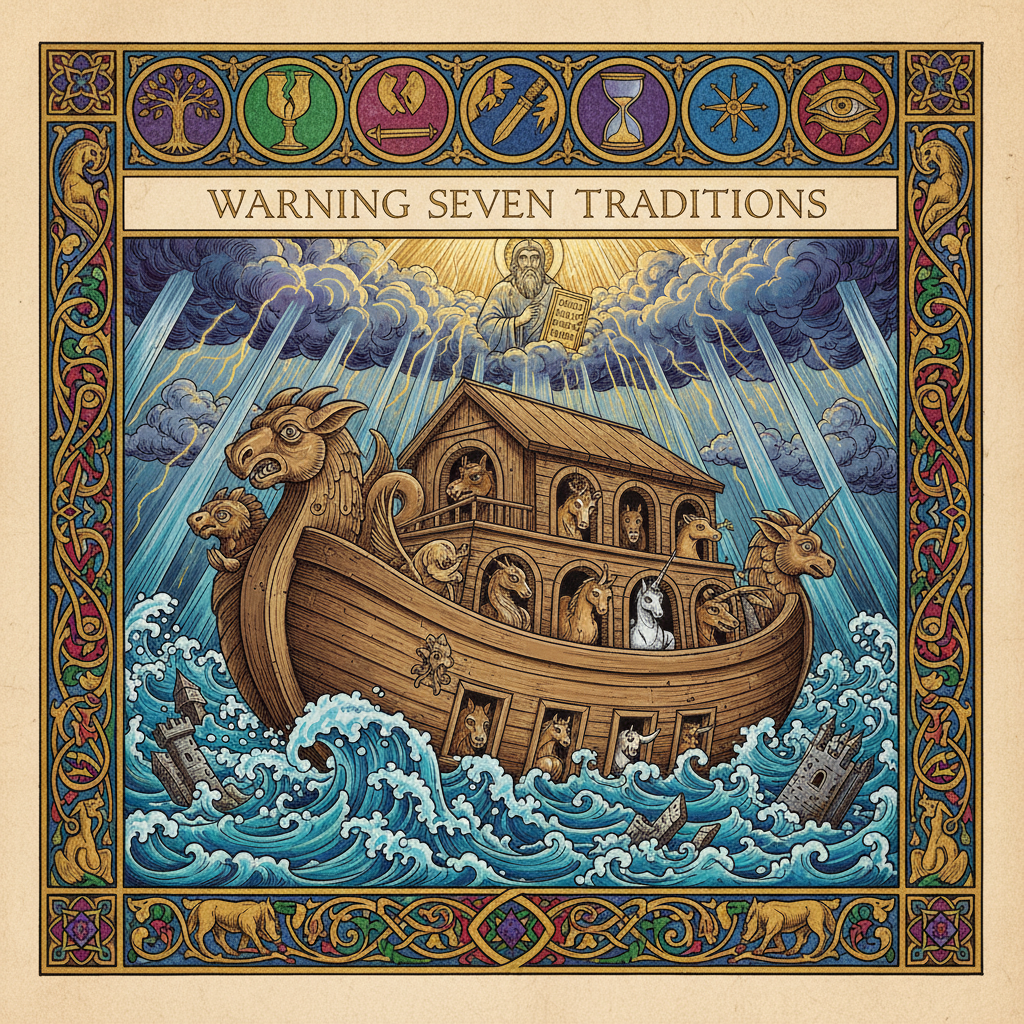
The second question: why does anyone survive? Each tradition’s answer reveals what it values most.
Atrahasis III.i.17–23 (trans. Lambert & Millard)
Atrahasis opened his mouth
And addressed his lord:
“Tell me the meaning of the dream, so that I may understand it.”
Enki spoke to him in a dream,
Speaking to a reed wall:
“Wall, listen to me!
Reed fence, listen to all my words!
Demolish the house, build a boat,
Reject possessions, seek life.”
Gilgamesh Tablet XI, lines 19–32 (trans. George)
“Man of Shuruppak, son of Ubar-Tutu,
Tear down your house and build a boat!
Abandon wealth and seek out living things!
Spurn property, save life!
Take on board the boat all living things’ seed.
The boat you will build —
Her dimensions shall be equal to each other:
Her length and breadth shall be the same.
Cover her with a roof, like the Apsû.”
(Enki cannot warn Utnapishtim directly — he swore an oath to the divine council not to reveal their plan to any mortal. He speaks to a reed wall. Utnapishtim listens from the other side. Divine obligation is preserved; humanity is saved. The oldest legal loophole in recorded literature.)
Genesis 6:9, 13–14 (ESV)
These are the generations of Noah. Noah was a righteous man, blameless in his generation. Noah walked with God.
…
And God said to Noah, “I have determined to make an end of all flesh, for the earth is filled with violence through them. Behold, I will destroy them with the earth. Make yourself an ark of gopher wood.”
(No oath constrains YHWH. No council has bound him. He speaks directly, without subterfuge, because there is only one divine will. The mechanism that created Enki’s loophole — a plurality of gods with competing obligations — is theologically impossible in Genesis.)
Shatapatha Brahmana 1.8.1.2–4 (trans. Eggeling)
In the morning they brought Manu water for washing, just as now they bring water for washing hands. When he was washing himself, a fish came into his hands. And it spoke this word to him: “Rear me, I shall save thee.” “Wherefrom wilt thou save me?” “A flood shall carry away all these creatures: from that I will save thee.” “How am I to rear thee?”
(The warning here is direct, personal, and incremental — Manu’s response is not to gather wood but to nurture a growing fish. Salvation is relational. The fish grows from a small creature that fits in a jar to a vast ocean creature. Manu has literally raised his own salvation.)
Ovid, Metamorphoses 1.316–324 (trans. Melville)
There was a man, Deucalion, and his wife,
Of all mankind the best in goodness, none
More just, none fonder of the gods than these.
When Saturn’s son saw that the world was drowned
With water everywhere, one man alone
Remaining from that multitude of men,
One woman too remaining, both so guiltless,
He tore the clouds apart and let the north winds blow.
(In Ovid, Prometheus has warned his son Deucalion in advance — the warning occurs off-stage, implied in the preparation. What Ovid emphasizes is the character of the survivors: guiltless, just, devoted to the gods. Worthiness, not advance notice, is the criterion.)
Ojibwe Oral Tradition
Waynaboozhoo climbed onto a great log and floated upon the rising waters. He did not know how long he would float or what would remain. But his relations — the animals, his brothers and sisters — came to him on the waters.
(There is no warning in the Ojibwe tradition. Waynaboozhoo survives because he is already in conflict with the forces that sent the flood — he fights, then floats. His survival is not a reward for righteousness but a consequence of being who he already is. And crucially: the animals come to him.)
Chinese: Gun-Yu Tradition
The Emperor Yao surveyed the great flood and found none who could control it. He was told of Gun, who had the power to stop the waters. Gun stole the Xirang — the miraculous growing soil — from Heaven and tried to dam the flood.
(No individual is warned and no individual survives alone — there is no single chosen survivor in the Chinese tradition. Gun’s “vessel” is not a boat but stolen divine technology. His failure leads to his execution. The story then passes to his son Yu, who succeeds not through divine favor but through years of exhausting physical labor and a fundamentally different strategy: working with the water, not against it.)
Comparative Analysis: The Chosen One
What criterion selects the survivor?
| Tradition | Why This Person? |
|---|---|
| Atrahasis | Enki’s favorite; exceedingly wise |
| Gilgamesh/Utnapishtim | Enki bends divine oath on his behalf; no moral explanation |
| Genesis/Noah | ”Righteous and blameless” — explicit moral selection |
| Hindu/Manu | Responsive to the divine warning; obedient and attentive |
| Greek/Deucalion | ”Best in goodness” and “just” — closest to Genesis moral selection |
| Ojibwe/Waynaboozhoo | Already in conflict; survives because of who he is, not reward |
| Chinese/Gun-Yu | Competence is the criterion — first the one who tries, then the one who succeeds |
The Mesopotamian version is remarkably non-moral: Utnapishtim survives because Enki likes him. Genesis is the most explicitly moral version. The Greek and Hindu versions represent intermediate positions. The Ojibwe and Chinese traditions are orthogonal to the entire moral framework.
III. The Vessel
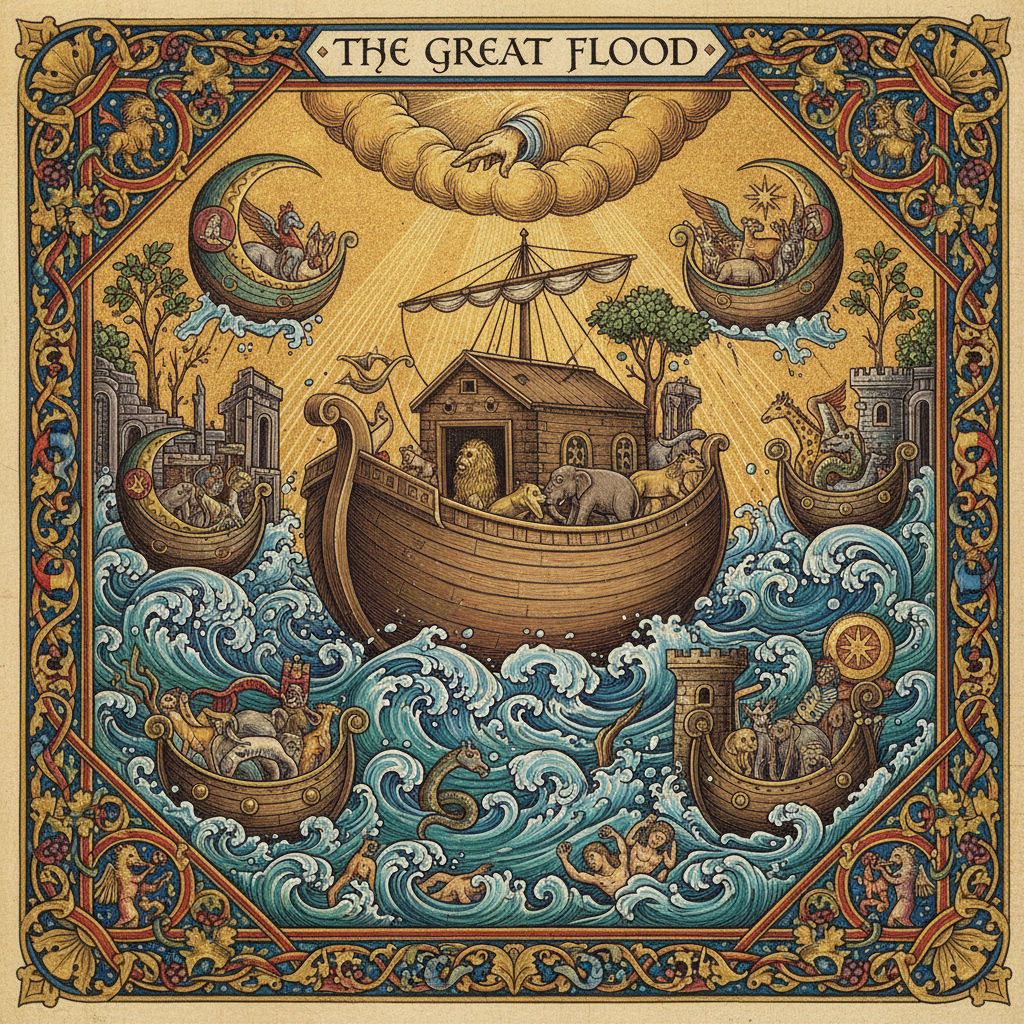
The physical specifications — when they exist — reveal the cosmological assumptions behind each tradition.
Gilgamesh Tablet XI, lines 54–65 (trans. George)
I laid out the shape of her body.
Six sar (acres) was her area, ten dozen cubits the height of each of her walls,
Ten dozen cubits square, her upper deck.
I gave it six decks, divided it into seven,
Divided its interior into nine.
I drove water-plugs into it,
I saw to the punting poles and laid in what was needed.
Three sar of bitumen I poured into the kiln,
Three sar of pitch I poured inside.
The Gilgamesh boat: A perfect cube — 120 × 120 × 120 cubits (~60 meters on each side). This is architecturally bizarre: a cube is the worst possible shape for ocean-going stability. It would spin and roll in open water. Scholars read this as deliberate symbolism: the cube is the shape of sacred space in Mesopotamian cosmology (the cella, the holy of holies in the temple). Utnapishtim builds not a ship but a floating temple.
Genesis 6:15–16 (ESV)
“This is how you are to make it: the length of the ark three hundred cubits, its breadth fifty cubits, and its height thirty cubits. Make a roof for the ark, and finish it to a cubit above, and set the door of the ark in its side. Make it with lower, second, and third decks.”
Noah’s ark: 300 × 50 × 30 cubits — a ratio of 10:1.67:1. This is, notably, a hydrodynamically functional shape. Scale models built to these dimensions exhibit stability properties consistent with ocean-going vessels. The Genesis vessel is longer and lower than the Mesopotamian cube, better suited to actual survival at sea. The theological contrast is precise: the Mesopotamian vessel is a sacred box, oriented toward the divine; the Genesis vessel is a functional survival craft, oriented toward continuation of life.
Shatapatha Brahmana 1.8.1.8 (trans. Eggeling)
Manu then built a ship; and when the flood rose, he tied the rope of the ship to the horn of the fish. By that rope he passed over this northern mountain.
Manu’s ship: No dimensions given. The vessel matters far less than the fish who tows it. The ship is essentially passive — it goes where the fish leads. This is consistent with the Hindu theological framework: Manu’s survival is not an act of engineering but an act of devotion and relationship. He built the ship, yes, but the fish does the work. Salvation comes from aligning with divine power, not from the quality of your boat.
Ovid, Metamorphoses 1.317–320 (trans. Melville)
Deucalion and his wife found refuge in a small vessel and came to rest on Parnassus, when all else was overwhelmed.
Deucalion’s vessel: Translated variously as a “chest,” “larnax” (coffin-box), or small boat. Apollodorus calls it specifically a larnax — the same word used for a funeral chest. Deucalion survives the flood inside what amounts to a coffin, and emerges from it alive. This is a resurrection symbol deeply embedded in the Greek version: the flood is a death; emergence from the chest is a birth. His landing on Parnassus echoes the Mountain of the Muses — the creative center of civilization. Deucalion doesn’t just survive; he is reborn at the birthplace of human culture.
Ojibwe/Waynaboozhoo
There was no boat. There was a log. Waynaboozhoo floated on the log with the animals who came to him, and they were as close together as family in the night.
The raft: Not built but found. The vessel is not planned but improvised. This matters: the Ojibwe tradition is not about preparation for disaster but response to disaster. Waynaboozhoo does not know the flood is coming. He finds a log. The animals come to him. Community is formed not by a chosen builder but by proximity on the waters. The “vessel” is not a physical shelter from the flood — it is a social node around which the surviving community of beings assembles.
Chinese: Gun-Yu Tradition
No vessel. This is the single most significant divergence from all other flood traditions. The Chinese flood hero does not build a boat. He tries to stop the water entirely. Gun attempts to block the flood with the magical Xirang (self-expanding soil stolen from heaven). He fails. Yu, his son, instead excavates drainage channels, dredges rivers, opens paths for the water to flow to the sea. He tames the flood not by escaping it or floating over it but by reorganizing the landscape so water finds its natural course. He works thirteen years. He passes his own home three times without going in. The Chinese flood is a story of infrastructure, governance, and environmental engineering — not theology.
IV. The Flood Itself
Duration Comparison
| Tradition | Storm/Flood Duration | Waters Prevail | Total |
|---|---|---|---|
| Atrahasis | 7 days and 7 nights | — | 7 days |
| Gilgamesh | 6 days and 7 nights | — | 7 days |
| Genesis (J source) | 40 days rain | 150 days water | ~1 year total |
| Hindu/Manu | Unspecified | — | — |
| Greek/Deucalion | 9 days and 9 nights (Ovid) | — | 9 days |
| Ojibwe | Unspecified | — | — |
| Chinese | 9+ years of flooding | Controlled over 13 years | ~22 years |
The 7-day duration in Atrahasis and Gilgamesh is almost certainly connected to the sacred 7-day week and the number’s Mesopotamian cosmological significance. Genesis’s 40 days carries its own Hebrew symbolic weight (40 years in the wilderness, 40 days of Moses on Sinai). The numbers are theological, not meteorological.
The Chinese tradition again inverts everything: the flood lasts not days but decades. This is not a crisis of days but a generational challenge. Civilization itself is defined by the response.
The Intensity: Gilgamesh Tablet XI, lines 108–127 (trans. George)
For one day the south wind blew, gathering speed as it went, submerging the mountains,
overwhelming the people like an attack.
No-one could see his fellow, they could not recognize each other in the catastrophe.
The gods were frightened by the Flood,
And retreated, they climbed to the heaven of Anu.
The gods were cowering like dogs, crouching against the outer wall.
Ishtar shrieked like a woman in labour.
The Lady of the Gods wailed:
“The olden days have alas turned to clay,
Because I commanded evil in the assembly of the gods.”
The gods are terrified of their own decision. This detail has no parallel in Genesis. YHWH is not frightened by the flood he sends. The Mesopotamian version reveals a cosmos in which the gods’ power is limited — they can unleash forces they cannot stand to witness. Ishtar’s confession — “I commanded evil” — is a moment of divine moral accountability that Genesis, with its single omnipotent deity, makes structurally impossible.
Genesis 7:17–24 (ESV)
The flood continued forty days on the earth. The waters increased and bore up the ark, and it rose high above the earth. The waters prevailed and increased greatly on the earth, and the ark floated on the face of the waters. And the waters prevailed so mightily on the earth that all the high mountains under the whole heaven were covered.
Genesis is characteristically restrained. Where Gilgamesh gives us the gods cowering like dogs, Genesis gives us measured prose. The flood does not terrify God. It executes his decision. The tone is judicial, not dramatic.
V. Testing for Dry Land: The Birds
This is the most forensically significant parallel in the flood traditions. The sequence of birds sent to find dry land appears in two versions — one Mesopotamian and one Biblical — with remarkable structural overlap.
Gilgamesh Tablet XI, lines 145–155 (trans. George)
When the seventh day arrived,
I put out and released a dove.
The dove went; it turned back,
For no perching place was visible to it, and it turned round.
I put out and released a swallow.
The swallow went; it turned back,
For no perching place was visible to it, and it turned round.
I put out and released a raven.
The raven went, it saw the waters receding,
And it ate, it scratched, it preened, and it did not turn round.
Order: Dove → Swallow → Raven. All three return except the final one. Dry land detected by the raven’s non-return.
Genesis 8:6–12 (ESV)
At the end of forty days Noah opened the window of the ark that he had made and sent forth a raven. It went to and fro until the waters were dried up from the earth. Then he sent forth a dove from him, to see if the waters had subsided from the face of the ground. But the dove found no place to set her foot, and she returned to him to the ark…
He waited another seven days and again sent forth the dove out of the ark. And the dove came back to him in the evening, and behold, in her beak was a freshly plucked olive leaf. So Noah knew that the waters had subsided from the earth. Then he waited another seven days and sent forth the dove, and she did not return to him anymore.
Order in Genesis: Raven → Dove (returns) → Dove (returns with olive branch) → Dove (doesn’t return). Note that the raven is sent first here, unlike Gilgamesh. The dove appears three times. The olive branch — one of the most famous symbols in Western civilization — appears only in Genesis and has no Mesopotamian counterpart.
Forensic significance: The bird test appears in Gilgamesh ~1000 years before the final redaction of Genesis. The parallel is undeniable. But the reordering is deliberate: Genesis elevates the dove, making it the symbol of completion and peace, while the raven (sent first) fades into background narrative. The Mesopotamian version has the raven as the climactic bird; Genesis reassigns the climax to the dove with the olive branch. This is not borrowing — this is editing with intent.
Ojibwe: The Muskrat
No birds. The Ojibwe version has no bird test — it has something more remarkable. Waynaboozhoo sends animals to dive for earth, not to search for dry land. The flood has covered everything. There is no high ground. The world must be remade, not rediscovered.
Waynaboozhoo called to his animal relations: “Who will dive for earth?” The Loon dove; it came up empty. The Otter dove; it came up empty. The Muskrat dove. A long time passed. They thought it had died. But when it surfaced, there was earth in its paw. A single grain of earth. The Muskrat had died in the attempt, but its paw opened on the surface with mud.
The muskrat’s sacrifice is the creation event. The Great Turtle offers its shell as the foundation. The grain of mud grows into the whole continent — Turtle Island. The Ojibwe flood myth is not a survival story. It is a creation story. The flood is not the end of a corrupt world but the occasion for building a new one.
This is the most theologically distinct of all seven traditions. The other traditions assume the world survives the flood. The Ojibwe tradition assumes the world is recreated through it.
VI. The First Act After the Flood
What the survivors do first tells us what each tradition thinks civilization is built on.
Gilgamesh Tablet XI, lines 155–166 (trans. Dalley)
I put out and sacrificed.
I scattered offerings on the peak of the mountain.
Seven and again seven cult vessels I set up.
I heaped up reed and cedar and myrtle in their bowls.
The gods smelled the fragrance,
The gods smelled the sweet fragrance,
The gods crowded like flies around the offering.
The gods gather like flies at the sacrifice. This image — which appears also in Atrahasis — is raw, almost embarrassing in its depiction of the divine: gods rushing toward food like insects. It reveals the Mesopotamian theological assumption that the gods need human sacrifice. Humanity was created partly to feed the gods, and when the flood threatened to eliminate all sacrificial offerings, the gods went hungry. Enlil’s anger at Utnapishtim’s survival is partly wounded pride; but the other gods’ gratitude is also partly hunger satisfied.
Genesis 8:20–21 (ESV)
Then Noah built an altar to the LORD and took some of every clean animal and some of every clean bird and offered burnt offerings on the altar. And when the LORD smelled the pleasing aroma, the LORD said in his heart, “I will never again curse the ground because of man, for the intention of man’s heart is evil from his youth. Neither will I ever again strike down every living creature as I have done.”
Genesis uses the same phrase — “smelled the pleasing aroma” — as the Mesopotamian versions. This is one of the most striking direct verbal parallels in the two traditions. But the result is different: YHWH’s response is a unilateral covenant, not divine food satisfaction. And his reasoning is astonishing — “for the intention of man’s heart is evil from his youth.” The very reason he sent the flood is now the reason he will never send another. Human nature has not changed. The covenant is not conditional on human improvement. It is unconditional mercy offered to the same species whose wickedness prompted the flood.
Shatapatha Brahmana 1.8.1.9–10 (trans. Eggeling)
Then he, wishing to sacrifice, looked around and saw nothing but water. He fished up a butter-dish from out of the water. He offered in it. Thence a woman was produced.
Manu’s first act is sacrifice, and from that sacrifice a woman appears. The first human after the flood is not preserved but created. This is a significant departure from all Near Eastern versions, in which the saved humans are a pre-flood couple or family. Manu begins with sacrifice and civilization is created through it — including his partner. The Hindu tradition uses the flood as a cosmological reset that produces a new humanity through ritual.
Greek: Ovid, Metamorphoses 1.379–383 (trans. Melville)
Deucalion prayed, “If the gods’ will and wrath are pacified, if now the power of fire divine is soothed, then show us, Themis, how to mend the ruined race and bring your aid to waters overwhelmed.”
Themis answered: “Go, veil your heads and throw your great mother’s bones behind your back.”
The repopulation method is the most unique feature of the Greek version. Deucalion and Pyrrha don’t have children the conventional way — they throw stones over their shoulders, and the stones become people. “Throw your great mother’s bones” — the great mother is Gaia, the earth; her bones are stones. The Greek tradition makes regeneration a sacred act, not a biological process. Humanity is not born from two survivors; it is created from the substance of the earth itself, by two survivors acting under divine instruction.
Chinese: Gun-Yu Tradition
When the waters receded, Yu surveyed the land. He established the nine provinces of China. He assigned each river its path and each mountain its name. He returned to the Emperor and said: “The work is done.”
Yu doesn’t sacrifice. He administers. His first act after taming the flood is not religious but governmental: he creates the political geography of China. The nine provinces, the legendary map of the realm, flow directly from his flood-control work. The flood is the occasion for the organization of civilization. Chinese identity — the territory, the administrative structure, the rivers that define the land — is defined by the flood response. There is no covenant with heaven; there is a mandate — demonstrated by competence.
VII. The Divine Response: Covenant, Immortality, and Aftermath
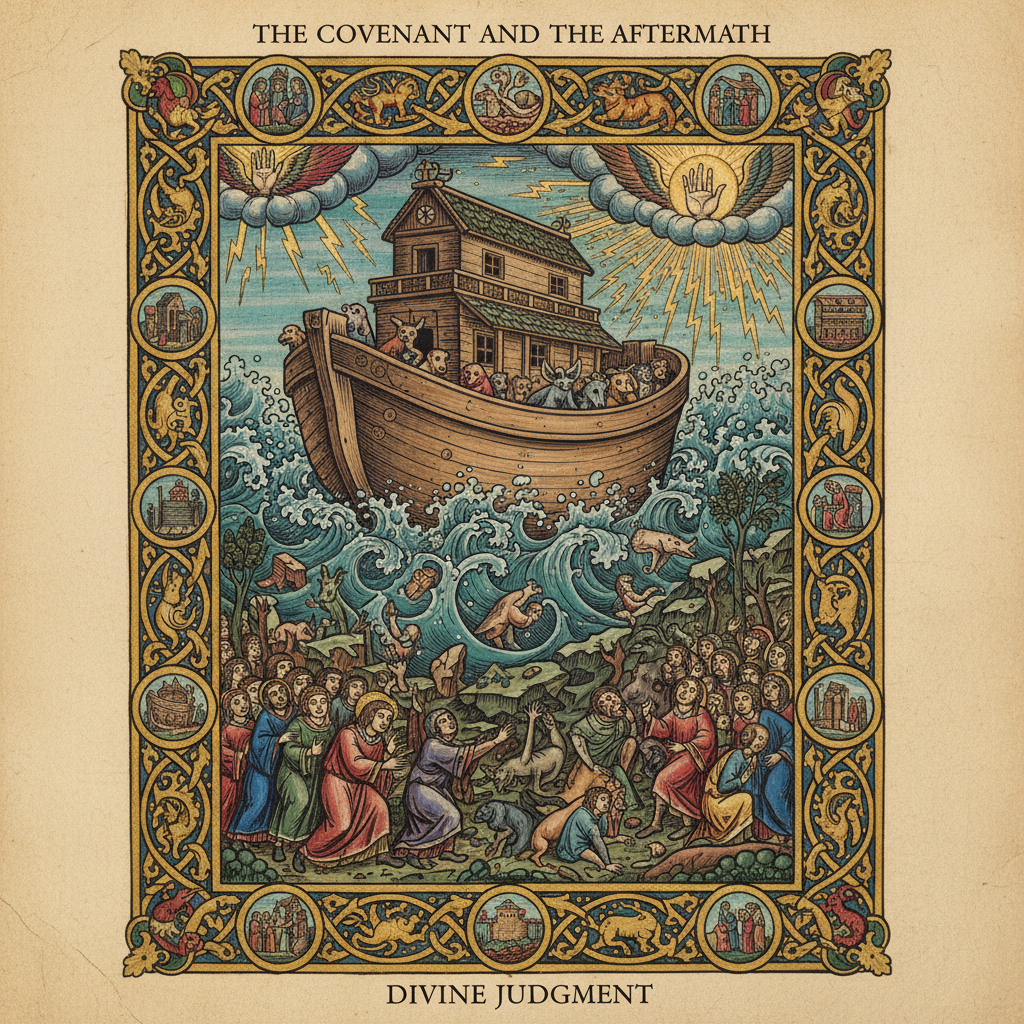
Gilgamesh Tablet XI, lines 187–200 (trans. George)
Enlil arrived and saw the boat.
Enlil was furious! He was filled with anger at the Igigi gods:
“No living being should have survived the destruction!”
Ninurta opened his mouth to speak,
And addressed the warrior Enlil:
“Who other than Enki could have contrived this?
It was Enki who let out the secret…”
Enki opened his mouth to speak:
…
”Now lay upon him his punishment. On Utnapishtim lay his punishment.”
Enlil arrived; he took my hand.
He led me up; he had my wife kneel beside me.
He touched our brows, stood between us, blessed us:
“Until now Utnapishtim had been mortal; now Utnapishtim and his wife shall become like gods.”
Enlil’s fury that anyone survived is remarkable — this is not divine gratitude but divine annoyance at being outsmarted. The immortality granted to Utnapishtim is explicitly a consolation prize, a one-time exception made under social pressure from the other gods. And it comes with a qualification: Utnapishtim and his wife will be removed to the ends of the earth. Their survival is real but their humanity is over. They become a category apart — not dead, not fully alive, not quite divine, not fully mortal. They live at the mouth of the rivers at the edge of the cosmos.
Genesis 9:8–17 (ESV)
Then God said to Noah and to his sons with him, “Behold, I establish my covenant with you and your offspring after you… I set my bow in the cloud, and it shall be a sign of the covenant between me and the earth. When I bring clouds over the earth and the bow is seen in the clouds, I will remember my covenant that is between me and you and every living creature of all flesh.”
The rainbow covenant is the most theologically developed conclusion in all the flood traditions. Three features distinguish it: (1) It is made not just with Noah but with all future generations and all living creatures. (2) The sign is a natural phenomenon reinterpreted — the warrior’s bow hung up, or the storm’s arch, now marks the limit of divine wrath. (3) God “will remember” — a phrase suggesting the covenant is written not on tablets but in the very structure of meteorology. Every rainbow is a reminder that God has bound himself.
Ojibwe: Turtle Island
The Earth grew on the Turtle’s back, spreading outward to the horizon. Waynaboozhoo saw the Earth growing and was glad. He called the animals together and gave thanks.
No covenant, no bow. The aftermath in the Ojibwe tradition is not a promise by a divine power to restrain itself — it is a remaking of the world through animal sacrifice and community. The turtle’s offer is the foundation of all life. The muskrat’s death was the condition. Relationship — between beings, between humans and animals, between the sky world and the water world — is what prevents future catastrophe, not a unilateral divine promise.
The Forensic Summary: Ten Key Beats
| Narrative Beat | Mesopotamian | Genesis | Hindu | Greek | Ojibwe | Chinese |
|---|---|---|---|---|---|---|
| Cause | Divine irritation / noise | Human moral wickedness | Cosmological inevitability | Moral outrage (Lycaon) | Cosmic conflict / vengeance | Natural catastrophe |
| Chosen by | Divine favor | Righteousness | Obedience / wisdom | Goodness | Not chosen — already present | Competence |
| Warning | Indirect (reed wall loophole) | Direct speech | Fish brings warning | Prometheus (implied) | None | Commission from Emperor |
| Vessel | Cube (sacred geometry) | Rectangle (functional) | Ship towed by fish | Chest/coffin (larnax) | Log/raft | No vessel |
| Animal cargo | ”All living things’ seed” | Two of every kind | Seven sages + plant seeds | Not specified | Animals come voluntarily | Not applicable |
| Duration | 7 days | 40 days rain / ~1 year total | Unspecified | 9 days | Unspecified | ~22 years |
| Landing | Mount Nisir | Mountains of Ararat | Northern Mountain / Himalayas | Mount Parnassus | Floating on waters | Not applicable |
| Test for land | Dove, swallow, raven | Raven, dove (×3) | None | None | Muskrat dives for earth | Not applicable |
| First act | Sacrifice (gods gather like flies) | Sacrifice (covenant follows) | Sacrifice (woman created) | Prayer to Themis | Gratitude / earth grows | Administrative geography |
| Aftermath | Immortality (one-time exception) | Rainbow covenant (universal) | First woman created from ritual | Stones become people | Turtle Island created | Nine provinces of China |
VIII. The Scholarly Debate
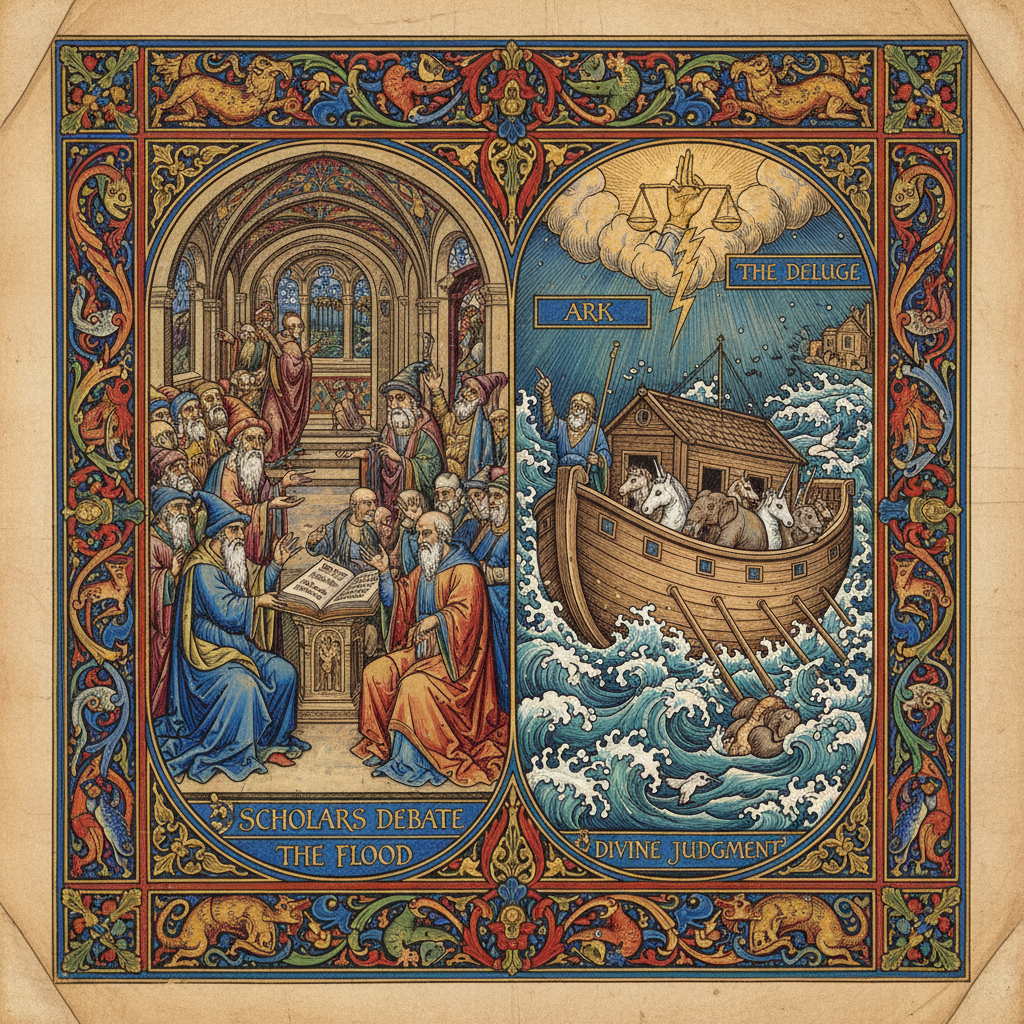
Question 1: Is Genesis literarily dependent on the Mesopotamian versions?
The case for yes (Andrew George, W.G. Lambert, Jeffrey Tigay):
The parallels are not thematic but sequential. Any two flood stories might share the motif of an ark and animals. But Genesis and Gilgamesh share the same sequence: warning → building → loading → flood → birds → mountain → sacrifice → divine response. The order of these elements is preserved across a millennium of transmission. Furthermore, the direct verbal parallel — “smelled the pleasing aroma” / “the gods smelled the fragrance” — represents the kind of specific phrase repetition that points to literary contact, not parallel development.
The Babylonian Exile (586–539 BCE) provides the transmission mechanism. Judean scribal elites in Babylon had direct access to the canonical Babylonian literary tradition. The Epic of Gilgamesh was not obscure — it was read in scribal schools, copied in multiple cities, and had been in circulation for 600 years before the Exile. The Genesis flood narrative, in its current form, almost certainly postdates the Exile.
The case for nuance (John Walton, Gordon Wenham):
Yes, the parallels exist. But the differences are as significant as the similarities — more so, theologically. Genesis has systematically corrected the Mesopotamian version on every major theological point:
- One God replaces many gods.
- Moral judgment replaces divine irritation.
- Direct warning replaces legal loophole.
- Universal covenant replaces one-time exception.
- The ark’s shape is functional, not sacred.
- God is not hungry.
This pattern of correction is too consistent to be accidental. Genesis is not copying Gilgamesh — it is arguing with Gilgamesh. Every major Mesopotamian theological assumption is addressed and inverted. The flood narrative is not borrowing; it is polemic.
Question 2: Do non-Near Eastern flood traditions reflect the same origin or independent development?
The Ojibwe and Chinese traditions share virtually no structural parallels with the Mesopotamian/Biblical family. There is no warned hero, no ark, no bird test, no rainbow covenant. What they share is: a flood, a survivor or group of survivors, and a world that must be reconstituted after the flood. This is either a universal archetype (Fontenrose’s argument) or evidence that flood myths are independently generated by human cultures that live near water and experience catastrophic flooding — which is most human cultures, throughout history.
The strongest version of the geological argument comes from Ryan and Pitman’s Noah’s Flood (1997), which proposes that the Black Sea (then a freshwater lake) was catastrophically inundated by Mediterranean seawater around 5600 BCE. If this event created refugees who spread through the ancient Near East carrying flood memory, it could explain the convergence of Near Eastern flood traditions without requiring literary dependence. The flood would be cultural memory, not literary borrowing.
Question 3: What does the Chinese tradition tell us about flood narrative as a form?
The Gun-Yu tradition is the most clarifying case in comparative flood mythology precisely because it refuses the Near Eastern structure entirely. China had catastrophic floods — the Yellow River has flooded repeatedly throughout Chinese history, causing some of the largest natural disasters in human memory. Chinese civilization was formed in large part around the problem of flood control: irrigation, dikes, canals, river management.
The result is a flood mythology that does not need a boat. The question is not “how do we survive the flood?” but “how do we tame it?” Yu’s success establishes the mandate of heaven not through religious virtue but through demonstrated governmental competence. The Chinese flood myth is a founding myth of the state.
This tells us something about flood myths in general: they encode what a civilization believes about the relationship between humans and chaos. If chaos is divine punishment, you need righteousness to survive it. If chaos is cosmological renewal, you need wisdom and devotion. If chaos is a conflict between cosmic forces, you need community and sacrifice. If chaos is an engineering problem, you need a plan.
IX. The Forensic Verdict
Seven traditions. One catastrophe or one archetype of catastrophe. The parallels between the Mesopotamian and Biblical versions are the product of literary contact — too precise, too sequential, too verbally specific to be explained any other way. Genesis reads Gilgamesh and Atrahasis and rewrites them. Every rewrite is intentional. Every change is theological.
The Hindu, Greek, Ojibwe, and Chinese traditions are not part of this literary family. They are what independent flood mythology looks like — different questions, different answers, different heroes doing entirely different things.
What the cross-cultural comparison finally reveals is not the unity of human flood memory but its diversity of response. Humans have been flooded since before writing. Some prayed. Some built. Some dove for mud. Some dug channels for thirteen years. Some threw stones over their shoulders and waited for people to grow from the ground. Every answer is a philosophy. Every philosophy is a civilization.
The question every flood myth is secretly asking is not “what happened to the world?” but “what are humans for?”
Genesis says: to walk with God.
Gilgamesh says: to die eventually, so enjoy this.
Manu says: to make offerings from which life can be created.
Deucalion says: to repopulate the earth from its own bones.
Waynaboozhoo says: to live in right relationship with every creature who shared the log.
Yu says: to govern the waters.
All of them are right. None of them agree.
Art Gallery
Art Style (All Pieces)
hyper-realistic comparative mythology scene, multiple traditions simultaneously visible, dramatic cinematic composition, oil painting rendering, rich jewel tones and metallic gold, awe-inspiring scale, 8k detail --ar 16:9 --s 750 --v 6.1See full art prompts: EpicArt/FloodComparison/_prompts.md
| # | Image | Scene |
|---|---|---|
| 1 | | The Warning — Seven traditions’ moments of divine communication |
| 2 | | Seven Vessels — The cube, the ark, the fish-towed ship, the chest, the log, and no vessel at all |
| 3 | | The Test for Land — Dove, raven, swallow, and the muskrat who dove to death |
| 4 | | The Aftermath — Rainbow, immortality at the world’s edge, Turtle Island growing |
| 5 | | The Survivors — Utnapishtim, Noah, Manu, Deucalion & Pyrrha, Waynaboozhoo, Yu, assembled |
See also: Parallel Texts: Mesopotamia and the Bible | Mesopotamian Entities | Podcast Episode 1: Why Does Every Culture Have a Flood Story?