Part of the Bestiary Compendium
Every tradition contains mass death. This is not a criticism. It’s a data point.
Sacred texts are not children’s books. They are the collected records of how humanity tried to make sense of reality — including the parts of reality where everything dies. The flood comes. The angel passes. The war ends everything. The fire falls. The traditions looked at these events and asked: what does this mean? This section asks a prior question:
How many?
This is an attempt to compile the body counts of sacred history with the same deadpan seriousness we apply to everything else here. The numbers are often mythological (1.66 billion at Kurukshetra is not a census figure). The sources are ancient. The accounting is imprecise by millennia. We note all of this and continue.
The Cosmic K/D Ratio applies universal justice: no tradition escapes the ledger.
Art style:
hyper-realistic scene of mass divine destruction, overwhelming scale of death and devastation,
dramatic chiaroscuro lighting, the weight of sacred violence made visible,
cinematic composition, oil painting rendering, 8k
The Numbers of the Dead — Ranked by Scale
| Event | Estimated Dead | Perpetrator | Method | Tradition | Source |
|---|---|---|---|---|---|
| Hindu Pralaya | Everything. All universes. Even Brahma. | The cycle itself | Cosmic dissolution | Hindu | Vishnu Purana |
| Ragnarok | Almost all gods AND most of humanity | Mutual annihilation | Fire, flood, combat | Norse | Voluspa |
| The Flood | All of humanity minus 8 (or 1 family) | God / Enlil | Drowning | Biblical / Mesopotamian | Gen 7, Gilgamesh XI |
| Sekhmet’s Rampage | Nearly ALL of humanity | Sekhmet | She just kept going | Egyptian | Book of the Heavenly Cow |
| Revelation (total) | ~50% of humanity (¼ + ⅓ of remainder) | The seals, trumpets, bowls | Everything imaginable | Christian | Revelation 6—16 |
| Kurukshetra | ~1.66 billion (per the text; obviously mythological) | Everyone | 18-day war | Hindu | Mahabharata |
| The Churning (Halahala) | Would have killed everything (averted) | The poison itself | Cosmic toxin | Hindu | Bhagavata Purana |
| Sodom & Gomorrah | Two cities (thousands) | God | Fire and brimstone | Biblical | Genesis 19 |
| Lanka’s Destruction | Ravana’s army (thousands of Rakshasas) | Rama + monkey army | Siege warfare, divine weapons | Hindu | Ramayana |
| The 10th Plague | Every firstborn in Egypt | The Angel of Death / YHWH | Divine visitation | Biblical | Exodus 12 |
| Sennacherib’s Army | 185,000 in one night | One angel | Unknown — they just didn’t wake up | Biblical | 2 Kings 19:35 |
| Elijah’s Aftermath | 450 prophets of Baal | Elijah | Executed after the fire contest | Biblical | 1 Kings 18:40 |
| Samson’s Temple | ~3,000 Philistines + himself | Samson | Structural collapse | Biblical | Judges 16:27-30 |
The Uncomfortable Chart
| Category | Body Count Leader | How They Did It |
|---|---|---|
| Largest single event | The Flood (all life minus 8) | Water |
| Fastest single night | Angel of Death in Egypt (185,000 soldiers) | Unknown — they just didn’t wake up |
| One person, most kills | Samson (~4,000 lifetime total) | Jawbone of a donkey + structural engineering |
| Most disproportionate weapon | Brahmastra (destroys everything, can’t be recalled) | Divine nuclear option |
| Kill that matters most | David (1 stone, 1 giant) | The smallest kill changed history more than any of the above |
| Highest divine body count, single tradition | Biblical YHWH (flood + plagues + army + cities) | Full toolkit |
| Most reluctant perpetrator | Arjuna (killed his own family at Kurukshetra) | Dharma |
| Best excuse | Shiva (killed Kama because Kama interrupted meditation) | Technically justified |
The Scale of Destruction
Tier Ω: Everything Dies
These events don’t have body counts. They have end states.
The Hindu Pralaya
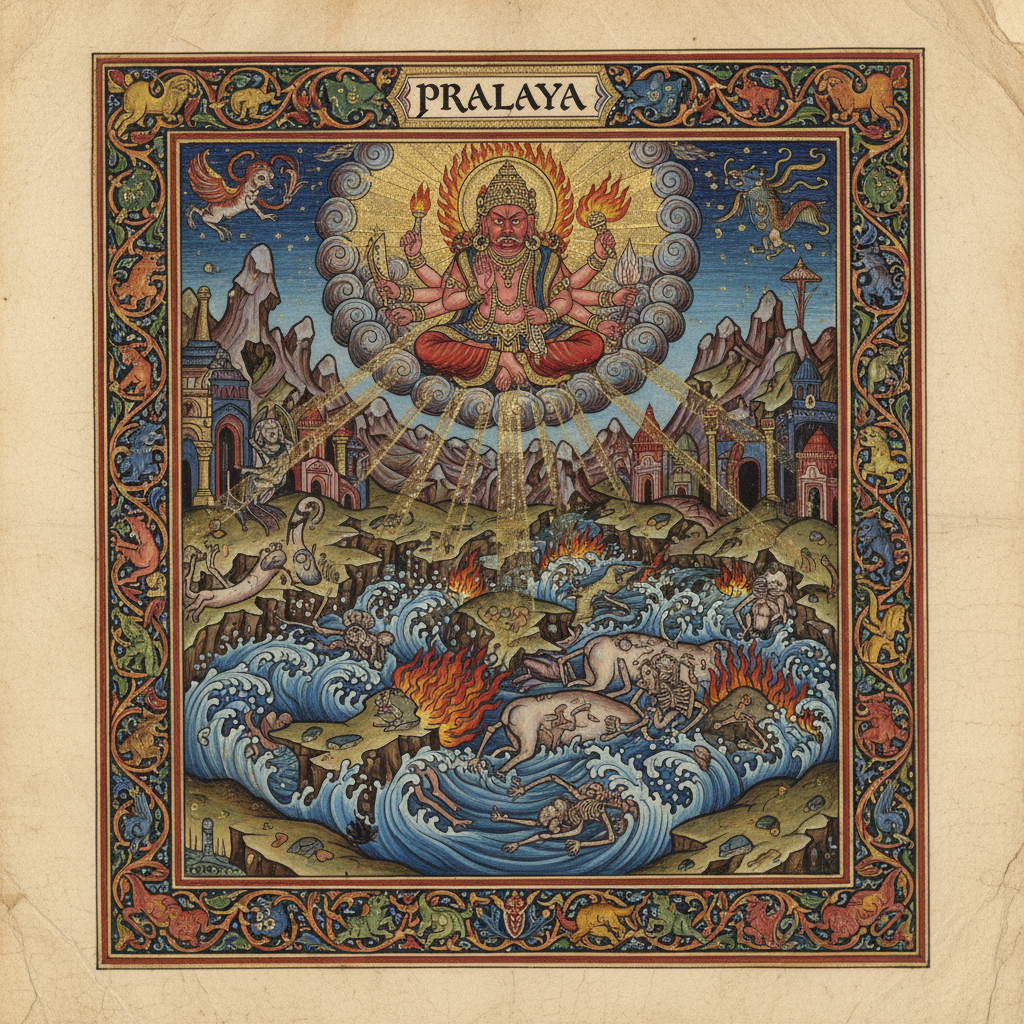
The Pralaya is not a story about catastrophe. It’s a story about structure.
In Hindu cosmology, creation is not a one-time event. Brahma creates a universe. The universe runs through its cycle — four Yugas, from golden to iron, each progressively degraded. At the end of a Kalpa (4.32 billion years), Brahma sleeps. His sleeping is the dissolution of the universe. All life, all worlds, all gods return to the unmanifest. Even Brahma eventually dies — after 100 Brahma-years (311 trillion human years), Brahma himself dissolves back into Vishnu.
Then Vishnu sleeps on the cosmic ocean. Then he wakes. Then Brahma emerges from his navel. Then creation begins again.
The body count is everything. Every sentient being across all universes, in every cycle. The number is infinite, because the cycles are infinite.
The Pralaya is not presented as tragedy. It’s presented as breathing. The universe inhales (creation) and exhales (dissolution) and this has been happening forever and will happen forever. The deaths are real. The grief is, in the cosmic view, the grief of a dream the dreamer is waking from.
This is either the most disturbing thing on this list or the most comforting. Possibly both.
Ragnarok
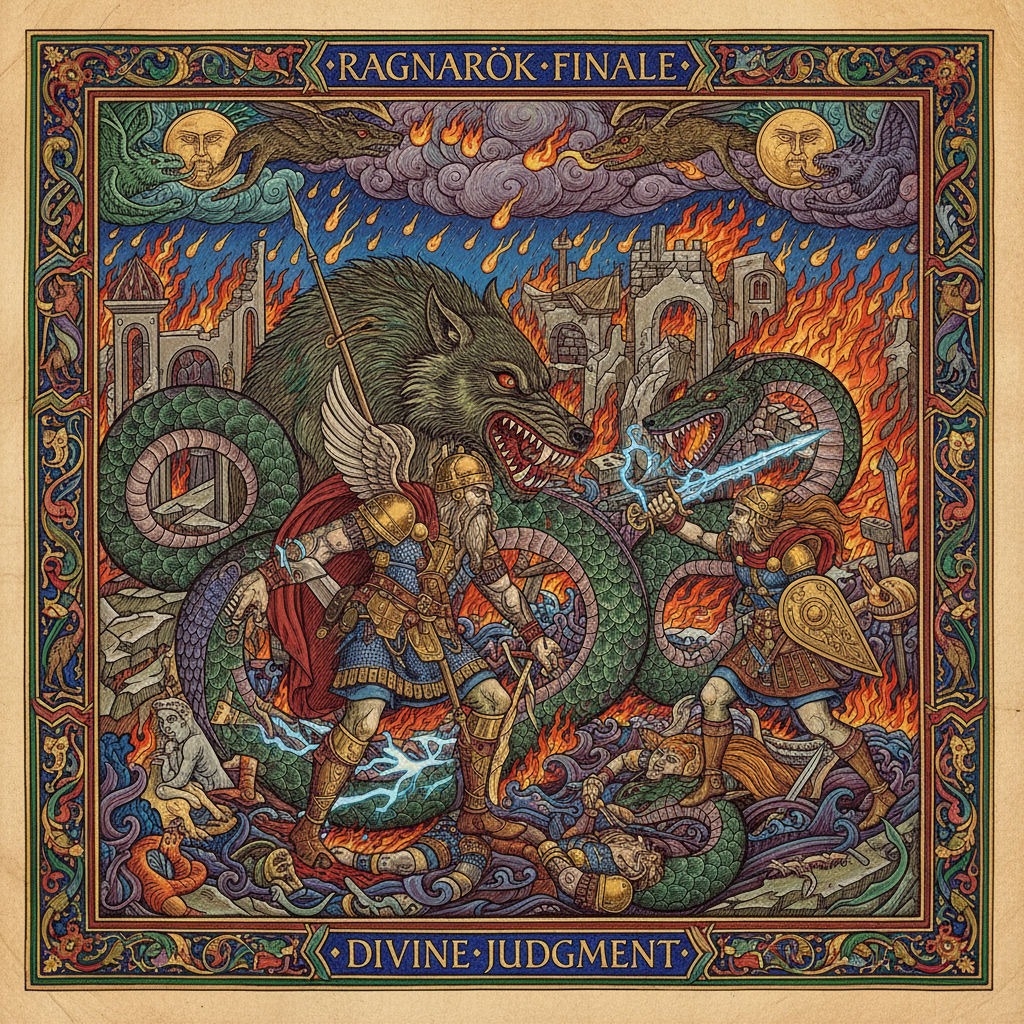
The Voluspa is Norse poetry’s answer to what happens at the end. What happens: almost everything dies.
The events unfold in sequence. Fimbulwinter — three winters with no summer between. Then the gods and the monsters meet at Vigrid, the field 100 leagues in every direction, because they need the room.
The kill roster:
- Odin is swallowed by Fenrir. Vidar tears Fenrir’s jaws apart and kills him.
- Thor kills the Midgard Serpent. Takes nine steps. Dies from the venom.
- Freyr fights Surtr with no weapon (he gave his magic sword away for love). Dies.
- Tyr and Garm (the hound of Hel) kill each other.
- Loki and Heimdall kill each other.
- Surtr burns the remaining world with his fire. The earth sinks into the sea.
The human death toll: nearly total. Only Lif and Lifthrasir survive, sheltered in Hoddmimir’s forest.
What makes Ragnarok different from the other entries on this list: the gods know it’s coming. They know Fenrir will eat Odin. They know Thor will die from the serpent. They know Freyr will fall. They fight anyway. The Norse vision of heroism is not winning. It’s showing up when you know you won’t win.
The sun goes black. The stars fall. The earth burns. Then — in the final stanzas of the Voluspa — a new earth rises from the sea, green and unscarred, and the surviving gods meet on the field and find, in the grass, the golden chess pieces they used to play before everything started.
The body count is almost everyone. The ending is inexplicable hope.
The Flood
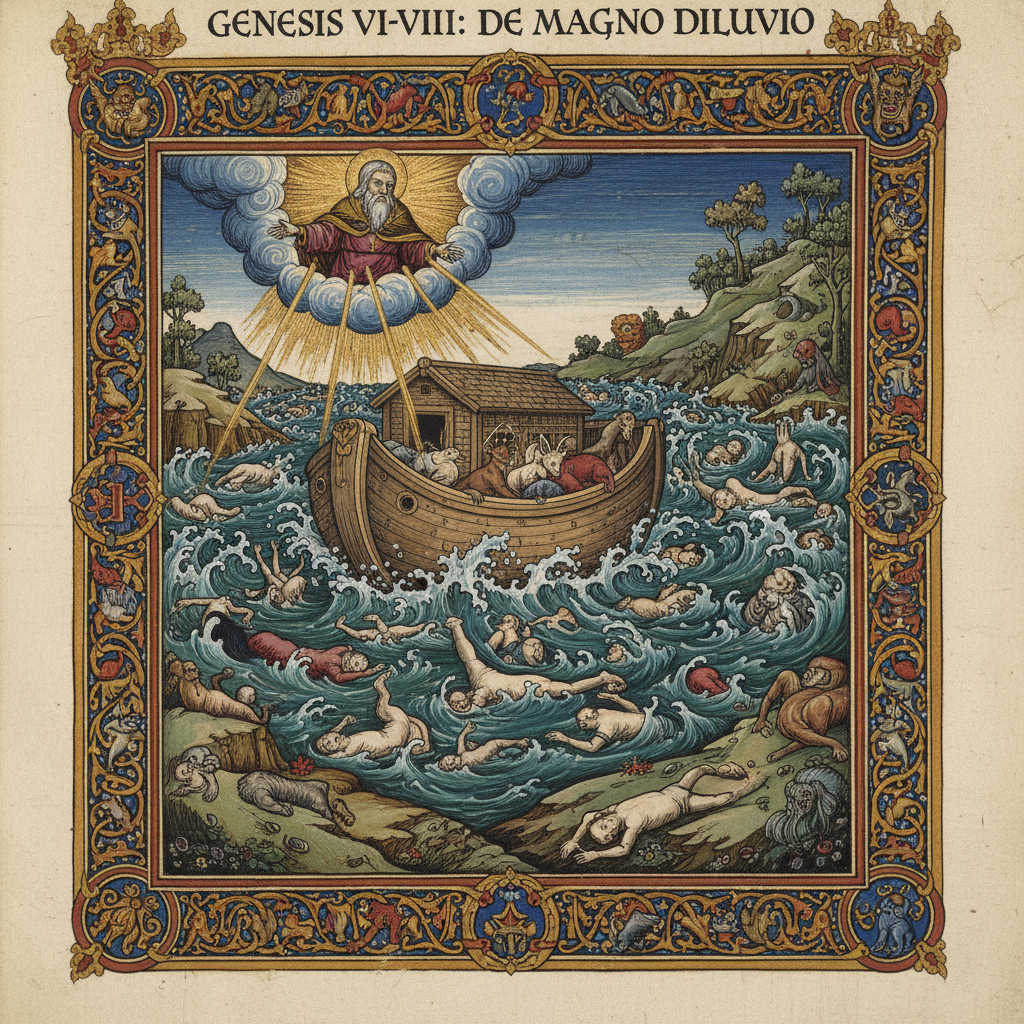
Genesis 7:21-23. Every living thing that moved on the earth perished. Birds. Livestock. Wild animals. Everything that swarmed. Every human being. The text is precise: “Only Noah was left, and those who were with him in the ark.”
The Babylonian version (Gilgamesh XI) tells the same story with different names. Utnapishtim instead of Noah. Enlil as the divine antagonist who wants the flood. Ea/Enki who warns Utnapishtim anyway. The boat. The birds sent out to find land. In Gilgamesh, the gods themselves are terrified by what they’ve done: the Anunnaki crouch against the outer walls of heaven like dogs, weeping. Even the gods who ordered the flood are shocked by the flood.
In Genesis, God sees the corruption of every human thought and grieves it. “The Lord regretted that he had made human beings on the earth, and his heart was deeply troubled.” The flood is not indifference. It’s grief. God kills everyone on earth because he is devastated by what they’ve become.
Eight people survive. Eight. From the entire population of a pre-diluvian world.
After the water recedes, God sets a rainbow in the cloud and makes a promise: never again. The first covenant in the Bible is made immediately after the largest mass death in the Bible. The promise is retroactive acknowledgment that what happened was enough. It won’t happen again.
The rainbow is the gods’ acknowledgment of the body count.
Tier I: Most of Humanity Dies
Sekhmet’s Rampage
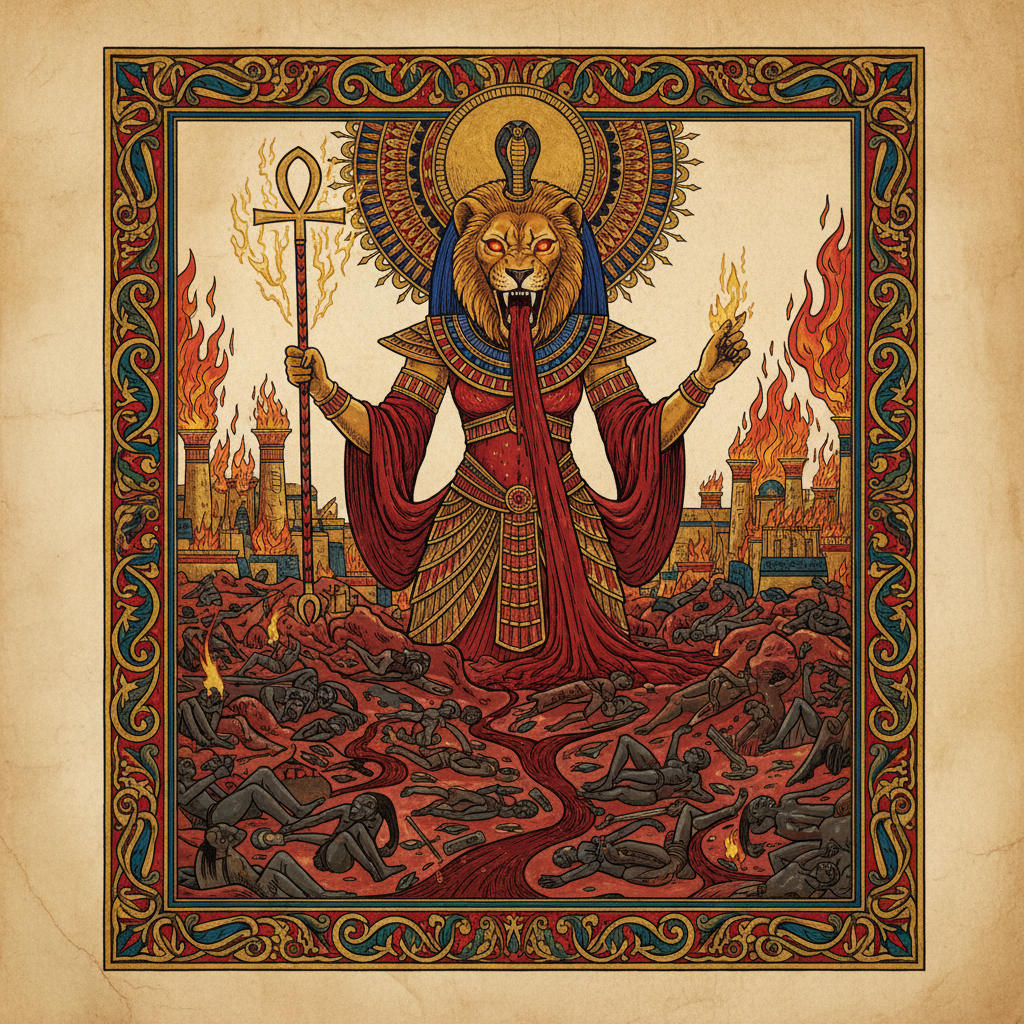
The Book of the Heavenly Cow is not one of the more famous Egyptian texts. It should be.
Ra, the sun god, grows old. Humanity begins to mock him and plot against him. Ra convenes the divine council. He sends his Eye — his daughter, Hathor — to punish them. She descends as Sekhmet, the lion-headed goddess of destruction.
Sekhmet begins killing. She is very good at it. She kills humans by the thousands. She bathes in their blood. She becomes intoxicated by it. She cannot stop.
The problem: Ra doesn’t want all humans dead. He wants them punished. There is a difference. He sends word to stop. Sekhmet cannot stop. The killing has become its own momentum.
Ra’s solution is genuinely desperate: he floods the fields with red beer dyed to look like blood. Sekhmet drinks it. She becomes so drunk she passes out. She wakes as Hathor, gentle goddess of love.
The unspecified-but-clearly-enormous number of humans who died before Ra could get the beer in place: the Book of the Heavenly Cow doesn’t say. The implication is that it was nearly everyone. The miracle isn’t the killing. The miracle is that Ra found a way to stop it.
The tradition is honest about what this means: the goddess created to protect humanity is also the goddess most capable of ending it. The same power that heals is the power that destroys. The only question is whether anyone can get the beer there in time.
Revelation’s Total Accounting
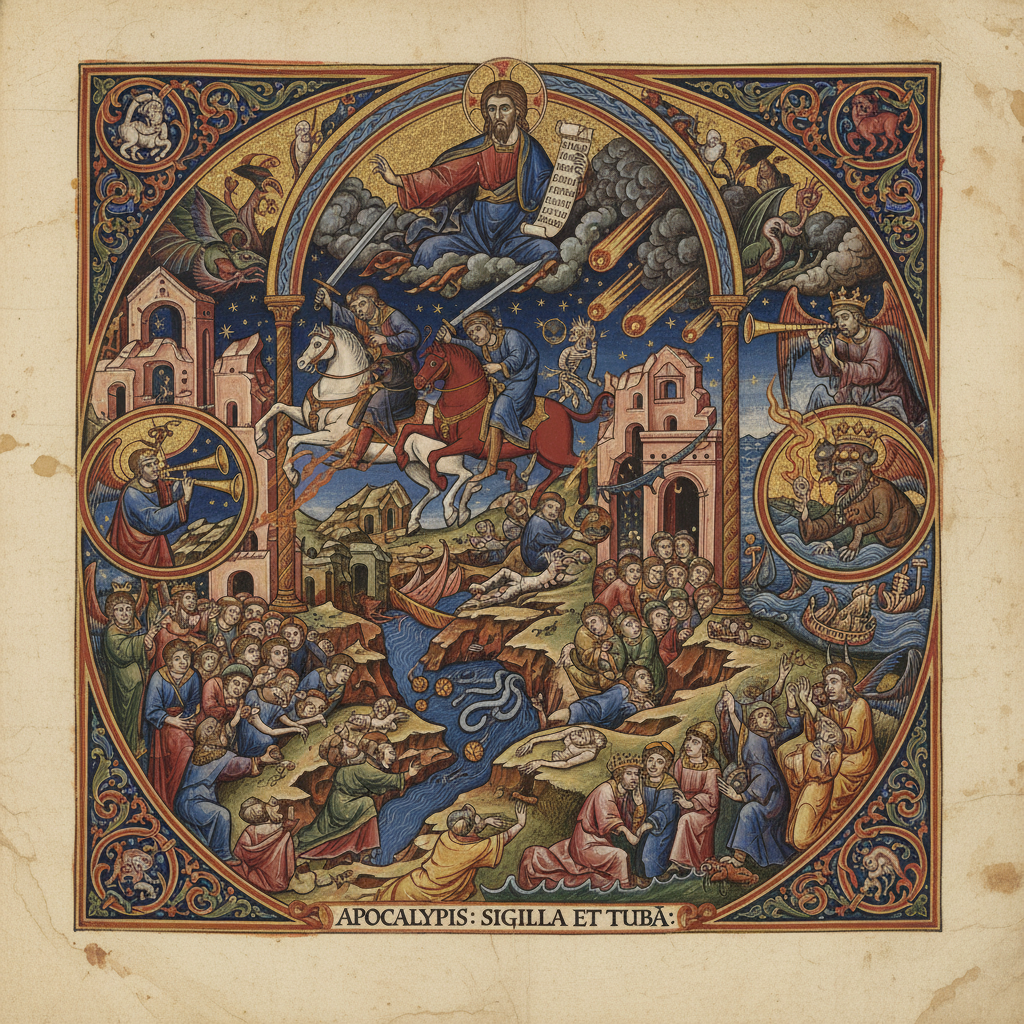
The Book of Revelation doesn’t give a single death toll. It gives a running count across seven seals, seven trumpets, and seven bowls.
The math, working sequentially:
- Fourth Seal (Revelation 6:8): Death and Hades given authority over one-fourth of the earth to kill.
- Sixth Trumpet (Revelation 9:15): An army of 200 million kills one-third of the remaining population.
If you start with 100 people: after the Fourth Seal, 75 remain. After the Sixth Trumpet, 50 remain. Before the bowls even begin.
The bowls then add: rivers and seas turning to blood (everything in the sea dies), intensified heat, darkness, the great river Euphrates dried up, hailstones weighing a talent (about 57 kg) falling on humanity.
The final accounting is roughly half of all humanity dead before the Second Coming. This is not counting the Battle of Armageddon, the destruction of Babylon, or what happens after.
Revelation is not trying to be comfortable. It is trying to describe the weight of divine judgment arriving after the full measure of human rebellion and cosmic injustice has been recorded. The scale of death is the scale of what is being responded to.
Every church that reads Revelation on Sunday morning contains people who have memorized this. They sing afterward.
Tier II: Mythological Numbers
Kurukshetra
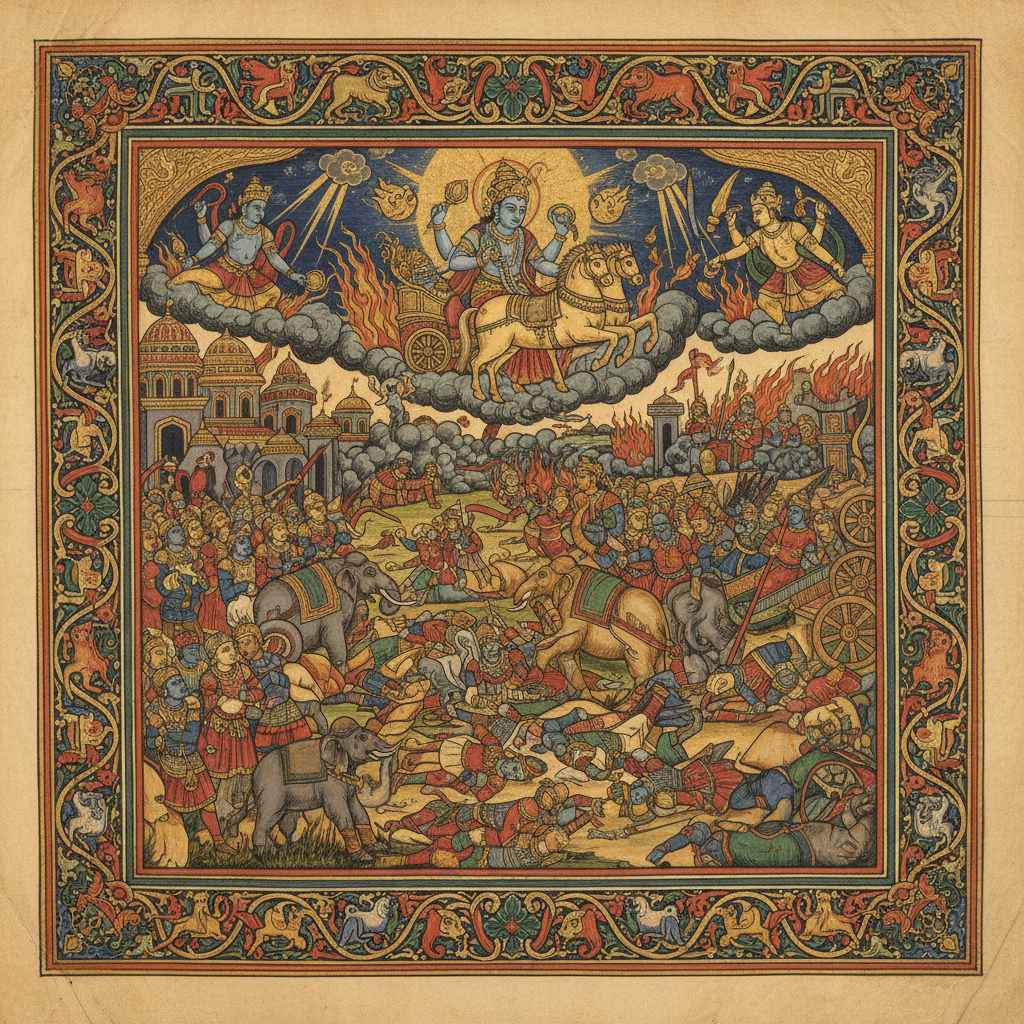
The Mahabharata gives a number: 1.66 billion dead over 18 days.
This is not a realistic figure. The population of the world circa 800 BCE, when parts of the Mahabharata were being composed, was approximately 50 million. The text is not attempting census accuracy. It is attempting to communicate scale — specifically, the scale of what dharma costs.
The war at Kurukshetra begins because Duryodhana will not return the Pandavas’ rightful kingdom. Yudhishthira wants to avoid war. Krishna tries diplomacy. Nothing works. The armies gather at Kurukshetra — described as spanning nine divisions of the cosmos.
The 18-day battle produces the Bhagavad Gita on Day 1 (Arjuna refuses to fight; Krishna explains why he must). It also produces:
- The death of Drona, killed by deception
- The death of Karna, killed when his chariot wheel sticks in the ground at the exact wrong moment
- The death of Duryodhana, his thigh broken by Bhima despite the rules of mace combat forbidding it
- The death of Abhimanyu, Arjuna’s son, 16 years old, killed inside a formation he knew how to enter but not to escape
- The night massacre — Ashwatthama attacks the Pandava camp while they sleep and kills almost everyone
At the end: the Pandavas win. Five brothers survive. Draupadi’s five sons are dead. The kingdom is won and almost everyone is dead. Yudhishthira, who wanted peace, inherits an empire of corpses.
The Mahabharata presents this without comfortable resolution. The winners are not happy. The war was necessary. The body count was real. And Yudhishthira, who never lied in his life, was made to say one ambiguous half-truth that allowed the war-turning deception — and he has thought about it every day since.
The 1.66 billion is the text’s way of saying: nothing was worth this.
Tier III: Specific Events, Documented Numbers
The Tenth Plague
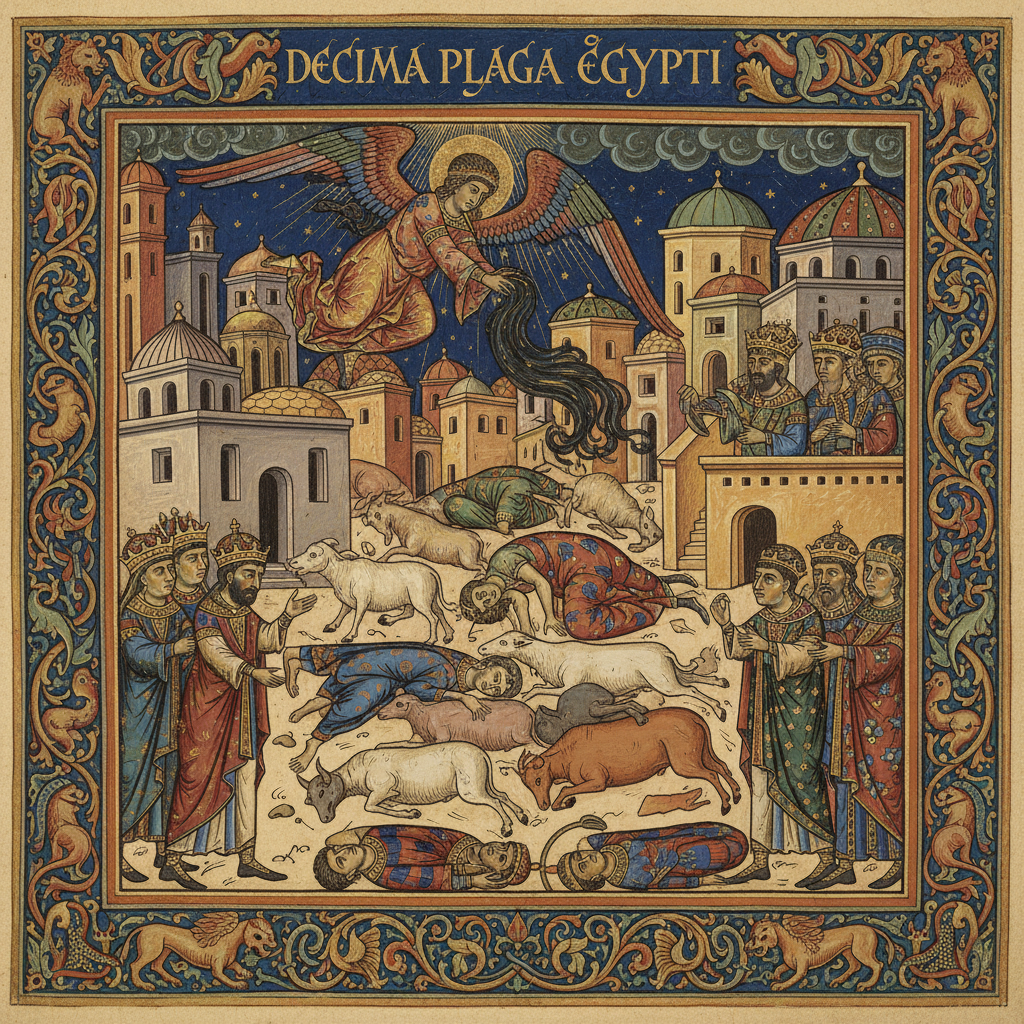
Exodus 12:29-30. At midnight, the Lord struck down every firstborn in Egypt — from the firstborn of Pharaoh to the firstborn of the prisoner in the dungeon, and the firstborn of all the livestock.
The text then says: “Pharaoh and all his officials and all the Egyptians got up during the night, and there was loud wailing in Egypt, for there was not a house without someone dead.”
Not a house without someone dead.
Egyptian census figures for this period are disputed among scholars, but estimates for the population of Egypt during the likely Exodus period (if historical) range from 3—5 million. If every family lost a firstborn male, the death toll was in the hundreds of thousands.
The Passover tradition that developed from this night is one of the most observed religious practices in the world. Every spring, Jewish families read the Haggadah, which includes the recounting of the ten plagues — and at each plague named, a drop of wine is removed from the cup. Joy is diminished by the suffering that was required. Even at liberation, the deaths of the enemy are not cause for unqualified celebration.
The Talmud records that when the angels began to sing as the Egyptians drowned at the Red Sea, God silenced them: “My creatures are drowning in the sea and you want to sing songs?”
The tradition remembers the body count. It doesn’t let you forget it.
The Angel at Sennacherib’s Camp
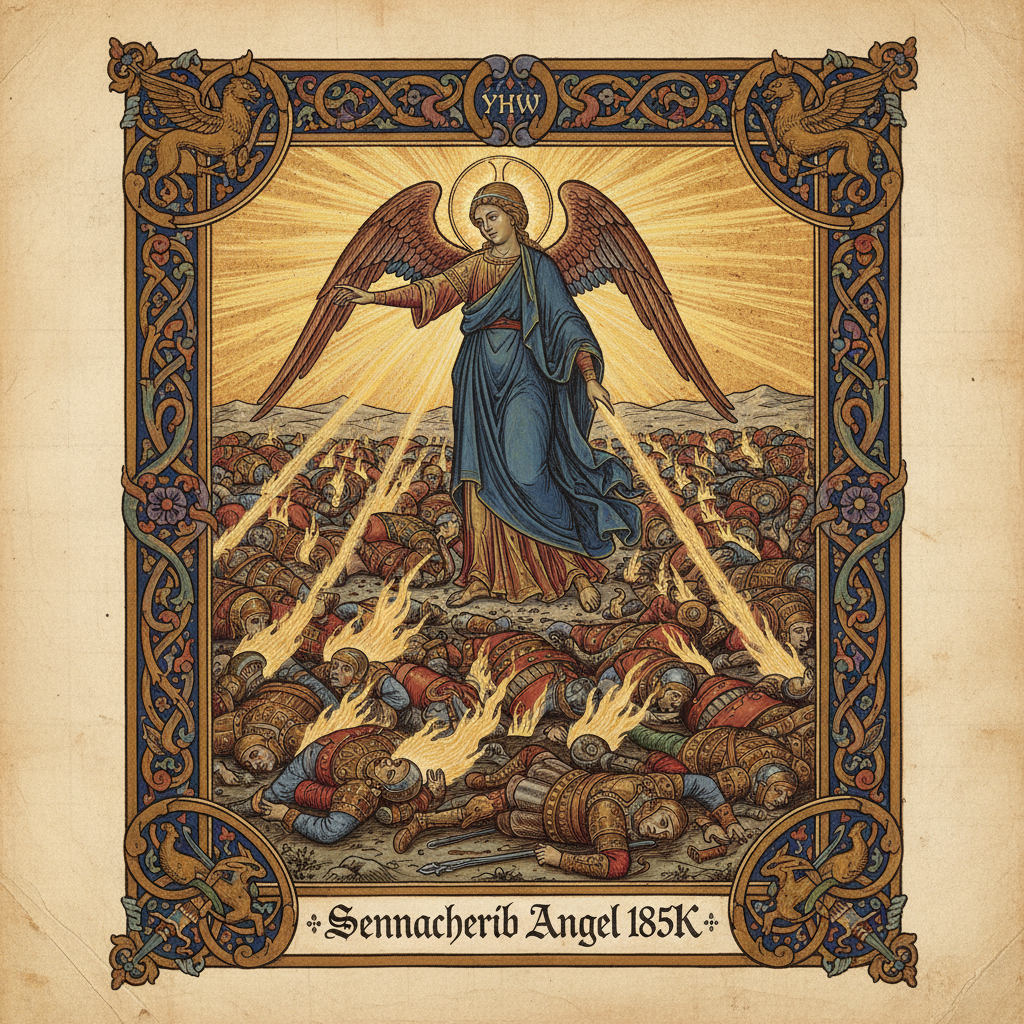
2 Kings 19:35. One of the most extraordinary verses in military history.
“That night the angel of the Lord went out and put to death a hundred and eighty-five thousand in the Assyrian camp. When the people got up the next morning — there were all the dead bodies!”
Context: Sennacherib, king of Assyria, has besieged Jerusalem. His officers have sent a letter mocking Hezekiah and YHWH. Hezekiah takes the letter to the temple and literally spreads it out before God. Isaiah sends word: God has heard.
Then an angel handles it. One angel. One night. 185,000 soldiers.
The method is unspecified. They were alive. Then they were not. “There were all the dead bodies.” The morning detail is striking — the surviving Assyrians woke up, looked around, and discovered that 185,000 of their colleagues had died in the night without apparent cause. Sennacherib broke camp and returned to Nineveh.
(He was later murdered by his own sons while worshipping in the temple of his god. The text notes this without comment.)
The 185,000 figure has attracted scholarly attention for centuries. Herodotus records a version of the same event involving mice eating the Assyrian bowstrings — a different explanation for the same sudden withdrawal. The number is large enough to be debated. It is also specific enough to demand the question: specific how? Who counted?
The text doesn’t say.
Elijah and the 450 Prophets of Baal
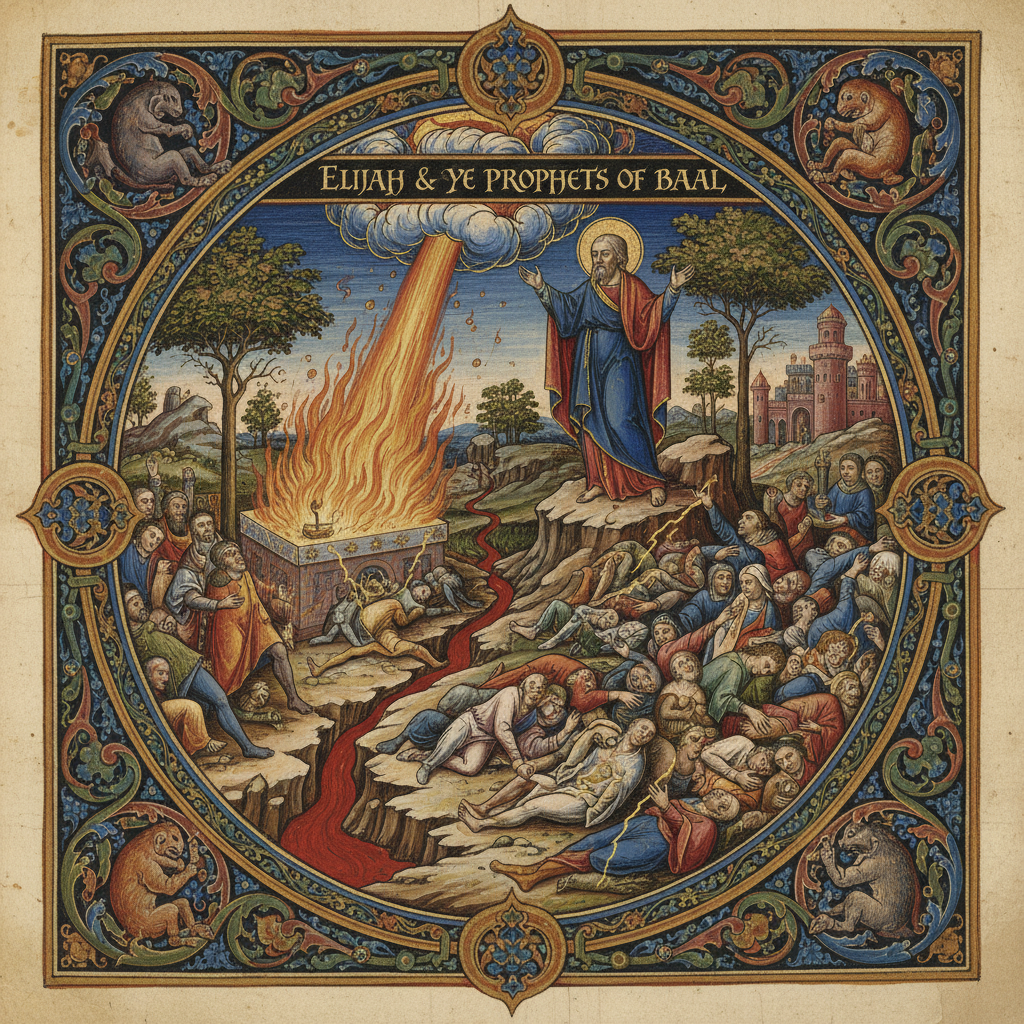
1 Kings 18. The contest on Mount Carmel is one of the most dramatic scenes in the Hebrew Bible.
The setup: Israel has been following Baal under Ahab and Jezebel. Elijah challenges 450 prophets of Baal to a contest: two bulls, two altars, the god who answers by fire is God.
The prophets of Baal go first. They call from morning until noon. They dance. They cut themselves until their blood flows. Nothing happens. Elijah mocks them: “Shout louder! Surely he is a god! Perhaps he is deep in thought, or busy, or traveling. Maybe he is sleeping and must be awakened.”
Then Elijah builds his altar, soaks it with water three times (twelve jars, so waterlogged no one could claim a hidden fire), and prays one simple prayer. Fire falls. It consumes the burnt offering, the wood, the stones, the soil, and the water in the trench.
Then: “Elijah commanded them, ‘Seize the prophets of Baal. Don’t let anyone get away!’ They seized them, and Elijah had them brought down to the Kishon Valley and slaughtered them there.”
450 men, executed by order of a prophet, on the same day God answered by fire. The contest proved the point. The executions secured it.
This is not presented in the text as a moral problem. Elijah has just demonstrated that YHWH is the living God. The prophets of Baal are false prophets leading Israel to destruction. The execution follows what the Law of Moses prescribed for false prophecy.
The 450 count is significant: Jezebel’s other 400 prophets of Asherah are not mentioned as being at the contest (1 Kings 18:19 says they were invited but 18:40 only mentions Baal’s prophets being killed). They survive this particular day. Elijah is not finished with Jezebel.
Samson’s Final Performance
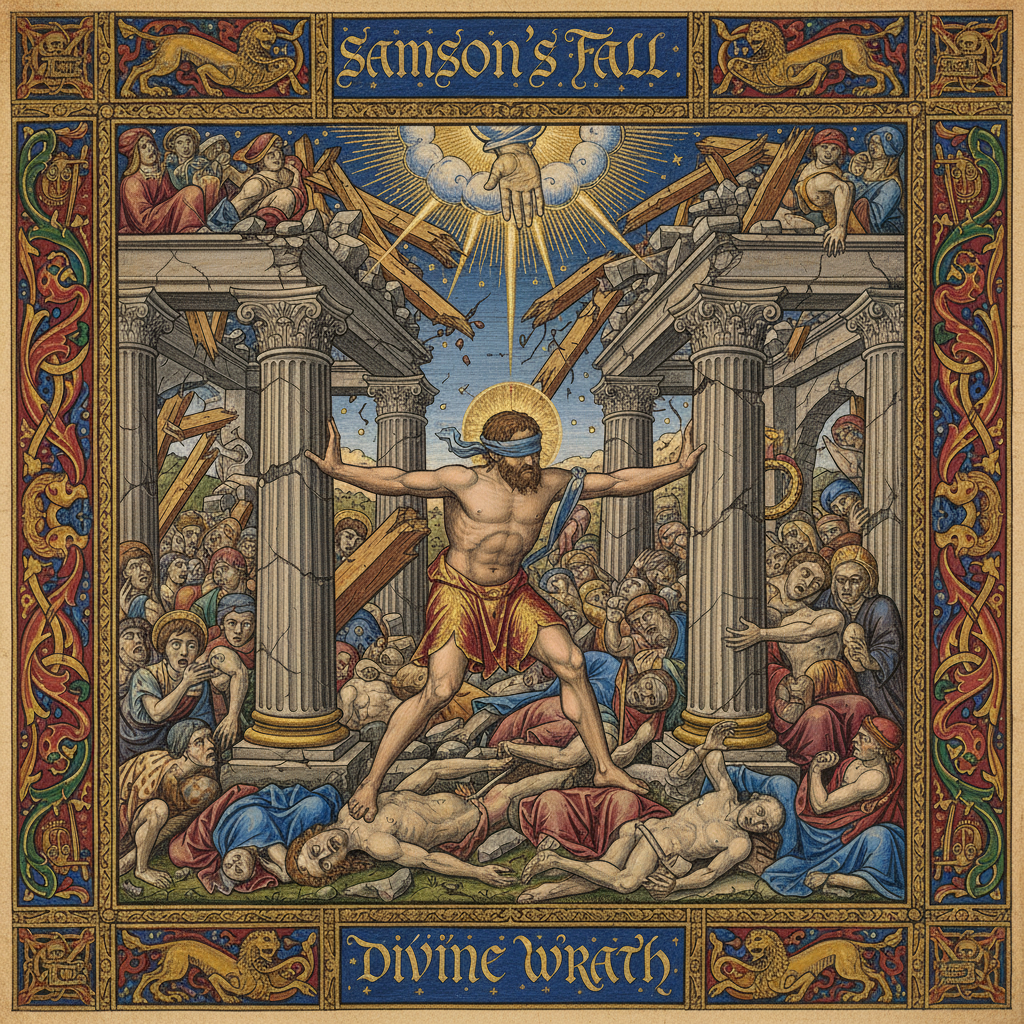
Judges 16:27-30. The last act of Samson of Dan.
Samson is blind. He has been betrayed by Delilah, who sold his secret to the Philistines. His eyes have been gouged out. He has been put to grinding grain in a Philistine prison — the labor of women, a deliberate humiliation. His hair has begun to grow back.
The Philistines bring him out to mock him at the temple of Dagon during a festival. Three thousand people are on the roof watching. He asks his guide to let him touch the pillars so he can lean against them.
He prays: “Sovereign Lord, remember me. Please, God, strengthen me just once more, and let me with one blow get revenge on the Philistines for my two eyes.”
He pushes against both pillars. The temple collapses.
The text: “Thus he killed many more when he died than while he lived.”
The 3,000 on the roof, plus the unspecified number inside. Samson’s lifetime kill count — the foxes-and-torches, the jawbone-of-a-donkey thousand, the earlier acts — is substantial. The temple brings the total to somewhere in the thousands.
And then there is this: Samson is on the list of faith heroes in Hebrews 11. He is a judge of Israel for twenty years. He is also a man who chose his enemies over his people, whose love interests were consistently Philistine women, whose secret was extracted through a manipulation he refused to learn from even after it happened twice.
The text holds both things. He ends well. He spent a lot of the middle badly. The final kill count is the text’s acknowledgment that even compromised people can do something decisive — once, at the very end, when they have nothing left to lose.
The Serious Point Underneath
Every tradition on this list contains mass death. The question was never whether sacred texts describe divine violence. They all do. The question was always what they do with it.
- The Flood is judgment — but ends in a covenant. God responds to the body count by making a promise.
- Ragnarok is ending — but ends in renewal. The earth rises again, green, from the sea.
- The Plagues are liberation — Israel’s freedom was purchased at the cost of Egyptian firstborns. Passover insists you hold both truths.
- Kurukshetra is dharma — the right thing had to be done, and the right thing cost 1.66 billion lives (or: cost the lives of everyone important to everyone who survived).
- Sekhmet is power without control — the lesson is Ra’s desperate intervention, not the killing.
- Sennacherib is proportion — God responds to one threatening letter with 185,000 deaths.
- Revelation is not description but warning — John of Patmos is not reporting history, he is holding up a mirror to empire and asking: do you see where this goes?
The body count is the same across traditions. The theology is different. Every tradition looked at mass death and built something out of it — meaning, warning, covenant, liberation, renewal.
The numbers don’t tell you whether the tradition is right. They tell you how seriously the tradition takes the weight of what it describes.
See also: The Miracles | The Apocalyptic | EpicScenes-Destruction