Part of the Bestiary Compendium
Every culture discovered it independently: sound is not just sound. It is the raw material of creation. Before there was light, there was vibration. Before there were words, there was the hum. The gods don’t just happen to play music — music is how they do everything. Create worlds, destroy armies, seduce the cosmos, raise the dead. This is the section where the universe has a soundtrack.
Art Style
Target aesthetic: Illuminated manuscript illustration of divine music, the musician and their instrument glowing with sacred power, sound made visible as golden waves or light, warm candlelit atmosphere, ornate border with musical notation, rich pigments.
illuminated manuscript illustration of divine music, the musician and their instrument glowing with sacred power, sound made visible as golden waves or light, warm candlelit atmosphere, ornate border with musical notation, rich pigments, 8k --ar 1:1 --s 750 --v 6.1The Divine Musicians
| Musician | Instrument | What Their Music Does | Tradition |
|---|---|---|---|
| David | Harp/lyre | Drove evil spirits from Saul; wrote the Psalms — the world’s most sung songs | Biblical |
| Orpheus | Lyre | Made stones weep, tamed wild beasts, almost conquered death itself | Greek |
| Apollo | Lyre | Harmony, order, civilization. Won a contest against Pan (flute/chaos) | Greek |
| Vainamoinen | Kantele | His songs literally reshape reality; the kantele made from a pike’s jawbone could enchant all nature | Finnish |
| Saraswati | Veena | The sound of pure knowledge; her instrument IS the universe vibrating | Hindu |
| Shiva | Damaru (hourglass drum) | The rhythm of creation and destruction. Each beat creates/destroys a universe | Hindu |
| Krishna | Flute | His flute playing enchants all of creation — animals, rivers, even the gods stop to listen | Hindu |
| Bragi | Harp | Norse god of poetry and music; runes carved on his tongue | Norse |
| Odin | His voice (galdr/rune-songs) | Magic through chanting; the runes ARE songs | Norse |
| Jubal | Lyre and pipe | ”Father of all who play stringed instruments and pipes” (Gen 4:21) — Cain’s descendant invented music | Biblical |
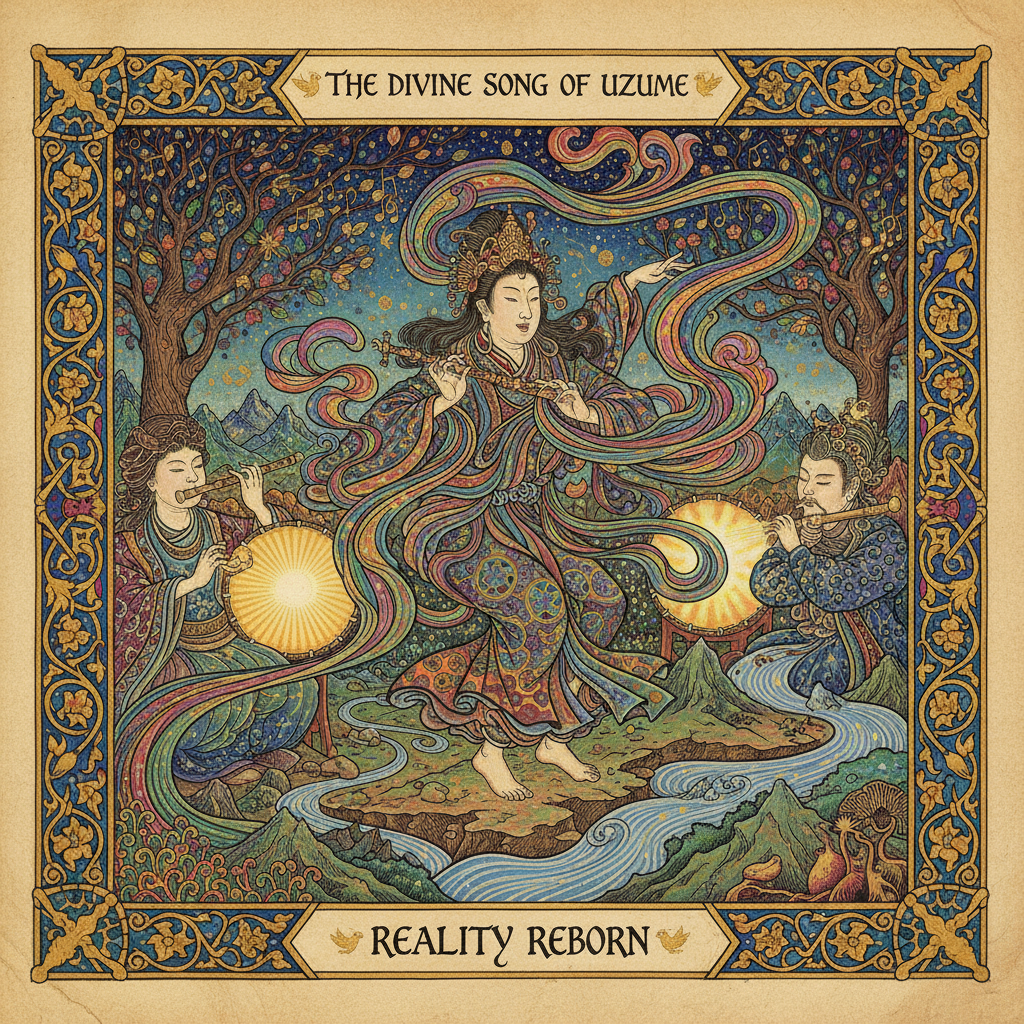
| Ame-no-Uzume | Dance + comedy | Her dance lured Amaterasu from the cave, restoring light to the world | Shinto |
| The Shaman’s Drum | Frame drum | The “horse” that carries the shaman between worlds; the heartbeat of the cosmos | Siberian/Universal |
| Om | The human voice | The primordial sound of creation itself; the vibration from which all reality emanates | Hindu/Buddhist |
| Gandharvas | Various celestial instruments | The celestial musicians of Hindu mythology; their music sustains the harmony of heaven | Hindu |
Sacred Sounds That Created Things
| Sound | What It Created | Tradition |
|---|---|---|
| ”Let there be light” | Everything (creation by speech) | Biblical |
| Om | The universe (creation by vibration) | Hindu |
| The Songlines | The Australian landscape (creation by singing) | Aboriginal |
| Ainulindale | Tolkien’s universe (creation by music — inspired by all of the above) | Literary |
| The Music of the Spheres | Planetary harmony (each planet produces a note) | Pythagorean/Medieval |
Every creation myth is a sound myth. The Biblical God speaks. The Hindu universe vibrates. The Aboriginal ancestors sing the land into existence — literally walk across the empty void singing, and whatever they sing about appears. Mountains. Rivers. Animals. The Pythagoreans took it further: the planets themselves produce music as they orbit, a harmony so constant we’ve stopped hearing it. Tolkien, the great mythologist, knew exactly what he was doing when he made his creation story a song — he was synthesizing all of the above.
The Duel Pattern — When Musicians Fought
| Duel | Who Won | Why It Matters | Tradition |
|---|---|---|---|
| Apollo vs Marsyas | Apollo (judged by Muses) | Marsyas was FLAYED ALIVE for losing — the price of challenging a god’s art | Greek |
| Apollo vs Pan | Apollo (judged by Tmolus) | King Midas said Pan won; got donkey ears as punishment for bad taste | Greek |
| David vs Goliath | David (different kind of duel) | But David’s REAL weapon was his harp — the music that sustained Saul’s sanity | Biblical |
| Vainamoinen vs Joukahainen | Vainamoinen | Sang his rival into a swamp — literally sank him with song | Finnish |
The musical duel is one of mythology’s most universal patterns. Every tradition has a version of it: two musicians face off, and the loser’s punishment is always disproportionate. Apollo doesn’t just defeat Marsyas — he skins him alive and hangs his hide. This isn’t cruelty for its own sake. It’s mythology saying: music is not entertainment. It is divine power. And you don’t challenge divine power casually.
The Sacred Scenes
1. David Plays for Saul — Music Against Madness
| Musician | David |
| Instrument | Harp/lyre |
| What His Music Does | Drove evil spirits from King Saul |
| Tradition | Biblical |
| Source | 1 Samuel 16:23 |
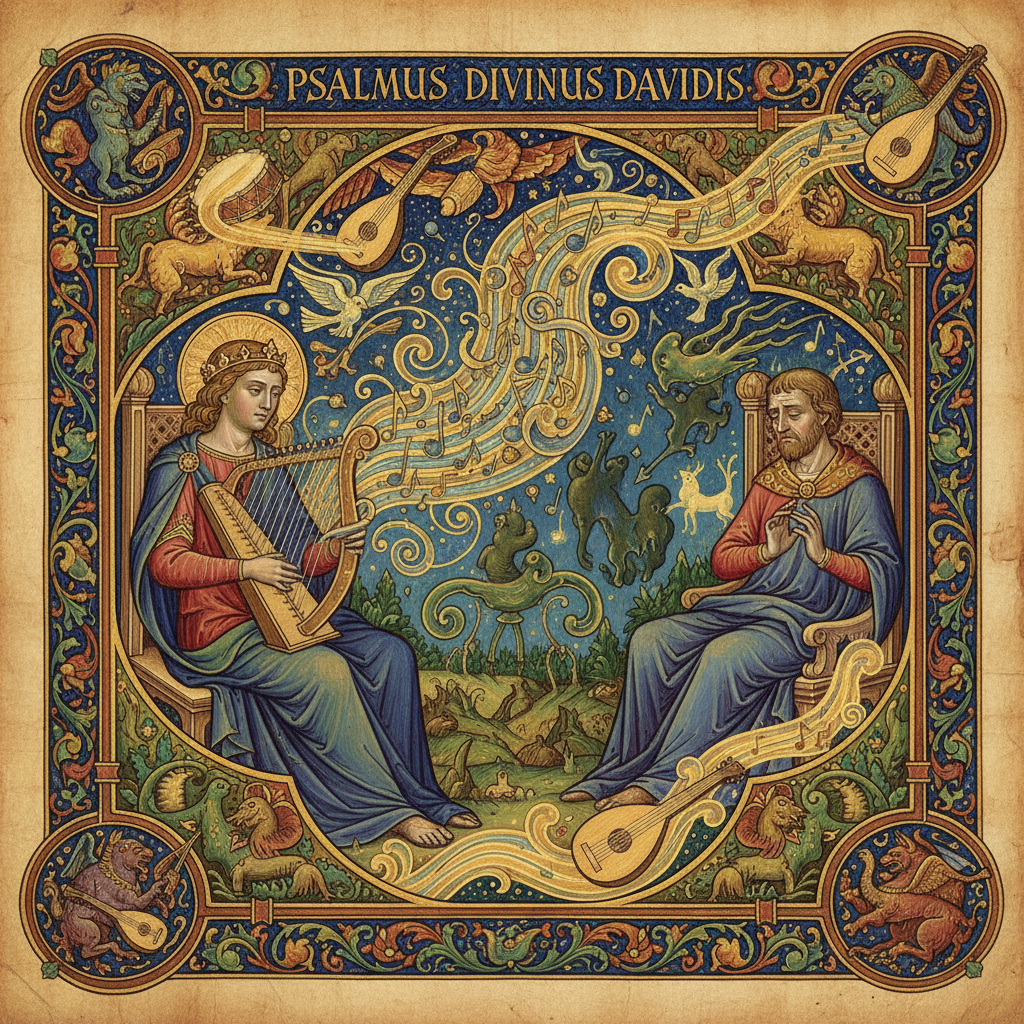
Before David was a king, before he killed Goliath, he was a musician. Saul was tormented by an evil spirit — what we might now call crushing depression, paranoid episodes, violent rages. His advisors searched the kingdom for someone whose music could reach him. They found a shepherd boy. “Whenever the spirit from God came on Saul, David would take up his lyre and play. Then relief would come to Saul; he would feel better, and the evil spirit would leave him.” Music as exorcism. Music as medicine. The boy who would be king got his start as a therapist.
King David as a young shepherd playing a golden harp for the tormented King Saul, Saul hunched on his throne with shadows and dark spirits visibly retreating from the golden sound waves emanating from David's instrument, warm candlelit palace interior, the music made visible as streams of golden light driving back darkness, illuminated manuscript illustration of divine music, ornate border with musical notation and harp motifs, rich pigments, 8k --ar 1:1 --s 750 --v 6.12. Orpheus in the Underworld — Almost
| Musician | Orpheus |
| Instrument | Lyre |
| What His Music Does | Made stones weep, tamed wild beasts, nearly conquered death |
| Tradition | Greek |
| Source | Ovid, Metamorphoses; Virgil, Georgics |
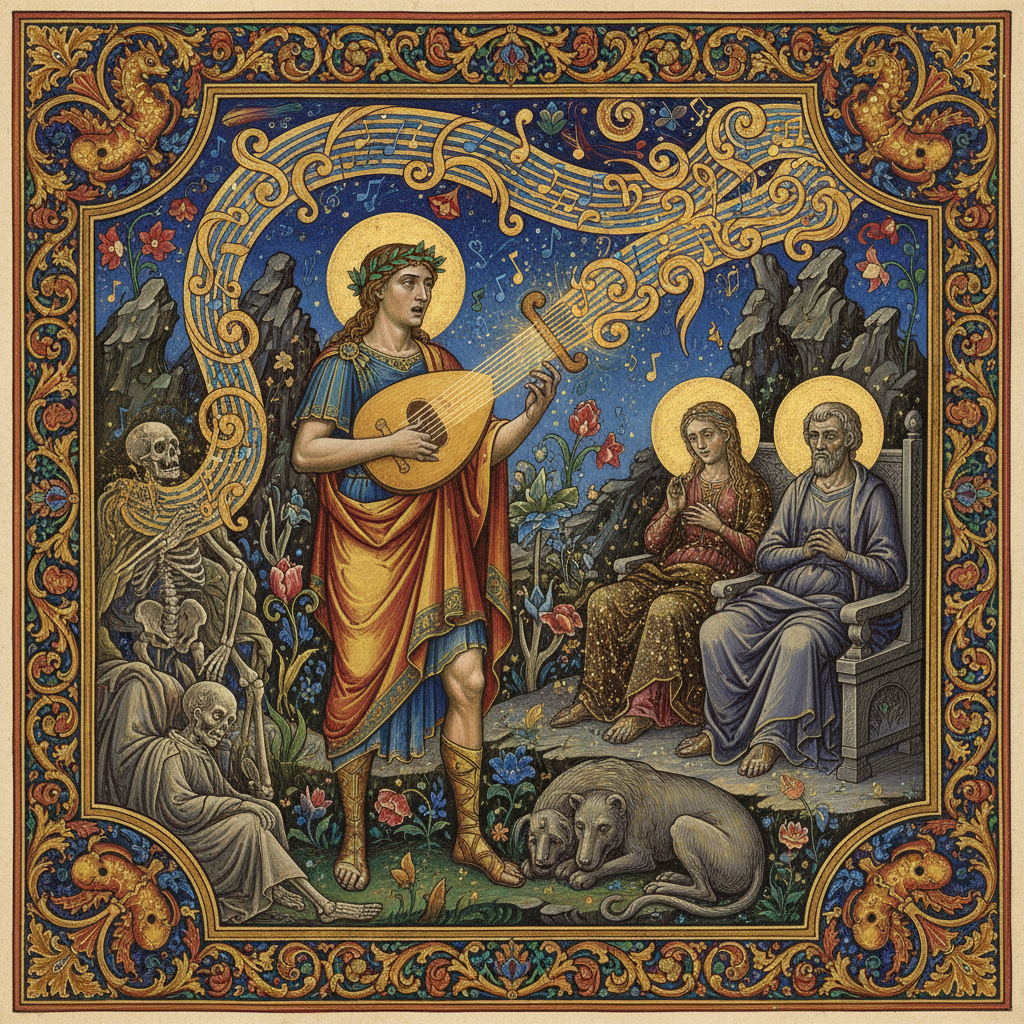
Orpheus’s wife Eurydice died on their wedding day — a snake bite. So Orpheus did what no mortal had ever done: he walked into the underworld with nothing but his lyre and played. He played so beautifully that Cerberus lay down. The damned stopped their torments to listen. Sisyphus sat on his boulder. The Furies wept — for the first time in eternity. Even Hades, god of the dead, was moved. “Take her back. One condition: don’t look back until you reach the surface.” He looked back. Of course he looked back. The greatest musician who ever lived couldn’t master the simplest human impulse: the need to see the face you love.
Orpheus playing his golden lyre in the underworld, surrounded by the shades of the dead who have stopped to listen in wonder, Cerberus sleeping peacefully, the Furies weeping, Eurydice's ghostly form behind him reaching toward the light of the surface, golden sound waves piercing the darkness of Hades, illuminated manuscript illustration of divine music, ornate border with lyre motifs and underworld imagery, rich pigments, 8k --ar 1:1 --s 750 --v 6.13. Krishna’s Flute — The Sound That Enchants Everything
| Musician | Krishna |
| Instrument | Bansuri (bamboo flute) |
| What His Music Does | Enchants all of creation — animals, rivers, gods |
| Tradition | Hindu |
| Source | Bhagavata Purana |
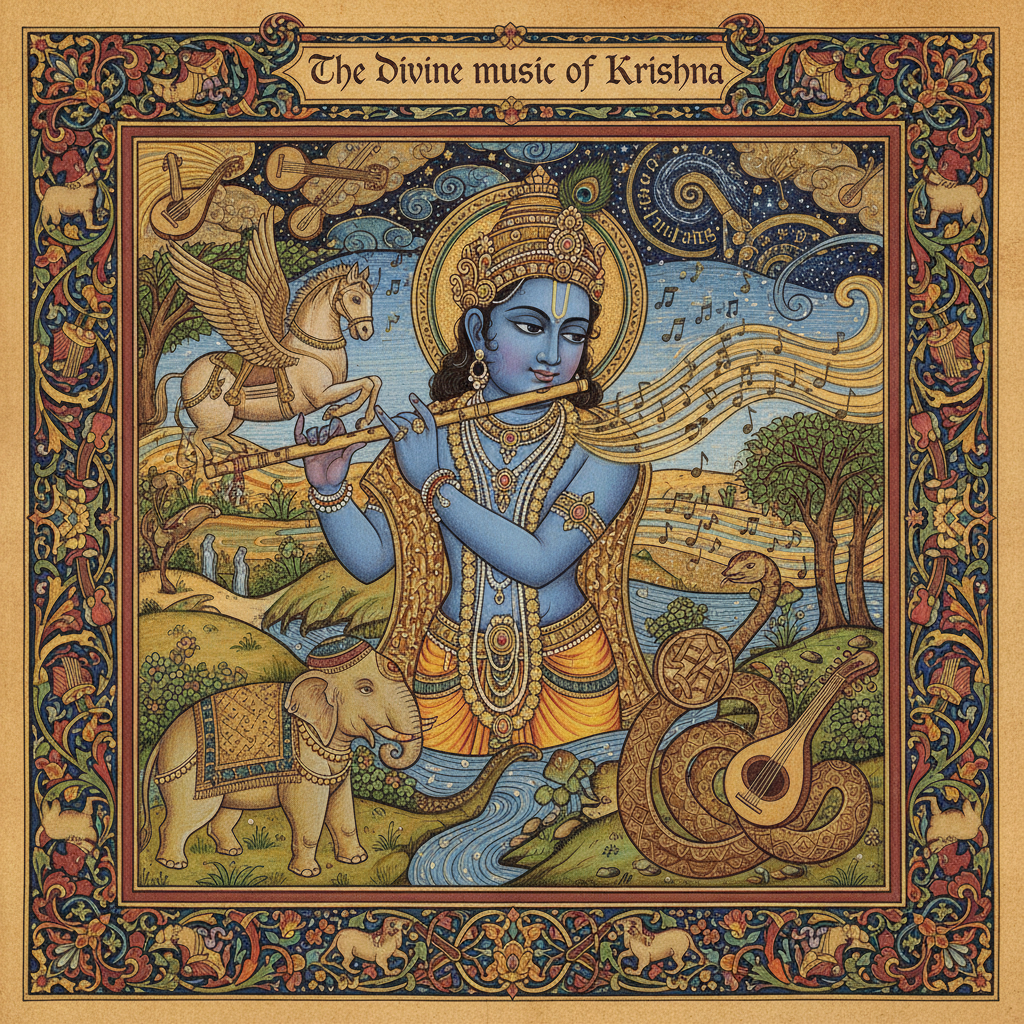
When Krishna plays his flute, the universe stops. The rivers reverse their courses to flow toward the sound. Cows freeze mid-step, grass hanging from their mouths. The gopis — the milkmaids of Vrindavan — abandon their homes, their husbands, their children, because the flute is irresistible. This isn’t a metaphor. In Hindu theology, Krishna’s flute IS the call of the divine to the soul. Every being in creation is a gopi. The flute is always playing. Most of us are just too busy to hear it.
Lord Krishna standing in a moonlit forest playing his bamboo flute, blue-skinned and adorned with peacock feather crown, all of creation enchanted around him -- cows frozen in place, rivers bending toward him, birds hovering in mid-flight, gopis emerging from the forest drawn by the sound, visible golden sound waves spiraling outward, illuminated manuscript illustration of divine music, ornate border with peacock feather and lotus motifs, rich pigments, 8k --ar 1:1 --s 750 --v 6.14. Shiva’s Cosmic Drum — The Beat of Creation and Destruction
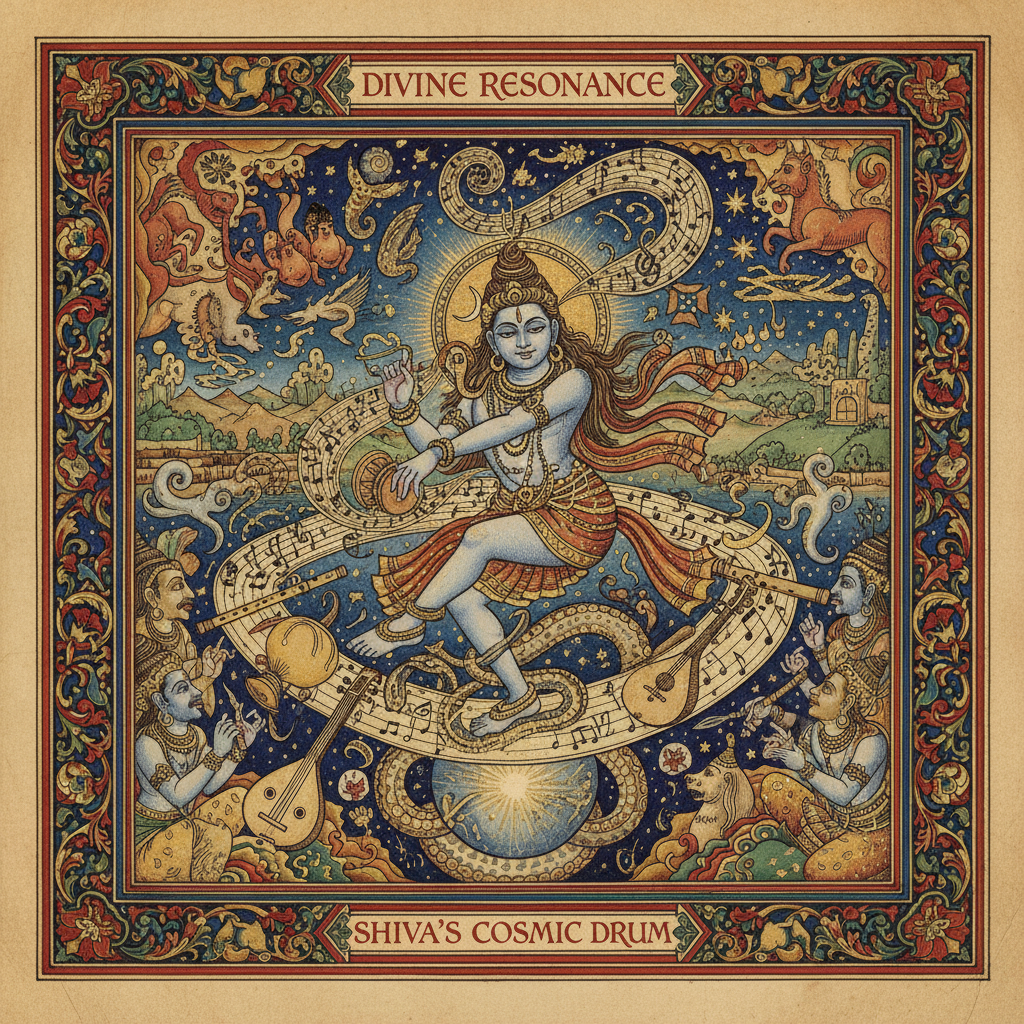
| Musician | Shiva (as Nataraja) |
| Instrument | Damaru (hourglass drum) |
| What His Music Does | Each beat creates and destroys a universe |
| Tradition | Hindu |
| Source | Natya Shastra, Shiva Sutras |
Shiva dances the Tandava — the cosmic dance of creation and destruction — and in his upper right hand he holds the damaru, the hourglass drum. Each beat of the drum creates. Each silence between beats destroys. The entire rhythm of the universe — birth, death, rebirth — is percussion. The fourteen sounds of the damaru became the Sanskrit alphabet. Language itself is a drum beat. When you speak, you are playing Shiva’s instrument.
Shiva as Nataraja performing the cosmic dance within a ring of fire, four arms holding the damaru drum in one hand and a flame of destruction in another, one foot crushing the dwarf of ignorance, the other raised in dance, visible sound waves from the drum creating stars and galaxies on one side while dissolving them on the other, illuminated manuscript illustration of divine music, ornate border with flame and cosmic motifs, rich pigments, 8k --ar 1:1 --s 750 --v 6.15. Saraswati and the Veena — The Sound of Knowledge
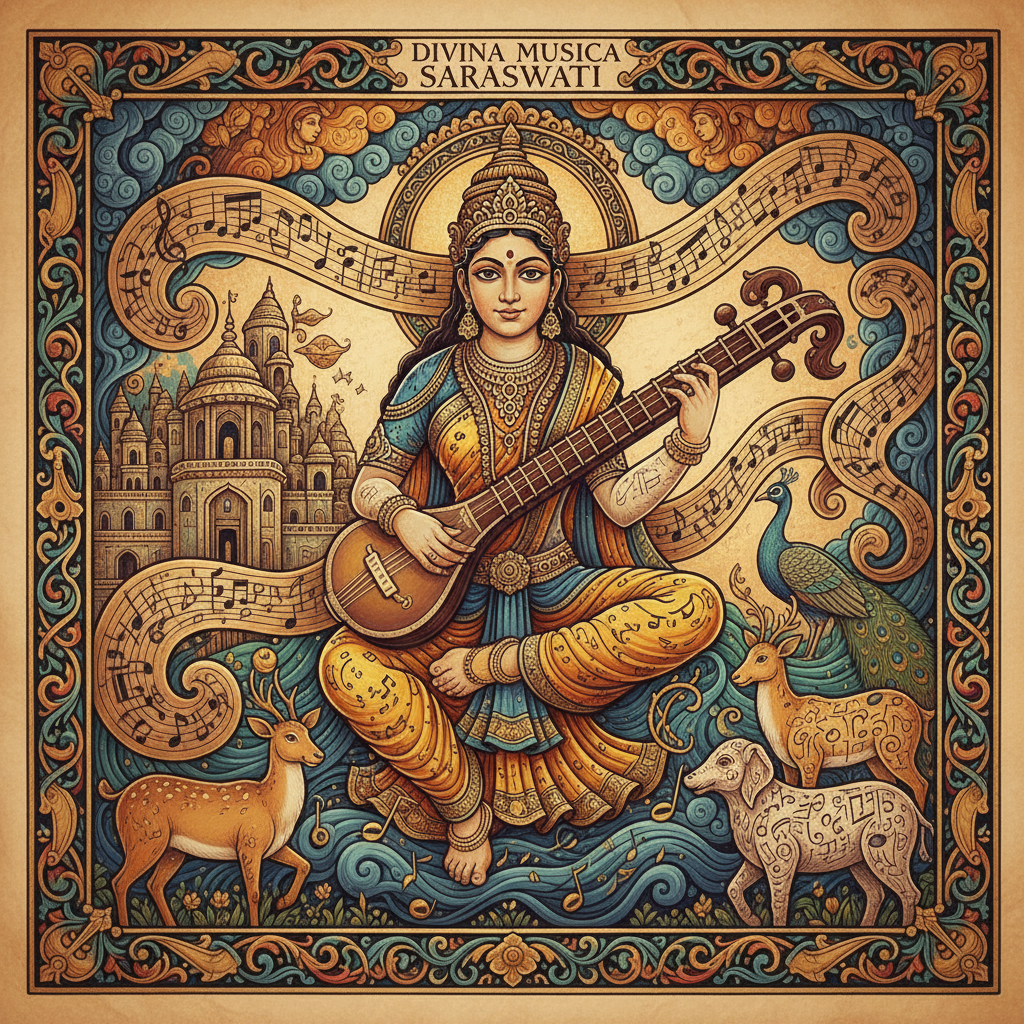
| Musician | Saraswati |
| Instrument | Veena |
| What Her Music Does | The sound of pure knowledge; her instrument IS the universe vibrating |
| Tradition | Hindu |
| Source | Rig Veda, Saraswati Stotram |
Saraswati sits on a white lotus in a white sari, playing the veena. She is the goddess of knowledge, music, art, and speech — and in Hindu philosophy, these are all the same thing. Knowledge IS music IS art IS speech. The veena has two gourds — one represents the material world, one the spiritual world. The strings connecting them are the bridge between the two. When Saraswati plays, she is literally vibrating the connection between matter and meaning. Every student who ever learned something felt her fingers move.
Goddess Saraswati seated on a white lotus in a flowing white sari with gold accents, playing an ornate veena, four arms with two hands on the instrument and two holding a book and prayer beads, a white swan beside her, a river of pure knowledge flowing from the veena's strings as visible golden vibrations, illuminated manuscript illustration of divine music, ornate border with lotus and book motifs, rich pigments, 8k --ar 1:1 --s 750 --v 6.16. Apollo vs Marsyas — The Price of Challenging a God
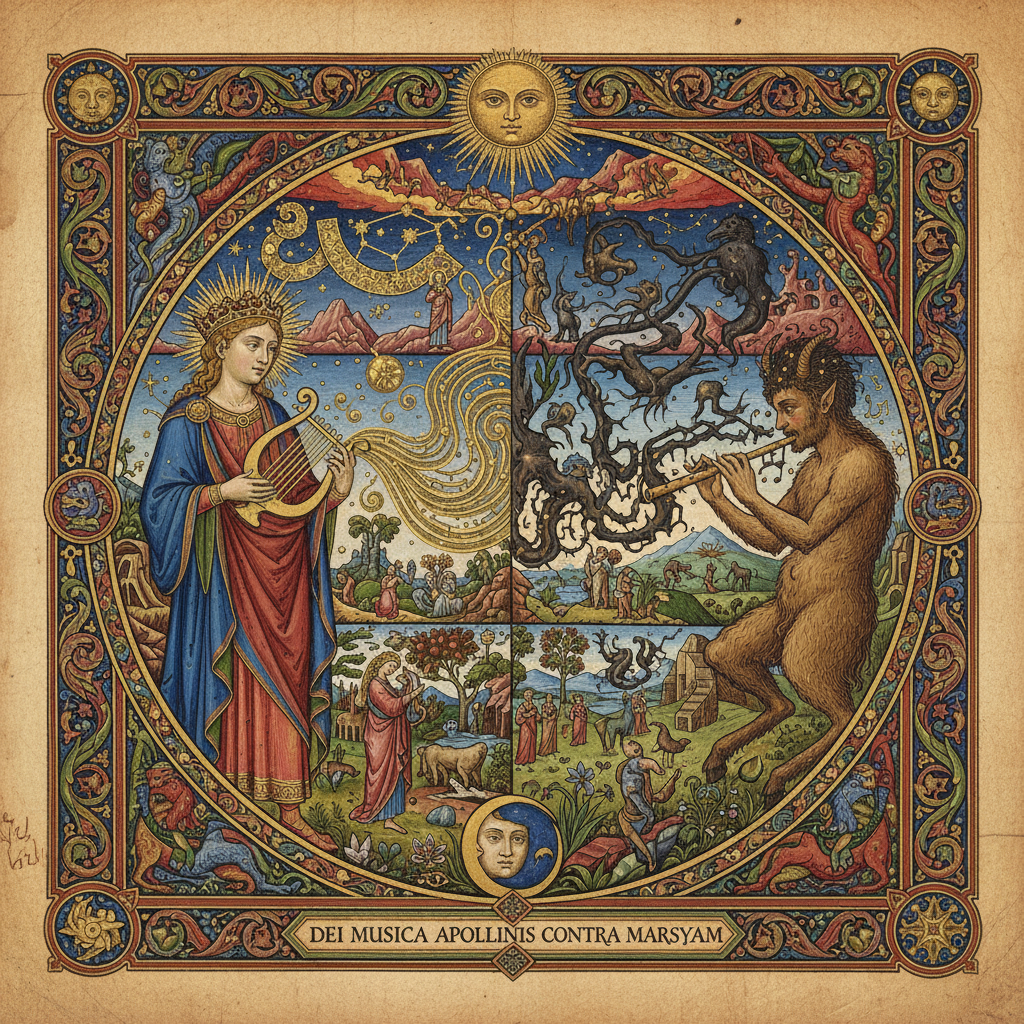
| Musician | Apollo (and Marsyas, who lost) |
| Instrument | Lyre vs aulos (double flute) |
| What Happened | The most brutal music competition in mythology |
| Tradition | Greek |
| Source | Ovid, Metamorphoses VI |
Marsyas found Athena’s discarded flute and became so good that he challenged Apollo — god of music — to a contest. They played evenly until Apollo turned his lyre upside down and kept playing. “Now you do that with your flute.” Marsyas couldn’t. He lost. Apollo’s prize: he flayed Marsyas alive. Every river that flows from that spot carries the satyr’s tears. The myth is savage because the lesson is savage: there is a difference between talent and divinity. Marsyas had talent. Apollo had the thing that talent tries to imitate.
Apollo in radiant golden robes playing his lyre with divine perfection while the satyr Marsyas lies defeated with his double flute fallen beside him, the Muses judging from their thrones, sound waves of golden light from Apollo's lyre overwhelming the earthly tones from Marsyas's flute, a dark foreshadowing of punishment in the shadows, illuminated manuscript illustration of divine music, ornate border with lyre and laurel motifs, rich pigments, 8k --ar 1:1 --s 750 --v 6.17. Vainamoinen and the Kantele — Songs That Reshape Reality
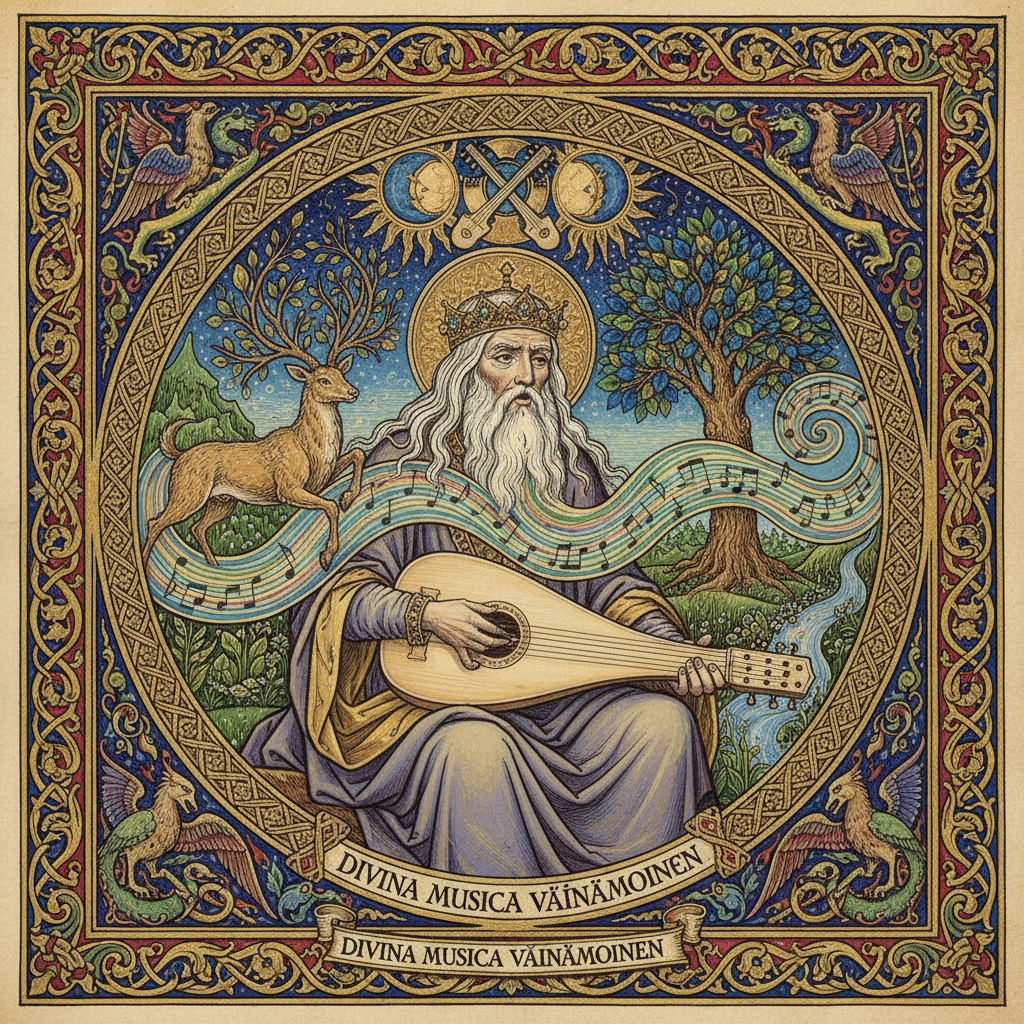
| Musician | Vainamoinen |
| Instrument | Kantele (made from a pike’s jawbone) |
| What His Music Does | His songs literally reshape physical reality |
| Tradition | Finnish |
| Source | Kalevala |
Vainamoinen is the eternal sage of Finnish mythology — born old, born singing. He made the first kantele from the jawbone of a giant pike, strung with the hair of a demon’s gelding. When he played, every creature in Finland stopped to listen. Bears came down from the mountains. Fish surfaced from the lakes. Trees bent toward the sound. Birds landed on his hands. His rival Joukahainen challenged him to a singing contest and Vainamoinen sang him into a swamp — literally. His words became reality. The ground opened and swallowed the challenger. In Finnish mythology, the poet doesn’t describe the world. The poet creates it.
The ancient sage Vainamoinen sitting by a Finnish lake playing a kantele made from a giant pike's jawbone, his long white beard flowing, all of nature enchanted -- bears descending from mountains, fish leaping from the lake, trees bending toward him, birds landing on his shoulders, the northern lights swirling in response to the music, illuminated manuscript illustration of divine music, ornate border with Nordic rune and pine motifs, rich pigments, 8k --ar 1:1 --s 750 --v 6.18. Ame-no-Uzume’s Dance — Laughter Saves the World
| Musician | Ame-no-Uzume |
| Instrument | Dance, drums, comedy |
| What Her Music Does | Lured Amaterasu from the cave, restoring light to the world |
| Tradition | Shinto |
| Source | Kojiki |
Amaterasu, the sun goddess, hid in a cave after her brother Susanoo’s violent tantrums, and the world went dark. The gods tried everything — prayers, offerings, arguments. Nothing worked. Then Ame-no-Uzume, the goddess of dawn and mirth, climbed onto an overturned tub and danced. Not a solemn ritual dance. A wild, bawdy, hilarious dance. She stripped. She stomped. The eight hundred gods laughed so hard the mountains shook. Amaterasu, alone in her cave, heard the laughter and thought: What could possibly be funny without me? Curiosity pulled the sun back into the sky. The world was saved by a comedienne.
The goddess Ame-no-Uzume performing a wild ecstatic dance on an overturned tub before the sealed cave of Amaterasu, eight hundred Shinto gods laughing uproariously around her, drums and stomping feet, a crack of brilliant golden light emerging from the cave as Amaterasu peeks out in curiosity, the world transitioning from darkness to dawn, illuminated manuscript illustration of divine music, ornate border with Shinto torii and sun motifs, rich pigments, 8k --ar 1:1 --s 750 --v 6.19. Odin’s Rune-Songs — Magic as Music
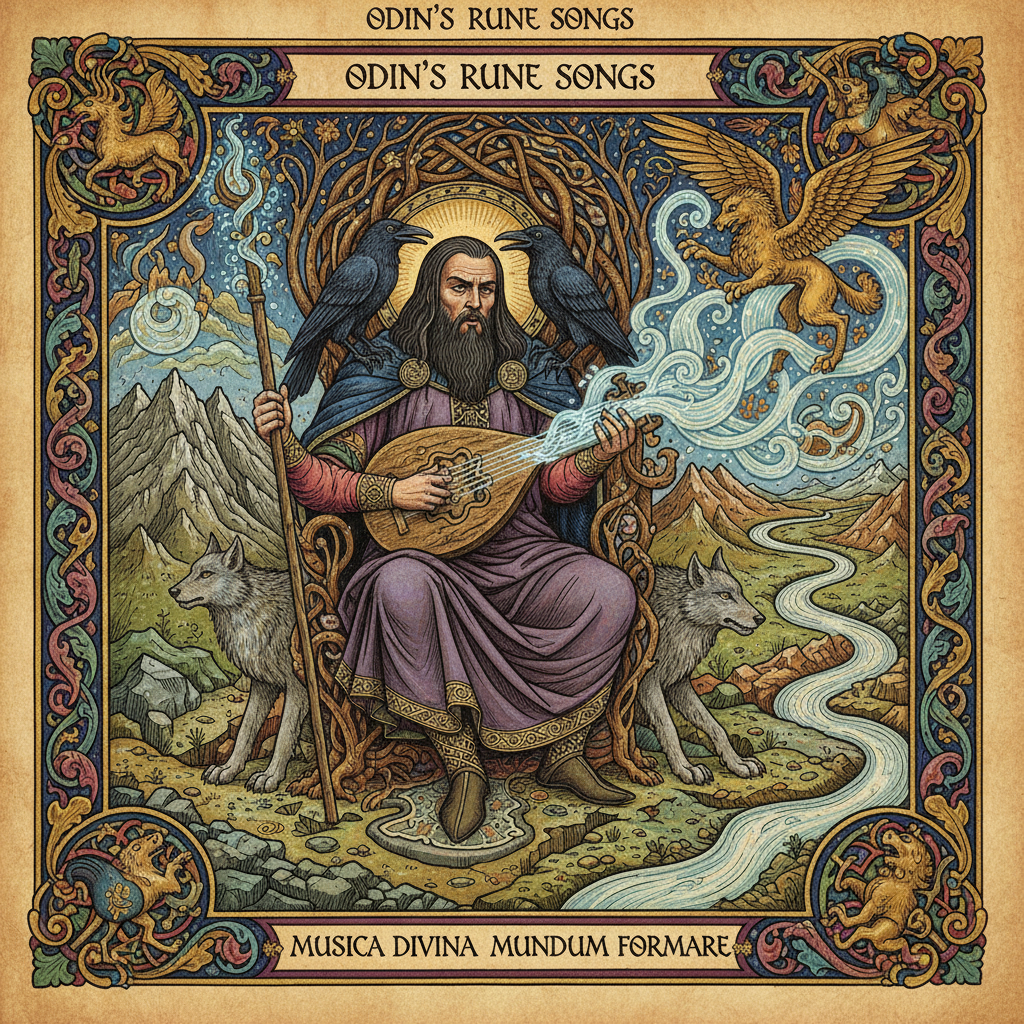
| Musician | Odin |
| Instrument | His voice (galdr — rune-chanting) |
| What His Music Does | The runes ARE songs; magic operates through chanting |
| Tradition | Norse |
| Source | Havamal (Poetic Edda) |
Odin hung himself on Yggdrasil for nine days and nights, pierced by his own spear, without food or water, to learn the runes. But the runes aren’t just symbols carved in stone — they are songs. The Havamal lists eighteen magical songs Odin learned: songs to heal, to bind enemies, to calm the sea, to make the hanged walk, to turn back arrows, to seduce, to wake the dead. Norse magic is called galdr — literally “chanting.” When Odin works magic, he sings. The runes on the page are just the sheet music.
Odin the All-Father hanging from the World Tree Yggdrasil, one eye missing, pierced by his own spear, his mouth open in a powerful chant as runic symbols materialize in the air around him glowing with blue-white fire, ravens Huginn and Muninn perched above, the nine worlds visible in the tree's branches, illuminated manuscript illustration of divine music, ornate border with Norse knotwork and rune motifs, rich pigments, 8k --ar 1:1 --s 750 --v 6.110. The Shaman’s Drum — The Heartbeat Between Worlds
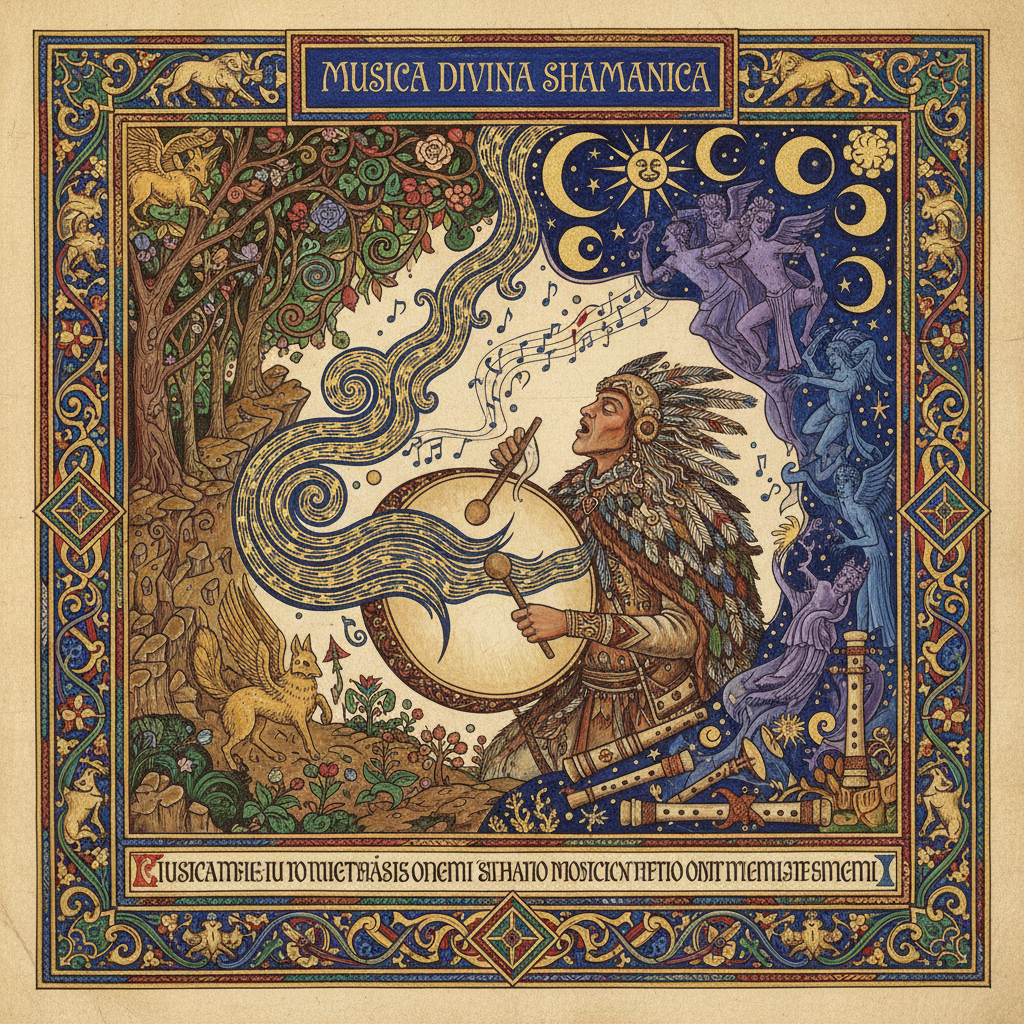
| Musician | The Shaman |
| Instrument | Frame drum |
| What Their Music Does | The “horse” that carries the shaman between worlds |
| Tradition | Siberian / Universal |
| Source | Mircea Eliade, Shamanism |
In Siberian shamanism, the drum is not an instrument. It is a horse. The shaman mounts the drum and rides it between the worlds — the drumbeat is the galloping of hooves across the sky. The frame is made from the wood of the World Tree. The skin is from the shaman’s spirit-animal. When the shaman beats the drum, the rhythm synchronizes with the heartbeat of the cosmos itself, and the barrier between this world and the spirit world becomes thin enough to cross. Every traditional culture on earth — from Siberia to Africa to the Americas — arrived at the same conclusion independently: a steady drum beat is the door between worlds.
A Siberian shaman in ceremonial reindeer-hide robes and antlered headdress beating a painted frame drum, the drum transforming into a spirit horse beneath them, the shaman ascending between three worlds -- the underworld below as roots, the middle world of forests and rivers, the upper world of stars and spirits above, visible sound waves creating a pathway between the realms, illuminated manuscript illustration of divine music, ornate border with shamanic symbols and animal spirits, rich pigments, 8k --ar 1:1 --s 750 --v 6.111. Om — The Sound Before Everything
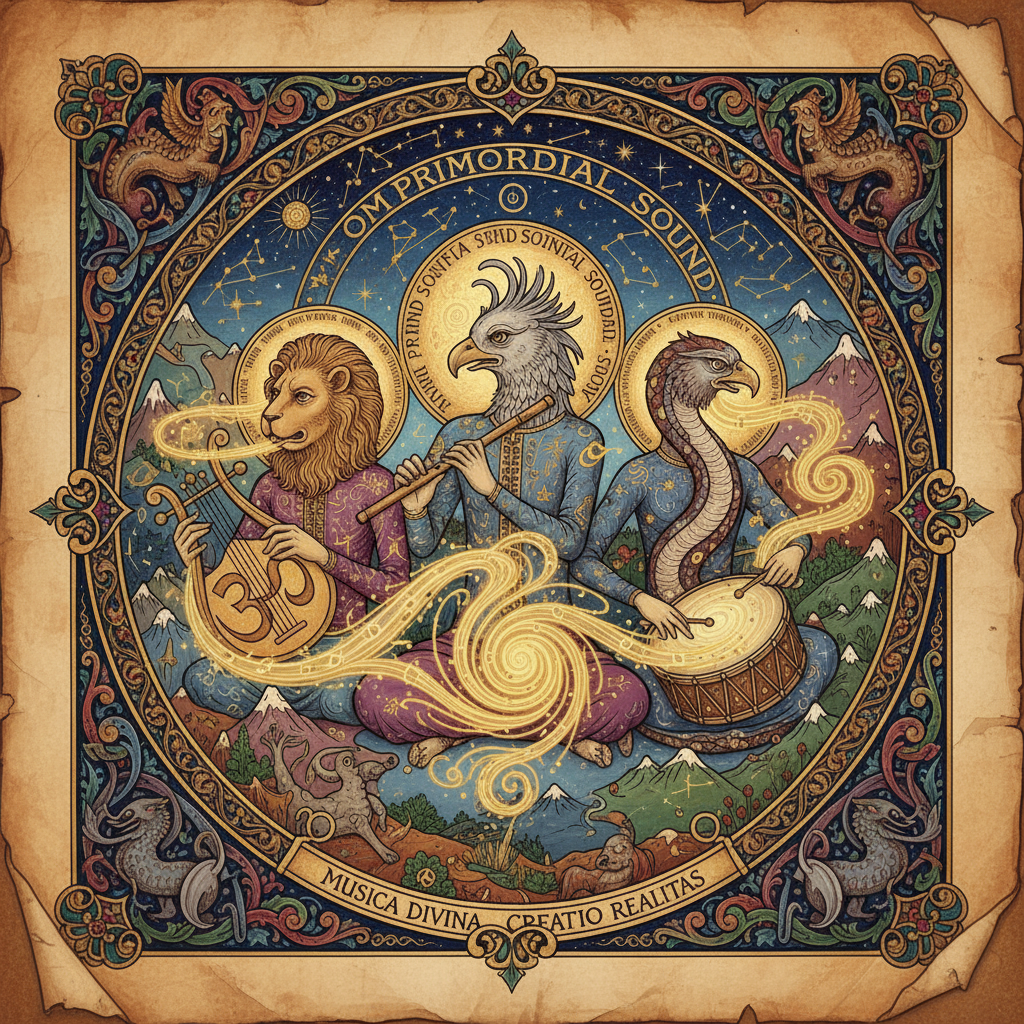
| Musician | The Universe |
| Instrument | The human voice |
| What It Does | The primordial sound of creation; the vibration from which all reality emanates |
| Tradition | Hindu / Buddhist |
| Source | Mandukya Upanishad |
Om is not a word. It is the sound the universe makes when it exists. The Mandukya Upanishad says the three phonemes — A, U, M — represent waking, dreaming, and deep sleep; creation, preservation, and destruction; past, present, and future. The silence after Om is the fourth state: turiya, pure consciousness beyond all categories. When a monk chants Om, they are not praying to God. They are vibrating at the same frequency as reality itself. Modern physics would agree: at the deepest level, everything is vibration. The Hindus just got there three thousand years earlier.
The sacred syllable Om rendered as a vast cosmic vibration emanating from the void, the Sanskrit symbol glowing at the center with golden light, concentric rings of sound creating the universe -- stars galaxies planets and life forming in the expanding waves, a meditating figure silhouetted at the source, the transition from silence to all of creation, illuminated manuscript illustration of divine music, ornate border with Sanskrit and mandala motifs, rich pigments, 8k --ar 1:1 --s 750 --v 6.112. The Gandharvas — Heaven’s Orchestra
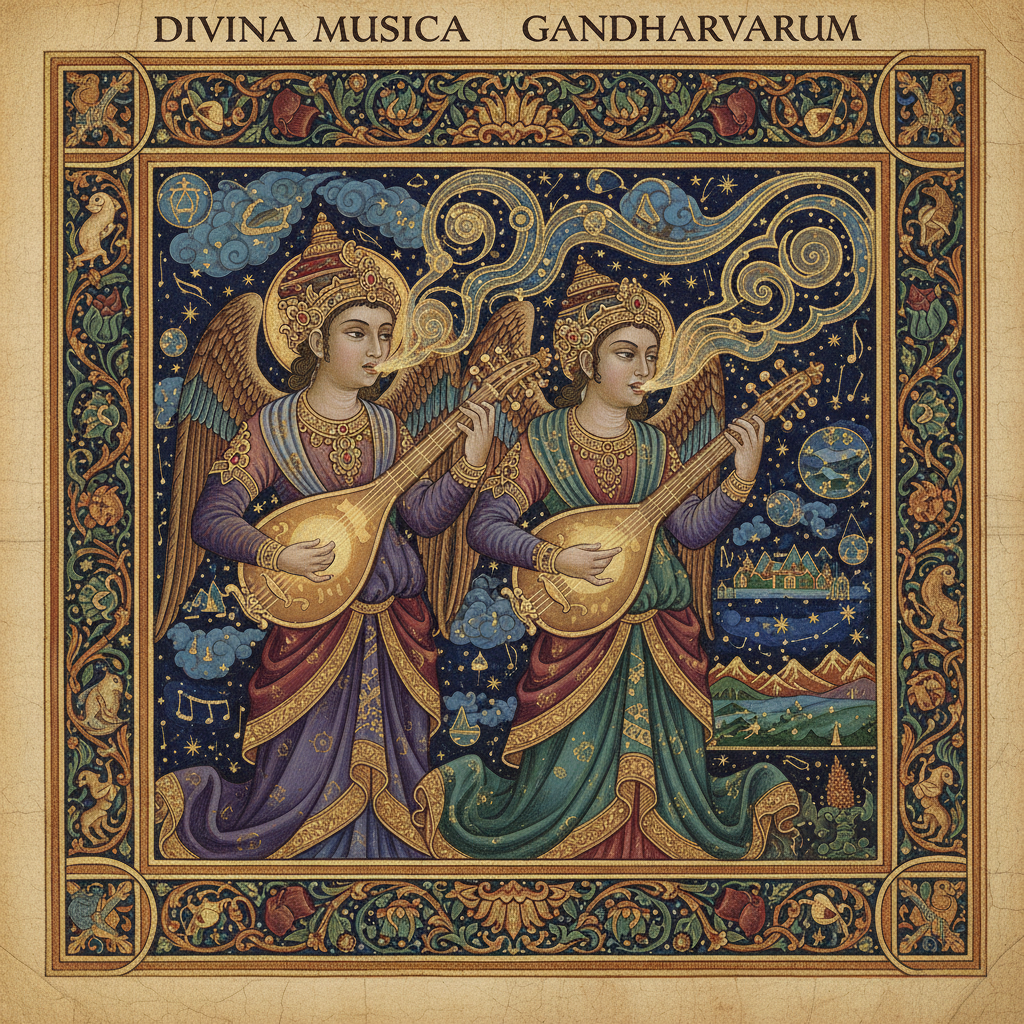
| Musician | The Gandharvas |
| Instrument | Various celestial instruments |
| What Their Music Does | Sustains the harmony of heaven; their music is the sound of cosmic order |
| Tradition | Hindu |
| Source | Rig Veda, Mahabharata |
The Gandharvas are the celestial musicians of Hindu mythology — divine beings whose sole purpose is to play music so beautiful that it maintains the harmony of the cosmos. They perform in Indra’s court, in the gardens of heaven, at every divine wedding and festival. Their music is not entertainment. It is infrastructure. Without the Gandharvas playing, the celestial order would fall apart. They are also dangerously seductive — their music can drive mortals mad with longing. Several of them married mortal women, and every one of those stories ended in heartbreak. The music of heaven was never meant for human ears.
A gathering of Gandharvas -- celestial musicians of Hindu mythology -- performing in the golden court of Indra in heaven, playing veenas, flutes, drums, and singing, their bodies luminous and adorned with divine jewels, clouds of incense and visible golden sound waves creating patterns of cosmic harmony, apsaras dancing around them, illuminated manuscript illustration of divine music, ornate border with celestial and lotus motifs, rich pigments, 8k --ar 1:1 --s 750 --v 6.1The Pattern
Every tradition arrived at the same discovery independently:
- Sound precedes matter. The universe was spoken, sung, or vibrated into existence. Not built. Not thought. Sounded.
- Music is not entertainment — it is technology. David’s harp heals. Orpheus’s lyre opens the gates of death. The shaman’s drum crosses worlds. These are not metaphors. These are engineering.
- The musician is always a threshold figure. David is shepherd AND king. Orpheus walks between life AND death. Odin hangs between worlds. The shaman exists in both realms simultaneously. Music lives in the liminal space.
- Challenging divine music is always fatal. Marsyas was flayed. Midas got donkey ears. Joukahainen was swallowed by the earth. The message: this power is not yours to claim.
- The most powerful instrument is the voice. Om. The spoken Word of God. Odin’s galdr. The Aboriginal songlines. Before there were instruments, there was the throat, the breath, the vibration of vocal cords. The first instrument was the one you were born with.
The universe is a concert. It always has been. Every tradition heard it. They just described it in different keys.