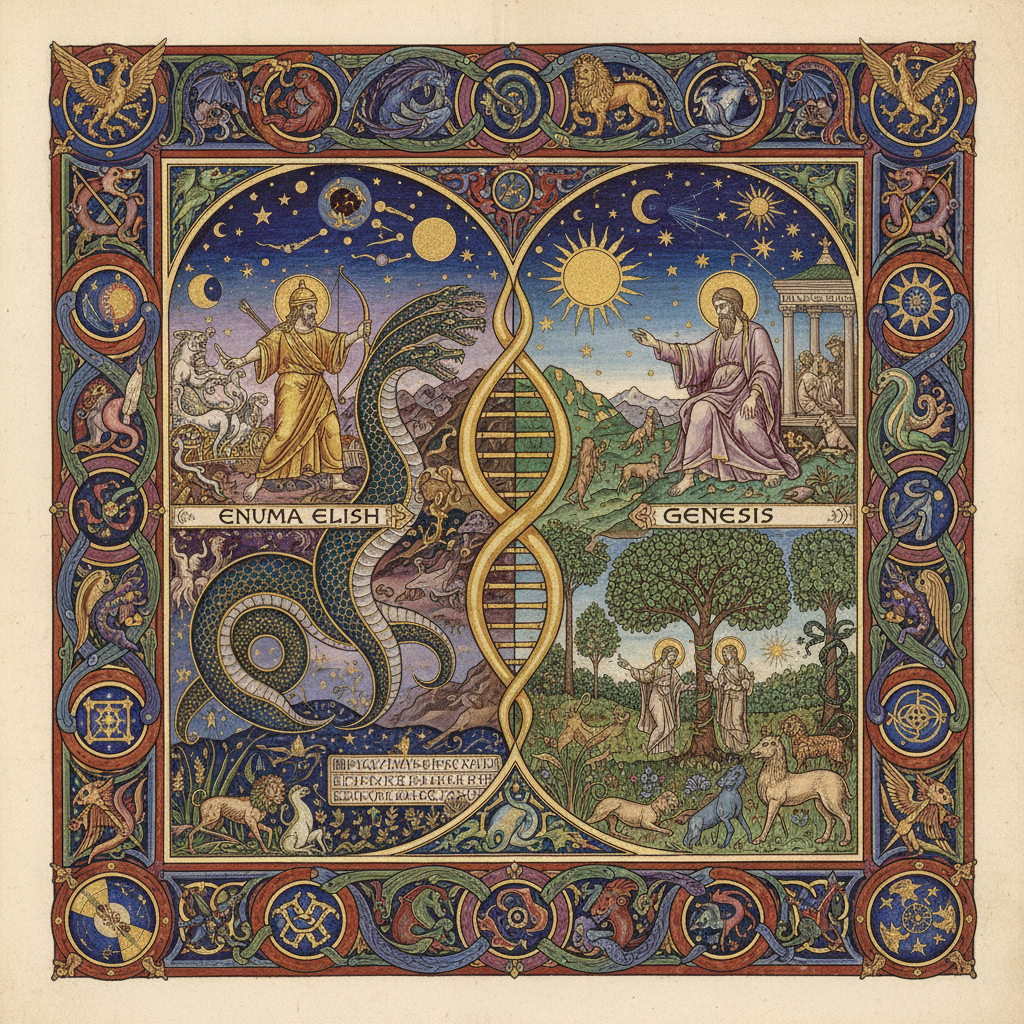
Part of the Bestiary Compendium | See also: Mesopotamian Entities
What this document is: Not summaries. Not “the Flood story is similar to Genesis.” The actual words. Set them beside each other and let them speak. Every passage below comes from a recognized scholarly translation. Judge for yourself.
Scholarly Positions
| Position | Who Holds It | Argument |
|---|---|---|
| Direct borrowing | Many critical scholars (e.g., Andrew George, W.G. Lambert) | The parallels are too specific, too sequential, and too textually close to be independent invention |
| Common cultural background | Others (e.g., John Day, Mark Smith) | Both traditions emerged from the same Fertile Crescent milieu; shared motifs don’t require direct literary copying |
| Divine revelation in both | Some theologians | God spoke to Mesopotamia as well as Israel, imperfectly, through the cultural forms available |
| Polemic: Genesis corrects Mesopotamia | Conservative scholars (e.g., John Walton, Kenneth Kitchen) | Genesis deliberately rewrites the myths: one God not many, creation by word not violence, flood from moral judgment not divine irritation |
The positions are not mutually exclusive. A text can borrow material and rewrite it polemically. The interesting question is not whether the parallels exist — they do — but what the biblical authors changed, and why.
Primary sources used in this document:
- Stephanie Dalley, Myths from Mesopotamia (Oxford University Press, 2008)
- Benjamin Foster, Before the Muses: An Anthology of Akkadian Literature (CDL Press, 2005)
- Alexander Heidel, The Gilgamesh Epic and Old Testament Parallels (University of Chicago Press, 1949)
- Andrew George, The Babylonian Gilgamesh Epic (Oxford University Press, 2003)
- W.G. Lambert & A.R. Millard, Atrahasis: The Babylonian Story of the Flood (Eisenbrauns, 1999)
I. The Flood: Gilgamesh XI vs. Genesis 6–9
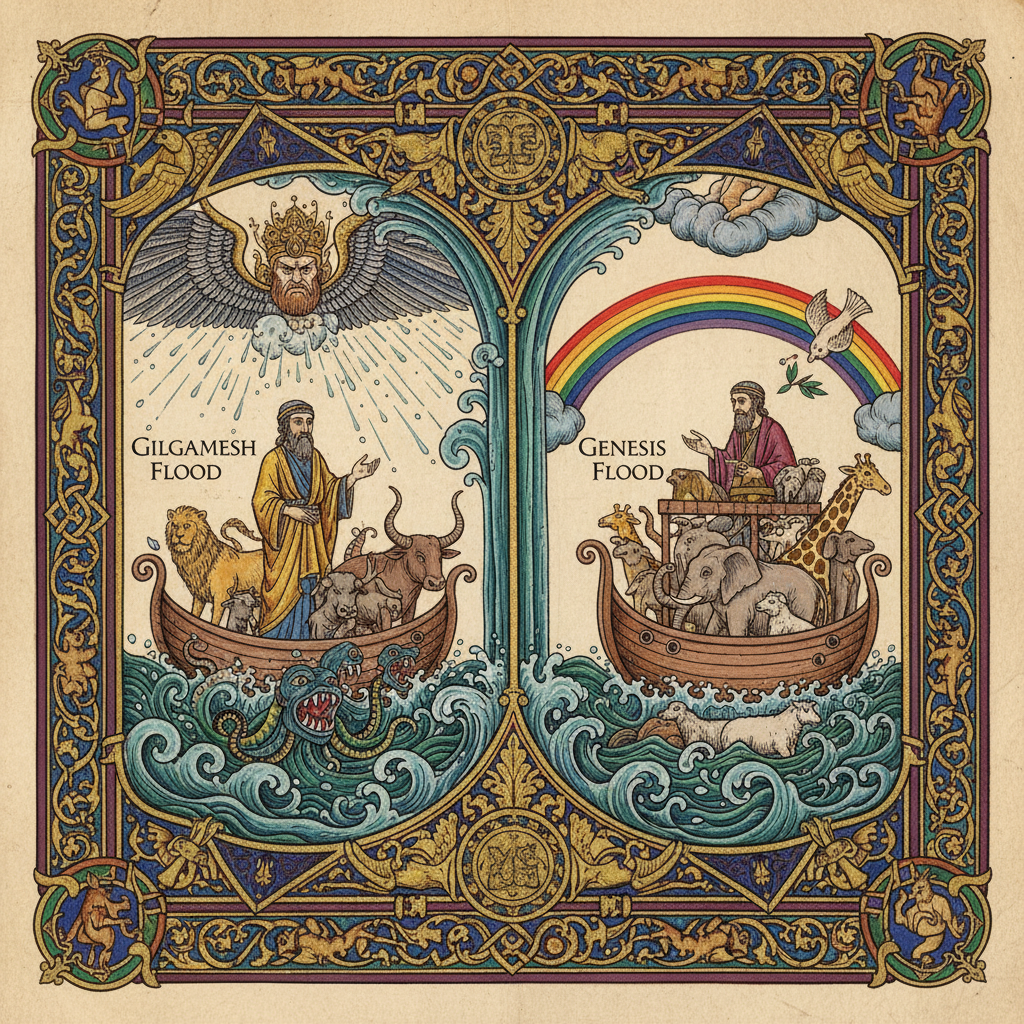
Gilgamesh Tablet XI (~1100 BCE Standard Babylonian version; underlying tradition ~2600 BCE) // Genesis 6–9 (~6th–5th century BCE final redaction)
1a. The Warning
Gilgamesh XI, lines 19–26 (trans. Dalley)
Wall, wall! Reed wall, reed wall!
Hear, O wall; pay attention, reed wall!
Man of Shuruppak, son of Ubar-Tutu,
Tear down the house, build a boat!
Abandon wealth, seek living beings!
Spurn possessions, save life!
Take on board the boat all living things’ seed.
The boat which you build —
Its dimensions shall be equal to each other.
(Enki/Ea cannot warn Utnapishtim directly — he swore not to reveal the gods’ plan to any human — so he speaks to a reed wall while Utnapishtim listens.)
Genesis 6:13–14 (ESV)
And God said to Noah, “I have determined to make an end of all flesh, for the earth is filled with violence through them. Behold, I will destroy them with the earth. Make yourself an ark of gopher wood. Make rooms in the ark, and cover it inside and out with pitch.”
Analysis: The structure is identical — a deity warns one righteous man, commands him to build a specific vessel, and the warning precedes the catastrophe. What differs is the mechanism of warning. In the Mesopotamian version, Enki is constrained by an oath and resorts to a legal fiction: he tells a wall, knowing Utnapishtim will hear. This preserves the technicality of the oath while subverting its intent — a characteristically trickster move by the god of wisdom. Genesis strips away the divine loophole entirely. YHWH speaks directly to Noah, without constraint, because no divine council has bound him. The single-deity theology of Genesis eliminates the institutional complexity that necessitates Enki’s workaround. Scholars note this as a deliberate theological simplification: the biblical version is less narratively complex precisely because monotheism makes the system cleaner.
1b. Building the Boat
Gilgamesh XI, lines 54–64 (trans. George)
I laid out the form of her body.
Six sar (acres) was her area, ten dozen cubits the height of each of her walls,
Ten dozen cubits square, her upper deck.
I laid out its structure, I drew it in a plan.
I gave it six decks,
Divided it into seven,
Divided its interior into nine.
I drove water-plugs into it,
I saw to the punting poles, and laid in what was needed.
Genesis 6:15–16 (ESV)
This is how you are to make it: the length of the ark 300 cubits, its breadth 50 cubits, and its height 30 cubits. Make a roof for the ark, and finish it to a cubit above, and set the door of the ark in its side. Make it with lower, second, and third decks.
Analysis: Both texts specify exact dimensions and multiple internal decks. Utnapishtim’s boat is a perfect cube (each wall equal) — 120 cubits on each side, giving six decks divided into seven, and the interior divided into nine parts: a sacred geometry of 6s, 7s, and 9s with religious significance in Mesopotamian numerology. Noah’s ark is rectangular, with a specific length-to-breadth-to-height ratio (300:50:30 = 10:5:3) and three decks. The specificity of both descriptions signals that these were technical documents in their original context — not vague “big boat” narratives but precise building instructions. Alexander Heidel, writing in 1949, identified this passage as the most convincing evidence of literary dependence: the probability that two independent traditions would independently specify exact dimensions, multiple decks, and interior divisions is vanishingly small.
1c. The Storm Begins
Gilgamesh XI, lines 97–106 (trans. Dalley)
When dawn came,
A black cloud rose from the horizon.
Adad rumbled inside it
While Shullat and Hanish went ahead,
Moving as heralds over hill and plain.
Errakal tore out the mooring poles,
Ninurta made the weirs overflow.
The Anunnaki gods lifted their torches,
Setting the land ablaze with their glow.
The tumult of Adad reached the heavens,
And all light was turned to darkness.
Genesis 7:11–12 (ESV)
In the six hundredth year of Noah’s life, in the second month, on the seventeenth day of the month, on that day all the fountains of the great deep burst forth, and the windows of the heavens were opened. And rain fell upon the earth forty days and forty nights.
Analysis: Both versions describe a catastrophic cosmological event, but the sources differ revealingly. The Mesopotamian storm is a committee effort: Adad, Shullat, Hanish, Errakal, Ninurta, and the Anunnaki gods all participate, each managing a different aspect of the destruction. The imagery is vivid and violent — torches lighting the land, mooring poles torn out, divine panic. Genesis is stripped of divine drama: just calendrical precision (“the seventeenth day of the second month”) and two sources of water — the deep and the sky. The Mesopotamian “fountains of the deep” (apsu) map directly onto Genesis 7:11’s “fountains of the great deep” (mayan tehom rabbah). Even the Hebrew lexicon retains the Mesopotamian hydraulic geography.
1d. The Bird Test
Gilgamesh XI, lines 145–155 (trans. George)
When the seventh day arrived,
I brought out a dove and set it free.
The dove went off and came back to me:
No perch was visible, so it circled back.
I brought out a swallow and set it free.
The swallow went off and came back to me:
No perch was visible, so it circled back.
I brought out a raven and set it free.
The raven went off, and saw the receding waters.
It ate, it scratched, it bobbed — it did not come back.
Genesis 8:6–12 (ESV)
At the end of forty days Noah opened the window of the ark that he had made and sent forth a raven. It went to and fro until the waters were dried up from the earth. Then he sent forth a dove from him, to see if the waters had subsided from the face of the ground. But the dove found no place to set her foot, and she returned to him to the ark… He waited another seven days, and again he sent forth the dove out of the ark. And the dove came back to him in the evening, and behold, in her mouth was a freshly plucked olive leaf. So Noah knew that the waters had subsided from the earth. Then he waited another seven days and sent forth the dove, and she did not return to him anymore.
Analysis: The bird test is the single most specific parallel in the entire flood comparison. Both versions: (1) send birds out sequentially, (2) use the birds’ return or non-return as the test for land, (3) include a raven. Gilgamesh uses dove, swallow, raven in that order; Genesis inverts to raven first, then dove three times. Scholars debate whether this is deliberate inversion (the biblical author knew the Gilgamesh order and changed it) or independent variant tradition. The raven in both texts does not return, having found food; the dove returns until it doesn’t. The narrative function — bird as surveyor of receding flood — is so specific that independent invention strains credulity. Benjamin Foster notes that the Atrahasis version does not include the bird test, while the Gilgamesh version does — and it is the Gilgamesh version, not Atrahasis, that Genesis most closely resembles at this point.
1e. The Sacrifice After
Gilgamesh XI, lines 155–165 (trans. Dalley)
I brought out an offering and offered it to the four winds;
I set up an incense offering on the summit of the mountain;
Seven and seven cult vessels I set up.
I heaped reeds, cedar, and myrtle in their censers.
The gods smelled the savor.
The gods smelled the sweet savor.
The gods gathered like flies around the one making sacrifice.
Genesis 8:20–21 (ESV)
Then Noah built an altar to the Lord and took some of every clean animal and some of every clean bird and offered burnt offerings on the altar. And when the Lord smelled the pleasing aroma, the Lord said in his heart, “I will never again curse the ground because of man…”
Analysis: “The gods smelled the sweet savor” and “the Lord smelled the pleasing aroma” — these passages are so close that Heidel called them “almost word-for-word.” The starving gods swarm “like flies” around the sacrifice in the Gilgamesh version — an image preserved by Dalley from the original Akkadian (kīma zibīti). Genesis strips this image entirely: YHWH smells the sacrifice, but he is alone, not swarming with fellow gods, and the sacrifice produces a response (covenant promise) rather than a feeding frenzy. The “flies” image reveals what the Genesis authors deleted: the polytheistic theology of gods who need human sacrifice for nourishment. The documentary tradition behind Genesis (particularly the Priestly source) is at pains throughout to deny that YHWH needs anything from humans. The transformation from “gods swarm like flies” to “the Lord smelled the pleasing aroma” is the difference between a theology of divine need and a theology of divine pleasure.
II. Creation: Enuma Elish vs. Genesis 1
Enuma Elish (~1100 BCE written form; underlying traditions ~1800–1600 BCE) // Genesis 1 (~6th century BCE Priestly source)
2a. The Opening Lines
Enuma Elish, Tablet I, lines 1–5 (trans. Dalley)
When on high the heavens had not been named,
Firm ground below had not been called by name,
Nothing but primordial Apsu, their begetter,
And Mummu-Tiamat, she who bore them all,
Their waters commingling as a single body.
Genesis 1:1–2 (ESV)
In the beginning, God created the heavens and the earth. The earth was without form and void, and darkness was over the face of the deep. And the Spirit of God was hovering over the face of the waters.
Analysis: Both texts begin with primordial waters that predate the organized cosmos. The Enuma Elish opens with a negative — “the heavens had not been named” — because in Babylonian thought, naming is creation: to name a thing is to bring it into existence. Genesis 1:1 opens with a positive assertion (“God created”), but by verse 2 we find the same primordial watery chaos, formless and dark. The Hebrew word tehom (“the deep”) in Genesis 1:2 is a direct linguistic cognate of the Akkadian Tiamat — they share the same Semitic root (thm, related to the deep sea). Whether the author of Genesis 1 knew Enuma Elish directly remains debated, but the cosmological framework is the same: the universe begins as undifferentiated watery darkness, and creation consists of imposing order on this chaos. John Walton (conservative) argues Genesis 1 is not about material creation but functional creation — bringing things into operation — which actually maps more closely onto the Babylonian cosmological worldview than the traditional Western “creation from nothing.”
2b. The Splitting of the Waters
Enuma Elish, Tablet IV, lines 135–140 (trans. Dalley)
He split her into two like a dried fish:
One half of her he set up and stretched out as the heavens.
He stretched the skin and appointed a watch
With the instruction not to let her waters escape.
He crossed the heavens and inspected the regions…
He made the lower waters into the earth.
Genesis 1:6–8 (ESV)
And God said, “Let there be an expanse in the midst of the waters, and let it separate the waters from the waters.” And God made the expanse and separated the waters that were under the expanse from the waters that were above the expanse. And it was so. And God called the expanse Heaven.
Analysis: Marduk splits Tiamat’s corpse in half: one half becomes the sky (which holds back her waters from above), the other becomes the earth. Genesis describes God creating an “expanse” (raqia) that separates waters above from waters below. The function is identical: a dividing structure that holds celestial waters above the visible sky, with terrestrial waters below. The mechanism is radically different: Genesis has no dragon, no corpse, no combat — just divine speech. Conservative scholars like John Walton argue this is precisely the point: the Priestly author of Genesis 1 is writing a polemic against the Enuma Elish. Where Babylonian creation is violent (dragon-slaying, corpse-splitting), Israelite creation is orderly (divine speech, naming, evaluation “it was good”). The same cosmic architecture — sky as barrier between upper and lower waters — is preserved, but the theology has been completely transformed. The universe is no longer the recycled body of a defeated chaos-monster; it is a deliberate, intentional, declared-good act of a sovereign God.
2c. The Creation of Humanity
Enuma Elish, Tablet VI, lines 1–8 (trans. Dalley)
When Marduk heard the speech of the gods
His heart prompted him and he made a wise suggestion:
“Blood I will mass and cause bones to be.
I will establish a savage, ‘man’ shall be his name.
Verily, savage-man I will create.
He shall be charged with the service of the gods
That they might be at ease!
I will cleverly alter the ways of the gods.”
(The god Kingu is executed; his blood, mixed with clay, becomes the substance from which humanity is fashioned.)
Genesis 2:7 (ESV)
Then the Lord God formed the man of dust from the ground and breathed into his nostrils the breath of life, and the man became a living creature.
Analysis: Both texts use material from the divine realm to create humanity — Kingu’s blood in Enuma Elish, the divine breath (neshamah) in Genesis 2:7. But the theological implication is inverted. In the Babylonian version, humans are created specifically to do the manual labor the lesser gods refuse — to dig canals, tend fields, and make sacrifices so the gods can rest. Humanity is a servant race, created from the blood of a rebel. In Genesis, humanity is created in God’s image (tselem), given dominion, and told to fill and subdue the earth. The human’s purpose is not divine service but divine co-regency. The contrast is stark: Babylonian humanity is made from a rebel to serve the gods; biblical humanity is made in God’s image to rule the earth. Where Enuma Elish creates the theological basis for human servitude and priestly hierarchy, Genesis creates the theological basis for human dignity. W.G. Lambert argued this contrast is the entire point of Genesis 1 — the Priestly source is writing a counter-narrative to the Babylonian creation cosmology encountered during the Exile.
III. The Fall: Adapa vs. Adam
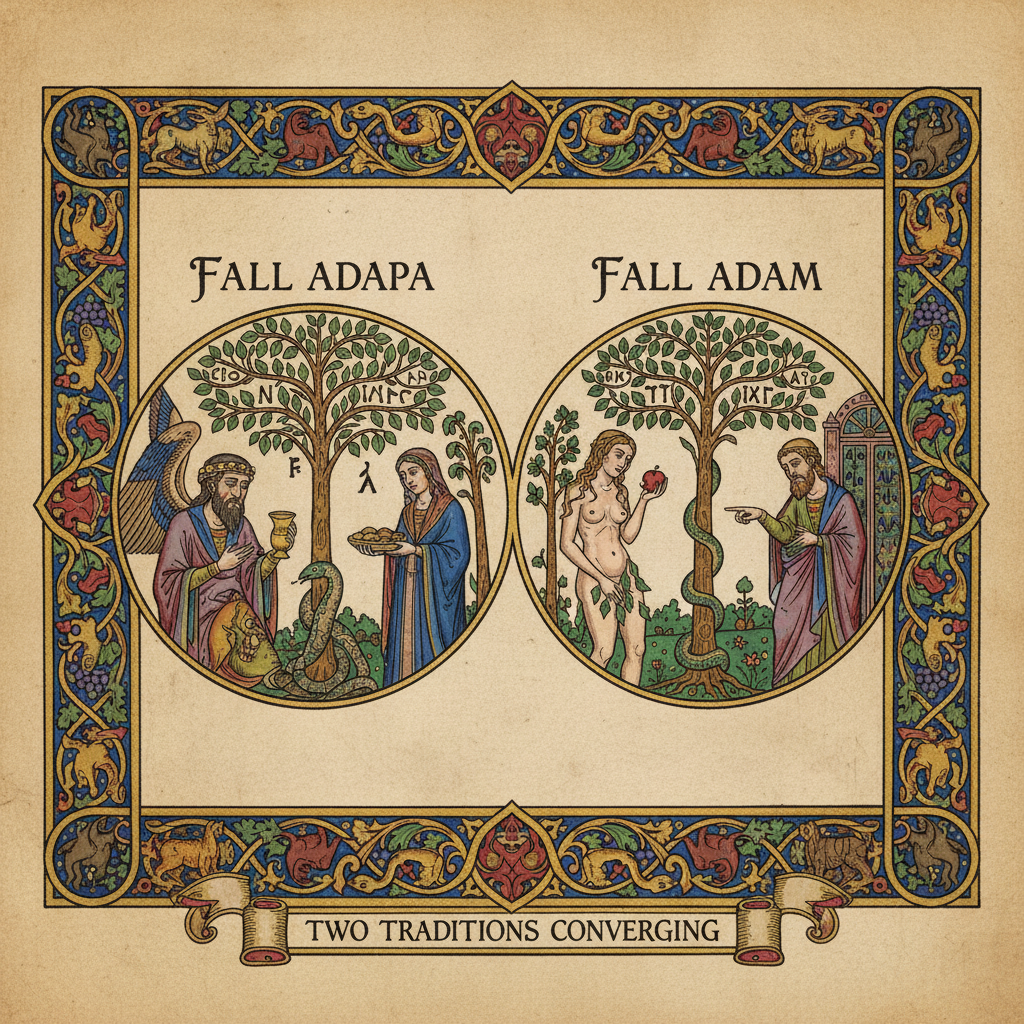
Adapa Myth (~14th century BCE Kassite period fragment; Tell el-Amarna version) // Genesis 2–3 (~10th–6th century BCE)
Adapa Myth, lines 60–75 (trans. Dalley)
Anu looked at Adapa and laughed.
”Come now, Adapa, why didn’t you eat, why didn’t you drink?
Will you not live? Are you not immortal?"
"Ea my lord told me: You shall not eat, you shall not drink."
"Take him away and return him to his earth.”
(Before Adapa’s summons to heaven, Enki had told him: “They will offer you the bread of death — do not eat it. They will offer you the water of death — do not drink it.” But what Anu actually offered was the bread and water of eternal life. Adapa, trusting his god, refused immortality and was returned to earth, mortal.)
Genesis 3:1–6, 22–23 (ESV)
Now the serpent was more crafty than any other beast of the field that the Lord God had made. He said to the woman, “Did God actually say, ‘You shall not eat of any tree in the garden’?” … So when the woman saw that the tree was good for food, and that it was a delight to the eyes, and that the tree was to be desired to make one wise, she took of its fruit and ate, and she also gave some to her husband who was with her, and he ate…
Then the Lord God said, “Behold, the man has become like one of us in knowing good and evil. Now, lest he reach out his hand and take also of the tree of life and eat, and live forever” — therefore the Lord God sent him out from the garden of Eden.
Analysis: Adapa and Adam are mirror images. Both are in a privileged relationship with a creator deity. Both face a moment involving food as the mechanism of gaining or losing immortality. Both are deceived — but in opposite directions, and the deceiver differs. Adapa is told by Enki not to eat or drink, because (Enki falsely implies) the food is deadly. He obeys and loses immortality. Adam is told by God not to eat the fruit of the knowledge tree; the serpent contradicts God; Adam disobeys and loses access to the tree of life. One man loses immortality through obedience; the other loses it through disobedience. Both stories agree on a deeper point: mortals were on the threshold of immortality and lost it through a divine interaction involving food and deception. The Mesopotamian version distributes the “fault” ambiguously — was Enki deceiving Adapa, or testing him, or was it a genuine misunderstanding? Genesis assigns fault clearly: the serpent deceives, humanity chooses, God judges. The moral architecture is sharpened. But the underlying mythological structure — food, divine trickery, lost immortality — is the same.
IV. The Law: Code of Hammurabi vs. Mosaic Law
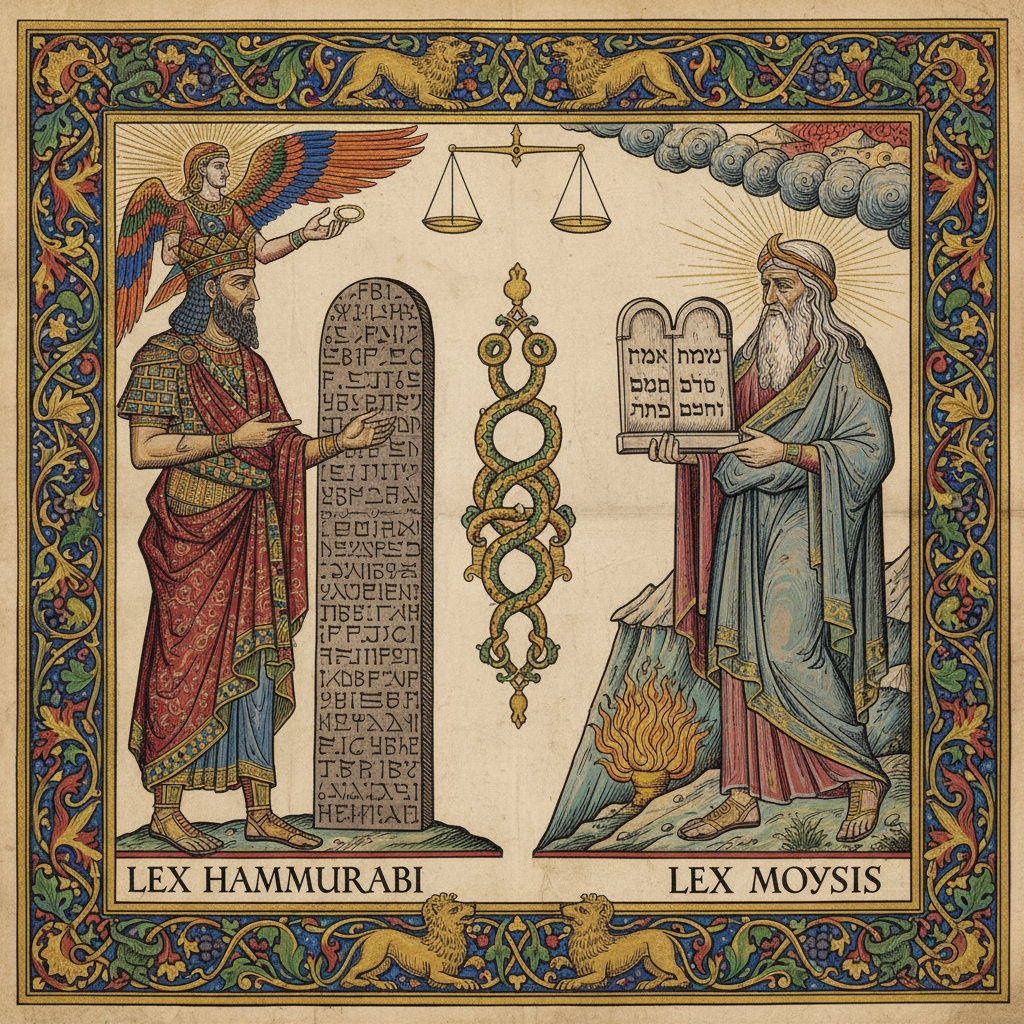
Code of Hammurabi (~1754 BCE, Babylon) // Exodus/Leviticus/Deuteronomy (~7th–5th century BCE final form; underlying traditions earlier)
4a. Lex Talionis — “An Eye for an Eye”
Code of Hammurabi, §196 (trans. Martha Roth)
If an awīlum has destroyed the eye of a member of the awīlum-class, they shall destroy his eye.
Code of Hammurabi, §197 (trans. Roth)
If he has broken the bone of an awīlum, they shall break his bone.
Exodus 21:23–25 (ESV)
But if there is harm, then you shall pay life for life, eye for eye, tooth for tooth, hand for hand, foot for foot, burn for burn, wound for wound, stripe for stripe.
Analysis: Lex talionis — proportional retaliation — appears in Hammurabi’s law code (§196–201) in almost identical form to Exodus 21:23–25, Leviticus 24:19–20, and Deuteronomy 19:21. Hammurabi dates to approximately 1754 BCE; the Exodus legislation, in its final form, dates to at least a millennium later. The principle itself (proportional, equivalent punishment) was common throughout the ancient Near East — it appears also in the Middle Assyrian Laws and the Hittite Laws. But the verbal and structural similarity between Hammurabi §196–201 and Exodus 21:23–25 is specific enough that most scholars conclude the biblical laws reflect a shared legal tradition with deep Mesopotamian roots, or possibly direct knowledge of Babylonian legal collections during the Exile. Critically, both Hammurabi and Exodus present the law as divinely given: Hammurabi receives his law code from the sun god Shamash, god of justice; Moses receives his from YHWH on Sinai. The claim of divine origin for law is the same; only the deity changes.
4b. The Goring Ox
Code of Hammurabi, §250–251 (trans. Roth)
If an ox gores a man while it is walking on the street and kills him, there is no basis for a claim. If a man’s ox was a known gorer and his city council informed him that it was a known gorer, but he did not blunt its horns or control his ox and then that ox gores a member of the awīlum-class and kills him, he shall give 30 shekels of silver.
Exodus 21:28–30 (ESV)
When an ox gores a man or a woman to death, the ox shall be stoned, and its flesh shall not be eaten, but the owner of the ox shall not be liable. But if the ox has been accustomed to gore in the past, and its owner has been warned but has not kept it in, and it kills a man or a woman, the ox shall be stoned, and its owner also shall be put to death. If a ransom is imposed on him, then he shall give for the redemption of his life whatever is imposed on him.
Analysis: The parallel here is near-verbatim: both codes distinguish between (1) a first-offense goring ox, where the owner is not liable, and (2) an ox with a known history of goring, where the owner was warned and did not act, making him liable for damages or death. This level of legal specificity — the same scenario, the same two-tier liability structure, the same “previous warning” standard — is not coincidental. Scholars including Raymond Westbrook and Bruce Wells have argued for a shared legal tradition across the ancient Near East, sometimes called the “common law of the ancient Near East.” The biblical law differs from Hammurabi in a crucial detail: Hammurabi’s code scales liability by social class (a goring death of a commoner costs less than a goring death of an aristocrat); the Mosaic law applies the same standard regardless of victim’s status. This is one of several places where biblical law apparently democratizes the Mesopotamian original, extending equal protection to all free males regardless of class.
V. Wisdom: Instructions of Shuruppak vs. Proverbs
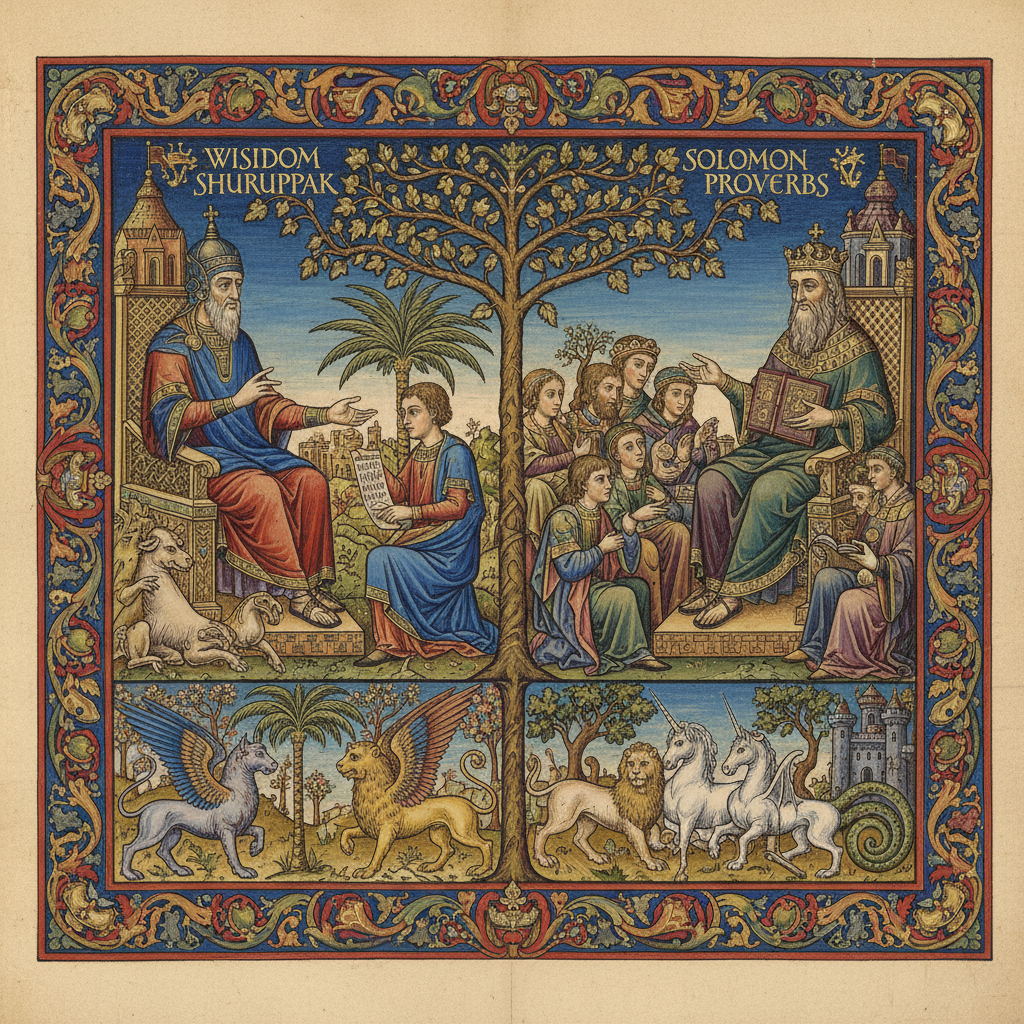
Instructions of Shuruppak (~2600 BCE original composition; surviving tablets ~1800 BCE) // Proverbs (~10th–5th century BCE)
5a. Against Theft from the Vulnerable
Instructions of Shuruppak, lines 50–52 (trans. Bendt Alster)
Do not steal anything; do not cut yourself off from your benefactor.
Do not commit robbery; do not cut off your own life.
You should not work with a pickaxe at the house of an alderman — a great man is in there.
Proverbs 22:22–23 (ESV)
Do not rob the poor, because he is poor, or crush the afflicted at the gate, for the Lord will plead their cause and rob of life those who rob them.
Analysis: Both texts prohibit theft, particularly from those who cannot protect themselves. The Shuruppak instruction adds a pragmatic warning: robbing a powerful man is self-destructive; robbing his alderman invites retaliation. Proverbs anchors the prohibition in divine justice: the Lord will defend the poor. The ethical command is the same; the motivation differs — practical self-preservation in Shuruppak, theological accountability in Proverbs. The Instructions of Shuruppak is addressed by a father to his son (Ziusudra, the Sumerian flood survivor) before the coming catastrophe — a framing device identical to Proverbs 1–9, which is structured as a father’s instruction to his son (“Hear, my son, your father’s instruction,” Prov 1:8). This generic framework — wise father, receptive son, practical-ethical maxims — is the definitive template of ancient Near Eastern wisdom literature, and the Shuruppak Instructions represent its oldest surviving example.
5b. Against Adultery
Instructions of Shuruppak, lines 33–34 (trans. Alster)
You should not have sexual intercourse with your friend’s wife.
The slander would be severe; your life would be cut short.
Proverbs 6:27–29 (ESV)
Can a man carry fire next to his chest and his clothes not be burned? Or can one walk on hot coals and his feet not be scorched? So is he who goes in to his neighbor’s wife; none who touches her will go unpunished.
Analysis: Both texts warn against adultery with a friend’s or neighbor’s wife, and both frame the warning in terms of self-destruction rather than abstract morality — you will be harmed. Shuruppak is blunt: your life will be cut short. Proverbs uses extended metaphor (fire, coals) to make the same point viscerally. The metaphorical elaboration is the biblical innovation; the core warning is identical in logic and framing. These parallels led the Assyriologist Bendt Alster to conclude that “the biblical wisdom tradition and the Sumerian wisdom tradition share not only genre and structure but specific ethical themes that were apparently pan-Near-Eastern commonplaces by the third millennium BCE.” This does not diminish the biblical text; it places it in its living cultural context — the Proverbs authors were participating in and transforming a conversation about ethics that had been running for over two thousand years.
VI. Suffering: Ludlul Bēl Nēmeqi vs. Job
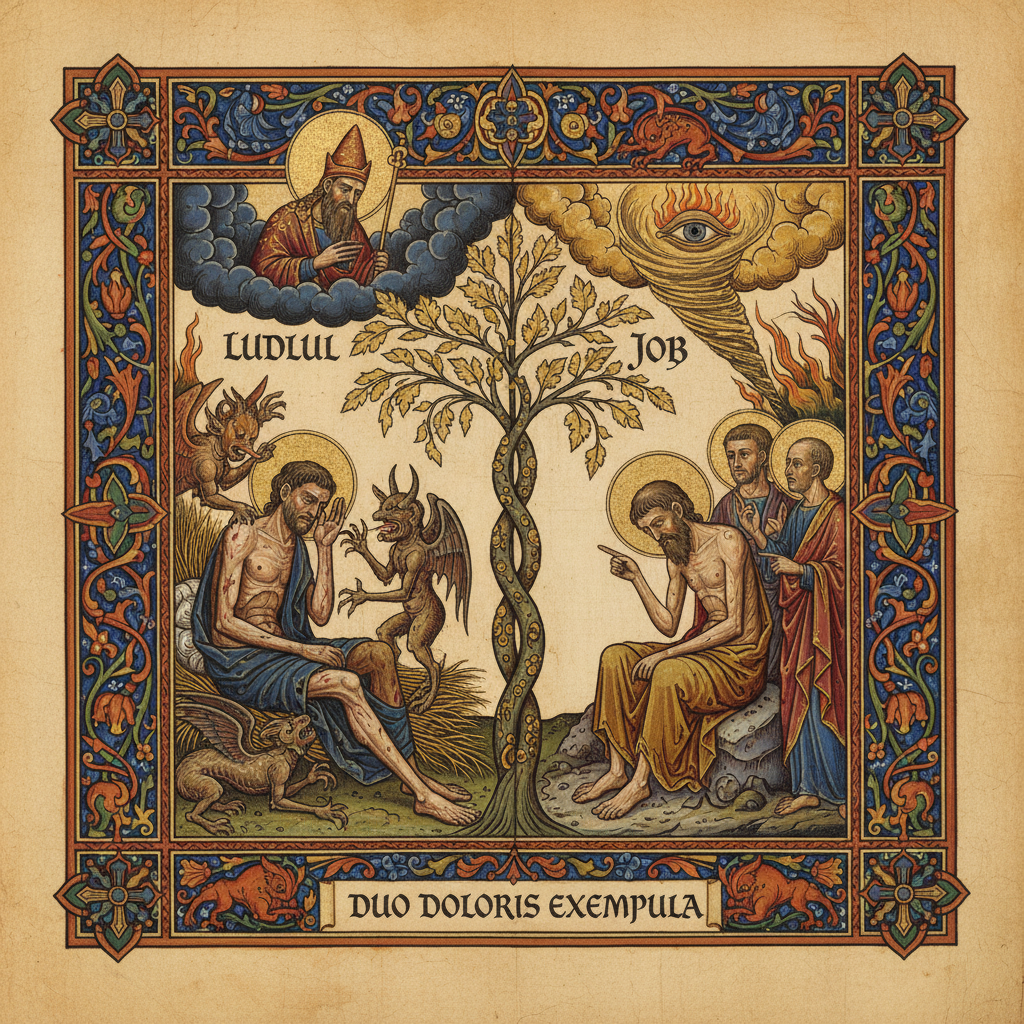
Ludlul Bēl Nēmeqi (“I Will Praise the Lord of Wisdom”) (~1200–1000 BCE Standard Babylonian) // Job (~5th century BCE, possibly earlier)
6a. The Righteous Sufferer
Ludlul Bēl Nēmeqi, Tablet I, lines 41–56 (trans. Foster)
I am one who has been thoughtful and prayerful,
Prayer was my custom, sacrifice my rule.
The day for venerating god was my delight,
The day of the goddess’s procession was my profit and wealth.
Veneration of the king was my joy,
And music for him was my pleasure.
I instructed my land to keep the god’s rites,
And provoked my troops to value the goddess’s name.
I made the king’s praise equal to god’s,
And taught the populace to revere the palace.
I wish I knew that these things were pleasing to one’s god!
What is proper to oneself is an offense to one’s god,
What in one’s own heart seems despicable is proper to one’s god.
Who knows the will of the gods in heaven?
Who understands the plans of the underworld gods?
Where have mortals learnt the way of a god?
Job 1:1, 8 (ESV)
There was a man in the land of Uz whose name was Job, and that man was blameless and upright, one who feared God and turned away from evil…
And the Lord said to Satan, “Have you considered my servant Job, that there is none like him on the earth, a blameless and upright man, who fears God and turns away from evil?”
Job 7:20–21 (ESV)
If I sin, what do I do to you, you watcher of mankind? Why have you made me your mark? Why have I become a burden to you? Why do you not pardon my transgression and take away my iniquity? For now I shall lie in the earth; you will seek me, but I shall not be found.
Analysis: Ludlul Bēl Nēmeqi — “I Will Praise the Lord of Wisdom” — is the Babylonian Job. Its protagonist, a nobleman named Shubshi-meshre-Shakkan, is a devout man who has performed every religious duty faithfully. He loses his position, his health, his servants, and his social standing. He cannot understand why. He rehearses his piety. He questions whether he can know the gods’ will at all. He suffers visitations of illness described in vivid, devastating physical detail. And then, in the final tablet, the god Marduk sends three dream-messengers who restore him. The structural parallel to Job is exact: righteous man, catastrophic loss, questioning of divine justice, restoration. Even specific theological problems are shared: both texts wrestle with the question of whether a man can know what his god requires, or whether divine will is simply inscrutable. “What is proper to oneself is an offense to one’s god” (Ludlul I) is the Babylonian formulation of the same problem Job dramatizes at length. W.G. Lambert, who produced the critical edition of Ludlul, argued that the Babylonian text and the biblical Job represent independent treatments of a pan-Near-Eastern wisdom theme: the crisis of theodicy that confronts any thoughtful person in any religious tradition.
6b. The Physical Suffering
Ludlul Bēl Nēmeqi, Tablet II, lines 49–60 (trans. Foster)
My eyes fixed and did not move,
They opened wide but could not see.
My ears pricked but could not hear,
Weakness fell over my whole body.
My limbs lay stretched out and were stiff.
I spent the night in my dung like an ox,
I wallowed in my excrement like a sheep.
The exorcist was frightened at what ailed me,
And the diviner looked at the omens in perplexity.
Job 7:3–5 (ESV)
So I am allotted months of emptiness, and nights of misery are apportioned to me. When I lie down I say, “When shall I arise?” But the night is long, and I am full of tossing till the dawn. My flesh is clothed with worms and dirt; my skin hardens, then breaks out afresh.
Analysis: Both texts deploy graphic physical suffering as the evidence of divine abandonment. Shubshi-meshre-Shakkan lies in his own waste like an animal; Job is covered in worms and broken skin. Both use bodily degradation to make the theological question visceral and unavoidable: if this man is righteous, and he suffers like this, what does that say about divine justice? The Babylonian text is remarkable for its clinical detail of the illness — modern scholars have attempted, with partial success, to identify the disease described. The Job text is more metaphorically dense but equally graphic. Both serve the same literary-theological function: to force the reader to feel the problem, not just analyze it intellectually. Theodicy as embodied experience, not abstract argument.
VII. Pleasure: Siduri’s Speech in Gilgamesh vs. Ecclesiastes
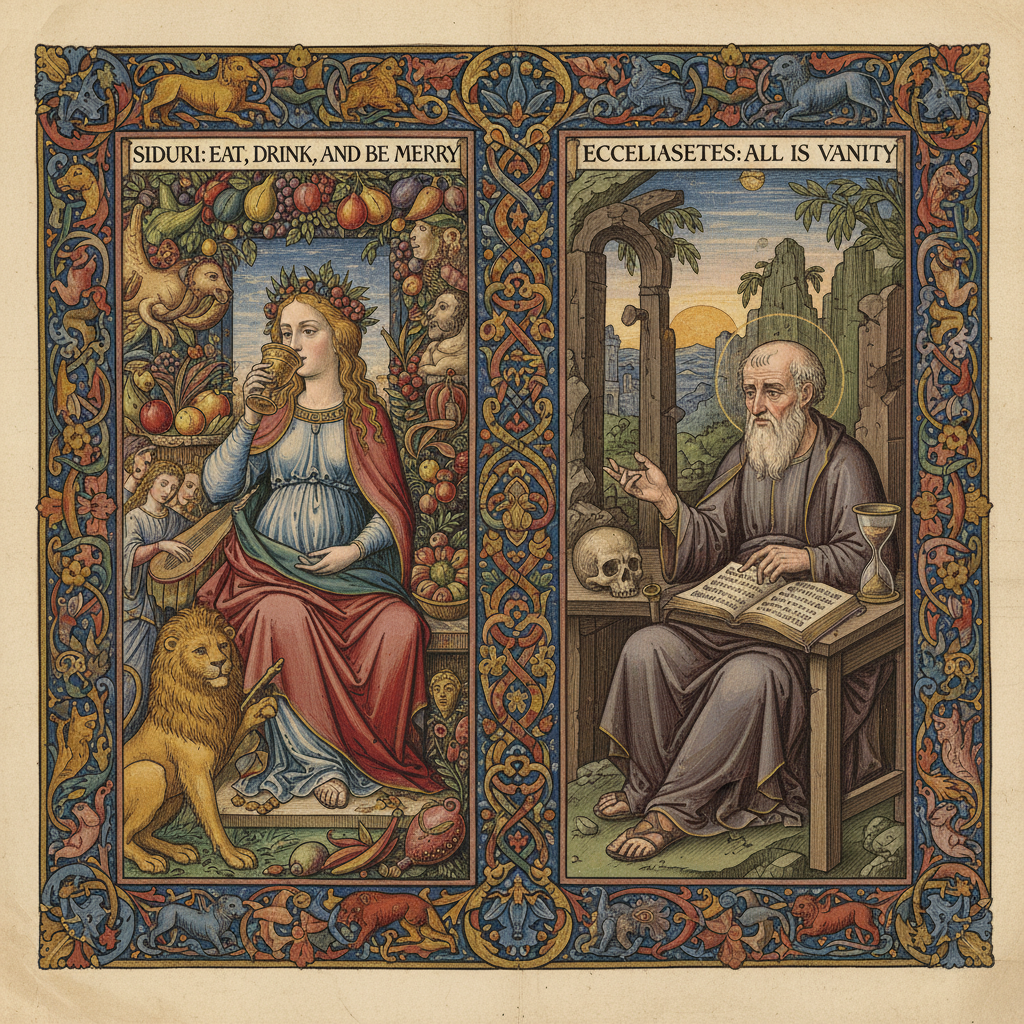
Epic of Gilgamesh, Tablet X (~1100 BCE Standard Babylonian version) // Ecclesiastes (~4th–3rd century BCE)
Gilgamesh X, Old Babylonian version, lines 1–14 (trans. George)
Gilgamesh, where are you hurrying to?
You will never find the life you are looking for.
When the gods created mankind,
They allotted death to mankind,
But life they retained in their own keeping.
As for you, Gilgamesh,
Let your belly be full,
Make merry day and night.
Of each day make a feast of rejoicing,
Day and night dance and play!
Let your garments be sparkling fresh,
Your head be washed; bathe in water.
Pay heed to the little one that holds on to your hand,
Let your spouse delight in your embrace.
For this is the task of mankind.
(Spoken by Siduri, the divine tavern-keeper at the edge of the world, to Gilgamesh as he grieves Enkidu and searches for immortality.)
Ecclesiastes 9:7–9 (ESV)
Go, eat your bread with joy, and drink your wine with a merry heart, for God has already approved what you do. Let your garments be always white. Let not oil be absent from your head. Enjoy life with the wife whom you love, all the days of your vain life that he has given you under the sun, because that is your portion in life and in your toil at which you toil under the sun.
Analysis: This is the most verbally precise parallel in the entire document. Line by line: let your belly be full / eat your bread with joy. Make merry day and night / drink your wine with a merry heart. Let your garments be sparkling fresh / let your garments be always white. Let your head be washed / let not oil be absent from your head. Let your spouse delight in your embrace / enjoy life with the wife whom you love. The sequence, the imagery, and the philosophical conclusion are virtually identical: since death is inevitable and immortality is beyond reach, seize pleasure in the present. The Gilgamesh version precedes Ecclesiastes by at minimum 700 years in its written form (and the underlying tradition by far more). Scholars including Peter Machinist and Tremper Longman III have argued that the author of Ecclesiastes either knew a version of the Gilgamesh speech directly or was drawing from a shared wisdom tradition in which this “carpe diem” response to mortality was a standard intellectual position. What Ecclesiastes adds is the theological frame (“for God has already approved what you do”) — the pleasure is not merely pragmatic but divinely permitted. Where Siduri speaks as a tavern-keeper at the edge of the world with gentle pragmatism, Qoheleth speaks as a philosopher in the shadow of the divine, but they reach the same conclusion: this — the bread, the wine, the spouse, the ordinary day — is the task of mankind.
Summary: What Changes, What Stays
| Parallel | What Mesopotamia Says | What the Bible Changes | Why It Matters |
|---|---|---|---|
| The Flood | Gods sent it because humans were noisy | God sent it because of human wickedness | Transforms caprice into moral justice |
| Creation | World made from dragon’s corpse by combat | World spoken into being by divine word | Creation becomes intentional, not incidental |
| Humanity’s origin | Made from rebel-god’s blood to serve the gods | Made in God’s image to rule creation | Human dignity vs. human servitude |
| Lost immortality | Adapa deceived into obedience, loses eternal life | Adam deceived into disobedience, loses access to eternal life | Both: food, deception, mortality — inverted moral |
| Law | Class-based justice; poor worth less | Lex talionis applied equally to all free males | Proto-democratic legal reform |
| Wisdom | Practical self-preservation ethics | Same ethics grounded in divine accountability | Motivation changes; the advice stays the same |
| Suffering | Gods are inscrutable; piety offers no guarantee | God is sovereign; suffering remains mysterious but personal | Same problem; different relational framework |
| Pleasure | Seize the day; death is the gods’ domain | Seize the day; God has already approved your joy | Same conclusion; theological legitimation added |
See also: Mesopotamian Entities | Biblical Entities | Podcast: The Flood Story