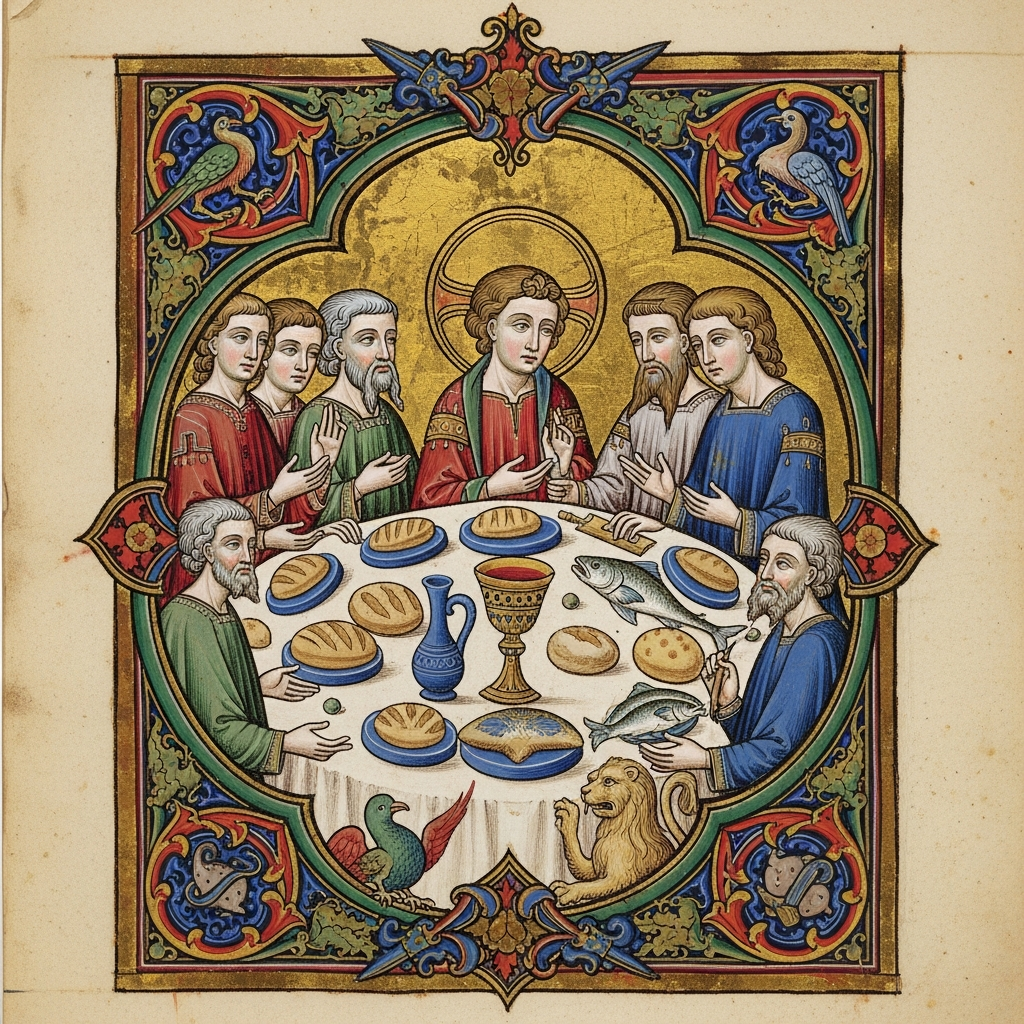
Part of the Bestiary Compendium
Food is the most democratic theology. You do not need to read, to travel, to belong to the right lineage, to speak the right language. You need only to eat. And every tradition on earth has looked at this most animal of necessities — the body’s insistence on being fed — and decided it is sacred. Not despite its ordinariness. Because of it.
The sacred meal says: the divine comes here. Not only to the temple, not only to the summit of the mountain, not only in the voice from the burning bush. The divine comes to the table. It comes in dates broken at sunset. It comes in bread that a priest has blessed. It comes in sweetened water stirred with a sword. It comes in a meal served to strangers on the floor of a gurdwara. It comes in the body of a boar that regrows every morning, and in the nectar that makes a god immortal, and in food placed on an ancestor’s grave because the dead, apparently, still need to eat.
The sacred meal is where religion stops being abstract.
Art style:
illuminated manuscript illustration of a sacred feast, warm golden candlelight, rich food and sacred vessels, community and ritual, gold leaf accents, ornate border, medieval bestiary styleSacred Meals — Every Tradition’s Table
| Meal | Tradition | What’s Eaten | What It Means | Source |
|---|---|---|---|---|
| The Eucharist / Communion | Christian | Bread and wine | Body and blood of Christ; remembrance and presence | Matt 26:26-28 |
| The Passover Seder | Jewish | Lamb, matzah, bitter herbs, wine | Remembrance of the Exodus; “Why is this night different?” | Exodus 12 |
| Iftar | Islamic | Dates, water, then a full meal | Breaking the Ramadan fast; gratitude and community | Hadith |
| Prasad | Hindu | Fruit, sweets offered to deity then shared | Food blessed by God, distributed to worshippers | Various |
| The Langar | Sikh | Full meal served to ALL regardless of faith or caste | Radical equality; everyone sits on the floor together | Guru Nanak |
| Dana/Alms | Buddhist | Monks receive food from laypeople | The giving IS the spiritual practice; non-attachment | Vinaya |
| The Feast of Valhalla | Norse | Meat of Saehrimnir (eternally regenerating boar), mead | Warriors feast and fight daily, preparing for Ragnarok | Prose Edda |
| The Agape Feast | Early Christian | A full communal meal (not just bread/wine) | Love feast; the original form of communion before it was ritualized | Jude 1:12 |
| Amrit | Sikh | Sweetened water stirred with a double-edged sword | Baptism into the Khalsa; the warrior-saint’s first drink | Khalsa tradition |
| Soma/Haoma | Vedic/Zoroastrian | An unidentified psychoactive plant drink | Contact with the divine; the priests drank it during rituals | Rig Veda, Avesta |
| The Churning of the Ocean — Amrita | Hindu | The nectar of immortality | Gods and demons churned the primordial ocean to produce it | Bhagavata Purana |
| Chinese Ancestor Offerings | Chinese | Full meals placed at graves/altars | Feeding the dead; they still need to eat | Chinese folk religion |
What Sacred Eating Does
Every tradition uses the sacred meal to accomplish something different — and the same.
It collapses the distance between human and divine. When the Eucharist priest says this is my body, bread becomes something else entirely. When the worshipper eats prasad, she is eating what God has already touched. When the Buddhist layperson places food in the monk’s bowl, she is feeding something that points beyond itself. The physical act of eating becomes a transaction with the invisible.
It creates equality. The Langar serves the same food to everyone: the highest-caste Brahmin and the untouchable, the Sikh and the stranger, the king and the beggar. You cannot claim superiority when you are eating the same dal on the same floor. The sacred meal is the great leveler. Guru Nanak understood this. The table is the one place where hierarchy becomes indefensible.
It defeats time. The Passover Seder is designed to make the Exodus present, not past. The Haggadah says: “In every generation, each person is obligated to see themselves as if they personally left Egypt.” The Seder is not a commemoration of something that happened. It is a mechanism for making it happen again, here, tonight, with this bitter herb on this tongue. Sacred eating is time travel by another name.
It feeds the dead. This is the oldest function and the strangest to modern minds. Chinese ancestor offerings, the Norse feast in Valhalla, the food left on graves across a hundred traditions — all of them proceed from the same premise: the dead are still somewhere, and they are still hungry. The meal extends across the boundary that everything else cannot cross.
It prepares for catastrophe. The warriors in Valhalla do not feast to celebrate peace. They feast because Ragnarok is coming and they must be ready. Amrit is drunk at the moment of initiation into a community that expects persecution. The Passover meal was eaten standing up, with sandals on, ready to move. Sacred meals at the edge of crisis are different from sacred meals in prosperity — they are not celebration but preparation.
1. The Eucharist — This Is My Body (Christian)
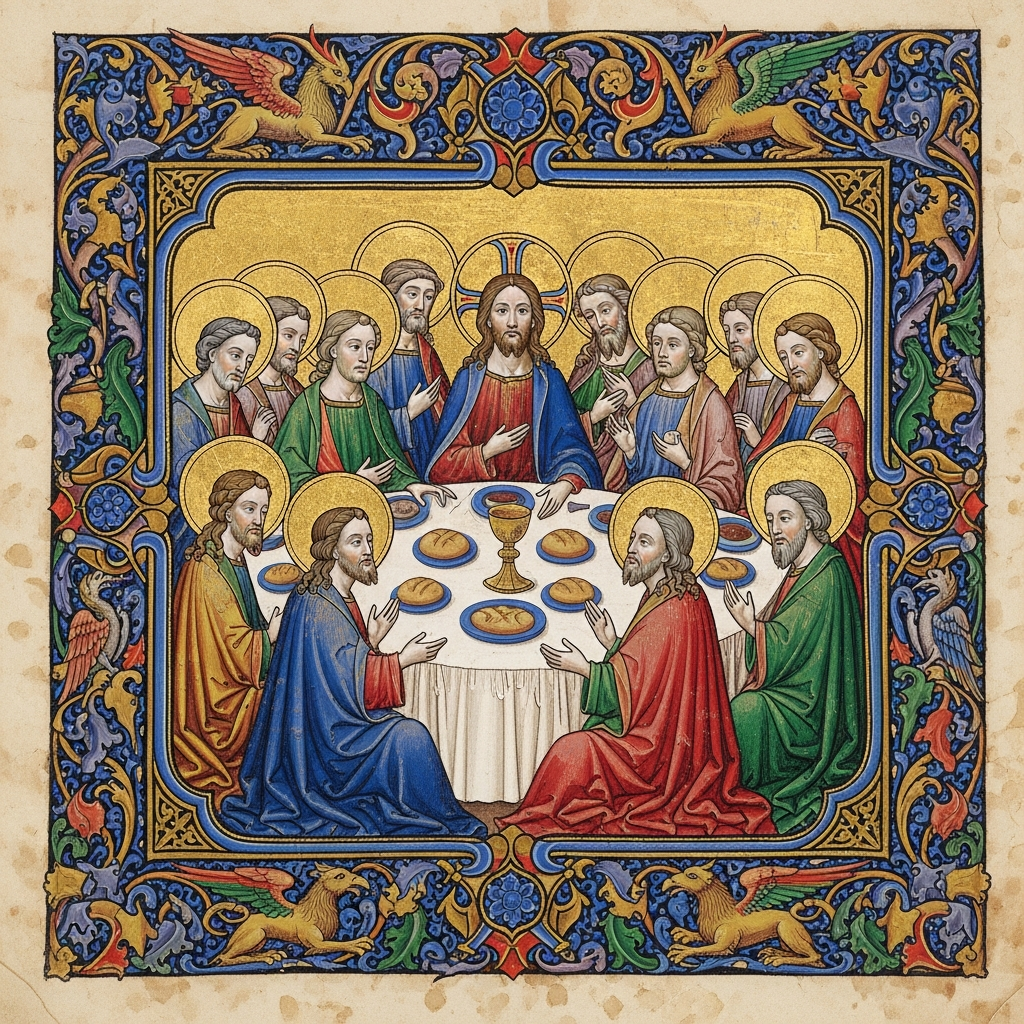
Matthew 26:26-28. The night before the crucifixion. Jesus takes bread, gives thanks, breaks it, and hands it to the twelve: “Take, eat; this is my body.” Then he takes the cup of wine: “Drink from it, all of you, for this is my blood of the covenant, which is poured out for many for the forgiveness of sins.”
He does not say: this represents my body. He says: this is my body.
What exactly happens in that moment of consecration has divided Christianity more completely than almost any other question. The Catholic and Orthodox traditions teach transubstantiation or its variants: the bread and wine become, in their substance, the actual body and blood of Christ — whatever their outward appearance remains. Protestant traditions teach memorial, or symbolic presence, or something between. The range of positions runs from “nothing at all changes in the bread” to “Christ is physically, entirely, truly present in the elements.”
Two thousand years of argument. Councils and confessions and wars. The Thirty Years’ War killed eight million people and one of its central axes was this question.
The meal itself is the simplest thing in the world. Bread. Wine. Words spoken over them. And then either: the most ordinary meal that has ever been called holy, or the most radical claim that has ever been made about a dinner table — that God is eaten, that the creator enters the creature through the act of eating, that the distance between human and divine collapses to nothing in the space between the chalice and the lips.
Every Sunday, one-third of the world’s population does this.
The Last Supper -- Jesus at the center of a long table breaking bread in the candlelit upper room, twelve apostles around him, some in quiet conversation, some watching, the bread held up in his hands still warm from breaking, the wine cups before each of them, his face calm and knowing what the night will bring, warm lamplight catching the texture of bread and the gleam of metal cups and the faces of men who do not yet understand what they are eating, the feast that becomes the center of all Christian worship, illuminated manuscript illustration of a sacred feast, warm golden candlelight, rich food and sacred vessels, community and ritual, gold leaf accents, ornate border, medieval bestiary style2. The Passover Seder — Why Is This Night Different? (Jewish)
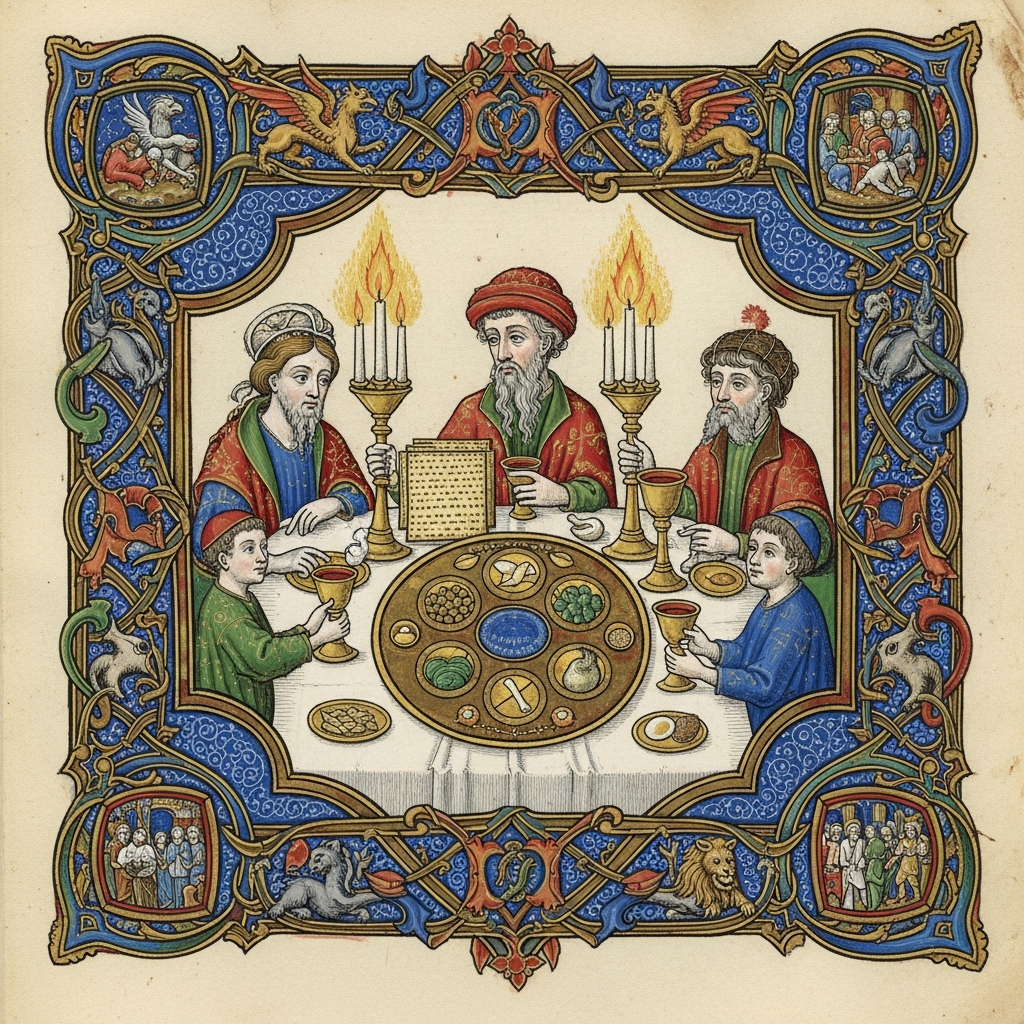
Exodus 12. God is about to kill the firstborn of Egypt. The Israelites are told to slaughter a lamb and paint its blood on their doorposts. That night, they are to eat the lamb, unleavened bread (no time for it to rise — they are leaving in the morning), and bitter herbs. They are to eat it standing up, sandals on their feet, staff in hand. Ready to move. Ready to flee.
They have been slaves for four hundred years. Tonight that ends. But first, they eat.
The Seder that descends from this moment is one of the most sophisticated ritual meals in human history. Every element of the meal is a mnemonic device, a sensory memory: the matzah is the bread of affliction. The bitter herbs (maror) are the bitterness of slavery. The charoset — the sweet brown paste of nuts, fruit, and wine — looks like the mortar the slaves mixed. The salt water is for tears.
The youngest child at the table asks four questions, beginning with: “Why is this night different from all other nights?” The Haggadah — the telling — answers over hours of story, song, argument, and the drinking of four cups of wine. The point is not to be efficient. The point is to be inside the story long enough that it stops being someone else’s story.
The Seder begins: “We were slaves to Pharaoh in Egypt. Now we are free.” The verb tense is first-person plural present. Not: they were slaves. We were slaves. Tonight is Egypt. Tonight is the Exodus. The bread on the table is the bread they baked without time for it to rise.
The meal is the memory is the liberation.
A Passover Seder table laden with ritual foods -- the Seder plate with bitter herbs, haroset, lamb shankbone, egg, parsley, salt water in a small bowl, matzah covered in white cloth, four wine cups, the Haggadah open before the father who leads the reading, candles lit, family gathered from children to grandparents, the youngest child looking up about to ask the four questions, the meal ready but not yet eaten, the door left open for Elijah, illuminated manuscript illustration of a sacred feast, warm golden candlelight, rich food and sacred vessels, community and ritual, gold leaf accents, ornate border, medieval bestiary style3. Iftar — The Breaking of the Fast (Islamic)
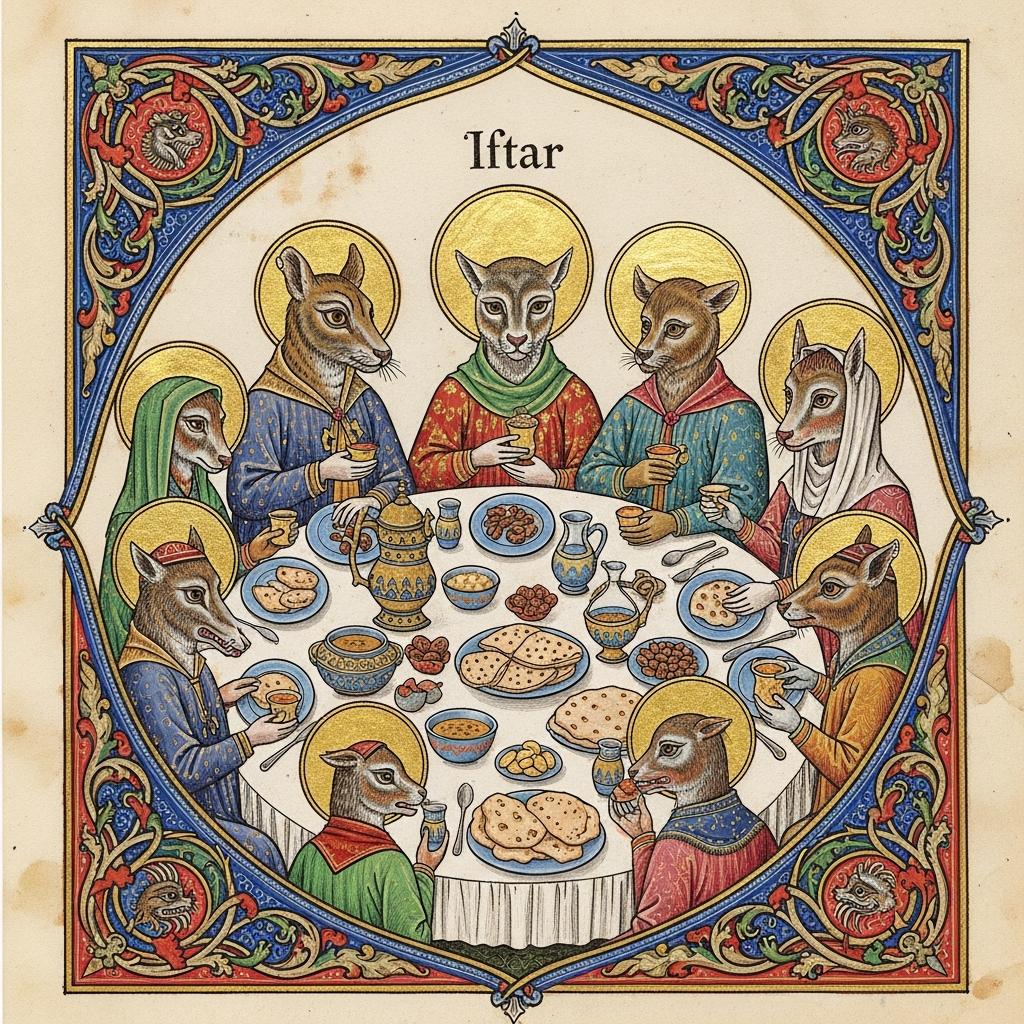
Every day of Ramadan, from the moment the sun rises until the moment it sets, a billion and a half people do not eat and do not drink. Not water. Nothing. Thirty days, the ninth month of the Islamic calendar, the month when the Quran descended to the Prophet. The fast is one of the Five Pillars: obligatory, not optional.
And then the sun goes down.
The Prophet Muhammad broke his fast with dates and water. “When one of you breaks his fast, let him break it with dates, for dates are a blessing.” So across the Muslim world, at the exact moment of sunset, the first thing that crosses the faster’s lips is usually a date — the same simple fruit that has grown in Arabia for ten thousand years — followed by water. Then prayer. Then a meal.
Iftar is not just the end of a fast. It is one of the most communal acts in Islamic practice. Mosques lay out enormous shared tables. Families host. Strangers are invited in. The wealthier feed the poorer. In Muslim-majority countries the streets are quiet during the day and loud after sunset, a reversal of ordinary life. Markets stay open late. The smell of food being prepared fills neighborhoods that have been quiet and still all day.
The fast creates the feast. The deprivation creates the gratitude. A person who has not eaten since before dawn does not take a date for granted. This is Ramadan’s central pedagogy: that hunger teaches what fullness cannot. That the discipline of the body is the training of the spirit. And that when the fast breaks, the breaking of it together — with family, with neighbors, with strangers — is the point.
A long Iftar table at the moment of sunset, dozens of people of all ages seated along both sides, the first dates and water cups raised simultaneously as the call to prayer sounds, faces showing the particular relief and gratitude of a fast broken, the table laden with traditional foods -- dates and water in the foreground, then elaborate dishes stretching into the distance -- candles and lanterns in the warm evening air, some bowing their heads in prayer before eating, the communal breaking of daylong hunger into sacred feast, illuminated manuscript illustration of a sacred feast, warm golden candlelight, rich food and sacred vessels, community and ritual, gold leaf accents, ornate border, medieval bestiary style4. Prasad — Food That Has Touched God (Hindu)
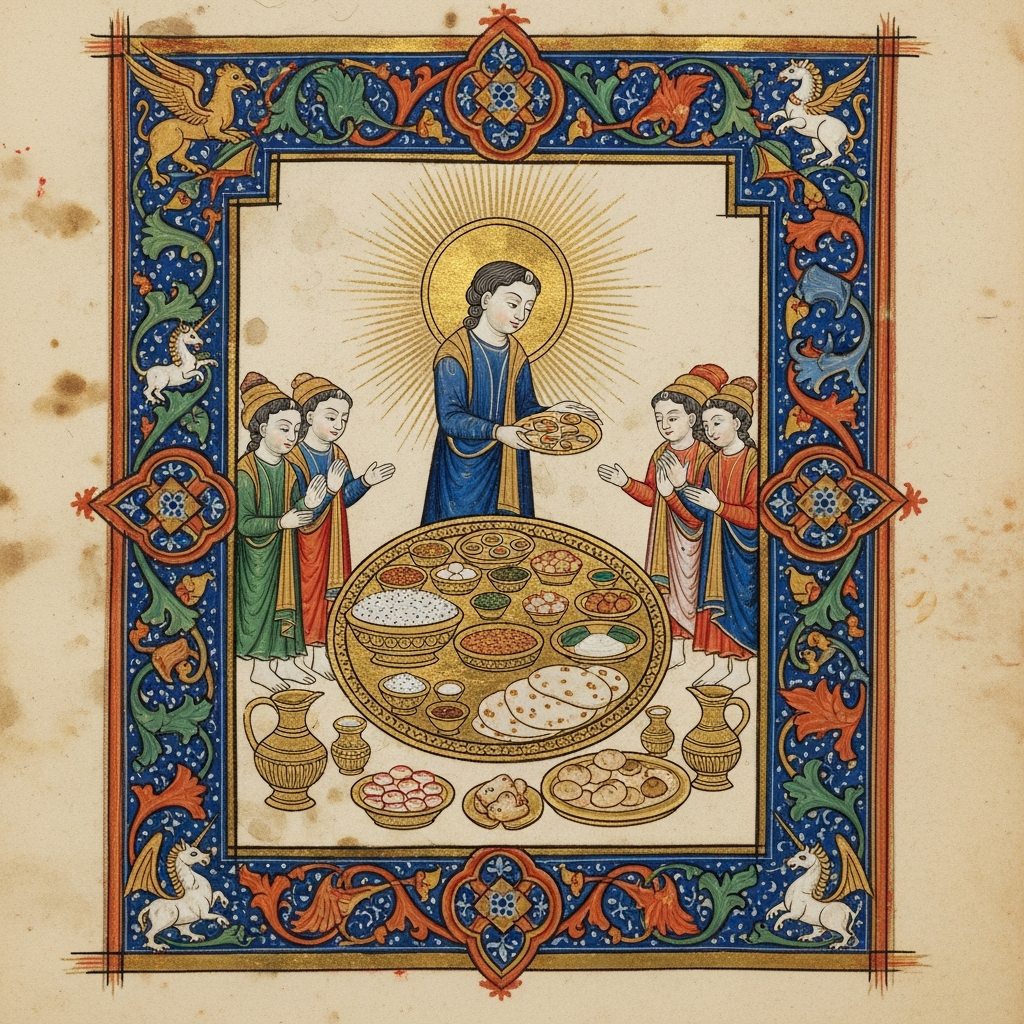
The logic of prasad is simple and strange: you bring food to the temple, place it before the deity, the deity accepts and blesses it, and then you eat what was on God’s plate.
The offerings vary enormously. In Vaishnavite temples, the scale can be staggering: the Tirupati Balaji temple in Andhra Pradesh serves over eighty thousand people per day with laddu — a sweet ball of chickpea flour, sugar, and ghee — that has been offered to the Lord Venkateswara. The laddu at Tirupati is so famous and so associated with the deity’s blessing that its recipe is legally protected and pilgrims queue for hours to receive one. The queue for prasad is itself an act of worship.
But prasad can be as small as a tulsi leaf or a single grain of rice. What matters is not the scale or the price. What matters is the touching. The food that has been before God carries something different in it. It is blessed in the most literal sense: the deity’s presence has altered it. To eat prasad is to take the deity’s grace into your body in a form your body can absorb.
This is the mirror image of the Eucharist — different theology, same underlying structure. In both cases, an ordinary food becomes extraordinary through its contact with the divine. In both cases, you eat what God has blessed and the eating is itself an act of receiving grace. The brahmin who offers flowers and fruit to Krishna and then distributes the prasad to the congregation is doing something structurally identical to the priest who consecrates bread and hands the host to the faithful.
The food comes back changed.
Inside a Hindu temple before the murti of a deity wreathed in flowers and incense smoke, a priest in white robes carefully placing offerings of fruit, sweets, and flowers before the shrine, the deity's image glowing with lamp-light and adornment, worshippers kneeling in the background awaiting the distribution of prasad, the ritual transfer of blessing from divine to human through the medium of food, sacred vessels of brass and gold holding the offerings, illuminated manuscript illustration of a sacred feast, warm golden candlelight, rich food and sacred vessels, community and ritual, gold leaf accents, ornate border, medieval bestiary style5. The Langar — The Meal That Abolished Caste (Sikh)
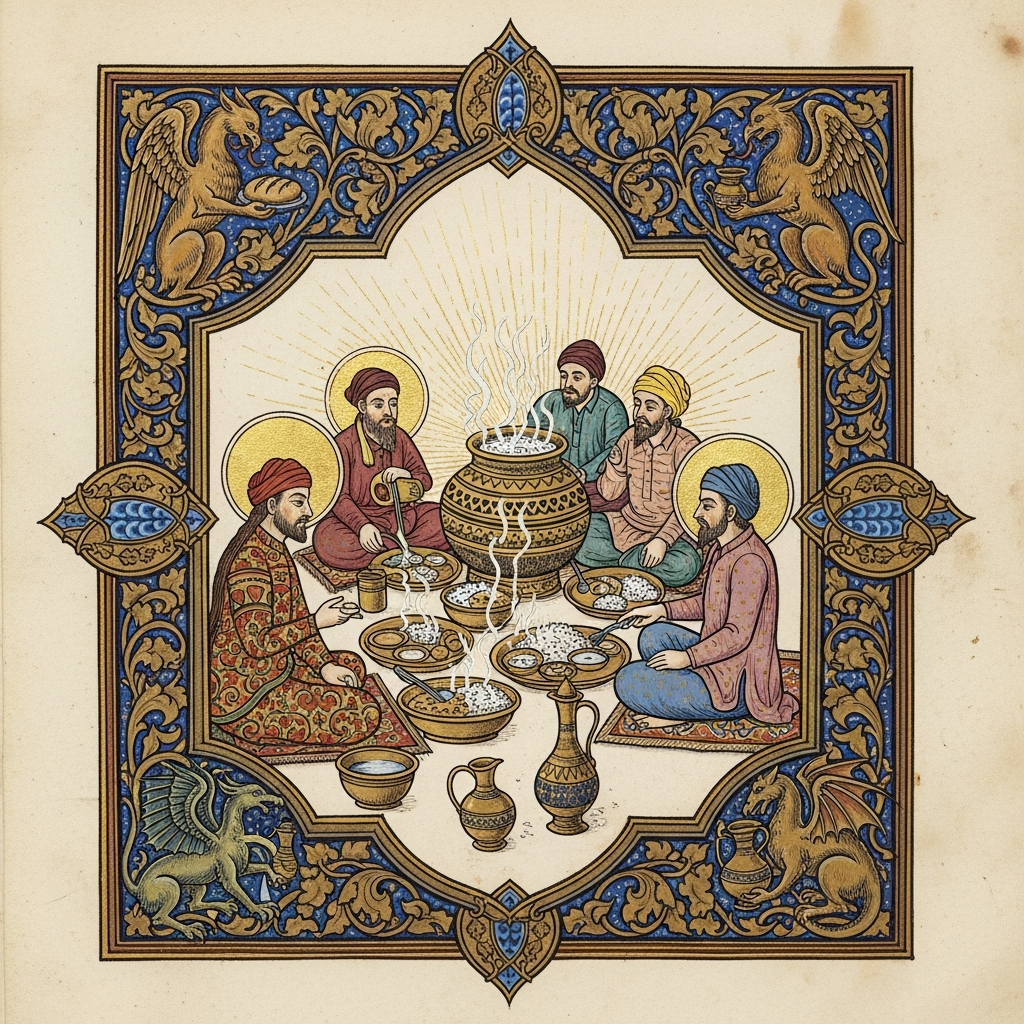
Guru Nanak, the first Sikh Guru, visited the city of Eminabad in the late fifteenth century. He was invited to stay with a rich merchant named Malik Bhago, who was hosting a religious feast. Nanak refused and instead ate with a poor carpenter named Lalo, whose simple food — earned by honest labor — Nanak said was more nourishing than any feast built on exploitation.
This story is the seed of the Langar.
Every Sikh gurdwara in the world runs a free kitchen. Anyone can eat: Sikh or Hindu or Muslim or atheist, high caste or low caste, man or woman, wealthy or destitute. The food is the same for everyone. You sit on the floor — pangat, the line of equals — because sitting on the floor together means no one is above anyone else. The meal is always vegetarian so no one’s dietary restrictions exclude them. It is cooked by volunteers who consider the cooking itself a form of worship (seva, selfless service).
The Golden Temple in Amritsar — the holiest site in Sikhism — feeds between fifty thousand and one hundred thousand people per day. Every day. The kitchen operates continuously. Flour is kneaded by thousands of hands. The dhal is stirred in vessels the size of swimming pools. It is the largest free kitchen in human history, and it has been running continuously for five hundred years.
The Langar does not ask if you deserve to eat. It does not ask if you are the right religion, the right caste, the right anything. You are hungry. There is food. Sit down.
Guru Nanak saw immediately that hunger is the great equalizer and the sacred table should be the place where human equality is not just believed but enacted. Twice a day, every day, five centuries later, the Langar makes the argument again.
The vast Langar hall of the Golden Temple in Amritsar, hundreds of worshippers and pilgrims of all faiths and appearances seated cross-legged in long rows on the floor, volunteers moving between the rows serving simple dal and roti from large vessels, the faces showing the particular dignity and equality of eating the same food together on the same floor, the kitchen visible in the background with great copper vessels and the smoke of a thousand meals, the embodiment of radical hospitality made daily practice, illuminated manuscript illustration of a sacred feast, warm golden candlelight, rich food and sacred vessels, community and ritual, gold leaf accents, ornate border, medieval bestiary style6. Dana/Alms — The Bowl as Mirror (Buddhist)
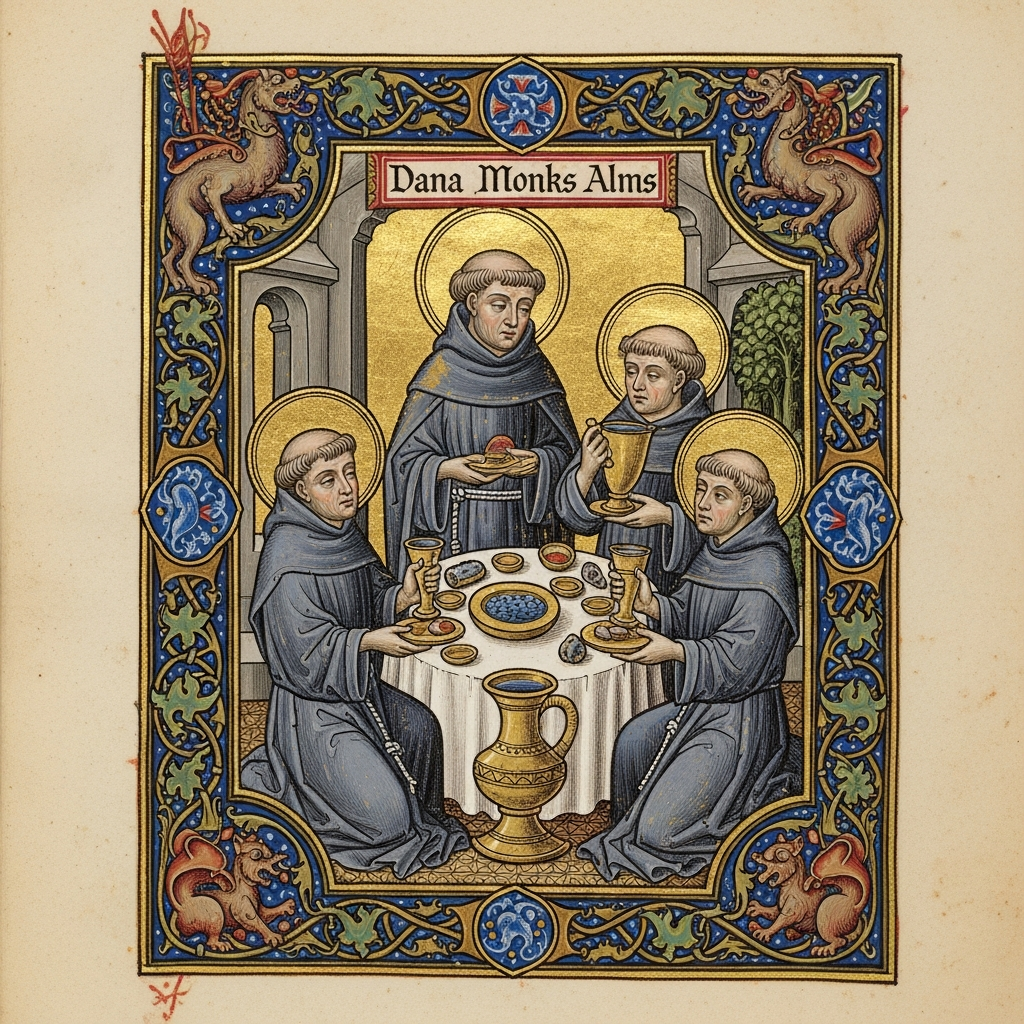
Every morning at dawn, in every Theravada Buddhist country, monks leave their monasteries and walk barefoot through the streets carrying their alms bowls. They do not ask. They do not beg in any ordinary sense. They simply walk and make themselves available. Laypeople kneel by the road and place food in the bowl: rice, curry, fruit, whatever they have prepared. The monks accept whatever is given and do not choose. They do not say thank you, because gratitude would suggest that something extraordinary has happened — but giving to the sangha is itself meritorious, a blessing to the giver. To be thanked for it would diminish it.
This reversal is the whole structure: the layperson gives food and receives merit. The monk receives food and provides the opportunity to give. Neither is the benefactor. Both are participating in something that is larger than the transaction.
The Buddha’s own practice was radical non-attachment to food. He would eat what was placed in his bowl — including meat, if it was offered — because attachment to dietary preferences was itself a form of desire. The only restrictions in the Vinaya (monastic code) are that meat must not have been specifically killed for the monk, the monk must not have seen the killing, and the monk must not suspect it was killed for him. Otherwise: accept what is given.
This makes the alms round a profound daily meditation on non-attachment. The monk does not know what he will eat. He cannot control it. He walks into the morning empty-handed, returns with whatever the village’s generosity provides, and eats it without preference. The meal is the practice is the teaching: release what you grip, receive what comes, do not make the body’s needs a site of desire.
A line of orange-robed monks walking barefoot at dawn through a Thai village street, their shaved heads bowed, alms bowls held in both hands, laypeople kneeling beside the road placing rice and food into the bowls with reverence, the soft light of early morning turning everything golden, the monks' faces showing the stillness of meditation even in motion, the daily enactment of giving and receiving without grasping, the simplest and most radical sacred meal, illuminated manuscript illustration of a sacred feast, warm golden candlelight, rich food and sacred vessels, community and ritual, gold leaf accents, ornate border, medieval bestiary style7. The Feast of Valhalla — The Meal That Never Ends (Norse)
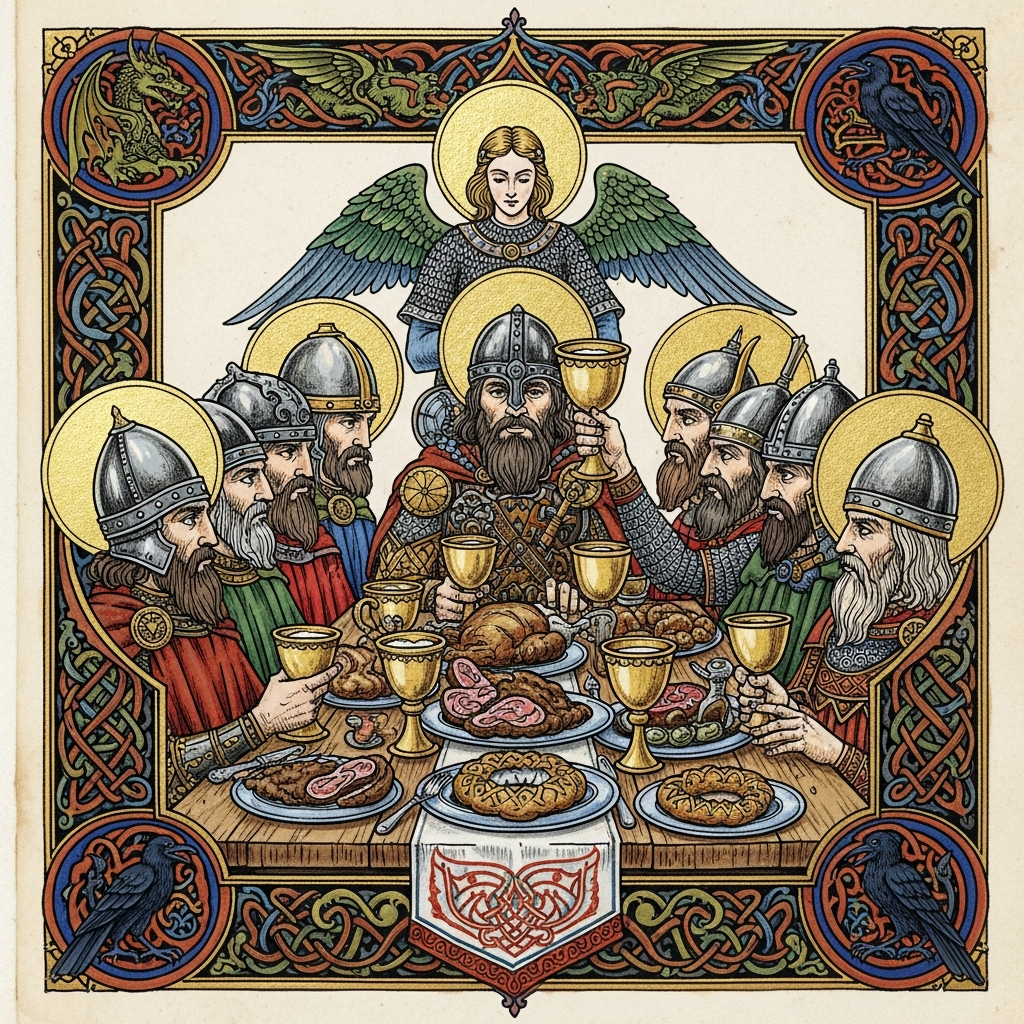
The Prose Edda, Gylfaginning. In Valhalla, Odin’s hall of the slain, every evening is the same: the Einherjar — the warriors chosen from battle — feast on the flesh of the boar Saehrimnir. The boar is slaughtered and cooked every day. Every night, the warriors eat it until they are full. Every morning, Saehrimnir is alive again, ready to be killed and eaten again.
The mead comes from the goat Heidrun, who stands on the roof of Valhalla browsing the leaves of Yggdrasil. From her udders flows not milk but mead, an inexhaustible supply filling a vat large enough to satisfy all the warriors in the hall.
The warriors eat, they drink, they fight — every day they go out and battle each other to the death, and every evening they come back together, whole and healed, for the feast. This is the preparation. Ragnarok is coming. When the end of the world arrives, the Einherjar will be ready. They have been training for it daily, dying and rising again and sitting down together at the table, for however long it has been since they fell.
The feast is not the reward. The feast is the conditioning. Odin chose these warriors not to give them eternal rest but to forge them into the sharpest possible weapon for the final battle he cannot win. They eat together because they will fight together when it matters.
There is something in the Norse Valhalla that the more peaceful afterlives do not have: the recognition that the table and the battlefield are not opposites. They are preparation and execution. The meal that precedes the hardest thing you will ever do is its own kind of sacred. The warriors know the feast ends at Ragnarok. They eat anyway.
The immense feasting hall of Valhalla by firelight, vast and rafter-high, hundreds of battle-scarred warriors seated at enormous tables laden with roasted boar and horns of mead, the boar Saehrimnir being carved at the far end, the goat Heidrun visible through a high window on the roof, Valkyries in armor moving between the tables pouring mead from great horns, the warriors mid-feast and mid-laughter, wounds from that day's battle already healed, the joy of men who know they are being prepared for something, the feast that readies the army of the apocalypse, illuminated manuscript illustration of a sacred feast, warm golden candlelight, rich food and sacred vessels, community and ritual, gold leaf accents, ornate border, medieval bestiary style8. The Agape Feast — Before It Became a Ritual (Early Christian)
Before the Eucharist became what it is — a brief liturgical act of consecrated bread and wine — there was the Agape: the love feast. In the earliest Christian communities, the Lord’s Supper was an actual supper. People brought food. They gathered in someone’s home. They ate together, the wealthy and the poor, the free and the enslaved, all at the same table. Then, as part of the meal, they broke bread and passed a cup and remembered.
Paul’s letter to the Corinthians (1 Corinthians 11) contains the earliest written account of the Lord’s Supper — and it contains a furious rebuke. The Corinthian church has divided itself even within the love feast: the wealthy eat their own food and are drunk while the poor go hungry. Paul is outraged. “When you come together, it is not the Lord’s Supper that you eat. For in eating, each one goes ahead with his own meal.” You cannot call it the Lord’s table if you’re refusing to share it.
Jude 1:12 speaks of people who are “hidden reefs at your love feasts, as they feast with you without fear, shepherding themselves.” The Agape was real enough that abusers could hide inside it.
The Agape was eventually separated from the Eucharist as Christianity formalized. By the third and fourth centuries, the simple meal had become a ritual, the ritual had been elevated, and the love feast had been demoted or discontinued. What survived was the liturgy. What was lost was the actual dinner — the food, the mess, the necessary awkwardness of eating together when not everyone is the same.
What the earliest Christians knew, and what Paul was trying to protect, was that the sacred meal cannot remain sacred if the people at the table are not actually sharing. The theology of communion is empty if the table is not actually communal.
An early Christian Agape feast in a Roman house-church, two dozen people of mixed status -- free citizens, slaves, tradespeople, women, men -- gathered around a low table in a lamp-lit triclinium, food and wine in common vessels shared equally, some in conversation, some listening to a reader at the far end, bread being broken and passed hand to hand, the simple domestic reality of the first church before the cathedrals and the priests and the liturgy, the love feast before it was named and then lost, illuminated manuscript illustration of a sacred feast, warm golden candlelight, rich food and sacred vessels, community and ritual, gold leaf accents, ornate border, medieval bestiary style9. Amrit — The Warrior-Saint’s First Drink (Sikh)
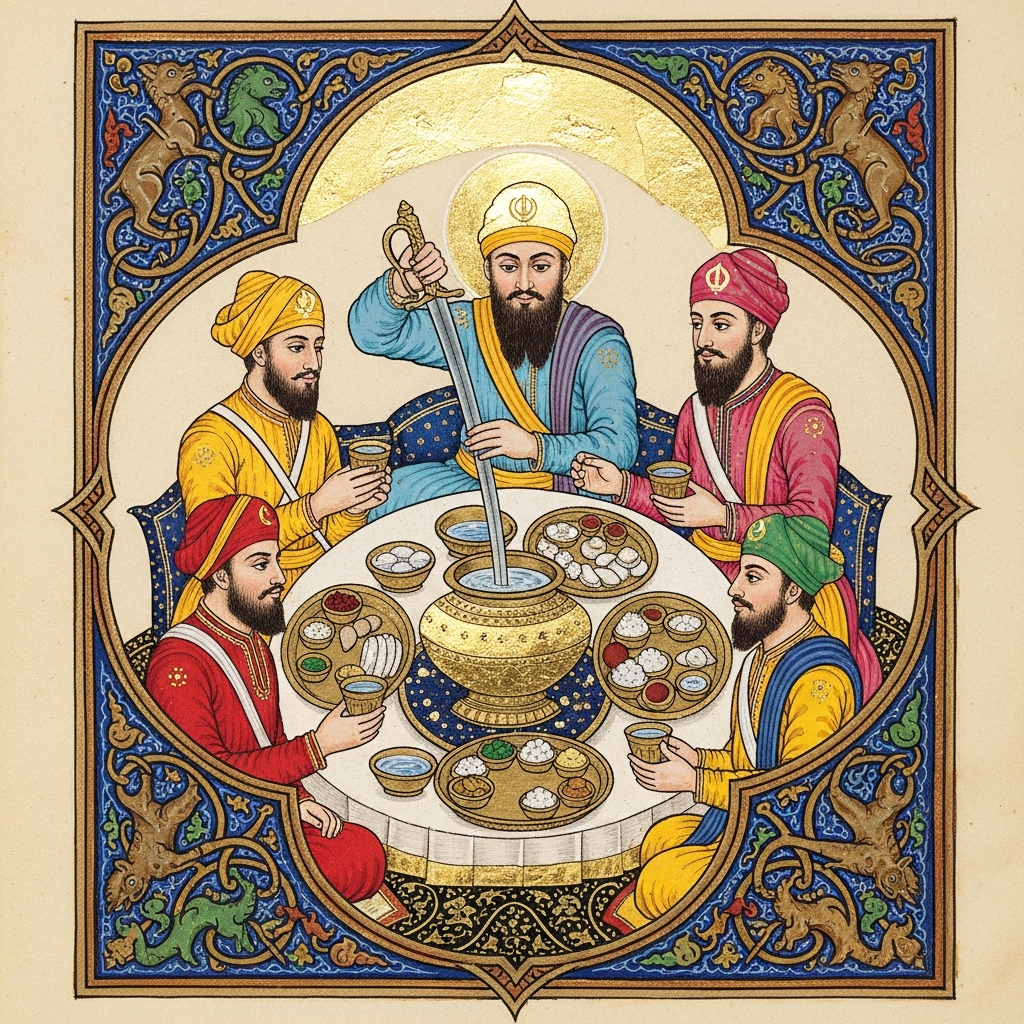
1699 CE, Baisakhi festival. Guru Gobind Singh, the tenth and final human Guru of the Sikh tradition, called the Sikhs together at Anandpur Sahib. He stood before them with a drawn sword and asked: who will give their head for the Guru? The crowd was silent and afraid. One man stepped forward. The Guru led him inside a tent. A sword rose and fell. The Guru emerged with a bloodied sword. He asked again. Another man stepped forward. This happened five times.
The five men who stepped forward were the Panj Pyare — the Five Beloved. When the Guru brought them back out, they were alive. (The blood was from goats, or, in some accounts, the Guru’s own initiative — the exact details are debated. What is not debated is that these five men had been willing to die.) The Guru then did something extraordinary: he prepared amrit and inducted them into the Khalsa — the community of the pure — and then he asked them to induct him. The Guru received initiation from the ones he had just initiated.
Amrit is water sweetened with sugar (patasas) and stirred with a double-edged sword (khanda) while five Sikhs recite the sacred prayers. The new initiate drinks from the same bowl as all the others — no distinction of caste or gender. They drink from common hands. They eat the same sweetened water that the sword stirred. They become, through the eating, something new: a saint-soldier, committed to stand against injustice wherever it appears.
The sword in the water is the key. The sweetness is the nurturing, the mercy, the community. The blade is the commitment to defend the defenseless. You drink both.
The Amrit ceremony of Khalsa initiation, five Sikhs in blue and saffron standing around a large iron vessel, one stirring the amrit with a double-edged khanda sword while prayers are spoken, a new initiate kneeling to receive the amrit in cupped hands drinking from the common bowl, the sacred steel weapons present and gleaming, the resolve on every face of people taking an oath that joins saint to soldier, sweetness and blade in the same cup, illuminated manuscript illustration of a sacred feast, warm golden candlelight, rich food and sacred vessels, community and ritual, gold leaf accents, ornate border, medieval bestiary style10. Soma/Haoma — Drinking the Divine (Vedic/Zoroastrian)
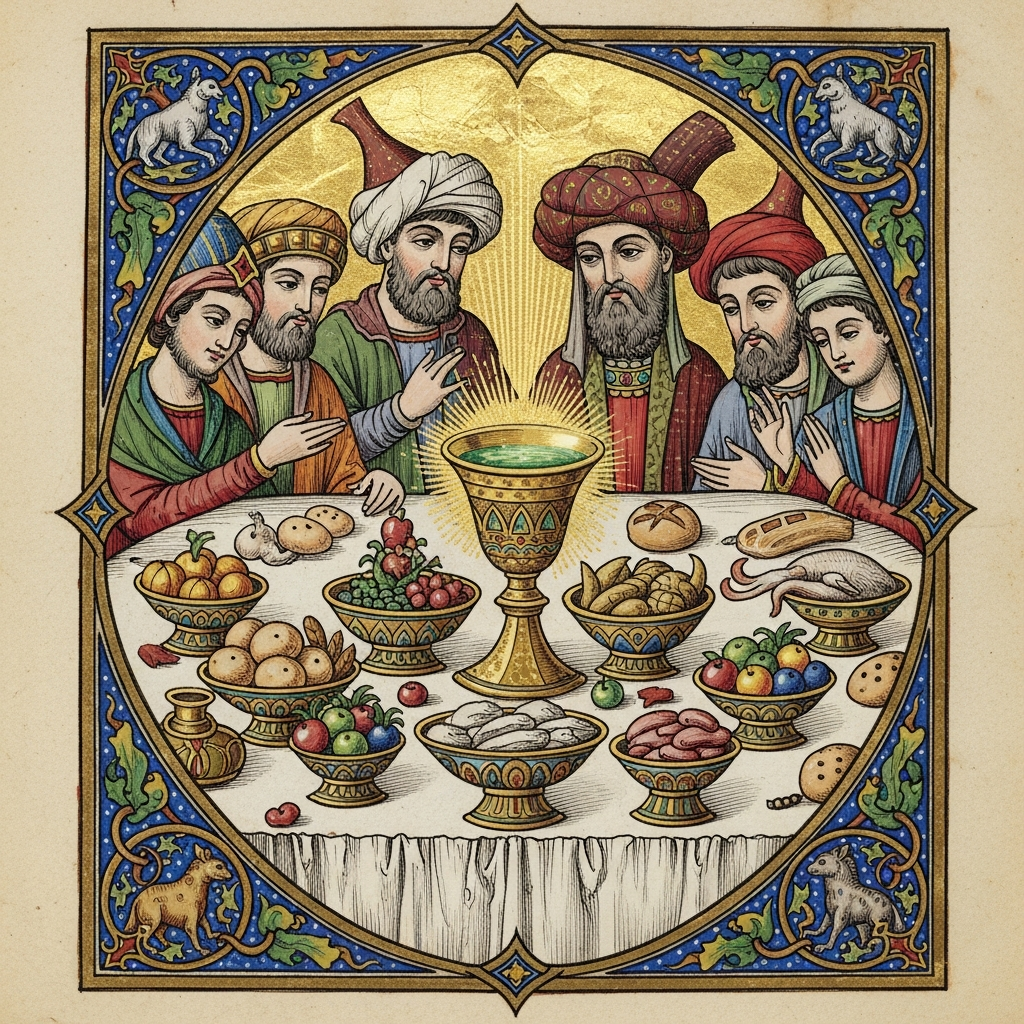
The Rig Veda contains one hundred and fourteen hymns addressed to Soma alone. It is more than is dedicated to any other deity except Indra and Agni. Soma is described as king of plants, lord of the forest, the one who makes the blind see and the lame walk, the drink that makes the gods immortal. The ninth Mandala is nothing but hymns to Soma — an entire book of a holy text devoted to a drink.
We do not know what soma was.
This is the central mystery of Vedic religion and one of the most debated questions in comparative religion. The plant was pressed, filtered through a fleece, mixed with milk or water, and drunk by priests during the most sacred Vedic rituals. It produced visions. It produced the sense of contact with the divine. It gave energy and euphoria. Rigveda 8.48: “We have drunk the Soma; we have become immortal; we have gone to the light; we have found the gods.”
Candidates proposed by scholars over the past two centuries include: fly agaric mushroom, cannabis, Ephedra (which gives the Zoroastrian Haoma its most defensible identification), Syrian rue, and many others. None of the identifications is fully satisfying.
The Zoroastrian counterpart — Haoma — is better documented in practice. Zoroastrian priests still perform the Yasna ceremony, during which Haoma (now generally made from Ephedra twigs) is pressed, filtered, and consumed. The ceremony is continuous with practices three thousand years old. Whatever the original Soma was, its Zoroastrian cousin is still being drunk in temples from Tehran to Mumbai.
The sacred meal here is not about community or equality or preparation for battle. It is about the shortest possible path to the divine — a plant pressed into a drink, swallowed, and then: the gods.
A Vedic fire sacrifice ceremony, a priest at an altar of sacred fire pressing a plant through a sieve of bundled grass over a ritual vessel of carved stone, the pressed juice collecting in the bowl that catches firelight, two other priests seated nearby reciting hymns from memory, smoke rising to the gods, the soma offering at the center of the Rig Veda's most sacred rite -- the drink that makes mortals briefly divine, the mystery that ten thousand scholars have argued about and no one has resolved, illuminated manuscript illustration of a sacred feast, warm golden candlelight, rich food and sacred vessels, community and ritual, gold leaf accents, ornate border, medieval bestiary style11. The Churning of the Ocean — Amrita (Hindu)
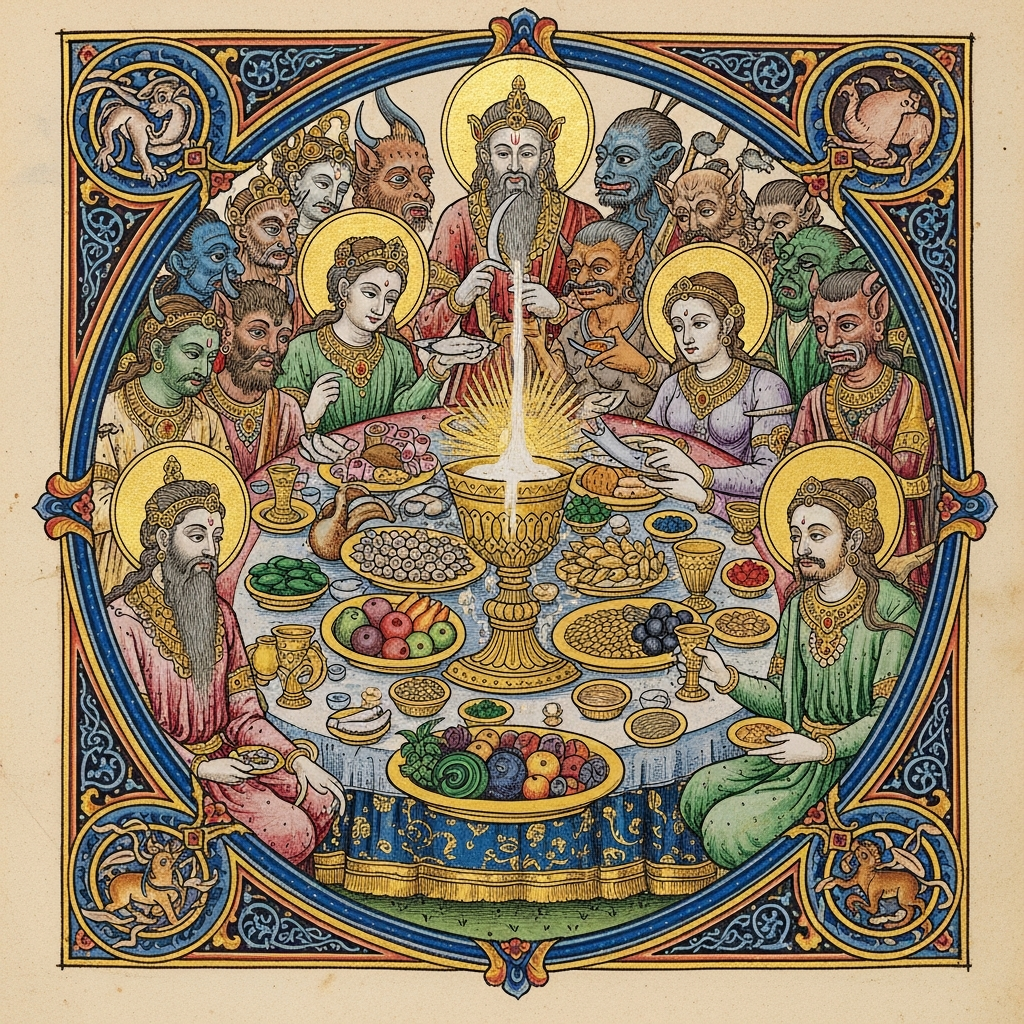
Bhagavata Purana. The gods had lost their power. They went to Brahma, who took them to Vishnu. Vishnu told them what to do: churn the cosmic ocean.
The gods cannot do this alone. They make a truce with the demons — the asuras — and together they uproot Mount Mandara from the Himalayas and use it as a churning rod. The serpent-king Vasuki becomes the rope. The gods pull from one end, the demons from the other, and they churn the primordial ocean — the Milk Ocean, the ocean of all possibility — back and forth.
The churning produces many things. It produces the goddess Lakshmi. It produces the divine physician Dhanvantari, holding a pot. It produces the wish-fulfilling tree. It produces a terrible poison that threatens to destroy the world, which Shiva drinks and holds in his throat (which is why his throat is blue). And finally, it produces Amrita: the nectar of immortality.
The demons grab it and run. Vishnu transforms himself into a beautiful woman to distract them, recovers the Amrita, and gives it to the gods. Some of it spills and lands on four cities in India, which become the sites of the Kumbh Mela — the largest religious gathering on earth.
The gods drink Amrita and their immortality is restored.
The sacred meal here is the most cosmically consequential on this list. All the others produce spiritual benefits for the human who eats: blessing, grace, communion, merit. Amrita makes you immortal. It is not a reminder of the divine or a channel toward it. It is the substance that makes you divine. The difference between gods and humans, in the Hindu tradition, is that gods have drunk from this churning and humans have not.
Yet.
The churning of the Milk Ocean -- on one side the gods pulling Vasuki the great serpent-king wrapped around Mount Mandara which rises from the ocean as the churning rod, on the other side the powerful demon asuras pulling, the cosmic ocean foaming and churning between them, Vishnu in his turtle avatar beneath the mountain as its foundation, and rising from the churned waters the golden pot of Amrita held by the divine physician Dhanvantari, the nectar of immortality emerging from the labor of gods and demons together, illuminated manuscript illustration of a sacred feast, warm golden candlelight, rich food and sacred vessels, community and ritual, gold leaf accents, ornate border, medieval bestiary style12. Chinese Ancestor Offerings — Feeding the Dead (Chinese)
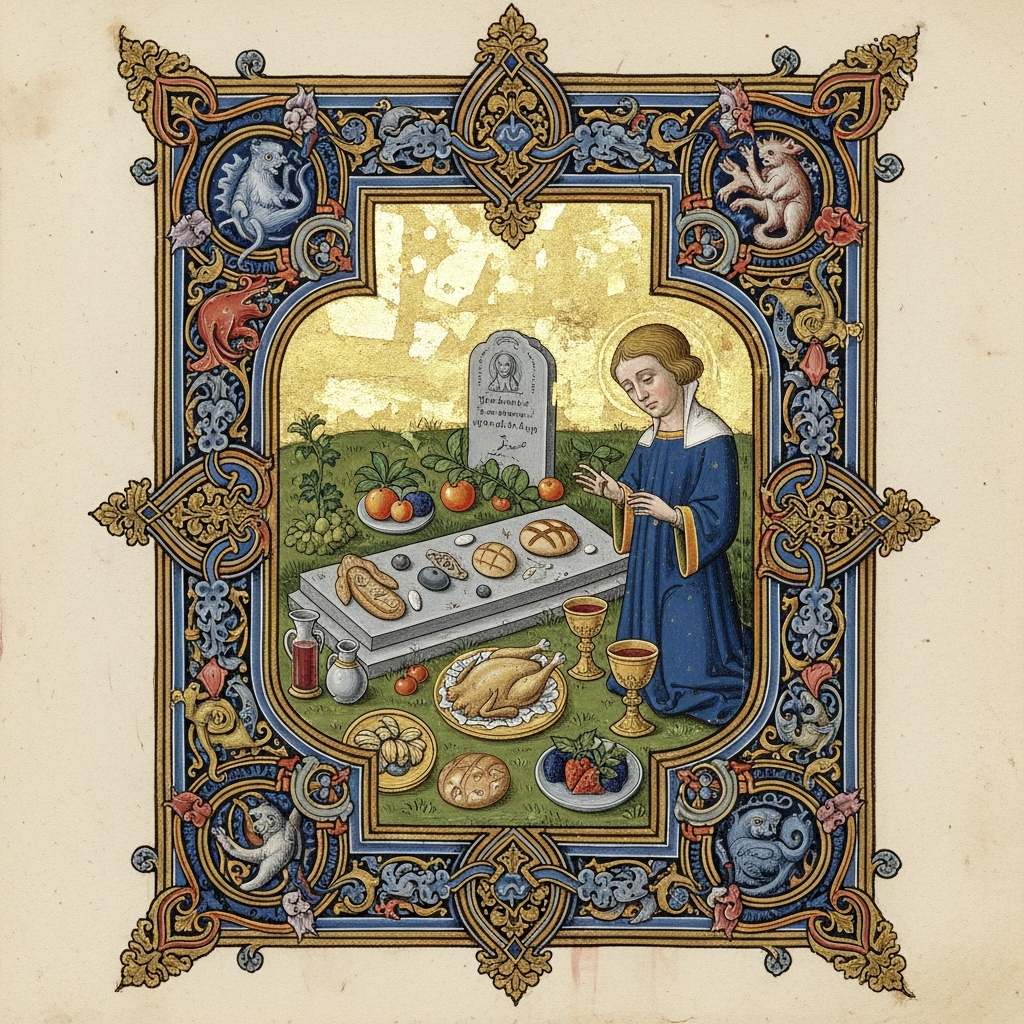
At Qingming — the Clear and Bright Festival, occurring in early April — Chinese families go to the graves of their ancestors. They bring food. Full meals, not token offerings: roast pork, steamed fish, dumplings, rice wine, fruit. They arrange it before the grave marker. They burn paper money. They burn paper goods — clothes, houses, cars — so that the dead will have them in the afterlife. Then they eat the food together with the dead, seated at the grave, because the dead are invited to the family meal.
The underlying premise of Chinese ancestor veneration is not that the dead are gone. They are still present, still part of the family, still with needs that the living can and should meet. The dead need to be kept comfortable, well-fed, and remembered. If they are neglected, they may become hungry ghosts — wandering spirits who cause misfortune because they have no one to care for them. The offerings are not optional. They are filial piety extended past the grave.
This is the most universal structure in world religion and the oldest. Before monotheism, before philosophy, before theology — the care of the dead and the feeding of the dead. Every agricultural civilization that has ever existed has left food for ancestors. The Chinese tradition has simply maintained it more visibly and continuously than most.
The sacred meal here contains a claim so strange that modern people often do not sit with it long enough to feel its full weight: the dead are still hungry. Not metaphorically. The food placed on the grave is real food, because the hunger is real hunger. The family that sits with their ancestors at the grave and eats together is not performing a ritual in memory of someone gone. They are having dinner with someone who is still there, still present, still family — just on the other side of a line that food, apparently, can cross.
A Chinese family at Qingming festival gathered around an ancestral grave, a full meal laid out before the grave marker on a cloth -- roast meat, fish, dumplings, fruit, cups of rice wine -- incense sticks smoking in the earth, paper offerings burning at the side, family members of three generations kneeling and bowing and then seated together sharing the food with the ancestor whose name is carved on the stone, the meal that crosses the boundary between living and dead, the feast that assumes the dead are still hungry and still here, illuminated manuscript illustration of a sacred feast, warm golden candlelight, rich food and sacred vessels, community and ritual, gold leaf accents, ornate border, medieval bestiary styleThe Pattern at the Table
Set every sacred meal side by side and something becomes visible.
The object matters less than the act. Dates broken at sunset. A boar that regrows. Water stirred with a sword. Pressed plant juice. A single rice cake. The content is almost arbitrary — what every tradition agrees on is that the eating is the thing. The meal is the moment. The food is less important than what happens to the people around it.
Sacred eating almost always creates equality. The Langar seats everyone on the floor. The Agape was scandalous to Paul because it wasn’t actually equal. Amrit is drunk from the same bowl by everyone regardless of caste. The alms round gives everyone the same food regardless of status. The table is almost universally the place where hierarchy is supposed to dissolve. When it doesn’t — when the wealthy eat separately, when the wrong people are excluded — the tradition notices and objects.
The meal bridges what cannot otherwise be bridged. Human and divine (Eucharist, prasad, soma). Past and present (the Seder). Living and dead (ancestor offerings). Peace and war (the Langar, Valhalla). The sacred meal seems to be the one human act that can cross any boundary — temporal, ontological, social, metaphysical. Eating is what every living thing does. And so it becomes the act through which every living thing can touch everything else.
The giving is as sacred as the receiving. Dana is about the giver’s practice, not the monk’s hunger. The volunteer cooking Langar is doing seva. The family placing food at the ancestor’s grave is performing filial piety — the benefit flows both ways. The sacred meal refuses to be a one-directional transaction.
Food is what keeps the body alive. And so every tradition has made it the medium through which the spirit reaches beyond the body’s limits — to God, to the past, to the dead, to the stranger across a caste line, to the warrior who will fight beside you at the end of the world.
The table is where all of it happens. It has always been the most sacred place.
See also: The Resurrections — Everyone Who Came Back | The Miracles — Supernatural Acts Across Traditions | The Mothers — The Divine Feminine Across All Traditions