Part of the Bestiary Compendium
Every tradition has its sacred animals — creatures chosen by the gods to carry, guard, announce, or embody divine will. Some pull chariots across the sky. Some whisper prophecy. Some devour the world at the end of time. The medieval bestiaries knew this: every animal is a sermon, every beast a theology. This is that bestiary, drawn from every tradition on earth.
The Sacred Animals
1. The Lamb — The Sacrifice That Won
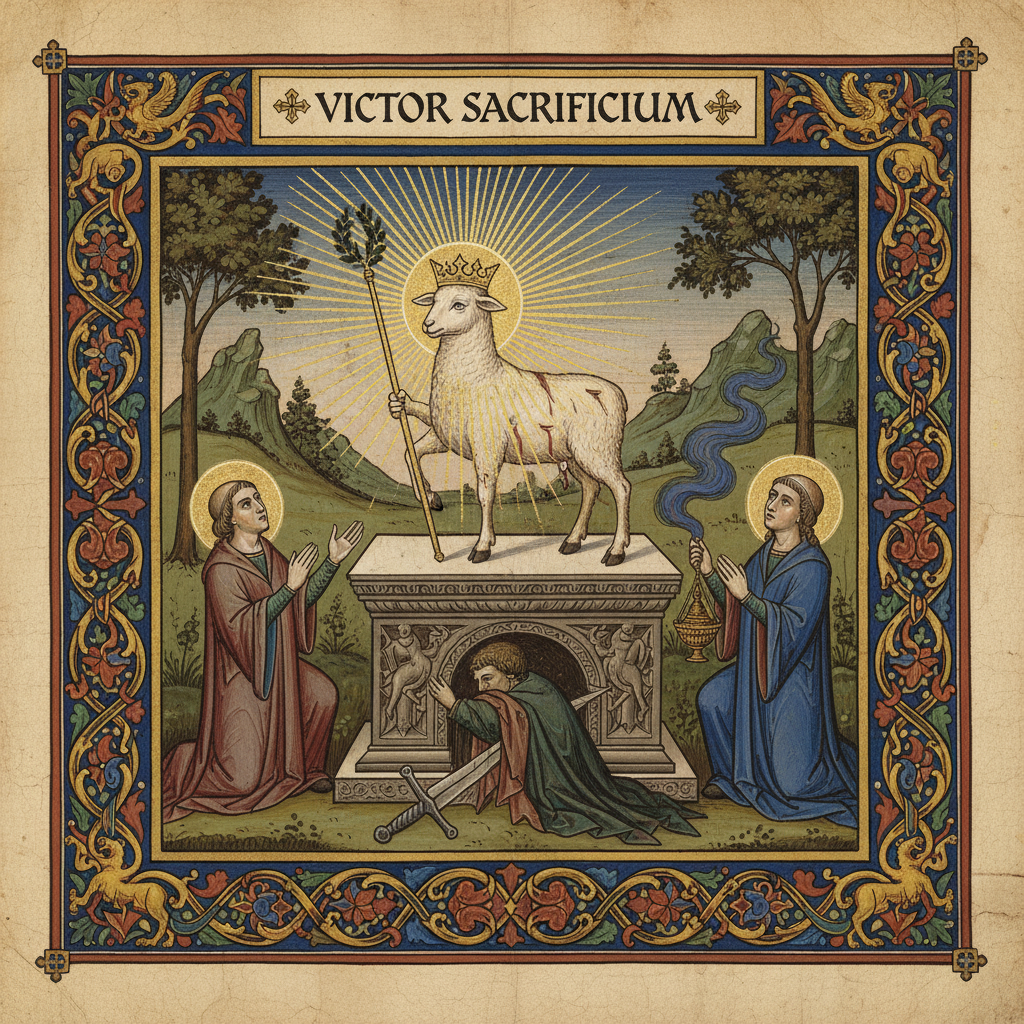
| Animal | Lamb |
| Tradition | Christian |
| Associated With | Christ |
| Role | ”The Lamb of God who takes away the sin of the world” |
| Source | John 1:29, Revelation 5:6 |
The most paradoxical animal in all of scripture. A lamb is prey — weak, silent, led to slaughter. And yet Revelation puts it on the throne of the universe. The Lamb with seven horns and seven eyes, who alone can open the scroll of history. Every Passover lamb in the Hebrew Bible was pointing here: the moment when God chose to save the world not by sending a lion, but by becoming the thing that gets eaten.
A radiant white lamb standing on a golden altar, seven eyes visible on its face glowing with divine light, seven small horns on its head, a sacrificial wound visible on its side streaming light instead of blood, surrounded by twenty-four elders bowing with golden crowns cast at its feet, illuminated manuscript bestiary animal portrait, gold leaf halo, medieval bestiary style, ornate border with Christian crosses and vine scrollwork, rich pigments on vellum, detailed naturalistic but symbolic rendering --ar 1:1 --s 750 --v 6.12. The Dove — Heaven Opens
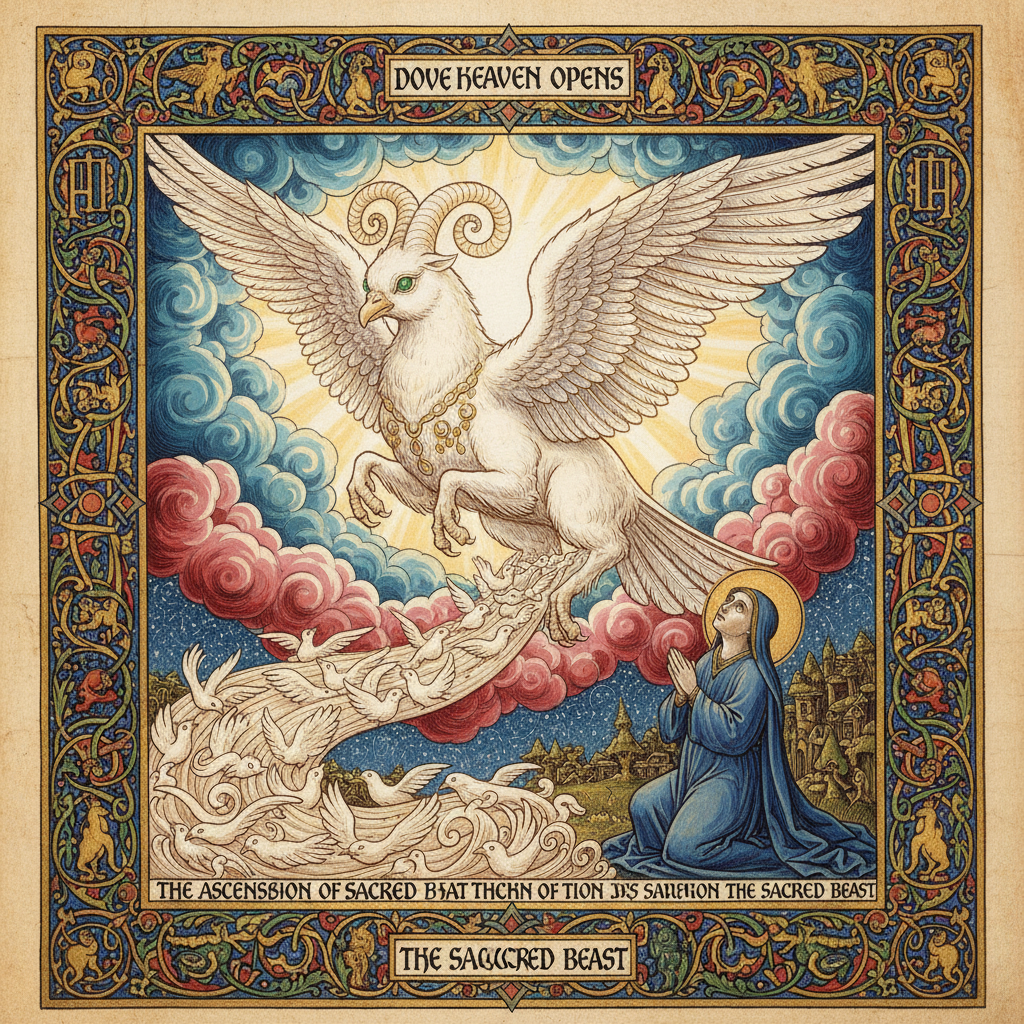
| Animal | Dove |
| Tradition | Christian |
| Associated With | Holy Spirit |
| Role | Descended at Jesus’ baptism |
| Source | Matthew 3:16 |
When Jesus came up from the water of the Jordan, the heavens tore open and the Spirit of God descended like a dove. Not an eagle. Not a hawk. A dove — the bird of peace, the bird Noah sent out over the flood. The same bird that returned with an olive branch to say “the destruction is over.” The dove means: God arrives gently. Even when the sky is ripping apart.
A luminous white dove descending through parted golden clouds, wings spread wide with rays of divine light streaming behind it, an olive branch in its beak, the Jordan River visible below with a baptismal scene, illuminated manuscript bestiary animal portrait, gold leaf halo around the dove, medieval bestiary style, ornate border with flowing water and olive branch motifs, rich pigments on vellum, detailed naturalistic but symbolic rendering --ar 1:1 --s 750 --v 6.13. The Eagle — Wings of the Almighty
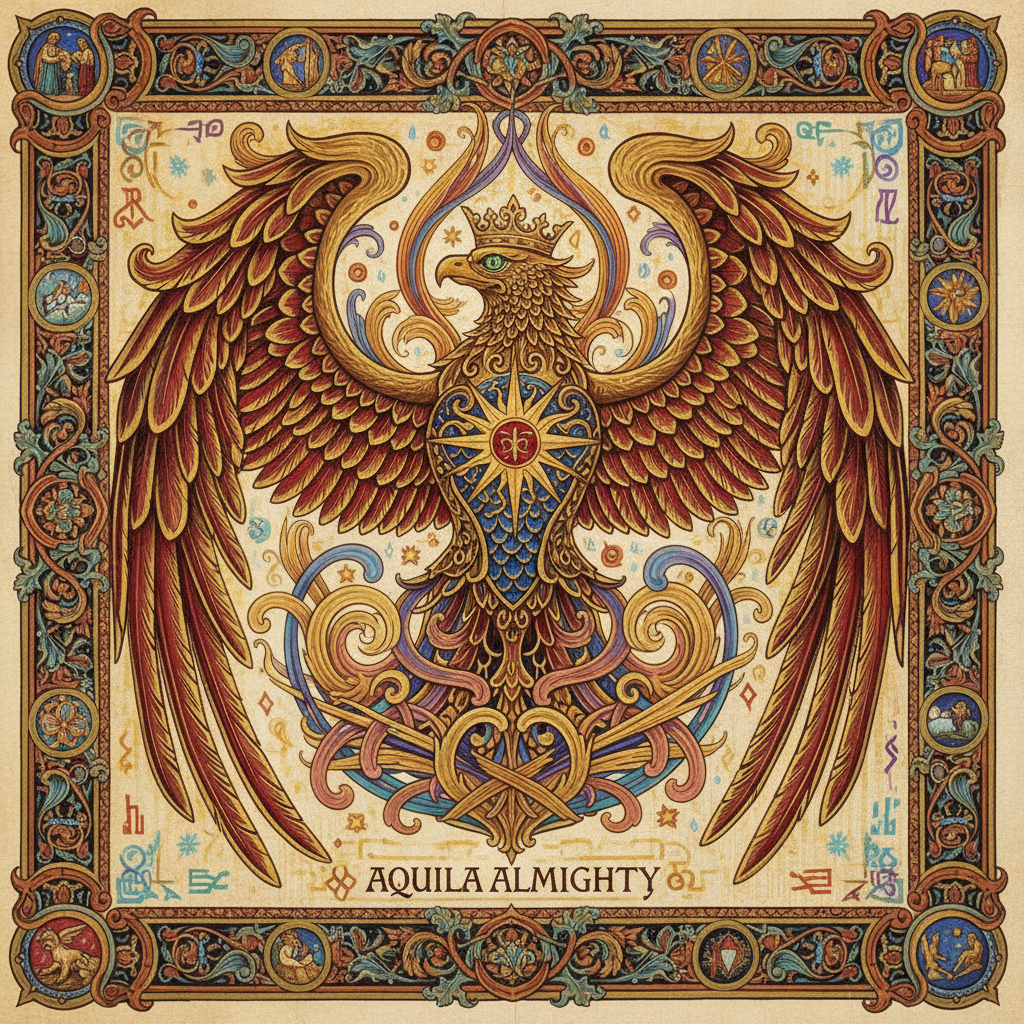
| Animal | Eagle |
| Tradition | Biblical / Roman / Native American |
| Associated With | God’s power, YHWH, Zeus, Thunderbird |
| Role | ”They shall mount up with wings as eagles” |
| Source | Isaiah 40:31 |
The eagle belongs to everyone because it rules the sky in every hemisphere. In the Bible it carries Israel out of Egypt “on eagles’ wings.” Zeus sends it to carry Ganymede to Olympus. The Romans put it atop every legion standard. The Lakota see Wanbli Gleska, the spotted eagle, as the highest messenger to the Great Spirit. The Thunderbird of the Northwest Coast is an eagle so vast its wingbeats make thunder. Every civilization that looked up and saw that silhouette circling said the same thing: whatever is up there, it flies like that.
A colossal golden eagle with wings spread wide descending from storm clouds, lightning crackling around its talons, one eye blazing like the sun, carrying divine fire, mountains and ancient temples visible far below, illuminated manuscript bestiary animal portrait, gold leaf halo, medieval bestiary style, ornate border with Roman eagles and Native thunderbird patterns, rich pigments on vellum, detailed naturalistic but symbolic rendering --ar 1:1 --s 750 --v 6.14. The Serpent — The Most Dangerous Symbol
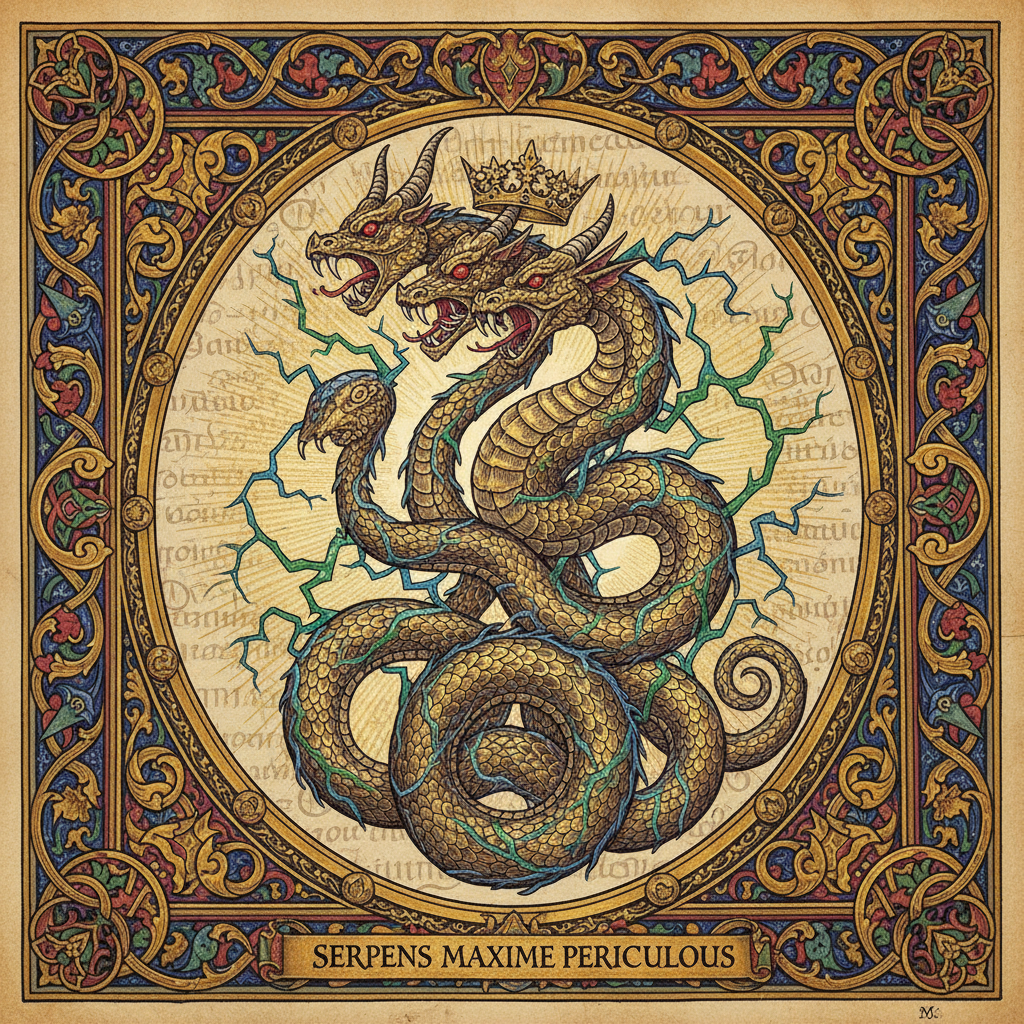
| Animal | Serpent |
| Tradition | Universal |
| Associated With | Satan AND wisdom AND healing AND chaos |
| Role | The most ambiguous animal in all religion |
| Source | Genesis 3, Numbers 21, Revelation 12 |
No animal in the history of religion carries more contradictory meaning. In Eden, the serpent is the deceiver. But in Numbers 21, God tells Moses to make a bronze serpent and put it on a pole — and anyone who looks at it is healed. Jesus himself references this in John 3:14. In Greek tradition, the serpent coils around Asclepius’s staff and becomes the symbol of medicine still used today. In Hindu cosmology, Shesha the cosmic serpent supports the entire universe. The Aztec Quetzalcoatl is a feathered serpent god. The Egyptian uraeus cobra sits on Pharaoh’s crown as divine protector. The Norse Jormungandr encircles the world. The serpent is simultaneously the most holy and most profane animal in existence. It depends entirely on who’s telling the story.
A massive cosmic serpent coiled in a figure-eight infinity shape, one half of its body radiant gold with healing light and wisdom symbols, the other half shadow-black with forbidden knowledge and chaos, an apple in one coil and a staff of healing in another, the Garden of Eden on one side and a cosmic void on the other, illuminated manuscript bestiary animal portrait, gold leaf accents, medieval bestiary style, ornate border with ouroboros serpent motifs, rich pigments on vellum, detailed naturalistic but symbolic rendering --ar 1:1 --s 750 --v 6.15. The Sacred Bull — Worshipped and Slaughtered
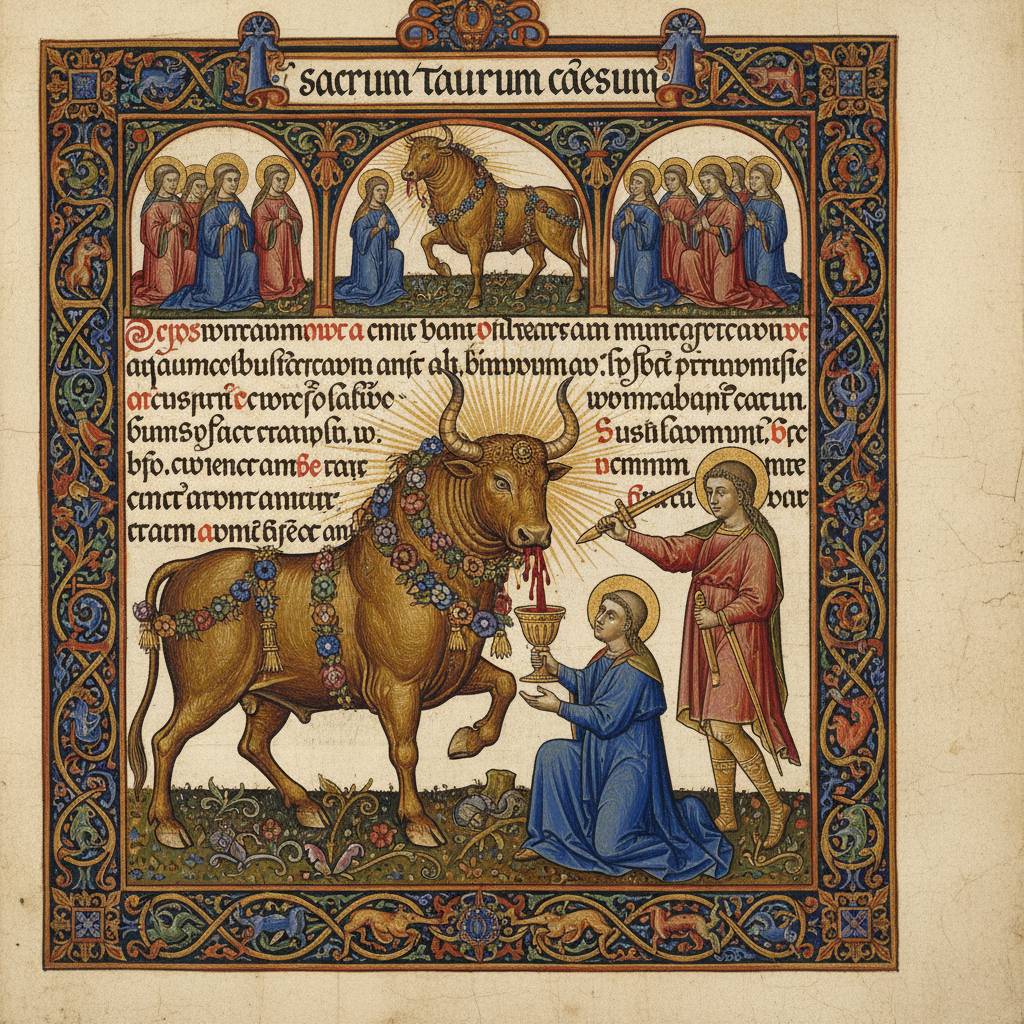
| Animal | Cow / Bull |
| Tradition | Hindu / Egyptian / Canaanite |
| Associated With | Nandi (Shiva’s bull), Hathor, Apis, the Golden Calf |
| Role | Sacred in some, sacrificed in others |
| Source | Various |
In India, the cow is so sacred that an entire civilization reorganized its diet around not eating it. Nandi the bull sits at the entrance of every Shiva temple — the god’s faithful mount and gatekeeper. In Egypt, the Apis bull was a living god: selected by sacred markings, worshipped in life, mummified in death. Hathor the cow goddess nursed the pharaohs. But in Canaan, the golden calf was the ultimate idolatry — the thing the Israelites made the moment Moses turned his back. Same animal. Opposite theology. The bull reveals what a tradition values most: power, fertility, loyalty, or obedience.
A magnificent white bull with golden horns standing at the entrance of a grand temple, sacred markings on its forehead, garlands of marigold flowers around its neck, a golden calf idol shattered at its feet, Egyptian Apis markings visible as ghostly overlay, illuminated manuscript bestiary animal portrait, gold leaf halo, medieval bestiary style, ornate border with Hindu lotus and Egyptian ankh patterns, rich pigments on vellum, detailed naturalistic but symbolic rendering --ar 1:1 --s 750 --v 6.16. The Divine Monkey — Trickster and Devotee
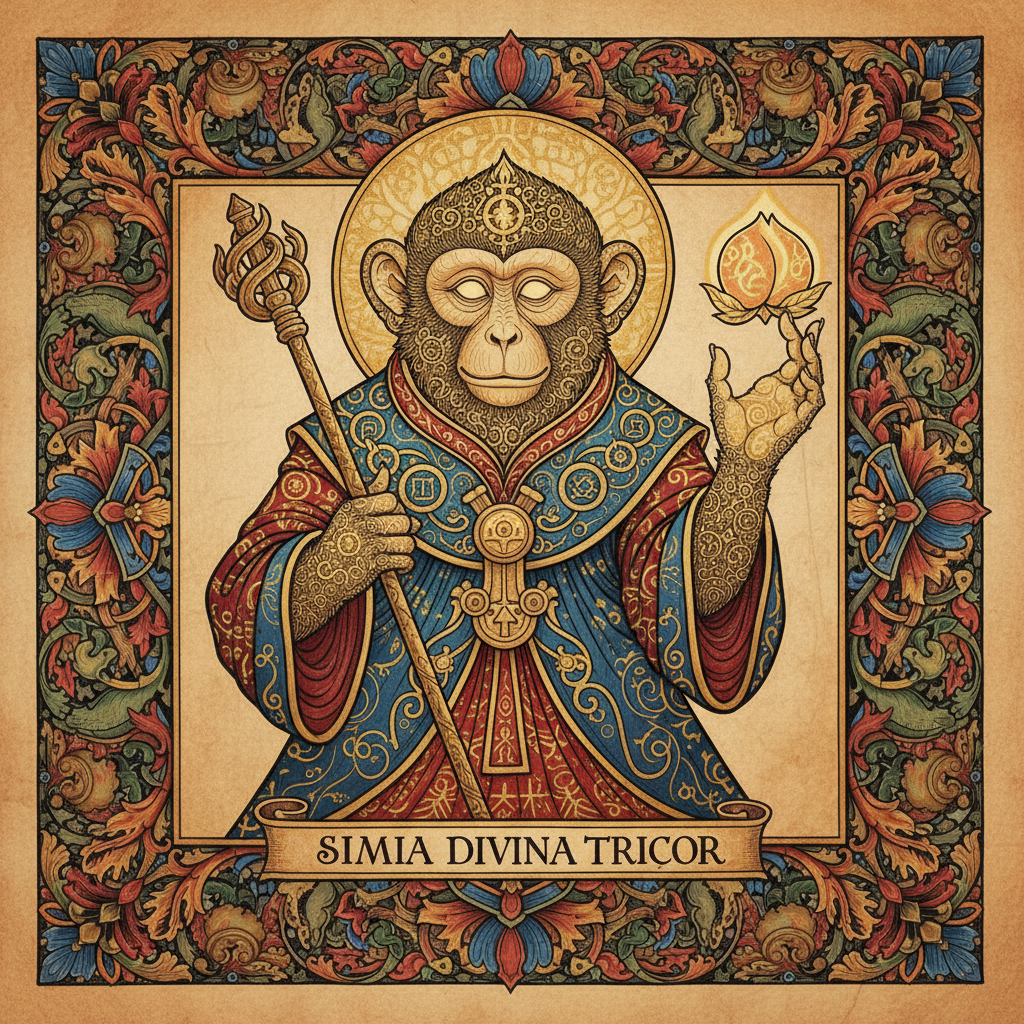
| Animal | Monkey |
| Tradition | Chinese / Hindu |
| Associated With | Sun Wukong, Hanuman |
| Role | Divine trickster-warrior-servant |
| Source | Journey to the West, Ramayana |
Two of the greatest heroes in Asian literature are monkeys. Hanuman, the monkey god of the Ramayana, is pure devotion incarnate — he tears open his own chest to reveal Rama and Sita living in his heart. He lifts an entire mountain because the herb he needs might be any of the plants growing on it. Sun Wukong, the Monkey King, is pure chaos who becomes devoted — he storms heaven, defeats 100,000 celestial soldiers, and is only stopped when the Buddha drops a mountain on him. After 500 years of imprisonment, he becomes a monk’s bodyguard on the journey to fetch scriptures. Both stories say the same thing: the wildest energy in the universe, once aimed at God, becomes unstoppable for good.
A divine monkey warrior in golden armor tearing open his chest to reveal a glowing divine scene within his heart, a massive mountain balanced on one palm, a golden staff in the other hand, clouds of heaven visible behind with defeated celestial soldiers, illuminated manuscript bestiary animal portrait, gold leaf halo, medieval bestiary style, ornate border with Chinese cloud motifs and Hindu lotus patterns, rich pigments on vellum, detailed naturalistic but symbolic rendering --ar 1:1 --s 750 --v 6.17. The Raven — Thought and Memory
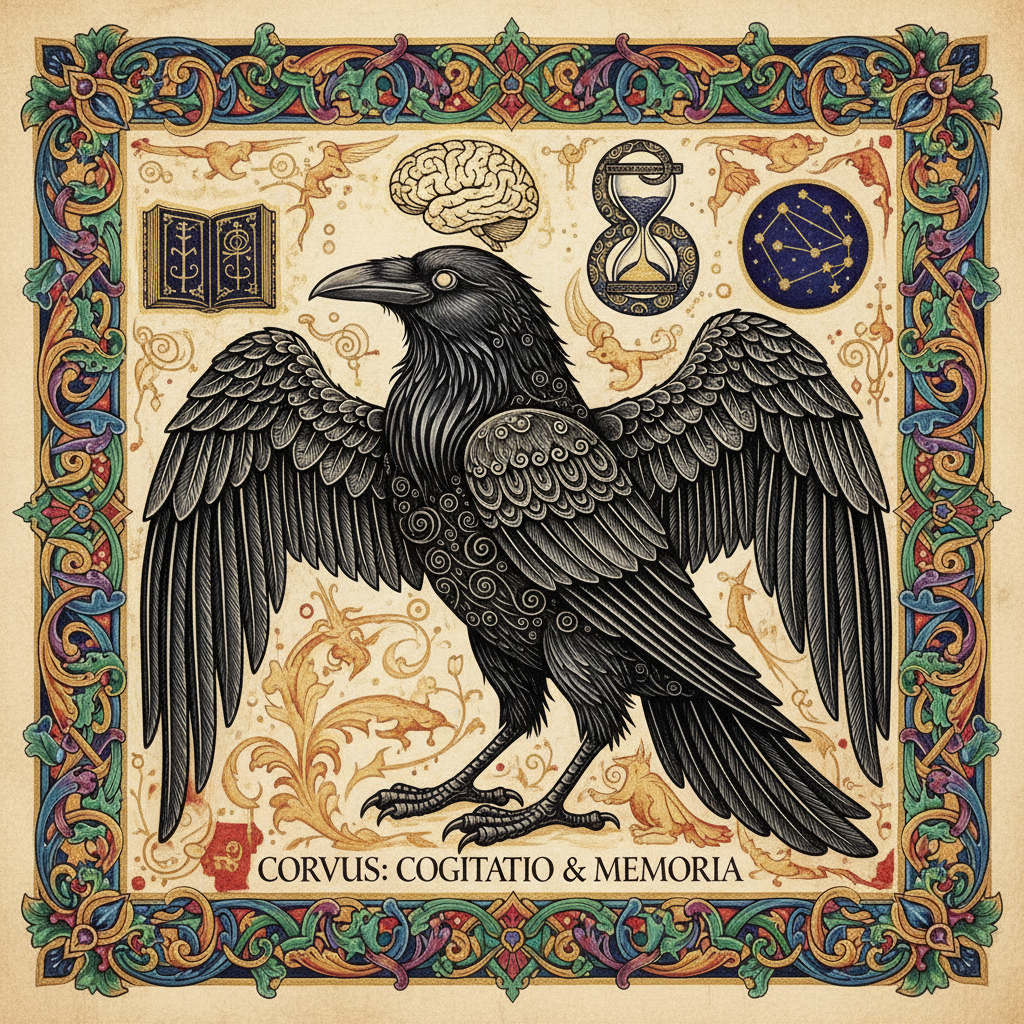
| Animal | Raven / Crow |
| Tradition | Norse / Native American / Celtic |
| Associated With | Odin’s Huginn & Muninn, Raven trickster, Morrigan |
| Role | Thought, memory, death, trickery |
| Source | Havamal, Tlingit oral tradition, Tain Bo Cuailnge |
Odin sends two ravens out every morning: Huginn (Thought) and Muninn (Memory). They fly across the entire world and return to whisper everything they’ve seen into his ears. Odin says he fears Muninn won’t return — even the god of wisdom is afraid of losing his memory. In the Pacific Northwest, Raven is the trickster who stole the sun and gave it to humanity — a thief who lit the world. In Celtic tradition, the Morrigan appears as a crow on the battlefield, choosing who dies. Ravens are the smartest birds on earth. Every tradition that watched them figured it out.
Two ravens perched on the shoulders of an ancient one-eyed figure barely visible in shadow, one raven whispering into the left ear, the other into the right, a stolen sun blazing in one raven's talons, Celtic war-crow silhouette in the background over a battlefield, illuminated manuscript bestiary animal portrait, gold leaf accents, medieval bestiary style, ornate border with Norse knotwork and Pacific Northwest formline art, rich pigments on vellum, detailed naturalistic but symbolic rendering --ar 1:1 --s 750 --v 6.18. The Wolf — Destroyer and Mother
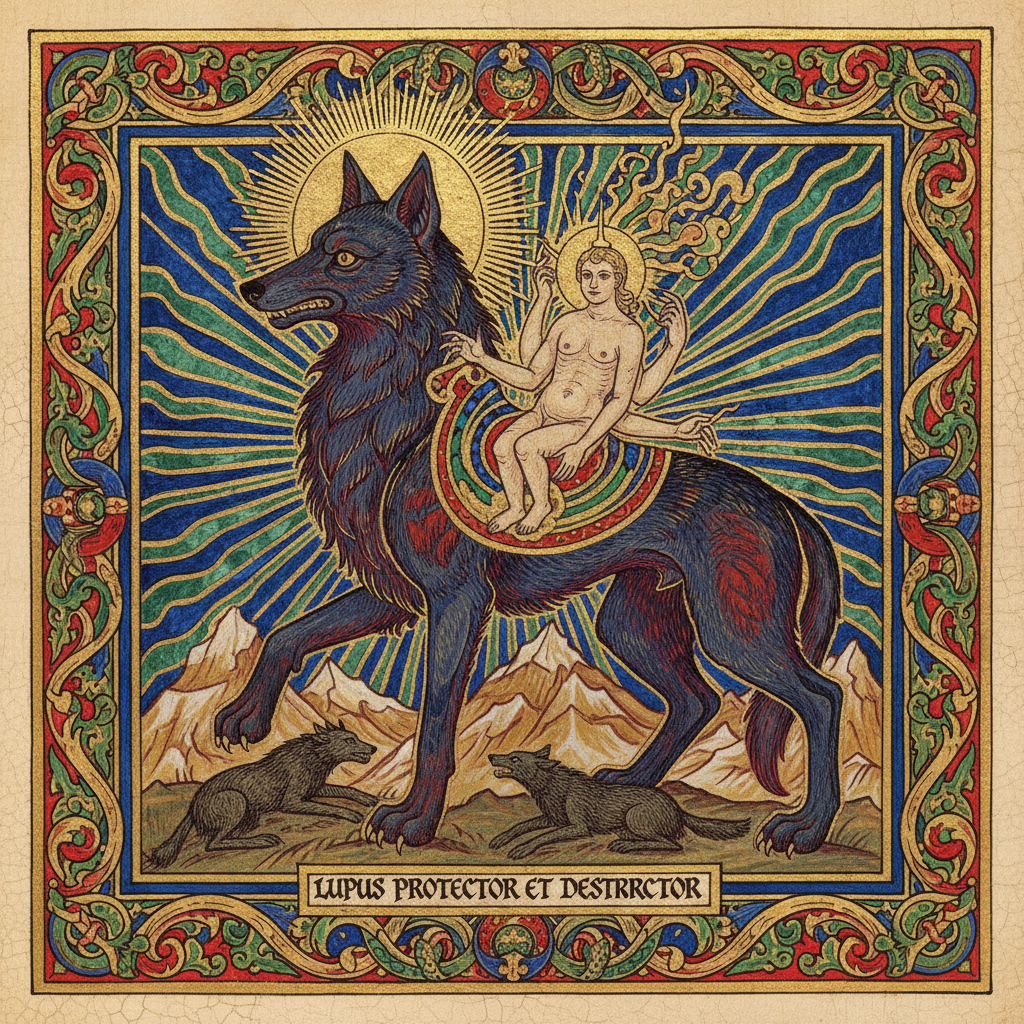
| Animal | Wolf |
| Tradition | Norse / Roman / Native American |
| Associated With | Fenrir, Romulus & Remus’s she-wolf, wolf clan totems |
| Role | Destruction AND nurturing |
| Source | Voluspa, Livy |
The wolf holds the most extreme duality in all mythology. Fenrir is the wolf-god who will swallow Odin at Ragnarok — the ultimate destroyer, so terrifying that the gods bound him with a chain made of impossible things (the sound of a cat’s footsteps, the beard of a woman, the roots of a mountain). But in Rome, a she-wolf nursed the abandoned twins Romulus and Remus, who founded the greatest empire in history. The wolf destroys heaven and founds civilization. Among many Native peoples, Wolf is the pathfinder, the teacher, the loyal one who models how a community should function. Same animal. Three truths.
A massive cosmic wolf with jaws open wide enough to swallow the sun, broken divine chains hanging from its legs, but in the shadow beneath it a gentle she-wolf nursing two human infants beside the Tiber River, wolf pack running in formation in the background like a lesson in community, illuminated manuscript bestiary animal portrait, gold leaf accents, medieval bestiary style, ornate border with Norse chains and Roman laurel wreaths, rich pigments on vellum, detailed naturalistic but symbolic rendering --ar 1:1 --s 750 --v 6.19. The Lion — The King of All Beasts
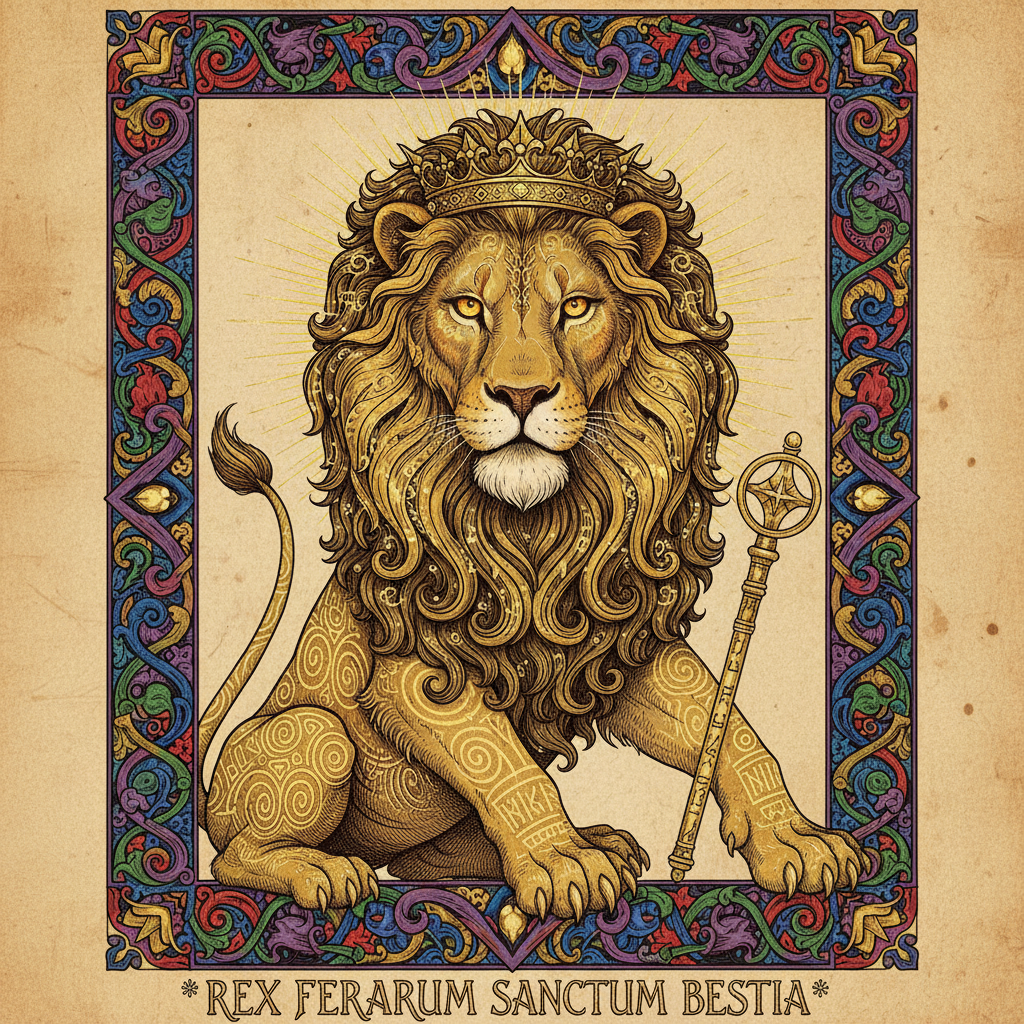
| Animal | Lion |
| Tradition | Biblical / Hindu / Buddhist |
| Associated With | Lion of Judah, Narasimha, Manjushri’s mount |
| Role | Kingship, divine power, courage |
| Source | Revelation 5:5, various |
“The Lion of the tribe of Judah has conquered.” Christ is called a lion in the same breath as he’s called a lamb. In Hindu mythology, Vishnu manifests as Narasimha — half-man, half-lion — to destroy a demon who had made himself invulnerable to man and beast alike. The solution was neither. In Buddhist iconography, Manjushri, the bodhisattva of wisdom, rides a lion. The Buddha’s teaching is called the “lion’s roar.” Every throne in every kingdom used lions as armrests. The lion doesn’t symbolize divinity — it symbolizes the moment divinity stops being patient.
A titanic golden lion with a blazing mane of divine fire, one paw on a fallen demon, the other raised in a gesture of teaching, half its face human and half lion in the style of Narasimha, a lamb sitting peacefully between its front paws, Buddhist wisdom sutras swirling in the air, illuminated manuscript bestiary animal portrait, gold leaf halo, medieval bestiary style, ornate border with Hebrew lions and Hindu temple carvings, rich pigments on vellum, detailed naturalistic but symbolic rendering --ar 1:1 --s 750 --v 6.110. The Fox — The Shape-Shifter
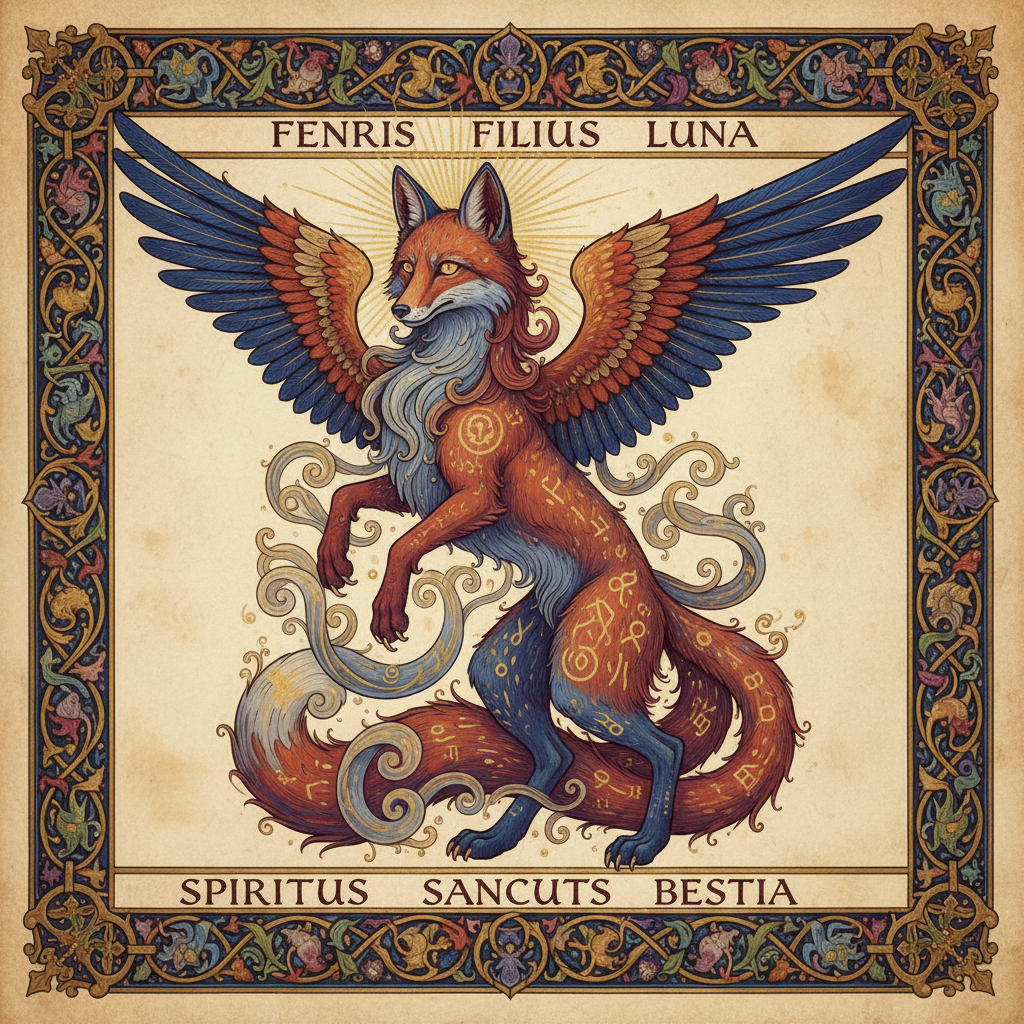
| Animal | Fox |
| Tradition | Japanese / Chinese / Korean |
| Associated With | Kitsune, Huli Jing, Gumiho, Inari’s messengers |
| Role | Shape-shifting, seduction, divine service |
| Source | East Asian folklore |
In Japan, foxes serve Inari, the god of rice, fertility, and prosperity. Every Inari shrine has fox statues at its gates — red-bibbed, sitting upright, often holding keys or jewels in their mouths. Kitsune gain tails as they age; a nine-tailed fox is nearly divine. But they also shape-shift into beautiful women and seduce men, sometimes lovingly, sometimes fatally. In China, the Huli Jing is a fox spirit of seduction and sorcery. In Korea, the Gumiho devours livers. The fox is the animal where service to the divine and service to desire become indistinguishable.
A nine-tailed fox with ghostly luminous white fur sitting before a vermillion torii gate, each tail tipped with foxfire, shifting between fox form and the shape of an elegant woman in a kimono, offerings of rice and sake at a small shrine before it, illuminated manuscript bestiary animal portrait, gold leaf accents, medieval bestiary style, ornate border with Japanese torii gates and Chinese cloud patterns, rich pigments on vellum, detailed naturalistic but symbolic rendering --ar 1:1 --s 750 --v 6.111. The Horse — The Apocalypse Rides
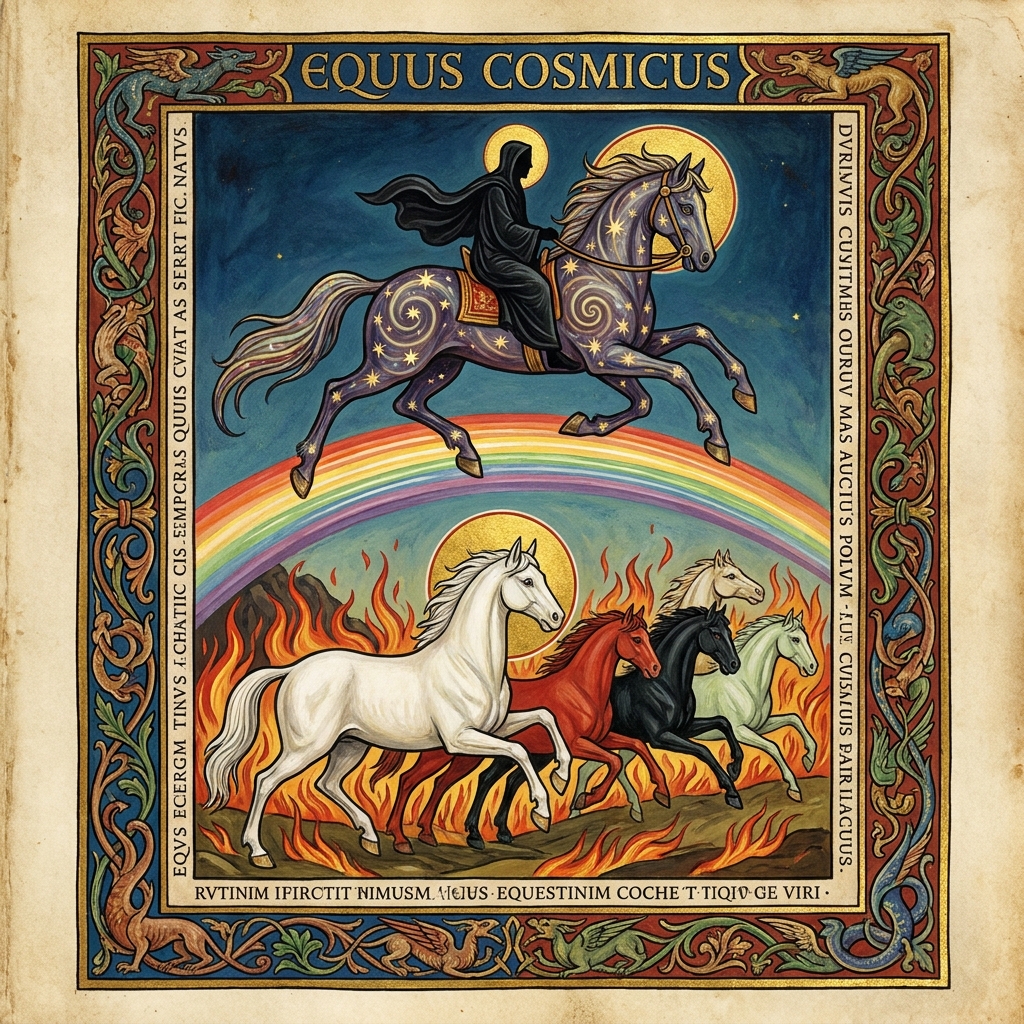
| Animal | Horse |
| Tradition | Norse / Hindu / Apocalyptic |
| Associated With | Sleipnir (8 legs), Kalki’s mount, Four Horsemen |
| Role | Divine transport, apocalypse, war |
| Source | Various |
Odin’s horse Sleipnir has eight legs and can gallop between worlds — born when Loki shape-shifted into a mare (long story). In Hindu eschatology, Kalki, the final avatar of Vishnu, will ride a white horse named Devadatta at the end of the age to destroy the wicked and restart the cycle. In Revelation, four horses carry Conquest, War, Famine, and Death across the earth. The horse is the animal of the end of things. When gods ride, they ride horses. When the world ends, horses are what bring the riders.
An eight-legged cosmic horse galloping across a bridge of rainbow light between worlds, its rider a silhouette in shadow, four horses of different colors -- white, red, black, and pale green -- charging behind it across a burning landscape, a white horse with divine radiance leading them all, illuminated manuscript bestiary animal portrait, gold leaf accents, medieval bestiary style, ornate border with Norse runes and apocalyptic seals, rich pigments on vellum, detailed naturalistic but symbolic rendering --ar 1:1 --s 750 --v 6.112. The Cat — Independent and Divine
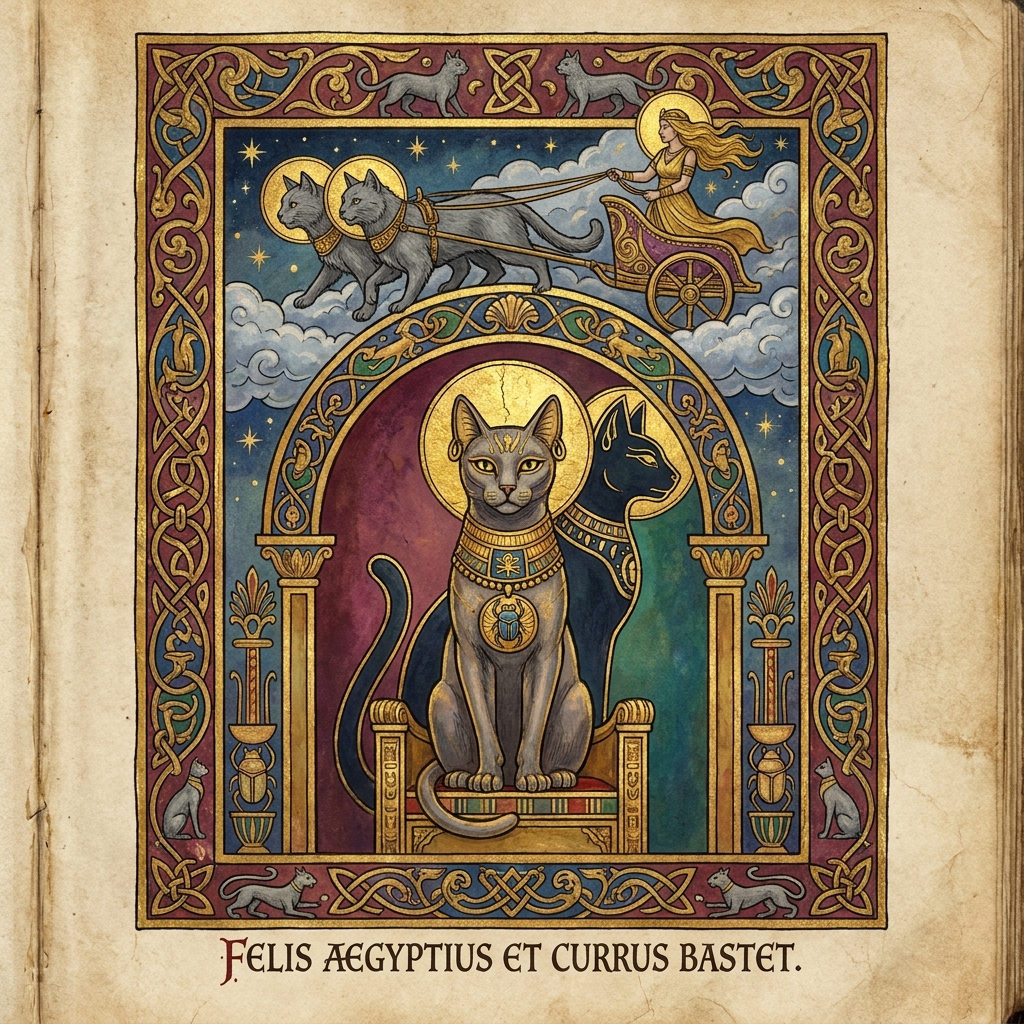
| Animal | Cat |
| Tradition | Egyptian / Norse |
| Associated With | Bastet, Freya’s chariot cats |
| Role | Protection, independence, the feminine |
| Source | Egyptian religion, Prose Edda |
Egypt made it a capital crime to kill a cat. Bastet, the cat-headed goddess, protected homes, women, and children. When a household cat died, the family shaved their eyebrows in mourning. The Romans found warehouses full of mummified cats. In Norse mythology, Freya — goddess of love, beauty, war, and death — drove a chariot pulled by two enormous cats. The cat is the only domesticated animal that chose domestication on its own terms. Every tradition that honored it recognized the same thing: this creature serves no one, and that’s exactly why the gods love it.
A regal Egyptian cat with golden jewelry and a scarab amulet, seated on a throne before a temple, the shadow of the cat-headed goddess Bastet rising behind it, two large Norse gray cats pulling a chariot through the sky above with a golden-haired goddess, illuminated manuscript bestiary animal portrait, gold leaf halo, medieval bestiary style, ornate border with Egyptian hieroglyphs and Norse knotwork, rich pigments on vellum, detailed naturalistic but symbolic rendering --ar 1:1 --s 750 --v 6.113. The Elephant — Wisdom Walks Heavy
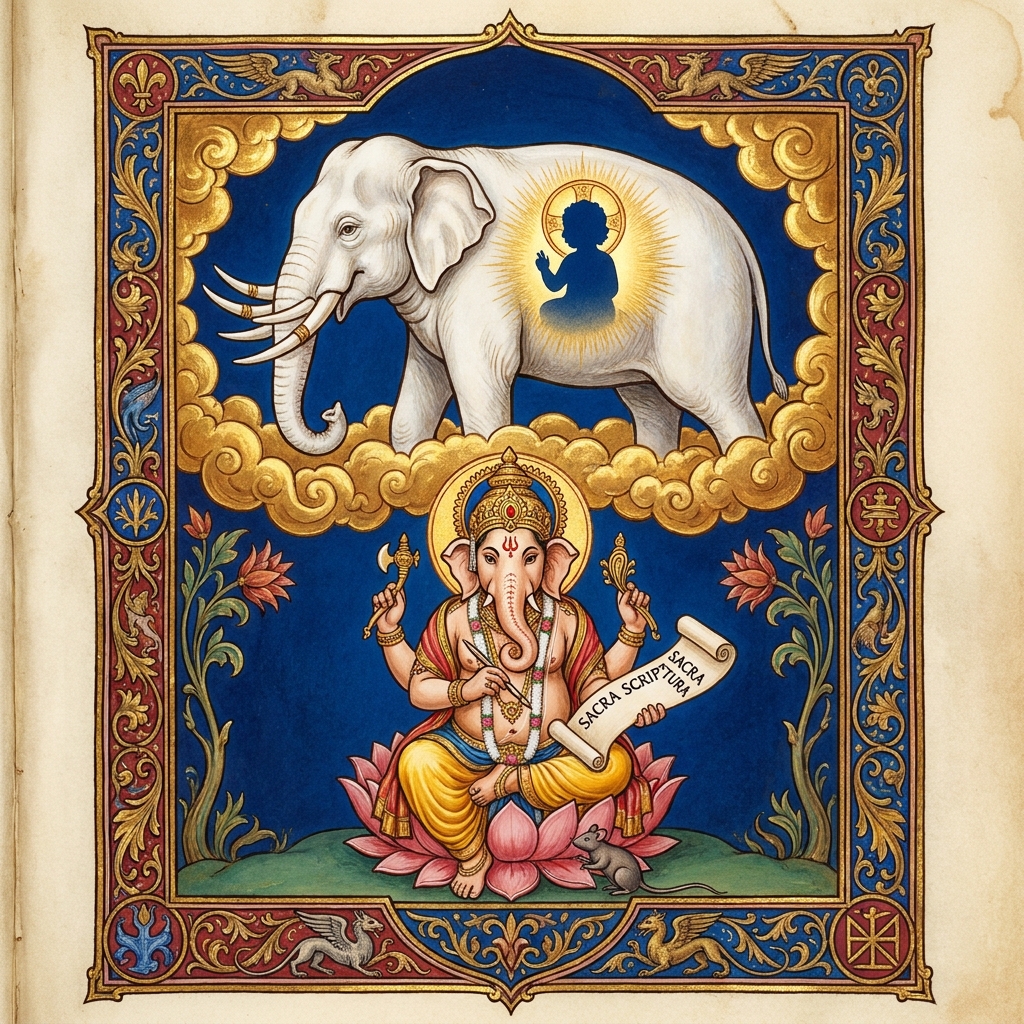
| Animal | Elephant |
| Tradition | Hindu / Buddhist |
| Associated With | Ganesh, the white elephant of Buddha’s conception |
| Role | Wisdom, obstacles removed, auspiciousness |
| Source | Various |
Ganesh, the elephant-headed god, is invoked before every new beginning in Hinduism. He removes obstacles. He loves sweets. He rides a mouse. His head was cut off by his own father Shiva (who didn’t recognize him) and replaced with the head of the first animal they found — an elephant. In Buddhism, Queen Maya dreamed that a white elephant entered her side, and she conceived the Buddha. The elephant is the largest land animal, and in both traditions it represents the biggest truth: wisdom isn’t about speed or sharpness. It’s about weight. About presence. About being so substantial that obstacles simply move.
A magnificent white elephant with six tusks descending from golden clouds, a divine child visible as a glowing silhouette within its side, an elephant-headed god seated cross-legged on a lotus before it holding a broken tusk as a pen and writing sacred scripture, a tiny mouse at its feet, illuminated manuscript bestiary animal portrait, gold leaf halo, medieval bestiary style, ornate border with Hindu mandala patterns and Buddhist lotus motifs, rich pigments on vellum, detailed naturalistic but symbolic rendering --ar 1:1 --s 750 --v 6.114. The Fish — The Hidden God
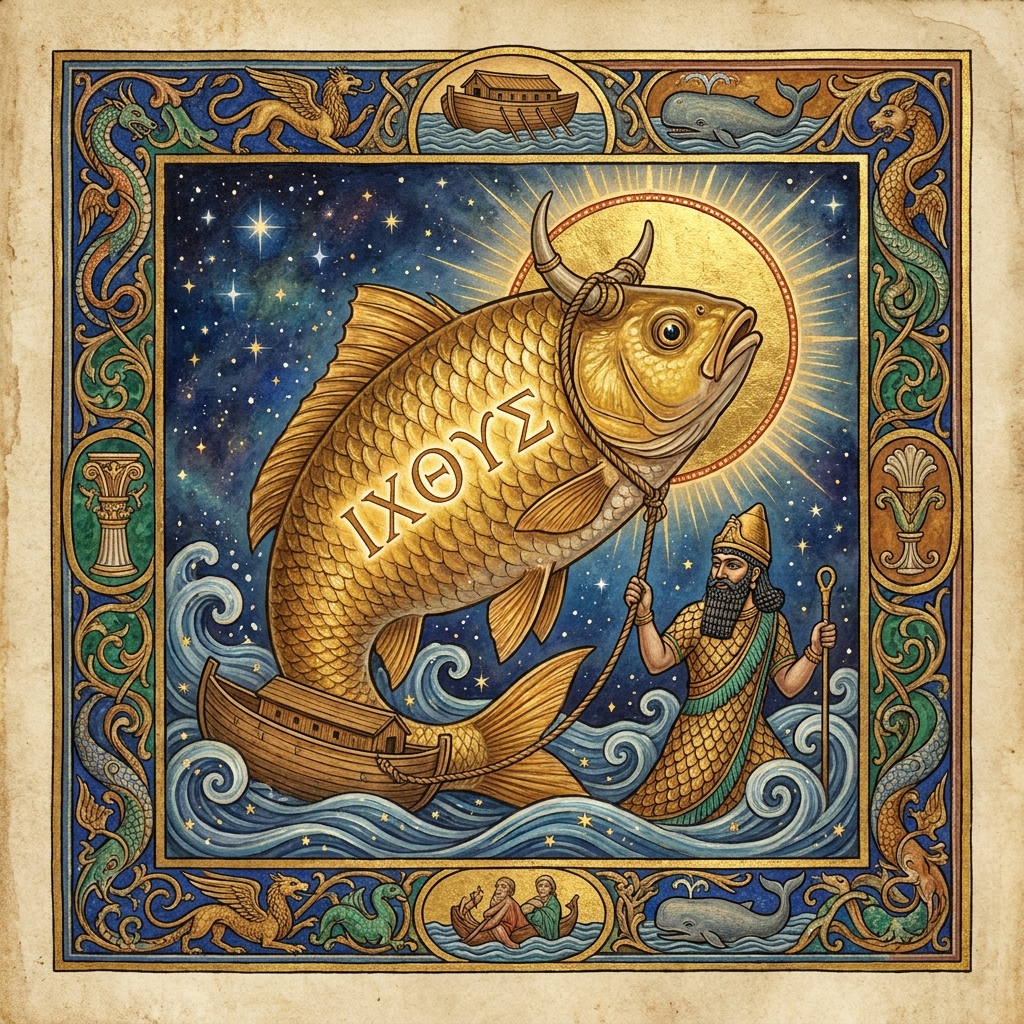
| Animal | Fish |
| Tradition | Christian / Hindu / Mesopotamian |
| Associated With | ICHTHYS, Matsya avatar, Ea/Enki |
| Role | Secret identity, salvation from flood |
| Source | Various |
The fish is the secret-keeper of religion. Early Christians used the fish symbol (ICHTHYS — an acrostic for “Jesus Christ, God’s Son, Savior”) as a covert signal during persecution. Draw half a fish in the dirt; if the other person completes it, they’re one of you. In Hindu mythology, Vishnu’s first avatar is Matsya, a fish who warns Manu of the coming flood and tows his ark to safety. In Mesopotamia, Ea/Enki, god of wisdom and water, appears in fish form. Three separate traditions independently made the fish into a vehicle of salvation from catastrophe. The fish saves you when the water rises.
A colossal golden fish with divine radiance swimming through cosmic floodwaters, a small ark attached by rope to its horn, the Greek letters ICHTHYS glowing on its scales, a bearded Mesopotamian god-figure in fish robes emerging from the water beside it, illuminated manuscript bestiary animal portrait, gold leaf accents, medieval bestiary style, ornate border with Christian fish symbols and Mesopotamian wave patterns, rich pigments on vellum, detailed naturalistic but symbolic rendering --ar 1:1 --s 750 --v 6.115. The Bear — The Sovereign Wild
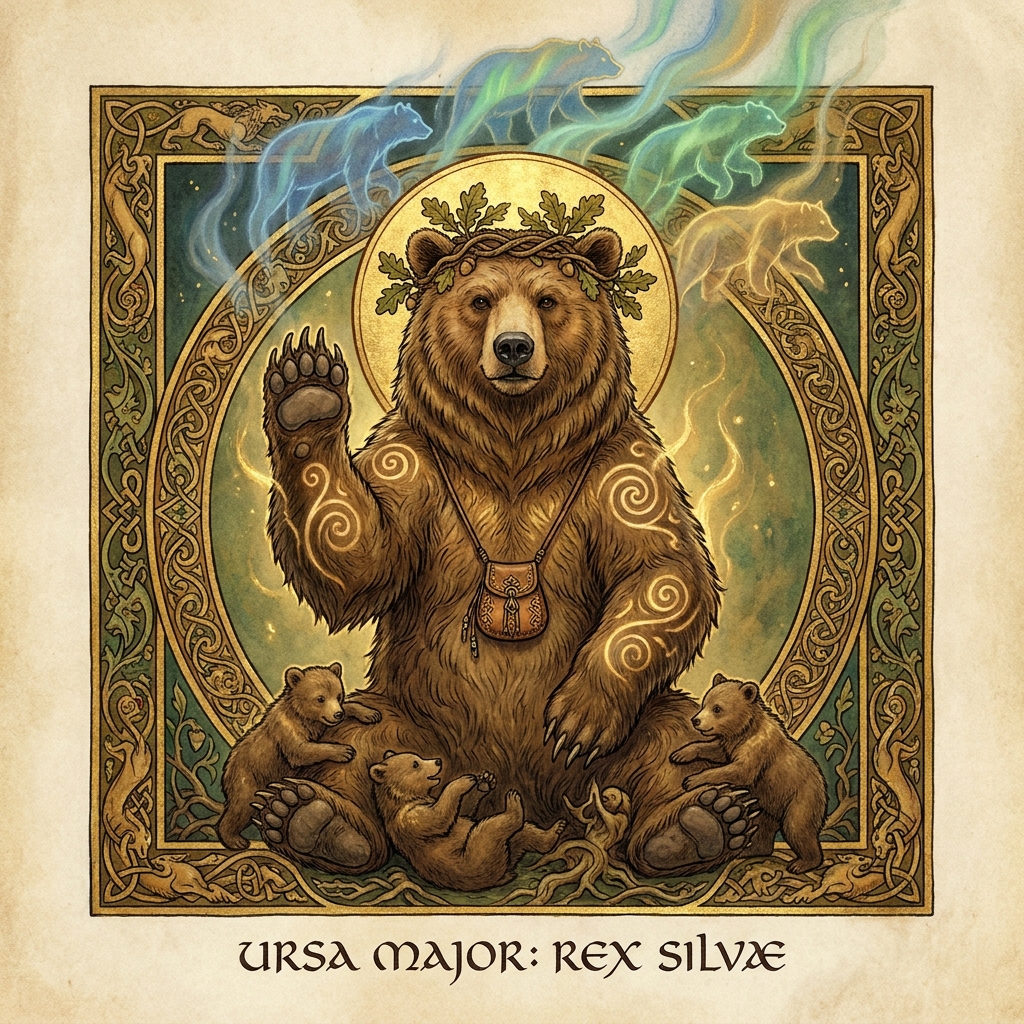
| Animal | Bear |
| Tradition | Celtic / Native American / Slavic |
| Associated With | Arthur (from Celtic artos = bear), Bear Mother, Veles |
| Role | Sovereignty, strength, the wild |
| Source | Various |
King Arthur’s name comes from the Celtic word artos — bear. The bear was the king of the European forest before the lion was imported as a symbol. In many Native traditions, Bear is the healer, the medicine keeper, the one who hibernates in the earth and returns — a living metaphor for death and resurrection. The Slavic god Veles, lord of the underworld, was associated with the bear. Among the Ainu of Japan, the bear was so sacred that the killing of a bear was itself a religious ceremony — sending the bear-god’s spirit home. The bear is what the wild looks like when the wild is holy.
A massive brown bear standing upright in an ancient forest, wearing a crown of oak leaves, one paw raised in blessing, Celtic spiral tattoos glowing on its fur, a medicine bundle hanging from its neck, bear cubs playing at its feet while ancestral spirits of bears drift upward like northern lights, illuminated manuscript bestiary animal portrait, gold leaf halo, medieval bestiary style, ornate border with Celtic knotwork and Slavic geometric patterns, rich pigments on vellum, detailed naturalistic but symbolic rendering --ar 1:1 --s 750 --v 6.116. The Jaguar — Night Sorcerer
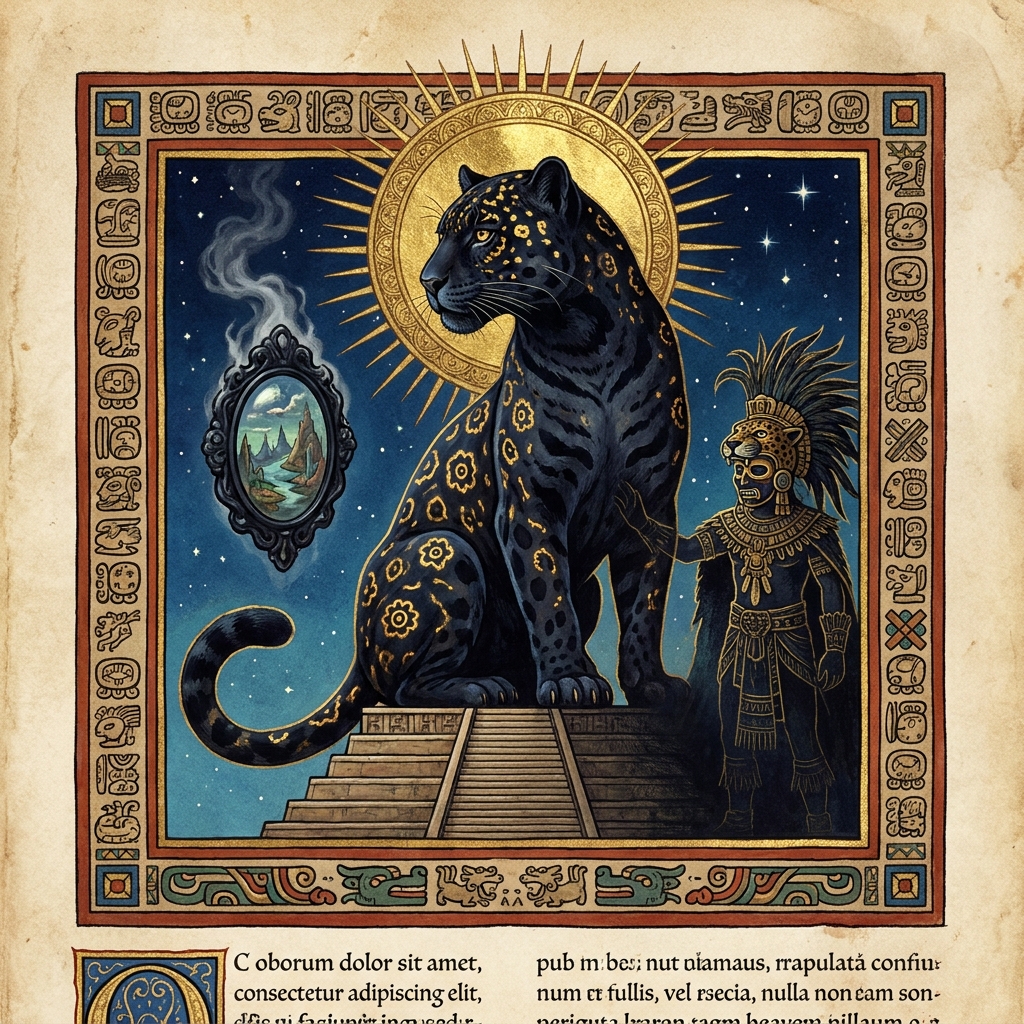
| Animal | Jaguar |
| Tradition | Mesoamerican |
| Associated With | Tezcatlipoca, Balam (Maya word for jaguar-priest) |
| Role | Night, sorcery, underworld power |
| Source | Maya / Aztec |
In Mesoamerica, the jaguar is what lives at the top of the food chain in a world without lions. Tezcatlipoca, the Smoking Mirror, transforms into a jaguar — the animal of the night, of sorcery, of power that operates in darkness. Maya priests called Balam (jaguar) were the most powerful sorcerers. Jaguar pelts were thrones. Jaguar warriors were the elite military order of the Aztec empire. The Olmec, the oldest Mesoamerican civilization, carved half-human half-jaguar figures that suggest the very first gods were jaguars. In the Americas, before the Europeans came, the top predator was also the top deity.
A massive black jaguar with golden rosettes glowing like stars, sitting on a stepped Mesoamerican pyramid throne at night, an obsidian smoking mirror floating beside it reflecting another world, a jaguar-priest in full ceremonial regalia merging with its shadow, illuminated manuscript bestiary animal portrait, gold leaf accents, medieval bestiary style, ornate border with Maya glyphs and Aztec sun stone patterns, rich pigments on vellum, detailed naturalistic but symbolic rendering --ar 1:1 --s 750 --v 6.117. The Turtle — The World’s Foundation
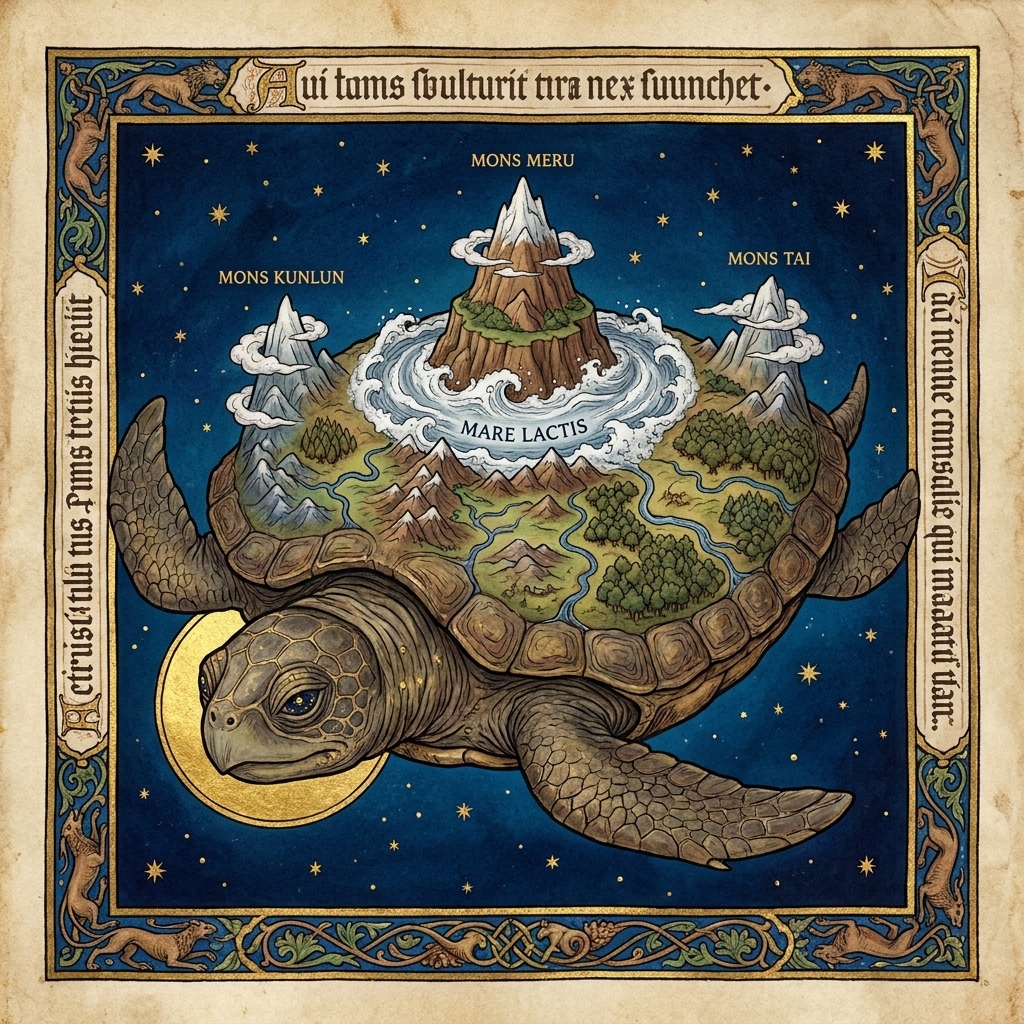
| Animal | Turtle |
| Tradition | Native American / Hindu / Chinese |
| Associated With | Turtle Island, Kurma avatar, Ao |
| Role | World-support, patience, the foundation |
| Source | Various |
In many Native American traditions, North America is Turtle Island — the continent rests on the back of a great turtle. In Hindu mythology, Vishnu’s second avatar Kurma is a cosmic turtle who supports Mount Mandara during the Churning of the Ocean, the event that produced the elixir of immortality. In Chinese cosmology, the great turtle Ao carries the world-mountains on its back. Three unconnected civilizations looked at the turtle and said: that’s what holds everything up. The turtle is the animal of foundation — slow, patient, ancient, and carrying more weight than anything else alive.
A colossal cosmic turtle swimming through space, an entire continent with mountains and rivers and forests growing on its shell, the ocean of milk churning around a great mountain balanced on its back, Chinese world-mountains rising from its shoulders, stars reflected in its ancient eyes, illuminated manuscript bestiary animal portrait, gold leaf accents, medieval bestiary style, ornate border with Native American turtle clan symbols and Hindu cosmic ocean waves, rich pigments on vellum, detailed naturalistic but symbolic rendering --ar 1:1 --s 750 --v 6.118. The Spider — The Weaver of Worlds
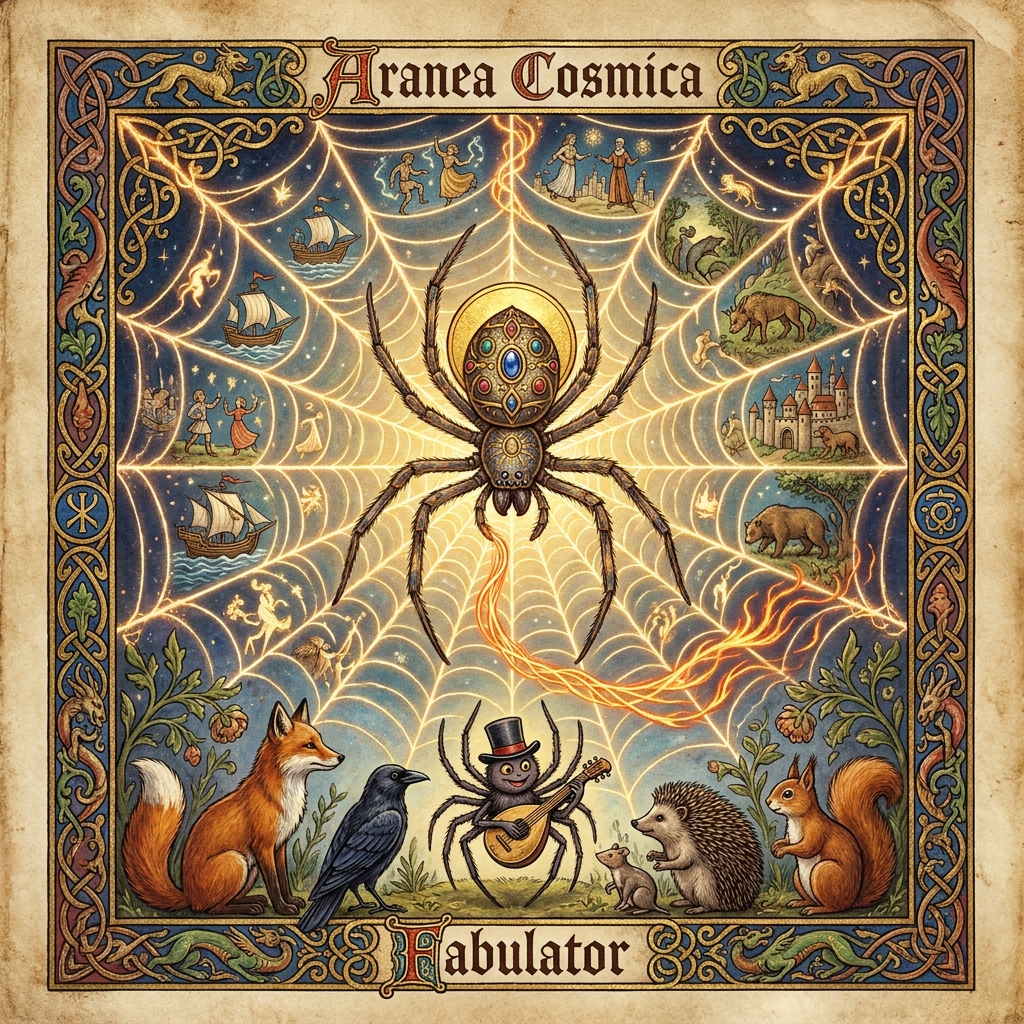
| Animal | Spider |
| Tradition | Native American / Akan |
| Associated With | Spider Woman (Hopi), Anansi (Akan) |
| Role | Creation (weaving), storytelling |
| Source | Hopi tradition, Akan folklore |
Spider Woman of the Hopi wove the world into existence. She sits at the center of creation, spinning threads of thought into reality, teaching the people how to weave. In West African and Caribbean tradition, Anansi the spider is the master storyteller — he tricked the sky god into giving him ownership of all stories. Every story ever told belongs to Anansi. The spider is the animal that makes something from nothing: it pulls silk from its own body and builds architecture in empty air. Creation and storytelling are the same act. The spider knows this.
A great spider sitting at the center of a cosmic web that extends to the edges of the universe, each strand of the web containing a tiny glowing story-scene, the spider weaving new threads of light from its spinnerets, a smaller trickster spider with a top hat telling stories to gathered listeners below, illuminated manuscript bestiary animal portrait, gold leaf accents, medieval bestiary style, ornate border with Hopi geometric weaving patterns and Akan adinkra symbols, rich pigments on vellum, detailed naturalistic but symbolic rendering --ar 1:1 --s 750 --v 6.119. The Dog — Loyal Beyond Death
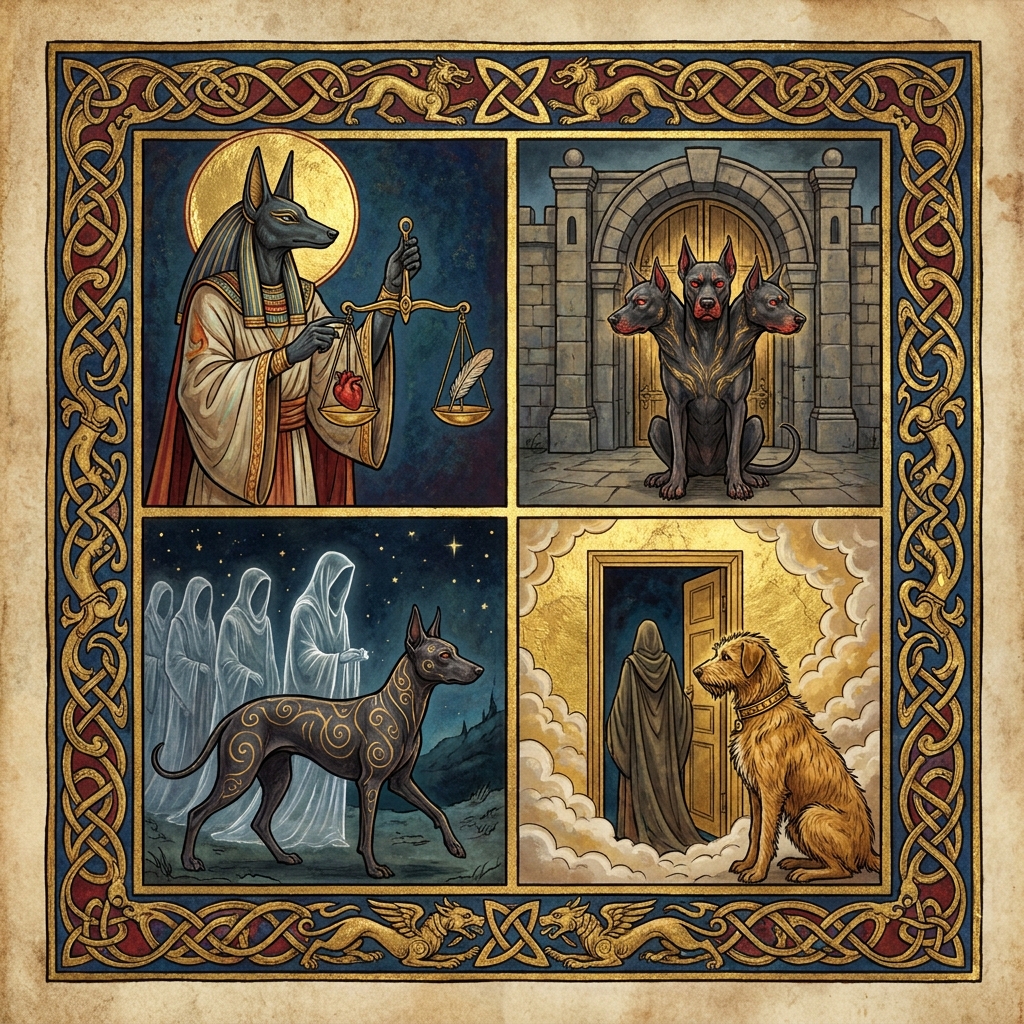
| Animal | Dog |
| Tradition | Egyptian / Greek / Aztec |
| Associated With | Anubis (jackal), Cerberus, Xolotl (guides the dead) |
| Role | Death, guarding, loyalty beyond death |
| Source | Various |
The dog is the only animal that followed us out of the wild by choice — and every tradition honored that loyalty by giving it the most important job: guarding the boundary between life and death. Anubis, the jackal-headed god, weighs your heart against the feather of truth. Cerberus, the three-headed dog, guards the gates of the Greek underworld — nothing gets out. Xolotl, the Aztec dog-god, guides the dead through the underworld’s nine levels. In the Mahabharata, when Yudhishthira reaches heaven, he refuses to enter without his dog — and the dog reveals itself as Dharma, the god of righteousness, testing his loyalty. The dog is the animal that proves death is not the end of devotion.
A jackal-headed guardian figure weighing a human heart on golden scales, a three-headed dog guarding a vast gate behind it, an Aztec hairless dog with divine markings leading a procession of spirits through darkness, a loyal mutt sitting at the threshold of heaven refusing to leave its master, illuminated manuscript bestiary animal portrait, gold leaf accents, medieval bestiary style, ornate border with Egyptian ankhs and Greek meander patterns, rich pigments on vellum, detailed naturalistic but symbolic rendering --ar 1:1 --s 750 --v 6.120. The Swan — Grace Between Worlds
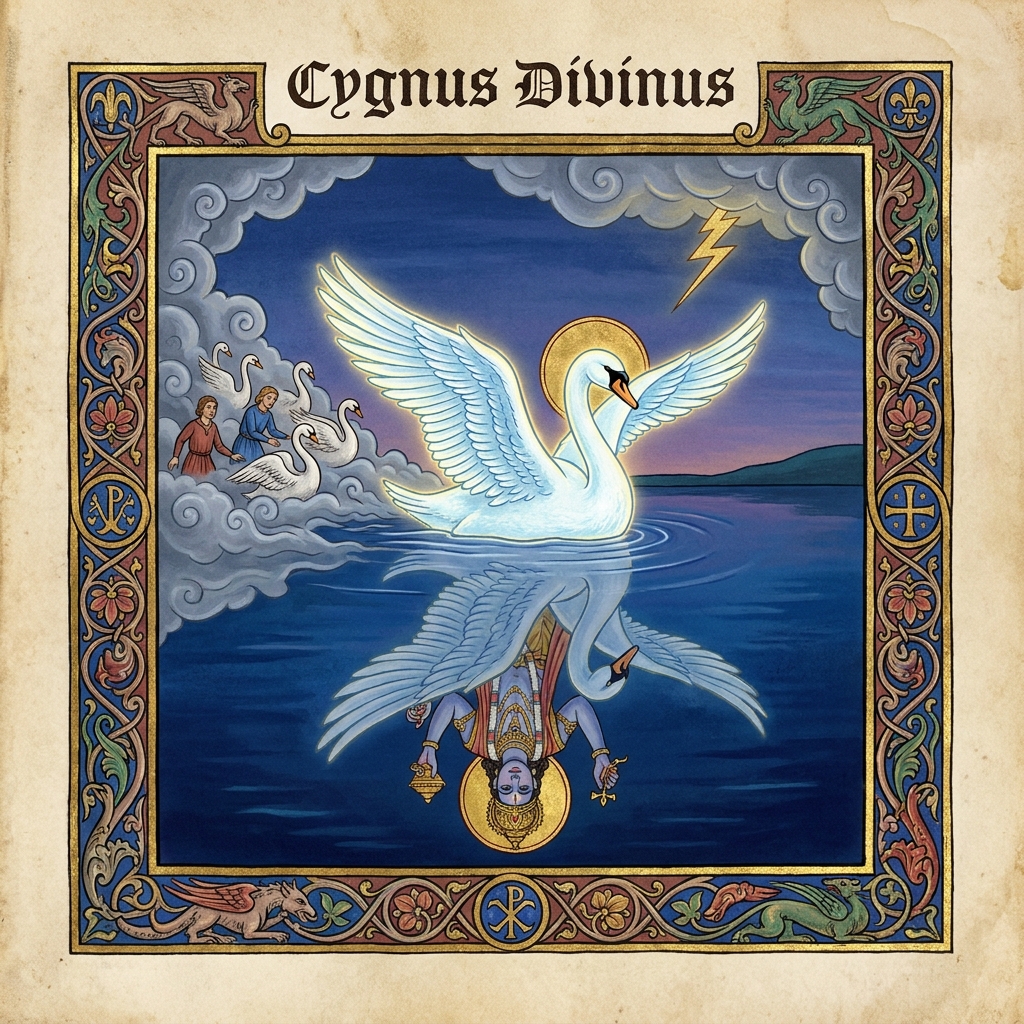
| Animal | Swan |
| Tradition | Hindu / Greek / Celtic |
| Associated With | Brahma’s mount, Zeus’s disguise, the Children of Lir |
| Role | Purity, transformation, divine grace |
| Source | Various |
Brahma, the creator god of Hinduism, rides a swan called Hamsa — a bird said to be able to separate milk from water, truth from illusion. In Greek mythology, Zeus transforms into a swan to seduce Leda, producing Helen of Troy — the most beautiful and destructive thing in the ancient world, born from divine grace in animal form. In Irish mythology, the four children of Lir are transformed into swans for 900 years by their jealous stepmother, singing songs so beautiful that all of Ireland weeps. The swan is the animal of transformation itself — the creature that moves between water, land, and air, between beauty and sorrow, between the human world and the divine.
A luminous white swan with wings spread wide gliding across a mirror-still sacred lake at twilight, the reflection showing not a swan but a divine being with four arms, four human children transforming into swans in the mist behind it, Zeus's thunderbolt barely visible in the clouds above, illuminated manuscript bestiary animal portrait, gold leaf halo, medieval bestiary style, ornate border with Hindu hamsa motifs and Celtic spirals, rich pigments on vellum, detailed naturalistic but symbolic rendering --ar 1:1 --s 750 --v 6.1The Pattern
Every culture that watched animals closely enough saw the divine in them. Not as metaphor — as recognition. The lamb dies willingly. The eagle sees everything. The serpent sheds its skin and is reborn. The turtle carries the world. The dog follows you into death.
These aren’t projections. They’re observations. The animals really do these things. What’s sacred is that someone looked closely enough to notice — and then built a theology around the looking.
The medieval bestiaries knew this. Every animal entry was simultaneously natural history and sermon. The pelican feeds its young with blood from its own breast (Christ). The phoenix burns and rises (resurrection). The unicorn can only be tamed by a virgin (incarnation).
This section is that tradition continued. Twenty animals. Every major religion. The same truth from twenty angles: the divine doesn’t just speak through prophets. It walks on four legs, flies on wings, swims in deep water, and coils in the grass.