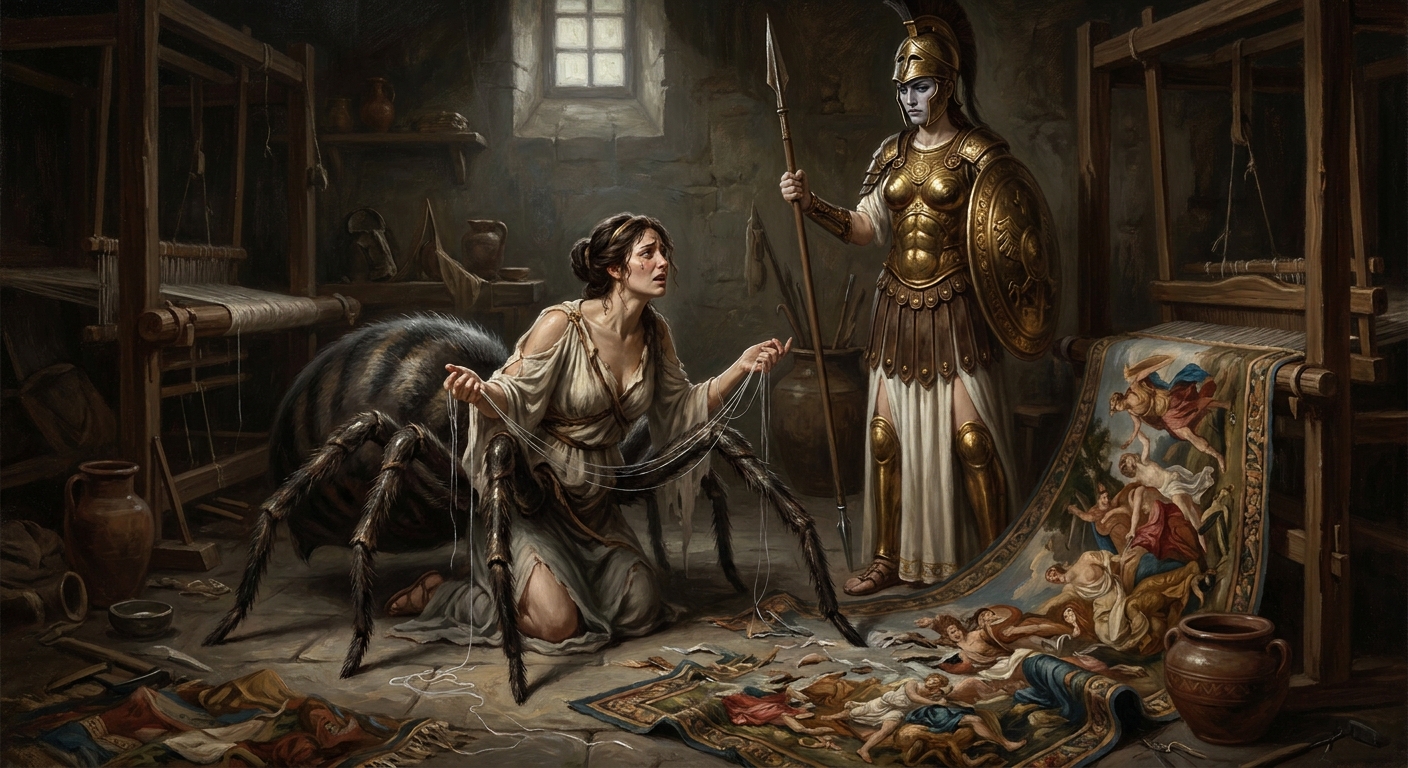
Part of the Bestiary Compendium
Every tradition has its gallery of the damned. Not the hell-bound masses — the specific sinners, the ones whose punishments became myths in themselves. This is the catalog of divine justice at its most theatrical: what the gods do when you steal from them, insult them, sleep with them, or try to become them.
Art style:
hyper-realistic dark mythology, dramatic chiaroscuro lighting, the horror and majesty of divine justice, the moment of punishment landing, cinematic composition, oil painting rendering, 8kThe Punishments — What Happens When You Cross the Divine
| Sinner | Sin | Punishment | Tradition | Source |
|---|---|---|---|---|
| Prometheus | Stole fire for humanity | Chained to a cliff, eagle eats his liver daily, it regenerates overnight. Forever. | Greek | Hesiod |
| Tantalus | Fed his son to the gods | Stands in water that recedes when he drinks, under fruit that pulls away when he reaches. Forever. | Greek | Homer |
| Sisyphus | Cheated death twice | Rolls a boulder uphill. It rolls back. Repeat. Forever. | Greek | Homer |
| Lot’s Wife | Looked back at Sodom | Turned into a pillar of salt. Instantly. | Biblical | Gen 19:26 |
| Uzza | Touched the Ark of the Covenant | Struck dead instantly. He was trying to PREVENT it from falling. | Biblical | 2 Sam 6:7 |
| Arachne | Boasted she was a better weaver than Athena | Transformed into a spider. Weaves forever but never creates beauty. | Greek | Ovid |
| Niobe | Boasted her children were better than Leto’s | Apollo and Artemis killed all 14 of her children. She wept until she turned to stone. Still weeping. | Greek | Homer, Ovid |
| Marsyas | Challenged Apollo to a music contest and lost | Flayed alive — his skin hung on a tree. | Greek | Ovid |
| Herod Agrippa | Accepted worship as a god | ”Eaten by worms and died” on the spot. | Biblical | Acts 12:23 |
| Nebuchadnezzar | ”Is not this the great Babylon I have built?” | Driven mad, lived as an animal eating grass for 7 years. | Biblical | Dan 4 |
| Lycaon | Served human flesh to Zeus to test if he was really a god | Transformed into the first werewolf. | Greek | Ovid |
| The Watchers | Mated with human women, taught forbidden knowledge | Bound in chains of darkness, imprisoned until the Day of Judgment | 1 Enoch | 1 Enoch 10 |
| Loki | Engineered Baldur’s death | Bound with his own son’s intestines. Serpent drips venom on his face. His wife catches it in a bowl. When she empties the bowl, he writhes and causes earthquakes. Until Ragnarok. | Norse | Prose Edda |
| Ixion | Tried to seduce Hera | Bound to a flaming wheel that spins through the sky forever. | Greek | Pindar |
| Set | Murdered Osiris | Defeated by Horus in trial. In some versions: castrated. Eternal pariah. | Egyptian | Plutarch |
The Escalation
| Offense Level | Punishment | Examples |
|---|---|---|
| Curiosity/disobedience | Transformation | Lot’s wife (salt), Arachne (spider), Lycaon (wolf) |
| Pride/hubris | Humiliation | Nebuchadnezzar (beast), Niobe (children slain) |
| Defying the divine order | Eternal torment | Prometheus (liver), Sisyphus (boulder), Tantalus (hunger) |
| Killing the innocent | Proportional destruction | Niobe (14 children killed), Loki (bound with son’s guts) |
| Claiming to BE God | Instant death | Herod Agrippa, Iblis (cast out) |
The Uncomfortable Question
Uzza was struck dead for trying to SAVE the Ark from falling. His sin was touching something holy with good intentions. Several traditions punish people for doing the right thing in the wrong way. Is divine justice about WHAT you do, or about respecting the rules regardless of intent?
1. Prometheus — The Eternal Price of Compassion (Greek)
Tradition: Greek Sin: Stole fire from the gods and gave it to humanity Punishment: Chained to a cliff in the Caucasus Mountains; an eagle tears out his liver every day. His liver regenerates overnight. This repeats forever. Source: Hesiod, Theogony
Prometheus loved humanity more than he loved the gods. He stole fire from Hephaestus’s forge and smuggled it to earth in a fennel stalk. Zeus was furious — not just at the theft, but at what it meant. Fire was power. Knowledge. The beginning of civilization. Prometheus had elevated mortals to near-divine status. So Zeus chained him to a rock at the edge of the world and sent an eagle — some say Zeus himself in eagle form — to eat his liver every day. Prometheus cannot die. He cannot sleep. Every dawn brings the eagle. Every night his flesh closes. The cruelest part: he knew it was coming. He is the Titan whose name means foresight.
Heracles eventually freed him. But the punishment lasted thirty generations.
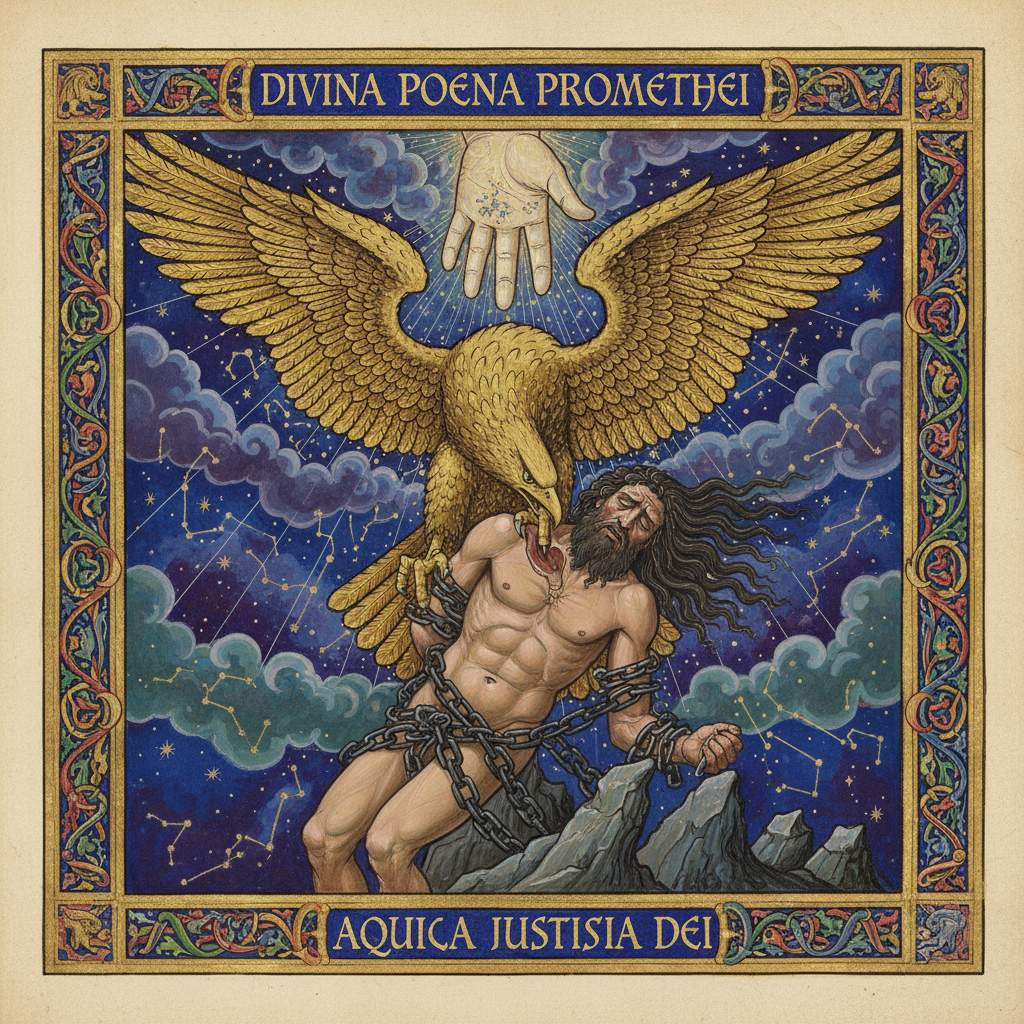
Prometheus chained spread-eagle to a jagged Caucasus cliff face, a massive divine eagle with blazing golden eyes tearing into his side, the Titan's face contorted in eternal agony yet still defiant, unbroken, his body scarred from centuries of the same wound, below him the distant fires of human civilization visible -- the very thing he suffered for, storm clouds roiling overhead, blood-red sunset sky, hyper-realistic dark mythology, dramatic chiaroscuro lighting, the horror and majesty of divine justice, cinematic composition, oil painting rendering, 8k2. Tantalus — Hunger Without End (Greek)
Tradition: Greek Sin: Killed his son Pelops and served him to the gods at a feast Punishment: Stands in a pool of water beneath fruit trees in Tartarus. When he reaches for fruit, the branches pull away. When he bends to drink, the water recedes. Forever hungry. Forever thirsty. Forever reaching. Source: Homer, Odyssey XI; Pindar
Tantalus was favored by the gods — invited to Olympus, allowed to eat ambrosia at their table. He repaid this privilege by stealing their food and their secrets, then committing the ultimate sacrilege: he killed his own son Pelops and served him as a feast to test whether the gods were omniscient. They were. They refused to eat. Demeter, distracted by grief for Persephone, accidentally ate a piece of his shoulder — but the gods restored Pelops to life with a shoulder of ivory. Tantalus got Tartarus. The water recedes. The fruit retreats. The word tantalize came from his punishment.
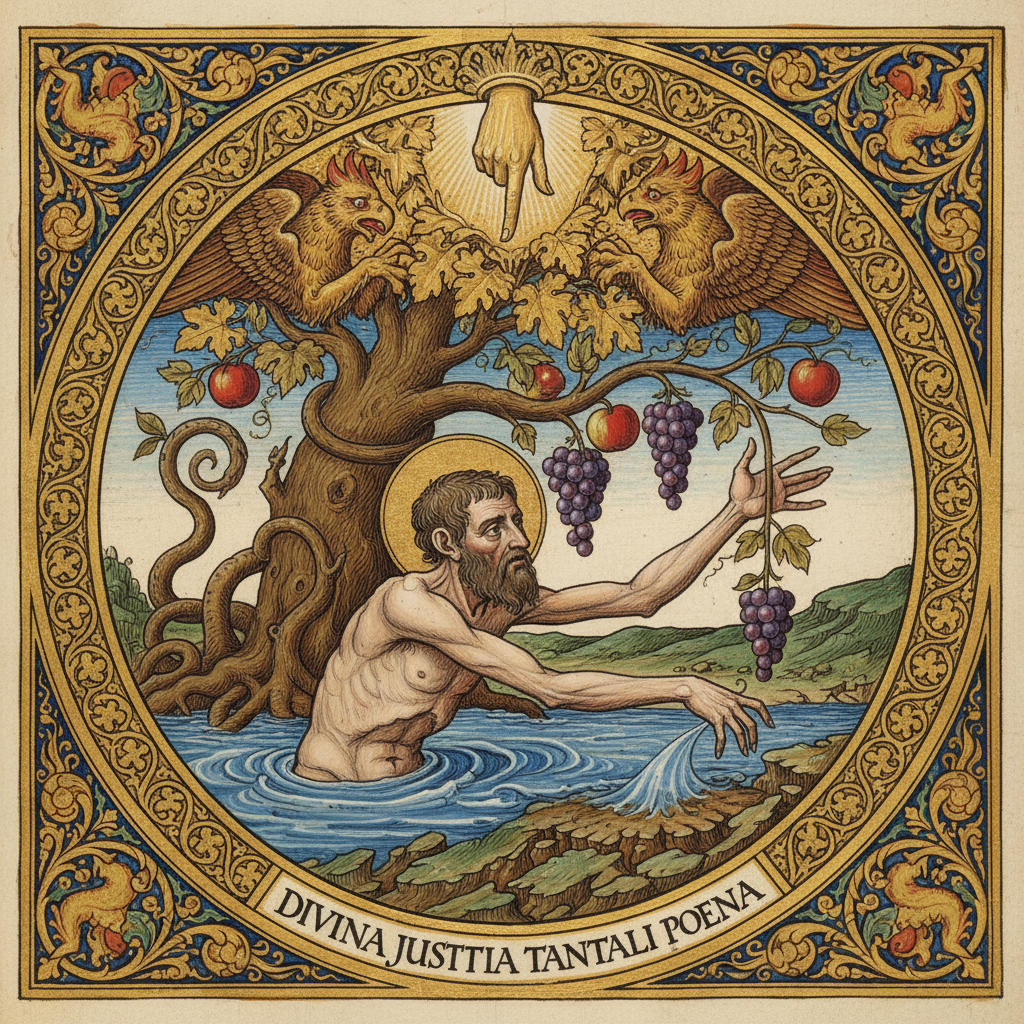
Tantalus standing chest-deep in a pool of shimmering water in Tartarus, both hands outstretched straining toward hanging clusters of golden fruit and ripe figs just inches beyond his fingertips, the branches visibly curling away from his touch, his face a mask of ravenous desperation and ancient anguish, the water around him pulling back as he bends toward it, leaving dry cracked earth, fruit trees heavy with abundance surrounding him in cruel abundance, dim hellish red light, hyper-realistic dark mythology, dramatic chiaroscuro lighting, cinematic composition, oil painting rendering, 8k3. Sisyphus — The Boulder, Again (Greek)
Tradition: Greek Sin: Cheated death twice — first by chaining Thanatos (Death himself), then by tricking Persephone into releasing him from the underworld Punishment: Rolls an enormous boulder up a steep hill. Every time it nears the top, it rolls back to the bottom. Repeat. Forever. Source: Homer, Odyssey XI; Ovid
Sisyphus was the craftiest man who ever lived. When Thanatos came for him, he chained Death — and for a time, no one could die. Ares had to come personally to free Thanatos. When Sisyphus finally went to the underworld, he told his wife not to perform his funeral rites, then complained to Persephone that without proper burial he had to return above ground. She let him go. He lived another decade before the gods dragged him back. His punishment was designed specifically for a man who could not stop scheming: a task that cannot be completed. No cleverness helps. No bargain is possible. Just the boulder, and the hill, and the roll back down.
Albert Camus said we must imagine Sisyphus happy.
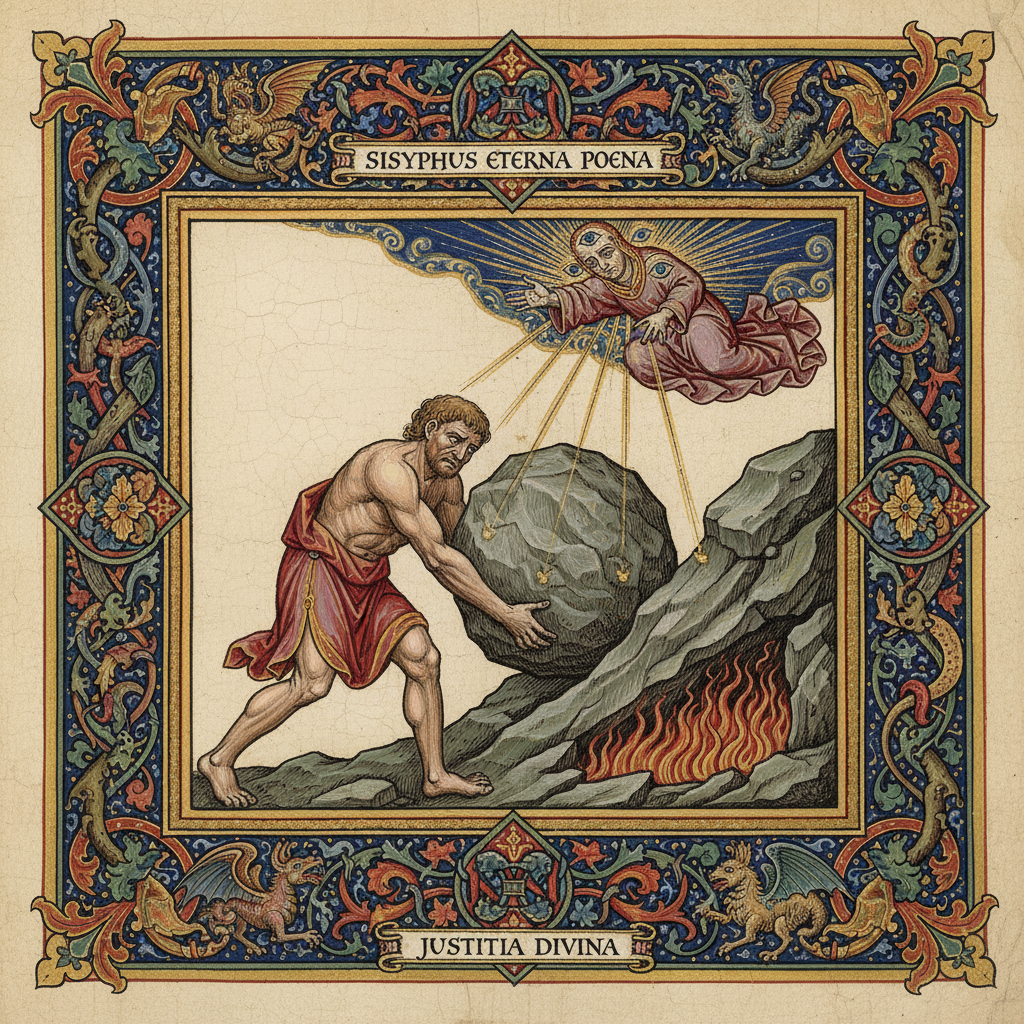
Sisyphus straining with every muscle to push an enormous granite boulder up a steep hellish slope in Tartarus, his body bent nearly horizontal from the effort, veins bulging, face set in grim determination, the boulder beginning to roll backward at the crest -- that terrible moment of failure -- other damned souls visible in the abyss below, dim red volcanic light, the Stygian landscape stark and merciless, hyper-realistic dark mythology, dramatic chiaroscuro lighting, the absurdity and horror of eternal futile labor, cinematic composition, oil painting rendering, 8k4. Lot’s Wife — The Cost of Looking Back (Biblical)
Tradition: Biblical Sin: Looked back at Sodom as she was fleeing Punishment: Turned into a pillar of salt. Instantly. Source: Genesis 19:26
The angels told them not to look back. They told them not to stop. They were fleeing the destruction of Sodom — fire and brimstone raining from heaven, two cities obliterating in divine judgment. Lot ran. His daughters ran. His wife ran. And then she turned around. One sentence in Genesis: “But his wife looked back from behind him, and she became a pillar of salt.” No explanation. No warning repeated to her specifically. No second chance. The scholars argue about whether her sin was disobedience, or longing for what she left behind, or curiosity, or hesitation. The text gives you nothing but the fact. She looked back. She became salt.
A pillar still stands near the Dead Sea. People have named it Lot’s Wife for centuries.
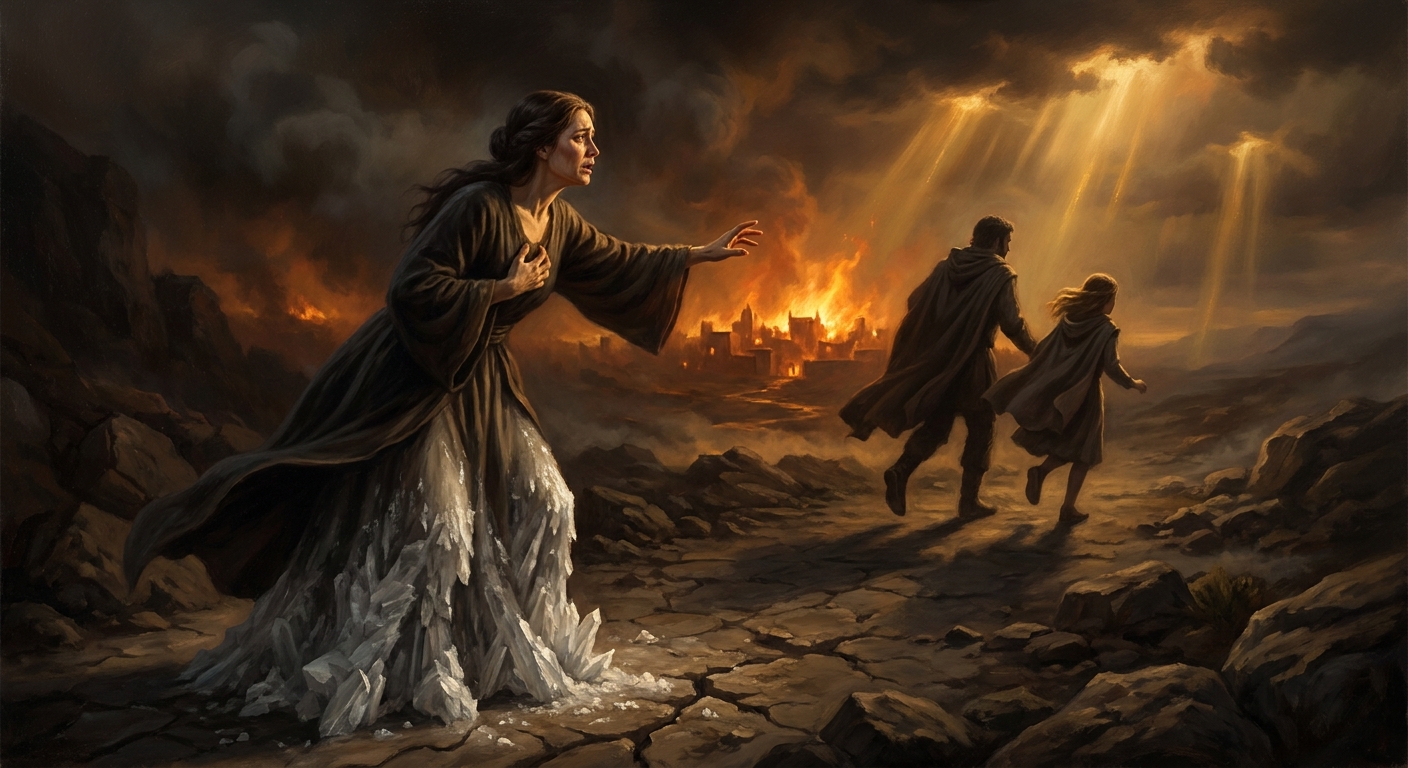
A woman mid-turn, her body already crystallizing from the waist down into white salt, her face caught in the moment of looking back at the city of Sodom being consumed by fire and sulfur raining from heaven, her expression a mixture of horror and longing, one hand reaching back toward the inferno, her daughters and husband ahead of her still running without looking back, the salt spreading upward through her body in the split second of transformation, golden fire and divine wrath filling the horizon, hyper-realistic dark mythology, dramatic chiaroscuro lighting, biblical terror, cinematic composition, oil painting rendering, 8k5. Uzza — Killed for Good Intentions (Biblical)
Tradition: Biblical Sin: Touched the Ark of the Covenant to prevent it from falling Punishment: Struck dead instantly by God Source: 2 Samuel 6:6-7
David was bringing the Ark of the Covenant to Jerusalem. It was being transported on a cart. The oxen stumbled. The Ark began to tip. Uzza reached out and grabbed it to prevent it from falling. He was struck dead on the spot. That’s the whole story. Uzza wasn’t trying to steal the Ark. He wasn’t attacking it or desecrating it. He was preventing it from hitting the ground. The text says God struck him because he had “put his hand to the Ark.” David was furious and terrified — so terrified he refused to bring the Ark to Jerusalem that day and left it at a stranger’s house for three months. The text does not explain. It does not justify. God’s anger burned against Uzza. Uzza died.
This story has troubled theologians for two thousand years.
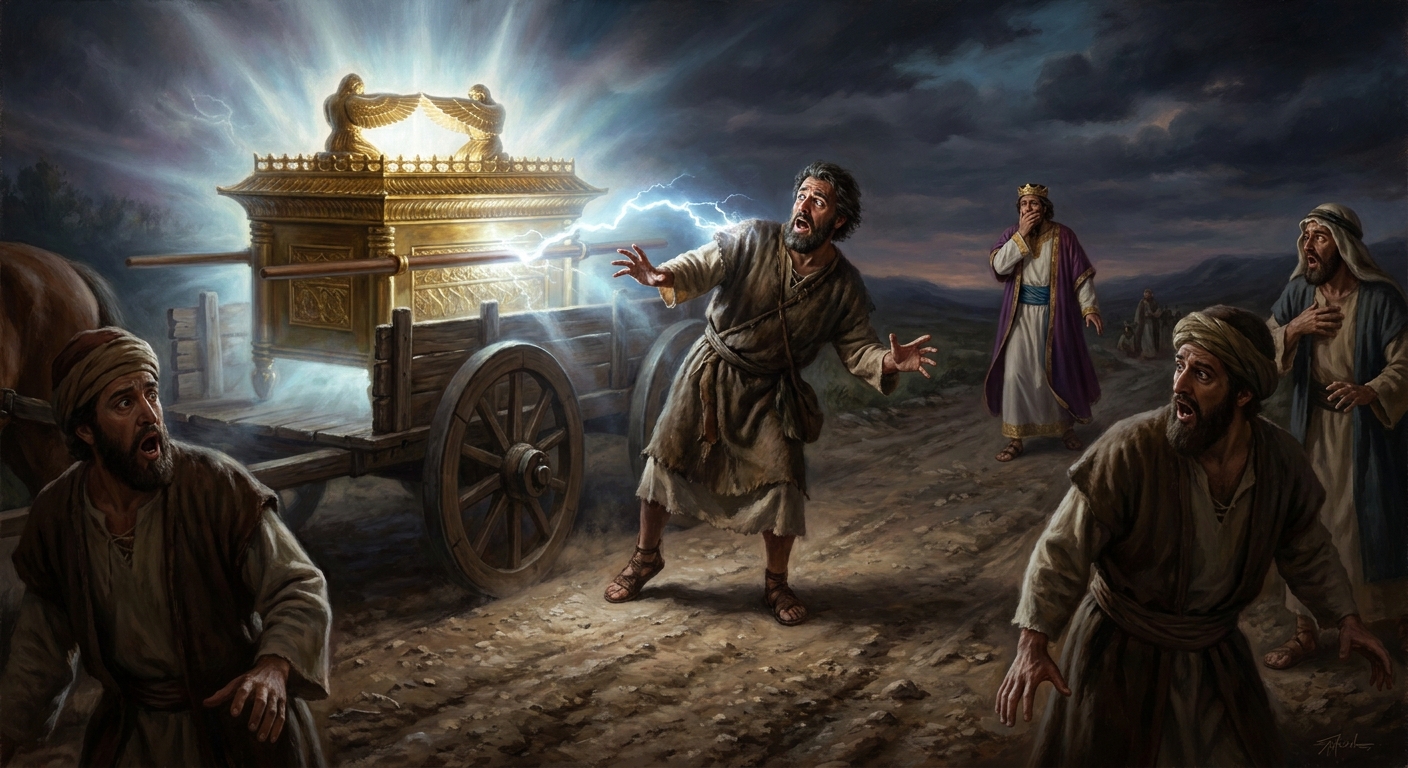
Uzza reaching out with both hands to steady the Ark of the Covenant as the oxen stumble, his face showing pure instinctive alarm and good intention, the moment of divine impact hitting him like lightning, his body recoiling from the Ark, other men watching in frozen horror unable to intervene, the golden Ark of the Covenant radiating terrible divine light, a sacred cart on a dusty road, King David visible in the background halting in shock and grief, hyper-realistic dark mythology, dramatic chiaroscuro lighting, the awful moment of unjust-seeming divine wrath, cinematic composition, oil painting rendering, 8k6. Arachne — Pride and the Loom (Greek)
Tradition: Greek Sin: Boasted that she was a better weaver than Athena, goddess of crafts Punishment: Transformed into a spider. Weaves forever but never creates beauty. Source: Ovid, Metamorphoses VI
Arachne was the greatest mortal weaver who ever lived. She was so good she claimed she surpassed Athena herself. Athena disguised herself as an old woman and warned Arachne to be humble. Arachne told the old woman to mind her business. Athena revealed herself. They had a weaving contest. Athena wove images of the gods in their glory. Arachne wove images of the gods in their crimes — Zeus seducing Europa, Poseidon raping Caenis, all the abuses of divine power done to mortals. Her tapestry was flawless. Athena, furious, destroyed it. Arachne hanged herself in shame. Athena, pitying her, transformed the noose into a thread and Arachne into a spider — so she could weave forever. The gift became the punishment.
Arachne mid-transformation from woman to spider, her upper body still recognizably human and beautiful but her lower body becoming a spider's abdomen, eight legs emerging from her sides, silk thread already spinning from her hands, her expression shifting from despair to something ancient and inhuman, Athena standing over her in full divine armor her expression cold and terrible, the shredded tapestry -- showing scenes of gods committing crimes against mortals -- scattered on the ground, a Greek workshop filled with looms, hyper-realistic dark mythology, dramatic chiaroscuro lighting, the horror of transformation as punishment, cinematic composition, oil painting rendering, 8k7. Niobe — All Fourteen (Greek)
Tradition: Greek Sin: Boasted that her fourteen children were more beautiful and numerous than the two children of the goddess Leto Punishment: Apollo and Artemis, Leto’s children, shot all fourteen of Niobe’s children dead with divine arrows. Niobe wept until she turned to stone. The stone still weeps. Source: Homer, Iliad XXIV; Ovid, Metamorphoses VI
Niobe was queen of Thebes, wealthy and beautiful, mother of seven sons and seven daughters — the most blessed mortal woman alive. During a sacrifice to Leto, she interrupted the ceremony and asked why anyone would worship a goddess with only two children when Niobe herself had fourteen. It took Apollo and Artemis one day to kill all fourteen. They shot the sons first while they were exercising. Then they came for the daughters. Niobe watched each child fall. She kept bargaining — “leave me this one, this one last!” — but they left her none. She wept without stopping until she transformed into a weeping rock on Mount Sipylus. In wet weather, water still seeps from the stone. The Greeks called it Niobe’s tears.
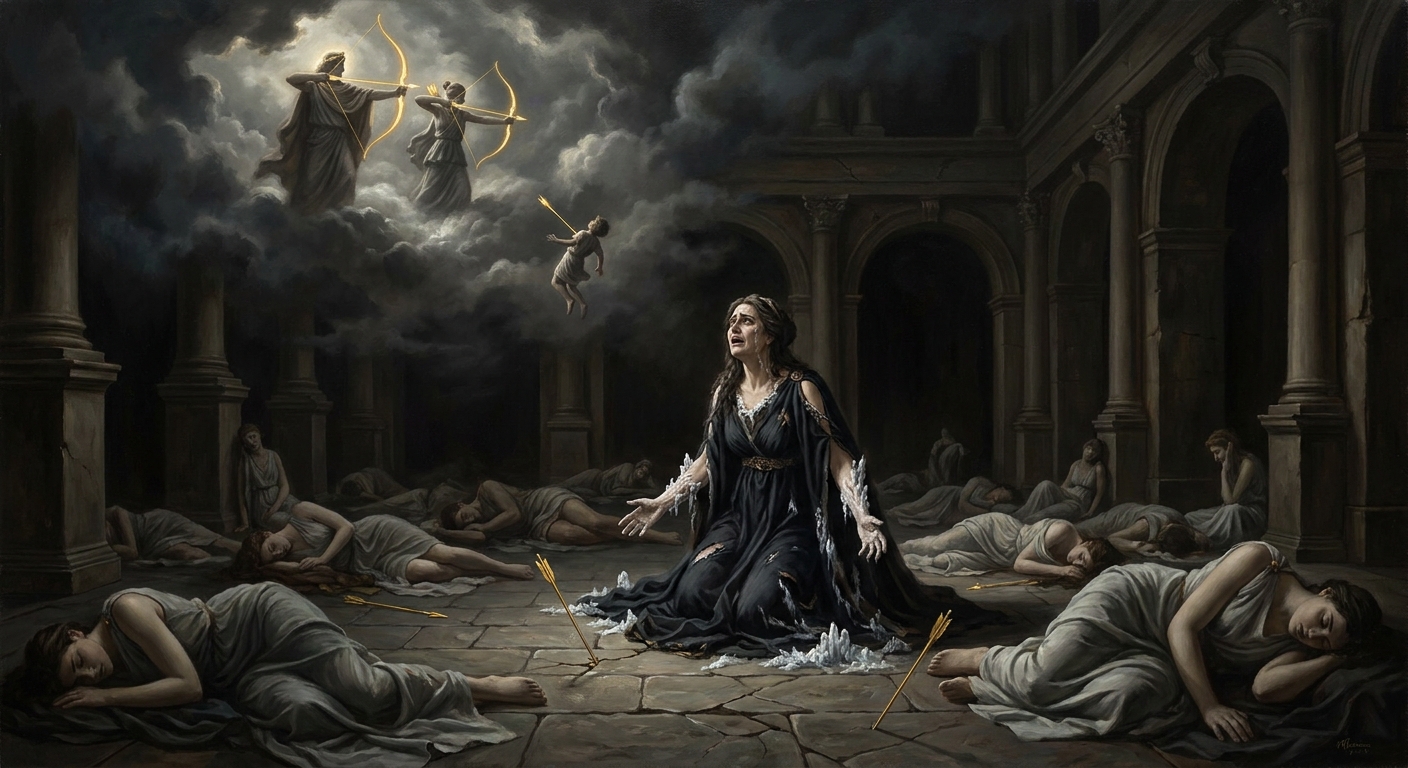
Niobe surrounded by the fallen bodies of her fourteen children on the ground around her, Apollo and Artemis visible in the sky above still drawing divine bows, the last child mid-fall from an arrow, Niobe's face captured in the absolute extremity of grief and horror, the proud queen brought to her knees, her royal robes and jewelry now meaningless, white marble-like crystallization beginning at the edges of her body as her weeping transforms her to stone, a Theban palace courtyard, divine golden arrows embedded in the ground, hyper-realistic dark mythology, dramatic chiaroscuro lighting, unbearable maternal grief meeting divine retribution, cinematic composition, oil painting rendering, 8k8. Marsyas — The Flaying of Ambition (Greek)
Tradition: Greek Sin: Challenged Apollo to a music contest and lost Punishment: Flayed alive. His skin hung from a tree. The river Marsyas springs from the place where he was flayed. Source: Ovid, Metamorphoses VI; Diodorus Siculus
Marsyas found the aulos — a double flute — that Athena had discarded because playing it puffed out her cheeks unbecomingly. He became so skilled that he challenged Apollo, god of music, to a contest. Whichever of them the Muses judged superior could do whatever he wished with the loser. The Muses judged Apollo the winner. Apollo chose to flay Marsyas alive. The satyr screamed, “Why are you tearing me from myself?” His blood and the tears of his fellow satyrs became the River Marsyas. His skin was kept in a grotto near Celaenae. The lesson: do not challenge a god to his own domain. The other lesson: the gods can be terrifyingly cruel winners.
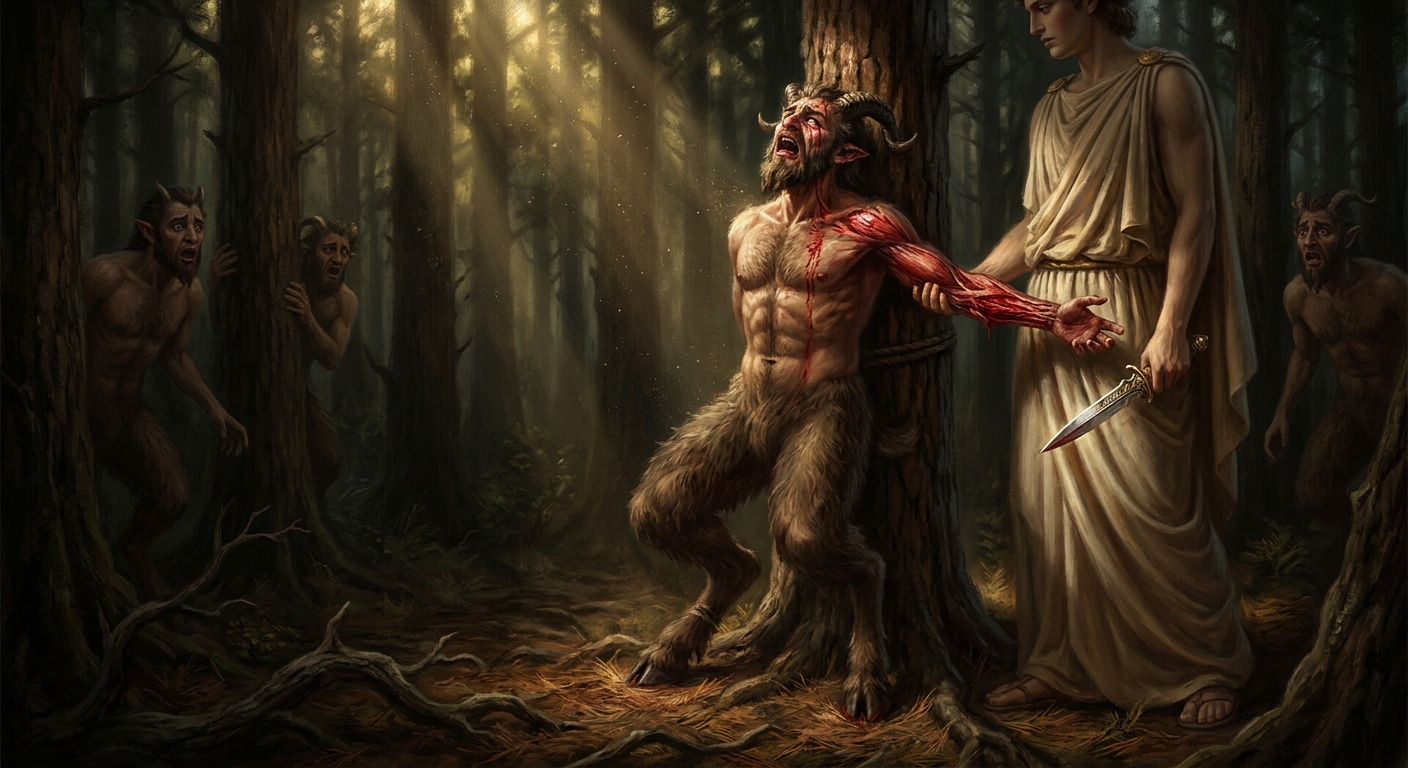
Marsyas the satyr bound upright to a pine tree in a forest clearing, Apollo standing before him with a divine knife, the flaying already begun -- one arm stripped of skin to the muscle, the satyr's face contorted in agony screaming upward, tears mixing with blood, other satyrs watching in horror from the treeline, the wound catching the light with terrible anatomical detail, Apollo's expression cold and dispassionate as a god who has simply claimed what was promised, shafts of golden light cutting through dark forest shadow, hyper-realistic dark mythology, dramatic chiaroscuro lighting, the horror of divine punishment taken to its extreme, cinematic composition, oil painting rendering, 8k9. Herod Agrippa — Eaten by Worms (Biblical)
Tradition: Biblical Sin: Gave a speech; when the crowd shouted “The voice of a god, not of a man!” he did not correct them or give glory to God Punishment: “An angel of the Lord struck him down, and he was eaten by worms and died” — immediately Source: Acts 12:20-23
Herod Agrippa I was king of Judea, the most powerful Jewish ruler under Rome in his generation. He had recently executed James the apostle and imprisoned Peter. He gave a public address — the ancient historian Josephus says he wore a garment woven of silver that blazed in the morning sun. The crowd called him divine. He accepted it. The angel struck him immediately. Acts describes the death in brutal detail: worms eating him on the spot. Josephus corroborates: he died five days later of a sudden violent illness. The crime was not claiming to be a god. The crime was hearing the claim and not denying it. Silence was enough.
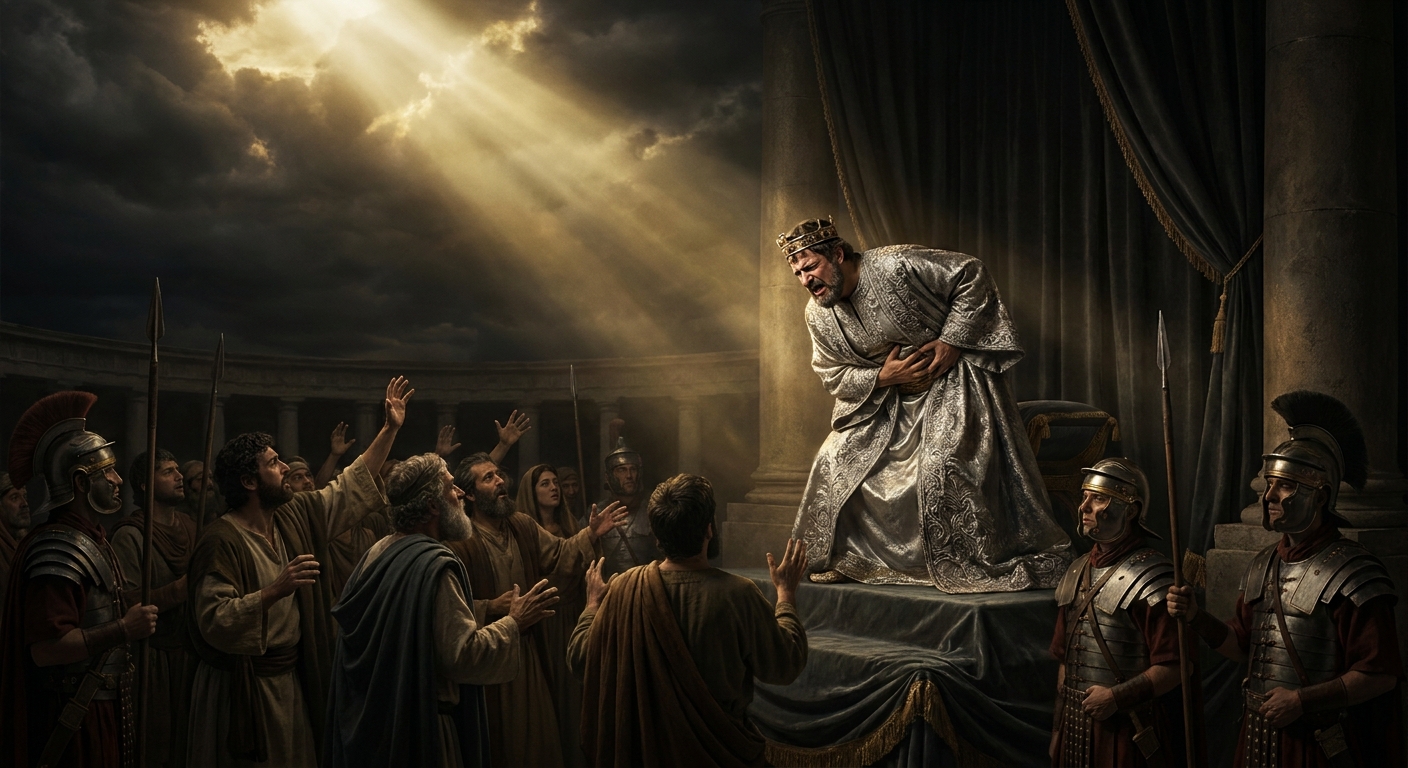
Herod Agrippa in his magnificent silver-threaded royal robes atop a raised dais, crowds below him calling out in worship, the moment of divine judgment striking him -- his body convulsing, face contorting in sudden agony, one hand clutching his abdomen, an invisible but palpable divine force hitting him as the crowd watches in confused horror, the king who was just worshipped now crumpling in sudden mortal vulnerability, the silver robes mocking him, Roman soldiers frozen in disbelief, a shaft of harsh divine light marking the blow, hyper-realistic dark mythology, dramatic chiaroscuro lighting, the instantaneous reversal of divine justice, cinematic composition, oil painting rendering, 8k10. Nebuchadnezzar — Seven Years as a Beast (Biblical)
Tradition: Biblical Sin: Walked on the roof of his palace and said: “Is not this great Babylon, which I have built by my mighty power as a royal residence and for the glory of my majesty?” Punishment: Driven mad immediately; lived in the fields like an animal, eating grass, until his hair grew like eagles’ feathers and his nails like birds’ claws. Seven years. Source: Daniel 4
While the words were still in his mouth, the judgment fell. A voice from heaven: “The kingdom has departed from you.” Nebuchadnezzar was driven from his palace immediately. He crawled in the fields. He ate grass. His body was drenched with dew. He had been the greatest king alive — builder of Babylon, conqueror of Jerusalem, master of the greatest empire on earth. For seven years he was indistinguishable from an animal. Then his sanity returned, he looked up to heaven, and praised God. The kingdom was restored. Daniel records Nebuchadnezzar’s own account of the event, written as a proclamation. The king who wrote “I built this” had his authorship taken from him until he could acknowledge who the real author was.
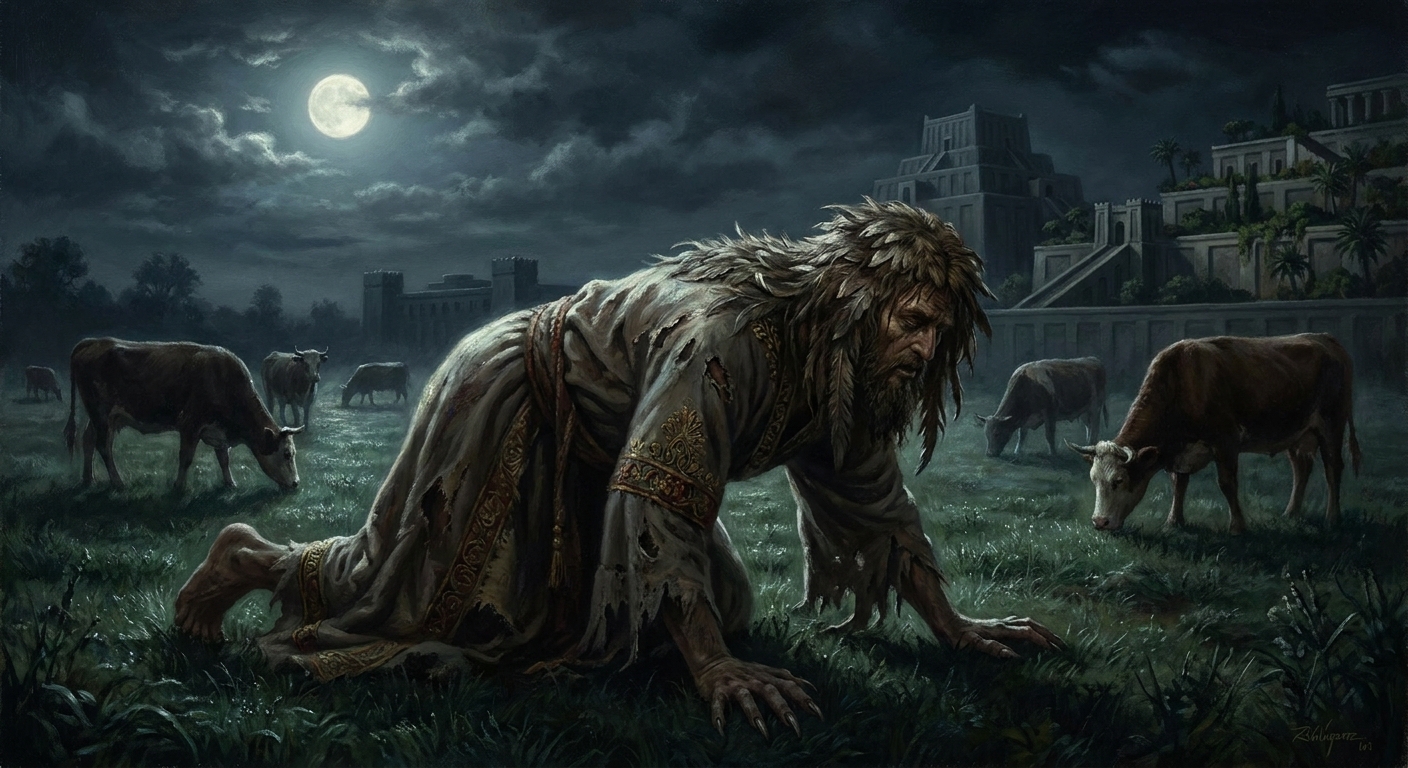
Nebuchadnezzar king of Babylon on all fours in a field outside his great city, eating grass like an ox, his royal robes in tatters, his hair massively overgrown and matted like eagle feathers, his fingernails and toenails grown into long curved talons, dew glistening on his wild animal-like form, the great walls and Hanging Gardens of Babylon visible in the background -- everything he built -- while he crawls unrecognized among common cattle, the full moon above, hyper-realistic dark mythology, dramatic chiaroscuro lighting, the humiliation of absolute power reduced to animal madness, cinematic composition, oil painting rendering, 8k11. Lycaon — The First Werewolf (Greek)
Tradition: Greek Sin: Served human flesh to Zeus to test whether Zeus was actually a god or just a man Punishment: Transformed into the first werewolf Source: Ovid, Metamorphoses I
Zeus had come to earth in human form to investigate the wickedness of humanity. King Lycaon of Arcadia heard that a god was among them. He decided to test it. He killed a hostage — some say a Molossian prisoner, some say his own son — cooked the flesh, and served it to Zeus at dinner. Zeus overturned the table in rage. Lycaon fled. As he ran, he transformed: his clothes became fur, his arms became legs, his words became howls. He retained the bloodlust. He retained the hunger. He became the first wolf-man. Ovid uses Lycaon’s transformation as Zeus’s justification for destroying all humanity in the flood. One act of sacrilege in one king became the indictment of a species.
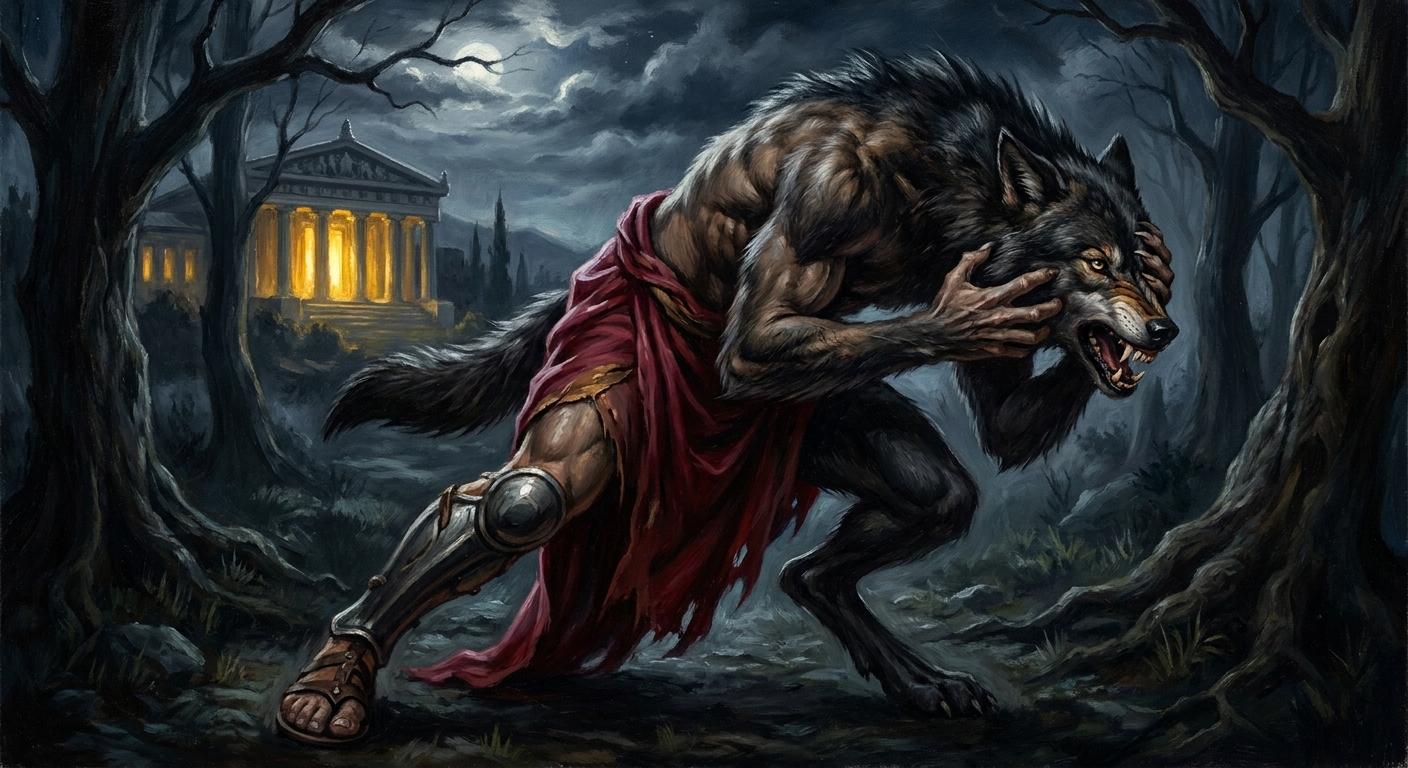
Lycaon the Arcadian king mid-transformation into a wolf as he flees through a dark forest, his body caught between man and beast -- one leg still human in sandals and the other a wolf's hind leg, his face elongating into a snarling muzzle, his kingly robes shredding as his torso thickens with fur, hands becoming massive clawed paws, his eyes still disturbingly intelligent and human within the wolf face, the Greek palace visible behind him with Zeus's divine light blazing at the windows, moonlight above, hyper-realistic dark mythology, dramatic chiaroscuro lighting, the horror of transformation as divine punishment, cinematic composition, oil painting rendering, 8k12. The Watchers — Bound Until Judgment (1 Enoch)
Tradition: Second Temple Judaism (1 Enoch) Sin: The sons of God descended to earth, mated with human women, fathered the Nephilim, and taught humanity forbidden knowledge: weapons, sorcery, cosmetics, divination Punishment: Bound in chains of darkness and imprisoned in a pit beneath the earth until the Day of Final Judgment Source: 1 Enoch 10; Genesis 6:1-4
Before Noah’s flood, two hundred angels called the Watchers made a pact at the summit of Mount Hermon to descend to earth and take human wives. Their leader was Azazel. They taught women sorcery and enchantments. They taught men to make swords, shields, breastplates. Azazel taught the art of making weapons and the knowledge of metals and of beautiful adornments. The Watchers’ offspring — the Nephilim — were giants who devoured humanity. God sent the archangels: Michael bound Semyaza and his followers in the valleys of the earth. Raphael bound Azazel hand and foot, cast him into a pit in the desert, covered him with rocks and darkness. There they wait, still bound, until the Great Day. The Book of Jude in the New Testament references them: “angels who did not stay within their own position of authority… kept in eternal chains under gloomy darkness until the judgment of the great day.”
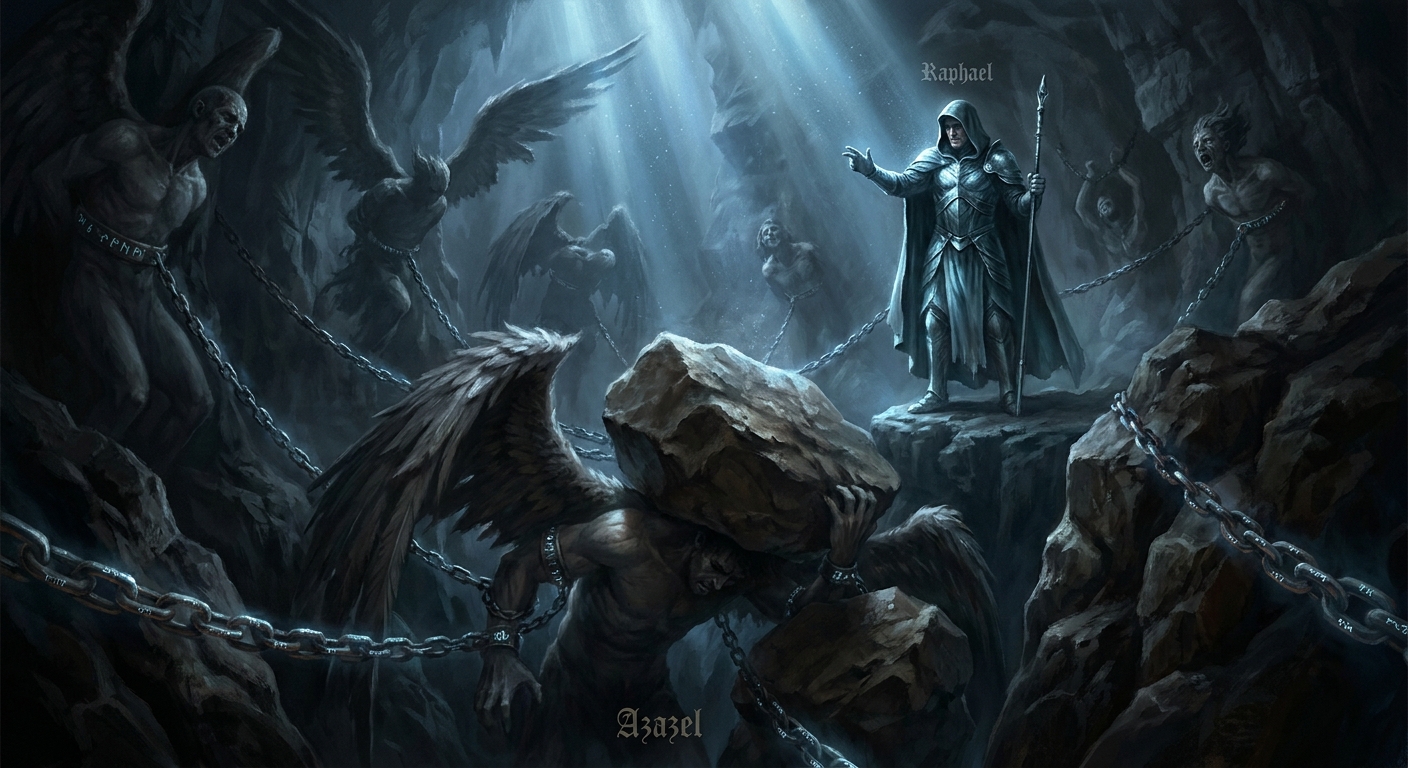
The Watchers -- fallen angels of immense stature -- being bound by archangels in a vast underground pit, massive chains of divine metal wrapped around their wings and limbs, their once-beautiful faces twisted with shame and rage, Azazel specifically pinned beneath boulders in a dark desert ravine, his six tattered wings crushed beneath the weight of stone, Raphael standing over him commanding the imprisonment, other Watchers visible chained to the cavern walls in chains that glow with divine inscription, total darkness broken only by cold divine light from the archangels, hyper-realistic dark mythology, dramatic chiaroscuro lighting, the imprisonment of fallen divine beings, cinematic composition, oil painting rendering, 8k13. Loki — Bound Until Ragnarok (Norse)
Tradition: Norse Sin: Engineered the death of Baldur the Beloved, then mocked the gods at a feast when they mourned Punishment: His own son Narfi was killed; his intestines were used to bind Loki to three boulders beneath the earth. A serpent drips venom onto his face. His wife Sigyn holds a bowl to catch it. When she empties the bowl, he writhes in agony and causes earthquakes. This continues until Ragnarok. Source: Prose Edda (Gylfaginning); Lokasenna
Baldur could not be killed — every living thing had sworn an oath not to harm him. Loki found the loophole: mistletoe, too young to swear. He made a dart of it and guided the blind god Hod’s hand to throw it. Baldur fell dead. The gods’ joy was extinguished. Then at the feast of AEgir, Loki appeared and named every god’s worst secret until they drove him out. They hunted him to a cave. They killed his son Narfi and used his intestines as chains — which then became iron. The serpent above him never runs dry. Sigyn, his faithful wife, catches the venom. But when she must turn to empty the bowl, the drops hit his face and his screaming shakes the earth. The Norse knew earthquakes were Loki’s pain.
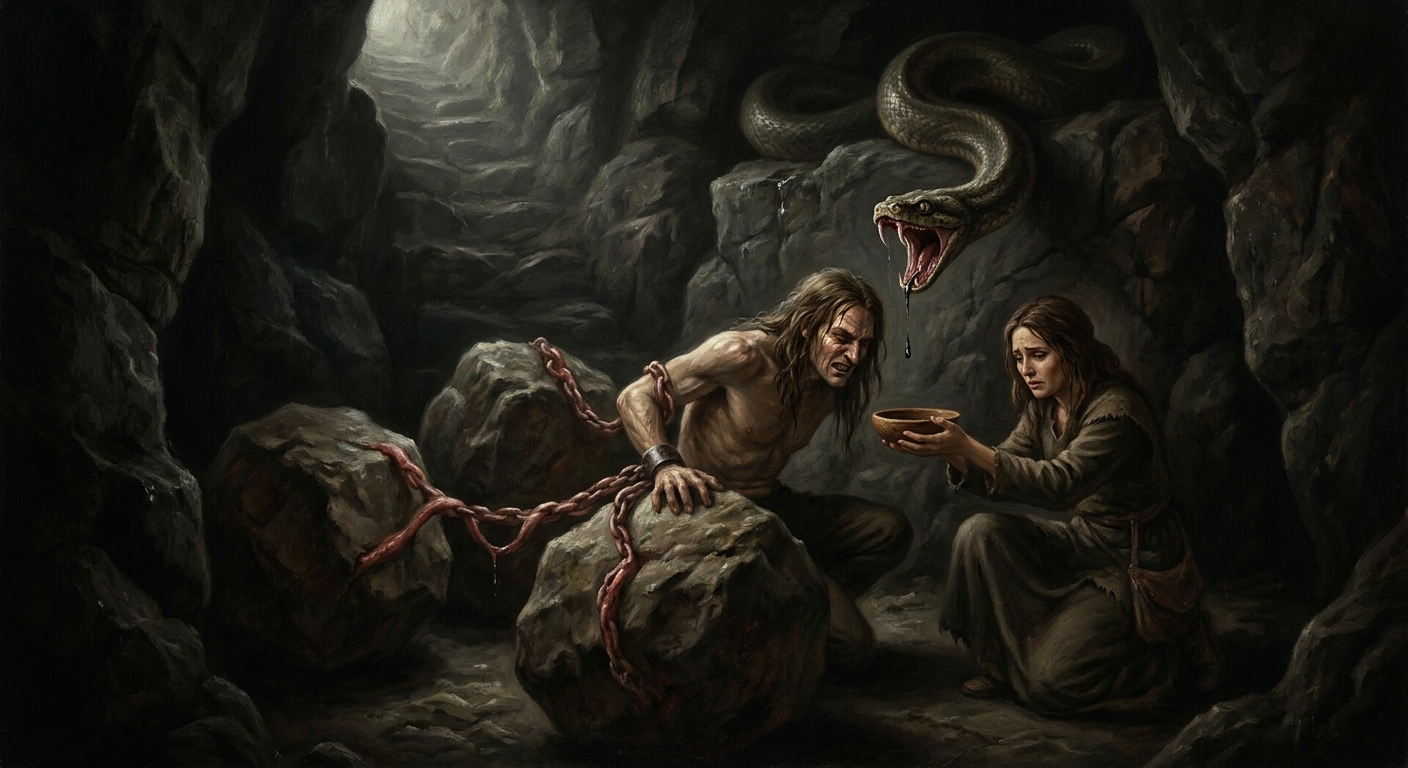
Loki chained to three boulders deep underground with chains made from his own son's intestines, a massive serpent coiled on the rock above him dripping venom downward, his beautiful face contorted in agony as a drop lands, his wife Sigyn kneeling beside him holding a small wooden bowl to catch the venom, her face a portrait of loving endurance and exhausted grief, the cave walls pressing close and oppressive, other bones and debris of what was once a salmon visible in the corner, the sense of geological weight above them, hyper-realistic dark mythology, dramatic chiaroscuro lighting, the horror of intimate eternal torment, cinematic composition, oil painting rendering, 8k14. Ixion — The Spinning Wheel (Greek)
Tradition: Greek Sin: Was the first man to murder a blood relative (his father-in-law), then — after Zeus purified him and invited him to Olympus — tried to seduce Hera, Queen of the gods Punishment: Bound to a flaming wheel that spins through the sky forever Source: Pindar, Pythian Odes II; Diodorus Siculus
Ixion killed his father-in-law to avoid paying the bride price. No one would purify him — killing kin was the ultimate taboo. Zeus took pity and purified him personally, invited him to Olympus, sat him at the divine table. Ixion repaid this with the worst possible ingratitude: he attempted to seduce Hera. Zeus created a cloud in Hera’s shape (Nephele) — Ixion coupled with the cloud and fathered the Centaurs. Zeus bound him to a winged, flaming wheel that spins forever through the underworld (some versions: through the sky itself). He is condemned to shout as he spins: “You should show gratitude to your benefactor.” The punishment mirrors the crime perfectly — he was given everything, wanted more, so now he spins forever wanting what he cannot have.
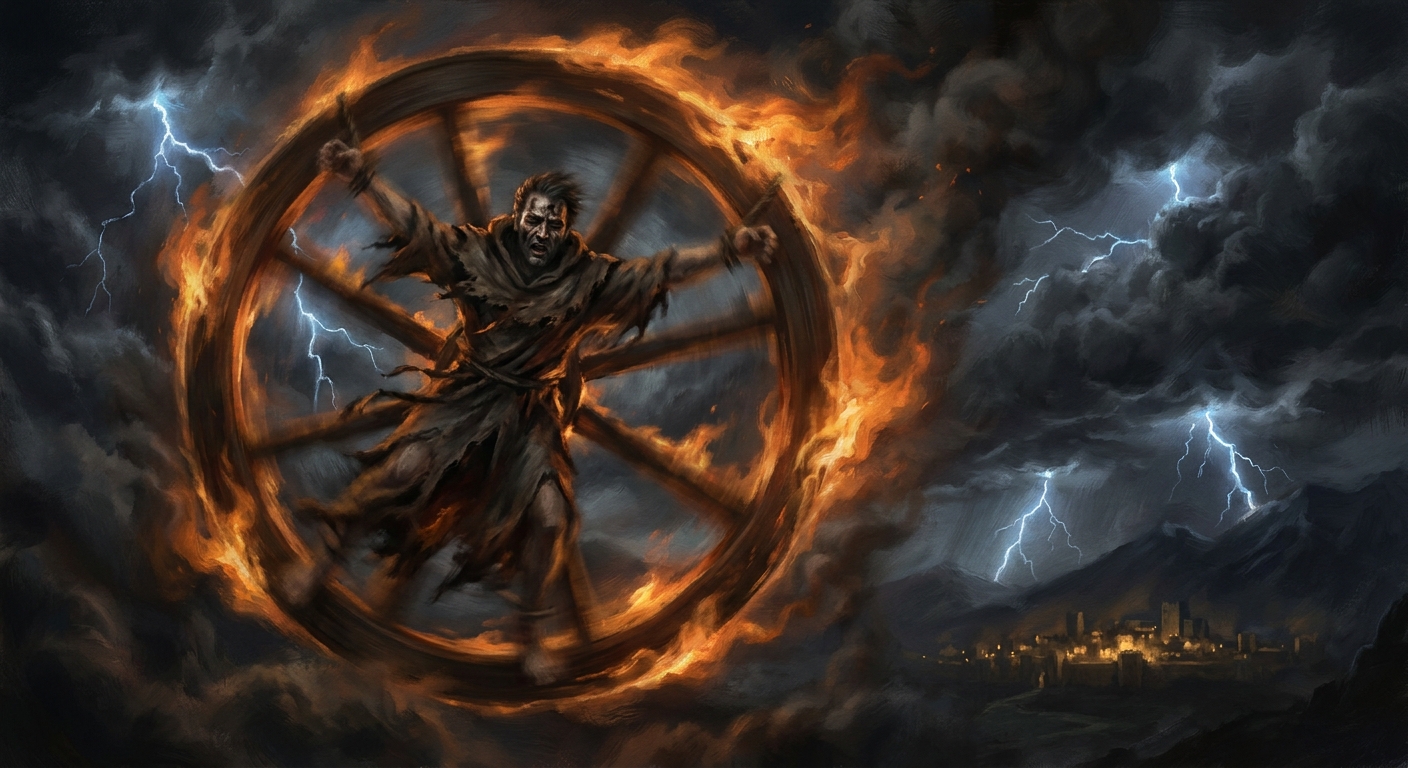
Ixion spread-eagled and bound to a massive spoked wheel wreathed in fire, spinning through a stormy sky or the infernal abyss, his body blurred by the spinning but his anguished face visible in one frozen moment, flames trailing from the wheel's spokes, his robes shredded and burning, the wheel glowing with divine heat, lightning and storm clouds around him, the sky itself his prison, below him the distant lights of Olympus from which he was exiled, hyper-realistic dark mythology, dramatic chiaroscuro lighting, the dizzying horror of infinite rotation and burning, cinematic composition, oil painting rendering, 8k15. Set — The Pariah God (Egyptian)
Tradition: Egyptian Sin: Murdered his brother Osiris, dismembered his body, scattered the pieces, usurped his throne, and later tore out the eye of Horus Punishment: Defeated by Horus in a divine tribunal. Stripped of legitimacy. In some versions: castrated by Horus in their final battle. Banished to the desert. Eternal pariah among the gods — neither fully destroyed nor ever rehabilitated. Source: Pyramid Texts; Plutarch, On Isis and Osiris; Contendings of Horus and Set
Set killed Osiris out of envy — Osiris was beloved, Set was feared. He tricked Osiris into a coffin, sealed it, and cast it into the Nile. When Isis retrieved the body, Set found it, dismembered it into fourteen pieces, and scattered them across Egypt. Isis and Nephthys collected the pieces, all but one. Osiris became King of the Dead. Set had won nothing he wanted — Horus, Osiris’s son, grew up and claimed Egypt after a tribunal of gods that lasted eighty years. In the final battles, Set and Horus mutilated each other (Set lost his testicles; Horus lost an eye). Horus won. Set was condemned — but the Egyptians needed Set. He protected Ra’s solar barque from Apophis every night. He was too useful and too dangerous to destroy. So he became the eternal outsider: essential, despised, unredeemed.
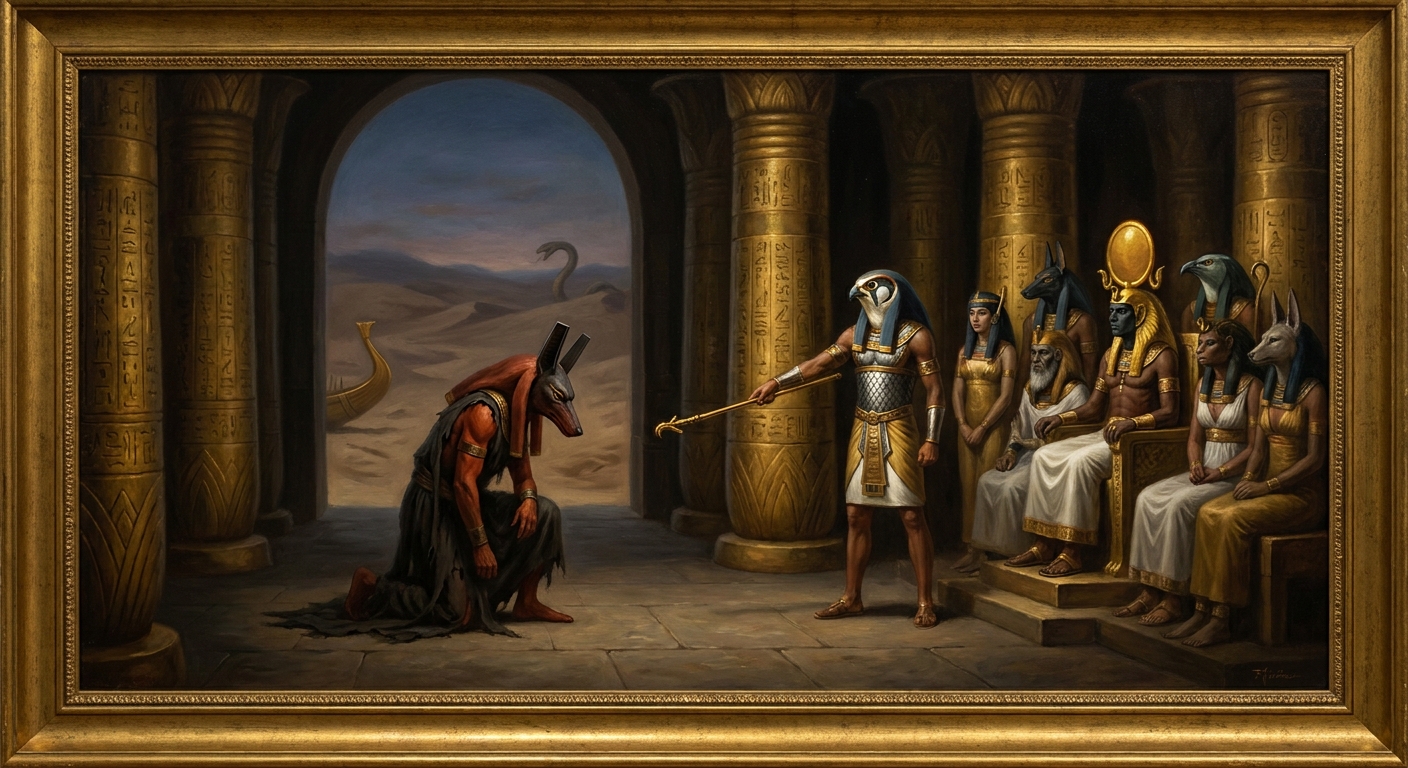
Set the Egyptian god of chaos standing before the divine tribunal of the gods, Horus opposite him pointing in accusation, Ra and the Ennead assembled in judgment, Set's composite animal head -- jackal-like with squared ears -- bowed in the moment of condemnation, his red skin and powerful form contrasting with his evident shame and isolation, the other gods turned away from him, behind him the desert he is banished to, but also visible the prow of Ra's solar barque where Set is needed to fight Apophis -- wanted and cast out simultaneously, Egyptian divine court with golden columns and hieroglyphs, hyper-realistic dark mythology, dramatic chiaroscuro lighting, the complexity of a condemned god who remains necessary, cinematic composition, oil painting rendering, 8kThe Pattern Beneath the Punishments
Look at what the gods cannot tolerate:
Hubris (Tantalus, Niobe, Arachne, Ixion, Herod Agrippa, Nebuchadnezzar) — The assumption that you are equal to or greater than the divine. Every tradition agrees on this one.
Boundary violations (Lycaon, Uzza, The Watchers, Prometheus) — Entering spaces you were not meant to enter. Touching what was not meant to be touched. Crossing thresholds that exist for reasons you were not given.
Killing the wrong person (Loki, Niobe, Set) — The gods have favorites. Killing one of them triggers a response disproportionate to the crime by any human standard.
Cleverness against the cosmic order (Sisyphus, Tantalus, Ixion) — Not the crime of being smart, but of using intelligence to circumvent rules that exist at a level above human law. Death is one of those rules. The divine hierarchy is another.
The punishments reveal the gods’ values more clearly than their rewards do.