Part of the Bestiary Compendium
Every tradition has its darkness. Its flood, its fall, its fire, its age of ruin. We’ve catalogued those: the destructions, the punishments, the apocalyptic end-states, the wars between gods and giants and the long slow dying of dharma.
This section is different.
This section is about what comes after. Not the destruction — the restoration. Not what gets broken — what gets fixed. Every tradition that looks honestly at the world as it is sees that something is wrong with it: violence, suffering, injustice, impermanence, separation from the divine. And almost every tradition answers that observation with a promise.
The promise takes different shapes. Some say the world will be destroyed and remade. Some say it will gradually improve. Some say the golden age is cyclical — that it already happened, will happen again. Some say the golden age is now, available in the present moment, if you know how to look.
But they all say: this is not the final word. Something better is possible. Something better is coming. Or something better is here, and you’ve been walking past it.
These are the promises. The most hopeful passages in world religion. The visions of the world as it should be.
Art style:
hyper-realistic divine paradise, luminous golden light, the world as it should be, peace and beauty beyond suffering, gardens and rivers and light, warm and welcoming not dark and dramatic, the opposite of every other section in the Bestiary, 8kThe Promises — What the World Looks Like When It’s Fixed
| Tradition | The Promise | What It Looks Like | Source |
|---|---|---|---|
| Christian | New Heaven and New Earth | ”God will wipe every tear. No more death, mourning, crying, or pain.” The tree of life restored. The city of gold with no temple because God IS the temple. | Rev 21-22 |
| Jewish | The Messianic Age | Universal peace. The wolf lies down with the lamb. All nations acknowledge God. The Temple rebuilt. Knowledge of God covers the earth like water. | Isa 11, Mic 4 |
| Islamic | Jannah (Paradise) | Gardens beneath which rivers flow. Everything you desire. No fatigue, no grief. “Therein they will have whatever they wish, and with Us is more.” | Quran 50:35 |
| Hindu | Satya Yuga (Golden Age) | The cycle resets after Kali Yuga. Virtue returns. Lifespan increases. Dharma stands on all four legs. Humanity lives in harmony. | Vishnu Purana |
| Buddhist | Sukhavati (Pure Land) / Maitreya’s coming | Either: rebirth in a pure land where enlightenment is easy. Or: Maitreya teaches again, dharma restored. | Pure Land sutras |
| Norse | The New World after Ragnarok | A green earth rising from the sea. Baldur returns. Two humans survive. An unnamed new god. “Fields unsown will bear fruit.” | Voluspa 59-66 |
| Zoroastrian | Frashokereti (The Making Wonderful) | Evil permanently destroyed. The dead resurrected. All souls purified even from hell. A new body for everyone. The world made perfect. | Bundahishn |
| Aboriginal | The Dreaming continues | Not a future promise — the Dreaming is NOW. The land renews itself. The ancestors are present. The obligation is to MAINTAIN, not to wait. | Aboriginal tradition |
| Taoist | Return to the Tao | Not a future age but a present possibility. “Return to the uncarved block.” Simplicity. Wu wei. The world is already perfect if you stop trying to fix it. | Tao Te Ching |
| Sikh | Halemi Raj (God’s benevolent rule) | A just society where all are equal, all are fed, all have dignity. Not supernatural — achievable through human action guided by divine will. | Guru Granth Sahib |
| Baha’i | The Most Great Peace | Global unity. One world government. Universal education. Elimination of prejudice. Not supernatural but INEVITABLE if humanity follows progressive revelation. | Bahá’u’lláh |
| Native American (Hopi) | The Fifth World | Emergence into a new world of balance. The previous four were destroyed. The fifth can be sustained if humans live correctly. | Hopi prophecy |
The Spectrum
| Type | Promise | Examples |
|---|---|---|
| Apocalyptic then renewal | The world must be destroyed first | Christian (Revelation), Norse (Ragnarok), Hindu (Pralaya) |
| Gradual improvement | The world gets better over time | Baha’i, Sikh, some Postmillennial Christian |
| Cyclical return | The golden age returns as part of a cycle | Hindu (Yugas), Hopi (Worlds) |
| Present possibility | The promise is available NOW, not in the future | Taoist, Aboriginal, Buddhist (nirvana) |
| Supernatural afterlife | Not this world but another one | Islamic (Jannah), Buddhist (Pure Land) |
The Most Beautiful Verse From Each Tradition
Christian
“He will wipe every tear from their eyes. Death will be no more; mourning and crying and pain will be no more, for the first things have passed away.” “And I saw the holy city, the new Jerusalem, coming down out of heaven from God, prepared as a bride adorned for her husband.” — Revelation 21:4, 21:2
Jewish
“The wolf shall dwell with the lamb, and the leopard shall lie down with the young goat, and the calf and the lion and the fattened calf together; and a little child shall lead them.” “They shall not hurt or destroy in all my holy mountain; for the earth shall be full of the knowledge of the LORD as the waters cover the sea.” — Isaiah 11:6, 11:9
Islamic
“Therein they will have whatever they wish — and with Us is more.” “No fatigue will touch them therein, nor will they be removed from it.” — Quran 50:35, 15:48
Hindu
“In the Satya Yuga, righteousness is established on all four of its feet. Men are truthful, compassionate, and long-lived. There is no disease, no hatred, no vanity. The earth yields all things in abundance without cultivation.” — Vishnu Purana 6.3
Buddhist
“In that land there is neither physical nor mental suffering for living beings. The sources of happiness are innumerable. For this reason that land is called Sukhavati — the Land of Bliss.” — Amitabha Sutra
Norse
“She sees a hall standing, fairer than the sun, thatched with gold, at Gimlé. There shall the trusty rulers live and spend their days in happiness.” “Fields unsown will bear fruit, all evil will be healed. Baldr will come back.” — Völuspá 64, 62
Zoroastrian
“Ahriman will be annihilated, the demons will be destroyed. The Druj will be vanquished forever. All matter will be perfected. The dead will rise. The world will be made wonderful.” “Every soul will receive a new body, shining and incorruptible.” — Bundahishn 34
Aboriginal
“The Dreaming is not a dream. The Dreaming is the land. The land is alive. The ancestors walk in it still. Your obligation is not to wait for it — it is to keep it alive.” — Traditional, Western Desert Peoples
Taoist
“Return to the root. Return to the uncarved block. The sage does not struggle and therefore does not lose. He holds to the ancient way and masters the present moment.” — Tao Te Ching 28, 16
Sikh
“In that realm of Dharma, the God who created all things watches over all, blesses all. Sorrow is here banished. Victory is proclaimed. The music of bliss plays without ceasing.” — Guru Granth Sahib, Japji Sahib 37
Baha’i
“The tabernacle of unity hath been raised; regard ye not one another as strangers. Ye are the fruits of one tree, and the leaves of one branch.” “The Most Great Peace… is no mere chimera. It is the next stage in the evolution of this planet.” — Bahá’u’lláh, Shoghi Effendi
Hopi
“The Fifth World will be a world of balance. Of those who emerge, only those who live in harmony with the earth will be able to enter. It is not promised. It is possible. It depends on us.” — Hopi Elder teaching
The Promises — Described
New Heaven and New Earth (Christian)
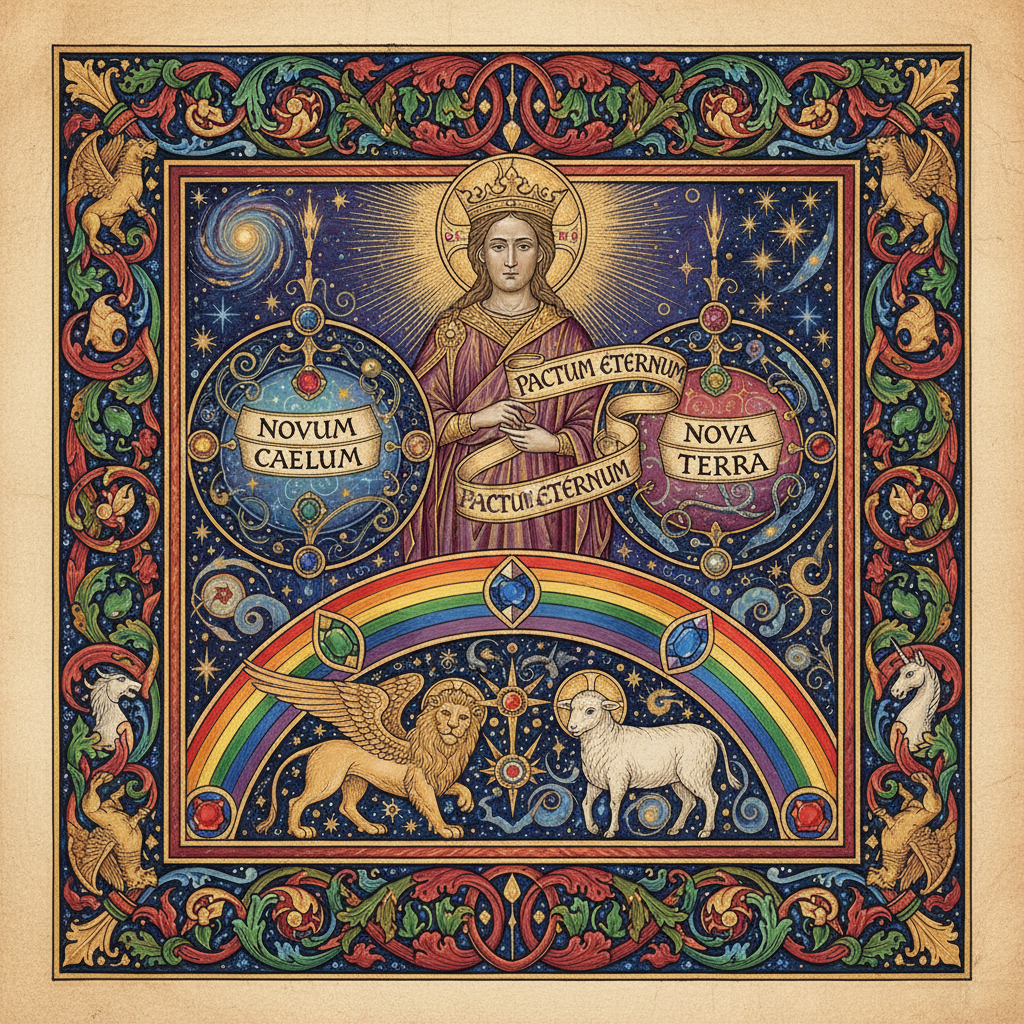
Revelation 21-22. After the dragon falls, after the beast is cast into the lake of fire, after death itself is thrown away — John sees something else entirely. A new heaven. A new earth. The first heaven and the first earth have passed away, and the sea is no more.
Then a city descends.
The holy city, the new Jerusalem, coming down out of heaven from God, prepared as a bride adorned for her husband. It is twelve thousand stadia on each side — roughly 1,400 miles in every direction. Its walls are jasper. The city itself is pure gold, but gold so pure it is like clear glass. Twelve foundations, each a different precious stone. Twelve gates, each a single pearl.
And there is no temple in it.
This is the detail that undoes everything that came before. Every form of religion, every institution of worship, every building designed to mediate between the human and the divine — obsolete. Because the dwelling of God is with humans. God himself is there. The Lamb is there. The city does not need the sun or moon because the glory of God is its light.
The river of the water of life flows from the throne of God through the center of the city. The tree of life stands on both sides of the river, bearing twelve kinds of fruit, one for each month, its leaves for the healing of nations.
Then the promise, which is the undoing of Genesis:
“He will wipe every tear from their eyes. Death will be no more; mourning and crying and pain will be no more, for the first things have passed away.”
The story that began with exile from a garden ends with arrival in a city. The exile is over. Everything that was taken back will be returned, but more than returned — perfected. The tree is there again. The water is there again. And the curse is lifted. And nothing will hurt anyone ever again.
The Christians kept reading this in the arenas.
The Messianic Age (Jewish)
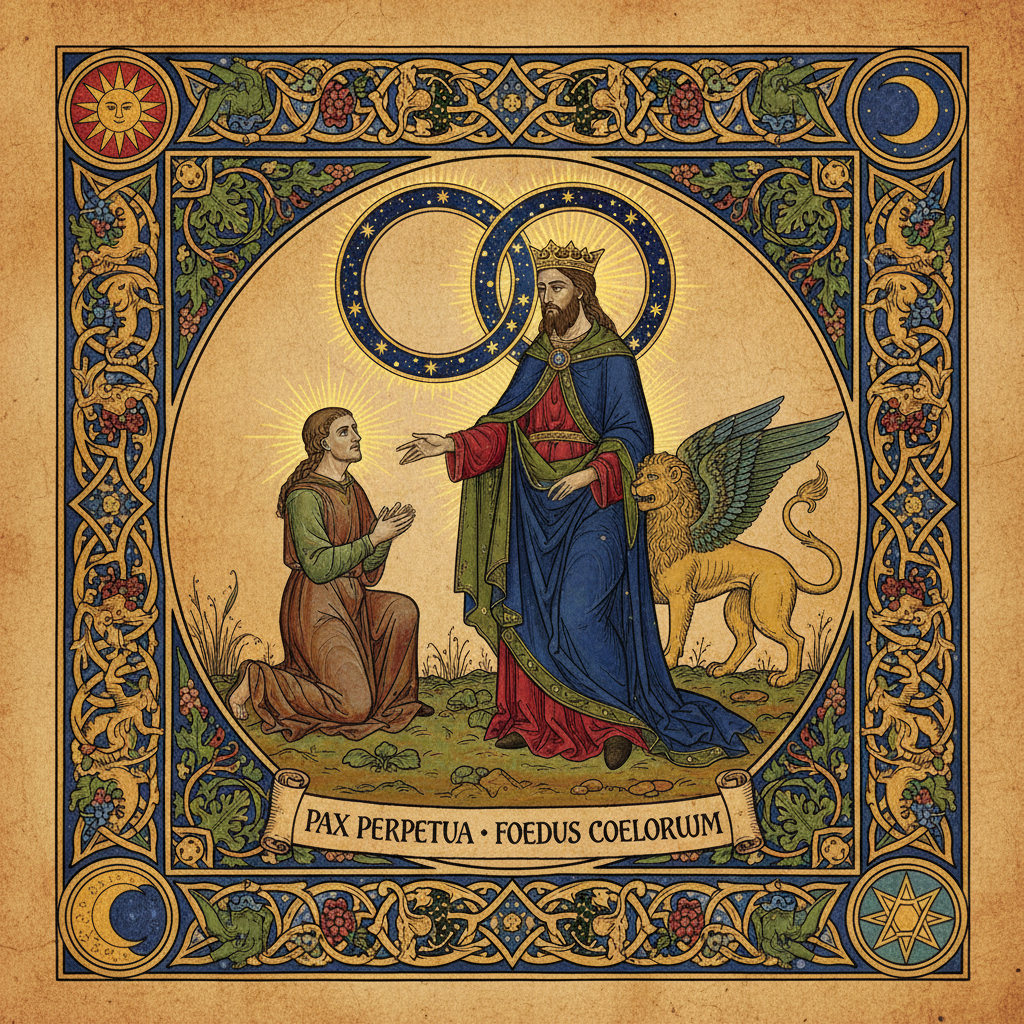
Isaiah 11. In the middle of a prophecy about judgment on the nations, a branch grows from the stump of Jesse. A shoot from cut-down wood. The Spirit of the Lord rests on him: wisdom and understanding, counsel and might, knowledge and the fear of God.
He does not judge by what he sees. He does not decide by what he hears. He judges the poor with righteousness and gives decisions for the meek of the earth.
And then the world changes. Not just human society — the animals themselves change.
“The wolf shall dwell with the lamb, and the leopard shall lie down with the young goat, and the calf and the lion and the fattened calf together; and a little child shall lead them.”
The cow and the bear will graze together. Their young will lie down together. The lion will eat straw like the ox. A nursing child will play over the hole of a cobra. The weaned child will put its hand into the adder’s den. Violence is not suppressed — it is gone. The food chain is abolished. The predator nature itself is transformed.
And the reason: “The earth shall be full of the knowledge of the LORD as the waters cover the sea.”
This is the Messianic hope: not the elimination of enemies but the transformation of nature. The lion doesn’t become vegetarian because it’s been defeated. It becomes vegetarian because knowing God completely changes what you want to eat. Knowledge of the divine is so comprehensive that even the biology of predation cannot survive in its presence.
Micah 4 adds the political vision: nations will flow to the mountain of the Lord. They will beat their swords into plowshares and their spears into pruning hooks. Nation will not take up sword against nation, and they will no longer train for war.
The rabbis debated whether the Messiah would bring the age or the age would bring the Messiah. The promise remained: this is not how it ends.
Jannah — Paradise (Islamic)
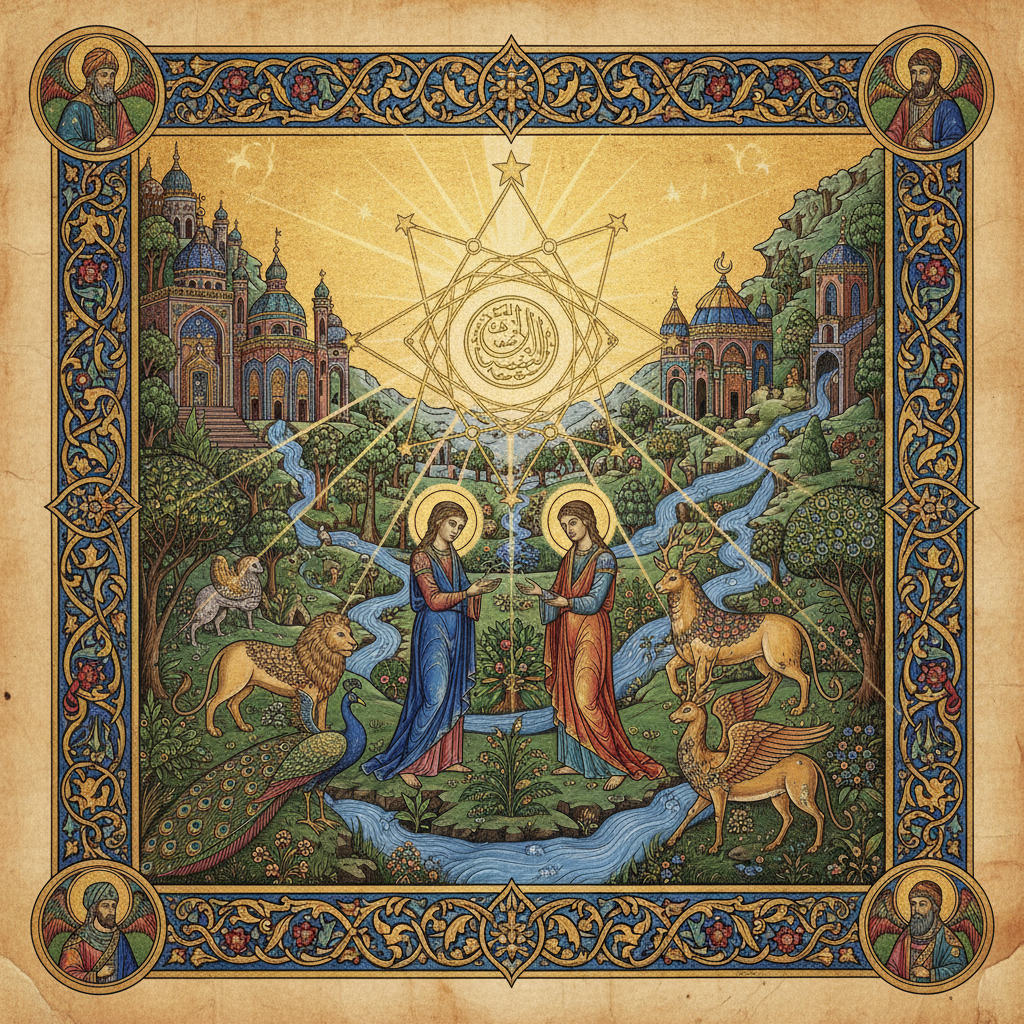
Quran 50:35. “Therein they will have whatever they wish — and with Us is more.”
Jannah is not metaphor. It is described with physical specificity because the body that worshipped, fasted, wept, and endured will be rewarded in the body. The Quran returns to it again and again, in different suras, from different angles, and the picture accumulates.
Gardens beneath which rivers flow. Not one garden — multiple gardens, layered, each with its own character. The temperature is perfect. There is no fatigue, no grief, no sense of time passing wrongly. What you desire is available, but what you desire has been purified of its corruption — the longing without the ache, the pleasure without the diminishment.
“No fatigue will touch them therein, nor will they be removed from it.”
The righteous recline on raised couches facing each other. Immortal youths circulate among them with vessels and cups of a pure drink that does not intoxicate. Fruits from whatever they choose. Meat of birds that they desire. Companions of pure character. And beneath it all, the rivers: of water uncorrupted, of milk that does not change in flavor, of wine delicious to drink, of honey purified.
The highest pleasure of Jannah, according to hadith, is the sight of the face of God. All other pleasures are superseded by this. The great scholar Al-Ghazali wrote that whoever has tasted this vision cannot value anything else.
The Quran adds, almost as an aside, that promise: “and with Us is more.” More than what? More than you could ask for. More than you could desire. The description is not the limit. It is just the beginning of what is coming.
Satya Yuga — The Golden Age (Hindu)
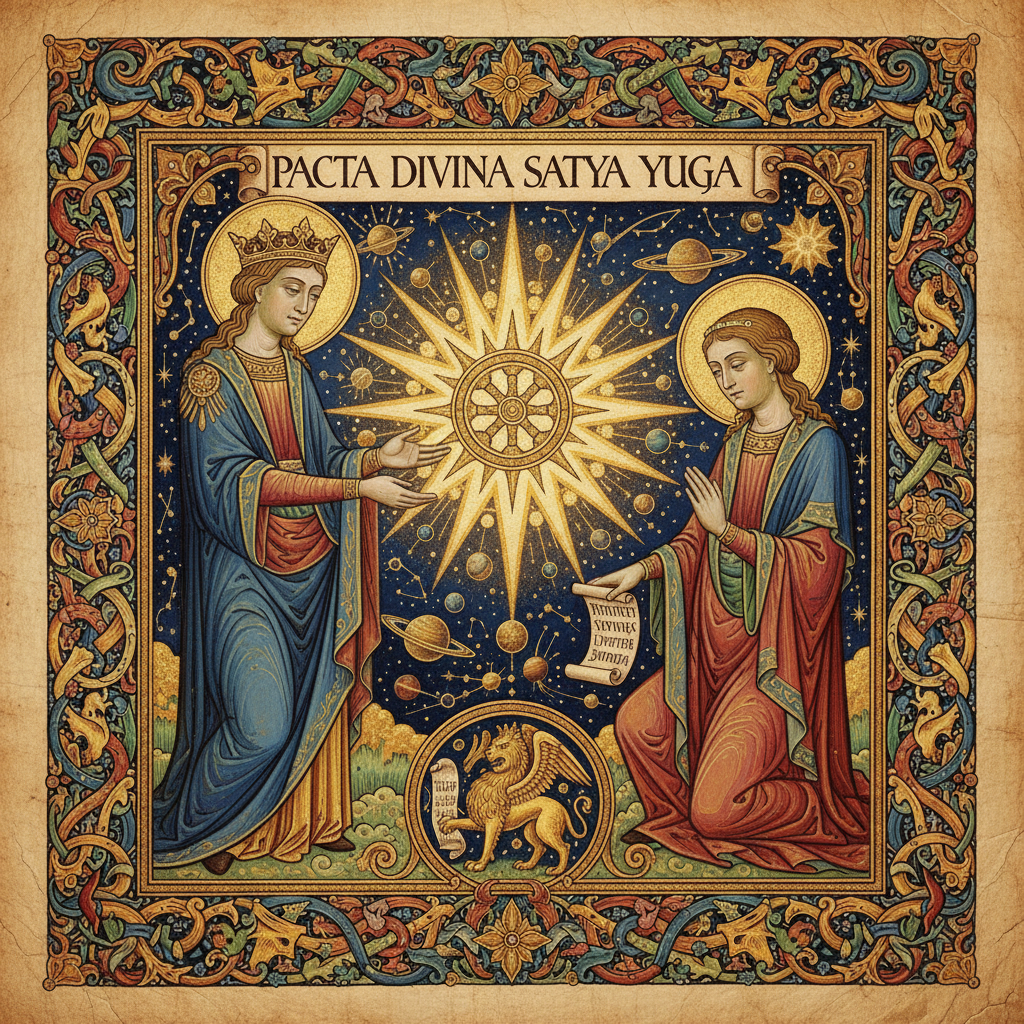
The Vishnu Purana. The cosmos moves in cycles. Each cycle — one kalpa, one day of Brahma — contains four ages: the Satya Yuga (age of truth), the Treta Yuga, the Dvapara Yuga, and the Kali Yuga. We are in the Kali Yuga now. The age of strife. The age of decline.
But the Kali Yuga ends.
When Kalki appears — the tenth avatar of Vishnu, riding a white horse, with a blazing sword — the Kali Yuga ends with fire and destruction, clearing the field. And then the Satya Yuga begins again.
The Satya Yuga is the world before the fall. Dharma stands on all four of its legs. In the Kali Yuga it stands on one, and barely. In the Satya Yuga: four. Virtue is everywhere. Men are truthful, compassionate, long-lived. There is no disease. No hatred. No vanity. The earth yields all things in abundance without cultivation.
The human lifespan was once one hundred thousand years. It will be again. The population was once vast and virtuous and free from illness. It will be again. The very laws of nature — the relationship between effort and fruit, between virtue and reward — are different in the Satya Yuga. The world runs on dharma, which means it runs correctly.
This is the Hindu comfort: nothing is permanent, including the Kali Yuga. The age of degradation is real, but temporary. The wheel turns. The Satya Yuga always returns. We are not in the worst state — we are in a phase. And the phase ends.
The Bhagavata Purana adds: even in the Kali Yuga, the benefits of right action are multiplied. The difficulty is greater, but so is the reward. The Kali Yuga is terrible, but if you can maintain dharma in the Kali Yuga, you have done something the heroes of the Satya Yuga never had to.
Sukhavati — The Pure Land (Buddhist)
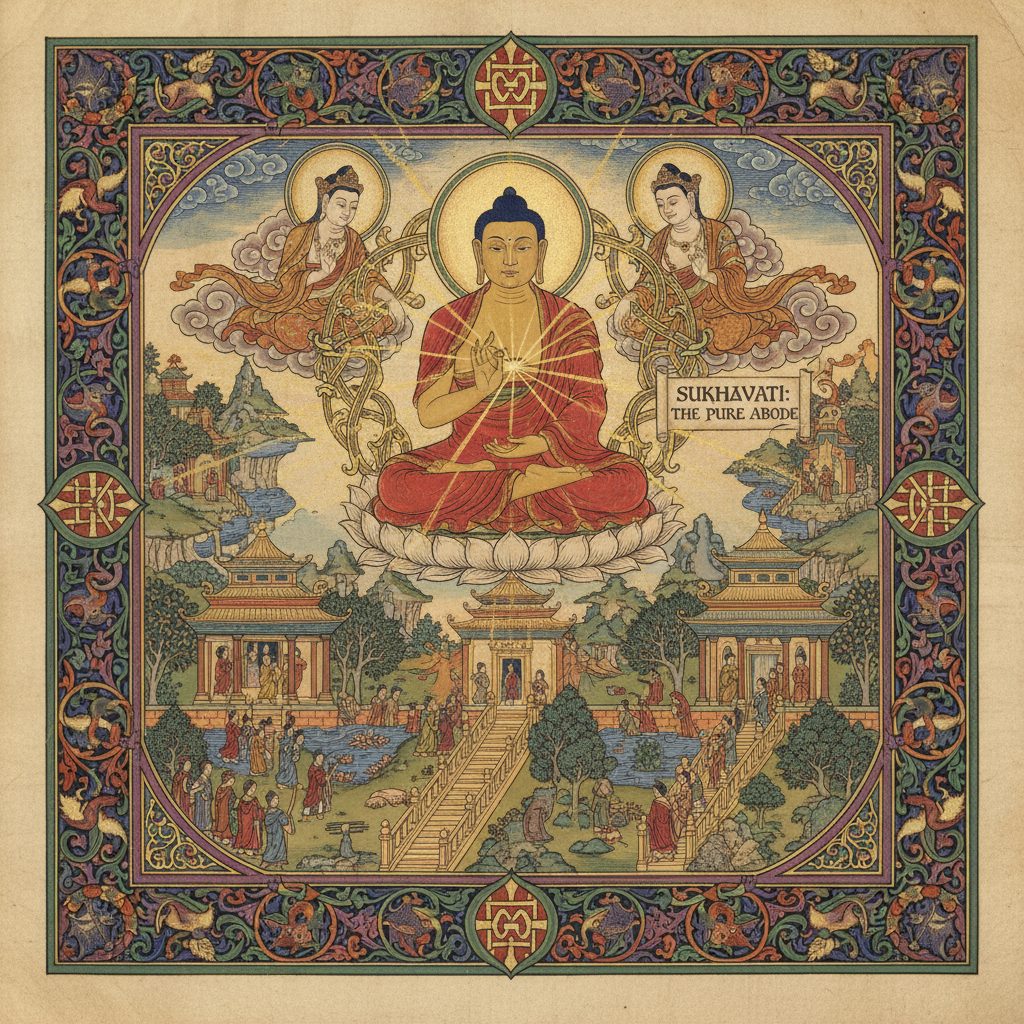
The Amitabha Sutra. Before he became the Buddha Amitabha, he was the monk Dharmakara. He made forty-eight vows to become a Buddha only if certain conditions were fulfilled — conditions that would guarantee the liberation of any being who sincerely called on his name. The eighteenth vow: if any being in the universe should desire to be born in his Pure Land and should call his name with sincere faith, even ten times, they would be reborn there.
Then Dharmakara achieved Buddhahood. All forty-eight vows were fulfilled. Sukhavati — the Land of Bliss — exists.
“In that land there is neither physical nor mental suffering for living beings. The sources of happiness are innumerable.”
Sukhavati is not nirvana. It is the ideal condition for achieving nirvana. The Pure Land is a world without the obstacles that make enlightenment so difficult here: poverty, suffering, bad teachers, short lifespans, distraction, despair. In Sukhavati, the very trees and rivers teach the dharma. The birds that fly overhead teach the dharma. You are surrounded by bodhisattvas and Buddhas who help you. Liberation is, if not automatic, at least possible in a way it rarely is here.
The competing promise is Maitreya. The future Buddha, the fifth of this age, who currently waits in the Tushita heaven. When the dharma has declined so far that it has nearly disappeared from the world, Maitreya will descend. He will teach the dharma again. The world will bloom again with enlightened beings. The sangha will be vast. What has been lost will be restored.
Both promises say: the difficulty of now is real, but not permanent. Help is available. The dharma will not disappear forever.
The New World after Ragnarok (Norse)
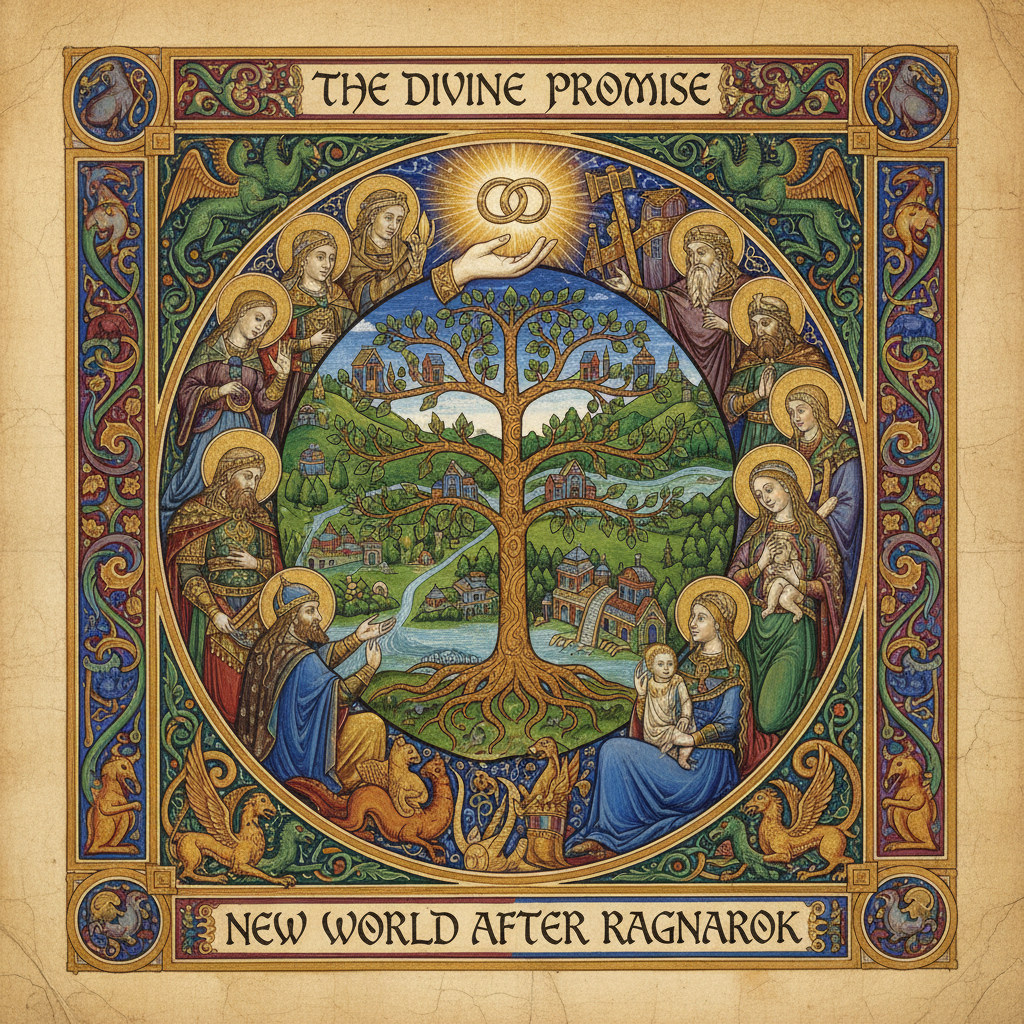
Völuspá 59-66. The seeress has described everything: the death of Baldur, the binding of Loki, the Fimbulwinter, the breaking of Bifrost, the battle of Vigrid, Fenrir swallowing Odin, Thor killing and being killed by Jormungandr, Surtr burning everything.
Everything burns. The world sinks into the sea.
And then.
“She sees, rising a second time from the sea, the earth, green once more.”
The Völuspá does not dwell here as long as it dwelt on the destruction. The restoration is quieter than the catastrophe. But it is there.
The earth rises from the water, green. The waterfall at Hvergelmir runs again. Eagles fish from the mountains. The Aesir meet on the field of Idavoll, where Asgard once stood, and talk about what happened. They find in the grass the old golden tables where they used to play. Baldur comes back. He walks out of Hel, because Hel is over. Hodr comes with him — even Hodr, the blind god who threw the mistletoe, even he is forgiven.
A hall stands at Gimlé, fairer than the sun, thatched with gold. The trusty rulers live there in happiness. The dragon Nidhogg no longer gnaws anything. The serpent is toothless.
Two humans survive Surtr’s fire: Lif and Lifthrasir, hidden in Hoddmimir’s wood. They will repopulate the world. They will eat morning dew. They will have children.
And something else: “then comes the Mighty One to the great judgment, the powerful one, from above.” Scholars debate who this is. An unnamed new god. Something not yet known.
The Norse promise is smaller than the Christian or Islamic paradise. It is not golden streets or rivers of milk. It is: the earth comes back, it is green again, the dead return, children are born, the good gods survive. The world that was destroyed is replaced by a world that can start over.
Sometimes that is enough.
Frashokereti — The Making Wonderful (Zoroastrian)
The Bundahishn. The word is frashokereti — “the making fresh,” “the making wonderful,” “the renovation.” It is the final event in Zoroastrian cosmic history, after which there is no more history. After which everything is as it was meant to be.
Ahriman, the evil spirit, will be destroyed. Not defeated — annihilated. Druj, the Lie, will be vanquished forever. The demons will be cast out of existence. Evil will not be imprisoned or managed or balanced. It will simply not exist.
Then the dead will rise. Every human who ever lived will receive a new body — a body of light, incorruptible, permanent. The Zoroastrian resurrection is physical and complete.
Then the rivers of molten metal. Every soul, living and dead, will pass through it. For the righteous, the metal will feel like warm milk. For the wicked, it will be what it is — but when they come out the other side, they will be purified. Even those who were in hell will be cleansed. Even those who served evil will ultimately be saved.
Every soul will ultimately be saved.
This is the Zoroastrian promise that distinguishes it from nearly everything else: universal salvation. Not as a liberal hope but as theological certainty. Angra Mainyu is evil and will be destroyed. Humanity, even in its wickedness, is ultimately not evil — it was deceived, infected, corrupted. The corruption can be burned away.
When it is burned away, the world will be perfect. Ahura Mazda will be king of a kingdom with no enemies. Asha — truth, righteousness, cosmic order — will reign without opposition. The world will be frasho — fresh, wonderful, as it was before the evil spirit attacked it.
The Zoroastrians were the first to articulate a final victory of good over evil. Every tradition that believes in a similar final state — Christian, Islamic, Jewish — is, in part, their inheritors.
The Dreaming Continues (Aboriginal)
Across many Aboriginal traditions of Australia.
The other promises on this list are promises about the future. The Dreaming is not a future promise. It is a statement about the present.
The ancestor beings shaped the land in the Dreaming — a time that is not the past but a dimension of reality that underlies and interpenetrates the present. The Dreaming is not over. It is not finished. The ancestors who walked across the land and sang it into existence are still there, in the land, in the sacred sites, in the ceremonies. The Songlines they left are still alive. The obligation is to keep them alive.
This is not despair. It is not the absence of hope. It is a different understanding of what hope means.
The promise of the other traditions is: the world will be set right. The promise of the Dreaming is: the world is already in its proper order, and your job is to participate in maintaining it. The sacred is not absent and coming — it is present and requiring attention. The tree does not need to return. The ancestor is here.
To wait for a golden age is, in this understanding, a misunderstanding. The golden age is not coming. It is woven into the land beneath your feet. The ancestors walk beside you. The ceremony you perform tonight is as important as anything that happened in the beginning, because in performing it, you are making the beginning present again.
This puts the responsibility — and the hope — in human hands. Not because the divine is absent, but because the divine asks to be participated with, not waited for.
Return to the Tao (Taoist)
Tao Te Ching, Laozi. The Tao that can be spoken is not the eternal Tao. And yet the Tao Te Ching spends eighty-one chapters pointing at something that cannot be pointed at.
The Taoist promise is not a future age. It is a present re-alignment.
“Return to the root. Return to the uncarved block.”
The pu — the uncarved block — is the natural state before civilization shaped it, before desire complicated it, before naming divided it. The Ten Thousand Things arise from the Tao and return to it. The sage does not struggle against this movement. The sage goes with it.
Wu wei: non-action. Not passivity but action perfectly aligned with the nature of things. When the ruler governs by wu wei, the people flourish without knowing why. When the person lives by wu wei, they are effective without effort.
The world is not broken. The world is perfect, if you stop trying to fix it. The suffering comes from resistance, from desire, from the illusion of a separate self that must have, control, achieve. The Tao is available now. The simplicity is available now. The harmony is not something to be achieved but something to be returned to.
The Tao Te Ching’s paradox: it describes a path to a state that is not a destination but a recognition. You have never left the Tao. You cannot leave the Tao. The return is the recognition that you were never gone.
This is either the most demanding promise on this list or the easiest. It requires nothing — no belief, no practice, no theology. It requires only stopping the thing you are doing that creates the suffering. Which turns out to be nearly impossible, which is why eighty-one chapters were needed to say it.
Halemi Raj — God’s Benevolent Rule (Sikh)
Guru Granth Sahib. The Sikh promise is political in the best sense: not power over others but justice for all. The Halemi Raj is the reign of God’s mercy, expressed through a society where no one is left behind.
“In that realm of Dharma, the God who created all things watches over all, blesses all. Sorrow is here banished. Victory is proclaimed.”
The ten Gurus across two centuries built not just a theology but a civilization. Langar — the free kitchen where anyone can eat, regardless of caste or creed — is not charity. It is the Halemi Raj made tangible. The moment when a high-caste Brahmin and an untouchable sit on the same mat and eat the same food, served by the same hands, the Halemi Raj has arrived, at least in that room, at least for that meal.
The promise is not that God will descend and rearrange society supernaturally. The promise is that humans, guided by divine will, can build the world that is possible. The Khalsa — the community of the initiated — takes responsibility for justice. The five Ks are not just personal symbols; they are the dress of people who have committed to intervening on behalf of the powerless.
This makes the Sikh promise perhaps the most demanding. It requires not faith that God will fix things, but action in the knowledge that you are the instrument through which the fixing happens. The Halemi Raj doesn’t come down from heaven. It is built, by human hands, guided by divine vision, one langar at a time, one act of justice at a time, until the world looks the way God intended it to.
The Most Great Peace (Baha’i)
Bahá’u’lláh, nineteenth century. The promise of the Baha’i faith is the most specific and most recent promise on this list. It is not a vision from the ancient world — it was articulated by a Persian exile writing in the 1860s-1890s, and it names things that had not yet been invented.
A world parliament. A universal auxiliary language. A world court with the power to enforce its decisions. Universal education — particularly for women. The abolition of racial, religious, class, and national prejudice. The harmony of science and religion.
Bahá’u’lláh called this the Most Great Peace. He distinguished it from the Lesser Peace — a political arrangement that nations would eventually reach out of exhaustion — and the Most Great Peace, which would only be possible when humanity accepted its spiritual maturity. He wrote to the kings and rulers of his time — Queen Victoria, Napoleon III, Tsar Alexander II, Pope Pius IX — and told them what was coming. Some of his predictions, including the fall of Napoleon’s dynasty, happened within his lifetime.
“The tabernacle of unity hath been raised; regard ye not one another as strangers. Ye are the fruits of one tree, and the leaves of one branch.”
The Baha’i promise is unusual because it is presented not as hope but as inevitability. Humanity is adolescent, passing through a turbulent phase. The Most Great Peace is not contingent on human virtue — it is the next stage of a development that is already in motion. The suffering is real, but it is the suffering of growth, not the suffering of a world that is simply wrong.
Progressive revelation: each major religion was appropriate for its age. The Baha’i revelation is for this age — the age of global civilization, of interconnection, of a humanity that can finally be unified because it finally has the technology and communication to attempt it.
The promise: the unity is coming. It has already begun, invisibly, in the hearts of those who see each other as one.
The Fifth World (Hopi)
Hopi tradition, American Southwest.
We have lived in four worlds. The First World was pure, and it became corrupted. The people forgot the Creator’s plan and the world was destroyed — by fire, some say. The Second World was also destroyed. The Third World — by flood, which is why the Hopi tell a story that sounds like Noah, because this pattern is built into the cosmos. The Fourth World is where we are now.
It is not going well.
The Hopi prophecies are specific and troubling: they describe things that sound like modern vehicles, modern weapons, modern environmental destruction — “a gourd of ashes” that could only be a nuclear weapon. The signs have been appearing. The Blue Star Kachina has not yet arrived, but when it does, the end of the Fourth World will begin.
And then: the Fifth World.
The Fifth World is not guaranteed. It is possible. It can be sustained if humans live correctly — in harmony with the earth, in accordance with the Creator’s plan, with the proper ceremonies maintained, the proper relationships honored. The people who survive will be those who maintained the way.
This makes the Hopi promise simultaneously hopeful and urgent. The golden age is not automatic. It requires action. It requires right living. The Fifth World will come — but it will not be populated by everyone alive today. The transition will be a sorting.
The Hopi elders teach: tend your garden, literally and spiritually. Live simply. Honor the land. Perform the ceremonies. Do not wait for someone else to do it. The Fifth World’s possibility depends on whether the people of the Fourth World choose to be its bridge.
See also: The Apocalyptic | The Miracles | The Visions | The Resurrections