Part of the Bestiary Compendium
Every culture that looked at death asked the same question: can you come back? The answers are wildly different — but the question is universal. Some gods die and return forever. Some die and return on a schedule. Some die and return only after the world itself ends. One tradition claims the return is available to everyone.
This is the definitive cross-tradition comparison: every major death-and-return narrative, what the variables are, and why the number three keeps showing up.
Art style:
hyper-realistic sacred resurrection, the moment of return from death, dramatic light breaking through darkness, the first breath after death, divine radiance, hope and awe, cinematic composition, oil painting rendering, 8k --ar 16:9 --s 900 --v 7The Resurrections
| Who Died | How | How Long Dead | How They Returned | What Changed | Tradition |
|---|---|---|---|---|---|
| Jesus Christ | Crucifixion | 3 days | Raised by God; appeared to 500+; ascended after 40 days | The foundation of Christianity; death itself defeated | Christian |
| Osiris | Murdered by Set, dismembered into 14 pieces | Indefinite | Isis reassembled him; became Lord of the Dead (not fully alive) | He rules the afterlife but can never return to the living | Egyptian |
| Baldur | Mistletoe dart (Loki’s trick) | Until after Ragnarok | Returns to rule the NEW world after the old one is destroyed | The most beloved god returns only after everything else ends | Norse |
| Dionysus | Dismembered by Titans | Brief | Reconstituted by Rhea or Zeus | Wine IS his blood; his cult celebrates ecstatic rebirth | Greek |
| Dumuzi/Tammuz | Dragged to underworld by demons | 6 months/year | His sister Geshtinanna takes his place for half the year | Seasons exist because of alternating death/return | Mesopotamian |
| Persephone | Abducted to underworld, ate pomegranate seeds | 6 months/year (winter) | Returns to surface each spring | Winter happens because her mother Demeter grieves | Greek |
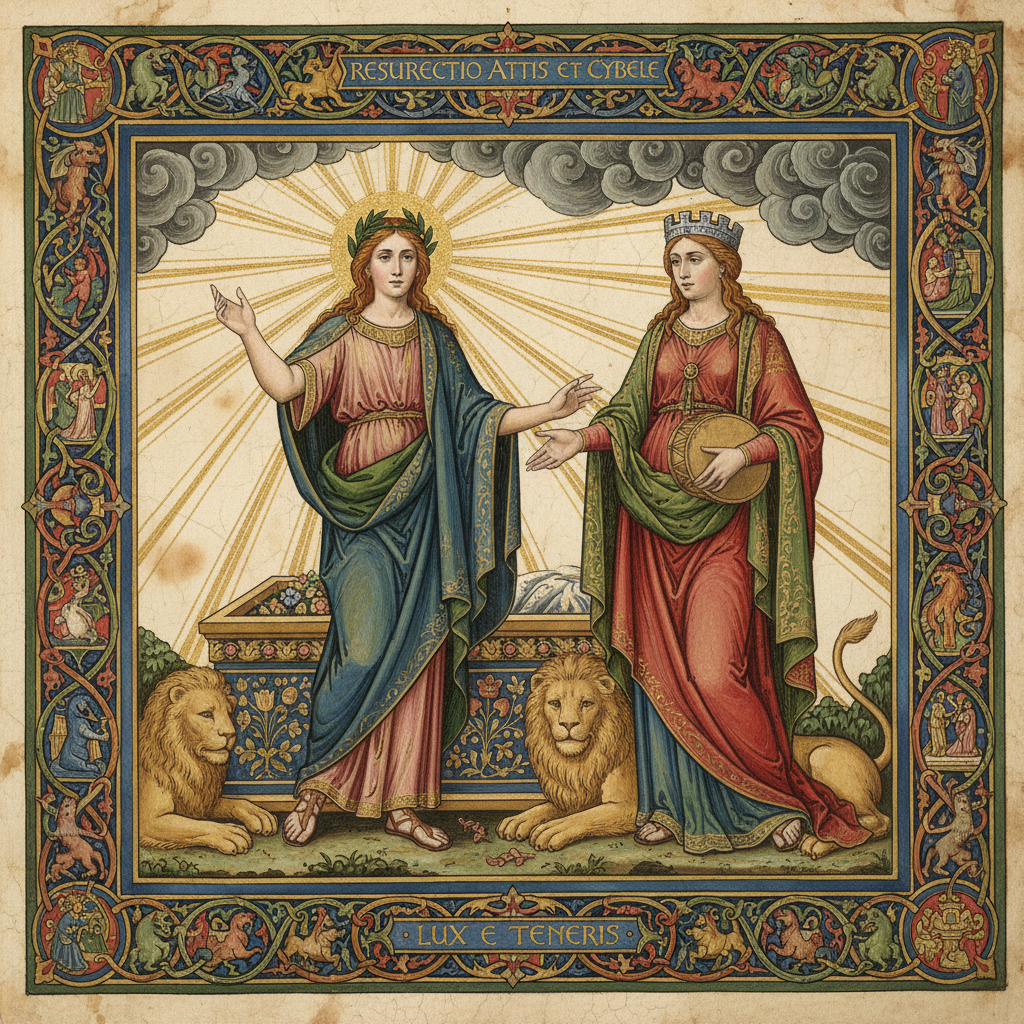
| Attis | Self-castration/death under a pine tree | 3 days (March 22-25) | Cybele resurrects him annually | His festival fell 3 days before Easter. Coincidence? | Phrygian/Roman |
| Inanna/Ishtar | Descended to underworld, killed by Ereshkigal | 3 days | Rescued by Enki’s creatures; traded Dumuzi for herself | The first descent-and-return narrative in literature | Mesopotamian |
| Lazarus | Illness | 4 days | Called out of the tomb by Jesus | The 4-day detail matters: Jewish belief said the soul left after 3 days | Biblical |
| The Maize God (Hun Hunahpu) | Defeated by Lords of Xibalba, decapitated | Until avenged | His sons (Hero Twins) defeat death; he becomes the corn cycle | Death and return IS the agricultural cycle — literal, not metaphorical | Maya |
| Cu Chulainn | Tied himself to standing stone, died | Appears after death | His ghost appears to warn Queen Medb’s army | Even dead, he’s terrifying | Celtic |
| Gandalf (literary) | Fell fighting the Balrog | Uncertain | ”Sent back” as Gandalf the White | Tolkien explicitly modeled this on Christ + Odin | Literary |
The Variables
The details change. The questions don’t.
| Question | Answers Across Traditions |
|---|---|
| Is it permanent? | Christ (yes, forever alive), Osiris (half — rules the dead), Dumuzi (cyclical), Persephone (cyclical) |
| Who causes the return? | God (Christ, Lazarus), a lover (Isis for Osiris), the cycle itself (Dumuzi, Persephone, Maize God) |
| What’s the cost? | Someone else dies (Dumuzi replaces Ishtar), the old world ends (Baldur), nothing (Christ — free grace) |
| Can it happen to anyone? | Christ says yes (resurrection of the dead). Most others: only for gods. |
| Does it solve death? | Christ: yes (for everyone). Baldur: only after Ragnarok. Everyone else: no, it’s cyclical. |
What the variables reveal
The deepest difference between resurrection traditions isn’t the mechanics — it’s the availability. In nearly every non-Christian tradition, resurrection is a god-only benefit. Osiris returns because Isis loves him. Baldur returns because the cosmos reboots. Persephone returns because that’s how nature works. The Hindu avatars descend and return because they were never really mortal to begin with.
The Christian claim is structurally unique: resurrection is offered to everyone. “Because I live, you also will live” (John 14:19). The Apostle Paul staked his entire theology on it: “If the dead are not raised, then Christ has not been raised either. And if Christ has not been raised, your faith is futile” (1 Corinthians 15:16-17). No other tradition makes the death-and-return of the divine figure a template for all humans.
The agricultural traditions (Dumuzi, Persephone, the Maize God) solve the problem differently: death isn’t defeated — it’s absorbed into the cycle. The corn dies and becomes the corn again. Persephone descends and ascends. Nothing is permanently gained. Nothing is permanently lost. For agricultural societies, this was not metaphor. The Maize God doesn’t represent the corn cycle — he is the corn cycle.
The Norse solution is the most brutal: you don’t get to come back until everything is destroyed first. Baldur’s return requires Ragnarok. The old world must burn completely. Only then does the beloved god walk again in the new green world. It’s resurrection through total annihilation.
The Three-Day Pattern
Christ: 3 days. Inanna: 3 days. Attis: 3 days. Jonah in the whale (prefiguring): 3 days. Why three?
The possibilities:
-
Biological observation. In hot climates, a body shows unmistakable signs of decomposition after three days. Three days means “definitely dead, not in a coma.” Lazarus at four days was significant precisely because Jewish tradition held the soul lingered near the body for three days then departed permanently. Day four = no take-backs.
-
Narrative structure. Three is the smallest number that creates a pattern. One day is an event. Two days is a coincidence. Three days is a story with a beginning, middle, and end. Every storytelling tradition gravitates toward three.
-
Shared cultural memory. Inanna’s descent (c. 1900-1600 BCE) predates the other three-day narratives by over a millennium. The Mesopotamian template may have diffused outward through trade routes, influencing Phrygian (Attis), Canaanite, and eventually Christian resurrection timelines. This doesn’t mean they copied — it means the template was in the water.
-
Astronomical observation. The moon disappears for approximately three days during the new moon. Ancient peoples who tracked lunar cycles would have seen the moon “die” and “return” every month on a three-day schedule. The oldest resurrection story might be in the sky.
The honest answer is probably all four at once. The three-day pattern works because it resonates on every level simultaneously — biological, narrative, cultural, and astronomical. That’s why it persists across traditions that never met.
The Profiles
1. Jesus Christ — The Empty Tomb
Tradition: Christian Death: Crucifixion under Pontius Pilate Duration: 3 days (Friday afternoon to Sunday morning) Return: Raised bodily by God; appeared to disciples, then to 500+ witnesses; ascended after 40 days Source: Matthew 28, Mark 16, Luke 24, John 20-21, 1 Corinthians 15
The stone rolled away. The tomb empty. The grave clothes folded. Mary Magdalene sees him first and mistakes him for the gardener — then he says her name. He walks through locked doors. He eats fish on a beach. He lets Thomas put his fingers in the wounds. This is not a ghost story. The body is real. The wounds are real. But death doesn’t have him anymore.
The resurrection of Christ isn’t one miracle among many — it’s the load-bearing wall. Paul says it explicitly: if this didn’t happen, the entire faith collapses. “If Christ has not been raised, your faith is futile; you are still in your sins” (1 Cor 15:17). Every other miracle in the Bible could be metaphor and Christianity survives. This one can’t be.
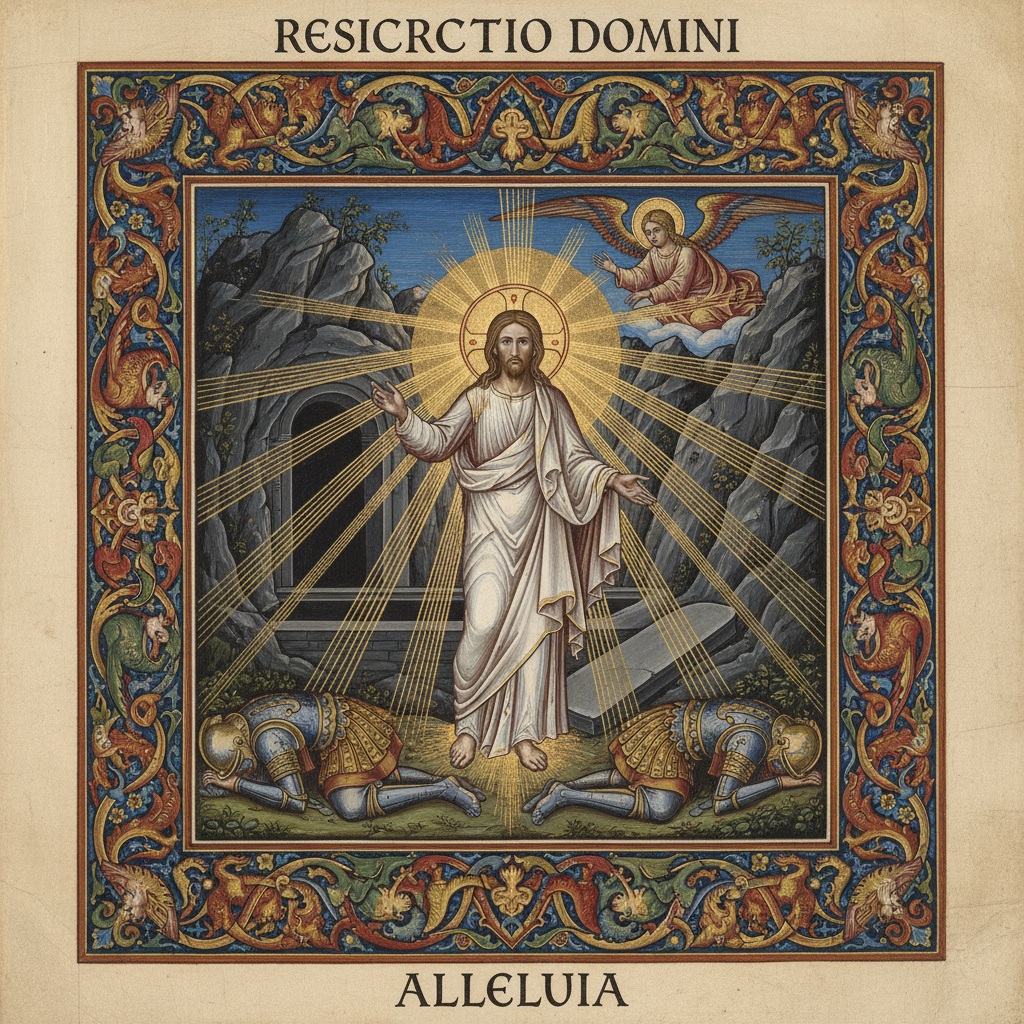
Jesus Christ risen from the dead emerging from the empty tomb, grave clothes fallen away, the massive stone rolled aside, blinding divine light radiating outward from his body, wounds visible in his hands, Roman guards fallen unconscious on the ground, dawn breaking over Jerusalem, the first breath after death, hyper-realistic sacred resurrection, dramatic light breaking through darkness, divine radiance, hope and awe, cinematic composition, oil painting rendering, 8k --ar 16:9 --s 900 --v 72. Osiris — Lord of the Dead
Tradition: Egyptian Death: Murdered by his brother Set, body dismembered into 14 pieces scattered across Egypt Duration: Indefinite Return: Isis gathered and reassembled all pieces (except one), performed the first mummification; Osiris became Lord of the Underworld Source: Pyramid Texts, The Contendings of Horus and Set, Plutarch’s De Iside et Osiride
Set threw a feast and brought out a beautiful chest — built secretly to Osiris’s exact measurements. “Whoever fits inside it, keeps it.” Osiris lay down. Set slammed the lid. Sealed it with lead. Threw it into the Nile. When that wasn’t enough, Set found the body, tore it into fourteen pieces, and scattered them across Egypt. Isis searched every inch of the land. She found thirteen pieces. She fashioned the fourteenth. She invented mummification on the spot. She hovered over his body in the form of a kite and conceived Horus.
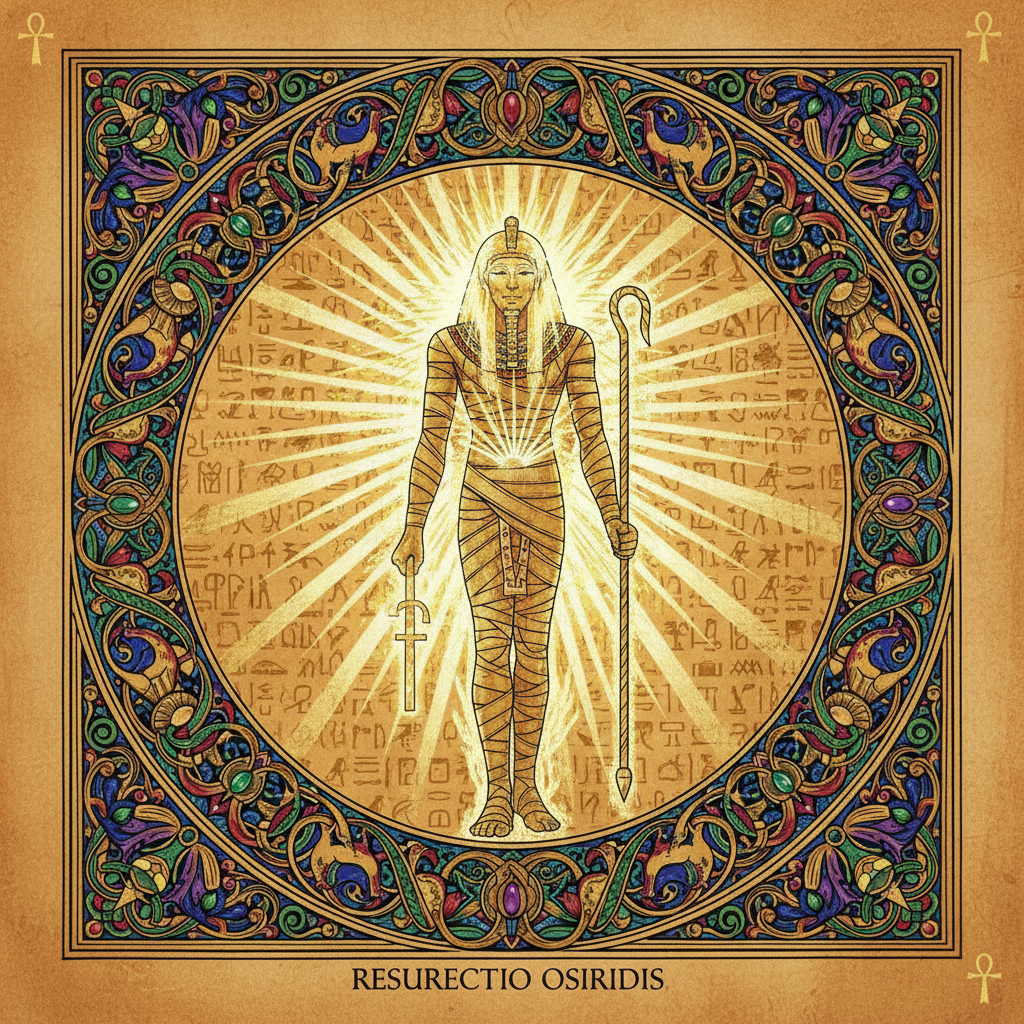
But Osiris doesn’t return to the living. He becomes king of the dead — the first mummy, the first resurrected god, ruling a kingdom no living person can visit and return from unchanged. His resurrection is real but bounded. He lives, but only in death’s country.
Isis in the form of a kite hovering over the reassembled body of Osiris on a stone slab, golden wings spread wide, divine light flowing from her into his green-skinned body, the fourteen pieces made whole again through divine magic, ancient Egyptian temple setting with hieroglyphic walls, the birth of mummification and the afterlife, hyper-realistic sacred resurrection, dramatic light breaking through darkness, divine radiance and devotion, cinematic composition, oil painting rendering, 8k --ar 16:9 --s 900 --v 73. Baldur — Returns After the End of Everything
Tradition: Norse Death: Killed by a mistletoe dart, Loki’s trick exploiting the one thing Frigg forgot to ask Duration: Until after Ragnarok — the destruction of the entire world Return: Walks out of Hel into a new green world after the old one burns Source: Voluspa, Gylfaginning (Prose Edda)
Everything in creation swore not to harm Baldur. Everything except mistletoe — too young, too small, too insignificant to bother with. Loki found out. Loki made a dart. Loki guided blind Hodr’s hand. The god of light fell.
Hermod rode to Hel to beg for Baldur’s return. Hel agreed — if every single thing in creation wept for him. Everything did. Except one giantess (probably Loki in disguise). So Baldur stayed dead. The gods’ grief became the fuel for Ragnarok. And only after the fire giant Surtr burns everything, after the World Serpent poisons the sea, after Odin is swallowed and Thor dies nine steps from victory — only then does Baldur walk out of death into a new world.
The cruelest resurrection: you only get it after you lose everything else.
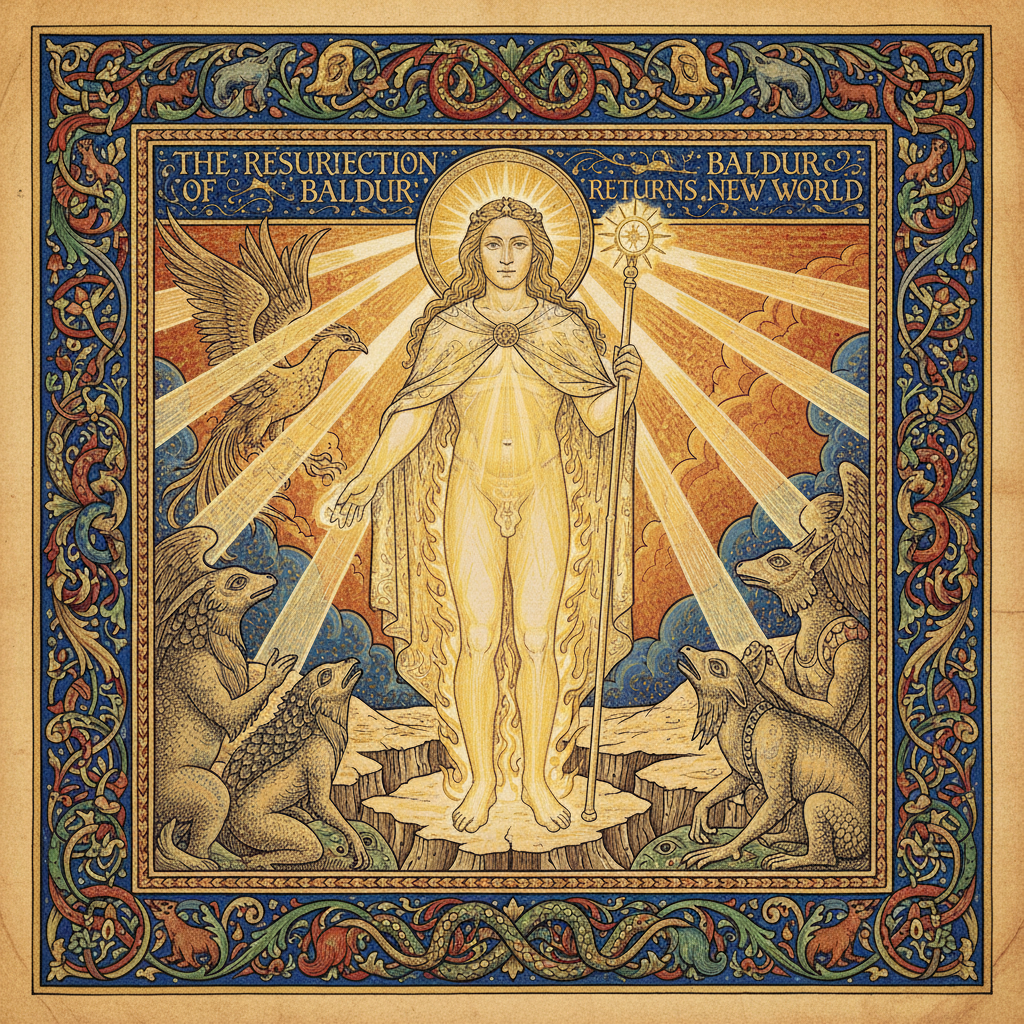
The Norse god Baldur walking out of the mists of Hel into a pristine new green world, the ruins of Ragnarok smoldering in the distance behind him, golden light surrounding his perfect form, flowers blooming where his feet touch the ground, the first dawn of a new creation, mountains and fresh rivers in the background, hyper-realistic sacred resurrection, dramatic light breaking through darkness, divine radiance, hope after total destruction, cinematic composition, oil painting rendering, 8k --ar 16:9 --s 900 --v 74. Dionysus — Torn Apart, Reborn in Wine
Tradition: Greek Death: Dismembered by the Titans as an infant (the Zagreus myth) Duration: Brief — reconstituted almost immediately Return: Reassembled by Rhea (or Zeus, depending on the source); his heart was saved and placed in a new body Source: Orphic traditions, Diodorus Siculus, Nonnus’ Dionysiaca
The Titans lured infant Dionysus with toys and a mirror. He was fascinated by his own reflection — the first being to see himself and wonder. Then they tore him apart and ate him. Zeus struck the Titans with lightning. From their ashes (mixed with divine flesh), humans were created — part Titan brutality, part divine spark. Dionysus’s heart survived. Zeus placed it in a new body.
This is why the Dionysian mysteries involved wine = blood, dismemberment = death, ecstasy = rebirth. The cult wasn’t celebrating a metaphor. They were re-enacting a cosmic event: the god who was torn apart so that humans could exist, who comes back every time the grape is crushed and the wine flows.
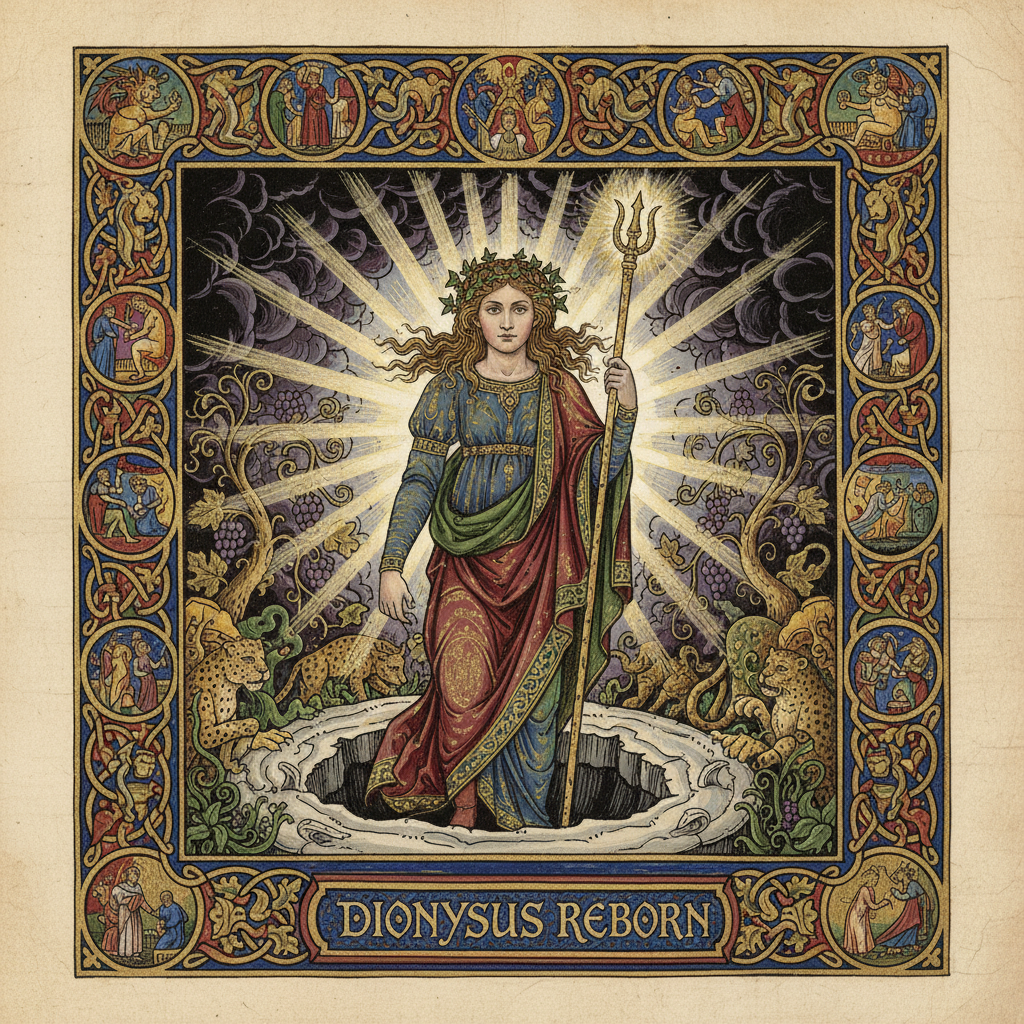
The infant god Dionysus being reconstituted from dismemberment, his glowing heart held aloft by Zeus, divine energy flowing outward reforming his body, grapevines and ivy erupting from the ground around him, the ashes of the Titans scattered below, a mirror reflecting his divine face, wine flowing like blood from the scene, hyper-realistic sacred resurrection, dramatic light breaking through darkness, ecstatic divine radiance, cinematic composition, oil painting rendering, 8k --ar 16:9 --s 900 --v 75. Dumuzi/Tammuz — The Seasonal Hostage
Tradition: Mesopotamian Death: Dragged to the underworld by demons (galla) sent by Inanna as her replacement Duration: 6 months per year, alternating with his sister Geshtinanna Return: Returns each spring when his sister descends to take his place Source: The Descent of Inanna, Sumerian hymns, Ezekiel 8:14
Inanna went to the underworld and came back. But the underworld demands a substitute — no one leaves without sending someone down. When Inanna returned and found Dumuzi sitting on her throne, not mourning, wearing fine clothes, she pointed at him: “Take him.”
The galla dragged him to death. His sister Geshtinanna offered to share his fate. So they alternate: six months alive, six months dead. The land blooms when Dumuzi returns and withers when he descends. This isn’t metaphor for the Mesopotamians — the agricultural cycle is the death-and-return cycle. The women of Jerusalem were still weeping for Tammuz at the Temple gate in Ezekiel’s time (Ezekiel 8:14), six hundred years before Christ.
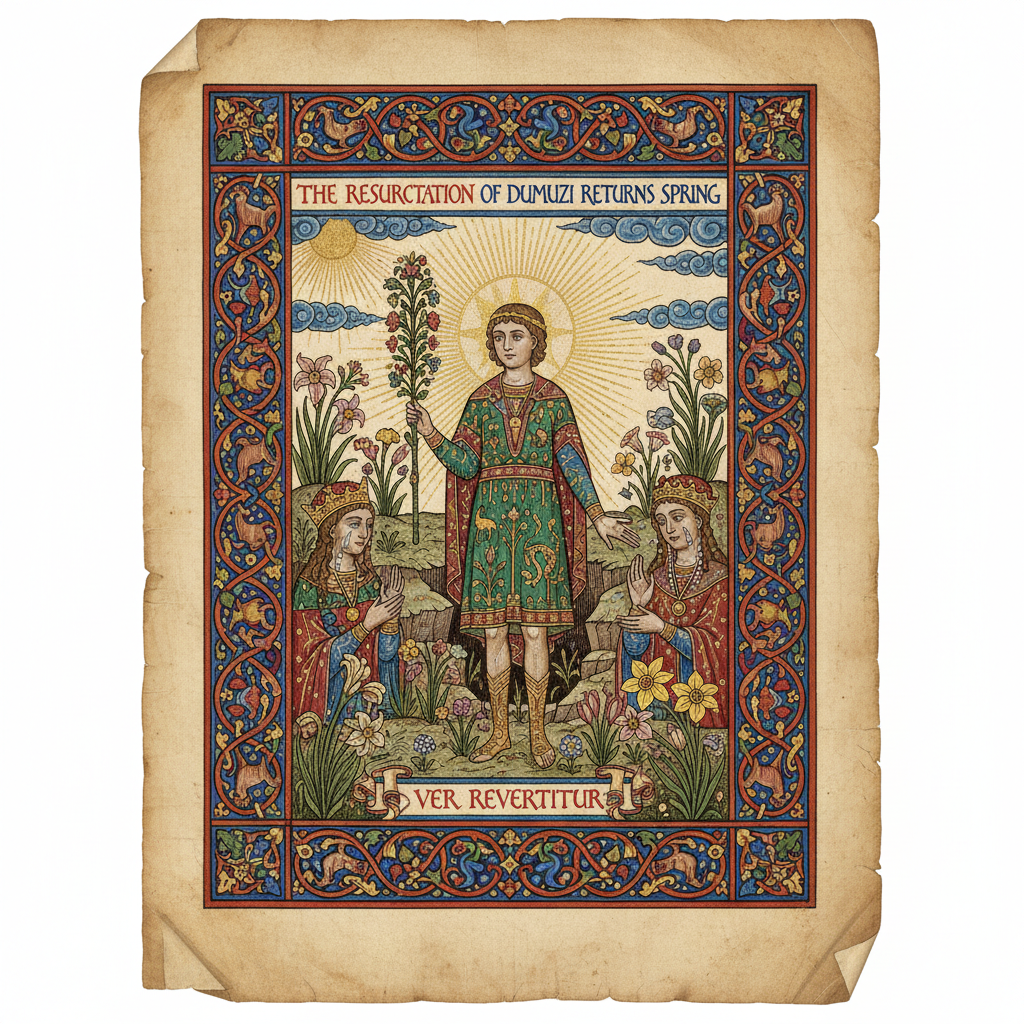
The Sumerian god Dumuzi ascending from a dark crack in the earth, emerging from the underworld into spring sunlight, flowers and grain sprouting around him, his sister Geshtinanna descending into the darkness behind him to take his place, Mesopotamian ziggurat in the background, the cyclical exchange of life and death, hyper-realistic sacred resurrection, dramatic light breaking through darkness, divine radiance and seasonal renewal, cinematic composition, oil painting rendering, 8k --ar 16:9 --s 900 --v 76. Persephone — Queen of Two Worlds
Tradition: Greek Death: Abducted to the underworld by Hades; ate pomegranate seeds that bound her Duration: 6 months per year (winter) Return: Returns to the surface each spring; her mother Demeter ends her grief and the earth blooms Source: Homeric Hymn to Demeter, Ovid’s Metamorphoses
She was picking flowers in a meadow. The earth opened. Hades took her. Her mother Demeter — goddess of the harvest — searched the earth, refusing to let anything grow until her daughter was returned. The world starved. Zeus intervened. But Persephone had eaten six pomegranate seeds in the underworld (you never eat the food of the dead), and that bound her: six months below, six months above.
Every spring, she ascends. Her mother rejoices. The earth blooms. Every autumn, she descends. Demeter grieves. The earth dies. The Greeks didn’t invent winter — they explained it. And the explanation is a mother’s grief.
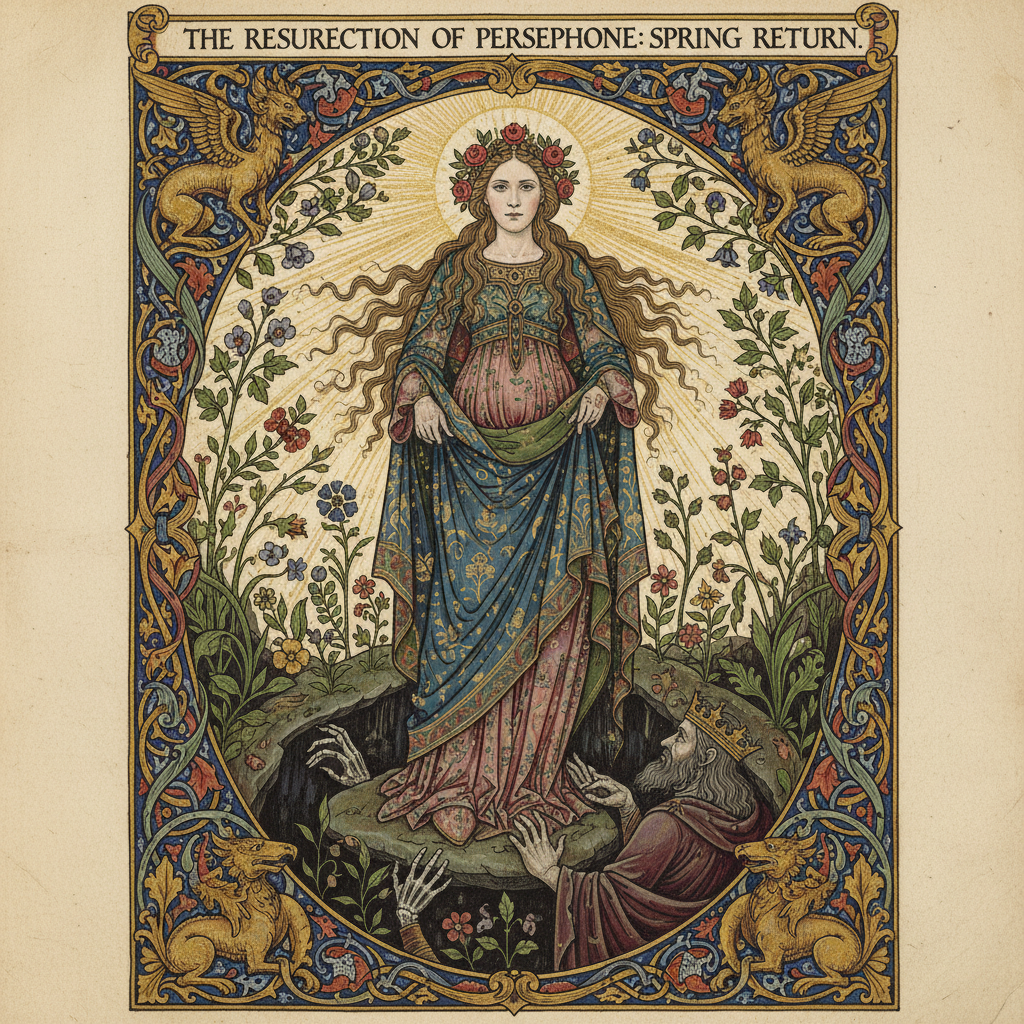
Persephone ascending from a dark chasm in the earth, emerging into brilliant spring sunlight, flowers erupting wherever she steps, her mother Demeter reaching for her with tears of joy, the contrast between the dark underworld below and the blooming meadow above, pomegranate seeds glowing red in her hand, hyper-realistic sacred resurrection, dramatic light breaking through darkness, divine radiance and maternal love, cinematic composition, oil painting rendering, 8k --ar 16:9 --s 900 --v 77. Attis — The Three Days Before Easter
Tradition: Phrygian/Roman Death: Self-castration and death under a pine tree, driven mad by Cybele Duration: 3 days (March 22-25 in the Roman calendar) Return: Resurrected annually by Cybele; celebrated with the festival of Hilaria (Day of Joy) Source: Ovid’s Fasti, Catullus 63, Arnobius
Cybele, the Great Mother, loved the beautiful shepherd Attis. When he was unfaithful, she drove him mad. He castrated himself under a pine tree and bled to death. Three days later, Cybele raised him. Every year, the Roman festival re-enacted this: March 22 — the pine tree was cut down (death). March 23-24 — mourning, fasting, self-flagellation, some priests castrated themselves. March 25 — Hilaria, the Day of Joy. He is risen.
The dates are impossible to ignore. The Attis festival of death (March 22) and resurrection (March 25) preceded Easter in the Roman calendar. Early Church fathers noticed. They said the devil had planted a counterfeit in advance. Modern scholars are less certain about who influenced whom — but the three-day resurrection pattern, celebrated in the same city, in the same month, is either convergence or contact.
The beautiful shepherd god Attis being resurrected by the Great Mother goddess Cybele beneath a sacred pine tree, his body restored from death, divine light pouring from Cybele's hands, pine branches and violets surrounding the scene, Roman priests celebrating in the background, the Day of Joy Hilaria, spring equinox light, hyper-realistic sacred resurrection, dramatic light breaking through darkness, divine radiance and ecstatic joy, cinematic composition, oil painting rendering, 8k --ar 16:9 --s 900 --v 78. Inanna/Ishtar — The First Descent
Tradition: Mesopotamian Death: Descended to the underworld of her own will; killed by her sister Ereshkigal, hung on a hook as a corpse Duration: 3 days Return: Rescued by Enki’s creatures (the gala-tura and kur-jara) who sprinkled her with the food and water of life Source: The Descent of Inanna (c. 1900-1600 BCE)
She went down voluntarily. She passed through seven gates. At each gate, she was stripped of one garment, one piece of divine power. By the seventh gate she was naked and powerless. Her sister Ereshkigal killed her and hung her corpse on a hook on the wall.
Three days. Then Enki — god of wisdom, the only one who could help — created two tiny beings from the dirt under his fingernails. He sent them to the underworld with the food and water of life. They sprinkled it on Inanna’s corpse. She rose.
This is the oldest death-and-return narrative in human literature. Written at least 1,500 years before Christ, probably older in oral form. The seven gates. The stripping. The three days. The resurrection through divine intervention. Every descent-and-return story that follows is writing in Inanna’s shadow.
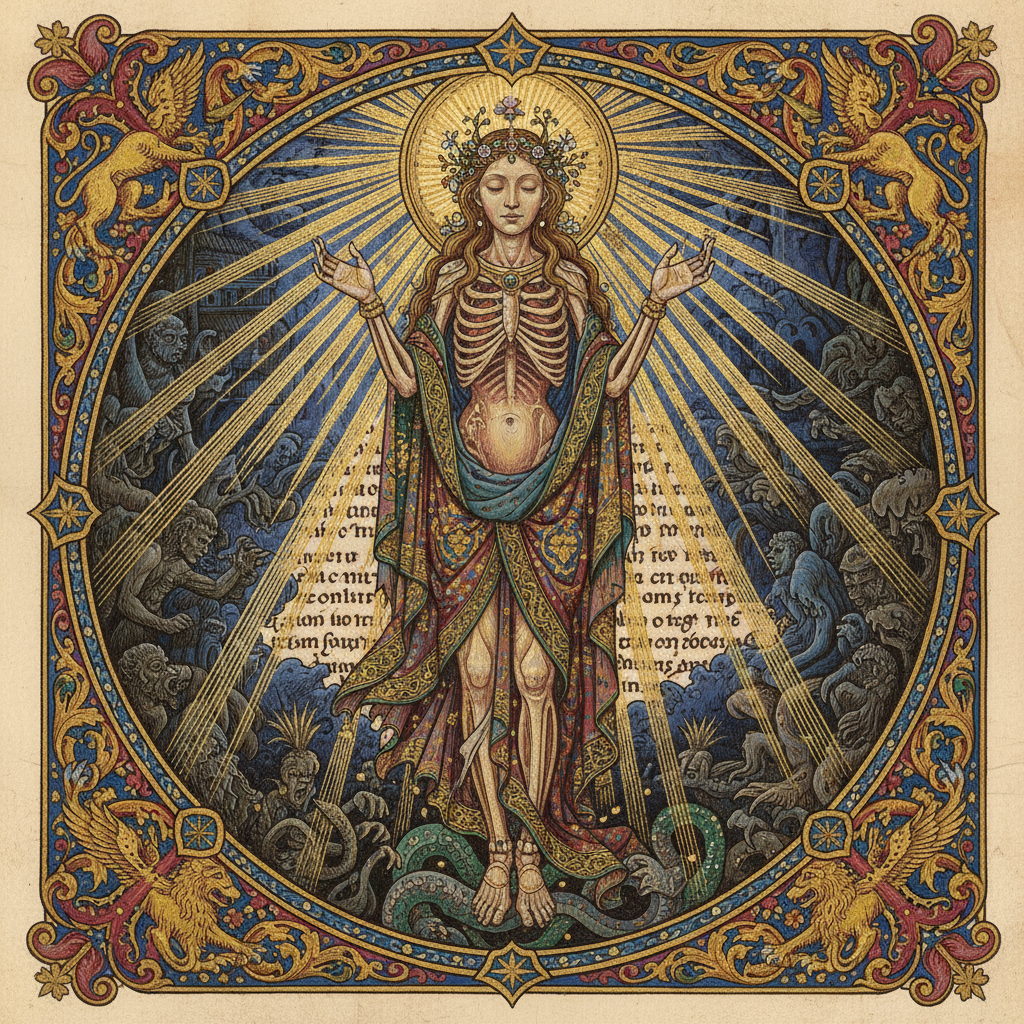
The goddess Inanna rising from death in the underworld, her corpse coming alive on the hook where she was hung, the tiny creatures of Enki sprinkling the food and water of life on her, divine light returning to her naked form, the seven gates of the underworld visible behind her, her sister Ereshkigal watching in shock, Mesopotamian underworld architecture, hyper-realistic sacred resurrection, dramatic light breaking through darkness, divine radiance and ancient power, cinematic composition, oil painting rendering, 8k --ar 16:9 --s 900 --v 79. Lazarus — The Fourth Day
Tradition: Biblical (Christian) Death: Illness Duration: 4 days in the tomb Return: Called out by Jesus: “Lazarus, come forth!” Source: John 11:1-44
Martha said: “Lord, by this time there will be an odor, for he has been dead four days.” That detail is the entire point. Jewish tradition held that the soul lingered near the body for three days, hoping to return. On day four, it departed permanently. The face changed. Decomposition was visible. There was no ambiguity left.
Jesus waited deliberately. He heard Lazarus was sick and stayed two more days before coming. He let it get to day four on purpose. So that when Lazarus walked out of the tomb, still wrapped in burial cloth, there could be no explanation except one. Not a coma. Not a mistake. Not the soul slipping back in before the deadline. Four days. Definitely dead. Definitely back.
“Jesus wept” (John 11:35) — the shortest verse in the Bible, and one of the most revealing. He knew he was about to raise Lazarus. He wept anyway. The resurrection doesn’t erase the grief.
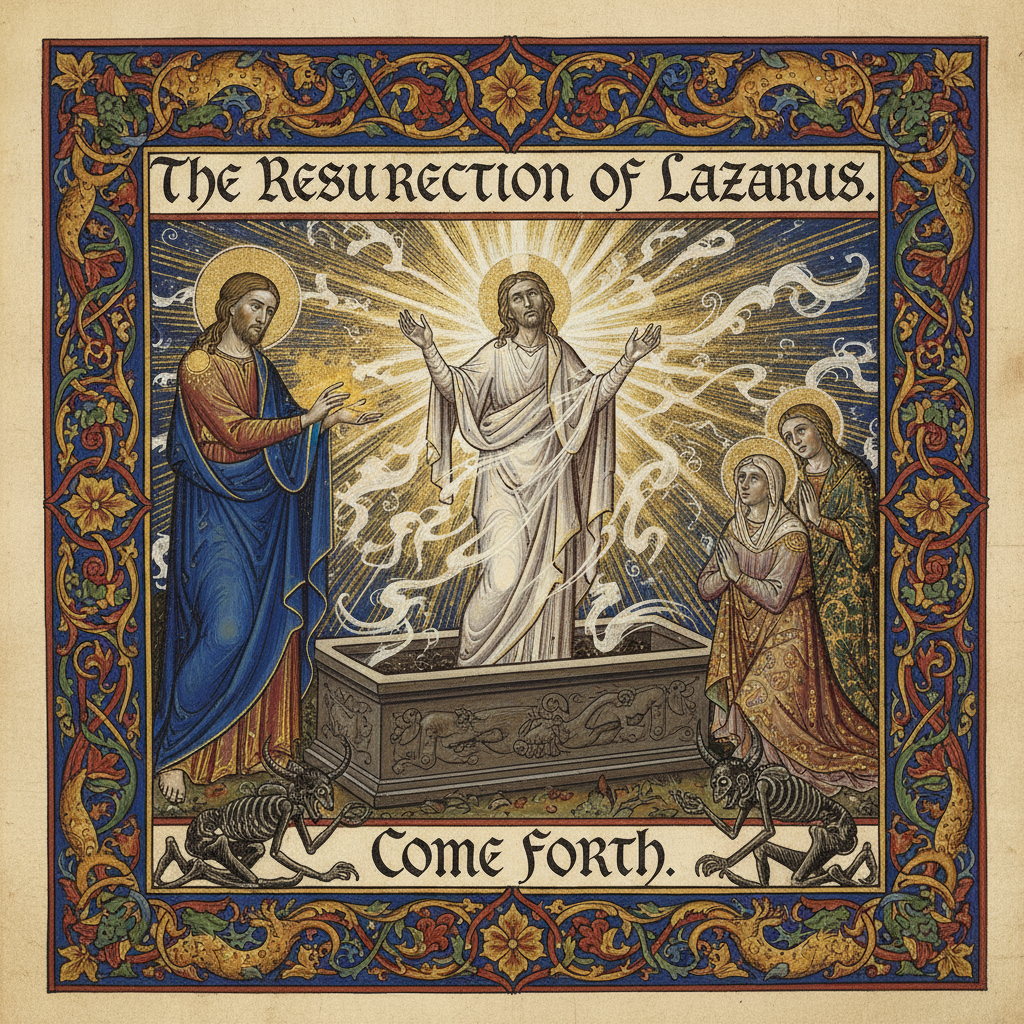
Lazarus emerging from a dark tomb wrapped in burial linens, Jesus standing before the tomb with arm outstretched commanding him to come forth, Martha and Mary falling to their knees in shock and joy, onlookers recoiling in terror and awe, the stone rolled away from the cave tomb, divine light on Jesus contrasting with the darkness of the grave, hyper-realistic sacred resurrection, dramatic light breaking through darkness, divine radiance and human awe, cinematic composition, oil painting rendering, 8k --ar 16:9 --s 900 --v 710. The Maize God (Hun Hunahpu) — Death IS the Harvest
Tradition: Maya Death: Defeated by the Lords of Xibalba (the underworld), decapitated; his head hung in a calabash tree Duration: Until his sons avenged him Return: His sons, the Hero Twins, descended to Xibalba, defeated the Lords of Death through cleverness, and the Maize God was reborn as corn Source: Popol Vuh
Hun Hunahpu and his brother played ball too loudly. The Lords of Xibalba, the death gods, summoned them to the underworld. They were tricked, tortured, and killed. Hun Hunahpu’s head was placed in a barren calabash tree — which immediately bore fruit. A death lord’s daughter (Xquic) spoke to the skull. It spat in her hand. She became pregnant with the Hero Twins.
The Twins grew up, descended to Xibalba, and beat the death gods at their own game — literally. They allowed themselves to be killed, came back, and dismembered the Lords of Death (who did not come back). Then their father was reborn as the Maize God, emerging from a crack in the earth like a corn stalk breaking through soil.
This is not metaphor. For the Maya, the planting cycle is the death-and-resurrection cycle. You put the seed in the ground (burial). It disappears (death). It emerges (resurrection). You eat it (communion). The Maize God didn’t represent agriculture — he was agriculture.
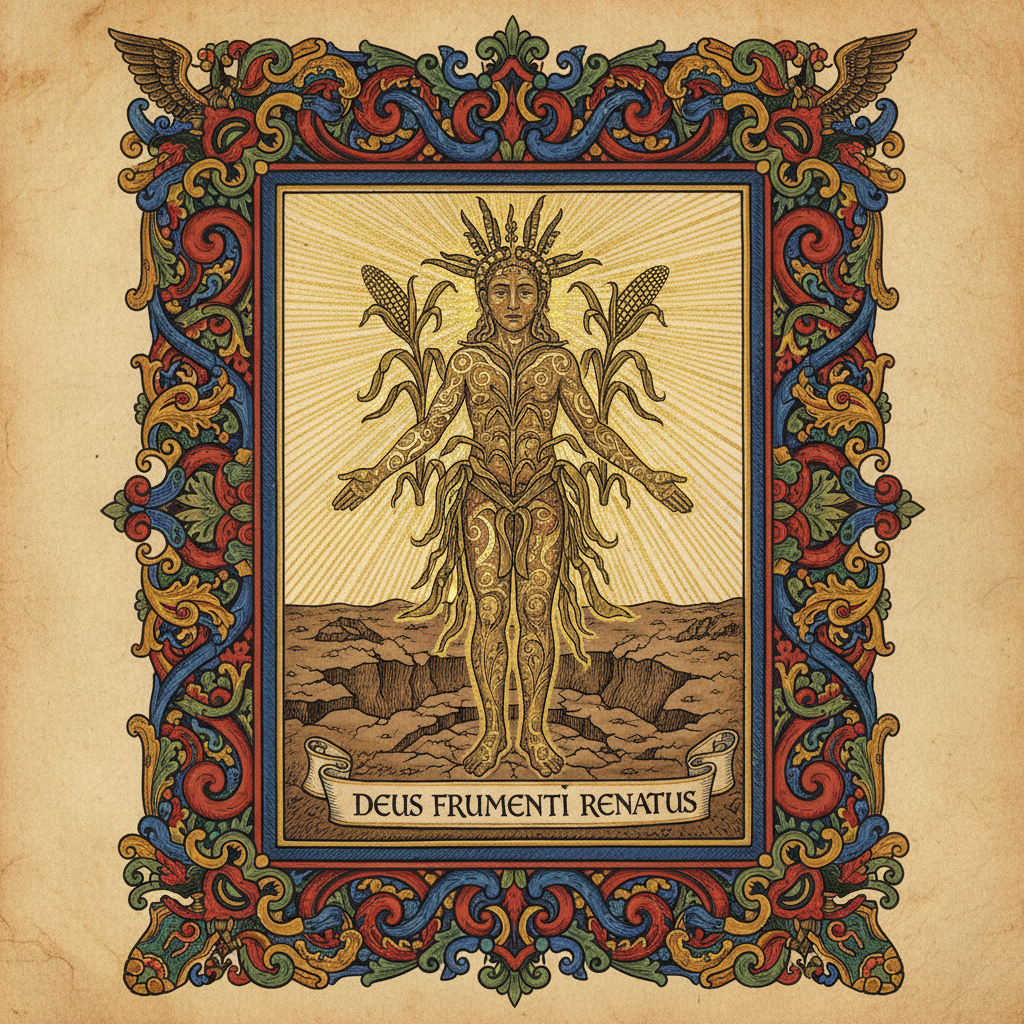
The Maya Maize God Hun Hunahpu emerging reborn from a crack in the earth like a corn stalk, the Hero Twins standing victorious over the defeated Lords of Xibalba, corn and vegetation erupting from the ground, Mayan temple pyramids in the background, jade and turquoise colors, the agricultural cycle as literal resurrection, hyper-realistic sacred resurrection, dramatic light breaking through darkness, divine radiance and natural abundance, cinematic composition, oil painting rendering, 8k --ar 16:9 --s 900 --v 711. Cu Chulainn — The Ghost on the Standing Stone
Tradition: Celtic (Irish) Death: Mortally wounded, he tied himself to a standing stone so he would die on his feet Duration: N/A — appears as a ghost after death Return: His phantom appears to Queen Medb’s army, terrifying them even in death Source: Tain Bo Cuailnge (The Cattle Raid of Cooley)
He was the greatest warrior Ireland ever knew. The Warp Spasm — the riastrad — turned his body inside out in battle. He held the pass at the ford alone against an entire army. When they finally killed him (it took a conspiracy of magic, broken taboos, and half an army), he tied himself upright to a standing stone with his own intestines so he wouldn’t die lying down.
His enemies were afraid to approach the body. A raven landed on his shoulder. Only then did they know for certain. And even dead, tied to that stone, his ghost appeared to Medb’s retreating army. Cu Chulainn’s resurrection isn’t physical — it’s the refusal to stop being terrifying. Death didn’t change his fundamental nature. It just removed the body. The threat remained.
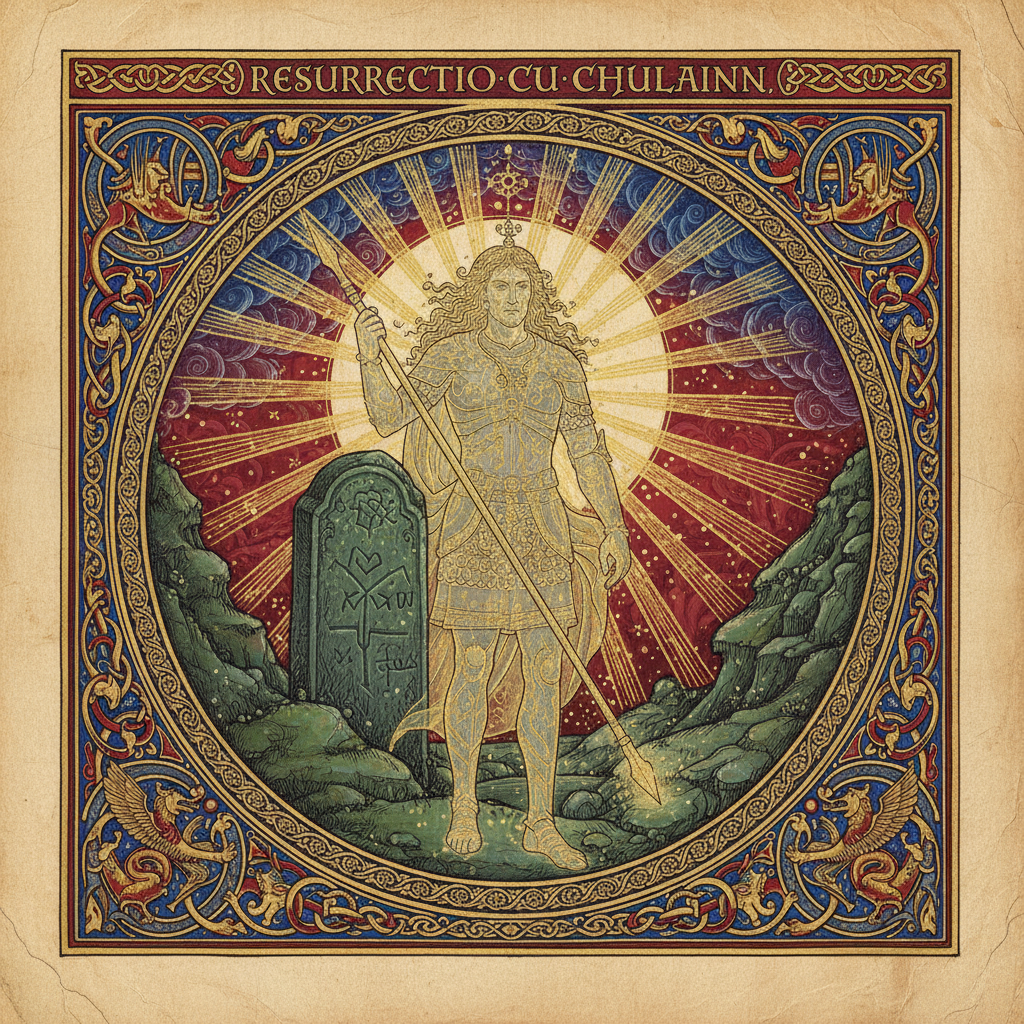
The ghost of Cu Chulainn appearing above his own dead body tied to a standing stone, his spectral form in full warp spasm riastrad, terrifying warriors fleeing before him, a raven perched on the shoulder of his corpse, the Irish landscape of green hills and mist, the greatest warrior refusing to die, hyper-realistic sacred resurrection, dramatic light breaking through darkness, ghostly radiance and primal terror, cinematic composition, oil painting rendering, 8k --ar 16:9 --s 900 --v 712. Gandalf — Sent Back (Literary)
Tradition: Literary (J.R.R. Tolkien) Death: Fell fighting the Balrog of Morgoth in the mines of Moria; fought for ten days falling and rising Duration: Uncertain — returned as Gandalf the White Return: “Sent back” by Eru Iluvatar (God, in Tolkien’s cosmology) to complete his task Source: The Lord of the Rings: The Two Towers
“I am Gandalf the White. And I come back to you now at the turn of the tide.”
Tolkien was a devout Catholic. He wasn’t subtle about it. Gandalf’s death and return maps explicitly onto the Christ pattern: sacrificial death in battle against evil, a period of absence, return in a glorified form with greater power and authority. But it also maps onto Odin: the grey wanderer, the old man with a staff, the seeker of wisdom who pays the ultimate price.
Tolkien’s genius was the fusion. Gandalf is Christ’s sacrifice and Odin’s wisdom combined in a single figure. He dies fighting a creature of pure ancient evil in the depths of the earth. He is sent back — not by his own power, but by the authority that made the world. He returns changed: whiter, more powerful, less patient with nonsense. The grey pilgrim became the white lord because the task demanded it.
The literary resurrection works because Tolkien understood the source material. He wasn’t borrowing a trope. He was channeling the oldest story in the world through the lens of his own faith.
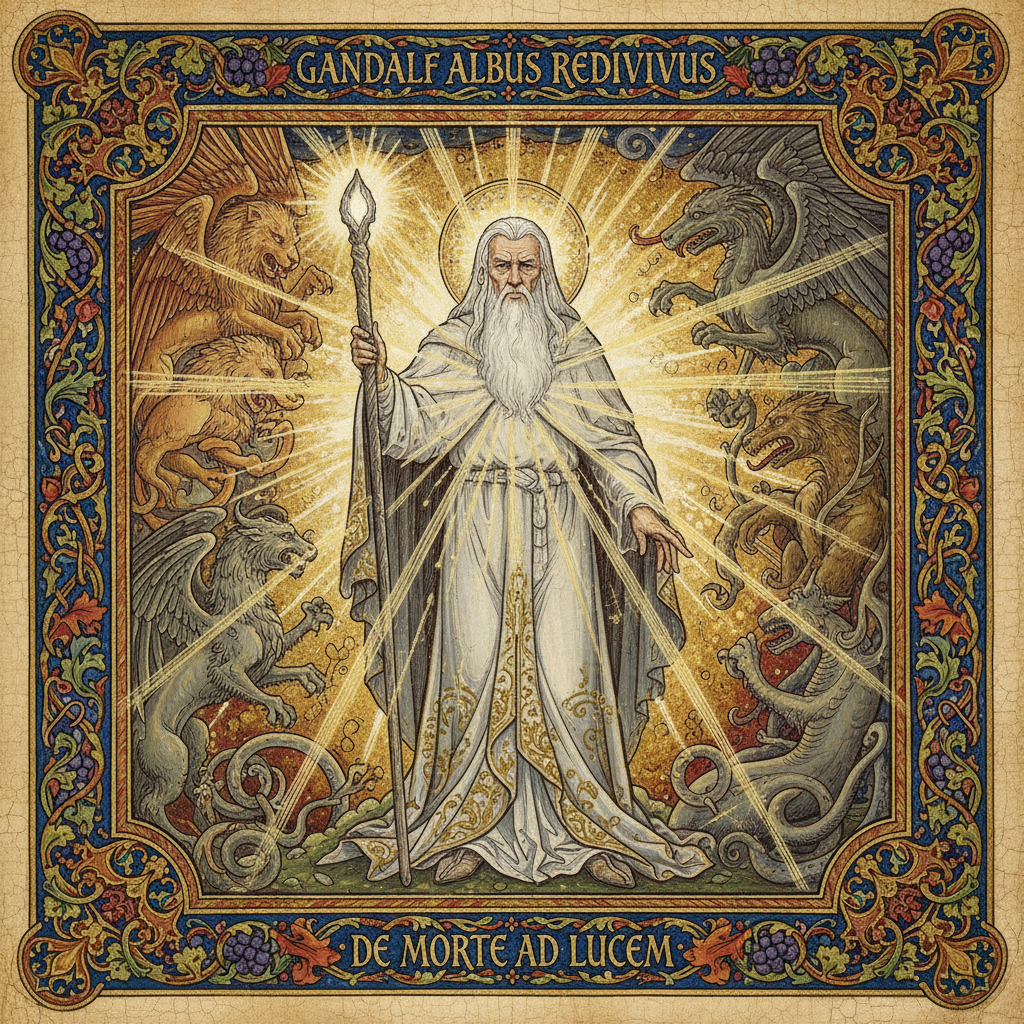
Gandalf the White appearing in blinding white light in the forest of Fangorn, his grey robes replaced with radiant white, staff gleaming with divine authority, Aragorn and Legolas and Gimli shielding their eyes, the moment of recognition, sent back from death at the turn of the tide, hyper-realistic sacred resurrection, dramatic light breaking through forest canopy, divine radiance and authority, cinematic composition, oil painting rendering, 8k --ar 16:9 --s 900 --v 7The Pattern Map
                    PERMANENT
                       |
              Christ --+
                       |
         Osiris -------+-------- PARTIAL
         (rules dead)  |         (only in death's realm)
                       |
                    CYCLICAL
                       |
    Dumuzi ---+--- Persephone --- Maize God
    (seasonal) |   (seasonal)     (agricultural)
               |
            Attis
            (annual)
                       |
                  CONDITIONAL
                       |
         Baldur -------+-------- Only after Ragnarok
                       |
         Gandalf ------+-------- Only if the task demands it
                       |
                  NOT REALLY
                       |
         Cu Chulainn --+-------- Ghost, not resurrection
         Lazarus ------+-------- Died again later
What It All Means
Every tradition that invented resurrection was trying to solve the same problem: death is the one thing that breaks all other stories. Love stories end. Hero stories end. Creation stories end. Death is the narrative wall.
The agricultural societies (Mesopotamia, Greece, Maya) solved it with the cycle: nothing is permanently lost because everything returns. The cost is that nothing is permanently gained either. Dumuzi comes back every spring and leaves every fall. Forever.
The Norse solved it with apocalypse: you can’t come back until the old world is completely destroyed. Baldur’s resurrection requires the death of everything else. It’s the most expensive ticket in mythology.
The Egyptian solution is jurisdiction: Osiris lives, but only in death’s country. He rules, but his kingdom is the grave. The resurrection is real, but the border between the living and the dead is absolute.
The Christian solution is the most ambitious: one death, one resurrection, universally available, permanently effective. It either happened or it didn’t. Paul said it himself: “If Christ has not been raised, our preaching is useless and so is your faith” (1 Cor 15:14). There’s no fallback position. No cyclical interpretation. No metaphorical safety net. Either the tomb was empty or the whole thing collapses.
Tolkien understood all of this. That’s why Gandalf works. He’s not a copy of Christ or Odin — he’s a literary argument that the resurrection pattern is true, told through the medium of fantasy. “The Gospels contain a fairy-story,” Tolkien wrote to C.S. Lewis, “or a story of a larger kind which embraces all the essence of fairy-stories.”
Every culture reached for the same story. Only one claimed it actually happened.