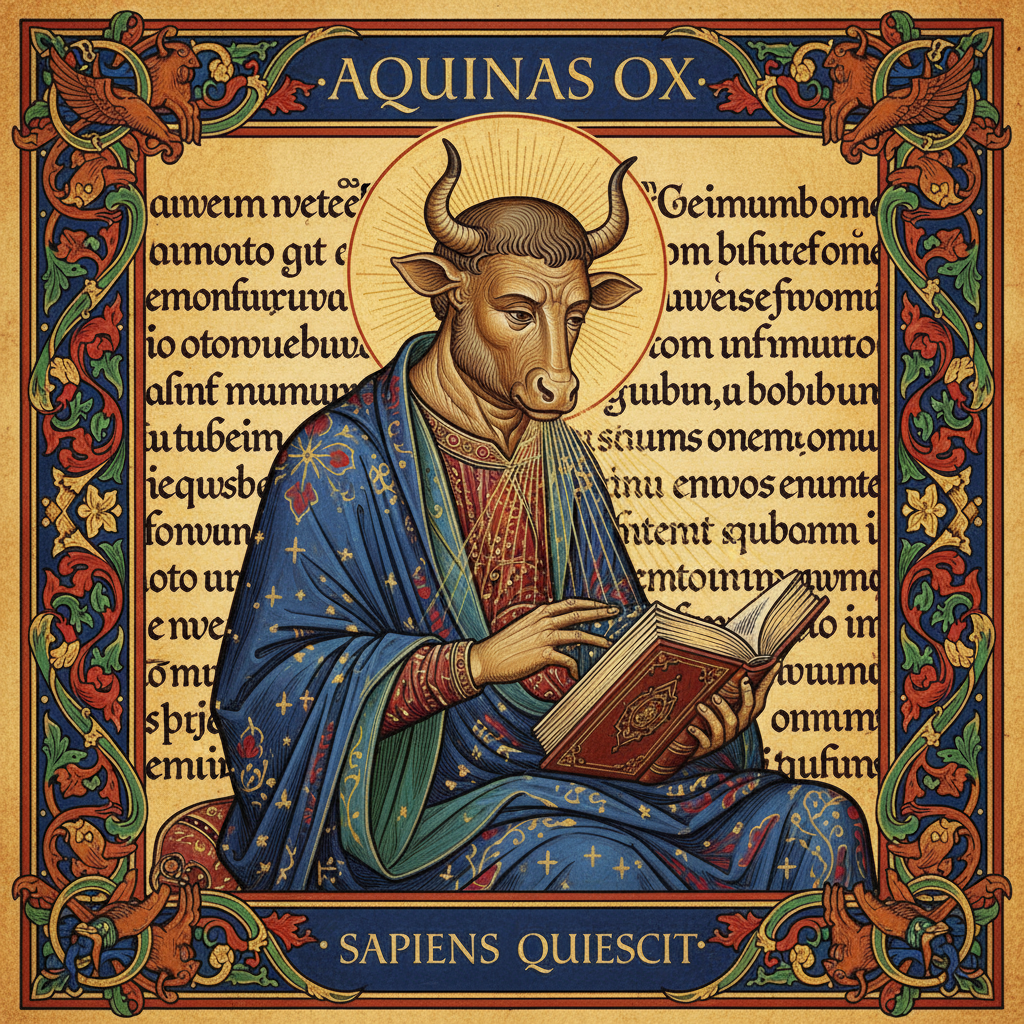
Part of the Bestiary Compendium
Not warriors. Not gods (mostly). MINDS. Every tradition has figures who embody wisdom itself — who sought knowledge at any cost, who thought harder and further than anyone around them, and who paid for it. Because wisdom is never free. In every tradition, across every culture, the wisest beings are the most burdened. The pattern is universal: wisdom and happiness are inversely correlated.
The Sages
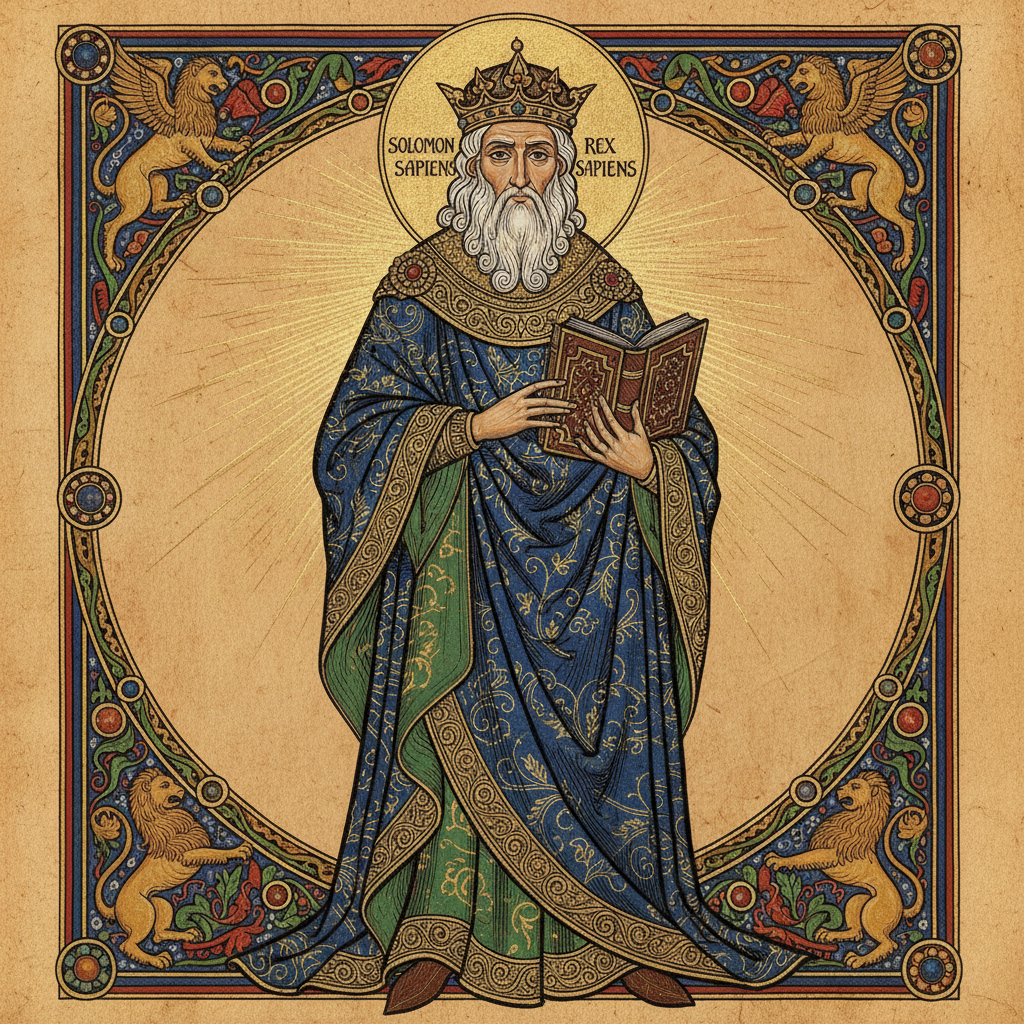
1. Solomon — The King Who Asked for Wisdom
| Tradition | Biblical |
| Their Wisdom | Asked God for wisdom instead of wealth or power. Got both. INT 100. |
| Their Cost | Wisdom couldn’t save him from 1,000 women. Fell anyway. |
| Source | 1 Kings 3-11 |
God appeared to Solomon in a dream and said: ask for anything. Solomon asked for wisdom. God was so pleased he threw in wealth and power for free. Solomon judged the two mothers, built the Temple, wrote Proverbs and Ecclesiastes, and commanded demons with a magic ring. Then 700 wives and 300 concubines turned his heart to foreign gods. The wisest man in the Bible couldn’t outsmart his own desires. Ecclesiastes reads like a man who saw everything clearly and wished he hadn’t: “For in much wisdom is much grief, and he who increases knowledge increases sorrow.”
King Solomon seated on a magnificent golden throne flanked by carved lions, surrounded by towering stacks of ancient scrolls and open books, a divine light illuminating his crowned head, one hand holding a quill writing Proverbs while the other rests on a signet ring of power, behind him the silhouettes of hundreds of women fading into shadow, warm scholarly atmosphere, hyper-realistic dark mythology, dramatic chiaroscuro lighting, volumetric atmospheric fog, warm golden rim lighting against cool desaturated background, muted earth tones with saturated gold and deep amber accents, cinematic composition, oil painting character rendering, high detail texture, mystical divine aesthetic, 8k --ar 16:9 --s 900 --v 72. Odin — The One-Eyed Seeker
| Tradition | Norse |
| Their Wisdom | Hung on Yggdrasil 9 days, sacrificed an eye at Mimir’s well. INT 100. |
| Their Cost | Knows exactly when and how he will die. Cannot change it. |
| Source | Havamal |
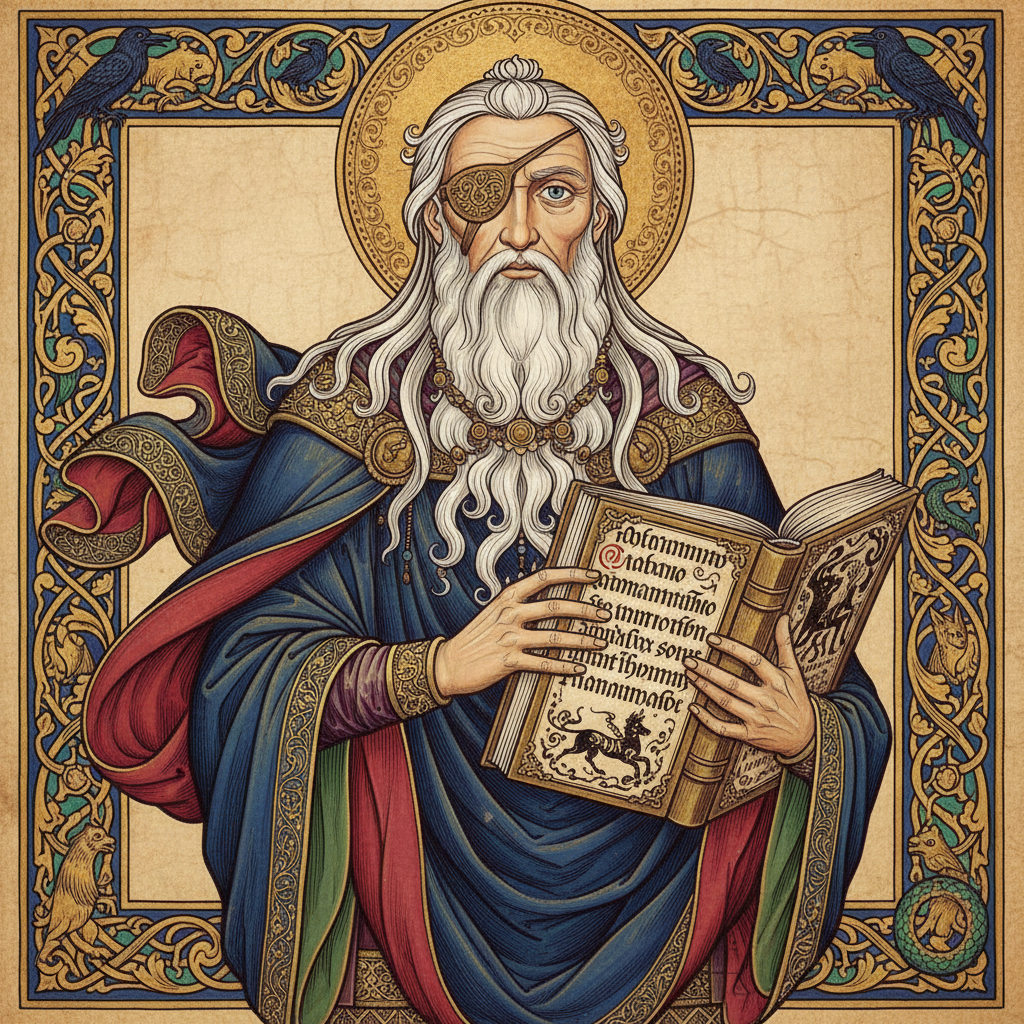
Odin is the only supreme god in any pantheon who SUFFERS for his power. He hung himself on the World Tree for nine days and nights, pierced by his own spear, staring into the void until the runes revealed themselves. Then he went to Mimir’s well and sacrificed an eye for a single drink of cosmic knowledge. What did he learn? That everything ends. That Ragnarok is coming. That the wolf Fenrir will swallow him whole. He spends eternity preparing for a battle he knows he will lose. The Allfather’s wisdom is knowing the exact shape of his own doom.
Odin the Allfather hanging from the great World Tree Yggdrasil, pierced by his own spear Gungnir, one eye socket empty and bleeding, the other eye blazing with terrible knowledge, ravens Huginn and Muninn circling above, glowing Norse runes emerging from the void below, nine days of suffering etched into his weathered face, hyper-realistic dark mythology, dramatic chiaroscuro lighting, volumetric atmospheric fog, cool blue-silver rim lighting against deep shadow background, muted earth tones with spectral ice-blue and blood-red accents, cinematic composition, oil painting character rendering, high detail texture, mystical divine aesthetic, 8k --ar 16:9 --s 900 --v 73. Thoth — The Recorder of All Truth
| Tradition | Egyptian |
| Their Wisdom | Invented writing, measured time, recorded the judgment of every soul. INT 100. |
| Their Cost | Carries the weight of every truth ever recorded. |
| Source | Various Egyptian texts |
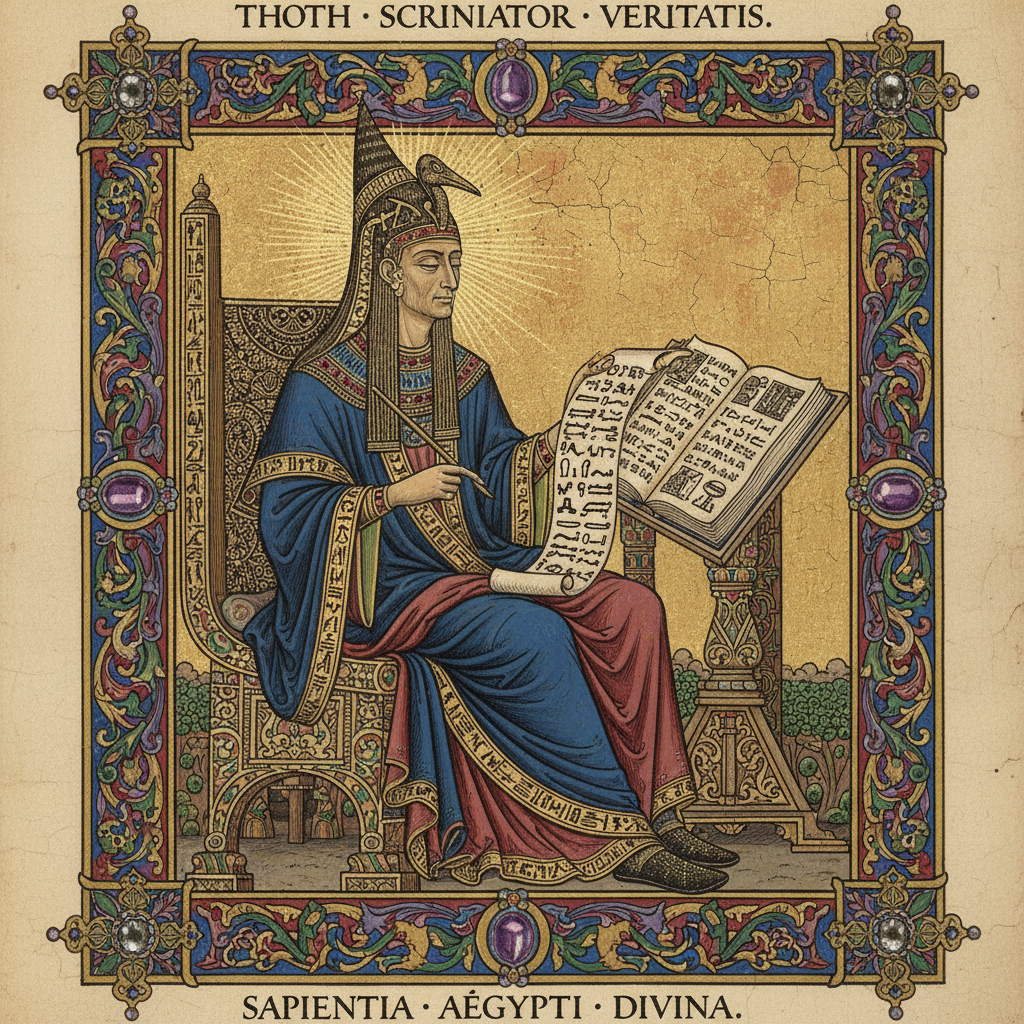
Thoth invented writing. Think about that. Before Thoth, nothing was recorded, nothing was measured, nothing was preserved. He created hieroglyphics, measured the calendar, invented mathematics, and stood at the scales of Ma’at recording whether each dead soul’s heart was lighter than a feather. Every truth, every lie, every judgment — Thoth wrote it down. He is the ibis-headed god who carries the weight of all recorded knowledge. The Greeks called him Hermes Trismegistus and built an entire esoteric tradition around his supposed writings.
Thoth the ibis-headed god of wisdom seated at a vast cosmic desk writing in an infinite book, a quill of light in one hand and the scales of Ma'at balanced in the other, hieroglyphic equations and star charts floating in the air around him, the moon disc and crescent crowning his head, papyrus scrolls stretching endlessly into darkness behind him, hyper-realistic dark mythology, dramatic chiaroscuro lighting, volumetric atmospheric fog, warm golden rim lighting against cool desaturated background, muted earth tones with deep lapis blue and liquid gold accents, cinematic composition, oil painting character rendering, high detail texture, mystical divine aesthetic, 8k --ar 16:9 --s 900 --v 74. Athena — The Mind That Never Loved
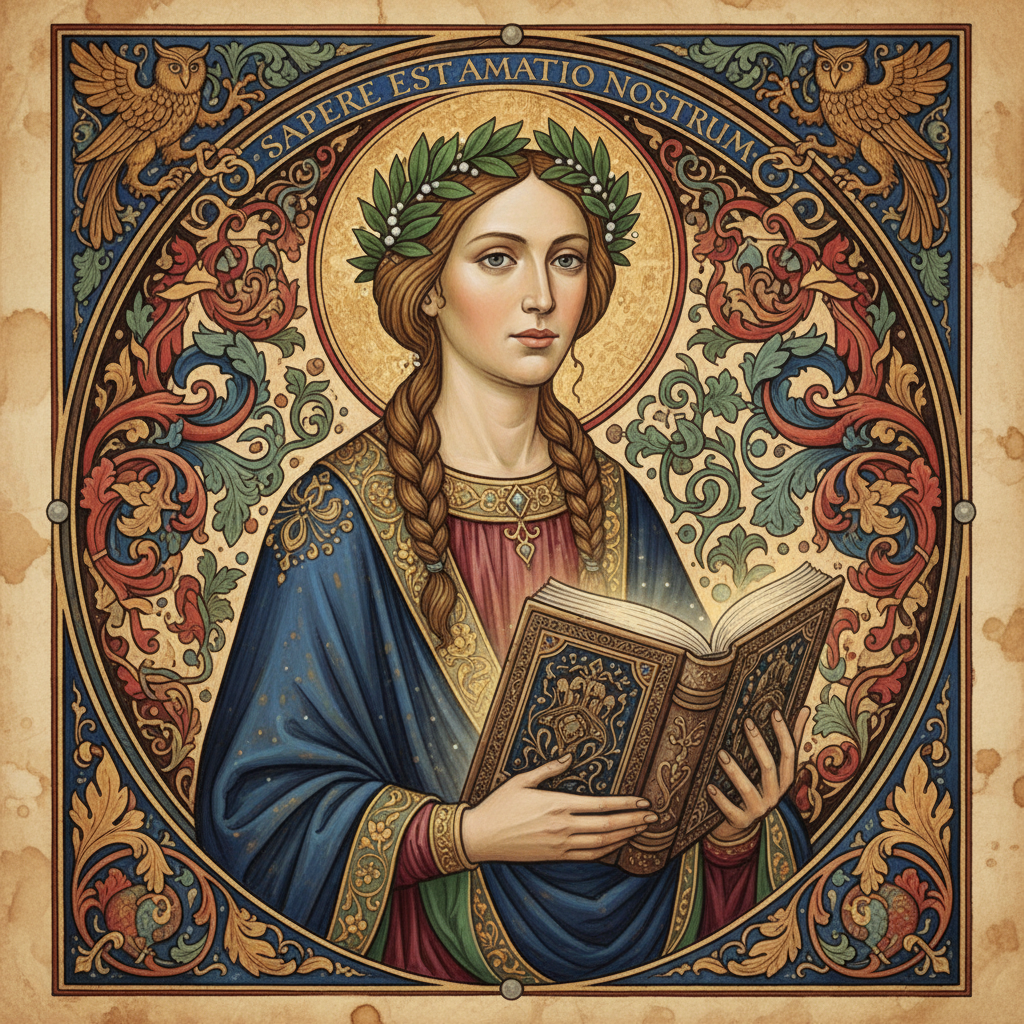
| Tradition | Greek |
| Their Wisdom | Born fully armed from Zeus’s head. Goddess of strategic warfare AND crafts. |
| Their Cost | Never loved. Wisdom and intimacy seem mutually exclusive. |
| Source | Homer, Hesiod |
She didn’t come from a womb. She came from a skull. Zeus swallowed her mother Metis (whose name literally means “wisdom”) and Athena burst from his head fully armed, screaming a war cry. She is the goddess of both strategic warfare and weaving — violence and creation, the sword and the loom. She never married. Never took a lover. In a pantheon where every other god is tangled in passionate, destructive relationships, Athena stands alone. Her virginity isn’t prudishness; it’s the cost of total intellectual clarity. You can see everything or you can feel everything. Not both.
Athena the grey-eyed goddess of wisdom standing alone in a vast marble library, wearing a golden aegis bearing Medusa's face on her breastplate, a spear in one hand and an owl perched on the other, her helmet pushed back revealing a face of cold perfect intelligence, a loom with a half-woven cosmic tapestry behind her, completely alone among infinite knowledge, hyper-realistic dark mythology, dramatic chiaroscuro lighting, volumetric atmospheric fog, cool silver-white rim lighting against grey marble background, muted earth tones with olive green and pale gold accents, cinematic composition, oil painting character rendering, high detail texture, mystical divine aesthetic, 8k --ar 16:9 --s 900 --v 75. Saraswati — The Overlooked Goddess
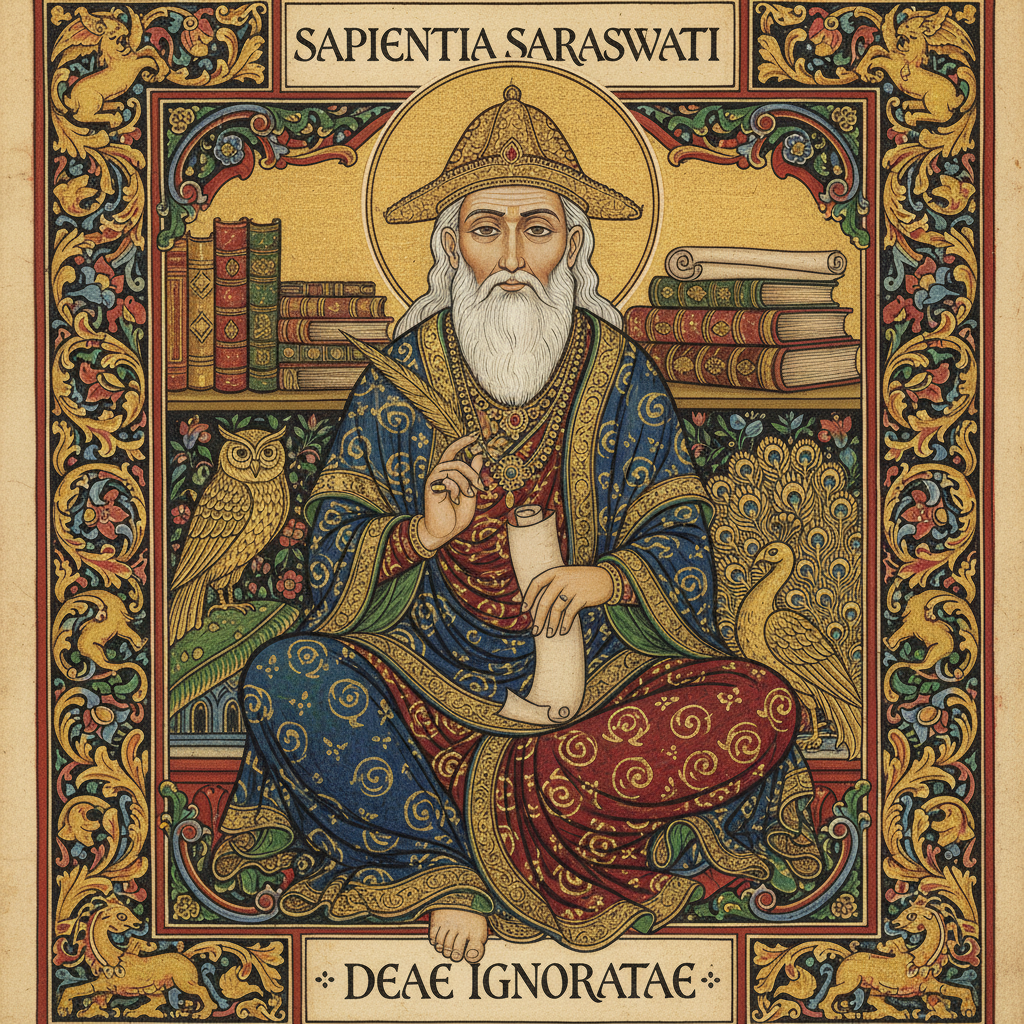
| Tradition | Hindu |
| Their Wisdom | Goddess of all knowledge, music, art. Plays the veena on a white lotus. |
| Their Cost | Often overlooked in favor of Lakshmi (wealth) and Parvati (love). |
| Source | Rig Veda |
Saraswati sits on a white lotus in a white sari playing a veena, and nobody pays attention because Lakshmi is handing out money and Parvati is handing out love. She is the goddess of knowledge, music, art, speech, and learning — the entire domain of human creativity and understanding. But temples to Saraswati are rare compared to Lakshmi’s. Students pray to her before exams and then forget her. The most profound commentary on wisdom in any religion: even among the gods, people prefer wealth and love to knowledge.
Saraswati the goddess of wisdom seated on a white lotus floating on a serene river, wearing pure white silk robes with minimal gold, playing a veena with four hands -- two on the instrument, one holding sacred scriptures, one holding a crystal mala, a white swan at her feet, peaceful and radiant yet entirely alone while distant temples to Lakshmi overflow with worshippers, hyper-realistic dark mythology, soft luminous lighting, volumetric atmospheric fog, warm pearl-white rim lighting against tranquil blue-green background, white and cream tones with subtle gold and azure accents, cinematic composition, oil painting character rendering, high detail texture, mystical divine aesthetic, 8k --ar 16:9 --s 900 --v 76. Laozi — The Sage Who Left
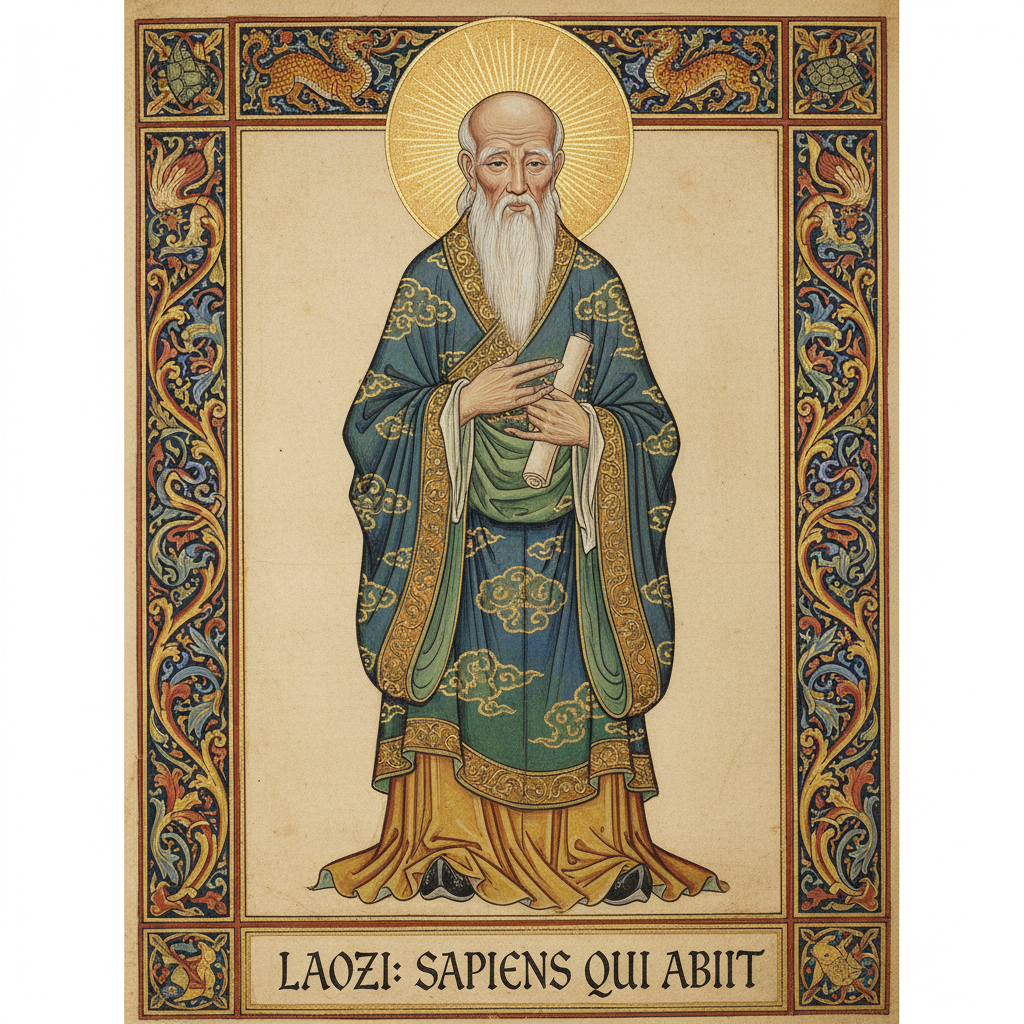
| Tradition | Taoist |
| Their Wisdom | Wrote the Tao Te Ching in one sitting, rode a buffalo into the sunset, vanished. |
| Their Cost | Couldn’t be bothered to stay. Wisdom and engagement are opposites. |
| Source | Tao Te Ching |
The legend: Laozi was the keeper of the royal archives. He watched civilization rotting from the inside. He climbed on a water buffalo and headed for the western pass. The border guard recognized him and begged him to write down his wisdom before he disappeared forever. Laozi sat down, wrote 5,000 characters — the Tao Te Ching — and rode into the mountains. Never seen again. The entire philosophy of Taoism comes from a man who was so disgusted with the world that he almost left without saying anything. The deepest wisdom in Chinese philosophy was an afterthought, scribbled at a border crossing.
Laozi the ancient sage riding a water buffalo through a misty mountain pass at sunset, long white beard flowing in the wind, a simple scroll tucked under his arm -- the entire Tao Te Ching, looking back one last time at civilization before disappearing into the clouds forever, the border gate of the western pass behind him, mountains dissolving into infinite mist ahead, hyper-realistic dark mythology, soft atmospheric lighting, volumetric mountain fog, warm amber sunset rim lighting against cool misty background, muted jade green and ink-wash grey tones with golden sunset accents, cinematic composition, oil painting character rendering, high detail texture, mystical divine aesthetic, 8k --ar 16:9 --s 900 --v 77. Thomas Aquinas — The Ox Who Stopped
| Tradition | Catholic |
| Their Wisdom | INT 100. Wrote the Summa Theologica. Then stopped: “All I have written is straw.” |
| Their Cost | Had a mystical experience so overwhelming it made his life’s work feel worthless. |
| Source | Summa Theologica |
They called him “the Dumb Ox” because he was large, quiet, and slow-moving. Then he wrote the Summa Theologica — the most comprehensive work of systematic theology in Christian history, still the foundation of Catholic intellectual thought 750 years later. Five volumes. 3,000 pages. 10,000 objections answered. Then on December 6, 1273, during Mass, something happened. He never said what. He put down his pen and never picked it up again. When his secretary begged him to continue, he said: “Everything I have written seems like straw compared to what has now been revealed to me.” He died three months later. The greatest Catholic thinker who ever lived was destroyed by a single glimpse of what he’d been writing about. — first mention only per entity per file
Thomas Aquinas the Dominican friar seated at a massive wooden desk piled with volumes of the Summa Theologica, a quill fallen from his hand, his large frame hunched forward, tears streaming down his face as divine light pours through a chapel window behind him illuminating the abandoned manuscript, the words turning to golden straw and dissolving, an overwhelming mystical presence filling the room, hyper-realistic dark mythology, dramatic chiaroscuro lighting, volumetric atmospheric fog, warm golden divine light against cool monastic stone background, muted brown and cream tones with celestial gold and white accents, cinematic composition, oil painting character rendering, high detail texture, mystical divine aesthetic, 8k --ar 16:9 --s 900 --v 78. Enki/Ea — The Subversive Genius
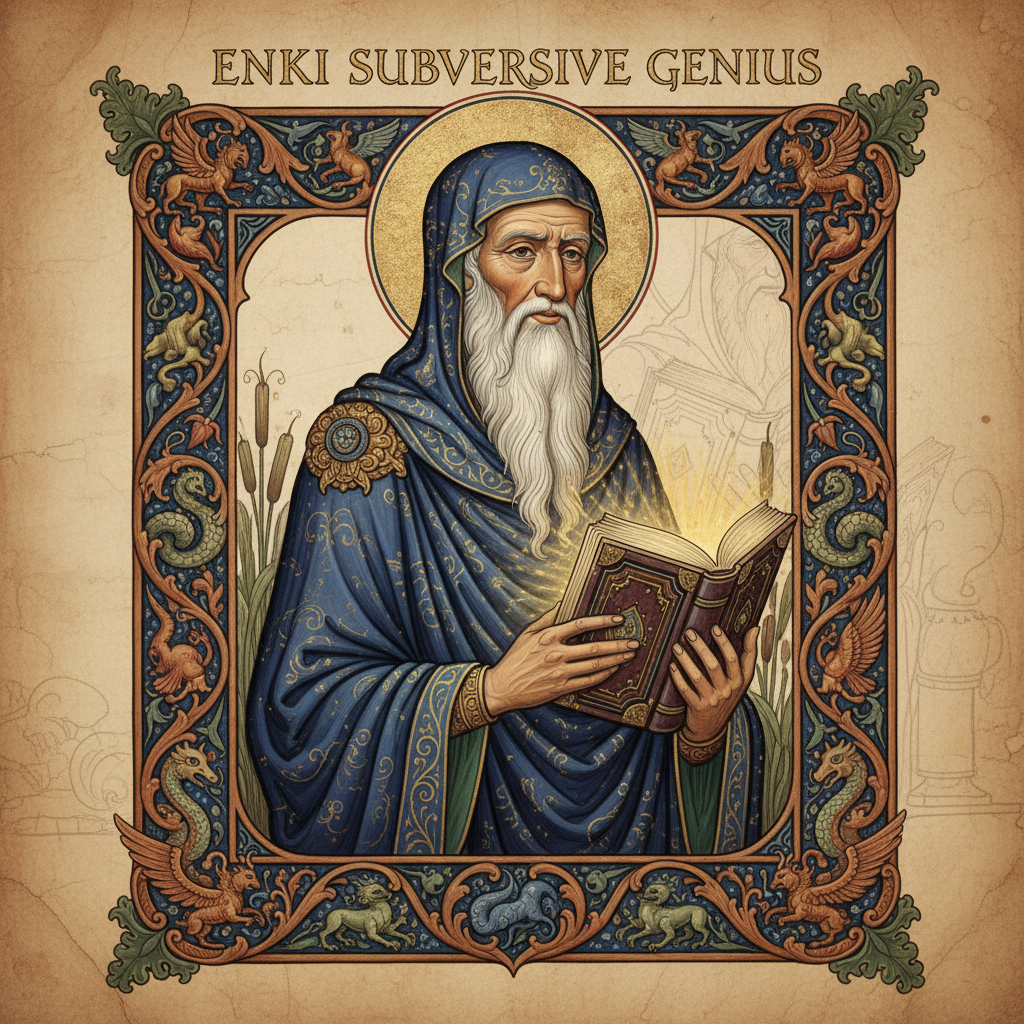
| Tradition | Mesopotamian |
| Their Wisdom | God of wisdom who saved humanity by whispering through a wall. |
| Their Cost | Always undermining the other gods. Wisdom as subversion. |
| Source | Atrahasis, Enuma Elish |
The gods decided to flood the earth because humans were too noisy. Enlil, king of the gods, swore everyone to secrecy. Enki — bound by the oath — technically spoke not to a human but to a reed wall, knowing the human Atrahasis was listening on the other side. The greatest legal loophole in mythology. Enki is the god who invented civilization, gave humans the arts, and repeatedly saved them from the other gods’ genocidal impulses by being cleverer than everyone else. His wisdom isn’t contemplative; it’s subversive. He’s the trickster who happens to be right.
Enki the Mesopotamian god of wisdom kneeling beside a reed wall in moonlight, whispering urgently through the woven reeds, on the other side a terrified human pressing his ear to the wall, cosmic floodwaters gathering in the sky above, cuneiform tablets and flowing fresh water surrounding Enki, his horned crown of divinity, a goatfish at his feet, the other gods sleeping unaware in the background, hyper-realistic dark mythology, dramatic chiaroscuro lighting, volumetric atmospheric fog, cool blue-silver moonlight against warm amber interior, muted earth tones with aquamarine and clay-red accents, cinematic composition, oil painting character rendering, high detail texture, mystical divine aesthetic, 8k --ar 16:9 --s 900 --v 79. Orunmila/Ifa — The Witness of Creation
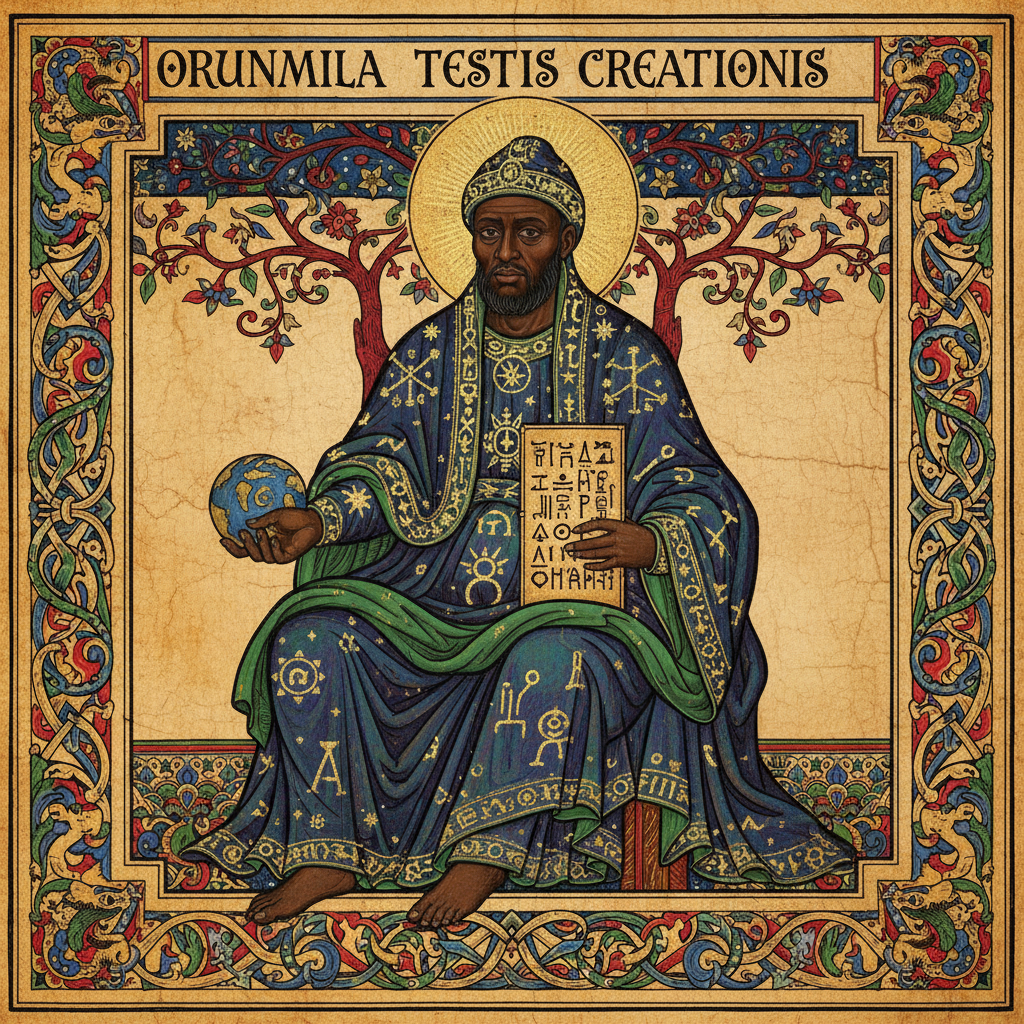
| Tradition | Yoruba |
| Their Wisdom | Witnessed creation. Devised the Ifa divination system. INT 100. |
| Their Cost | Carries the burden of knowing all possible futures. |
| Source | Ifa oral tradition |
Orunmila was present at the creation of every human soul. He watched Olodumare shape each destiny. He knows what will happen to everyone, everything, always. From this impossible knowledge he created the Ifa divination system — 256 odu (signs), each containing thousands of verses, stories, prescriptions, and warnings. Ifa priests spend decades memorizing a system that describes every possible configuration of fate. Orunmila carries the weight of omniscience without the power to override it. He can tell you your fate. He cannot change it.
Orunmila the Yoruba deity of wisdom and divination seated cross-legged on a sacred mat, casting the ikin palm nuts of the Ifa oracle onto a divination board, 256 sacred odu patterns glowing in the air around him like constellations of fate, his eyes seeing all possible futures simultaneously, the moment of creation visible in a swirling cosmic scene behind him, wearing traditional white robes with green and brown beaded necklaces, hyper-realistic dark mythology, dramatic chiaroscuro lighting, volumetric atmospheric fog, warm golden rim lighting against deep indigo background, rich earth tones with emerald green and sacred white accents, cinematic composition, oil painting character rendering, high detail texture, mystical divine aesthetic, 8k --ar 16:9 --s 900 --v 710. Manjushri — The Sword That Cuts Ignorance
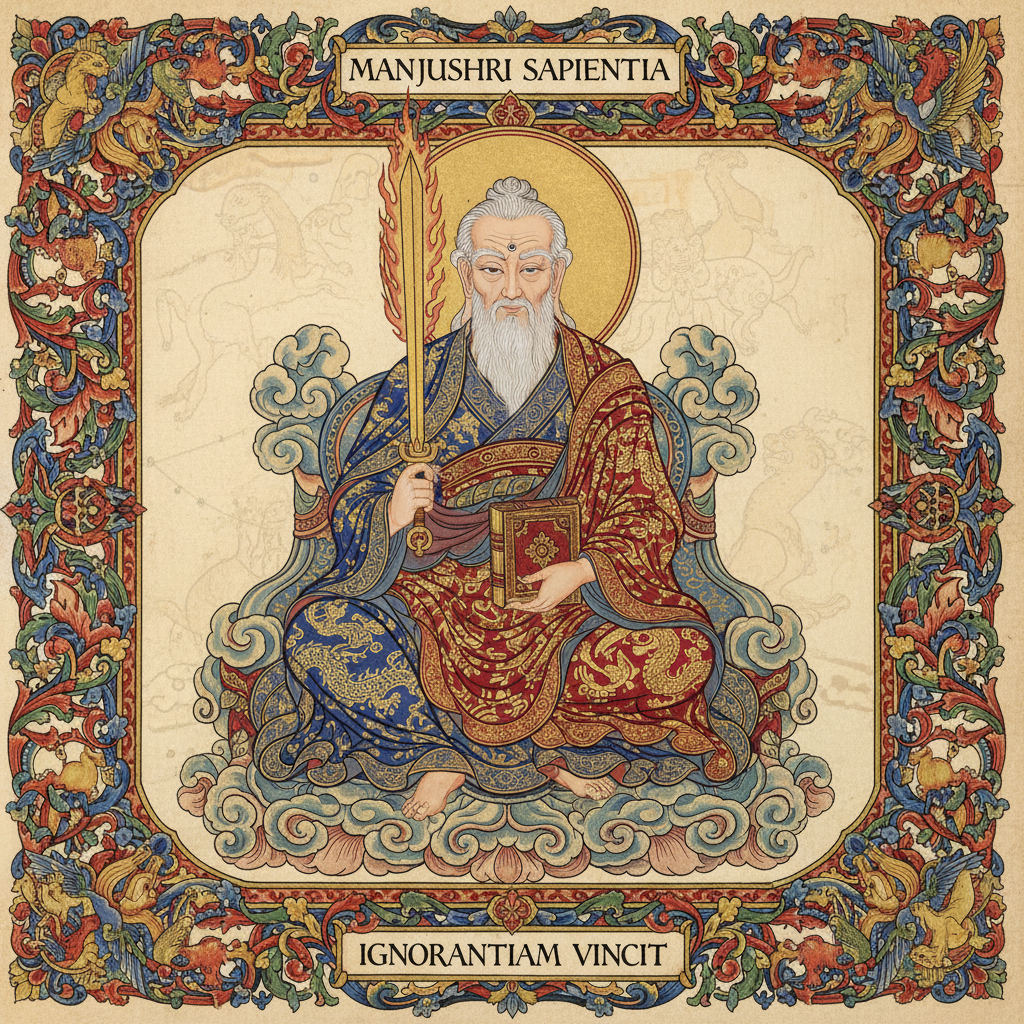
| Tradition | Buddhist |
| Their Wisdom | Bodhisattva of wisdom. Flaming sword cuts through ALL ignorance. |
| Their Cost | Wisdom means seeing the suffering clearly. |
| Source | Prajnaparamita Sutras, various Buddhist texts |
Manjushri carries a flaming sword in one hand and the Prajnaparamita Sutra (the Perfection of Wisdom) in the other. The sword doesn’t kill — it cuts through delusion, through the illusions that keep beings trapped in suffering. But here’s what makes Manjushri tragic: as a bodhisattva, he has achieved the wisdom to see through all suffering. He could leave. He stays. He stays because wisdom without compassion is just another form of ignorance. He sees the suffering of every sentient being with perfect clarity, and he chooses to keep seeing it rather than look away. The sword cuts everything except the pain of watching.
Manjushri the bodhisattva of wisdom seated on a roaring lion, a flaming sword of prajna held high in his right hand cutting through dark clouds of ignorance, the Prajnaparamita Sutra balanced on a lotus in his left hand, youthful face radiating both infinite compassion and terrible clarity, all the suffering of the world visible in his serene eyes, golden skin and flowing celestial robes, hyper-realistic dark mythology, dramatic chiaroscuro lighting, volumetric atmospheric fog, warm saffron-gold rim lighting against deep meditation-blue background, muted earth tones with flame orange and lotus pink accents, cinematic composition, oil painting character rendering, high detail texture, mystical divine aesthetic, 8k --ar 16:9 --s 900 --v 711. Merlin — The Prophet Trapped by Love
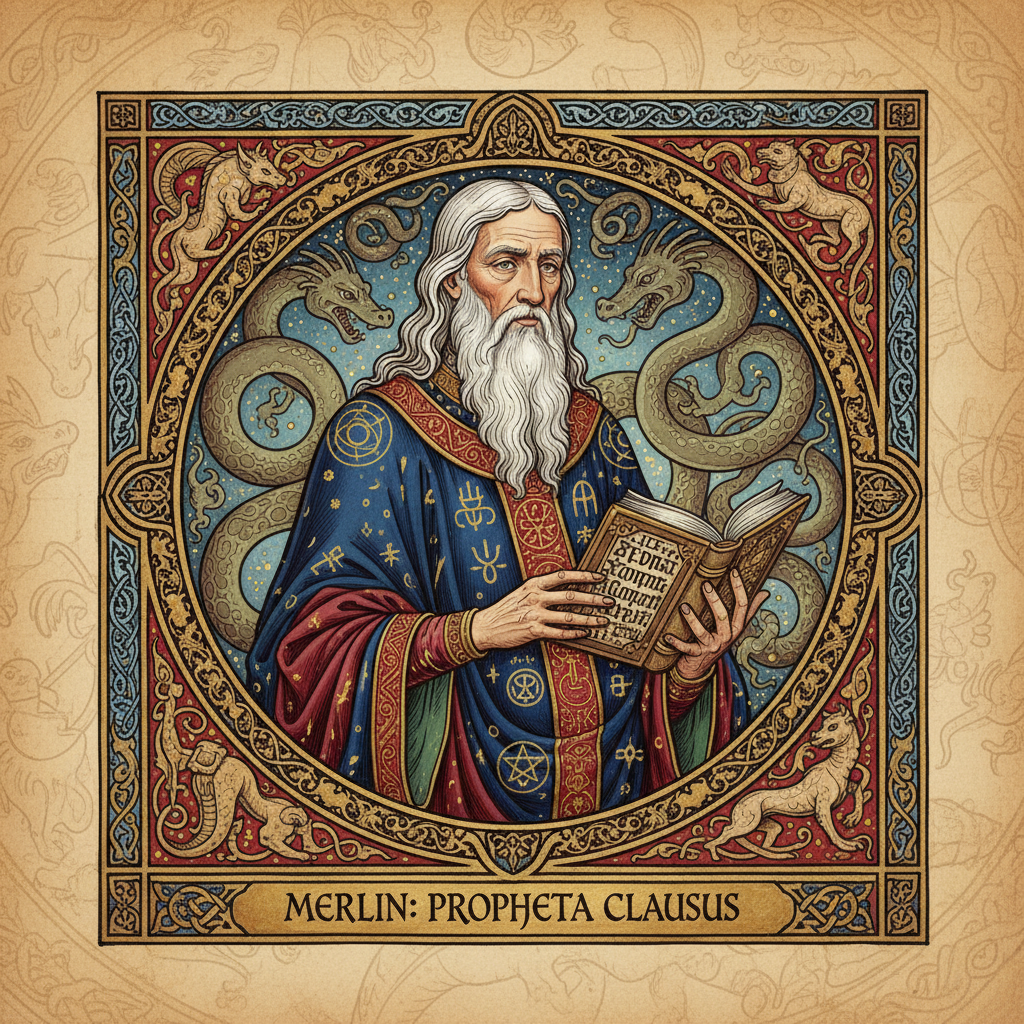
| Tradition | Arthurian |
| Their Wisdom | INT 98. Half-demon prophet who built a kingdom. |
| Their Cost | Imprisoned by a woman. The wisest man trapped by love. |
| Source | Geoffrey of Monmouth, Malory |
Half-demon, half-human. His father was an incubus; his mother was a nun. He should have been evil but was baptized immediately, keeping the demonic powers while losing the demonic allegiance. He could see the future, shapeshift, and manipulate the fabric of reality. He engineered the conception of Arthur, built Camelot, and created the Round Table. Then Nimue (or Viviane) came along. He taught her everything he knew because he loved her. She used his own magic to seal him in a crystal cave (or a tree, or a tower) for eternity. The wisest man in Britain, undone by the one thing wisdom can’t protect against. He saw it coming. He went anyway.
Merlin the wizard half-trapped inside a great crystal cave, his ancient bearded face visible through translucent stone, one hand still reaching out with arcane power while the other is already encased, the beautiful sorceress Nimue walking away with his staff and spell-book, Camelot visible on the distant horizon crumbling without its architect, prophecies and star charts etched into the crystal walls around him, hyper-realistic dark mythology, dramatic chiaroscuro lighting, volumetric atmospheric fog, cool blue-violet crystal light against warm amber distance, muted earth tones with amethyst purple and silver accents, cinematic composition, oil painting character rendering, high detail texture, mystical divine aesthetic, 8k --ar 16:9 --s 900 --v 712. Hildegard of Bingen — The Woman Who Thought Anyway
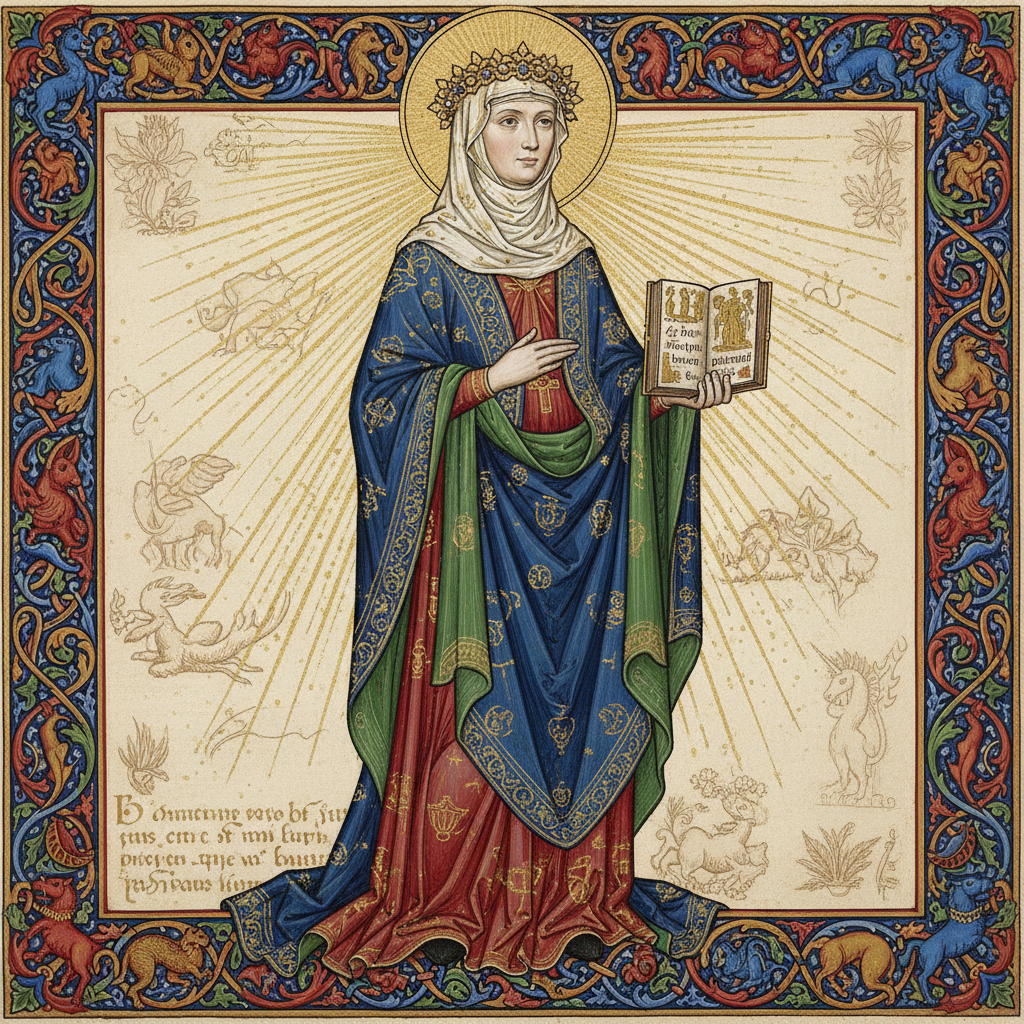
| Tradition | Catholic |
| Their Wisdom | INT 95. Composer, writer, herbalist, mystic, abbess, polymath. 12th century. |
| Their Cost | A woman in a world that didn’t want women to think. |
| Source | Her own works: Scivias, Physica, Causae et Curae |
Born 1098. Hildegard of Bingen was a woman in the 12th century who composed 77 liturgical songs, wrote three major theological works, invented a constructed language, practiced medicine, catalogued hundreds of plants and their medicinal properties, founded two monasteries, went on four preaching tours (as a WOMAN, in the 12th century), corresponded with popes and emperors, and described her mystical visions in such vivid detail that modern neurologists recognize classic migraine aura patterns. She did all of this while the Church officially considered women intellectually inferior. She didn’t argue the point. She just kept producing work they couldn’t ignore.
Hildegard of Bingen the medieval abbess at a vast scriptorium desk surrounded by her works -- illuminated manuscripts of visions, jars of herbs and medicines, musical notation sheets, botanical drawings, letters sealed with wax, a constructed alphabet -- fire-red and gold cosmic visions spiraling above her veiled head, her pen moving with unstoppable determination, 12th century monastery walls trying and failing to contain her genius, hyper-realistic dark mythology, dramatic chiaroscuro lighting, volumetric atmospheric fog, warm candlelight and divine red-gold vision light against cool stone background, muted earth tones with visionary crimson and celestial green accents, cinematic composition, oil painting character rendering, high detail texture, mystical divine aesthetic, 8k --ar 16:9 --s 900 --v 713. Metatron — The Scribe Who Was Mistaken for God
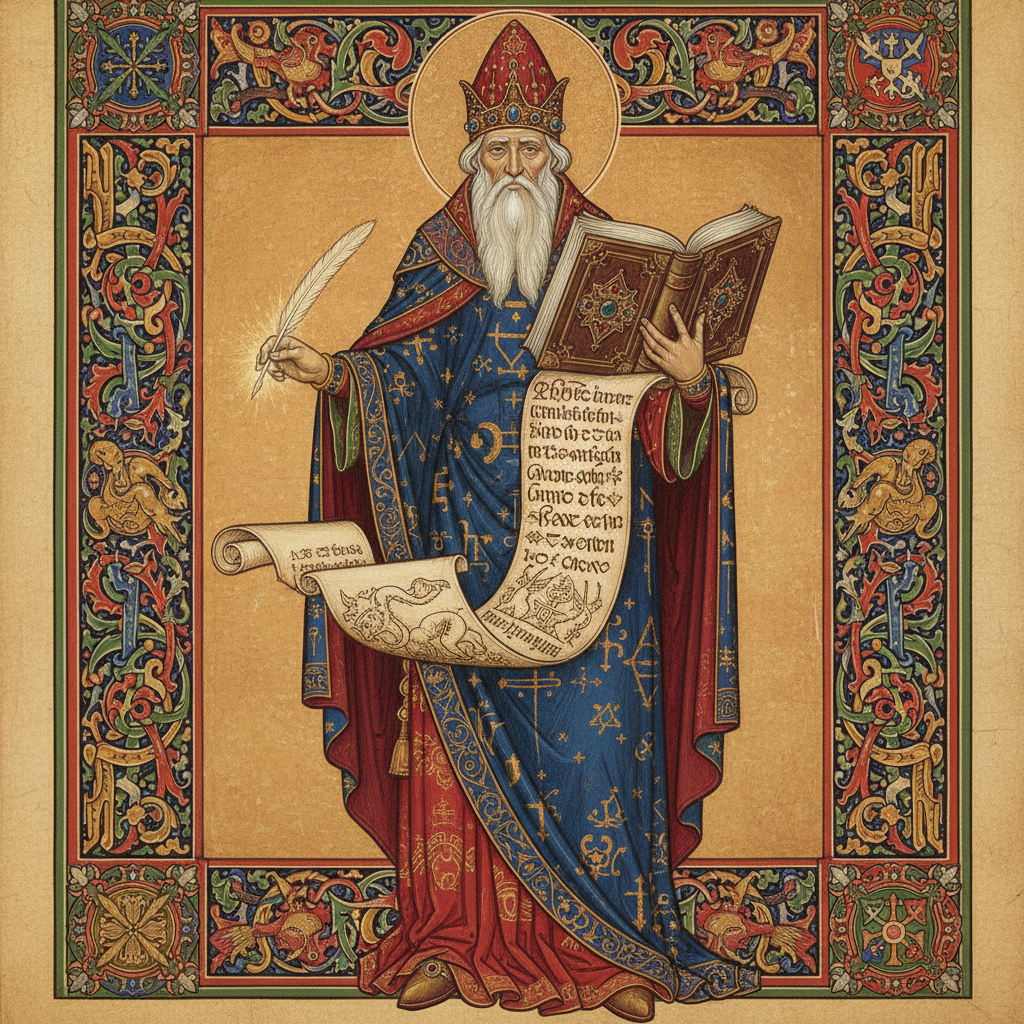
| Tradition | Jewish (Merkabah mysticism) |
| Their Wisdom | INT 100, SPR 100. The heavenly scribe. Records everything God says. |
| Their Cost | So powerful he was mistaken for a second God (the Talmud warns about this). |
| Source | 3 Enoch, Talmud |
Once he was Enoch, a mortal man who “walked with God.” Then God took him. Transformed him into Metatron — the angel with 36 pairs of wings, whose body is covered in eyes and burning letters, who sits on a throne (the only angel permitted to sit in God’s presence), who records every divine utterance, who serves as the voice of God to humanity because God’s actual voice would destroy anyone who heard it. The Talmud (Hagigah 15a) records the heresy of Elisha ben Abuya, who saw Metatron seated in heaven and concluded there must be two powers in heaven. The warning: Metatron is so vast, so luminous, so powerful that he can be confused with God himself. The scribe became indistinguishable from the author.
Metatron the heavenly scribe enthroned in a sea of divine fire, 36 pairs of wings unfolded in every direction, his entire form covered in blazing Hebrew letters and all-seeing eyes, a cosmic scroll unfurling from his hands recording every word God speaks, so radiantly powerful that the boundary between angel and deity dissolves, the cube of Metatron's sacred geometry glowing beneath his throne, lesser angels shielding their eyes, hyper-realistic dark mythology, dramatic chiaroscuro lighting, volumetric divine fire and atmospheric light, blinding white-gold rim lighting against deep cosmic void, pure white and gold tones with electric blue divine fire accents, cinematic composition, oil painting character rendering, high detail texture, mystical divine aesthetic, 8k --ar 16:9 --s 900 --v 714. Imhotep — The Man Who Became a God
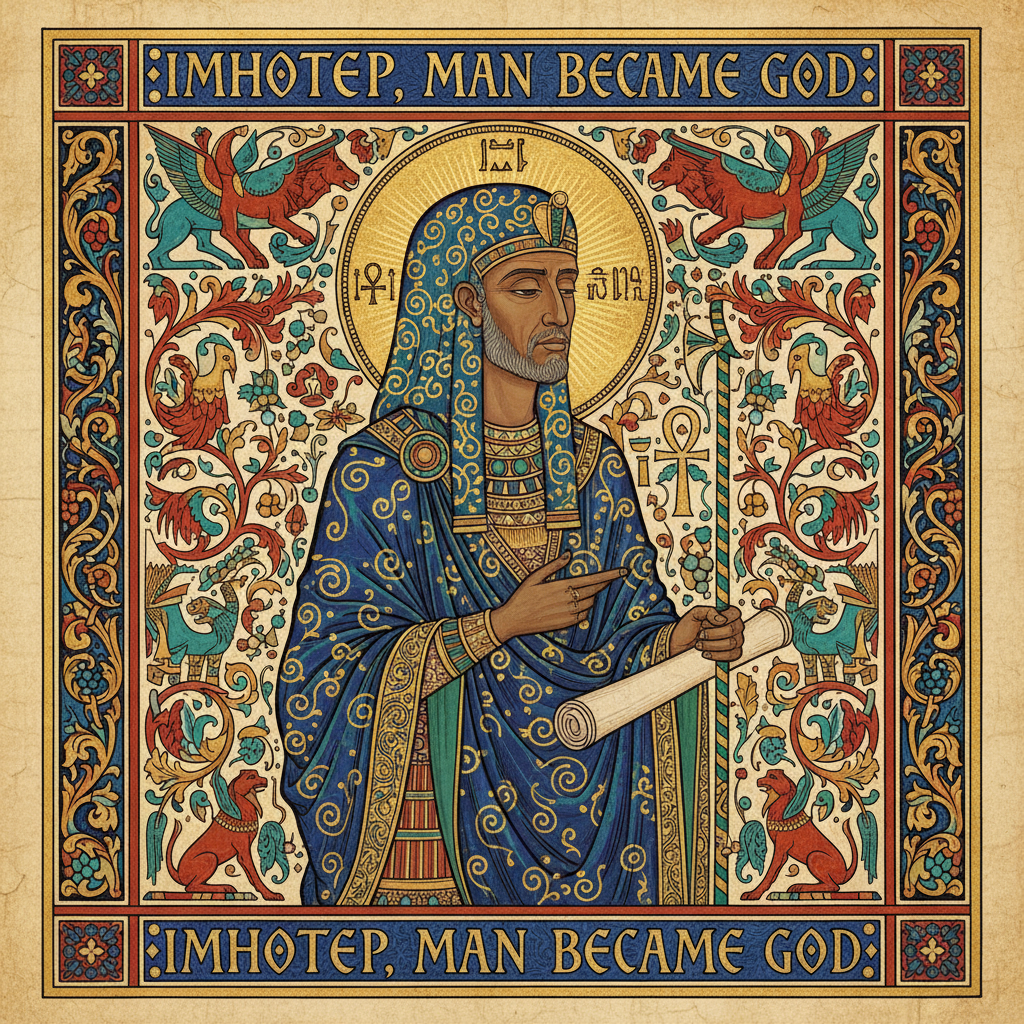
| Tradition | Egyptian |
| Their Wisdom | Historical: architect of the first pyramid, physician, sage. Deified 2,000 years later. |
| Their Cost | The only historical human in Egyptian religion to become a full god. |
| Source | Historical records, Egyptian tradition |
Imhotep was REAL. He lived around 2650 BCE. He designed the Step Pyramid of Djoser — the first monumental stone building in human history. He was chancellor to the pharaoh, a physician, an astronomer, and a writer. Two thousand years after his death, the Egyptians made him a god — the god of medicine and architecture. The Greeks identified him with Asclepius. He is the only confirmed historical person in Egyptian religion to be elevated to full divine status. Not a pharaoh. Not a priest-king. A thinker. A builder. A healer. His mind was so exceptional that 2,000 years wasn’t enough time for people to stop being impressed by it.
Imhotep the historical sage standing before the Step Pyramid of Djoser at dawn, holding architectural plans in one hand and medicinal herbs in the other, wearing the simple white linen of a vizier not a pharaoh, behind him a timeline showing his mortal form gradually transforming across 2000 years into the seated divine figure worshipped in Ptolemaic temples, papyrus scrolls of medical knowledge at his feet, hyper-realistic dark mythology, dramatic chiaroscuro lighting, volumetric desert dawn atmosphere, warm sandstone and amber rim lighting against cool predawn sky, muted earth tones with desert gold and lapis lazuli accents, cinematic composition, oil painting character rendering, high detail texture, mystical divine aesthetic, 8k --ar 16:9 --s 900 --v 715. Confucius — The Teacher Who Thought He Failed
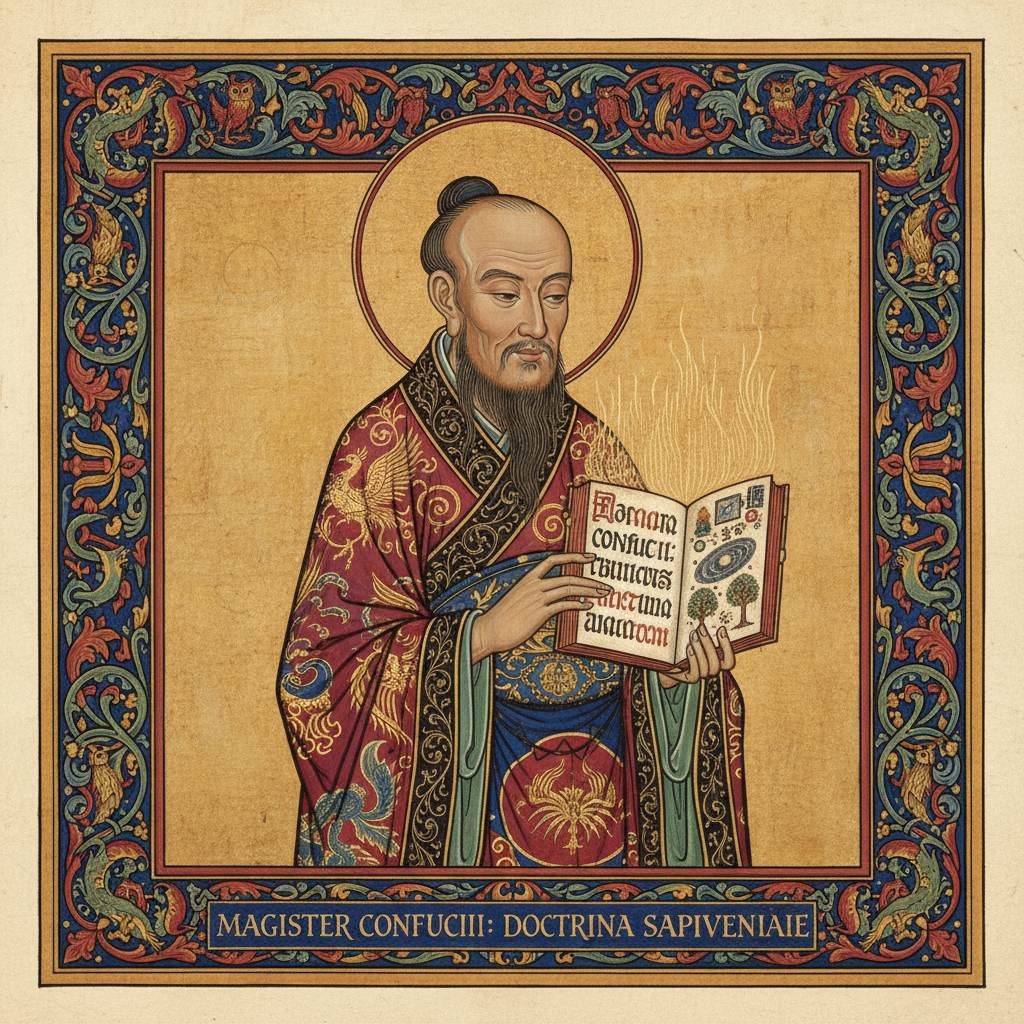
| Tradition | Chinese |
| Their Wisdom | Not a god or sage in the Western sense. A teacher who shaped 2 billion people’s ethics. |
| Their Cost | Died thinking he had failed. His students preserved everything. |
| Source | Analects |
Kong Qiu (Confucius) wandered from state to state for 14 years trying to find a ruler who would implement his ideas about virtue, ritual propriety, and good governance. Nobody listened. He was chased out of multiple kingdoms, nearly starved, and once sat between two crumbling pillars saying: “No intelligent ruler takes me as his master. My time has come to die.” He died in 479 BCE believing he had accomplished nothing. His students wrote down everything he said and created the Analects. His philosophy became the ethical foundation of Chinese, Korean, Japanese, and Vietnamese civilization for 2,500 years. Two billion people’s moral framework was built by a man who died thinking he was a failure.
Confucius the aged teacher seated among crumbling pillars of a ruined state, exhausted from years of wandering, a circle of devoted students around him writing down his every word on bamboo strips though he does not know these words will shape billions of lives, his simple scholar's robes worn and patched from 14 years of travel, dignity and sorrow in his weathered face, the distant future showing vast civilizations built on his teachings but invisible to him, hyper-realistic dark mythology, dramatic chiaroscuro lighting, volumetric atmospheric fog, warm amber lamplight against cool twilight background, muted earth tones with jade green and ink-black accents, cinematic composition, oil painting character rendering, high detail texture, mystical divine aesthetic, 8k --ar 16:9 --s 900 --v 7The Price of Wisdom
EVERY wise figure in every tradition PAYS for their wisdom. This is not coincidence. This is the most consistent theological pattern in comparative religion.
| What They Paid | Who Paid It |
|---|---|
| An eye | Odin |
| Their life’s work felt like straw | Aquinas |
| Their sanity | Various prophets and mystics |
| Their relationships | Athena (never loved), Merlin (imprisoned by love) |
| Their freedom | Merlin (crystal cave), Metatron (eternal servant) |
| Their relevance | Laozi (vanished), Confucius (thought he failed), Saraswati (overlooked) |
| Their humanity | Metatron (transformed beyond recognition), Imhotep (deified after death) |
| Their peace | Orunmila (knows all futures), Manjushri (sees all suffering) |
| Their joy | Solomon (“in much wisdom is much grief”) |
The pattern is absolute: wisdom and happiness are inversely correlated across all traditions. The wisest beings are the most burdened. To see clearly is to suffer clearly. To understand everything is to bear everything. The Tao Te Ching says it plainly: “The sage has no fixed mind; he takes the mind of the people as his mind.” To be wise is to stop being yourself.
Why This Matters
This isn’t pessimism — it’s honest theology. Every tradition independently concluded that knowledge has a cost, that seeing the truth means carrying it, that the examined life is heavier than the unexamined one. The wise ones aren’t cautionary tales. They’re the proof that understanding was never supposed to be comfortable.
Odin gave an eye and got the runes. Aquinas gave his pen and got a glimpse of God. Solomon gave his heart and got Ecclesiastes. Confucius gave his life and got the Analects (posthumously). Manjushri gave his freedom and got the flaming sword.
The exchange rate is always the same: everything you have, for everything you can see.