Part of the Bestiary Compendium
Every tradition keeps these stories. The ones where the smallest won. Where the weakest, the most overlooked, the most unlikely defeated the seemingly invincible. These are not tales of luck — they are the universe’s statement that power calculates wrong. The strong count armies. The weak find the loophole.
The Underdog Victories — When the Weakest Won
| Victor | Defeated | How | Why It Worked | Tradition |
|---|---|---|---|---|
| David (boy, sling) | Goliath (9ft, bronze armor) | One stone to the forehead | Precision beats power | Biblical |
| Jael (tent-dwelling woman) | Sisera (general with 900 iron chariots) | Tent peg through the skull while sleeping | Hospitality as weapon | Biblical |
| Judith (widow) | Holofernes (Assyrian general) | Seduced him, got him drunk, beheaded him | Beauty and courage combined | Deuterocanonical |
| Gideon’s 300 (farmers) | 135,000 Midianites | Torches and trumpets at night | God’s strategy: fewer is better | Biblical |
| Durga (created for the purpose) | Mahishasura (invincible to males) | Created female because the boon had a loophole | The loophole is always the weakness | Hindu |
| Narasimha (man-lion, twilight, threshold) | Hiranyakashipu (invincible by any known category) | Exploited EVERY condition of the boon simultaneously | Divine creativity vs mortal legalism | Hindu |
| Odysseus (mortal king) | Polyphemus (giant cyclops, son of Poseidon) | Blinded him, escaped under sheep, said his name was “Nobody” | Wit beats strength | Greek |
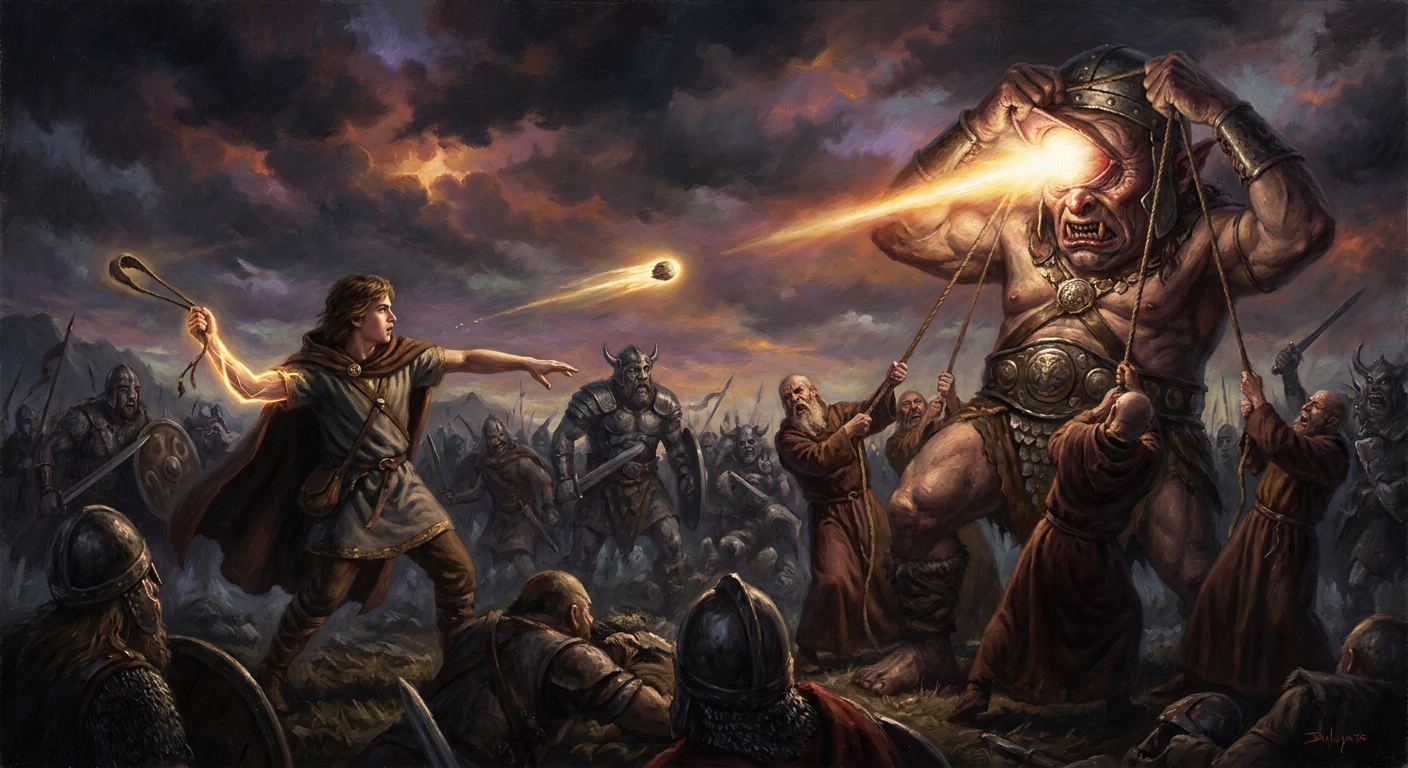
| Lugh (young god with a sling) | Balor (evil eye destroys everything) | Sling stone through the evil eye | The prophecy: grandson kills grandfather | Celtic |
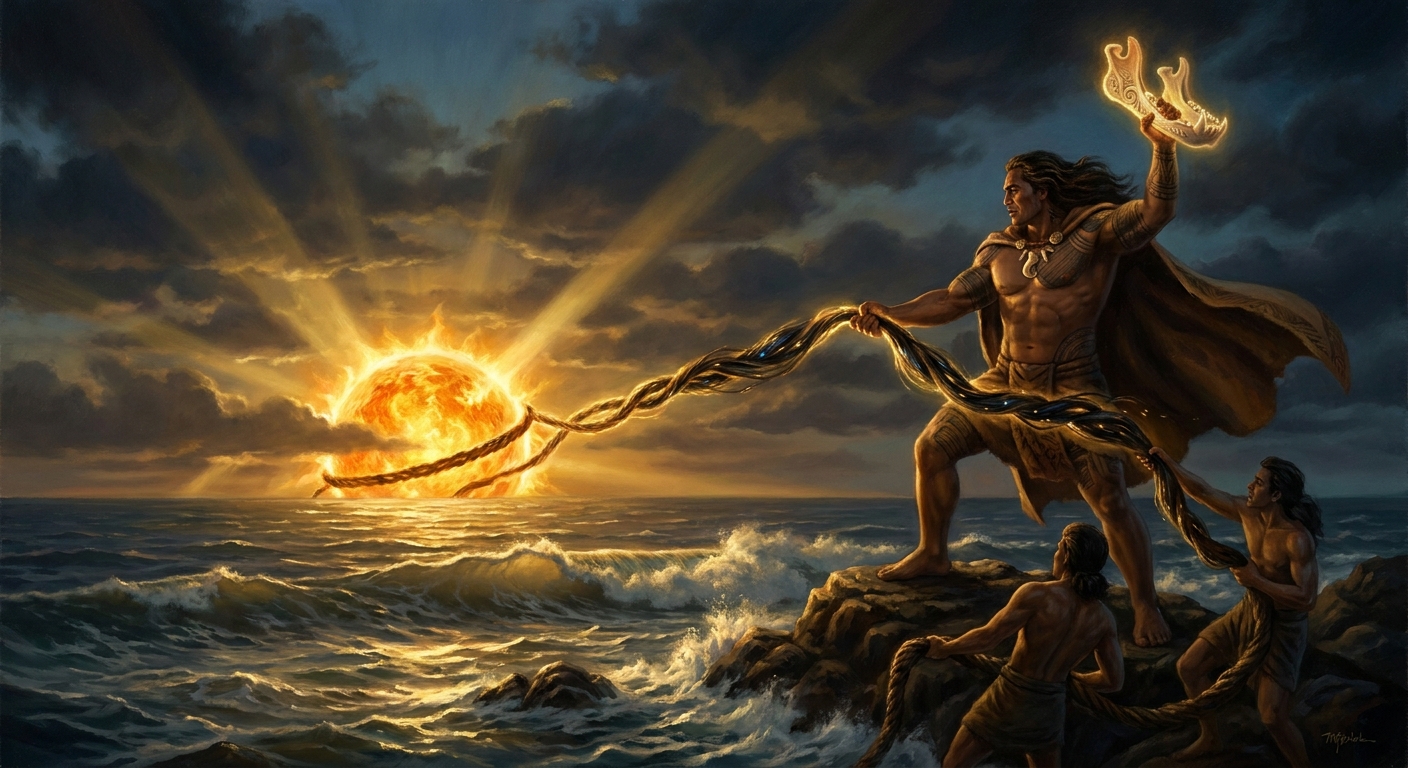
| Maui (demigod trickster) | Te Ra (THE SUN) | Lassoed it and beat it with a jawbone | Audacity beyond reason | Polynesian |
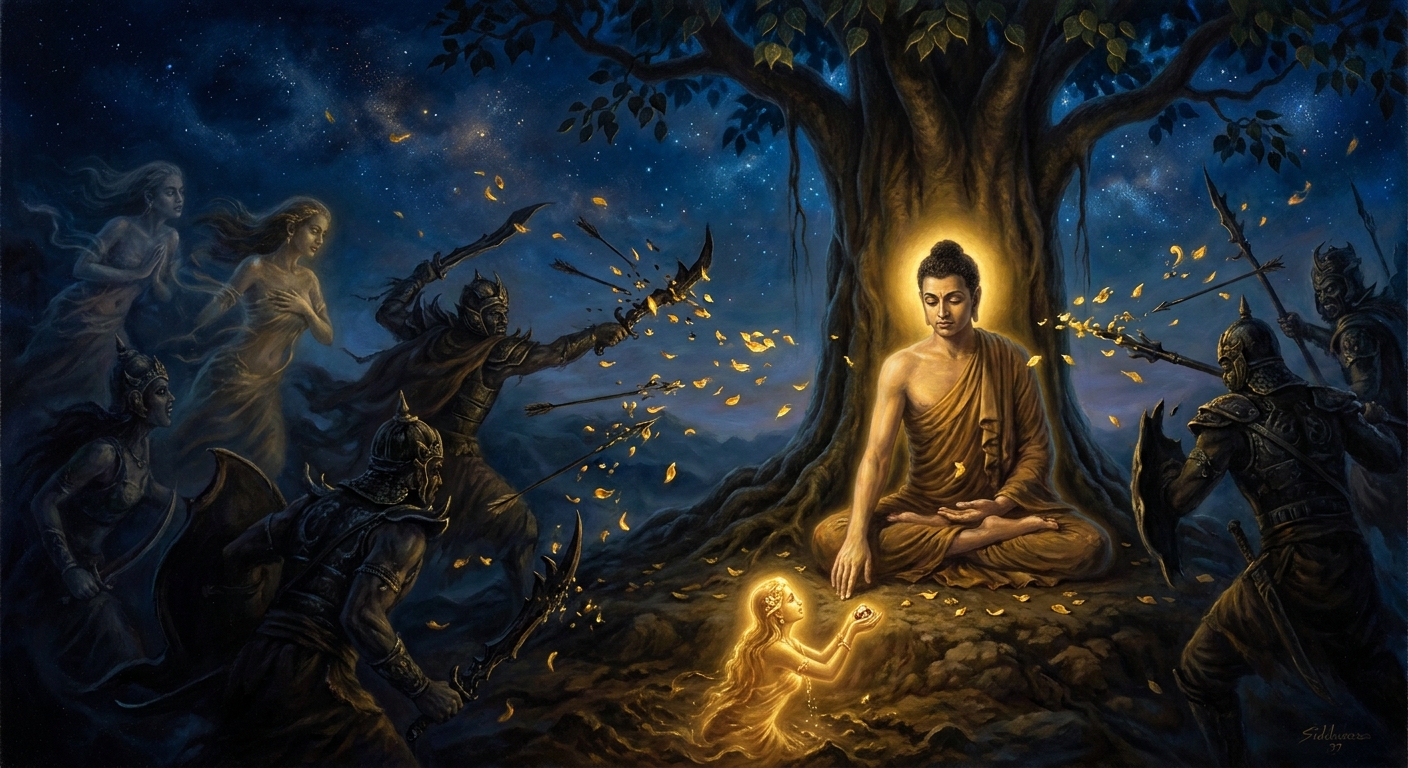
| The Buddha (sitting still) | Mara (armies, seduction, doubt, cosmic power) | Touched the earth. Didn’t move. | Non-action defeats all action | Buddhist |
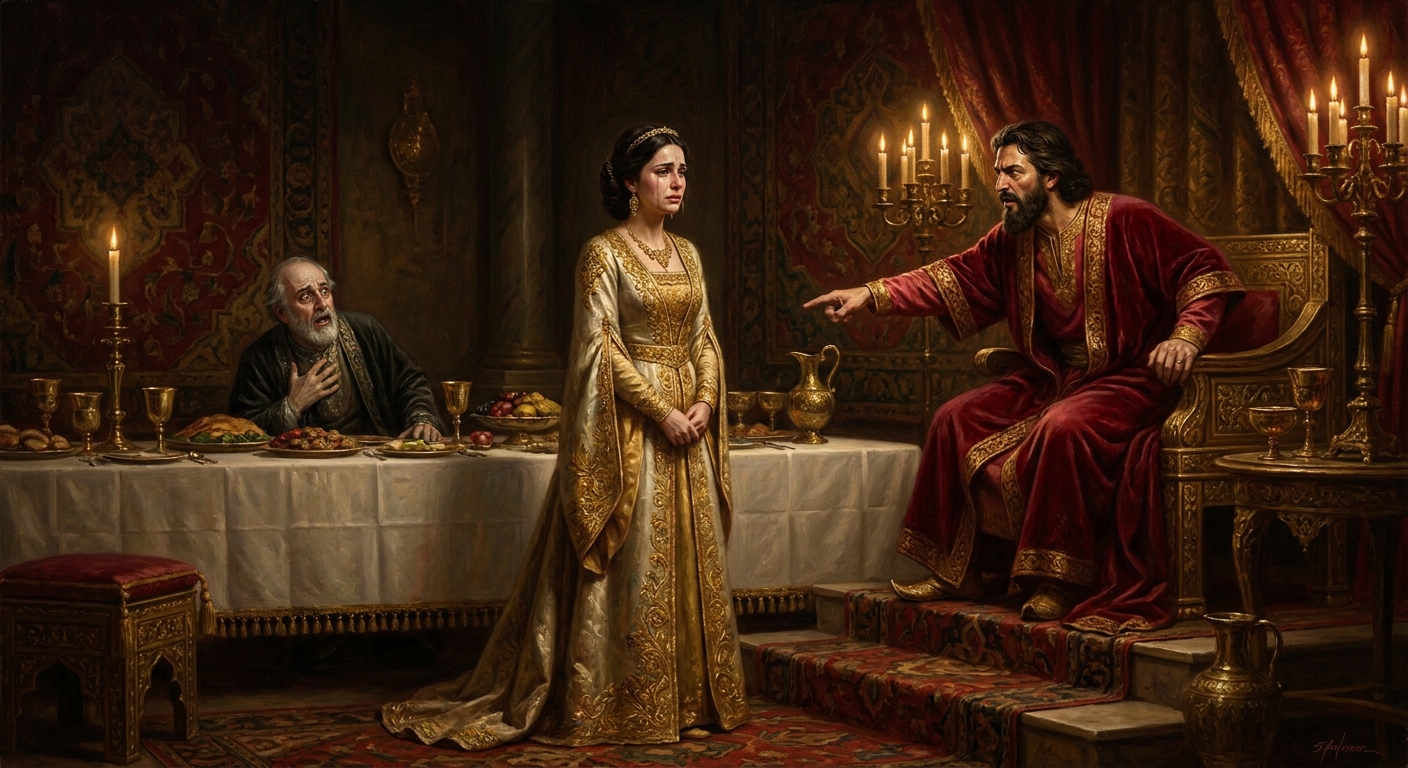
| Esther (orphan queen) | Haman (vizier planning genocide) | Revealed the plot at a dinner party | Timing and courage | Biblical |
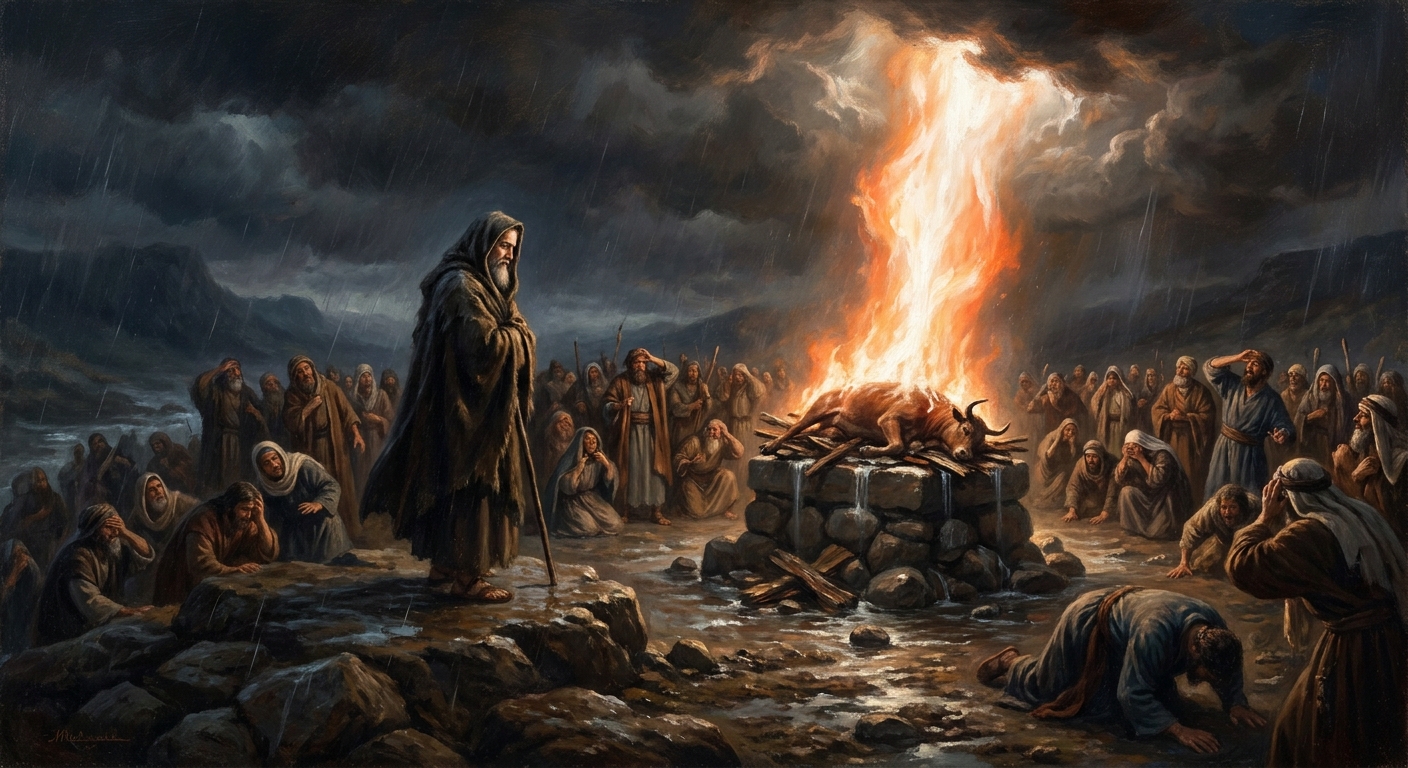
| Elijah (one man) | 450 prophets of Baal | Called fire from heaven after they failed all day | ”Maybe your god is sleeping” — the greatest trash talk | Biblical |
The Victories
1. David vs Goliath — Precision Beats Power
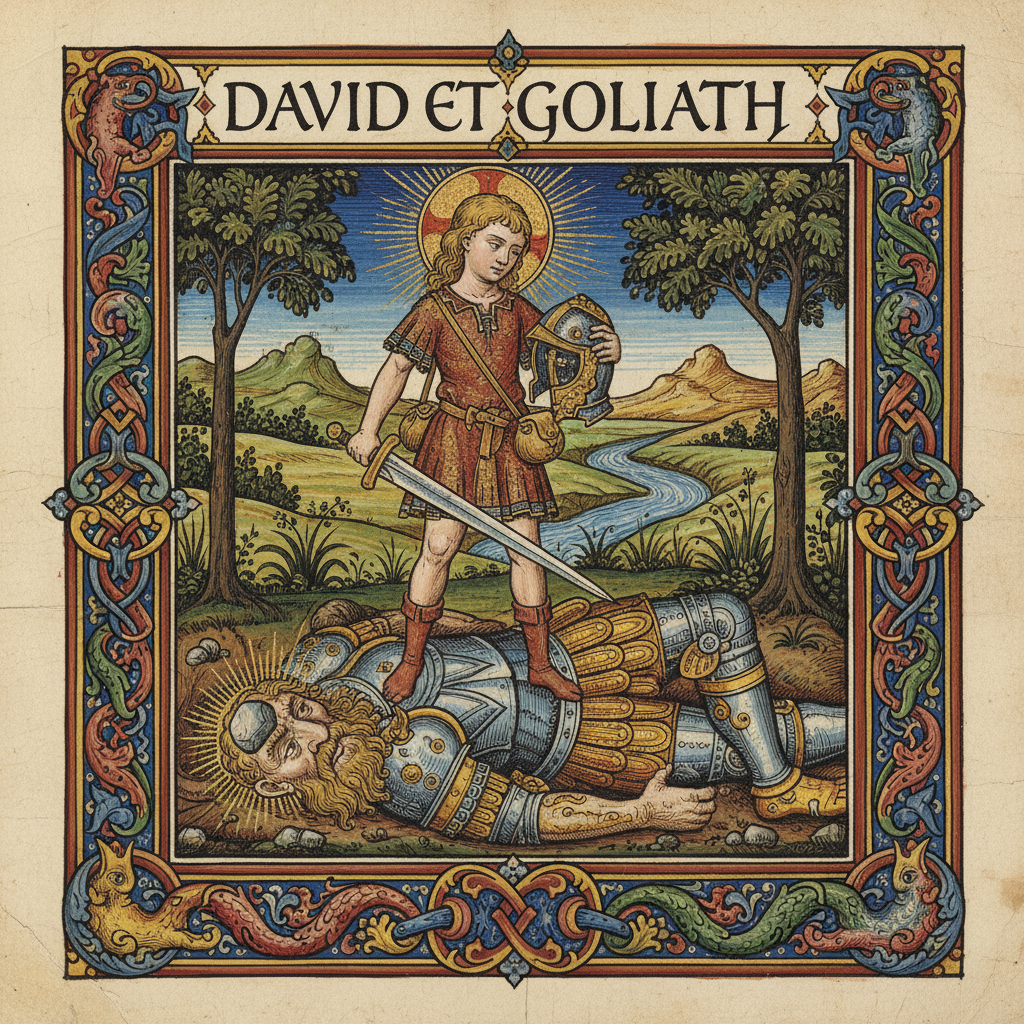
| Victor | David (shepherd boy, sling) |
| Defeated | Goliath (9 feet tall, bronze armor, 40 days undefeated) |
| How | One stone to the forehead |
| Why It Worked | Precision beats power |
| Tradition | Biblical |
The entire Israelite army was paralyzed with fear. Every trained soldier, every experienced warrior stood frozen while Goliath shouted his daily challenge. Then a teenager showed up with lunch for his brothers and got annoyed. David declined Saul’s armor because he’d never tested it — he went with what he knew. Five smooth stones from a brook. He needed one.
The genius of the sling: Goliath’s armor covered everything except his forehead. David didn’t aim at the weak point out of desperation. He aimed at it because a shepherd who survived lions and bears understands that precision is a weapon. Goliath had nine feet of muscle that had never learned to dodge a stone, because nothing had ever survived long enough to try.
Young David with a sling releasing a stone at nine-foot Goliath in full bronze armor, the stone embedded in Goliath's forehead as he begins to fall forward, two massive armies watching in frozen shock on opposite hillsides, the impossible moment of the underdog victory, hyper-realistic dark mythology, dramatic chiaroscuro lighting, the small defeating the great, warm golden rim lighting against dusty battlefield, muted earth tones with bronze and crimson accents, cinematic composition, oil painting rendering, 8k2. Jael vs Sisera — Hospitality as Weapon
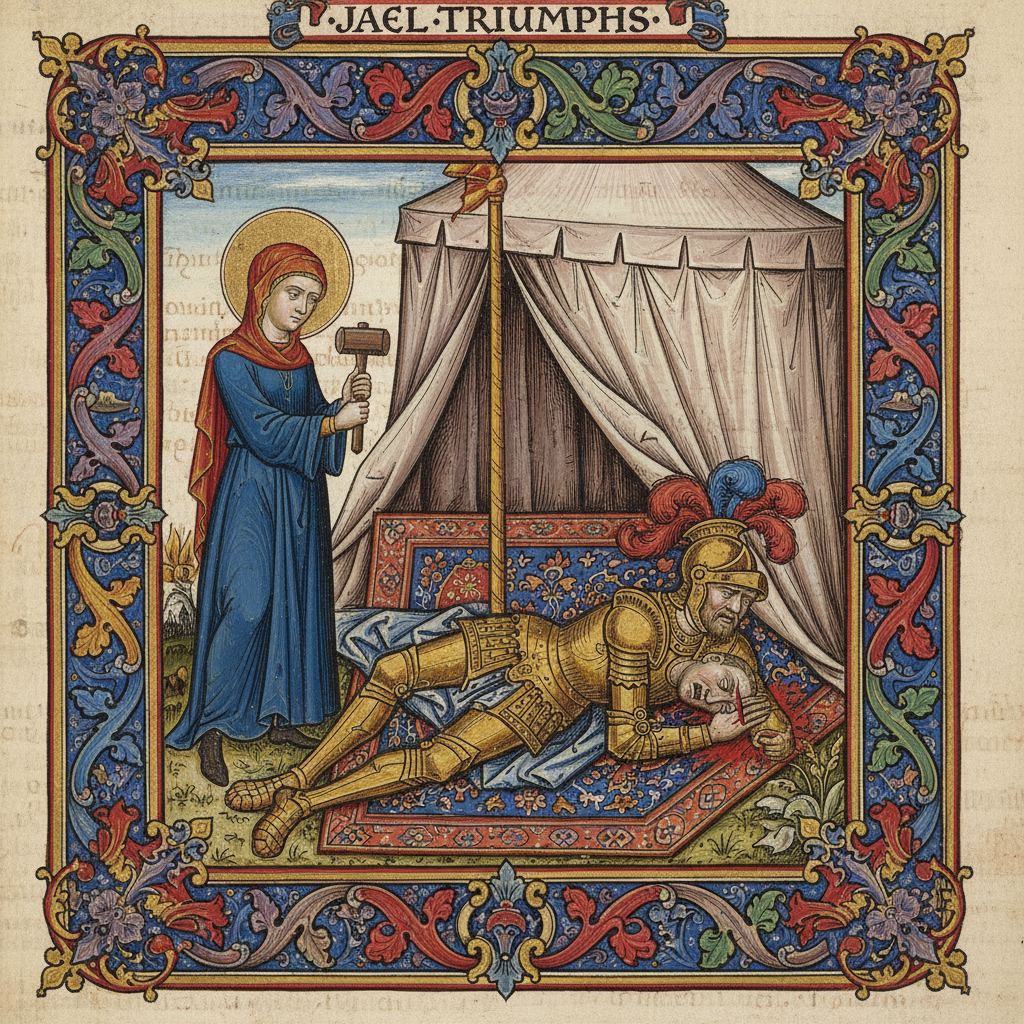
| Victor | Jael (tent-dwelling woman, wife of Heber the Kenite) |
| Defeated | Sisera (general commanding 900 iron chariots) |
| How | Tent peg through the skull while sleeping |
| Why It Worked | He trusted hospitality. She knew he would. |
| Tradition | Biblical |
Sisera’s army had 900 iron chariots. He was the most technologically advanced military commander in the region. When the battle turned against him, he fled on foot and sought sanctuary in the tent of Jael, a woman whose tribe had a peace treaty with his king. She welcomed him. She covered him with a blanket. She gave him milk when he asked for water, extra warmth and comfort. He slept.
Then she drove a tent peg through his temple with a mallet. The Song of Deborah calls her “most blessed of women.” The greatest military commander of his era was killed by someone whose only weapon was what she had in her hands — and the understanding that a man who thinks he’s safe is the most vulnerable man alive.
Jael standing over the sleeping Canaanite general Sisera in a tent, driving a tent peg through his temple with a wooden mallet, her face calm and determined, the general's iron chariot army visible in chaos outside, the moment of the impossible assassination, hyper-realistic dark mythology, dramatic chiaroscuro lamplight inside tent, the weak defeating the mighty, deep shadow with warm amber candlelight, cinematic composition, oil painting rendering, 8k3. Judith vs Holofernes — Beauty and Courage Combined
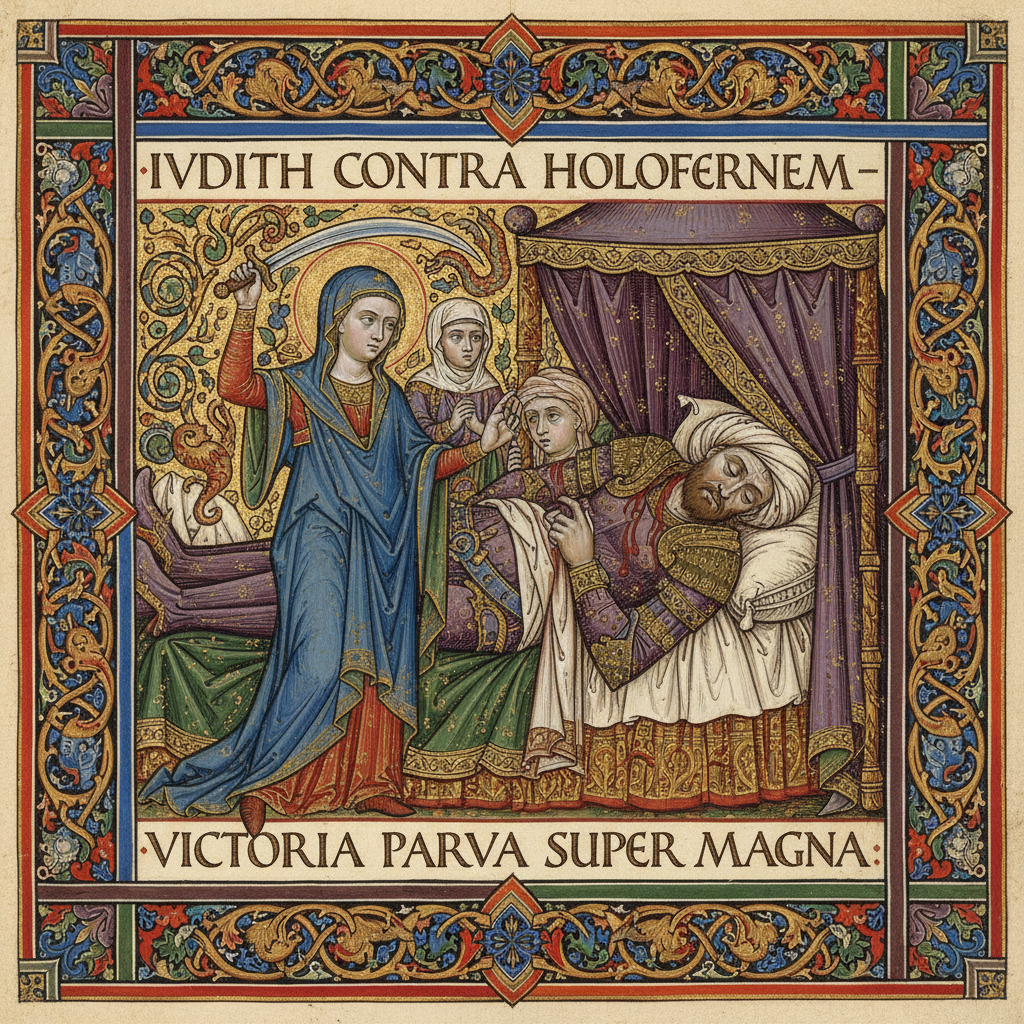
| Victor | Judith (widow, pious, alone) |
| Defeated | Holofernes (general of the Assyrian Empire, sieging her city) |
| How | Seduced him, got him drunk, beheaded him with his own sword |
| Why It Worked | He never imagined a woman walking into his camp was the weapon |
| Tradition | Deuterocanonical (Book of Judith) |
Bethulia was about to surrender. The city elders had given God five days to respond before they would capitulate to the Assyrian siege. On day four, a widow dressed herself in her finest clothes and walked into the enemy camp with her maidservant and a bag.
She told Holofernes she was fleeing her city and would lead him to victory. He believed her because she was beautiful and the idea that she could be the danger never occurred to him. Four days of access. One night of wine. Then she prayed, took his sword from where it hung above his bed, grabbed his hair in both hands, and struck twice. She carried the head back in her bag. Bethulia held.
Judith the Hebrew widow standing in the tent of the Assyrian general Holofernes, holding his severed head by the hair in one hand and his sword in the other, her fine robes spattered with blood, her maidservant holding the bag, her expression not triumph but grim resolve, the impossible courage of one woman defeating an empire, hyper-realistic dark mythology, dramatic chiaroscuro tent lighting, oil painting rendering, cinematic composition, 8k4. Gideon’s 300 vs 135,000 — God Says “Too Many”
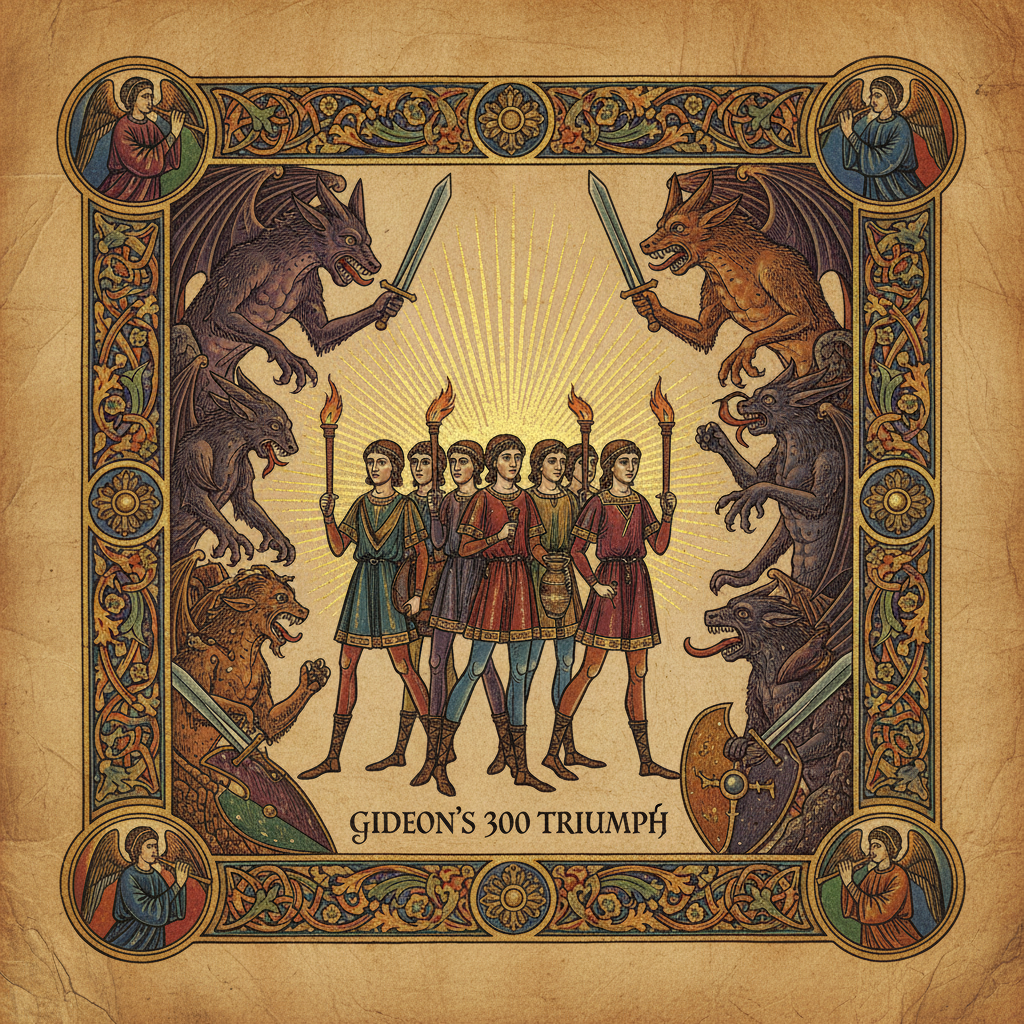
| Victor | Gideon’s 300 (farmers, torches, trumpets) |
| Defeated | 135,000 Midianites (the “camel army” that devastated Israel for 7 years) |
| How | Surrounded the camp at night, broke the jars, blew the trumpets, raised the torches |
| Why It Worked | God’s strategy: fewer soldiers means the miracle is undeniable |
| Tradition | Biblical |
Gideon started with 32,000 volunteers. God told him: too many. Send home anyone who’s afraid. 22,000 left. God said: still too many. Take them to water; keep only the ones who drink while watching, not with their faces down. 300 remained. God said: perfect.
The military strategy was pure psychological warfare: 300 men surrounded the vast sleeping Midianite camp at three points. On signal, they all shattered clay jars simultaneously — revealing torches hidden inside — blew rams’ horns, and shouted “A sword for the LORD and for Gideon!” The Midianites woke in the dark, saw fire everywhere, heard the roar, and assumed they were already surrounded by a massive army. They attacked each other in the confusion. The 300 never had to fight.
Gideon's 300 warriors surrounding a vast Midianite camp at night, breaking clay jars to reveal blazing torches, blowing rams' horns, raising their weapons, 135000 enemy soldiers in chaos and confusion fighting each other in the darkness, fire and sound as weapons instead of swords, the divine strategy of impossible odds, hyper-realistic dark mythology, dramatic chiaroscuro firelight, torches illuminating the night, cinematic composition, oil painting rendering, 8k5. Durga vs Mahishasura — The Loophole Is the Weakness
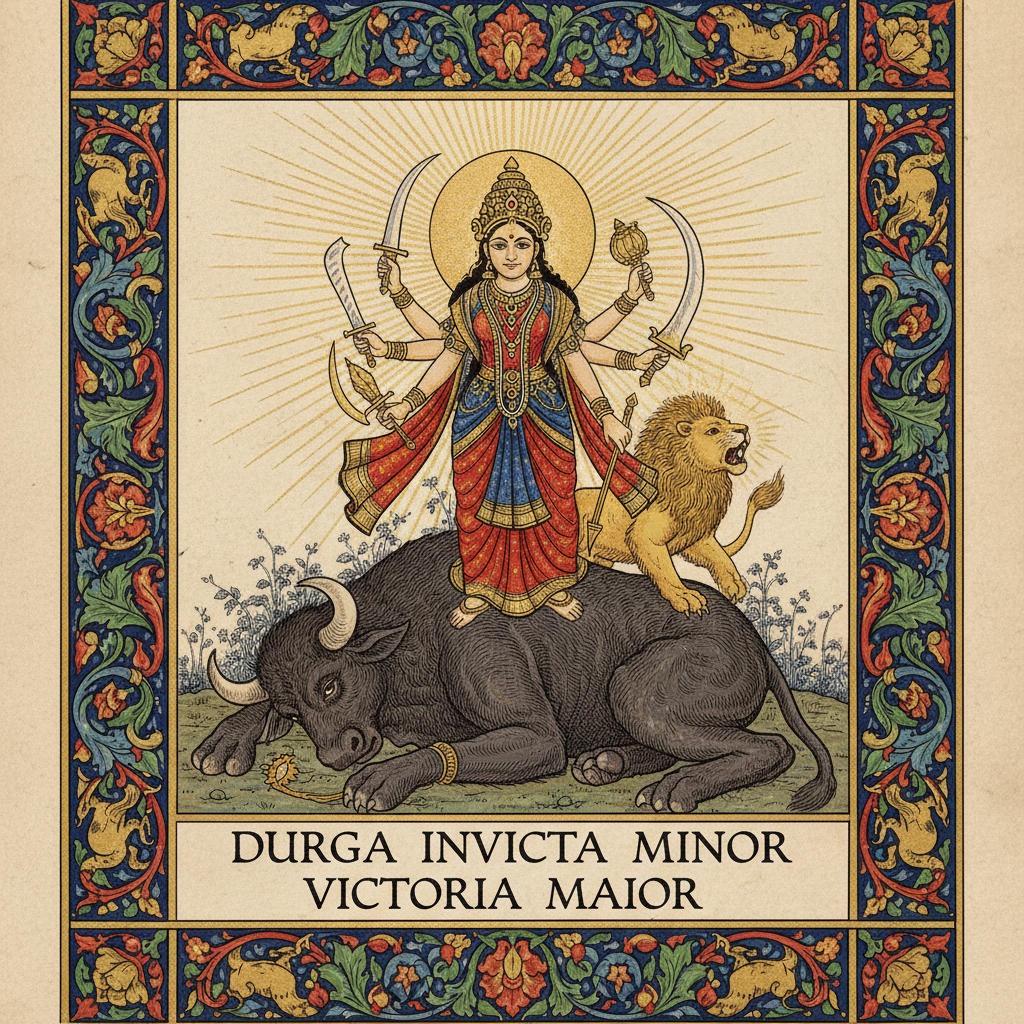
| Victor | Durga (goddess created specifically for this purpose) |
| Defeated | Mahishasura (buffalo demon, invincible to all males) |
| How | The gods created a female deity because his invincibility boon had a loophole |
| Why It Worked | The loophole is always the weakness |
| Tradition | Hindu |
Mahishasura performed such intense austerities that Brahma granted him a boon. He asked for invincibility against all males — gods, demons, mortals. Brahma agreed. Mahishasura then conquered the three worlds, expelled the gods from heaven, and ruled with total impunity.
The gods gathered their divine energies together — all their power, combined — and from that combined light, Durga was born. Armed with weapons from each god, riding a lion, with eighteen arms, she met the demon in battle. He transformed repeatedly: buffalo, lion, man, elephant. She met each form, pinned him with her lion, and drove her trident through his chest. The invincibility was real and total — except for the category he forgot to include. The most powerful beings learn to specify correctly. Mahishasura didn’t.
Durga the goddess with eighteen arms riding a great lion in fierce battle against Mahishasura the buffalo demon, her weapons glowing with divine light, the demon transforming between forms -- buffalo, lion, man -- as she drives her trident into his chest, the armies of gods watching from above, the impossible female warrior defeating the invincible demon, hyper-realistic dark mythology, dramatic chiaroscuro lighting, saturated divine gold and crimson, cinematic composition, oil painting rendering, 8k6. Narasimha vs Hiranyakashipu — Divine Creativity vs Mortal Legalism
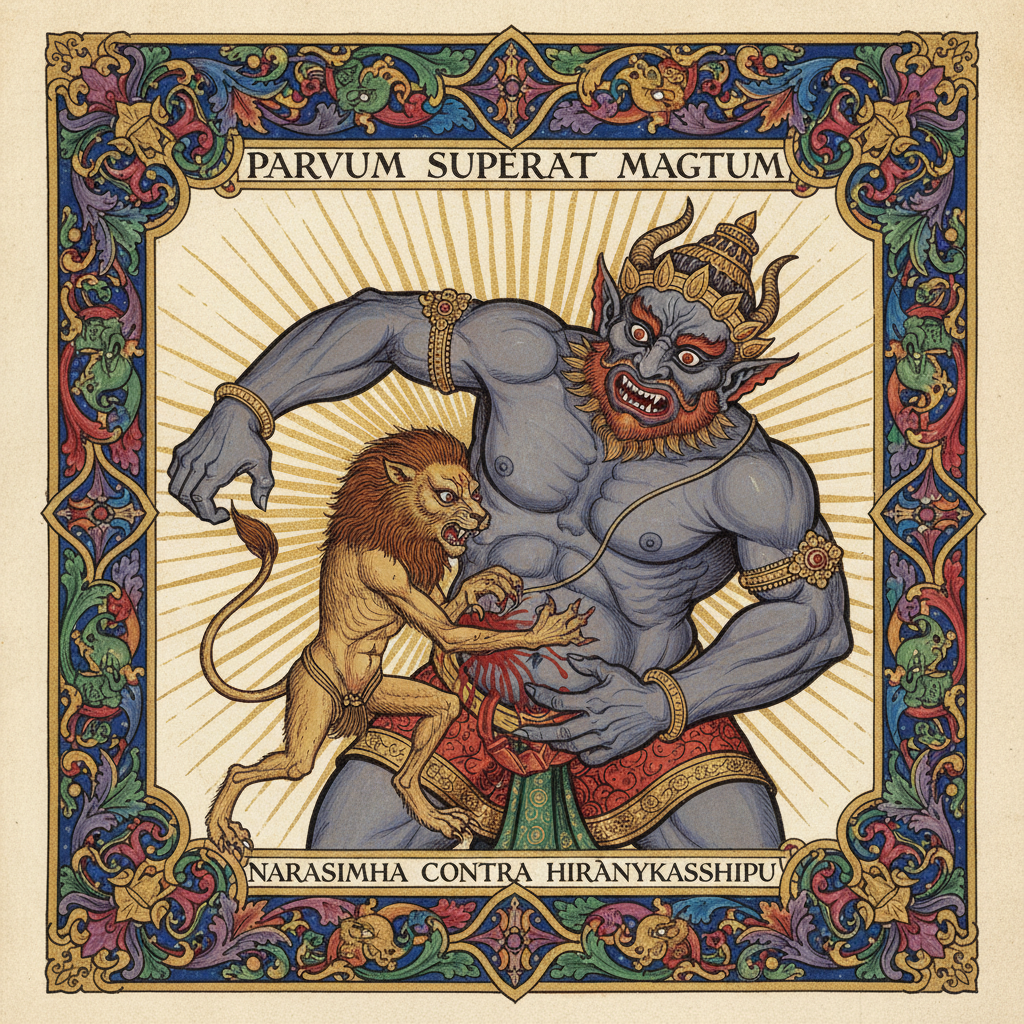
| Victor | Narasimha (the man-lion avatar of Vishnu) |
| Defeated | Hiranyakashipu (demon king with the most ironclad invincibility boon ever) |
| How | Exploited every single condition of the boon simultaneously |
| Why It Worked | Divine creativity finds the gap that mortal legalism cannot see |
| Tradition | Hindu |
Hiranyakashipu’s boon from Brahma was the most comprehensive attempt at invincibility in recorded mythology. He could not be killed: by man or beast, by god or demon, by any weapon, indoors or outdoors, by day or night, on earth or in heaven, from above or from below.
When Vishnu manifested as Narasimha — half-man, half-lion — he carried Hiranyakashipu to the threshold of the palace (neither inside nor outside), placed him across his own thighs (neither on earth nor in heaven, neither above nor below), at twilight (neither day nor night), and tore him open with his claws (neither a weapon nor not). Every condition was fulfilled. Every loophole was closed — by being all of them at once. The demon’s boon was not defeated. It was simply outthought.
Narasimha the man-lion avatar of Vishnu -- torso of a lion, body of a man -- holding the demon king Hiranyakashipu across his thighs at the threshold of a palace pillar at twilight, tearing him open with divine claws, the demon's face showing the realization that his perfect boon has been outthought, neither inside nor outside, neither day nor night, on no ground and no sky, hyper-realistic dark mythology, dramatic chiaroscuro twilight lighting, divine gold and deep crimson, cinematic composition, oil painting rendering, 8k7. Odysseus vs Polyphemus — Wit Beats Strength
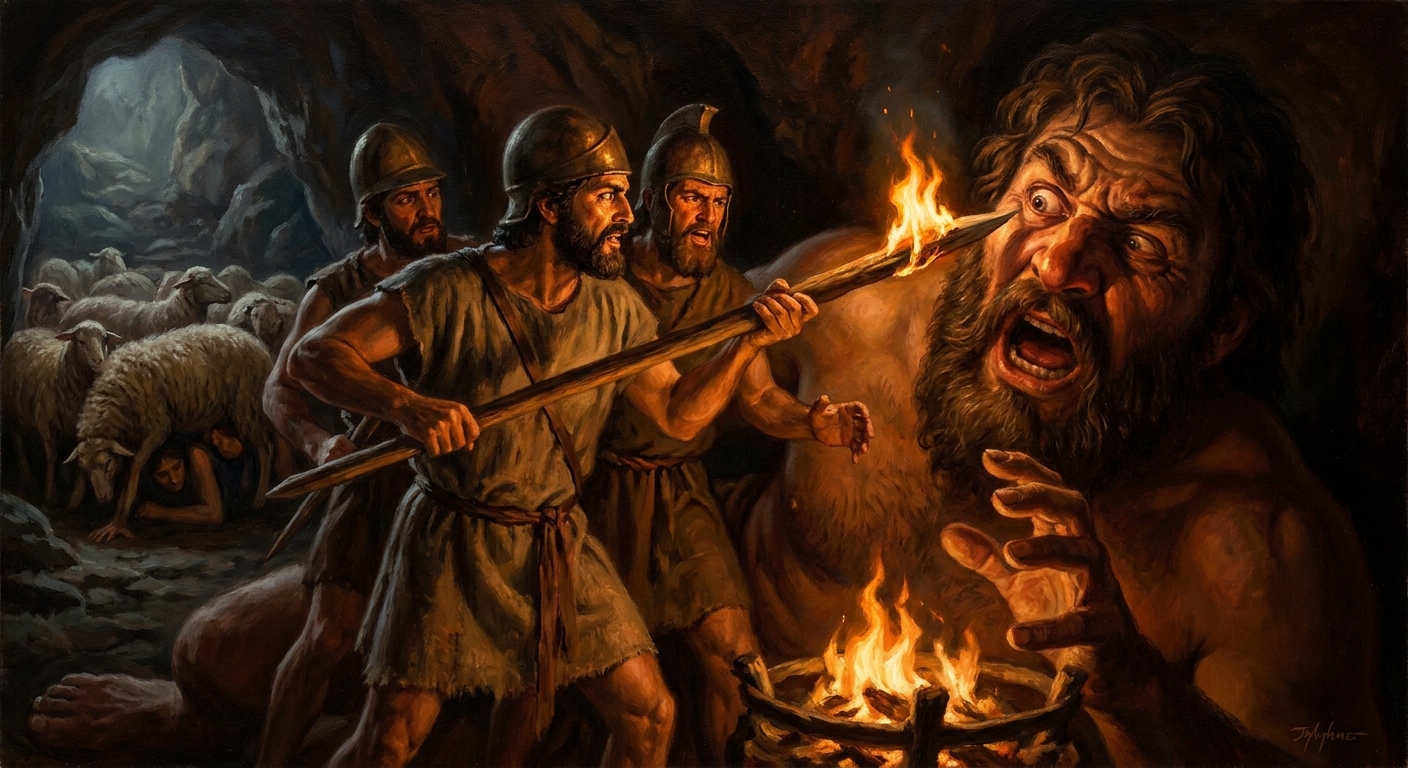
| Victor | Odysseus (mortal king, no weapons, trapped in a cave) |
| Defeated | Polyphemus (son of Poseidon, cyclops, had already eaten several crew members) |
| How | Got him drunk, blinded him with a sharpened stake, escaped under the sheep |
| Why It Worked | Wit beats strength — and “Nobody” beats a name |
| Tradition | Greek |
They were trapped. The cyclops had rolled a stone over the cave entrance that twenty men couldn’t move. He ate two crew members for breakfast. Odysseus’s plan: find a large olive-wood stake, sharpen it, hide it under the dung. Get Polyphemus drunk on the wine Odysseus happened to bring — wine so strong it needed mixing twenty-to-one with water.
When the cyclops asked his name, Odysseus said: “My name is Nobody.” Then, while Polyphemus was drunk and lying down, Odysseus drove the burning stake into his eye. The cyclops screamed. The neighboring cyclopes called out: “Who’s hurting you?” He answered: “Nobody is hurting me.” They went back to sleep. The escape under the bellies of the sheep was Odysseus being Odysseus — invisible, underneath, beneath notice. He announced his real name afterward, from the safety of the ship, which was his one mistake. Pride costs.
Odysseus and his crew driving a burning sharpened olive stake into the single eye of the giant cyclops Polyphemus in a dark cave, the massive monster screaming in agony and blindly grasping at empty air, sheep bleating around them, the escape under the sheep's bellies visible, mortal cunning defeating divine monstrous strength, hyper-realistic dark mythology, dramatic chiaroscuro firelight in the cave, oil painting rendering, cinematic composition, 8k8. Lugh vs Balor — The Prophecy: Grandson Kills Grandfather
| Victor | Lugh (young sun god, the Long-Armed, sling) |
| Defeated | Balor of the Evil Eye (Fomorian king — his eye destroys armies) |
| How | A sling stone through the evil eye — literally putting it out |
| Why It Worked | The prophecy always wins: grandson kills grandfather |
| Tradition | Celtic (Irish) |
Balor of the Evil Eye was the most feared being among the Fomorians. His eye was so destructive that it took four men to lift his eyelid — when it opened, whatever it looked upon died. He’d been told by prophecy that his own grandson would kill him, so he locked his daughter Ethlinn in a tower of glass to prevent any children. Cian found a way in. Ethlinn gave birth to triplets. Balor had two thrown into the sea. One survived: Lugh.
At the Second Battle of Mag Tuired, Lugh faced his grandfather across the battlefield. As the four men heaved open Balor’s deadly eyelid, Lugh released a stone from his sling that drove the eye back through Balor’s skull — and out the other side, where it annihilated a portion of Balor’s own army. The eye destroyed what it looked upon. Lugh made it look at the Fomorians. The prophecy was always going to happen. Balor had simply spent decades helping aim it.
Young Lugh the Irish sun god releasing a glowing sling stone toward the massive Fomorian king Balor of the Evil Eye at the exact moment his evil eyelid is being heaved open by four servants, the stone driving back through his skull, the eye's destructive beam turning on his own forces, the moment the prophecy fulfills itself, hyper-realistic dark mythology, dramatic chiaroscuro battle lighting, Celtic mythological aesthetic, cinematic composition, oil painting rendering, 8k9. Maui vs Te Ra — Audacity Beyond Reason
| Victor | Maui (demigod trickster, jawbone, rope) |
| Defeated | Te Ra (THE SUN — the actual sun) |
| How | Waited until sunrise, lassoed it with enchanted ropes, beat it with his grandmother’s jawbone until it promised to slow down |
| Why It Worked | Audacity so extreme the universe had no contingency plan for it |
| Tradition | Polynesian |
The sun moved too fast. Days were too short for fishing, for crops, for anything. Maui’s solution was so ridiculous it worked: make ropes from the hair of his sister Inaika, gather his brothers, travel to the underworld and steal the jawbone of his ancestor Murirangawhenua, then travel to where the sun rises and wait.
At sunrise, when Te Ra was at his most vulnerable — just emerging from the underworld — they threw the ropes. The sun was caught. Then Maui beat the sun with the jawbone until it agreed to move more slowly across the sky. The sun did not agree because it was convinced. It agreed because Maui had a jawbone made of divine bone and no intention of stopping. The universe made a deal because what else could it do with someone this unreasonable.
Maui the Polynesian demigod lassoing the sun Te Ra at the horizon with enchanted ropes, the blinding sun caught and struggling, Maui beating it with his ancestor's glowing magical jawbone while his brothers hold the ropes, the audacity of a mortal subduing the actual sun, hyper-realistic dark mythology, dramatic chiaroscuro dawn lighting, blinding golden sun against deep ocean darkness, cinematic composition, oil painting rendering, 8k10. The Buddha vs Mara — Non-Action Defeats All Action
| Victor | Siddhartha Gautama (sitting beneath a fig tree, not moving) |
| Defeated | Mara (armies, seductive daughters, existential doubt, cosmic power) |
| How | Touched the earth. Didn’t move. |
| Why It Worked | Non-action defeats all action |
| Tradition | Buddhist |
Mara sent his army of demons — thousands of monsters with every weapon imaginable. The Bodhisattva did not move. The weapons turned to flowers before they reached him. Mara sent his daughters, the most beautiful beings in existence, offering every sensory pleasure. The Bodhisattva did not move. He sent doubt — whispered that Siddhartha had no right to this awakening, that no one witnessed his countless lifetimes of merit, that he was alone and unsupported. Siddhartha reached down and touched the earth.
The earth itself testified. The earth goddess rose up and confirmed every lifetime of practice. Mara had no counter to a witness who had been there for everything. The battle was not won by resistance, by fighting, by strategy. It was won by the refusal to be moved. The most powerful cosmic force of desire and fear could not touch someone who had already let go of everything it had to offer.
The Bodhisattva Siddhartha Gautama seated in perfect stillness beneath the Bodhi tree, one hand reaching down to touch the earth, Mara's demon army surrounding him with weapons turning to flower petals before reaching him, Mara's seductive daughters fading away, the earth goddess rising from the ground to testify, the moment of enlightenment defeating cosmic evil through absolute stillness, hyper-realistic dark mythology, dramatic chiaroscuro lighting, deep blue night with golden light emanating from within, cinematic composition, oil painting rendering, 8k11. Esther vs Haman — Timing and Courage
| Victor | Esther (orphan, Jewish, queen by fortune not by choice) |
| Defeated | Haman (vizier of Persia, second in the empire, genocidal planner) |
| How | Revealed the plot at precisely the right dinner party |
| Why It Worked | Timing. And the courage to speak when silence was safer. |
| Tradition | Biblical |
Haman had signed the decree. Every Jew in the Persian Empire was to be killed on a specific date. He had even built the gallows for Mordecai personally. Esther was the queen, but approaching the king unsummoned was punishable by death. She hadn’t been summoned in thirty days. She said: if I perish, I perish. Then she approached.
She didn’t reveal the plot immediately. She invited the king and Haman to dinner. Then a second dinner. The timing was everything — that night the king couldn’t sleep and had the royal records read to him. He discovered that Mordecai had once saved his life and been given nothing. Then Haman arrived early in the morning to ask permission to hang Mordecai. The king asked Haman what should be done for a man the king wishes to honor. Haman, assuming the king meant him, described an extravagant honor. Then the king told him to do exactly that for Mordecai. Then came the second dinner. Then the revelation. Haman died on the gallows he built.
Queen Esther standing before the Persian King Ahasuerus at the royal banquet, her face finally revealing the truth -- she is Jewish and Haman the vizier seated at the table has signed the decree to kill her people, the king's expression turning to fury, Haman's face showing the realization of his doom, the orphan queen who risked death to save her people, hyper-realistic dark mythology, dramatic Persian court lighting, rich gold and deep crimson throne room, cinematic composition, oil painting rendering, 8k12. Elijah vs 450 Prophets of Baal — The Greatest Trash Talk
| Victor | Elijah (one man, on a mountain, done with everything) |
| Defeated | 450 prophets of Baal (calling down fire all day) |
| How | Called fire from heaven after dousing the altar with water three times |
| Why It Worked | The God who answers by fire — he is God |
| Tradition | Biblical |
The contest was Elijah’s idea. One altar for Baal, one for the LORD. Whichever deity answered by fire was the real one. The 450 prophets of Baal went first. They called and danced and cut themselves from morning until evening. Nothing. Elijah watched all day, and when noon came, he offered the definitive commentary: “Shout louder! Surely he is a god! Perhaps he is deep in thought, or busy, or traveling. Maybe he is sleeping and must be awakened.”
Then it was Elijah’s turn. He repaired the broken altar. Dug a trench around it. Had the whole thing soaked with water three times until the trench was full. Impossibly wet wood, soaking altar, full trench. One prayer. Fire fell from heaven, consumed the sacrifice, the wood, the stones, the soil, and the water in the trench. The people fell on their faces. Then Elijah seized the 450 prophets and had them killed. He was one man who had been hiding in the wilderness for three years. He outplayed 450 of them simultaneously.
Prophet Elijah standing alone before a waterlogged stone altar on Mount Carmel, divine fire descending from heaven and consuming not just the sacrifice but the stones and the water in the trench, 450 prophets of Baal on their knees in terror, the prophet standing completely calm and not even looking at the fire, one man defeating hundreds through absolute faith, hyper-realistic dark mythology, dramatic chiaroscuro divine fire lighting, deep contrast between the lone prophet and the supernatural blaze, cinematic composition, oil painting rendering, 8kThe Pattern
Every single underdog victory follows ONE of these templates:
1. The Loophole
Durga, Narasimha
The invincibility has fine print. Every boon, every protection, every power has the exact shape of the request that created it. Ask to be invincible to all males: there are non-males. Ask to be immune to god or demon or weapon: there are other categories. The universe doesn’t cheat. It just has more categories than you listed.
2. The Unexpected Weapon
David’s sling, Jael’s tent peg, Judith’s beauty, Maui’s jawbone
The thing the powerful never fear because it doesn’t look like a weapon. A shepherd boy’s tool. A woman’s domestic implement. A widow’s face. A demigod’s audacity. The most effective weapons are the ones no one thought to defend against.
3. The Refusal to Fight
Buddha, Esther at the dinner
The enemy’s power has nothing to grip. Mara’s army dissolves against perfect stillness. Haman’s scheme collapses against perfect timing. Not resistance — dissolution. The most powerful action is sometimes the refusal to react on the opponent’s terms.
4. The Cosmic Strategy
Gideon’s 300 — God says “too many soldiers”
The divine calculation runs opposite to human calculation. More soldiers means the human victories. Fewer means the miracle is undeniable. The underdog wins not despite the disadvantage but because of it — the impossible outcome is the only outcome that can’t be explained away.
5. The Trash Talk
Elijah, Odysseus calling himself “Nobody”
The opponent’s weakness is made visible. “Maybe your god is sleeping.” When Elijah said it, he wasn’t being rude — he was stating the theological conclusion precisely. When Odysseus named himself Nobody, he wasn’t hiding — he was making the cyclops’s own strength his prison. The word that names the weakness correctly can be more lethal than a blade.
See also: EpicScenes.md | Children-of-Gods.md | EpicScenes-Battles.md