Combat Profile
Omniscient Whisper
reveals the hidden thoughts, secrets, and true intentions of any mortal or entity, rendering deception impossible in their presence.
Master of Arts and Sciences
grants supernatural mastery over all fields of knowledge, craft, and intellectual pursuit to those who serve them.
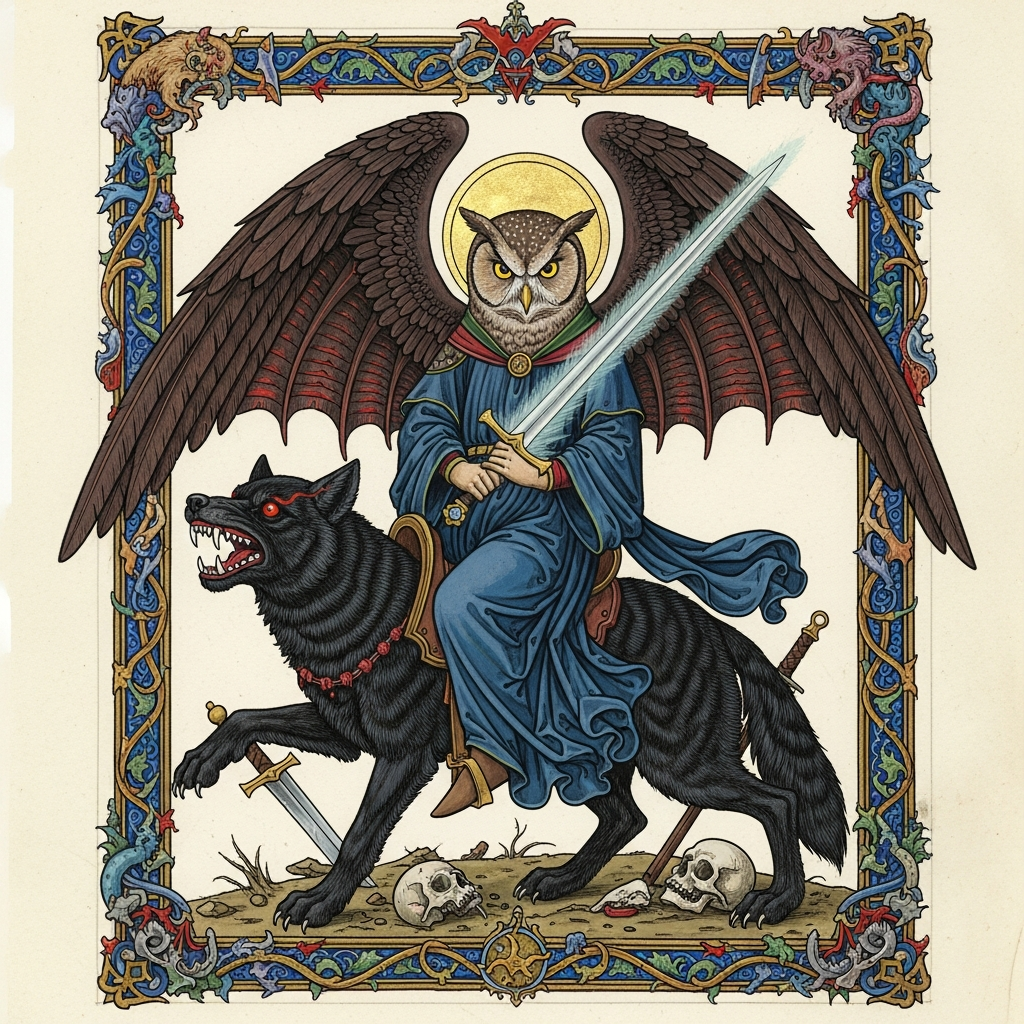
Andras is the most dangerous spirit in the Goetia. Every other demon can be bargained with, bound, or reasoned with to some degree. Andras exists only to sow discord and murder. He will kill the summoner and the summoner’s servants if the magician shows the slightest lapse in the protective circle. The Pseudomonarchia Daemonum specifically warns that he is “a great Marquesse” who “killeth the Maister, the servant, and all assistants” if given any opportunity. His owl-headed angel form riding a black wolf is one of the most striking visual designs in the Goetia — heavenly beauty corrupted into predatory menace. He teaches nothing useful. He offers no knowledge. He is pure, weaponized hostility.
Stolas is the Goetia’s scholar-prince. He appears first as an owl — the classical symbol of wisdom — but an uncanny one, with legs far too long for his body, giving him a spindly, alien elegance. In human form he wears the robes of an academic. He teaches astronomy and the knowledge of plants and precious stones, making him one of the most genuinely educational spirits in the catalog. Unlike Andras, Stolas poses no special danger to the summoner; he is cooperative and intellectually generous. His domain is the natural sciences as understood in the Renaissance: the movements of the heavens, the medicinal properties of herbs, the occult virtues of gemstones. He represents the Goetia at its most Faustian — forbidden knowledge offered freely, the price hidden in the contract itself.
Phenex is the saddest spirit in the Goetia. He appears as a phoenix — the bird of resurrection and renewal — and sings with a voice so beautiful it sounds like a child’s. He teaches the sciences and is an excellent poet. But the detail that sets him apart from every other demon is this: “he hopes to return to the seventh throne after 1,200 years.” He is a fallen being who has not given up hope of redemption. In a catalog of spirits who are bound, hostile, deceptive, or resigned to their infernal station, Phenex alone looks upward. Whether the text means this sincerely or as one more demonic deception is left to the reader. But the image endures: a burning bird singing poetry in hell, counting the years until it can go home.
Marchosias is one of the Goetia’s most visually spectacular demons: a fire-breathing she-wolf with the wings of a griffin and the tail of a serpent. She is explicitly female in the original text — unusual in a catalog dominated by male-presenting entities. She is a strong fighter who gives true answers to all questions and is described as faithful to the summoner. Like Phenex, she carries a note of pathos: the text says she “hopes to return to the seventh throne” and told Solomon she had this expectation. She was once of the Order of Dominations before the fall. Marchosias represents the warrior-class of hell — loyal, powerful, and direct, with none of the scholarly pretensions of the intellectual demons.
Orobas holds a unique distinction among the 72 spirits: he never deceives the summoner. The text states this explicitly — “he is very faithful unto the Author and will not suffer him to be tempted of any Spirit.” In a system built on danger and deception, where every demon is assumed to be lying unless bound, Orobas is the one exception. He reveals the past, present, and future, provides favors from both friends and enemies, and speaks truthfully about divinity and the creation of the world. His appearance is modest — a horse that becomes a man, with none of the dramatic multi-headed or hybrid forms of the other demons. His value is entirely in his reliability. For the Renaissance magician working through a catalog of 72 spirits who might kill, deceive, or corrupt him, Orobas was the safe choice — the honest broker of the infernal world.
Dantalion is the Goetia’s telepath. He appears as a man holding a book, but his face is not singular — it shifts and changes, showing every human face that exists. He knows the thoughts of all people and can change them at will. He teaches all arts and sciences, but his true power is psychological: he can reveal what anyone, anywhere, is secretly thinking, and he can alter those thoughts. This makes him simultaneously one of the most useful and most terrifying spirits in the catalog. For the summoner seeking intelligence — who plots against me? what does the king intend? — Dantalion is an unparalleled asset. But his power to change thoughts as well as read them places him in the realm of mind control. He is the penultimate spirit in the Goetia (71st of 72), positioned near the end like a final temptation: absolute knowledge of every human mind, and the power to reshape them.
4 min read
Ars Goetia #71; *Pseudomonarchia Daemonum*