Combat Profile
Silk Snare
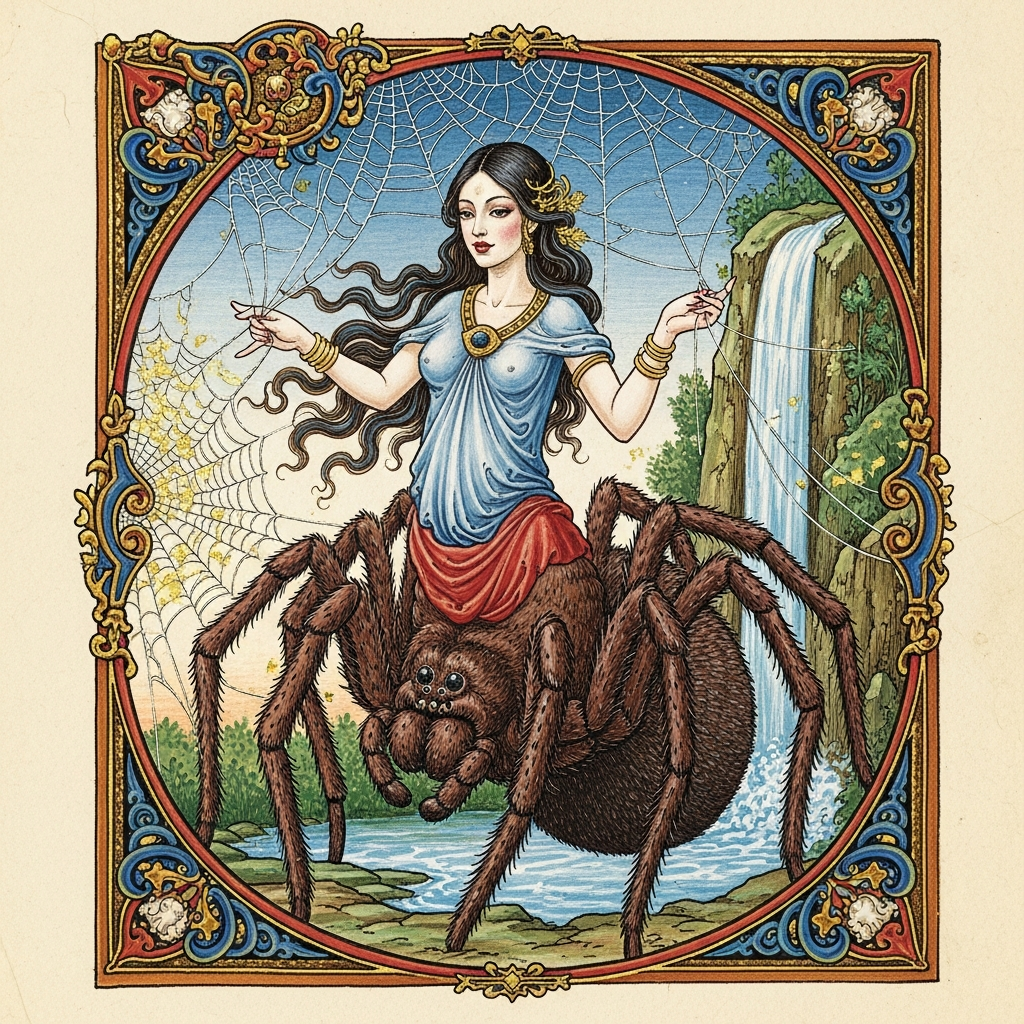
Jorogumo weaves magical webs that bind victims in place and drain their life force with each passing turn.
Shapeshifter's Grace
Jorogumo appears as an enchanting woman to mortals, gaining increased evasion and charm resistance to direct attacks while in humanoid form.
Fire destroys her webs and breaks her illusions. Her true form is revealed by mirrors or holy seals. She is fundamentally a predator -- incapable of genuine love despite her ability to simulate it perfectly
“A beautiful woman sat beside the waterfall, playing the biwa. He sat to listen. He could not leave. When dawn came, he was wrapped in silk, and she was no longer beautiful.” — Traditional Jorogumo tale
Lore: Jorogumo (literally “binding bride” or “entangling woman,” depending on the kanji) is a spider yokai of immense age — a golden orb-weaver spider (Trichonephila clavata, native to Japan) that has lived for 400 years and gained the power to take human form. She typically establishes her lair behind a waterfall and assumes the appearance of a beautiful woman to lure young men. She plays the biwa to enchant them, wraps them in spider silk so fine it is invisible, and drains their life force over days or weeks. The Joren Falls in Shizuoka Prefecture are specifically associated with the Jorogumo legend — woodcutters who slipped into the pool below the falls would feel threads wrapping around their legs, pulling them under.
In some versions, the Jorogumo is not purely malicious but tragically lonely, a creature of immense intelligence trapped in a predatory nature, capable of simulating love but never truly feeling it. She represents a distinctly Japanese take on the predatory feminine supernatural: unlike the succubus of Christian demonology, the Jorogumo is a natural creature that has transcended its nature through age and accumulated power — a concept deeply rooted in the Japanese folk belief that any creature or object that endures long enough will eventually gain supernatural awareness (tsukumogami for objects, obake for creatures).
Parallel: The femme fatale spider-woman appears across world mythology: the Greek Arachne (transformed into a spider for challenging Athena), the Navajo Spider Woman (benevolent — a contrasting case), and Shelob in Tolkien’s work (drawing on Anglo-Saxon monster tradition). The “beautiful woman who is secretly a devouring monster” motif connects to Lilith in Jewish tradition, the rakshasas of Hindu mythology, and the biblical Proverbs’ “strange woman” whose path leads to death (Proverbs 7:27). The biwa-playing detail links Jorogumo to the broader Japanese tradition of musical enchantment, most famously in the tale of Hoichi the Earless.
2 min read
Buddhist monks with spiritual sight; fire; the Jorogumo's own loneliness (some tales hint she genuinely wishes she could love the men she kills)
*Taihei Hyakumonogatari* (1732); Toriyama Sekien, *Gazu Hyakki Yagyo*; Lafcadio Hearn; regional legends of Joren Falls (Izu Peninsula)