Combat Profile
Soul Severance
instantly sever a soul's final thread, determining whether passage to the afterlife proceeds or is delayed by karmic judgment.
Threshold Warden
perceive all souls within vicinity and sense the exact moment of death across connected realms, immune to deception about life-state.
They are functionaries, not sovereigns -- they serve the natural order and can sometimes be outwitted, bargained with, or delayed by human cleverness
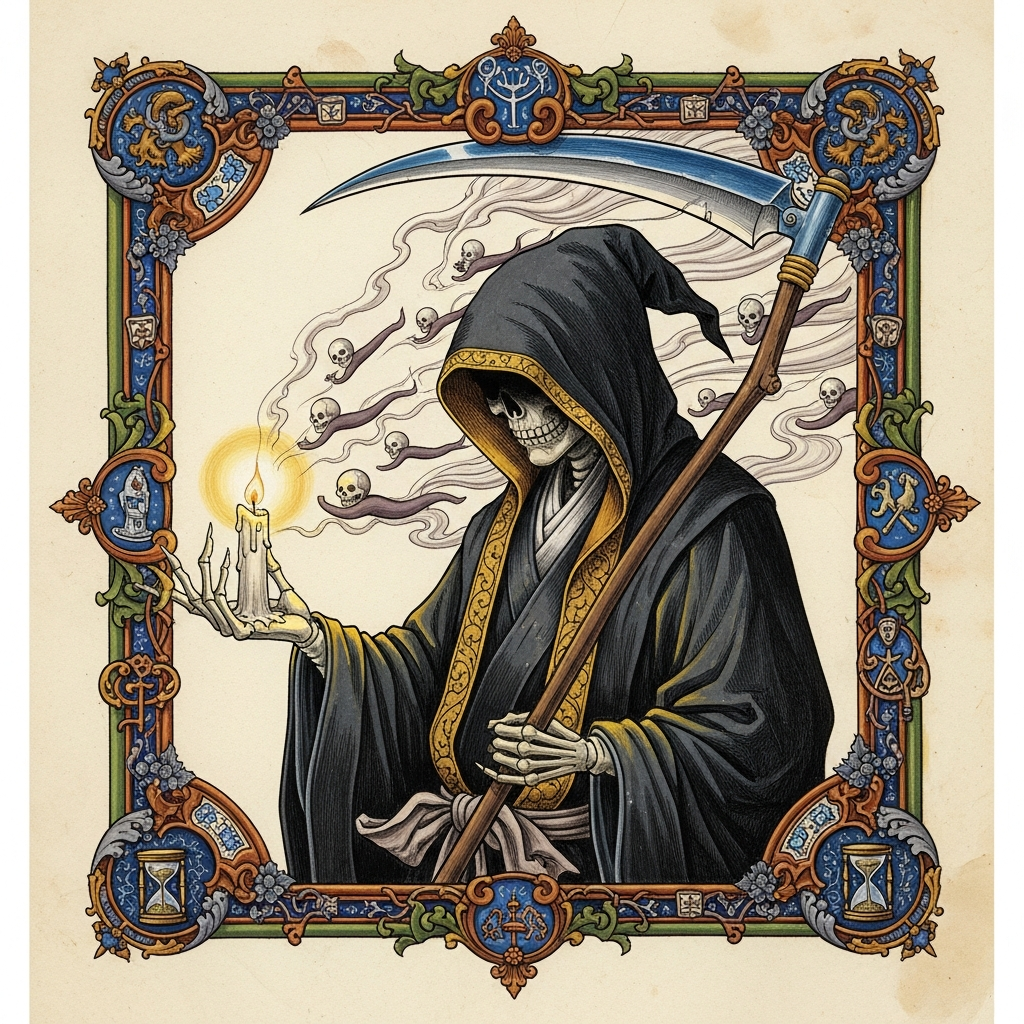
“Each life is a candle. When the flame goes out, I come. I do not blow it out. I only carry what remains.” — Shinigami, from the rakugo tradition
Lore: Shinigami (“death gods” or “death spirits”) are a relatively late addition to Japanese mythology, emerging primarily in the Edo period (1603-1868), likely influenced by Chinese concepts of death spirits and possibly Western ideas through the Dutch trading post at Nagasaki. They do not appear in the Kojiki or Nihon Shoki. Earlier Shinto tradition did not personify death as a reaper-figure — death was a state of pollution associated with Yomi, not an entity that came to collect you.
In the famous rakugo tale “Shinigami,” a down-on-his-luck man encounters a shinigami who shows him candles representing human lifespans — tall candles for the young, guttering stubs for the elderly. The shinigami teaches the man to see other shinigami standing at people’s bedsides, allowing him to pretend to be a healer (driving away shinigami from those not yet fated to die, by rotating the sickbed so the shinigami stands at the foot instead of the head). The tale ends darkly when the man tries to cheat his own death and accidentally extinguishes his own candle. The shinigami in this tradition is not malevolent — it is simply the inevitable.
Modern Japanese pop culture has transformed shinigami into one of the most globally recognizable concepts in the yokai tradition, most notably through the manga Death Note (2003-2006) and the Bleach franchise, though these modern depictions diverge significantly from the Edo-period originals.
Parallel: Shinigami are the Japanese equivalent of the Greek Thanatos, the Norse Valkyries (selective soul-collectors), and the Angel of Death in Jewish and Islamic tradition (Azrael/Malak al-Mawt). The candle-of-life motif in the rakugo tradition is directly paralleled in the Brothers Grimm tale “Godfather Death” (Der Gevatter Tod), in which Death shows a man a cave full of candles representing lifespans — a parallel so precise that direct transmission (via the Dutch in Nagasaki) is likely. The key distinction: shinigami are characteristically Japanese in their intimacy. They are not grand cosmic figures but subtle, quiet presences — the whisper at the cliff’s edge, the shadow by the sickbed. Death in Japanese tradition is not a cosmic drama; it is a quiet arrival.
2 min read
Quick thinking; certain Buddhist sutras; acts of exceptional virtue or devotion; the intervention of compassionate beings (Kannon, Jizo)
Edo-period *rakugo* tradition; San'yutei Encho's "Shinigami" (1860s); folk traditions; modern depictions (manga, anime)