The Story
Shinto — “the way of the kami” — is Japan’s indigenous spiritual tradition: no founder, no binding scripture, no universal creed (Nihon Shoki). It is, simply, what was already there. Before Japan, the islands’ inhabitants worshipped kami — the sacred powers in mountains, rivers, storms, ancestors, rice fields, and place itself. Animism wove with ancestor veneration into a worldview that treated creation as alive, sacred, shot through with personality. The shrine (jinja), the rope marking the holy (shimenawa), and the torii gate were in place before writing arrived.
Literacy arrived from China and Korea in the 6th century — and with it, Buddhism (Nihon Shoki, 538 CE). What happened next is exceptional: the two traditions didn’t collide or collapse. They fused. Under honji suijaku (“original ground, manifest traces”), kami became local manifestations of universal Buddhas and bodhisattvas. Shrines and temples shared compounds. Priests and monks worked side by side. This synthesis, Shinbutsu-shugo, lasted over a thousand years — arguably the most durable act of religious fusion in human history.
In the 8th century the imperial court did something unprecedented: it wrote Shinto down. The Kojiki (712 CE, compiled by Ō no Yasumaro) and Nihon Shoki (720 CE) froze fluid myth into court-sponsored cosmogony — culminating in Amaterasu’s grandson Ninigi descending from heaven to found the imperial line (Kojiki). From that moment on, Japanese emperors claimed direct descent from the sun goddess. Genealogy became theology.
For the next thousand years this was a quiet courtly claim, coexisting with everyday Shinto-Buddhist fusion in villages and shrines. Then in 1868 everything inverted.
The Meiji Restoration (1868) rebuilt Japan around a sacred empire. It forcibly severed Buddhism from Shinto (shinbutsu bunri): statues ripped from shrines, priests defrocked, a thousand years of fusion unwound by decree (Meiji edicts). State Shinto became imperial cult. Every shrine was a state node. The emperor was declared divine (Meiji Constitution, 1889). Loyalty was religious duty. This Shinto — mobilized, militarized — propelled the 20th century: kamikaze pilots, Yasukuni war theology, holy-empire ideology.
In 1945 Japan fell. On January 1, 1946, Hirohito signed the Ningen-sengen — renouncing his divinity (imperial rescript). MacArthur’s occupation disestablished State Shinto (Shinto Directive, 1945). Shinto returned to civil society (postwar Constitution, 1947).
Today, Shinto is something quieter, stranger: a living tradition most Japanese practice without calling themselves “Shinto.” Eighty percent visit shrines for New Year, festivals, weddings, child blessings (Jinja Honcho, 2026) — yet few self-identify as Shinto. The 2.5 million in formal sects are the visible core; tens of millions are quiet participants. The tradition remains entangled with Japanese identity in still-contested ways: Yasukuni Shrine, where wartime leaders are enshrined as kami, remains a flashpoint. Shinto is ancient nature religion and folk practice and a tradition still reckoning with the imperial nationalism imposed upon it in the 19th and 20th centuries.
Pivotal Events
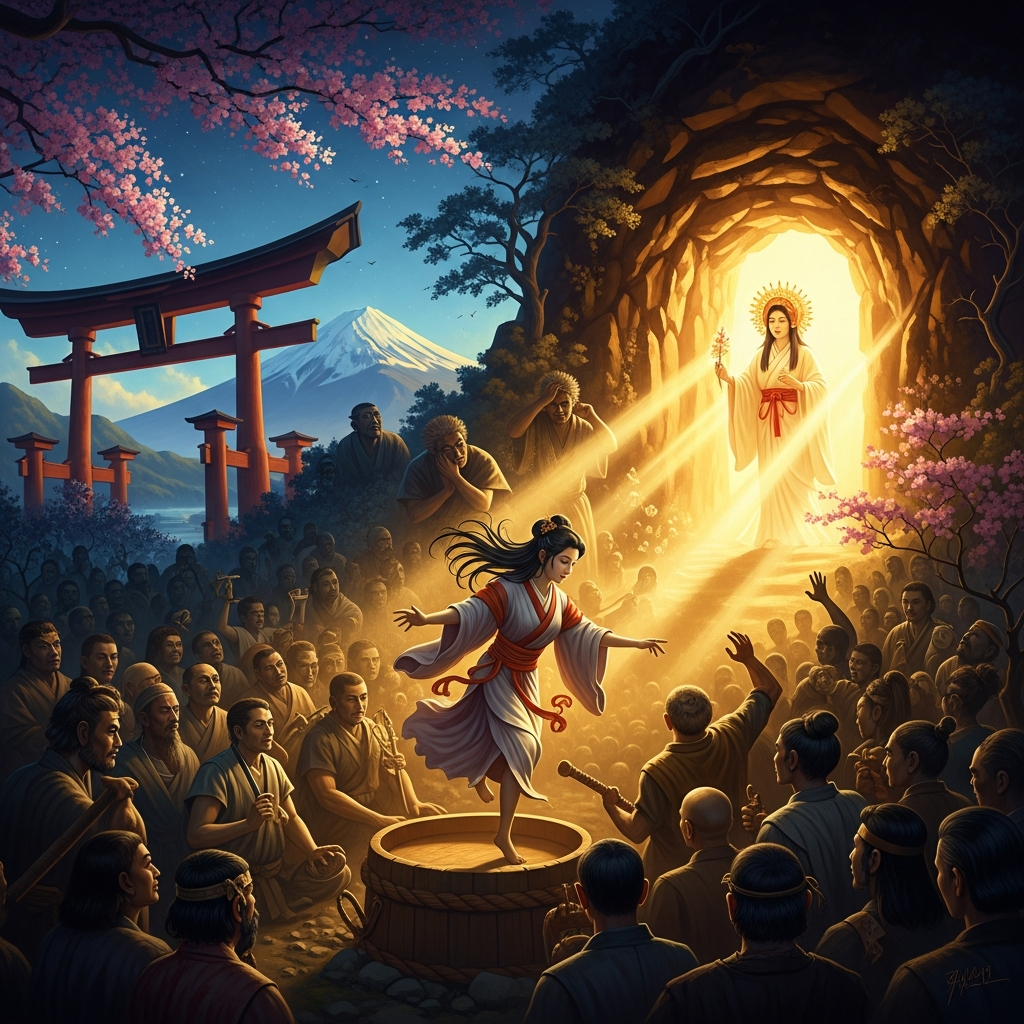
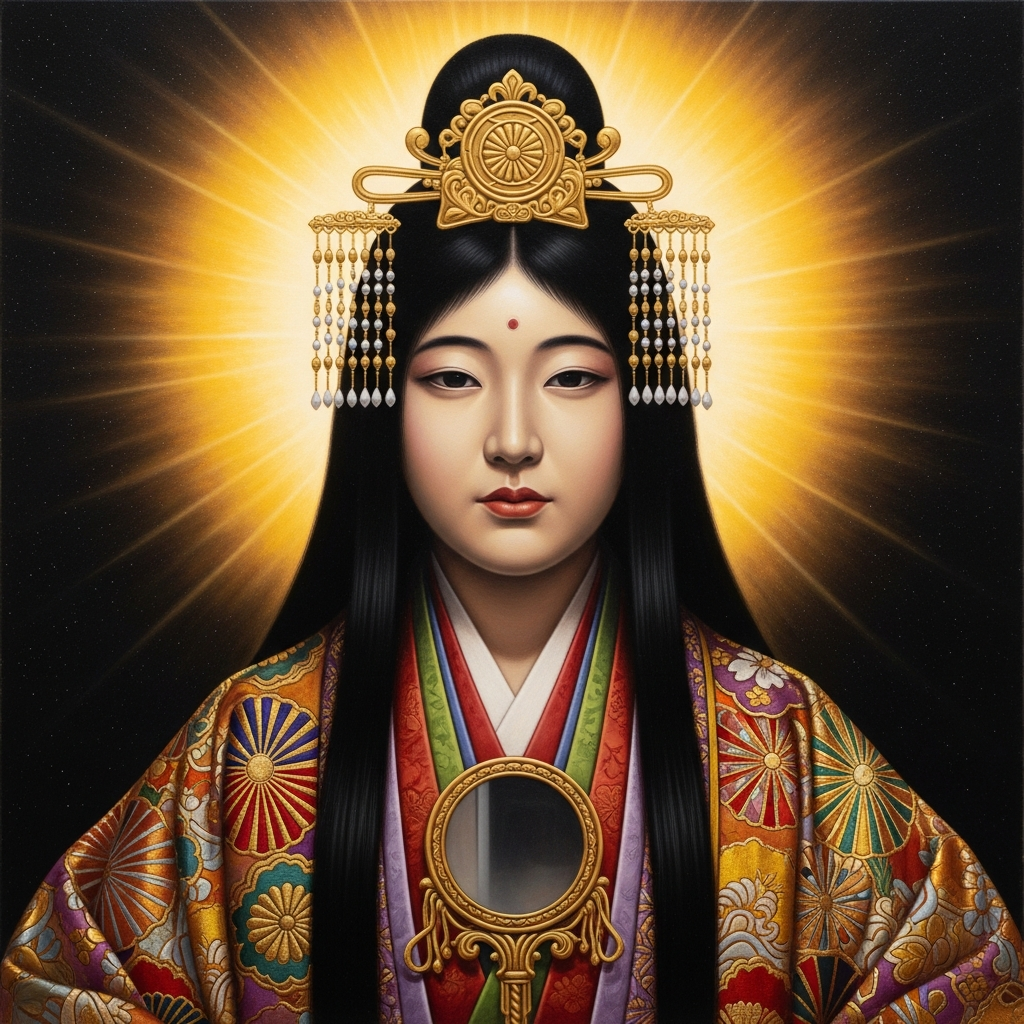
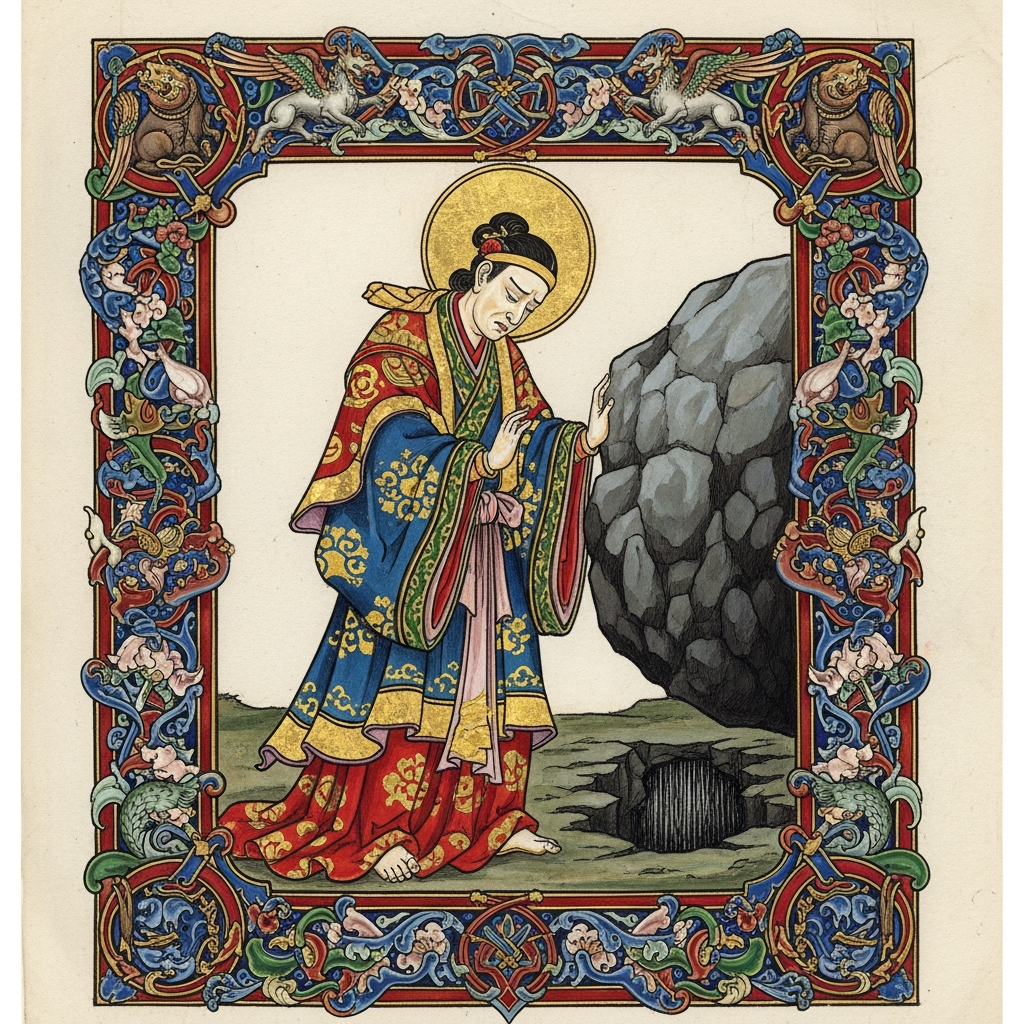
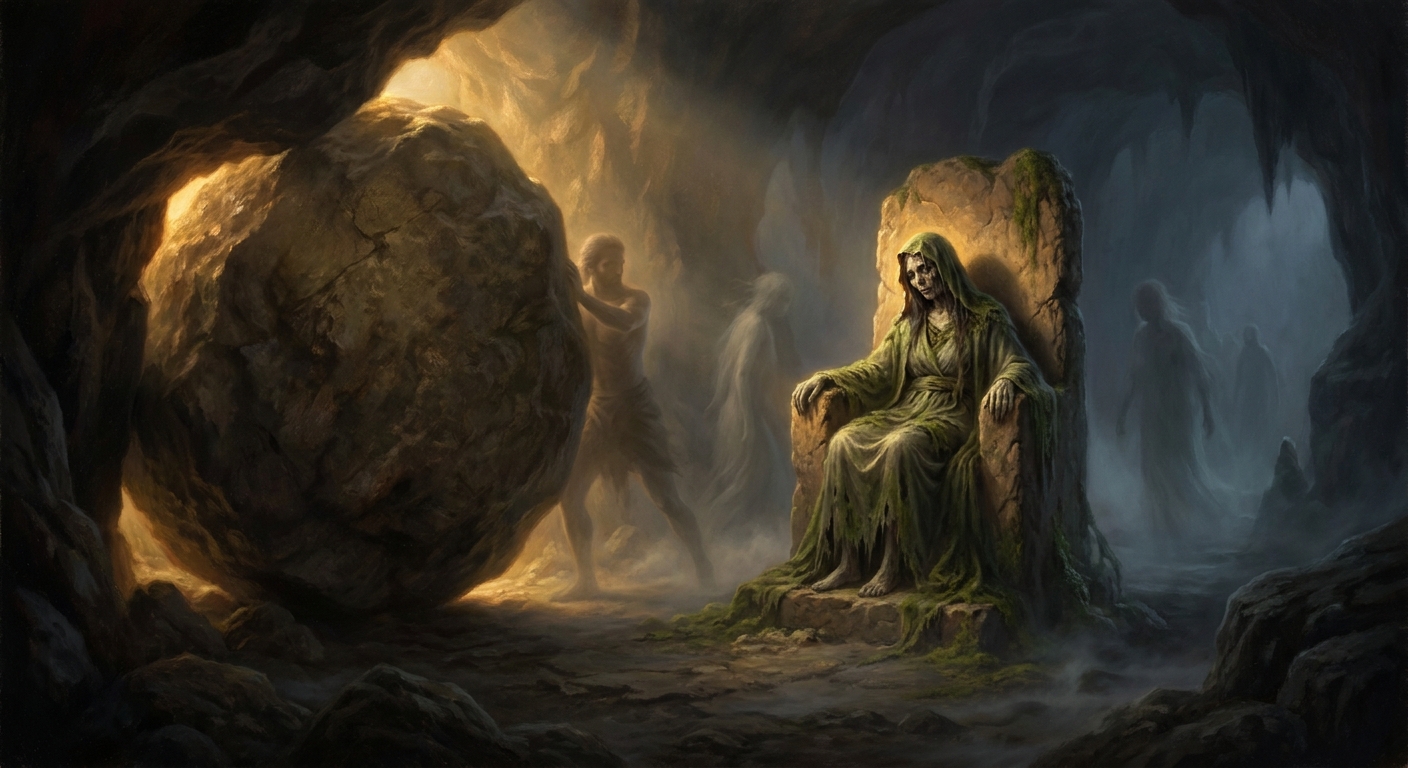
Amaterasu, the sun goddess and imperial ancestor, withdraws into heaven’s rock-cave (Ame-no-Iwato) in rage at her brother Susanoo’s violence. Darkness falls. Eight hundred myriad kami devise a solution: a sacred mirror hung on a tree, jewels, cock-crows, and the goddess Ame-no-Uzume’s obscene ecstatic dance on an overturned tub. The kami roar with laughter. Curious, Amaterasu cracks the cave and sees her reflection in the mirror — thinking it another sun. She emerges. Light returns. The foundational myth of return-from-darkness; the mirror becomes one of the three Imperial Regalia.
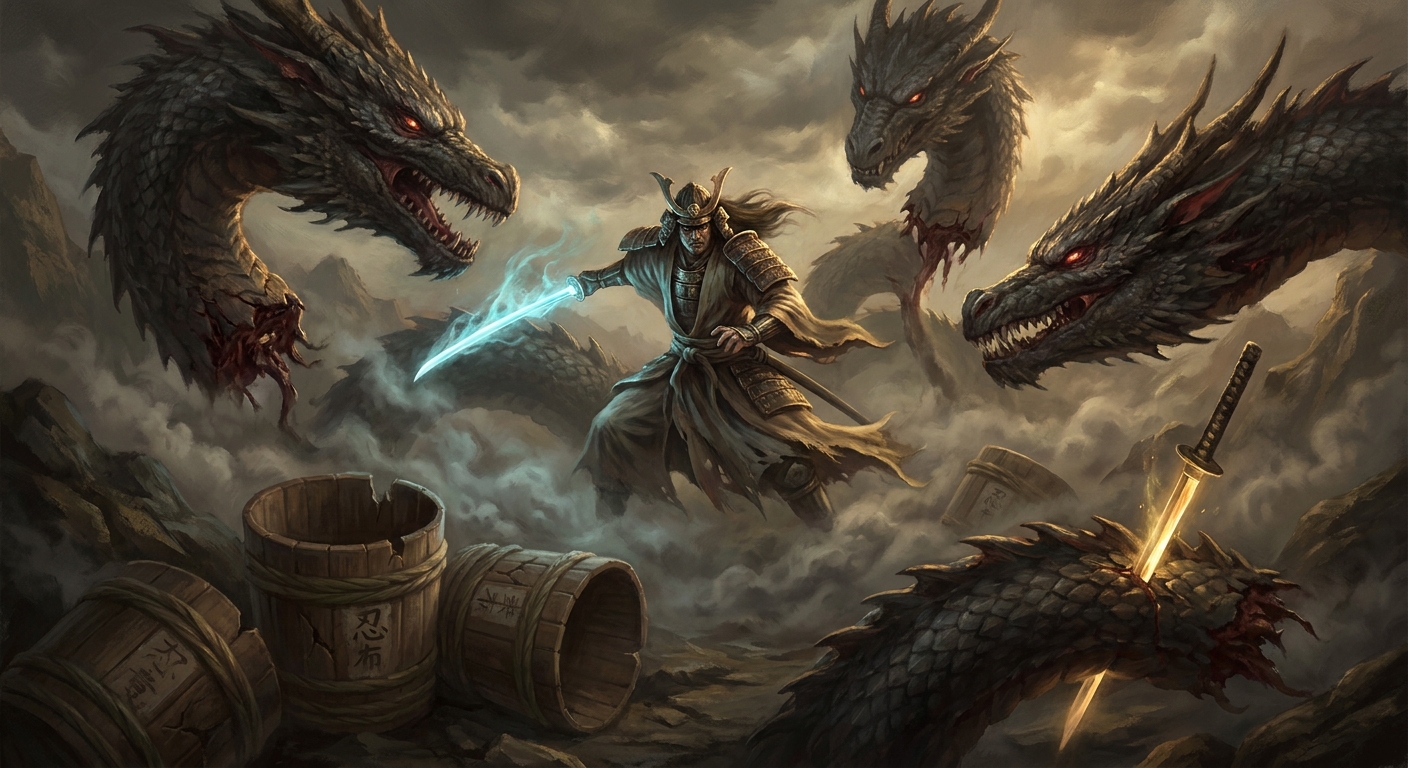
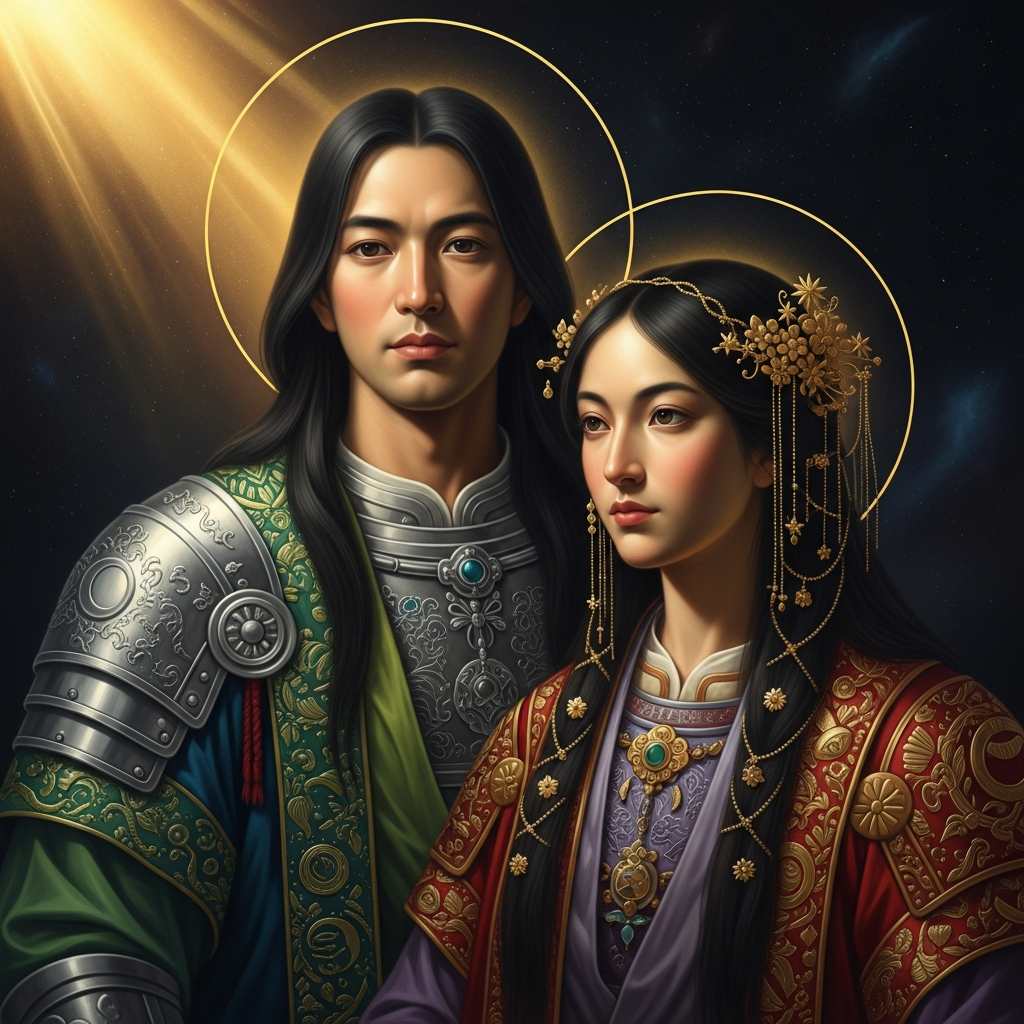
Exiled from heaven for violence, Susanoo descends to Izumo and meets an elderly couple: seven daughters devoured by the eight-headed, eight-tailed serpent Yamata-no-Orochi. The last daughter, Kushinada-hime, will be next. Susanoo bargains: slay the dragon, marry the girl. He fills eight vats with rice wine. The serpent drinks itself stupid; he beheads each head in turn. From the dragon’s tail emerges the great sword Kusanagi-no-Tsurugi (“grass-cutter”) — the second Imperial Regalia. Trickster becomes hero. The imperial sword enters mythology.
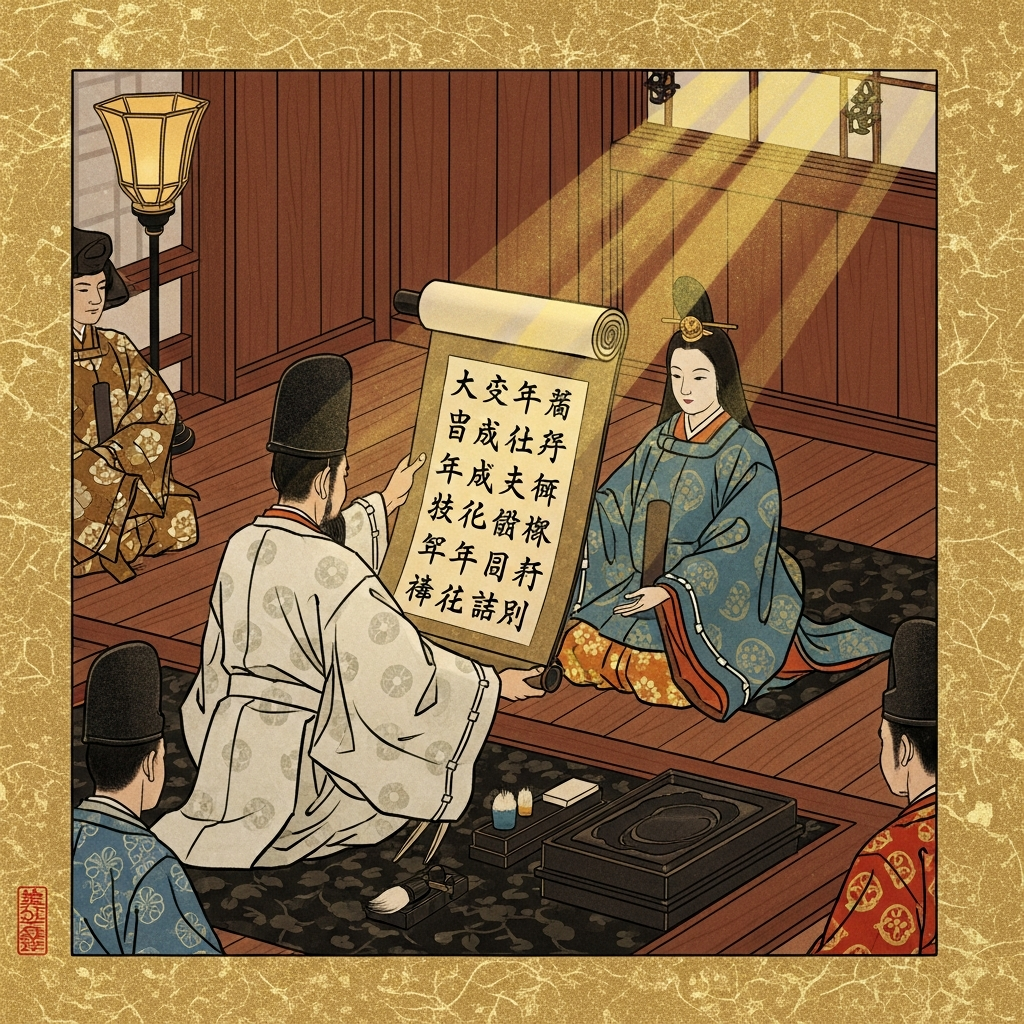
Shinto myth lived in oral transmission and clan ritual for centuries. In 712 CE, Empress Gemmei commissioned the scribe O no Yasumaro to compile the Kojiki (“Record of Ancient Matters”) from court reciter Hieda no Are’s memorized recitations. Eight years later (720 CE), the more formal Nihon Shoki followed. Both texts crystallized fluid myth into authoritative form: the Age of Kami, Ninigi’s descent, the unbroken imperial line. The political project was transparent — cosmic genealogy for the Yamato dynasty — but the consequence is that almost everything we know about Shinto myth comes through these two court documents.
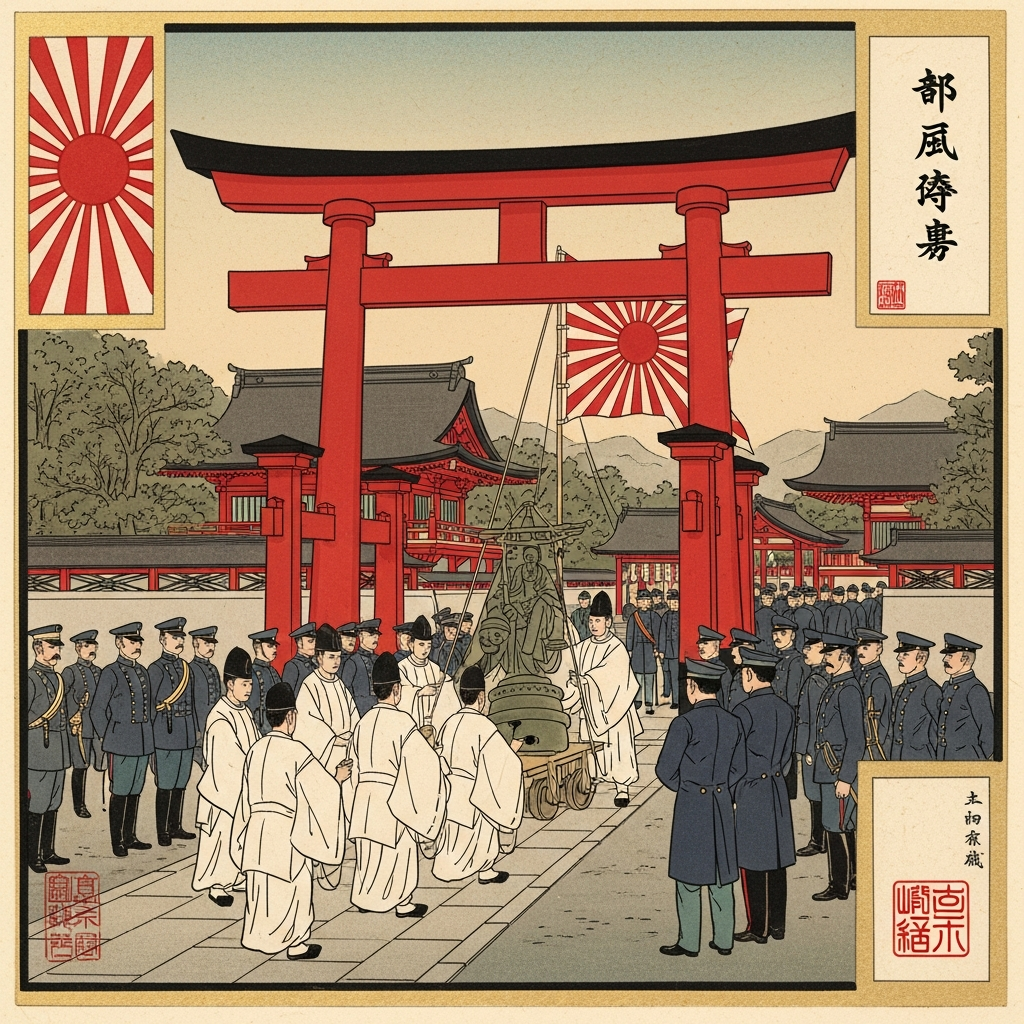
In 1868, the new Meiji government forcibly severed Buddhism and Shinto (shinbutsu bunri) to build a modern nation-state on sacred-imperial ground. For a thousand years the traditions had shared shrines, priests, and practices. In a few violent years it was undone: Buddhist images stripped, priests defrocked, temples ransacked in haibutsu kishaku iconoclasm. Shinto became State Shinto — an imperial cult where the emperor’s divinity, sun-goddess genealogy, and shrine reverence functioned as civic religion. This structural decision enabled 20th-century religious nationalism.
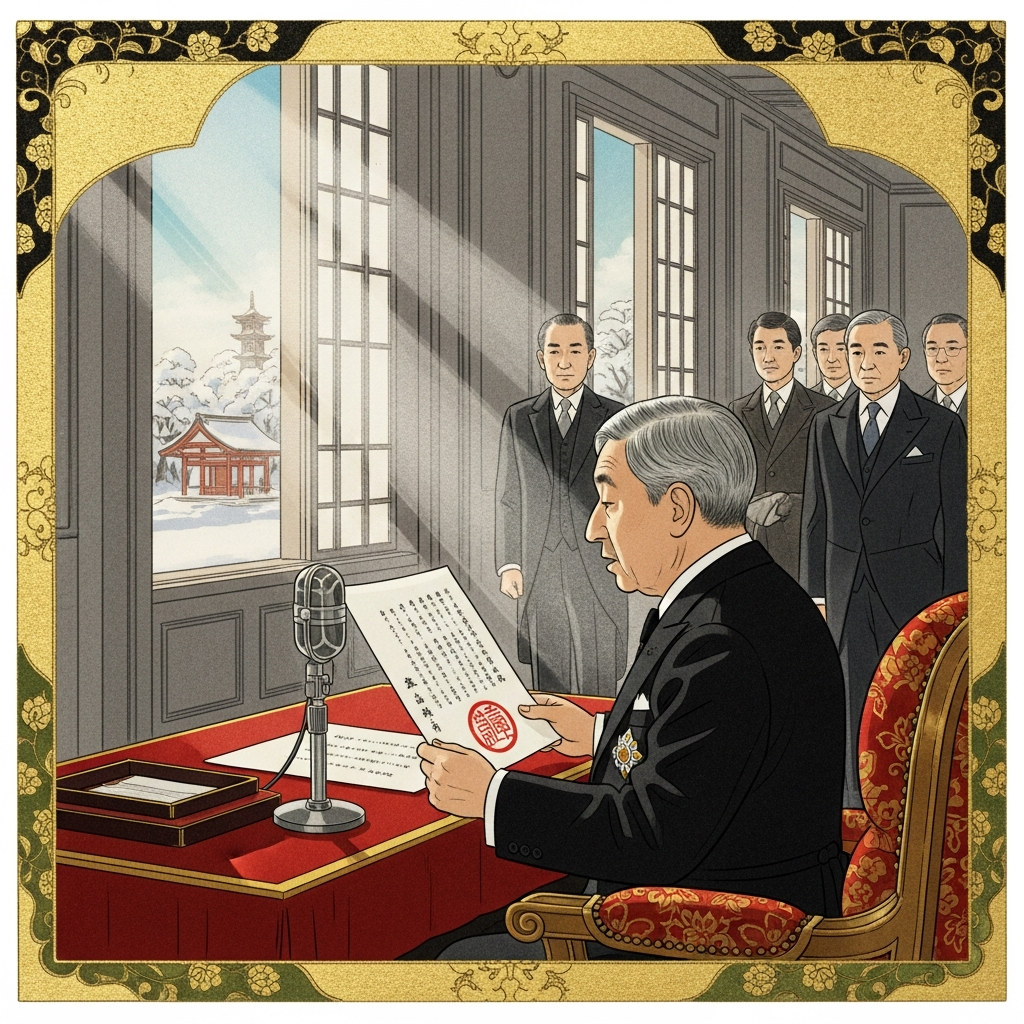
On January 1, 1946, Hirohito issued the Ningen-sengen — renouncing his divine status and the myth of Japanese racial destiny. MacArthur’s occupation formally disestablished State Shinto (Shinto Directive, December 1945), and the postwar constitution (1947) enshrined religious freedom. Seventy-eight years of State Shinto — Meiji separation to imperial humanity — collapsed in a single rescript. Postwar Shinto became the long process of reckoning with what the tradition is when it is no longer the state religion.
Timeline
| Era | Date | Event | Source |
|---|
| Mythic Age | — | Izanagi and Izanami create the Japanese islands and birth the kami | Kojiki book 1 |
| Mythic Age | — | Amaterasu born from Izanagi’s left eye; rules the High Plain of Heaven | Kojiki book 1 |
| Mythic Age | — | Amaterasu hides in the rock-cave; the world goes dark and is restored | Kojiki book 1 |
| Mythic Age | — | Susanoo slays Yamata-no-Orochi; Kusanagi sword recovered | Kojiki book 1 |
| Mythic Age | — | Ninigi descends from heaven with the three Imperial Regalia | Kojiki book 2 |
| Legendary | 660 BCE (traditional) | Emperor Jimmu, grandson of Ninigi, founds the imperial line | Nihon Shoki |
| Yayoi / Kofun | ~300 BCE - 538 CE | Indigenous animism and ancestor veneration; shrine archaeology | archaeology |
| Asuka | 538 CE | Buddhism formally introduced from Baekje (Korea) | Nihon Shoki |
| Asuka | 587 CE | Soga clan victory establishes Buddhism at court | Nihon Shoki |
| Nara | 712 CE | Kojiki compiled by O no Yasumaro under Empress Gemmei | Kojiki preface |
| Nara | 720 CE | Nihon Shoki completed | Nihon Shoki |
| Heian | ~9th-12th c. | Honji suijaku doctrine: kami as local manifestations of Buddhas | Tendai/Shingon |
| Kamakura | 1185-1333 | Ise Shinto and Watarai Shinto begin theological systematization | Watarai texts |
| Kamakura | 1281 | Kamikaze (“divine wind”) typhoons repel Mongol invasion fleet | Hachiman Gudokun |
| Muromachi | 14th c. | Yoshida Shinto founded by Yoshida Kanetomo; proto-pure-Shinto | Yoshida texts |
| Edo | 17th-18th c. | Kokugaku (“National Learning”) movement; Motoori Norinaga’s Kojiki-den | Motoori |
| Edo | 1868 | Meiji Restoration: shinbutsu bunri separates Buddhism from Shinto | Meiji edicts |
| Meiji | 1870 | Great Promulgation Campaign declares the Way of the Kami | imperial edicts |
| Meiji | 1889 | Meiji Constitution: emperor declared sacred and inviolable | Meiji Constitution |
| Showa | 1937-1945 | State Shinto fuses with wartime militarism; Yasukuni enshrines war dead | wartime decrees |
| Showa | December 15, 1945 | Allied Shinto Directive disestablishes State Shinto | SCAP Directive |
| Showa | January 1, 1946 | Emperor’s Humanity Declaration (Ningen-sengen) | imperial rescript |
| Showa | 1947 | Postwar Constitution enshrines religious freedom | Constitution Art. 20 |
| Postwar | 1946 | Association of Shinto Shrines (Jinja Honcho) founded | Jinja Honcho |
| Heisei / Reiwa | 1989 - present | Contested Yasukuni visits; Shinto as cultural-civic practice | press coverage |
| Reiwa | 2026 | ~80% of Japanese visit shrines; ~2.5M formal sect members | demographic data |
Shinto — The Indigenous Soul of Japan
Shinto (literally “the way of the gods,” from the Chinese shen dao) is the indigenous spiritual tradition of Japan, practiced by over 80 million people. Unlike the religions of the book, Shinto has no single founder, no universal creed, no systematic theology. It is a religion of kami — the sacred powers that inhabit all things: mountains, rivers, trees, storms, ancestors, and the inexplicable forces that make the world numinous (Kojiki). The two foundational texts are the Kojiki (“Record of Ancient Matters,” 712 CE, by Ō no Yasumaro) and the Nihon Shoki (“Chronicles of Japan,” 720 CE), both compiled at the imperial court to establish a mythological charter for the Japanese state and its ruling dynasty (Nihon Shoki). These are not “bibles” — they are court-sponsored cosmogonies that weave together local clan myths, origin stories, and genealogies linking the imperial family to Amaterasu, the sun goddess.
What makes Shinto unique among world religions is its extraordinary capacity for synthesis. When Buddhism arrived in Japan in the 6th century (Nihon Shoki, 538 CE), rather than producing the violent theological collisions seen in other cultures, Japan performed one of the most remarkable acts of religious fusion in human history. The kami were reinterpreted as local manifestations of universal Buddhas and bodhisattvas (honji suijaku — “original ground, manifest traces”). Shinto shrines and Buddhist temples stood side by side, often sharing the same compound. This synthesis persisted for over a thousand years until the Meiji government forcibly separated the two in 1868 (shinbutsu bunri, Meiji edicts). Even today, most Japanese participate in both traditions without sensing contradiction — Shinto for birth and life celebrations, Buddhism for death and the afterlife.
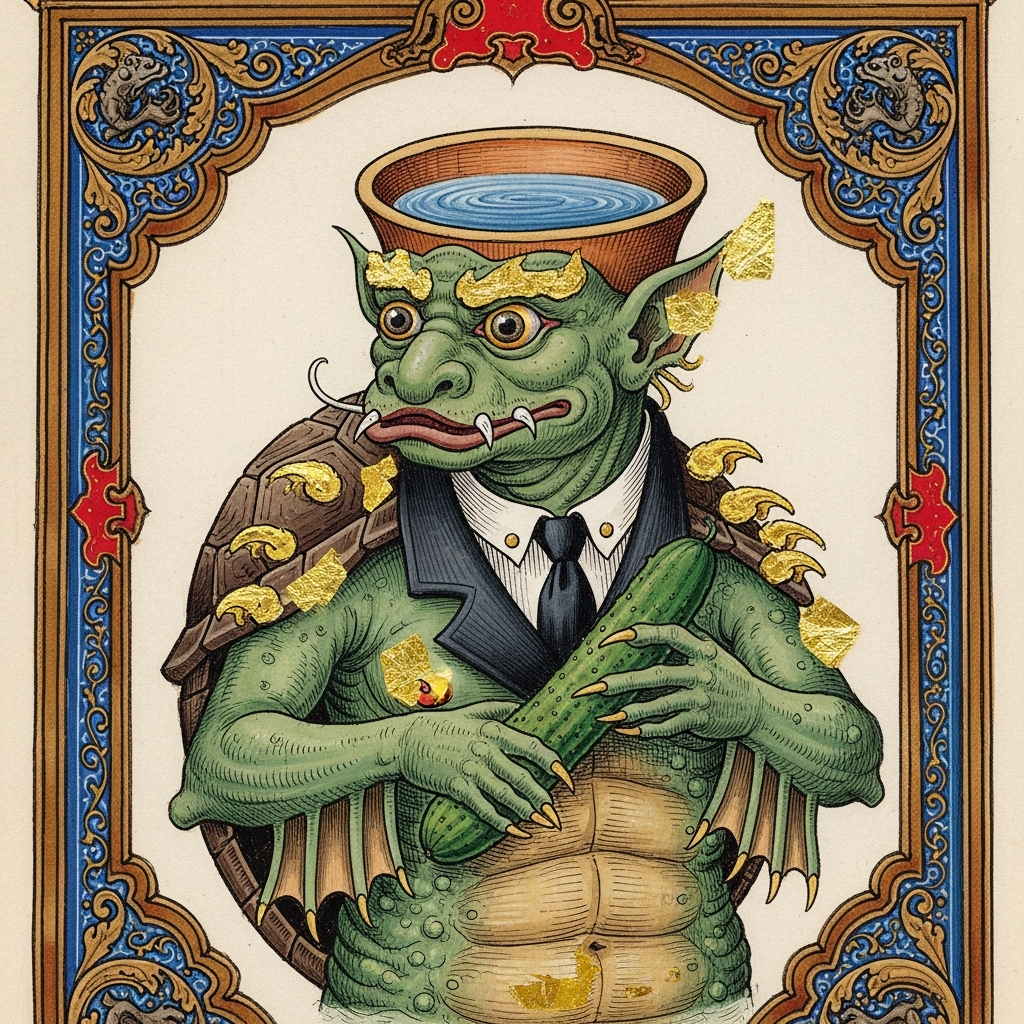
The yokai tradition — the vast bestiary of Japanese supernatural creatures — draws from Shinto animism, Buddhist cosmology, Chinese Taoist influence, and pure folk imagination. Compiled most famously by Toriyama Sekien in the 18th century (Gazu Hyakki Yagyo, 1776-1784) and given literary form by Lafcadio Hearn (the Western writer who became a Japanese citizen as Koizumi Yakumo, Kwaidan, 1904), yokai represent a worldview in which the boundary between the natural and supernatural is porous, and the spirits of foxes, spiders, rivers, and mountains are as real as the humans who encounter them.
A note on respect: Shinto is not a dead mythology. It is a living faith practiced by tens of millions. The kami described here are not “characters” — they are revered beings at the center of active worship. The yokai, while treated with more playfulness in Japanese popular culture, still carry deep cultural significance. This compendium treats all entries with the seriousness they deserve.
Key Sources:
- Kojiki (712 CE) — Ō no Yasumaro, commissioned by Empress Gemmei
- Nihon Shoki (720 CE) — Prince Toneri and Ō no Yasumaro
- Gazu Hyakki Yagyo (1776-1784) — Toriyama Sekien
- Kwaidan: Stories and Studies of Strange Things (1904) — Lafcadio Hearn
- Kojiki (translation, 1968) — Donald L. Philippi (translator)
- Shinto: The Kami Way (1962) — Sokyo Ono
- Handbook of Japanese Mythology (2003) — Michael Ashkenazi
- Shinto: A History (2017) — Helen Hardacre
- Religion in Japanese History (1966) — Joseph Mitsuo Kitagawa
- The Fox and the Jewel: Shared and Private Meanings in Contemporary Japanese Inari Worship (1999) — Karen Smyers
- Buddhas and Kami in Japan: Honji Suijaku as a Combinatory Paradigm (2003) — Mark Teeuwen & Fabio Rambelli, eds.

Cosmological Map — The Three Realms
flowchart TB
    subgraph COSMOS["THE THREE REALMS OF SHINTO"]
        direction TB

        subgraph TAKAMA["TAKAMAGAHARA -- The High Plain of Heaven"]
            AMA["<b>AMATERASU</b><br/>Sun Goddess<br/>Supreme Kami"]
            TSUKU["<b>TSUKUYOMI</b><br/>Moon God"]
            INNUMERABLE["<b>Yaoyorozu no Kami</b><br/>(Eight Million Gods)<br/>The innumerable kami"]
        end

        subgraph ASHIHARA["ASHIHARA NO NAKATSUKUNI -- The Central Land of Reed Plains"]
            HUMANS["<b>HUMANITY</b><br/>The mortal world<br/>Japan"]
            YOKAI_REALM["<b>YOKAI</b><br/>Supernatural creatures<br/>inhabiting the borders"]
            KAMI_LOCAL["<b>LOCAL KAMI</b><br/>Spirits of rivers,<br/>mountains, trees"]
        end

        subgraph YOMI_REALM["YOMI NO KUNI -- The Land of the Dead"]
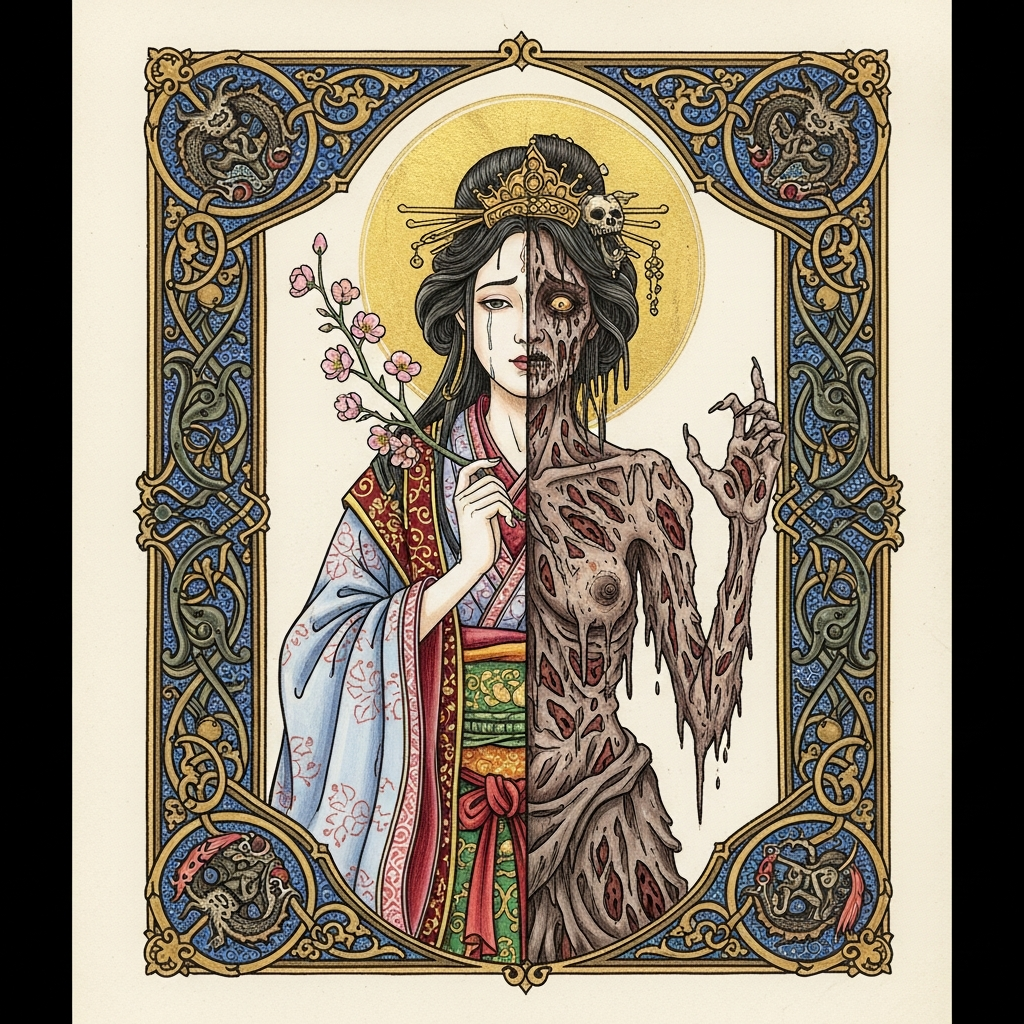
            IZANAMI_DEAD["<b>IZANAMI</b><br/>Queen of the Dead"]
            SHIKOME["<b>SHIKOME</b><br/>Hags of Yomi"]
            SHINIGAMI_REALM["<b>SHINIGAMI</b><br/>Death Spirits"]
        end
    end

    TAKAMA -->|"Kami descend<br/>to sacred sites"| ASHIHARA
    ASHIHARA -->|"The dead pass<br/>through the slope<br/>of Yomotsu Hirasaka"| YOMI_REALM

    style COSMOS fill:#1a1a2e,stroke:#16213e,color:#fff
    style TAKAMA fill:#c9a227,stroke:#B8860B,color:#000
    style ASHIHARA fill:#228B22,stroke:#006400,color:#fff
    style YOMI_REALM fill:#2F2F2F,stroke:#000,color:#fff
    style AMA fill:#FFD700,stroke:#B8860B,color:#000
    style TSUKU fill:#C0C0C0,stroke:#808080,color:#000
    style INNUMERABLE fill:#DAA520,stroke:#B8860B,color:#000
    style HUMANS fill:#4682B4,stroke:#2E5A88,color:#fff
    style YOKAI_REALM fill:#483D8B,stroke:#2F2F4F,color:#fff
    style KAMI_LOCAL fill:#2E8B57,stroke:#006400,color:#fff
    style IZANAMI_DEAD fill:#4B0000,stroke:#2a0000,color:#fff
    style SHIKOME fill:#3B0000,stroke:#1a0000,color:#fff
    style SHINIGAMI_REALM fill:#1a1a1a,stroke:#000,color:#fff
flowchart TB
    IZANAGI["<b>IZANAGI</b><br/>Father Creator"]
    IZANAMI["<b>IZANAMI</b><br/>Mother Creator"]

    IZANAGI --- IZANAMI
    IZANAGI & IZANAMI -->|"Created together"| ISLANDS["The Islands of Japan<br/>& many kami"]
    IZANAMI -->|"Died giving birth to"| KAGUTSUCHI["<b>KAGUTSUCHI</b><br/>God of Fire"]
    IZANAGI -->|"Killed in grief"| KAGUTSUCHI

    IZANAGI -->|"Washed left eye"| AMATERASU_T["<b>AMATERASU</b><br/>Sun Goddess"]
    IZANAGI -->|"Washed right eye"| TSUKUYOMI_T["<b>TSUKUYOMI</b><br/>Moon God"]
    IZANAGI -->|"Washed nose"| SUSANOO_T["<b>SUSANOO</b><br/>Storm God"]

    AMATERASU_T -->|"Ancestor of"| IMPERIAL["The Imperial Line"]
    SUSANOO_T -->|"Slew"| OROCHI["<b>YAMATA NO OROCHI</b><br/>Eight-Headed Dragon"]
    SUSANOO_T -->|"Married"| KUSHI["<b>KUSHINADAHIME</b><br/>The rescued princess"]

    style IZANAGI fill:#4682B4,stroke:#2E5A88,color:#fff
    style IZANAMI fill:#9370DB,stroke:#6A5ACD,color:#fff
    style AMATERASU_T fill:#FF6347,stroke:#DC143C,color:#fff
    style TSUKUYOMI_T fill:#B0C4DE,stroke:#4682B4,color:#000
    style SUSANOO_T fill:#2F4F4F,stroke:#000,color:#fff
    style KAGUTSUCHI fill:#FF4500,stroke:#8B0000,color:#fff
    style OROCHI fill:#8B0000,stroke:#4B0000,color:#fff
    style IMPERIAL fill:#FFD700,stroke:#DAA520,color:#000
    style KUSHI fill:#DDA0DD,stroke:#BA55D3,color:#000
Summary Statistics
| Entity | ATK | DEF | SPR | SPD | INT | Tier |
|---|
| Izanagi | 80 | 85 | 95 | 75 | 80 | A — Archangelic |
| Izanami | 75 | 90 | 90 | 55 | 78 | A — Archangelic |
| Amaterasu | 82 | 90 | 100 | 92 | 95 | S — Cosmic |
| Tsukuyomi | 68 | 75 | 82 | 90 | 85 | A — Archangelic |
| Susanoo | 95 | 78 | 72 | 88 | 80 | A — Archangelic |
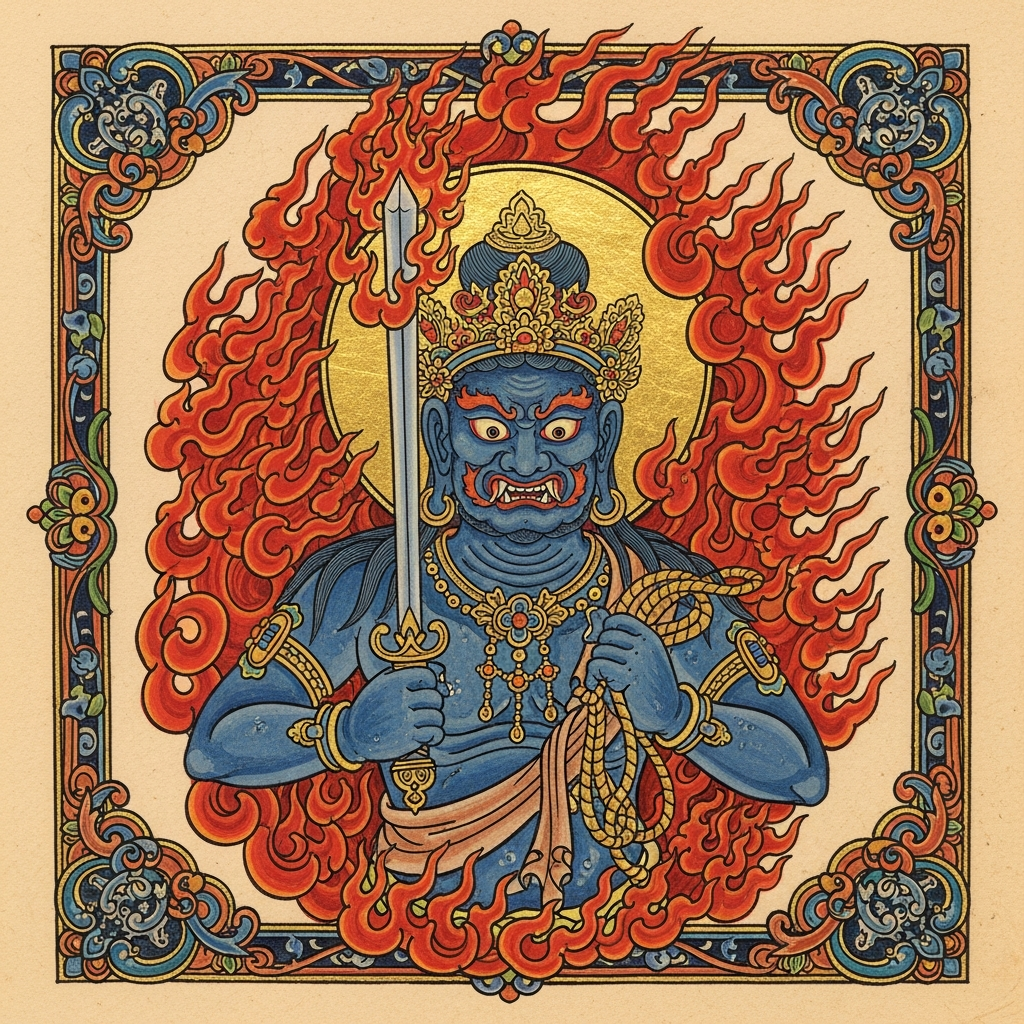
| Fudo Myoo | 92 | 98 | 88 | 60 | 90 | S — Cosmic |
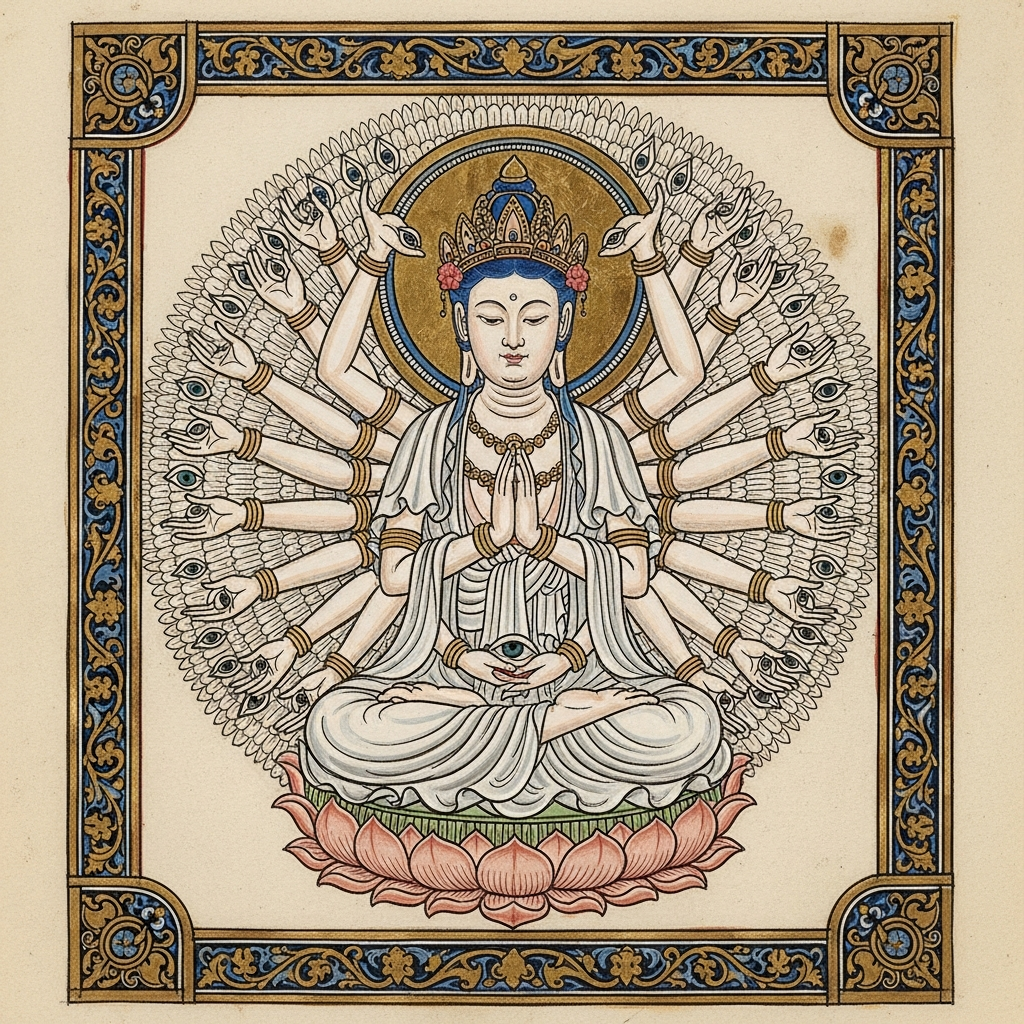
| Kannon | 45 | 85 | 100 | 90 | 92 | S — Cosmic |
| Kitsune | 55-80 | 60-85 | 65-95 | 85 | 90 | B-A (varies by age) |
| Tengu | 82 | 75 | 68 | 92 | 78 | A — Archangelic |
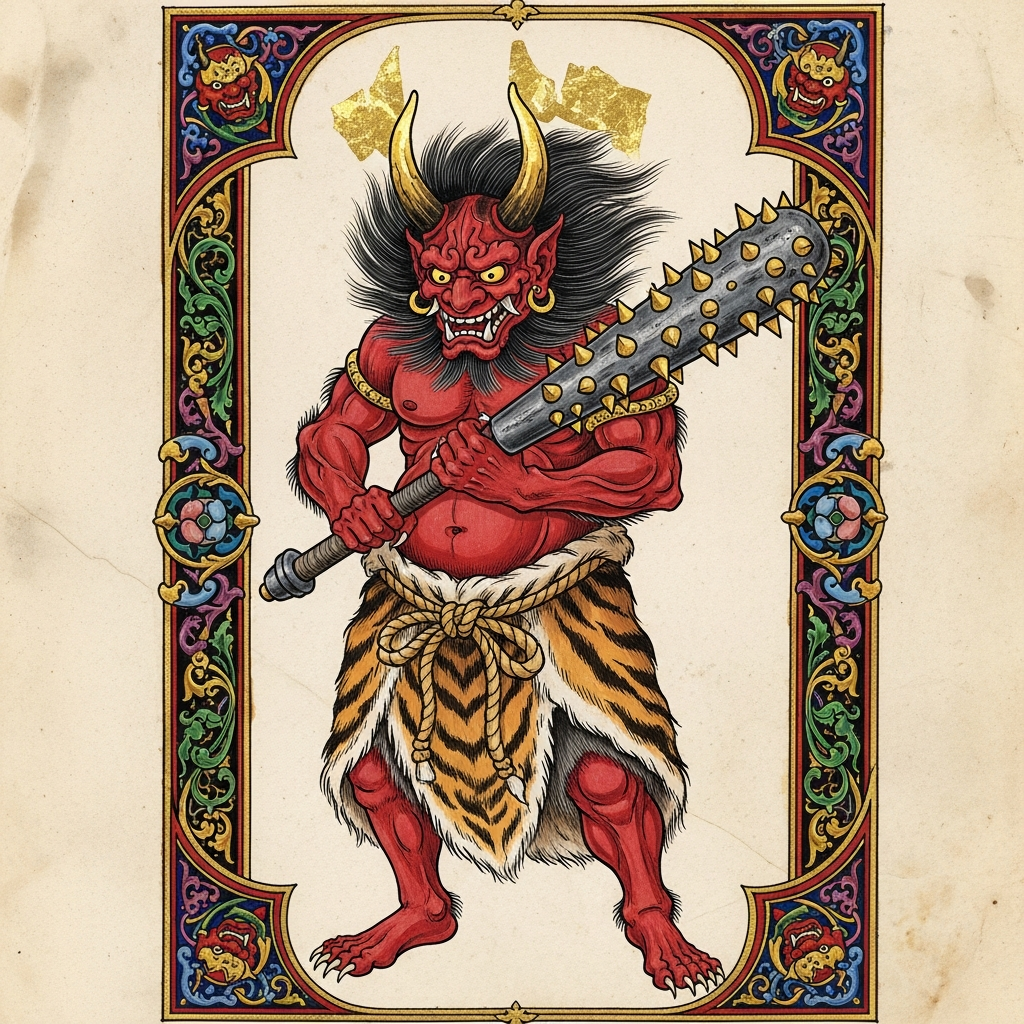
| Oni | 88 | 85 | 30 | 65 | 40 | B — Greater |
| Kappa | 55 | 50 | 35 | 70 | 60 | C — Lesser |
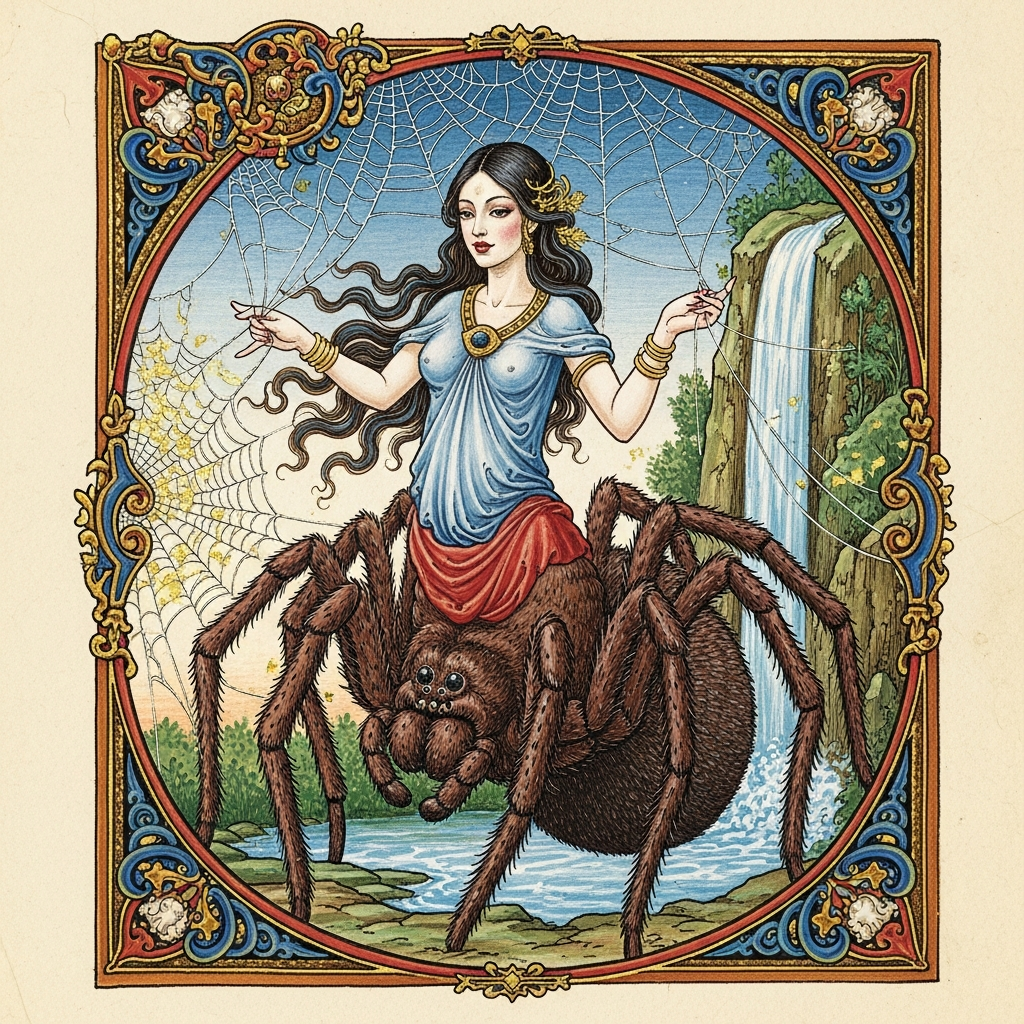
| Jorogumo | 72 | 60 | 55 | 78 | 88 | B — Greater |
| Yomi | — | 100 | 80 | — | — | S — Cosmic (realm) |
| Shinigami | 70 | 65 | 75 | 95 | 72 | B — Greater |
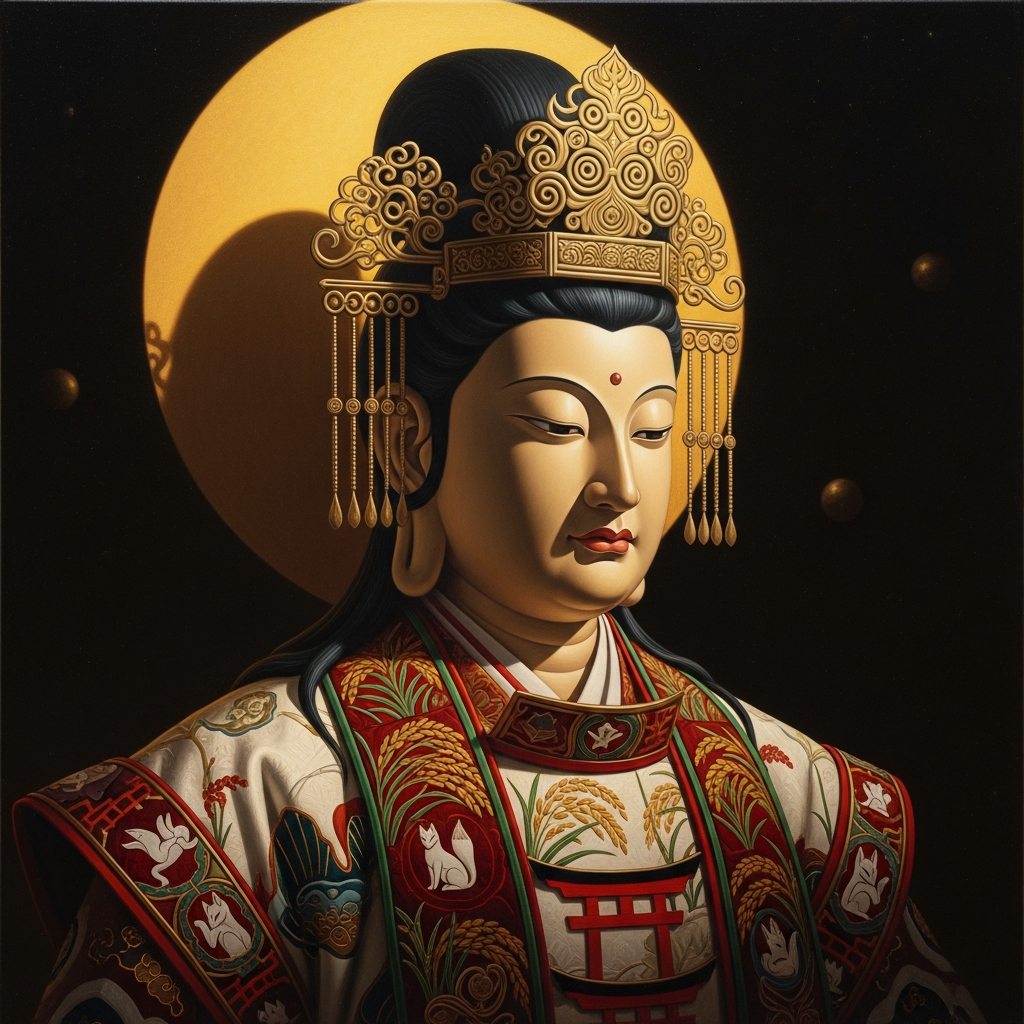
| Inari | 55 | 80 | 92 | 75 | 85 | A — Archangelic |
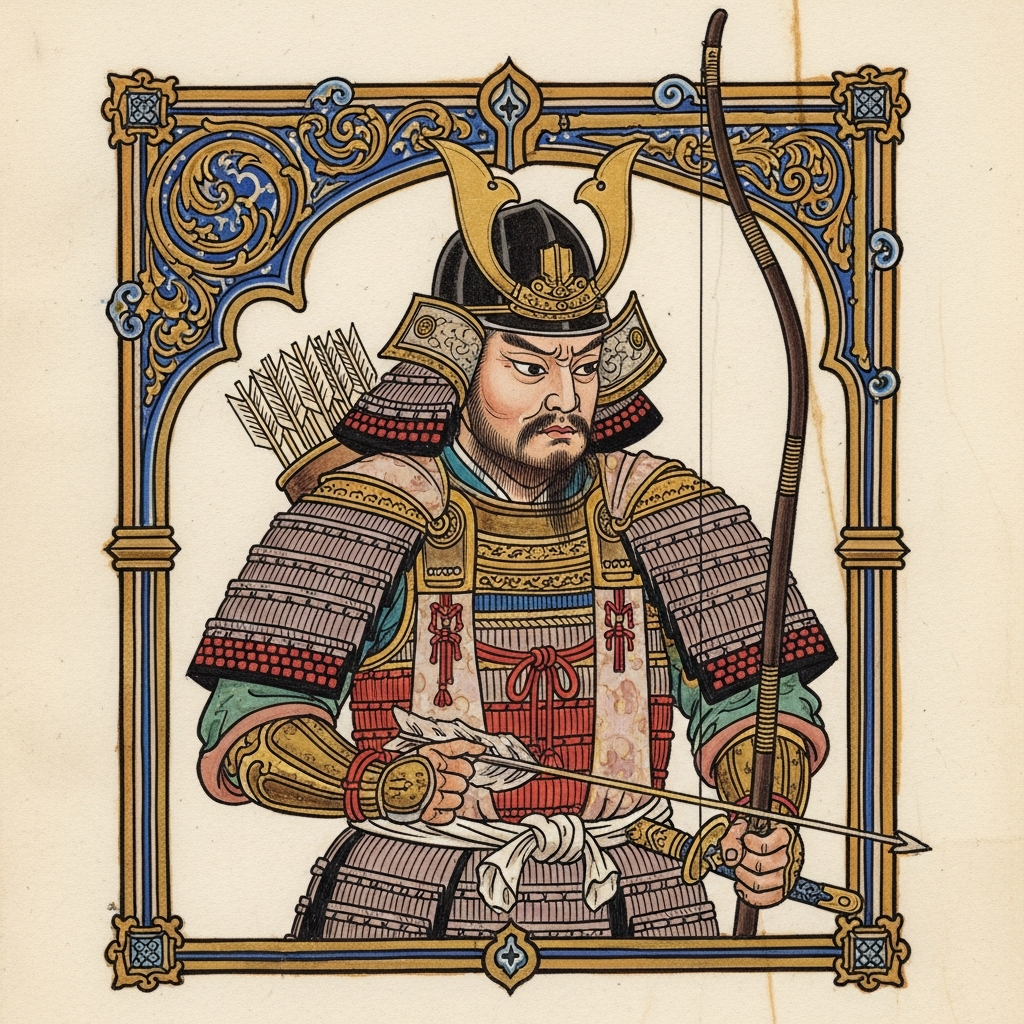
| Hachiman | 90 | 88 | 82 | 80 | 78 | A — Archangelic |
Cross-Tradition Parallels
| Shinto Entity | Closest Parallel | Tradition | Nature of the Parallel |
|---|
| Izanagi & Izanami | Orpheus & Eurydice | Greek | Husband descends to underworld for dead wife; forbidden to look; looks; loses her |
| Izanami (Queen of Yomi) | Ereshkigal / Hel / Persephone | Sumerian / Norse / Greek | Goddess becomes sovereign of the underworld; eating underworld food traps her |
| Amaterasu (cave withdrawal) | Demeter (withdrawal after Persephone) | Greek | Supreme deity withdraws in grief; world suffers; ribald comedy draws them back |
| Susanoo (dragon-slayer) | Perseus / Marduk / St. George | Greek / Mesopotamian / Christian | Hero slays multi-headed monster to save a maiden; finds treasure/weapon within |
| Kitsune (fox-wife) | Selkie / Swan maiden | Celtic / pan-European | Supernatural creature takes human form, marries mortal, is revealed, must depart |
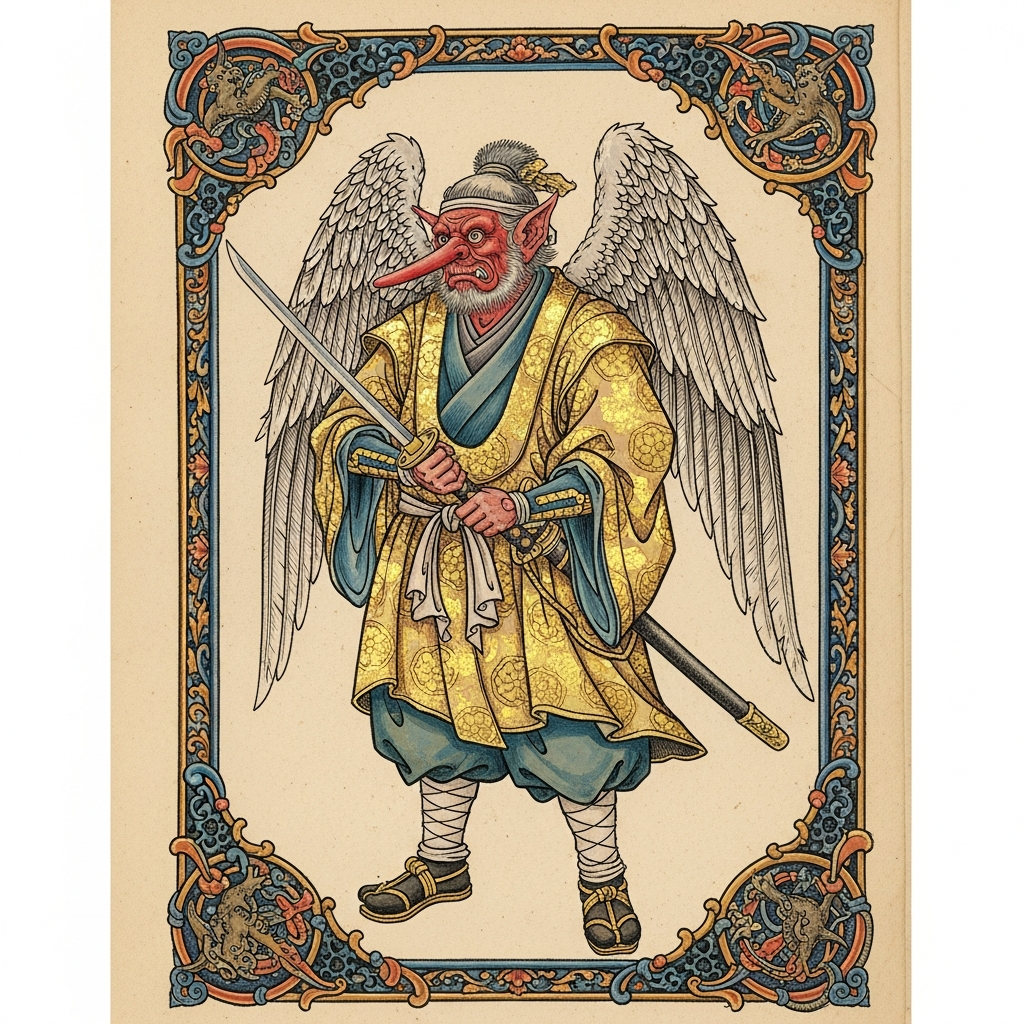
| Tengu (mountain teachers) | Watchers (1 Enoch) / Chiron | Hebrew / Greek | Supernatural beings on mountains who teach forbidden or secret arts to humans |
| Oni | Titans / Shedim / Jotnar | Greek / Hebrew / Norse | Massive, powerful chaotic beings opposing divine order |
| Kappa (head-weakness) | Achilles / Samson | Greek / Hebrew | Single specific vulnerability in otherwise powerful being |
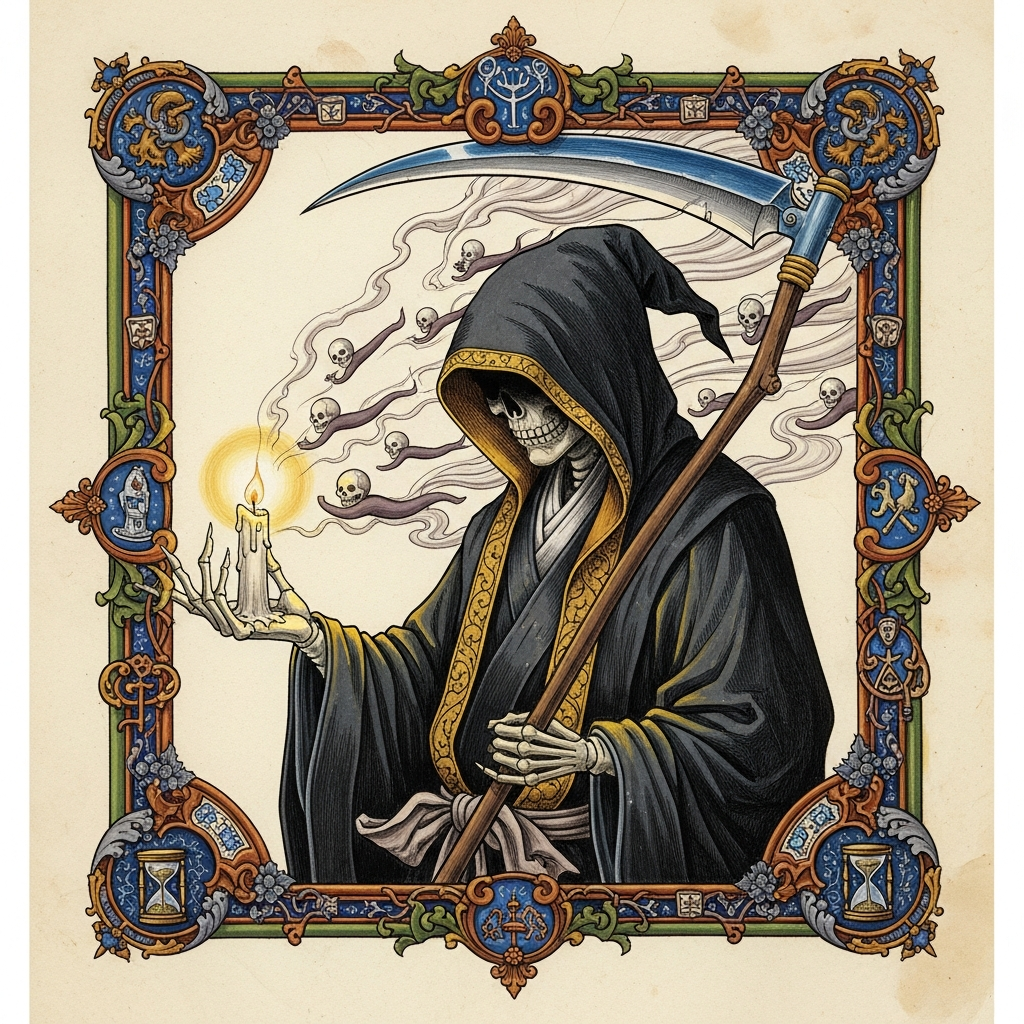
| Shinigami (candle tale) | Godfather Death (Grimm) | German | Death shows candles representing lifespans; mortal tries to cheat; dies |
| Fudo Myoo (wrathful protector) | Cherubim with flaming sword / Michael | Hebrew / Christian | Fierce guardian with flaming weapon protecting sacred boundary |
| Kannon | Virgin Mary | Catholic | Compassionate intercessor; most popular figure for personal devotion; gender-transformed across cultures |
| Yomi | Sheol | Hebrew | Neutral underworld for all dead regardless of moral standing; not punitive |
| Hachiman (kamikaze) | Patron saints in battle | Christian | Divine intervention attributed to supernatural protector during military crisis |
| Jorogumo | Lilith / Arachne | Jewish / Greek | Seductive/predatory feminine supernatural figure associated with webs and entrapment |
Scholarly Note on Sources and Sensitivity
Shinto is a living religious tradition practiced by over 80 million people. The entities described here are not fictional characters from an obsolete mythology — they are kami venerated at shrines throughout Japan today. Amaterasu is worshipped at the Ise Grand Shrine, which is ritually rebuilt every 20 years (the most recent reconstruction was in 2013). Inari’s 32,000 shrines see daily offerings. Millions participate in Setsubun, Shichi-Go-San, and other festivals rooted in the traditions described above. The yokai, while occupying a different cultural register than the great kami, remain deeply embedded in Japanese folk religion, regional identity, and artistic tradition.
The Kojiki and Nihon Shoki were court-commissioned texts with political purposes — they were written to legitimize the imperial dynasty’s divine descent from Amaterasu. They do not represent the full range of Shinto belief and practice any more than the Pentateuch represents the full range of Jewish belief and practice. Regional shrine traditions, oral folklore, and the rich literature of yokai studies (from Toriyama Sekien through Yanagita Kunio to modern ethnographers) provide essential supplements.
The Shinto-Buddhist synthesis described in this document was real, profound, and enduring. The Meiji-era forced separation was an act of political violence against a living religious tradition. Any study of Japanese religion that treats Shinto and Buddhism as wholly separate systems is reflecting 19th-century nationalist ideology, not the 1,300 years of syncretic practice that preceded it.
Sources & Further Reading
-
Kojiki (“Record of Ancient Matters,” 712 AD) — O no Yasumaro, commissioned by Empress Genmei. The oldest surviving Japanese text. Contains the creation myths, the divine genealogies, and the early Imperial legends. The foundational text for Shinto theology. English translations: Basil Hall Chamberlain (1882); Donald Philippi (1968); Gustav Heldt (2014).
-
Nihon Shoki (also Nihongi, “Chronicles of Japan,” 720 AD) — The second-oldest text, more politically oriented, with multiple variant versions of key myths. English translation: W.G. Aston (1896).
-
Lotus Sutra (Saddharma Pundarika Sutra) — Chapter 25, “The Universal Gateway of Avalokiteshvara,” is the primary scriptural source for Kannon devotion.
-
Mahavairocana Sutra (Dainichi-kyo) — The foundational text of Shingon esoteric Buddhism and the primary source for Fudo Myoo’s role in Japanese Buddhist practice.
-
Konjaku Monogatarishu (“Tales of Times Now Past,” early 12th century) — A massive collection of over 1,000 tales from India, China, and Japan, including numerous yokai stories.
-
Donald L. Philippi — Kojiki (University of Tokyo Press, 1968). The most widely used English translation of the Kojiki, with extensive scholarly apparatus and appendices.
-
Helen Hardacre — Shinto: A History (Oxford University Press, 2017). Comprehensive historical treatment of Shinto from its origins through the modern period, with particular attention to the Meiji and wartime periods.
-
Joseph Mitsuo Kitagawa — Religion in Japanese History (Columbia University Press, 1966). Foundational study of the interplay between Shinto and Buddhism across Japanese history.
-
Lafcadio Hearn — Glimpses of Unfamiliar Japan (1894); Kwaidan: Stories and Studies of Strange Things (1904). Essential reading, though filtered through a Victorian Romantic lens.
-
Michael Ashkenazi — Handbook of Japanese Mythology (2003). Comprehensive academic reference.
-
Sokyo Ono — Shinto: The Kami Way (1962). Authoritative introduction to Shinto practice and theology.
-
Karen Smyers — The Fox and the Jewel: Shared and Private Meanings in Contemporary Japanese Inari Worship (1999). The definitive study of Inari worship.
-
Mark Teeuwen & Fabio Rambelli, eds. — Buddhas and Kami in Japan: Honji Suijaku as a Combinatory Paradigm (2003). Essential for understanding the Shinto-Buddhist synthesis.
-
Toriyama Sekien — Gazu Hyakki Yagyo (“The Illustrated Night Parade of a Hundred Demons,” 1776) and sequels. The foundational yokai bestiary.
-
Yanagita Kunio — Tono Monogatari (“The Legends of Tono,” 1910). The founding text of Japanese folklore studies.
-
Royall Tyler — Japanese Tales (1987). Excellent anthology of translated folk tales and yokai encounters.
-
Matt Alt — Yokai Attack! The Japanese Monster Survival Guide (2012). Accessible modern reference.
This compendium covers 16 entities from the Shinto and Japanese Buddhist tradition. Shinto is a living faith practiced by over 80 million people. The yokai tradition, while more playful in modern Japanese popular culture, carries centuries of accumulated meaning. The kami are still worshipped. The shrines are still visited. The festivals are still held. The way of the gods continues.
 MYTHIC
  LEGENDARY
  LEGENDARY
  MYTHIC
  RARE
RARE 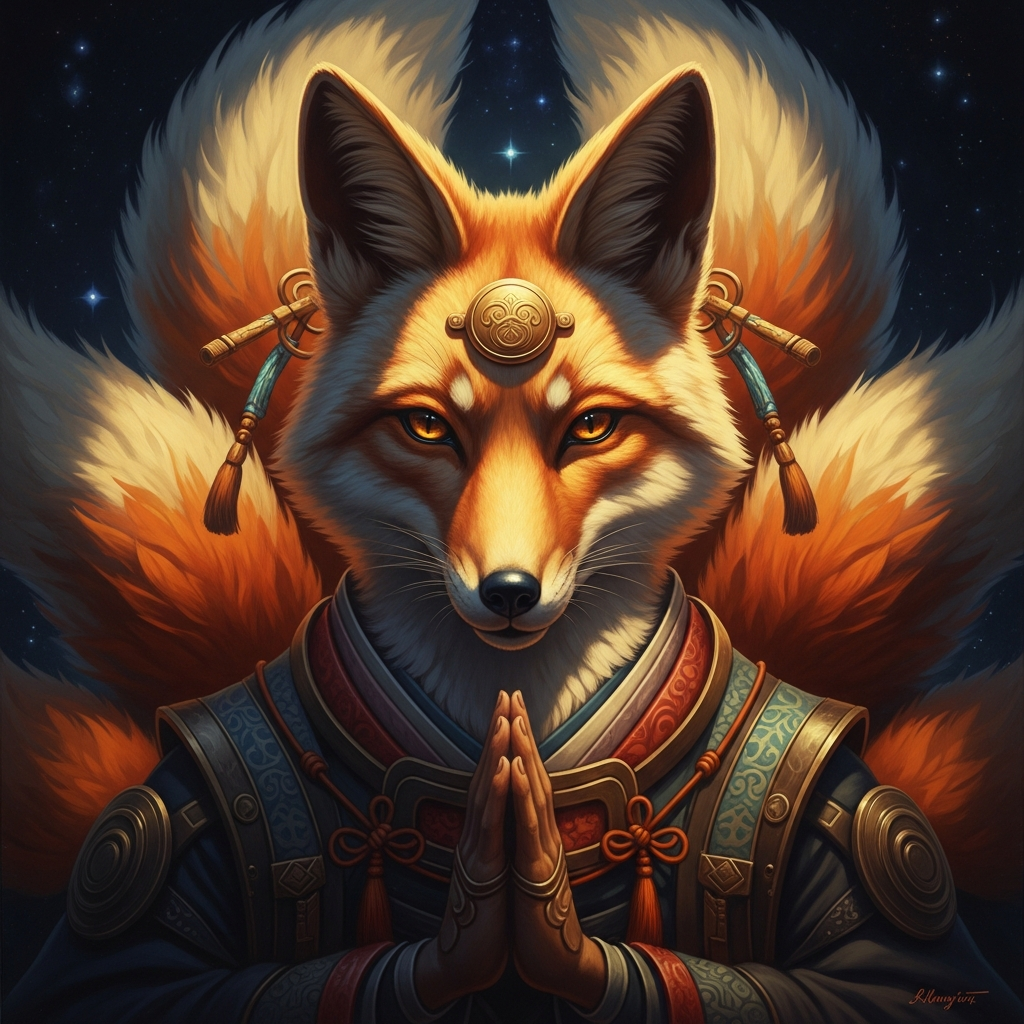
 RARE
RARE 
 LEGENDARY
 LEGENDARY
 MYTHIC