The Story
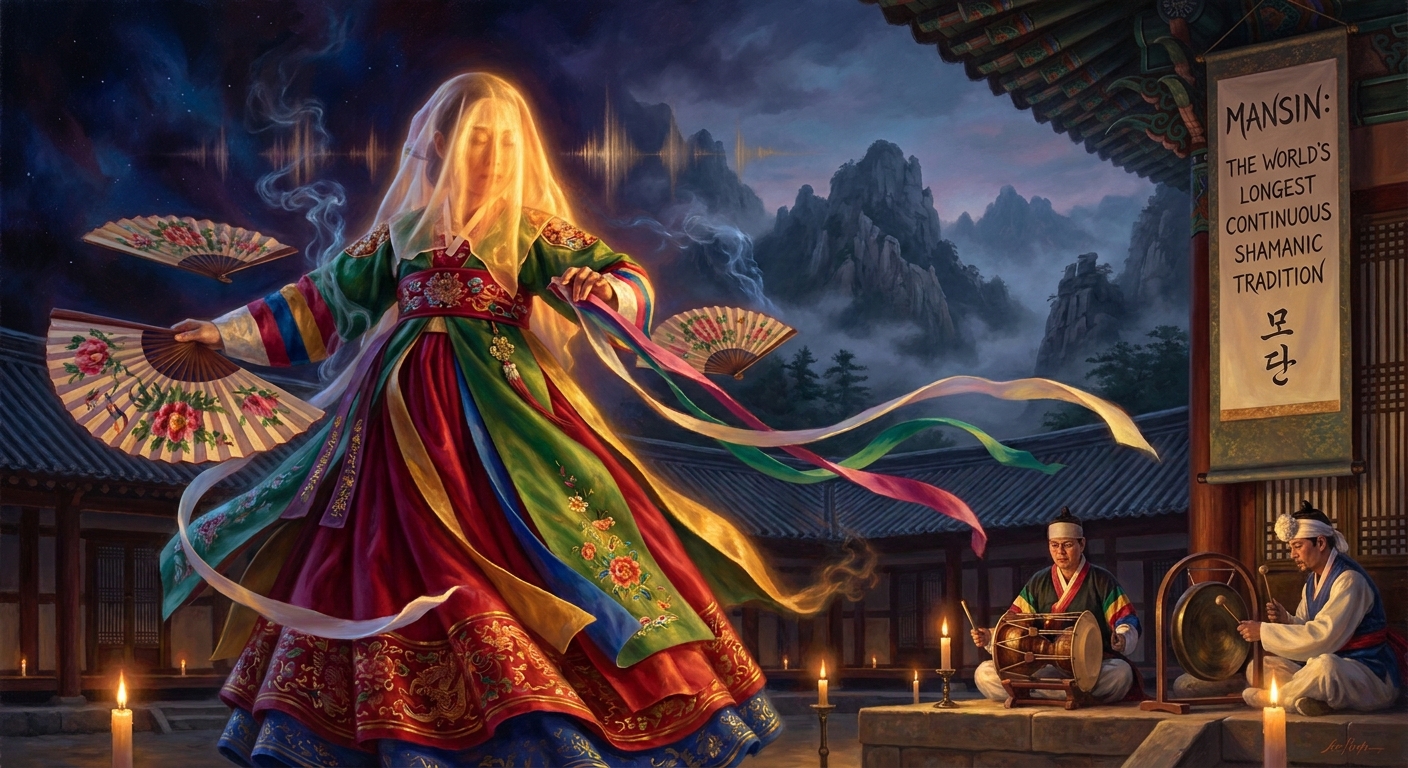
Korean religion is a layered palimpsest: shamanism beneath Buddhism beneath Confucianism beneath Christianity, all four active simultaneously—often in the same household. No religious landscape on earth quite resembles it. The layering itself is the distinctively Korean fact.
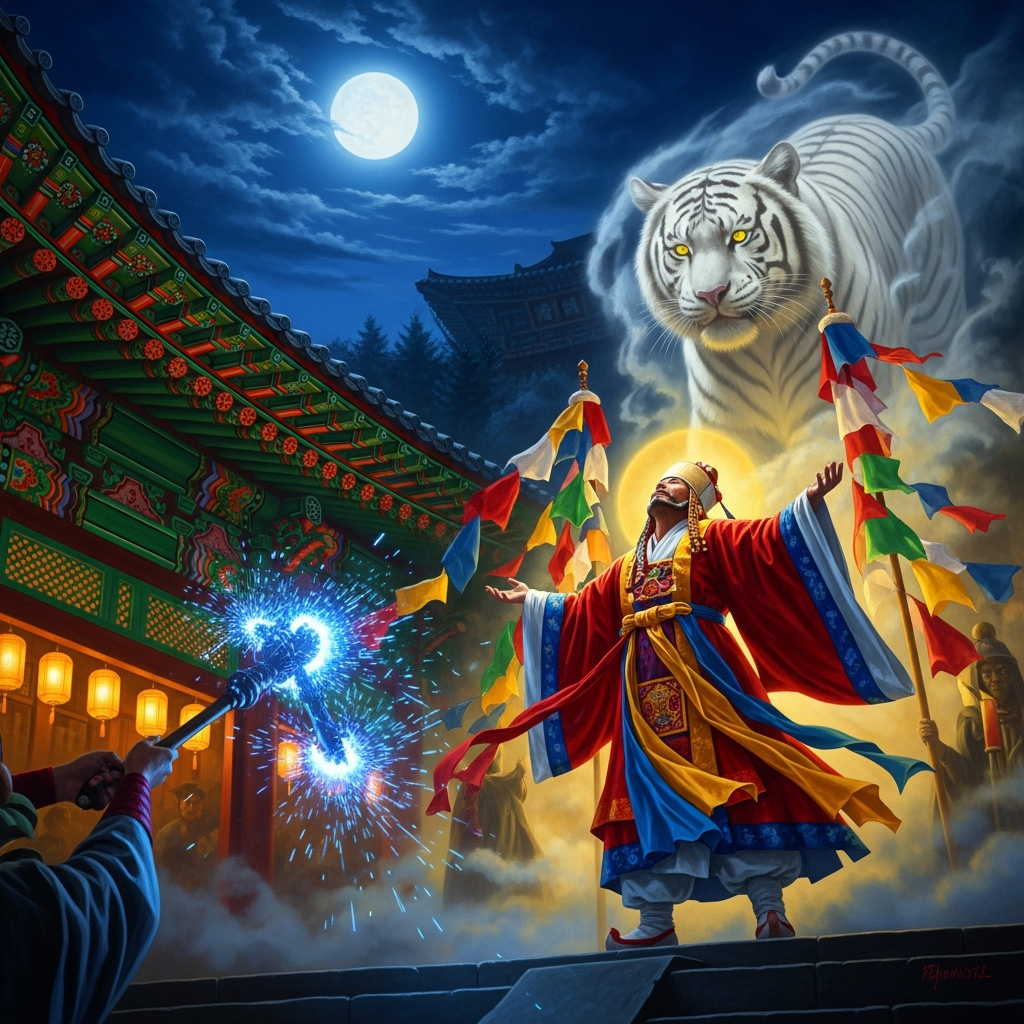
Muism, the substrate (prehistoric–present): Korean shamanism ranks among the world’s oldest continuously practiced traditions. The mudang—almost always female—predates writing, Buddhism, and the Korean state. She enters trance, hosts gods in her body, dances with knives and bells, performs the kut (ritual ceremony) to heal, settle restless dead, and broker between spirit and ordinary life (Samguk Yusa). Every religion that arrived in Korea had to negotiate with her. None displaced her.
Founding myth (~2333 BCE traditional): Hwanung, son of the sky god Hwanin, descends to Mount Taebaek with three thousand spirit-followers. A bear and a tiger pray to become human; the bear endures twenty-one days of garlic and mugwort in a cave and becomes a woman, Ungnyeo. She marries Hwanung. Their son Dangun founds Gojoseon in 2333 BCE (traditional reckoning, Tan’gun Sinhwa). Dangun remains the founding ancestor of the Korean nation, myth or memory either way.
Buddhism arrives (372 CE): Sundo, a Chinese monk, brings Buddhism to the Goguryeo court (Samguk Sagi). It spreads to Baekje (384) and Silla (527, Samguk Yusa), becoming state religion and shaping the Hwarang warrior-aristocracy. Through unified Silla and Goryeo (918–1392), Buddhism dominates institutionally: temple-states, vast monasteries, the Tripitaka Koreana (81,258 carved woodblocks, still at Haeinsa). Buddhism doesn’t replace shamanism; it absorbs and is absorbed. Mountain spirits get shrines inside Buddhist temples.
Joseon and Confucian dominance (1392–1897): The Joseon dynasty makes Neo-Confucianism state ideology and systematically suppresses both Buddhism and shamanism. Monks are banned from cities. Mudang are taxed, shamed, occasionally rounded up. Confucian ancestor rites, civil-service exams, and patriarchal lineage structures reorder Korean society. Buddhism survives in mountain monasteries; shamanism survives in households, women’s quarters, villages.
Catholic self-evangelization (1784): Korean Catholicism is unique: Koreans converted before missionaries arrived. Korean scholars in Beijing encountered Jesuit texts, baptized themselves, returned home, and converted others. Yi Seung-hun, baptized in Beijing in 1784, brought the faith back. The Joseon court viewed Catholic refusal of ancestor rites as treason and launched persecution waves (Hwang Sayoung Letter). Thousands were martyred between 1801 and 1866. Korea has more canonized saints than nearly any country (103 canonized, 124 beatified).
Protestant arrival and Pyongyang Revival (1885–1907): Protestant missionaries (Horace Allen, Horace Underwood, Henry Appenzeller) arrived after the 1882 treaty opened Korea. They built schools and hospitals. In 1903–1907 a massive revival broke out in Pyongyang: mass confession, all-night prayer, tens of thousands converted. Pyongyang became “the Jerusalem of the East.” This revival is the origin event of Korean Christianity as a mass movement.
Twentieth century rupture: Japanese colonization (1910–1945), the Korean War (1950–1953), and partition split the religious landscape. North Korea imposed Juche—state ideology with religious features built around the Kim family—and crushed organized religion. South Korea became Asia’s most evangelical Christian nation. The peninsula’s two halves became theological opposites in a single generation.
Today: South Korea is roughly 30% Christian (Protestant/Catholic split), 25% Buddhist, 50% claiming no formal religion—yet the kut is still performed, ancestors honored at Chuseok, megachurches seat tens of thousands, Buddhist temple stays draw pilgrims and tourists. Roughly 15 million Korean Christians worldwide. North Korea remains officially atheist under Juche; religion driven underground. The mudang’s drum, four thousand years on, has not stopped.
Pivotal Events
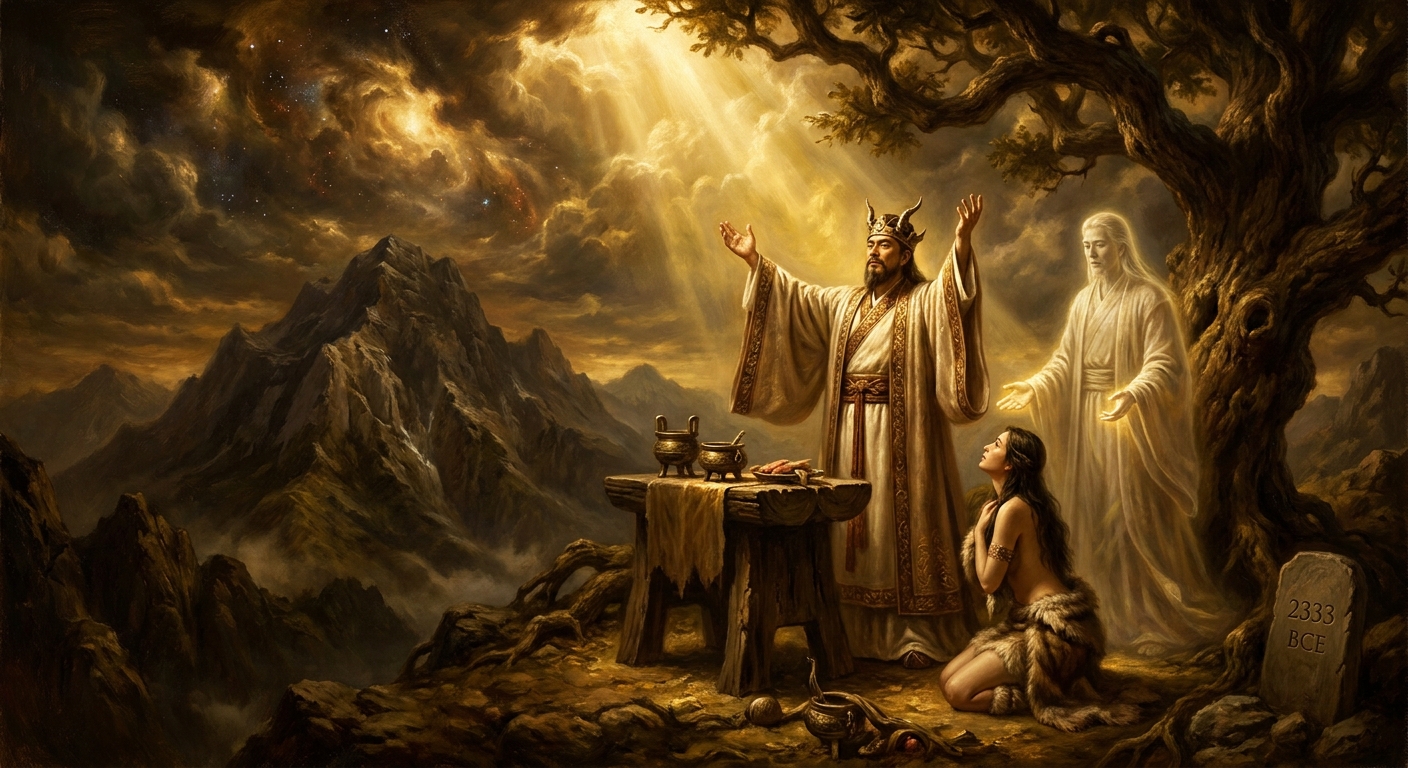
The founding story begins with descent from heaven. Hwanung, son of sky god Hwanin, comes down to Mount Taebaek with three thousand spirit-followers, bringing gods of wind, rain, clouds (Tan’gun Sinhwa). A bear and tiger pray to become human; only the bear—enduring twenty-one days in a cave with garlic and mugwort—succeeds. She becomes Ungnyeo, marries Hwanung, bears Dangun, who founds Gojoseon (traditionally 2333 BCE). Whether historical, semi-historical, or wholly mythic, Dangun remains the nation’s ancestral founder—the figure both Koreas trace identity to. The myth itself grounds muism: the divine descends, marries the earth, and the result is us.
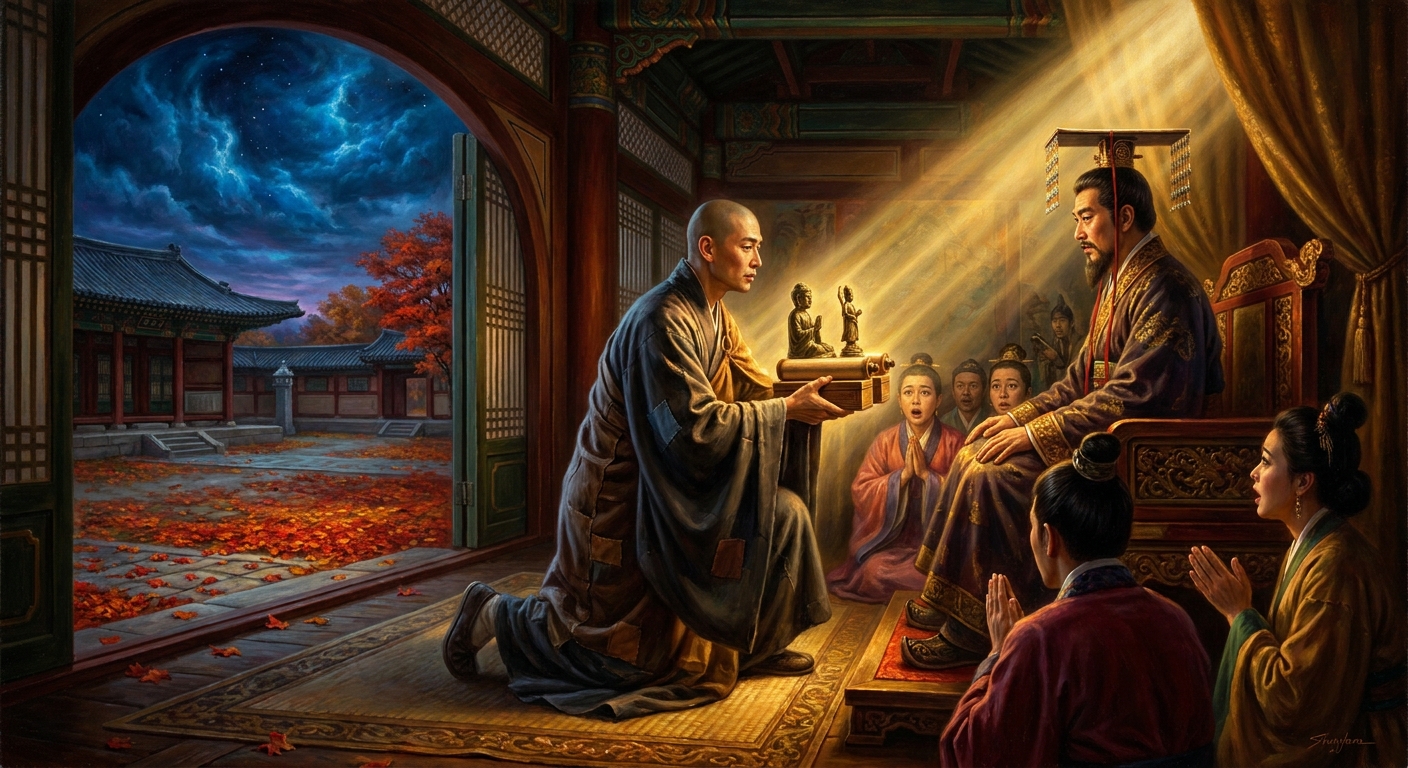
In 372 CE, Chinese monk Sundo arrived at King Sosurim’s court in Goguryeo carrying scriptures and images (Samguk Sagi). He was received as ambassador of a foreign god. Within a generation Buddhism became Goguryeo’s state religion; within two centuries it spread to all three kingdoms (Baekje 384, Silla 527 after Ichadon’s martyrdom, Samguk Yusa). Through unified Silla (668–935) and Goryeo (918–1392), Buddhism shaped civilization everywhere: art, architecture, statecraft, military ethics (the Hwarang code), and the Tripitaka Koreana (81,258 hand-carved woodblocks, still at Haeinsa Temple). Buddhism never displaced muism; the two fused. Mountain spirits got shrines inside Buddhist compounds. Bodhisattvas absorbed shamanic functions.
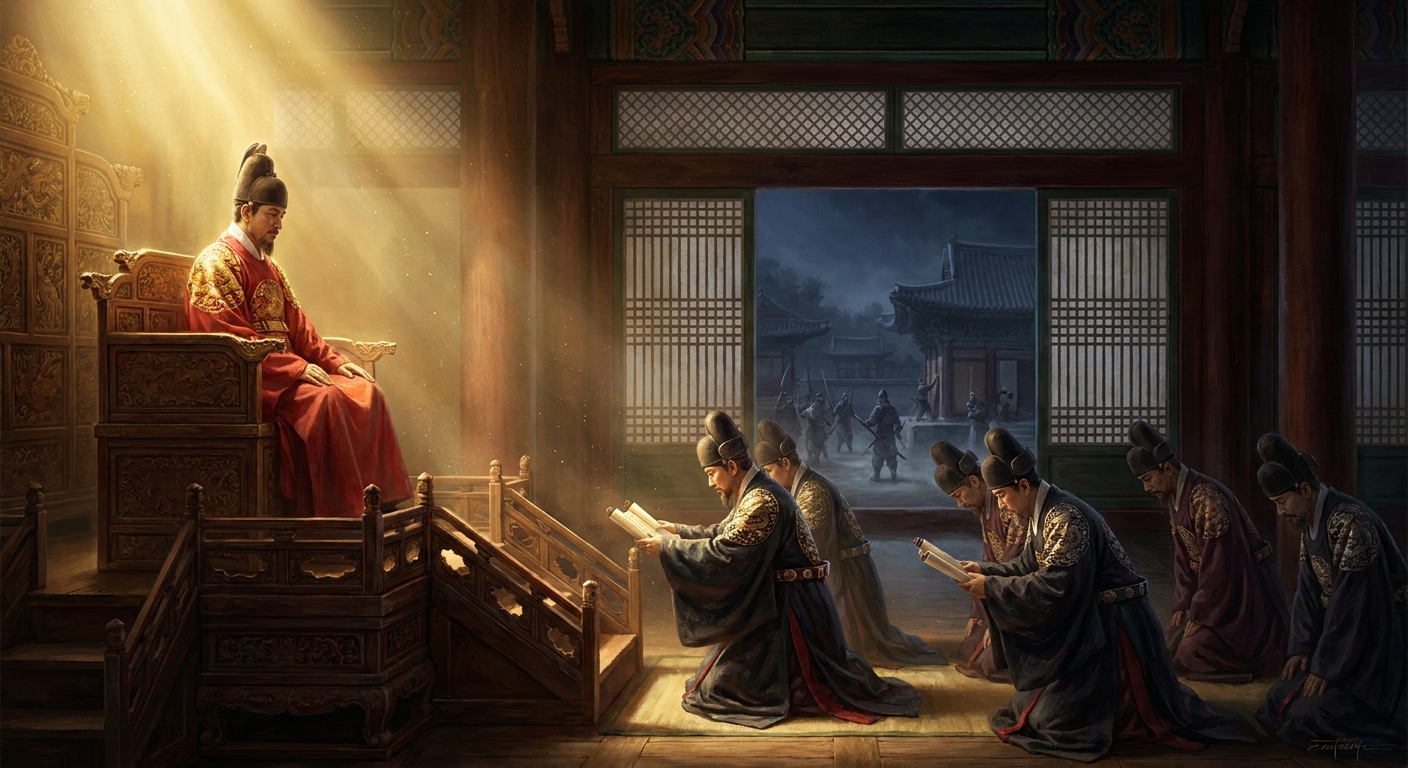
When General Yi Seong-gye founded the Joseon dynasty in 1392 (Joseon Wangjo Sillok), he reversed five hundred years of Buddhist statecraft. Neo-Confucianism became official ideology. Buddhist monasteries lost land and slaves; monks were banned from the capital; state exams excluded Buddhist content. Shamanism faced parallel suppression: mudang were taxed, shamed, occasionally rounded up. Joseon rebuilt society around Confucian patriarchy, ancestor rites, civil-service meritocracy, rigid class (yangban, sangmin, cheonmin). Buddhism retreated to mountain temples and the women’s quarter; shamanism to households and villages. Five centuries of suppression produced a Korea officially Confucian, privately Buddhist, and shamanic at the household altar.
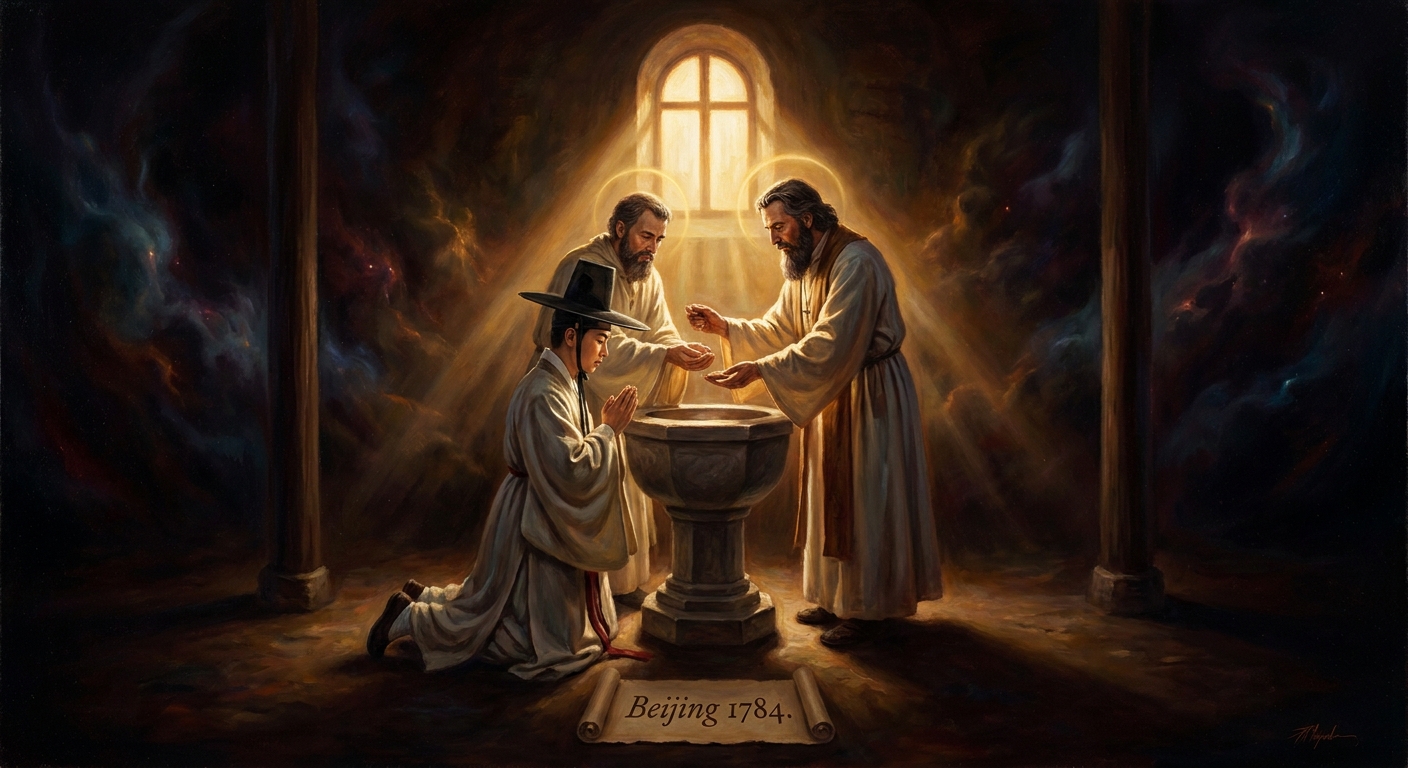
Korean Catholicism is the only major Christian tradition that began without missionaries. Korean Confucian scholars in Beijing in the eighteenth century encountered Jesuit texts and converted by reading them. They baptized each other, returned home, and started a church. Yi Seung-hun, baptized in Beijing in 1784 (taking the name Peter), is counted as the first Korean Catholic. Within a decade, thousands had converted—no foreign priests present. The Joseon court viewed Catholic refusal of ancestor rites as treason against Confucian order and launched persecution waves (1801 Sinyu Persecution, 1839 Gihae, 1846 Byeong-o, 1866 Byeongin). Tens of thousands were martyred. The Church has canonized 103 Korean martyrs and beatified 124 more—one of the world’s largest national martyrologies.
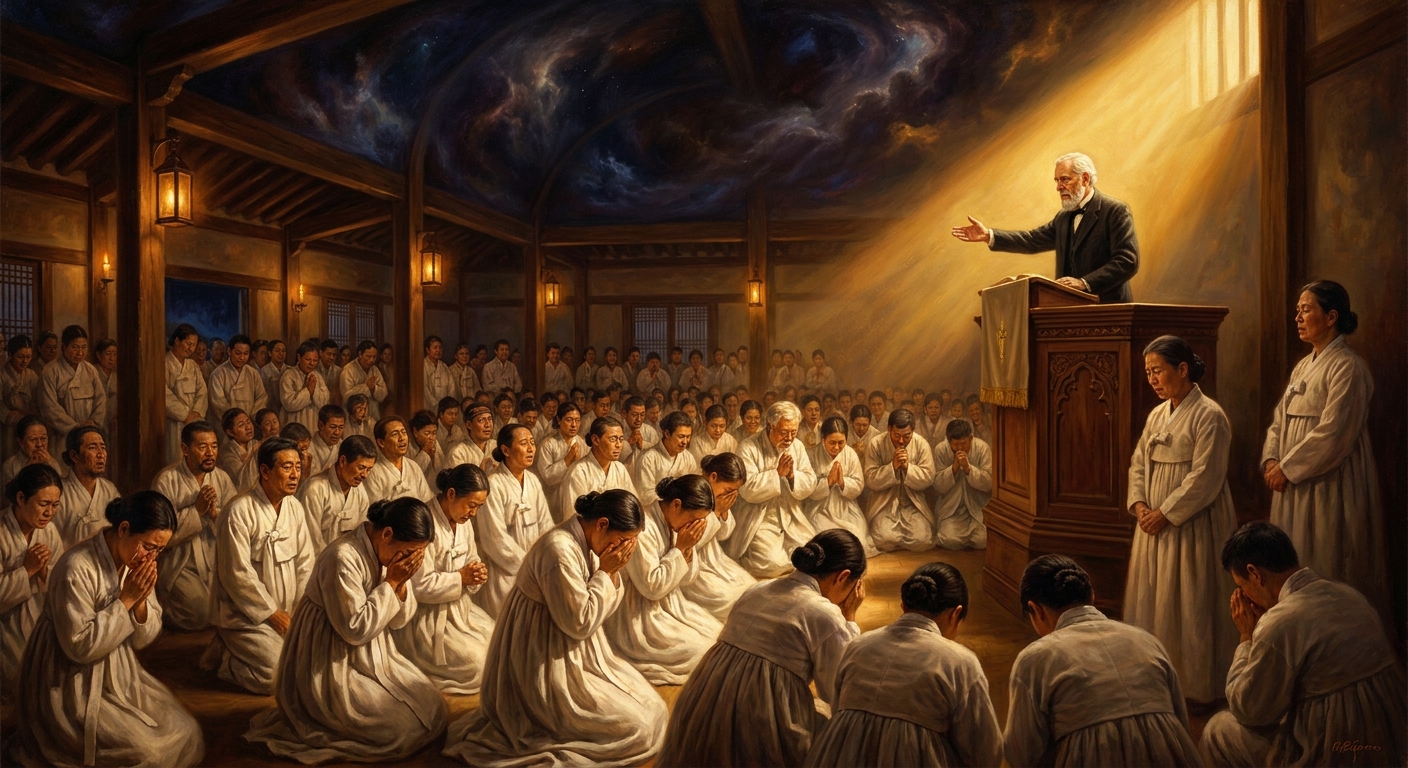
In autumn 1903, at a Methodist mission station in Wonsan, missionaries began prayer that escalated into mass confession and conversion. The movement spread to Pyongyang, where in January 1907 it erupted into the great Korean Revival: thousands packed churches for all-night prayer, weeping confessions, mass baptisms (mission records). Pyongyang became “the Jerusalem of the East,” with more Christians per capita than any Asian city. The revival fused evangelical Protestantism with the affective intensity of a kut ceremony: ecstatic prayer (tongsung kido), spiritual healing, bodily release. This is the origin event of Korean Christianity as mass movement—the engine that produced megachurches, global Korean missionary movements (now second-largest after the US), and—bitterly—a Pyongyang that within forty years became the global capital of state atheism under Juche.
Timeline
| Era | Date | Event | Source |
|---|
| Prehistoric | before recorded history | Mudang shamanism practiced on the Korean peninsula | archaeological / oral tradition |
| Mythic Founding | ~2333 BCE (traditional) | Dangun founds Gojoseon at Mount Taebaek | Samguk Yusa |
| Bronze / Iron Age | ~1000-300 BCE | Tribal confederations; bronze ritual implements (mirrors, daggers, bells) | archaeology |
| Three Kingdoms Begin | 57 BCE - 668 CE | Goguryeo, Baekje, Silla emerge | Samguk Sagi |
| Buddhism Arrives | 372 CE | Sundo brings Buddhism to Goguryeo court | Samguk Sagi |
| Buddhism in Baekje | 384 CE | Marananta brings Buddhism to Baekje | Samguk Sagi |
| Ichadon’s Martyrdom | 527 CE | Buddhism adopted by Silla after Ichadon’s miraculous death | Samguk Yusa |
| Unified Silla | 668-935 | Buddhism flourishes; Hwarang warrior-aristocracy | Samguk Sagi |
| Goryeo Dynasty | 918-1392 | State Buddhism; Tripitaka Koreana (81,258 woodblocks) carved 1236-1251 | Goryeosa |
| Joseon Founded | 1392 | Yi Seong-gye establishes Joseon; Neo-Confucianism becomes state ideology | Joseon Wangjo Sillok |
| Hangul Created | 1443-1446 | King Sejong promulgates the Korean alphabet | Hunminjeongeum |
| Catholic Self-Evangelization | 1784 | Yi Seung-hun baptized in Beijing; first Korean Catholics | Catholic Church records |
| First Persecution | 1801 | Sinyu Persecution; hundreds of Catholics martyred | Hwang Sayoung Letter |
| Major Persecutions | 1839, 1846, 1866 | Gihae, Byeong-o, and Byeongin persecutions; thousands killed | Korean Martyrs records |
| Protestants Arrive | 1885 | Underwood (Presbyterian) and Appenzeller (Methodist) reach Korea | mission records |
| Korea Opens | 1882-1910 | Treaty ports; missions establish schools and hospitals | diplomatic records |
| Pyongyang Revival | 1903-1907 | Mass confession and conversion; Pyongyang as “Jerusalem of the East” | mission records |
| Japanese Colonization | 1910-1945 | Forced Shinto worship; church resistance | colonial archives |
| Korean War & Partition | 1950-1953 | Religious landscape split; mass Christian flight south | historical records |
| Juche Established | 1955 onward | North Korea imposes Juche; religion driven underground | DPRK state texts |
| Megachurch Era | 1970s-2000s | Yoido Full Gospel Church (Cho Yonggi) becomes world’s largest congregation | church records |
| 103 Martyrs Canonized | 1984 | Pope John Paul II canonizes Korean martyrs in Seoul | Vatican records |
| Present | 2026 | South Korea: ~30% Christian, ~25% Buddhist, ~50% no formal religion; kut still practiced | demographic surveys |
Introduction
Korean shamanism, called muism (무교) in Korean, is not a relic of the past. It is a living tradition, practiced today by approximately 300,000 shamans (mostly women) in Korea. Unlike many spiritual traditions that exist as historical artifacts, muism continues to evolve, adapt, and serve communities through gut ceremonies, healing rituals, and the mediation between human and spirit worlds. At its heart stands the mudang—the shaman—whose ecstatic trance and drumming bridge the visible and invisible.
The entities of Korean shamanism reflect a cosmology where:
- The divine descends to earth (Hwanung)
- Humans inherit divine bloodline (Dangun, founder of Korea)
- Spirits inhabit objects, mountains, and the liminal spaces
- Shamans are possessed, not controlled—they dance in union with gods
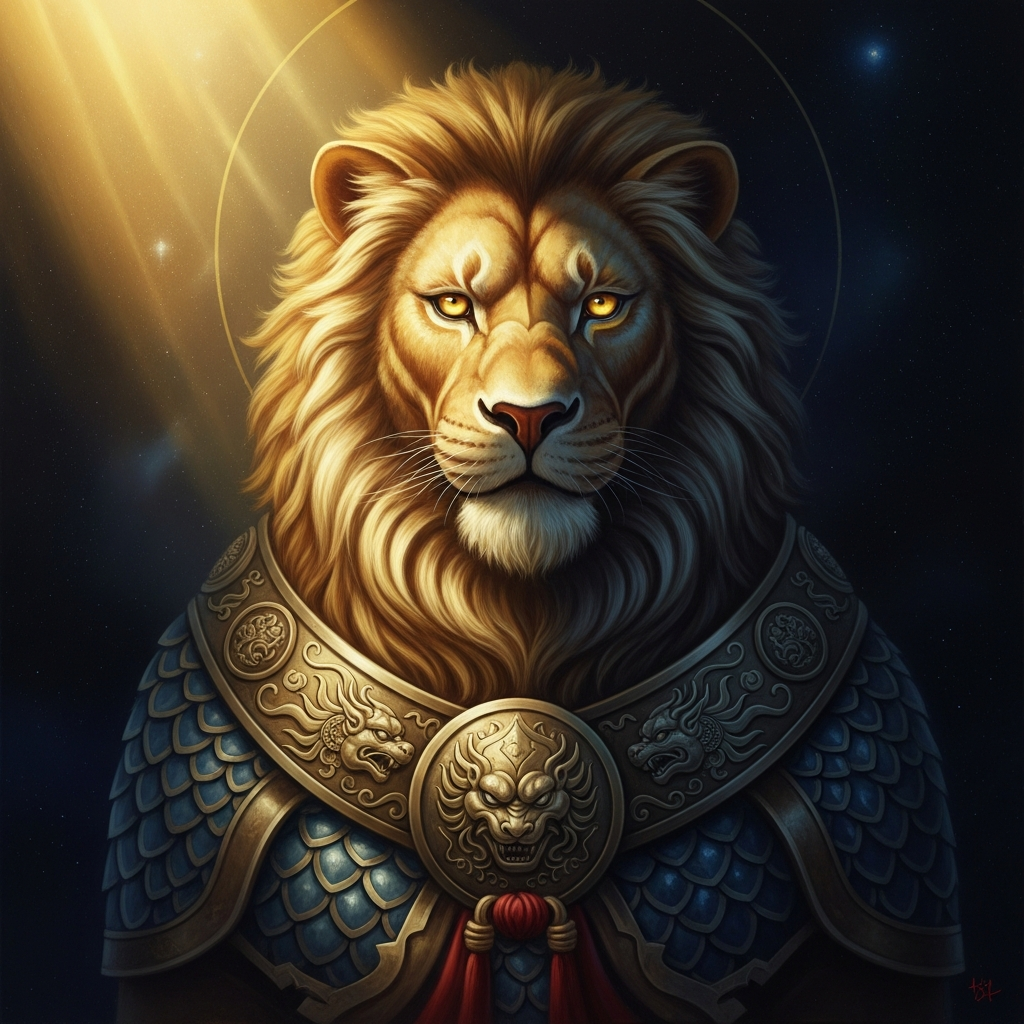
- Right action and virtue carry cosmic weight (Haetae judges)
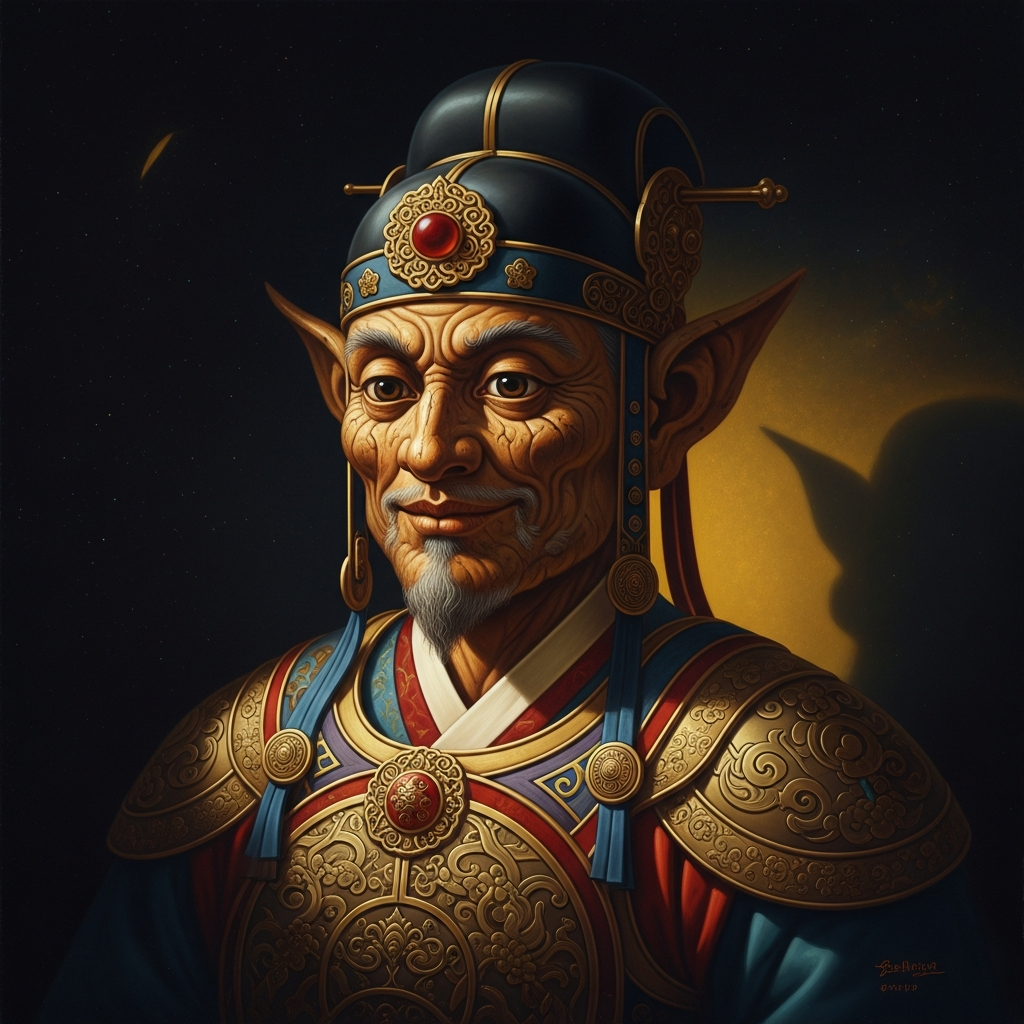
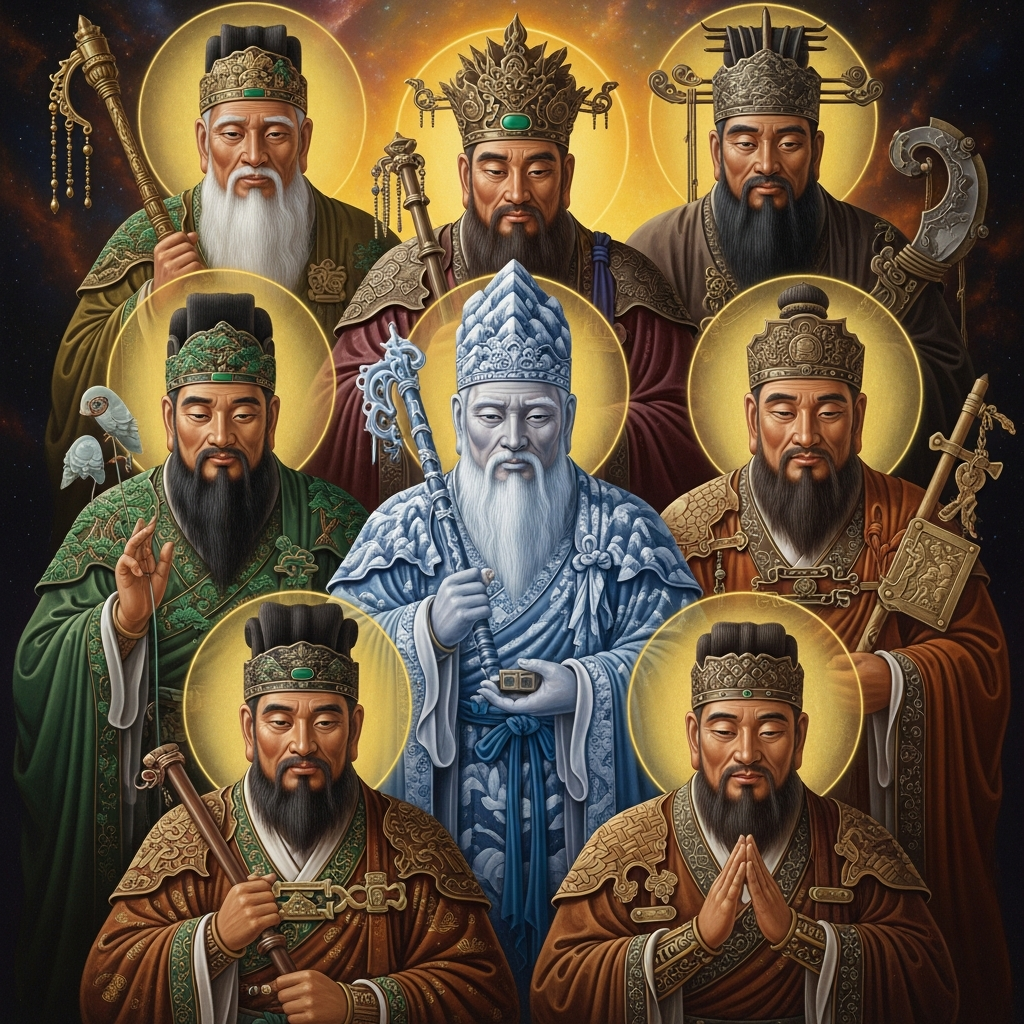
This section presents eight key entities from muism, with emphasis on the Mudang as the living center of the tradition—the one who embodies the ecstatic union of human and divine.
The Centerpiece: The Gut — When the Shaman Dances
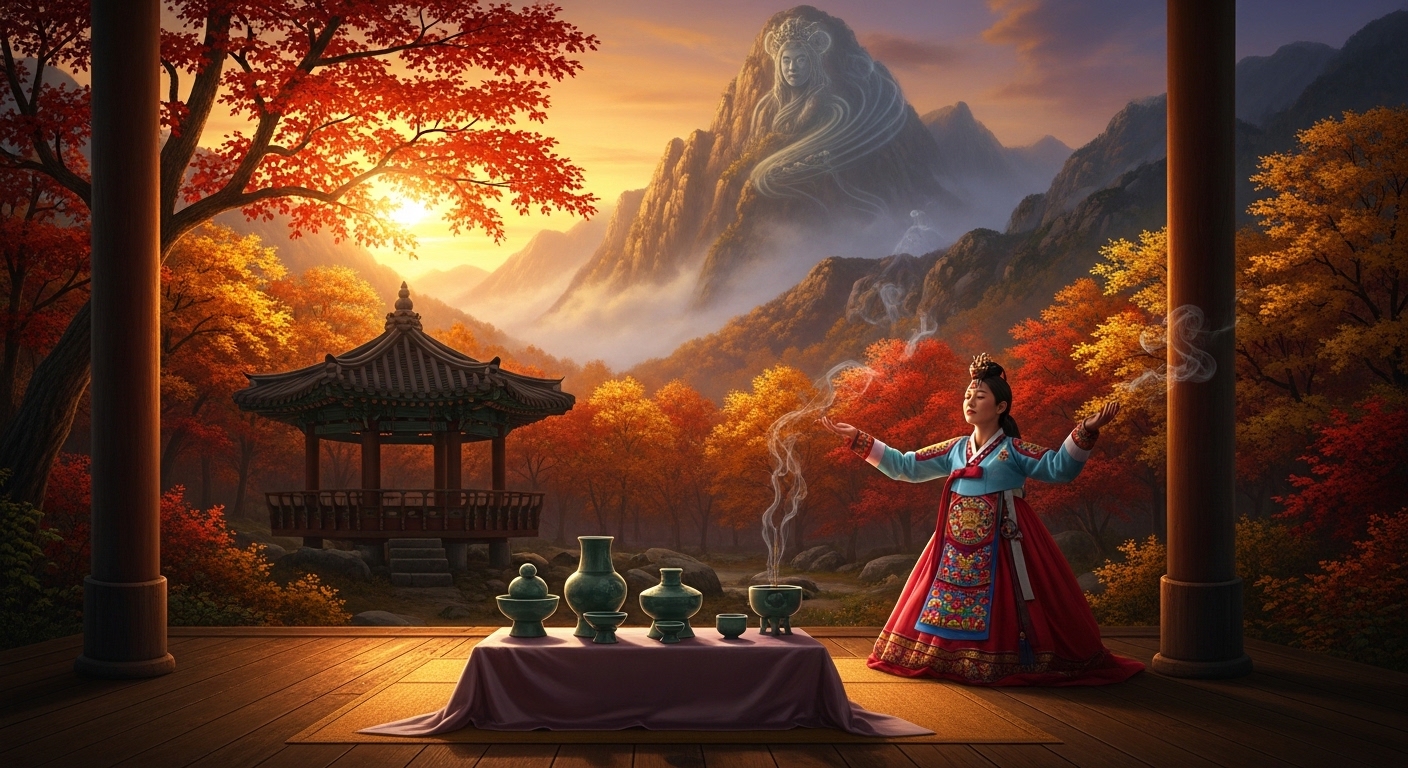
The gut (굿) is the ritual heart of muism. A gut can last hours, days, or weeks depending on its purpose. The space is prepared: an altar, musicians, family members of the person for whom the ceremony is held, and the mudang. The drumming begins—a rhythm that will not stop.
The mudang dances. At first, she is still herself—conscious, aware, moving deliberately to the drum. Then the boundary dissolves. She is no longer in the room; she is in the spirit. Her body becomes the conduit. Ancestors speak through her mouth. Gods dance through her limbs. She whirls, stamps, convulses, speaks in voices not her own. Sometimes she bleeds. Sometimes she laughs with a joy that is not human. Sometimes she collapses, gasping, as if she has traveled infinitely far and returned exhausted.
The gut is not possession in the sense of demonic control. The mudang is not helpless or defeated. Rather, she is transfigured—her consciousness expanded, merged with other agencies. She chooses this union. She calls it down. And when the ceremony ends, she returns to herself, exhausted but whole.
The purpose of the gut varies:
- Kosa: Offerings to ancestors, to maintain the relationship between living and dead
- Gosa: Offerings to gods and spirits of place, for blessing and protection
- Kut: Healing of illness, the calling-back of a lost soul
- Jesa: Memorial for the newly deceased, ensuring safe passage to the afterlife
- Gut geori: The grand, multi-day ceremony to resolve familial or collective trauma
What happens in the gut cannot be fully explained. Illnesses disappear. Families reconcile. The afflicted find peace. Skeptics call it psychology and catharsis. Believers know it as the direct action of the spirits. Perhaps both are true. Perhaps the distinction dissolves in the ecstatic space where human and divine meet.
The gut is not unique. Across the world, at different times, shamans and priests have entered ecstatic states through rhythm, possession, and the deliberate dissolution of the boundary between self and spirit:
In Vodou, the Houngan or Mambo calls down a loa (spirit/god). The possessed person becomes cheval (horse)—mounted by the loa. Like the mudang, the cheval speaks with the loa’s voice, moves with its mannerisms, embodies its presence. The ceremony has the same structure: drumming, dancing, the gradual crossing of the threshold, the moment when the person disappears and the god emerges.
But there is a key difference: in Vodou, the loa is a distinct entity—Legba, Erzulie, Damballa, each with their own personality. The possessed person becomes that specific god. In muism, especially in shamanic traditions emphasizing ancestral connection, the mudang may embody a lineage of ancestors, not a single named god. The possession is more diffuse, more genealogical.
Yet the experience is identical: the body becomes a temporary vessel for powers greater than itself. The drumming drives the crossing. The community witnesses and validates the union. And the ecstatic state produces real effects—healing, resolution, peace.
The Mevlevi dervish performs sema, the whirling ceremony. To an outsider, it appears meditative—the dervish spins continuously, one palm up (receiving divine grace), one palm down (distributing it to the world), moving in precise geometric patterns. The music builds. The dervish enters a state of profound presence, merged with the music and the moment.
The key insight: the dervish is not possessed; the dervish dissolves. The ego, the sense of separate self, spins away. What remains is pure presence—awareness without an “I.” In the Islamic context, this is union with the divine, not through external possession, but through the annihilation of the illusion of separateness.
Compared to the mudang: the mudang dances with gods and ancestors; the dervish dances as none-self, absent of agency. Yet both seek the same transformation: the human self subordinated to larger forces, the boundary dissolved, the ecstasy achieved.
In Pentecostal and Charismatic Christianity, the faithful may speak in tongues—glossolalia—understood as the direct action of the Holy Spirit upon the believer. The person opens themselves to the Spirit. The Spirit seizes their voice, their body, their intention. They speak words they do not know, in languages that may not exist, as vessels for divine utterance.
Like the mudang, the glossolalist is possessed. Unlike the mudang, the Christian tradition emphasizes that the Holy Spirit is precisely not a foreign entity—it is the indwelling divine presence already within the believer, simply powerfully activated. The distinction is theological, not phenomenological: the glossolalist speaks in tongues and the mudang dances in possession, but the experience—the boundary-dissolution, the speaking of what the person does not will—is the same.
All these traditions report the same phenomenon: under certain conditions (drumming, music, intention, community), the human person can enter a state where they are no longer the sole agent of their body and speech. Something larger takes hold. Something speaks through them. Something acts through them.
The scientific answer is usually: this is hypnosis, or dissociation, or the power of suggestion. The neurological answer is: this is the right hemisphere of the brain becoming dominant, or the dissolution of the sense of agency in the brain’s agency-detection networks. These answers are not wrong. But they may also not be sufficient.
The spiritual answer is: yes, under these conditions, the boundary between human and divine is genuinely permeable. The spirit can possess. The god can mount. The ancestor can speak. The ecstasy is not illusion; it is union.
In muism, the answer is practical: it works. The person who enters the gut afflicted leaves it healed. The family fractured by grief and shame leaves it reconciled. The community threatened by bad fortune leaves it blessed. Whether the mechanism is neurological or supernatural, the result is undeniable: the gut transforms.
The Sacred Calendar
Gaecheonjeol (3 October): Dangun’s founding of Korea. Invoked in gut ceremonies to anchor the community in deep time.
Chuseok (Autumn Full Moon): Harvest festival where shamans perform ceremonies to thank gods and ancestors for abundance.
Jesingosa (Spring/Autumn): Seasonal offerings to Sansin (mountain gods) for protection and blessing.
Gut Seasons: Traditionally, the most intensive gut ceremonies occur in spring (renewal) and autumn (harvest), though modern shamans perform gut year-round as requested.
Sources & Further Reading
-
Samguk Sagi (History of the Three Kingdoms, Kim Bu-sik, 1145) — Official chronicle of Goguryeo, Baekje, and Silla
-
Samguk Yusa (Memorabilia of the Three Kingdoms, Iryeon, 1281) — Collection of legends, including Dangun founding myth and Buddhist narratives
-
Tan’gun Sinhwa (Foundation Myth) — Foundational narrative of Gojoseon and Hwanung descent
-
Laurel Kendall, Shamans, Housewives, and Other Restless Spirits (University of Hawaii Press, 1985) — The definitive anthropological study of Korean shamanism, based on fieldwork with mudang.
-
Laurel Kendall, Getting Married in Korea (University of California Press, 1996) — How shamanic ritual structures life transitions.
-
James Huntley Grayson, Korea: A Religious History (RoutledgeCurzon, 2002) — Comprehensive survey of Korean religious traditions from prehistory through modernity.
-
Daniel Kister, Jongmyo Jerye: An Analysis of the Korean Royal Ancestral Rite (University of California Press, 2012) — Royal ceremonies and their relation to popular shamanism.
-
Boudewijn Walraven, Songs of the Immortals: An Anthology of Kishōmon (Brill, 1987) and additional works on Korean shamanism and folk religion.
-
Shamanism in Korea — The UNESCO Intangible Cultural Heritage listings document contemporary mudang and gut practices.
-
Korean Folk Religion and Shamanism — Koreana magazine and the Korea Foundation publish ongoing research in English.
Cross-Tradition Connections
The Mudang and the Oracle: Like the Delphic Oracle, the Sibyl, and the Pythia, the mudang is a woman possessed by divine or ancestral forces, speaking truth that the community cannot otherwise access. Yet unlike the Greek oracles (who spoke in riddles and prophecy), the mudang often addresses immediate, practical concerns—health, family, the location of lost items.
Sansin and Place-Spirits: Like Shinto kami, Islamic djinn, and the land wights of Norse tradition, the Sansin embody the principle that divinity is not abstract and universal, but located, specific, and responsive to local communities.
The Gut and Collective Catharsis: The gut resembles Greek kathexis (catharsis) through drama, Carnival’s ritual reversal, and the communal meal in many traditions—the structured space where normal social order is suspended, emotional truth is released, and the community is renewed.
Hwanung and the Divine King: Like Indra descending to help humanity, Quetzalcoatl in Mesoamerica, or the bodhisattva in Buddhism, Hwanung represents the principle that the divine actively engages with the human—not from distance, but through direct incarnation and assistance.
Final Word
Korean shamanism is not a museum piece. It is not a curiosity for tourists. It is a living practice, supported by hundreds of thousands of practitioners, sustained by real communities, producing real effects. The mudang continues to dance. The drum continues to sound. The ancestors continue to speak through the body of the ecstatic, and the world continues to be healed through the ancient ceremony of the gut.
In an age of secularization and postmodernism, muism persists not through dogma or institutional power, but through the simple, undeniable fact: it works. The tradition works because it meets a need that modernity cannot fully address—the need to be heard by powers greater than oneself, to have one’s grief witnessed and transformed, to touch the sacred and be changed by it.
The mudang stands at the threshold. On one side, the ordinary world—the everyday, the rational, the bounded self. On the other, the spirit realm—the ancestors, the gods, the mountain peaks, the source. The mudang dances between them, carrying the prayers of the living to the dead, bringing the blessing of the gods back to the community. The drum sounds. The dance begins. And in that ecstasy, the boundary dissolves.
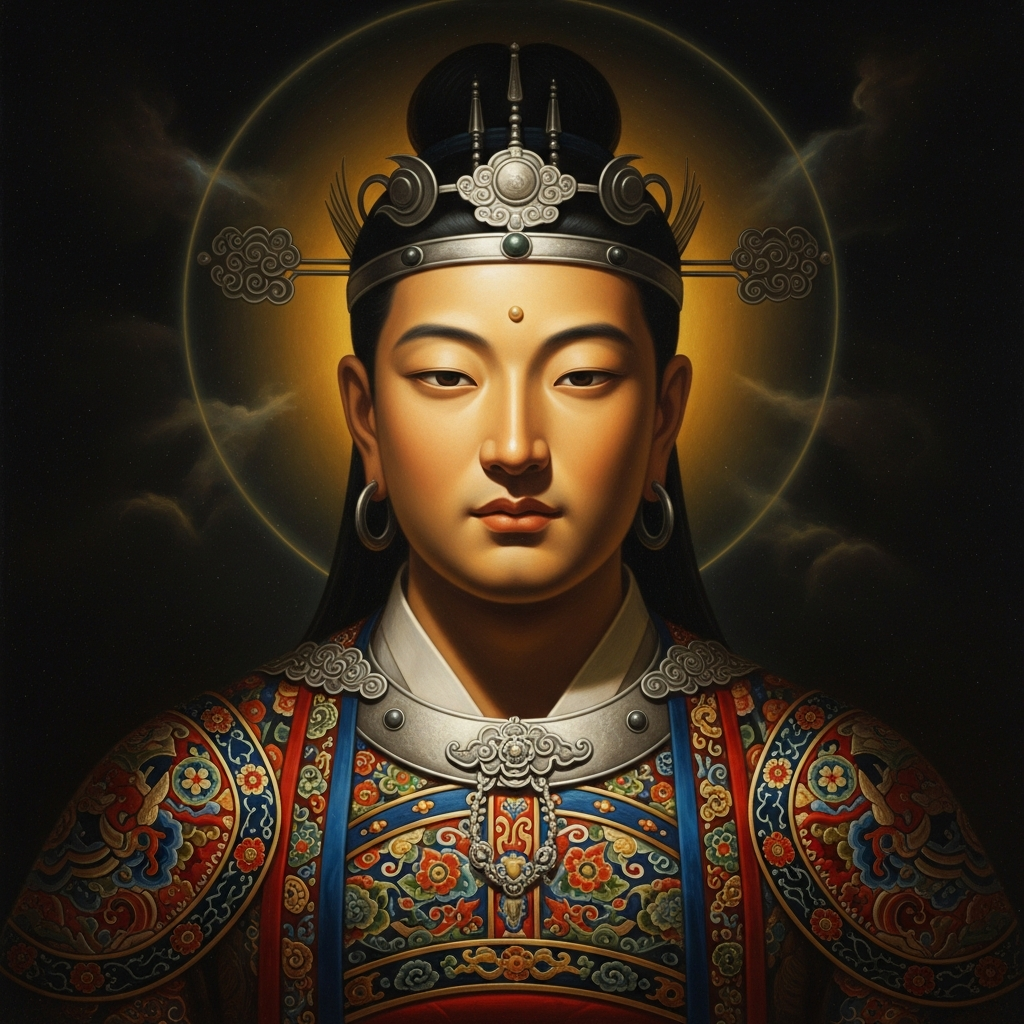 LEGENDARY
 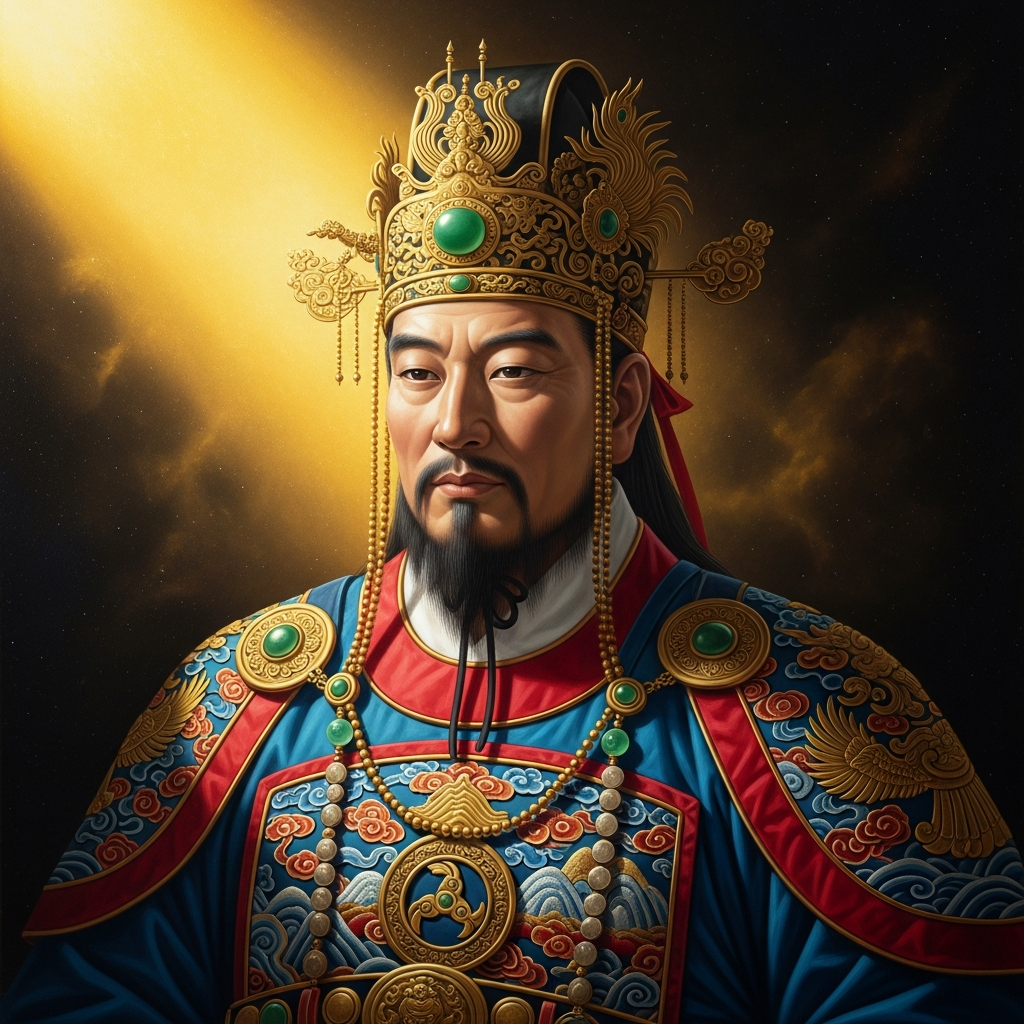 LEGENDARY
 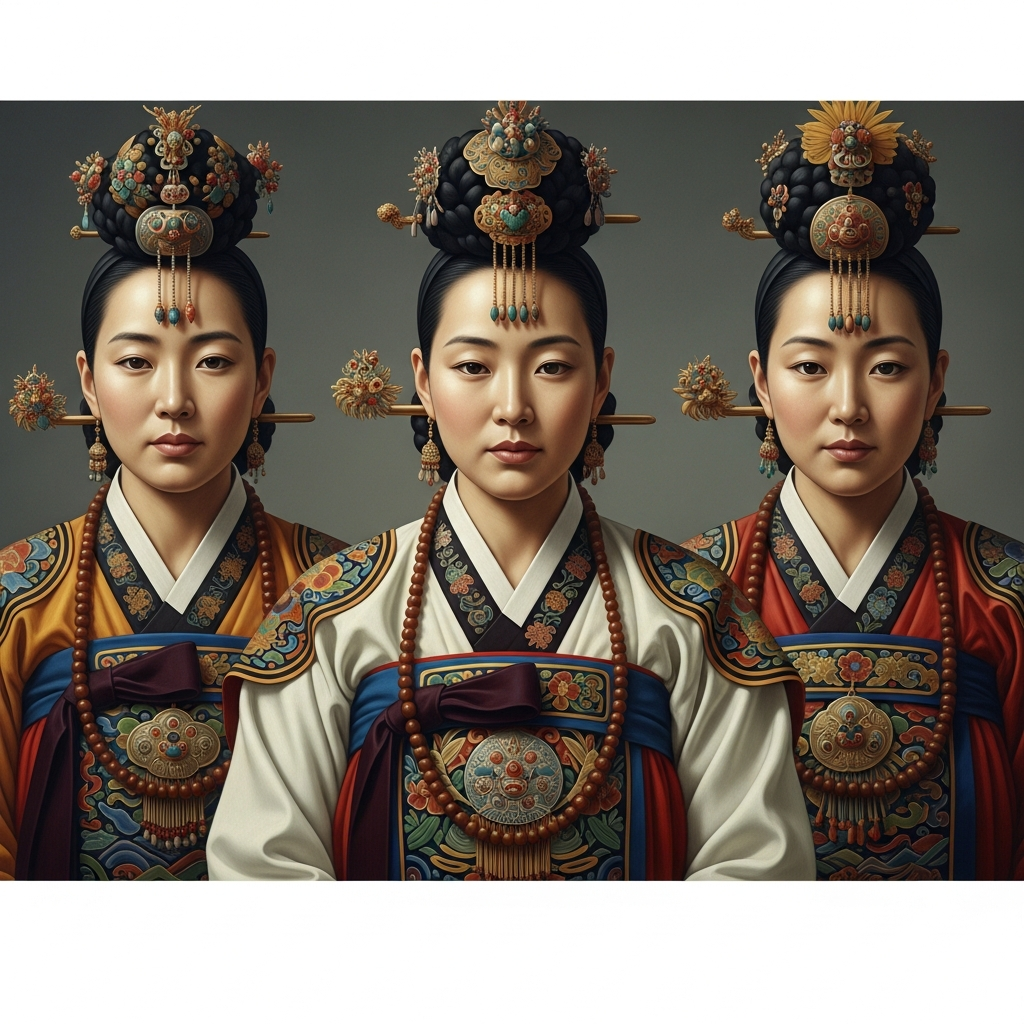 LEGENDARY
 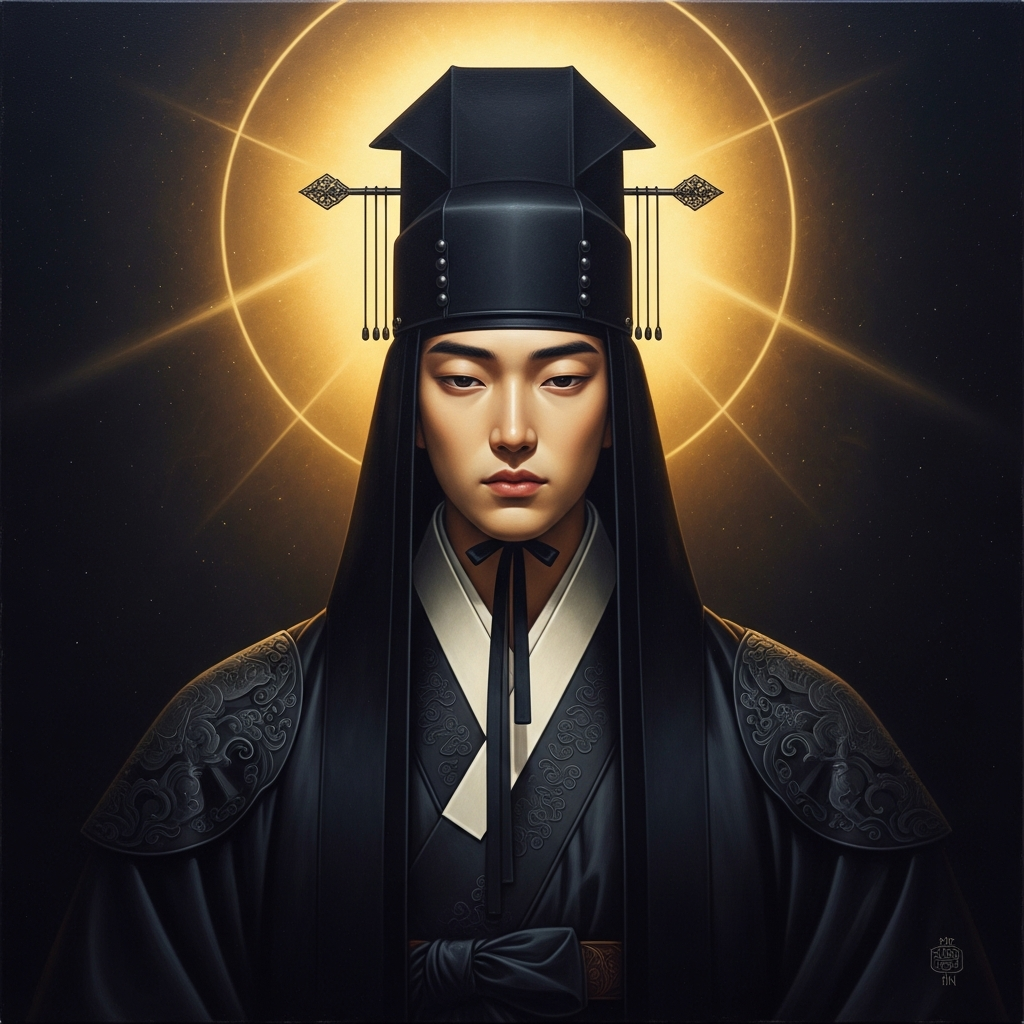 MYTHIC
  RARE
RARE 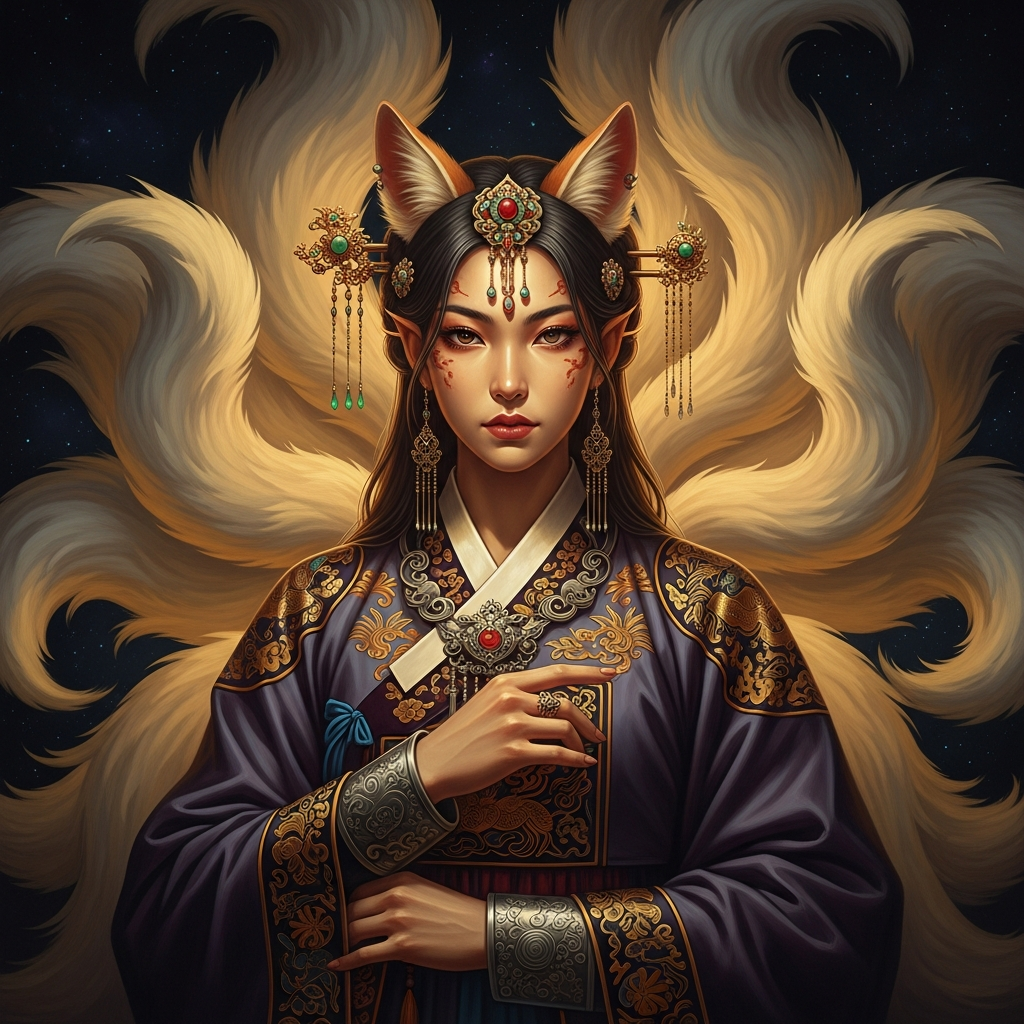 LEGENDARY
  LEGENDARY
  LEGENDARY